
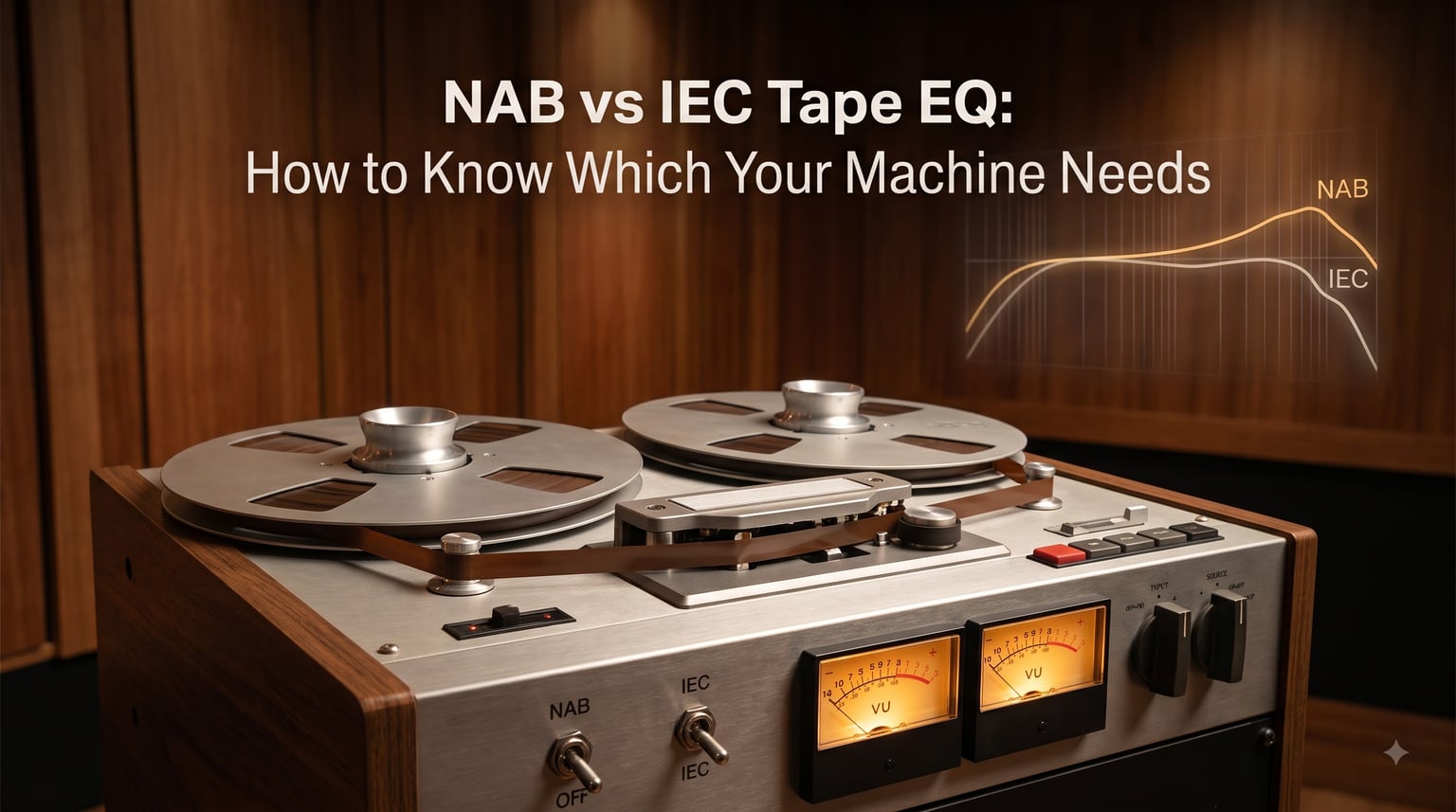
When I plugged my first vintage reel-to-reel deck back in, I noticed two tiny toggle switches on the front panel labeled “NAB” and “IEC.” I had no idea what they meant, and I figured the previous owner had them set correctly. After a month of dull, muffled recordings and obvious tape hiss, I learned the hard way: NAB vs IEC tape EQ is one of the most misunderstood decisions in analog recording. Choosing the wrong setting can make your masters sound thin, boomy, or just plain wrong, even when your deck is in perfect mechanical condition.
This guide walks through what each standard is, how they differ, and a step-by-step method to figure out which one your machine actually needs. I have pulled from technical references, calibration tape manufacturers, and years of forum debates to put together the clearest explanation I can offer.
Table of Contents
What Is NAB Equalization?
NAB equalization is the magnetic tape playback standard developed by the National Association of Broadcasters in North America. It defines the frequency response curve applied during recording and playback to compensate for the physical limits of magnetic tape.
The standard uses specific time constants, measured in microseconds, that shape how low and high frequencies are boosted or rolled off. For 7.5 ips playback, NAB specifies time constants of 3180 and 50 microseconds. For 15 ips playback, NAB uses 3180 and 17.5 microseconds. The first number controls the bass shelf turnover, and the second controls the high-frequency boost during playback.
Because NAB uses the same 3180 microsecond low-frequency time constant at both speeds, calibrating a deck across multiple speeds is simpler. Many American-made reel-to-reel machines from Studer, Ampex, and Crown were built around the NAB standard. If your deck came from a North American studio or home setup built before 1985, there is a strong chance it expects NAB EQ.
What Is IEC Equalization?
IEC equalization refers to the standard published by the International Electrotechnical Commission under IEC 60094-1. It is sometimes called the CCIR standard, which was the predecessor organization. This is the dominant playback curve in Europe, Asia, and most professional studios worldwide outside North America.
The IEC standard uses different time constants than NAB. At 7.5 ips, IEC specifies 3180 and 70 microseconds. At 15 ips, IEC uses 3180 and 35 microseconds. The IEC 15 ips curve has a more aggressive high-frequency boost than NAB at the same speed, which results in lower apparent tape hiss because high-frequency content is shaped differently during recording.
Studer, Telefunken, and most European broadcast machines were built to the IEC standard. If your deck has European service stickers, a multi-language manual, or was sold by a European distributor, it almost certainly uses IEC. The technical name “IEC 60094-1” appears on calibration tape labels for professional decks.
Key Differences Between NAB and IEC Tape EQ
The practical differences between NAB and IEC equalization come down to four areas: time constants, tape hiss behavior, recording application, and geographic tradition. I have summarized them in the table below for quick reference.
| Feature | NAB | IEC (CCIR) |
|---|---|---|
| Origin | North America | Europe / International |
| Time constant at 7.5 ips | 3180 / 50 us | 3180 / 70 us |
| Time constant at 15 ips | 3180 / 17.5 us | 3180 / 35 us |
| Apparent tape hiss at 15 ips | Higher | Lower |
| Calibration across speeds | Simpler (same LF constant) | More complex |
| Calibration tape label | NAB or “320 nWb/m” | IEC or “250 nWb/m” |
| Common on | Ampex, Crown, Teac (USA) | Studer, Telefunken, Revox (EU) |
The biggest audible difference shows up at 15 ips. IEC playback at 15 ips produces noticeably less tape hiss than NAB at the same speed. Several Tapeheads users confirmed this in blind tests: IEC EQ sounds cleaner because the high-frequency boost during recording trades signal level for noise reduction at playback.
However, NAB has a real advantage for machines that operate at multiple speeds. Since the low-frequency time constant stays the same, switching from 7.5 to 15 ips on a NAB-calibrated deck requires fewer EQ adjustments. This is one reason NAB remains popular in American broadcast and home studios.
How to Determine Which EQ Your Machine Needs?
Figuring out whether your machine expects NAB or IEC playback EQ is usually straightforward. I follow the same four-step checklist every time I work on an unfamiliar deck.
Step 1: Check the service manual. Look up the model number and download the original manual. Service manuals always specify the playback equalization in the alignment section. If the manual lists a “3180 / 35 us” time constant, the deck is IEC. If it lists “3180 / 17.5 us” at 15 ips, it is NAB.
Step 2: Look for EQ or bias switches on the front panel. Many professional decks have NAB/IEC toggle switches or pushbuttons. This is the most direct indicator. If the switch is present, the deck supports both standards, and you need to know which one the recordings on your tapes were made with.
Step 3: Identify the manufacturer and country of origin. American-made decks from before 1985 usually default to NAB. European-made decks usually default to IEC. Studer, Telefunken, and REVOX decks typically use IEC, while Ampex, Crown, and most consumer Teac or Tascam decks use NAB.
Step 4: Inspect the calibration tape label. If the previous owner left a calibration tape, look at the label. It will say either NAB or IEC (sometimes labeled “CCIR”). The label also lists the operating level, typically 185, 250, or 320 nWb/m for open-reel tapes.
If you still cannot tell, run a known IEC reference tape on the deck and listen. If playback sounds dull and muffled, your deck is set to NAB. If it sounds harsh and thin, your deck is set to IEC. Forum members on AudioKarma have used this same listening test for years because the differences are audible, even to non-expert ears.
Speed-Specific Recommendations for 7.5 ips and 15 ips
Tape speed and EQ choice are tightly linked. The general rule I follow when mastering new recordings is to use IEC at 15 ips and NAB at 7.5 ips, unless the machine or tape is specifically designed for the other pairing.
At 7.5 ips, NAB is the most common standard. Most consumer reel-to-reel decks, including the Teac 3300 series and Akai 1800 series, used NAB equalization at 7.5 ips. NAB at 7.5 ips has a milder high-frequency boost than IEC at 7.5 ips, which results in slightly more hiss but a warmer, smoother top end that suits consumer and home recordings.
At 15 ips, IEC is dominant in professional studios. The IEC curve’s stronger high-frequency boost reduces hiss and produces a flatter response at the top of the audible band. Most half-track mastering decks built after 1975 default to IEC at 15 ips, including professional Studer, Otari, and Tascam machines.
Modern tape formulations, such as ATR Magnetics and SM900, perform well with either standard but tend to show slightly better signal-to-noise ratios when paired with IEC EQ at 15 ips. If you are recording fresh material on a modern tape, IEC at 15 ips is generally the safe professional choice.
Understanding Calibration Tapes and EQ Matching
Calibration tapes are pre-recorded reference tapes used to set playback levels, EQ, and head alignment on a tape machine. They come in NAB and IEC versions, and the standard on the calibration tape must match the playback EQ of your deck, or every measurement will be wrong.
The reference flux level also differs. NAB calibration tapes are typically recorded at 320 nWb/m, while IEC calibration tapes use 250 nWb/m. Using the wrong reference tape can produce level mismatches of 2 to 3 dB, which then cascade through every recording made with that setup.
Yes, it is crucial to order the right calibration tape. I learned this when I accidentally ordered an IEC calibration tape for an Ampex deck. Every measurement was off by exactly 2 dB, and I spent two hours troubleshooting the heads before I noticed the label. Calibration tape manufacturers like Magnetic Reference Labs and Standard Tape Laboratory sell NAB and IEC versions separately, so always confirm before ordering.
To pick the right calibration tape, check the service manual for the deck’s expected playback EQ. Order a calibration tape that matches the EQ, speed, and operating level listed in the manual. If the deck supports both NAB and IEC, buy one of each so you can switch as needed.
Cross-Compatibility and Compensation Methods
Yes, you can play IEC-recorded tapes on a NAB-calibrated deck, and vice versa, but the result will not sound right without compensation. The frequency response will be skewed: too much or too little bass and treble, depending on the mismatch.
Some professional decks include EQ selector switches that let you switch the playback curve on the fly. If your deck has this switch, you can play both NAB and IEC tapes by flipping it before each session. This is the cleanest solution for studios that handle a mixed library of tapes.
If your deck does not have an EQ switch, you can compensate with a graphic equalizer in the monitor path. Boost or cut the appropriate frequencies to flatten the response. For NAB playback of an IEC tape, roll off around 3 dB at 10 kHz and add a small shelf boost below 100 Hz.
Modern tape formulations have made cross-compatibility easier. Newer tapes with higher output levels mask EQ mismatches better than older tapes did. But the cleanest approach is still to match the EQ standard on every recording and playback session.
Common Mistakes to Avoid
Over the years I have seen the same EQ mistakes repeated in studio after studio. Here are the four most common ones to watch out for.
Mistake 1: Assuming the EQ switch position is correct. Previous owners often flipped EQ switches without thinking. Always verify the switch position against the tape you are playing, not against the deck itself.
Mistake 2: Ordering the wrong calibration tape. This is the single most common mistake on Tapeheads and AudioKarma. Double-check the manual before placing an order, and never assume that “calibration tape” without a label means either standard.
Mistake 3: Mixing EQ standards within a project. If your first reel of a project was recorded with NAB and the second was recorded with IEC, you will get inconsistent tonal balance. Pick one standard per project and stick with it.
Mistake 4: Ignoring documentation. Service manuals, calibration logs, and original purchase records often specify the EQ standard. Many decks also have a sticker on the back panel listing the playback equalization. Five minutes of paperwork can save five hours of troubleshooting.
Frequently Asked Questions
What is NAB tape?
NAB tape refers to a magnetic tape recording or playback standard defined by the National Association of Broadcasters. NAB specifies the frequency response curve used during recording and playback, with time constants of 3180 microseconds for low frequencies and 17.5 microseconds at 15 ips for high frequencies.
Does reel-to-reel sound better than cassette?
Reel-to-reel tape generally produces better sound quality than cassette because it runs at higher speeds and uses wider tracks. Open-reel formats also have less tape hiss and a wider dynamic range, especially at 15 ips with IEC equalization.
How many times can you record over a reel-to-reel tape?
Reel-to-reel tapes can typically be recorded over 5 to 20 times before audio quality degrades noticeably. High-quality tapes on professional machines hold up longer than consumer-grade tapes, but each pass adds a small amount of noise and print-through.
How to test a reel-to-reel tape recorder?
Test a reel-to-reel tape recorder by playing a calibration tape, checking playback level with a meter, inspecting head alignment with a mirror or scope, running a frequency response sweep, and listening for wow, flutter, and dropouts. Document every measurement against the service manual specifications.
Is it absolutely crucial to get it right when ordering either NAB or IEC calibration tape?
Yes, it is crucial. Using the wrong calibration tape standard produces level errors of 2 to 3 dB and skewed frequency response measurements, which then carry over into every recording made with that setup. Always confirm the deck’s expected EQ before ordering a calibration tape.
Final Thoughts on Choosing Between NAB and IEC Tape EQ
The NAB vs IEC tape EQ decision comes down to three things: the country of origin of your machine, the speed you record at, and the standard your existing tapes were recorded with. North American decks and consumer 7.5 ips playback usually default to NAB. European and professional 15 ips decks usually default to IEC.
My team here at SK Records runs IEC at 15 ips for all new mastering work, NAB at 7.5 ips for archival playback, and we keep one of each calibration tape on hand for every deck in the studio. That setup has served us well across hundreds of sessions. Pick a standard, document it, and stick with it.