
If your mixes sound great in your studio but fall apart in your car, your listening position might be the problem. I spent years chasing translation issues before I discovered that moving my chair three feet fixed more than any plugin ever could.
The 38% rule mixing sweet spot is one of the fastest, free fixes you can make in any home studio. It costs nothing, takes about 20 minutes, and can dramatically improve the accuracy of what you hear while mixing.
In this guide, I will walk you through exactly what the 38% rule is, why it works, and how to find the sweet spot in your own room. Whether you mix in a treated space or a tiny bedroom, this technique gives you a reliable starting point for better low-end balance.
Table of Contents
What Is the 38% Rule for Mixing?
The 38% rule is an acoustic guideline stating that the most balanced listening position in a rectangular room sits at 38% of the room’s length, measured from either the front or back wall. At this position, bass frequencies tend to be most evenly distributed.
Wes Lachot, an acoustic designer, developed this principle based on how room modes interact along the length of a room. The math works because the 38% point avoids the extreme peaks and nulls created by standing waves between parallel walls.
Here is the simple formula: multiply your room length by 0.38. For a 12-foot room, that gives you 4.56 feet from the front wall. For a 15-foot room, you get 5.7 feet. That calculated distance is where you place your ears.
The rule applies to your ear position, not your desk or your speakers. Measure from the wall behind your speakers to where your head sits while mixing. Your speakers sit between that wall and your listening position, typically about one-third into the room.
One important detail: the 38% rule addresses the lengthwise dimension of your room. Width and height still create their own modes, but the length axis usually has the strongest effect on bass response because it is the longest dimension.
Why Your Mixing Sweet Spot Matters for Audio Quality?
Standing waves build up in every room, creating areas where bass frequencies are boosted and areas where they disappear entirely. If you sit in a bass peak, your mixes will lack low end everywhere else. If you sit in a null, you will overcompensate and muddy your mixes.
The difference between positions is not subtle. Users on audio engineering forums report 8dB or more variation in bass response just by moving a few feet within the same room. That kind of swing is enough to completely change your mix decisions.
I have tested this myself using Room EQ Wizard (REW), a free acoustic measurement tool. Moving my chair from 25% to 38% of room length smoothed out a massive 12dB dip around 80 Hz. My kick drum suddenly had the weight I always thought was missing.
Without finding your sweet spot, you are essentially mixing with a filter you cannot see. Every EQ decision gets filtered through the room’s resonances before it reaches your ears. Finding the right position removes that invisible filter.
This matters more than gear upgrades. A pair of budget monitors in the right position will outperform expensive monitors in a bad spot. Your room is part of your monitoring chain, and the listening position is the most tunable element of that chain.
How Room Modes Affect Your Sweet Spot?
Room modes are resonant frequencies that build up between parallel surfaces. When a sound wave’s wavelength matches your room dimensions, that frequency gets amplified or canceled at predictable points along each axis.
There are three types of modes. Axial modes bounce between two parallel walls and are the strongest. Tangential modes involve four surfaces and are about half as strong. Oblique modes involve all six surfaces and are roughly one-quarter as strong. Axial modes along the room length are what the 38% rule primarily addresses.
Standing waves create a pattern of peaks and nulls along the room. At the walls, bass pressure is maximum. At the halfway point, you often find a deep null. Between these extremes, the response shifts dramatically depending on frequency.
The 38% position lands in a zone where multiple room modes overlap more evenly. No position is perfect in an untreated room, but 38% tends to minimize the worst peaks and nulls simultaneously. That is the whole point of the rule.
Another factor is SBIR, or Speaker Boundary Interference Response. This occurs when sound from your speaker reflects off the wall behind it and combines with the direct sound, creating comb filtering. SBIR depends on speaker distance from walls, but your listening position determines how severely you hear its effects.
By placing yourself at 38% of room length, you reduce the combined impact of axial standing waves and SBIR. The result is a more even frequency response that lets you make better mix decisions without acoustic treatment.
How to Find Your Mixing Sweet Spot: Step by Step
Finding the 38% rule mixing sweet spot takes about 20 minutes and requires no special equipment. Here is the exact process I use in every room.
Tools You Need
You need a tape measure, some Post-it notes or masking tape, a smartphone or speaker to play test tones, and two or three reference tracks you know inside out. That is it. No measurement microphone required.
Step 1: Measure Your Room Length
Measure the interior length of your room from the front wall (behind your speakers) to the back wall. Write this number down. Be precise to the inch, because small measurement errors shift your calculated position.
Step 2: Calculate 38%
Multiply your room length by 0.38. If your room is 14 feet long, that is 14 x 0.38 = 5.32 feet. Convert the decimal to inches (0.32 x 12 = about 4 inches), so your target is 5 feet 4 inches from the front wall.
Step 3: Mark Several Candidate Positions
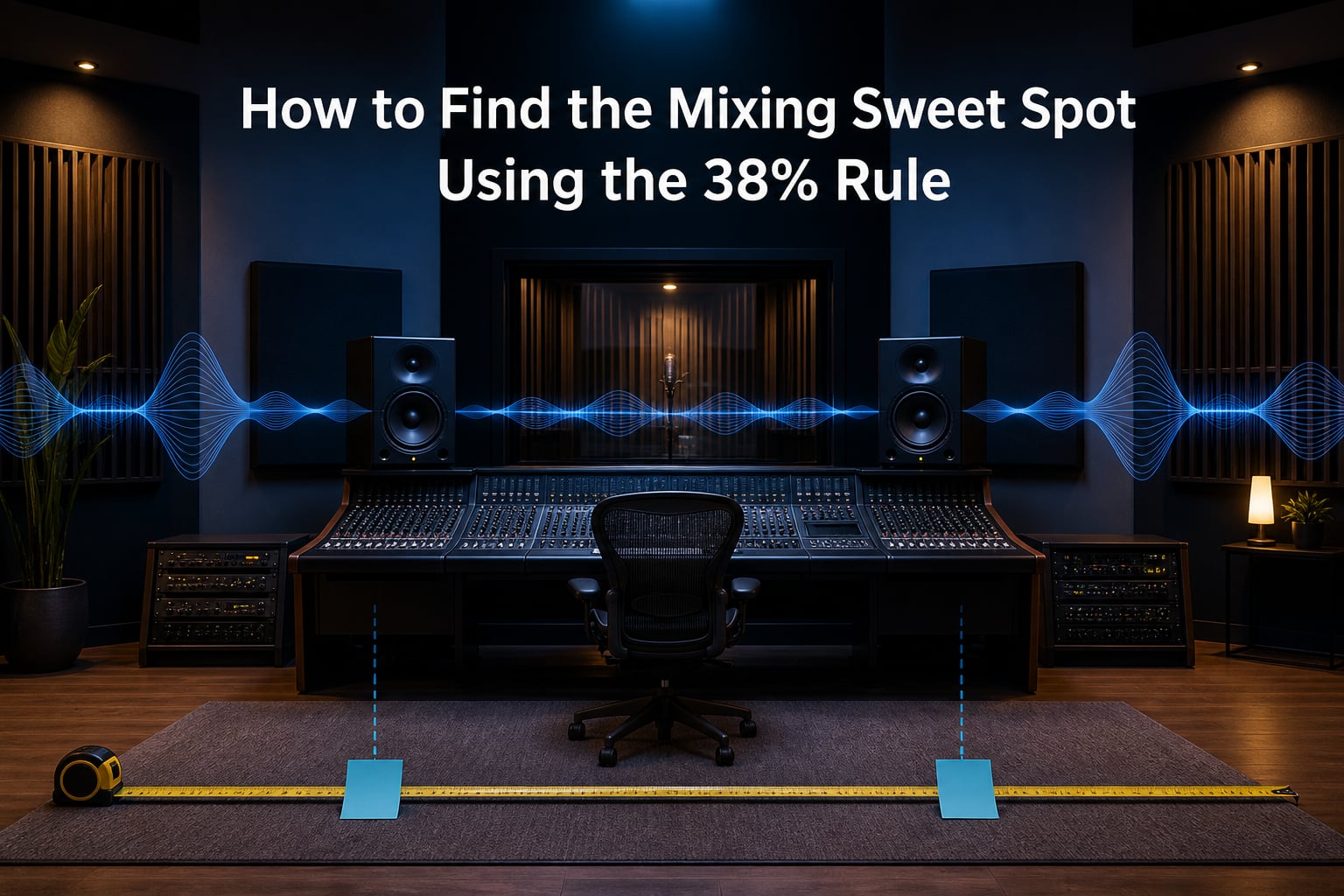
Place Post-it notes on the floor at 30%, 35%, 38%, 42%, and 46% of room length from the front wall. This range brackets the 38% mark and gives you comparison points. The rule is a guideline, so testing nearby positions helps you confirm the best spot for your specific room.
Step 4: Position a Speaker or Sub in the Front Corner
For the most dramatic test, place a subwoofer or full-range speaker in the front corner of your room. Corner placement excites all room modes, which makes the differences between listening positions much easier to hear. If you only have your studio monitors, use those.
Step 5: Queue Your Reference Tracks
Pick tracks you have heard hundreds of times on multiple systems. You want material with clear bass content, a defined kick drum, and full low-end information. A solo bass track, a well-mixed pop song, and something with deep sub-bass work well as a trio.
Step 6: Listen at Each Marked Position
Start at the position closest to the front wall and work your way back. Sit down at each Post-it note, close your eyes, and listen to your reference tracks. Pay attention to how the bass changes from position to position.
Step 7: Narrow Down the Sweet Spot
You will notice positions where the bass is boomy and overwhelming, and positions where it thins out. The sweet spot is where the low end sounds even, controlled, and proportional to the rest of the frequency spectrum. This is often near the 38% mark, but let your ears confirm.
Step 8: Lock In Your Position
Once you identify the best position, mark it permanently with tape or a small mark on the floor. Set up your desk and chair at that exact spot. This is now your mixing position, and every session benefits from the balanced response you just found.
What to Listen For When Testing Positions
Knowing what to focus on makes the Post-it note method far more effective. Here is a checklist of audio cues I use when comparing listening positions.
Bass evenness: Does the low end sound proportional to the mids and highs, or does it overwhelm everything? In a peak position, bass will sound bloated. In a null, it will sound thin or absent.
Kick drum weight: A well-balanced position gives the kick drum punch and definition without overwhelming the mix. If the kick disappears or becomes boomy, you are in a problematic spot.
Low-mid clarity: Listen for muddiness around 200-400 Hz. Room modes can pile up energy in this range, making mixes sound congested. A good position keeps this area clean.
Stereo imaging: While the 38% rule primarily affects bass, your distance from speakers also impacts stereo width. You want a focused center image with clear left-right separation.
Transient response: Snare hits and percussive elements should sound sharp and distinct. If transients get smeared or muddy, room reflections are interfering.
Reference comparison: The same track should sound similar in balance to how you remember it on other systems. If your reference suddenly has way more or less bass than usual, your position is coloring what you hear.
I recommend making a quick checklist on your phone and running through it at each candidate position. The differences become obvious once you know what to listen for.
Combining the 38% Rule With the 83% Speaker Placement Rule
The 38% rule tells you where to sit. The 83% rule tells you where to place your speakers. Using both together gives you a complete starting setup for accurate monitoring.
The 83% rule states that your speakers should be placed at 83% of your room length from the back wall. If your room is 12 feet long, that means your speakers sit about 10 feet from the back wall, which puts them roughly one-third of the room length from the front wall.
With your speakers at roughly 33% and your ears at 38%, you get a balanced distance between speakers and listener. This typically creates a gap of about one to two meters between your speakers and your head, which suits nearfield and midfield monitors alike.
From there, position your speakers to form an equilateral triangle with your head. Each speaker and your ears should form the three points of a triangle with equal sides. Tweeters should sit at ear level, and speakers should point directly at your ears with a slight toe-in.
Together, these two rules address the two most important positioning decisions in your studio. Get these right before spending money on treatment or monitors, because no gear can fix a fundamentally wrong setup geometry.
Remember that both rules assume a rectangular room and flush or near-wall speaker placement. If your setup is different, use these as starting points and adjust based on listening tests.
Caveats and Limitations of the 38% Rule
The 38% rule is a guideline, not a law of physics. Experienced audio engineers on Gearspace and Reddit consistently describe it as a starting point rather than a definitive answer. Here are the situations where the rule needs adjustment.
Small rooms: In rooms smaller than 10 by 9 feet with 8-foot ceilings, the 38% position may place you too close to the back wall. When your head ends up within a foot or two of the wall behind you, boundary interference creates its own problems. In tiny rooms, you may need to treat the back wall heavily or consider a position closer to 35%.
Irregular room shapes: The rule assumes a rectangular room. L-shaped rooms, spaces with alcoves, closets in the back corner, or angled walls all change how modes develop. In these cases, the Post-it note method becomes even more important because the math no longer maps cleanly to reality.
Front versus back wall: A common point of confusion is whether to measure from the front or back wall. The rule works from either direction. Measuring from the front wall (behind speakers) gives you the same result as measuring 62% from the back wall. Pick whichever wall makes your setup practical.
Treated rooms: In rooms with proper bass trapping and broadband absorption, the peaks and nulls that the 38% rule helps you avoid are already reduced. The rule still applies, but the differences between positions become less dramatic. In a well-treated room, you have more flexibility.
Flush-mounted monitors: The original 38% rule was developed assuming monitors are flush with or very close to the front wall. If your speakers sit several feet into the room on stands, SBIR changes the equation. Move your speakers as close to the front wall as practical for the rule to work best.
I have applied the rule in four different rooms over the years, and it has never been exactly right on the first try. It always got me close, and then listening tests fine-tuned the final position by a few inches.
Common Mistakes to Avoid
Treating 38% as gospel: The biggest mistake is assuming the calculated position is automatically correct without verifying with your ears. Always test. Some rooms sound best at 35% or 41%, and only listening reveals that.
Ignoring speaker placement: Finding the perfect listening position means nothing if your speakers are in the wrong spot. Address both the 38% listener rule and the 83% speaker rule together.
Skip the reference tracks: Testing positions without familiar reference material makes it nearly impossible to judge accuracy. Use tracks you have heard on dozens of systems so you can identify when something sounds off.
Forgetting about height: Bass modes exist on the vertical axis too. If your ears are at a height where floor and ceiling reflections create a null, your horizontal position will not save you. Test small height adjustments as well.
One-time testing only: Rooms change. You add gear, furniture, rugs, or treatment. Re-test your sweet spot periodically, especially after any significant change to your room.
Assuming treatment replaces positioning: Acoustic treatment helps, but it does not eliminate room modes entirely. Even in a treated room, position matters. Start with positioning, then add treatment, then re-verify.
Frequently Asked Questions
What is the 38% rule?
The 38% rule is an acoustic guideline that says the most balanced listening position in a rectangular room sits at 38% of the room’s length from the front or back wall. At this position, bass frequencies from room modes are most evenly distributed, giving you the flattest low-end response for mixing.
How do I calculate 38% of my room length?
Multiply your room length by 0.38. For example, if your room is 14 feet long, calculate 14 x 0.38 = 5.32 feet. That means your ears should be about 5 feet 4 inches from the front wall. Measure to where your head sits while mixing, not to your desk.
Is the 38% rule always accurate?
No, the 38% rule is a guideline, not a guarantee. It works best in rectangular rooms with speakers placed near the front wall. In small rooms, irregularly shaped rooms, or spaces with obstructions, the actual sweet spot may be slightly different. Always verify with listening tests using reference tracks.
Should I measure from the front or back wall?
You can measure from either wall. Measuring 38% from the front wall is the same as measuring 62% from the back wall. Most engineers measure from the front wall (behind the speakers) for simplicity. Choose whichever direction makes your room setup practical.
Can I find the sweet spot without measurement equipment?
Yes. The Post-it note method uses only your ears. Mark several candidate positions around the 38% mark, play familiar reference tracks at each spot, and choose the position where bass sounds most even and balanced. Measurement tools like REW can confirm what you hear, but they are optional.
What is the 83 percent speaker rule?
The 83% rule states that your speakers should be placed at 83% of your room length from the back wall, which puts them roughly one-third of the room length from the front wall. Combined with the 38% listening position rule, this creates a balanced distance between your speakers and your ears for accurate monitoring.
Does the 38% rule work for small rooms?
The rule still applies in small rooms, but with caveats. In rooms smaller than 10 by 9 feet, the 38% position may place your head very close to the back wall, creating boundary interference. In tiny spaces, test positions between 35% and 38% and add bass trapping to the back wall if possible.
Finding Your Sweet Spot
The 38% rule mixing sweet spot technique gives you a free, immediate improvement to your monitoring accuracy. No plugin, no upgrade, and no expensive treatment can match what simply moving your chair does for your low-end balance.
Start by measuring your room, calculate 38% of the length, and test nearby positions with reference tracks. Trust the math to get you close, then trust your ears to fine-tune the final spot.
Once your position is locked in, combine it with proper speaker placement using the 83% rule and an equilateral triangle setup. From there, acoustic treatment becomes the next layer of improvement rather than a band-aid for a positioning problem.
Your room is part of your monitoring chain. Take 20 minutes this week to find the sweet spot, and your mixes will translate better on every system.