
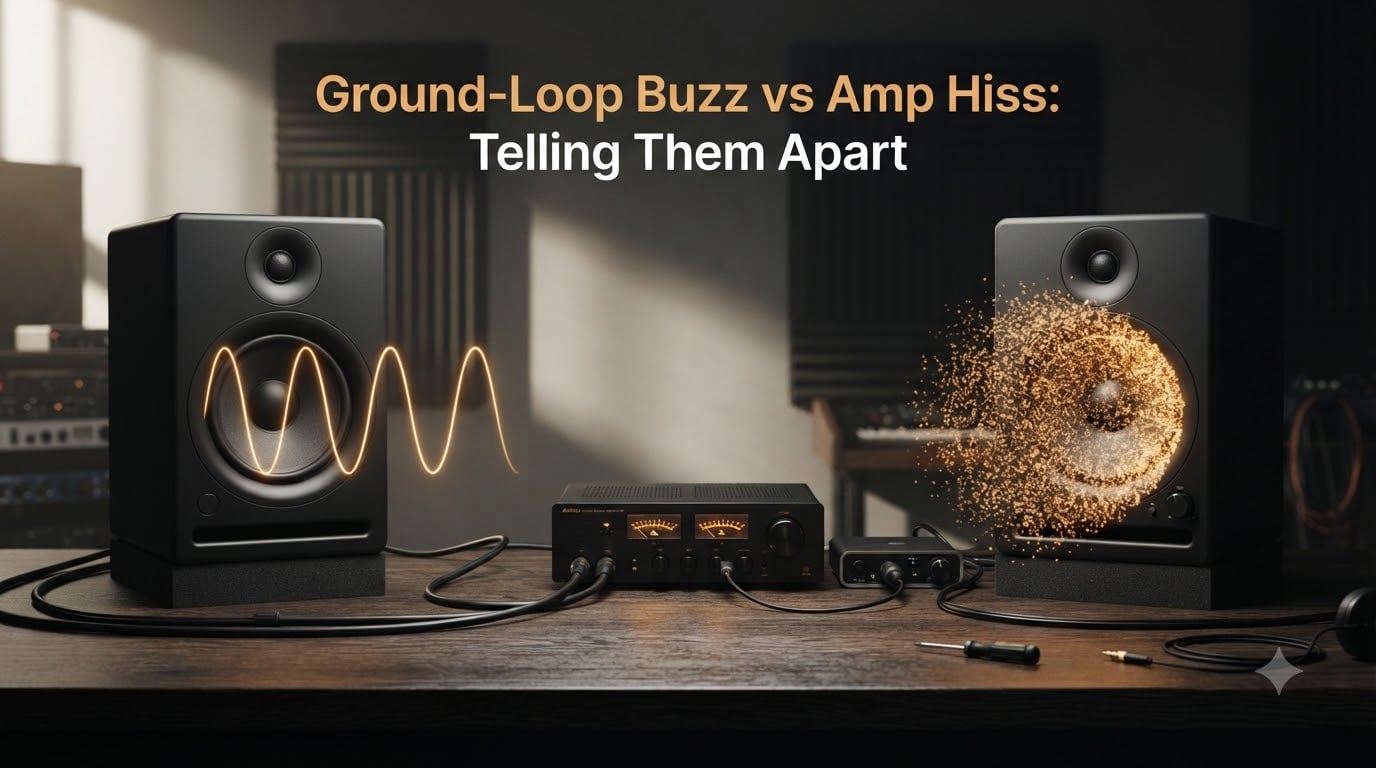
Every audio enthusiast has been there. You set up your system, power everything on, and there it is — an unwanted noise creeping through your speakers. The question immediately becomes: is this a ground-loop buzz or amp hiss? Getting the diagnosis wrong means you could spend weeks chasing the wrong fix.
I have spent years troubleshooting audio systems, from home theater setups to recording studios, and the confusion between these two noise types is the single most common problem people describe. The good news is that ground-loop buzz and amp hiss have distinctly different characteristics once you know what to listen for.
Ground loop buzz vs amp hiss is a comparison that demands a clear framework, because the two noises come from entirely different sources and require completely different solutions. Mix them up and you will waste money on isolators when the real problem is your gain structure — or vice versa.
This guide breaks down exactly what each noise sounds like, why it happens, and how to tell which one is plaguing your system. By the end, you will have a reliable diagnostic process you can run in under five minutes.
Table of Contents
Quick Diagnostics: The 30-Second Identification Test
Before diving into the technical details, run these three quick tests. They will point you in the right direction almost immediately.
The Mute Test: Press the mute button on your preamp or receiver. If the noise completely disappears, you are dealing with a ground loop or upstream component issue. If the noise persists even when the system is muted, you are hearing amp hiss from the power amplifier itself.
The Volume Test: Slowly rotate your volume control up and down. Ground loop buzz stays relatively constant regardless of volume position because it enters through the ground path. Amp hiss changes in level with the volume knob, getting louder as you increase gain in the preamp stage.
The Disconnect Test: Unplug all source components (streamer, turntable, cable box) leaving only your amplifier and speakers connected. If the noise vanishes, a ground loop involving an interconnected device is the likely culprit. If a hiss remains, that is your amplifier’s inherent noise floor.
What Is Ground Loop Buzz?
Ground loop buzz is a low-frequency electrical noise caused by multiple ground paths existing between interconnected audio devices at different electrical potentials. When two pieces of equipment each connect to ground through separate paths, a small voltage difference between those grounds drives current through your audio cables’ shields, injecting noise directly into your signal.
The signature sound is a 60Hz hum in North America (50Hz in Europe and other regions) often accompanied by harmonics at 120Hz, 180Hz, and higher multiples. This gives it that distinctive buzzy, rattling character rather than a pure tone. Some people describe it as sounding like a refrigerator compressor or fluorescent light ballast.
Ground loops almost always appear when you add a new component to your system. I have seen this repeatedly — someone gets a new powered subwoofer or connects their cable TV box, and suddenly the 60Hz hum appears. The common thread is that the new device introduced a second ground path that created a loop.
Classic triggers include cable TV connections (the coax cable line is grounded outside at a different point than your electrical system), connecting a computer or audio interface to a home theater receiver, and running powered subwoofers on a different circuit than the rest of your gear. Each scenario creates that dreaded dual-ground-path situation.
What Is Amp Hiss?
Amp hiss is broadband noise — often described as white noise or pink noise — that originates from the electronic components inside your amplifier itself. Unlike ground loop buzz, hiss is not caused by external interference or grounding issues. It is a fundamental property of electronic amplification.
Every resistor, transistor, and vacuum tube in an amplifier generates a tiny amount of thermal noise (also called Johnson-Nyquist noise) simply because electrons move randomly at temperatures above absolute zero. When your signal passes through multiple gain stages, this noise gets amplified right along with your music.
Hiss sounds like steam escaping, ocean waves in the distance, or the static between radio stations. It is broadband, meaning it contains energy across a wide frequency range rather than concentrating at a specific pitch like the 60Hz hum does. The character is high-frequency and airy, sitting above where most music content lives.
A certain amount of hiss is completely normal. High-gain guitar amps, phono stages, and preamps with high output all produce audible hiss when you place your ear near the speaker. The question is not whether hiss exists but whether the level is acceptable for your listening environment. Hiss becomes a problem when it is audible from your normal listening position.
Ground Loop Buzz vs Amp Hiss: Key Differences
Understanding the distinction between ground loop buzz vs amp hiss comes down to five key differences. Once you internalize these, identifying noise becomes straightforward.
Frequency Content: Ground loop buzz is concentrated at 60Hz and its harmonics, giving it a deep, pitched character. Amp hiss spans a broad frequency range with no dominant pitch, sounding like diffuse static.
Response to Volume: Ground loop buzz remains relatively steady as you change volume because it enters through the ground path, not the signal path. Amp hiss changes with volume position since it passes through the same gain stages as your audio signal.
Response to Muting: Ground loop buzz may persist even when the preamp is muted because the loop exists in the physical grounding. Amp hiss disappears when the preamp mutes because the noise was being generated upstream in the signal chain.
Source of the Noise: Ground loop buzz is caused by external factors — your building’s electrical wiring, interconnected devices, cable TV lines. Amp hiss is generated internally by the amplifier’s own electronic components.
Approach to Fixing: Ground loop buzz can be eliminated entirely with proper isolation and grounding techniques. Amp hiss can be reduced through gain staging and better components, but it cannot be fully eliminated — some level of noise is inherent to all amplification.
| Characteristic | Ground Loop Buzz | Amp Hiss |
|---|---|---|
| Primary Frequency | 60Hz (or 50Hz) with harmonics | Broadband, no single pitch |
| Sound Character | Low-pitched hum or buzz | High-frequency static or steam |
| Changes with Volume | Minimal change | Louder with higher gain |
| Persists When Muted | Often yes | No |
| Root Cause | Multiple ground paths at different potentials | Thermal noise in electronic components |
| Can Be Fully Eliminated? | Yes, with proper isolation | No, only reduced |
| Common Fix | Ground loop isolator, star grounding | Gain staging, better components |
How to Diagnose Which One You Have
A systematic diagnosis saves hours of frustration. Follow these five steps in order, and you will narrow down the noise type with confidence.
Step 1 — The Ear Test: Listen carefully to the character of the noise. A low, rhythmic hum or buzzy rattle suggests ground loop. A high, airy whoosh like steam or distant surf suggests amp hiss. Trust your ears first.
Step 2 — The Mute Test: Engage the mute function on your preamp or receiver. Note whether the noise stops, continues unchanged, or changes character. If it stops, the noise is upstream of the mute circuit. If it continues, it originates after that point in the chain.
Step 3 — The Volume Test: Turn the volume knob from minimum to maximum while listening. Ground loop buzz changes very little because it rides the ground path. Amp hiss grows noticeably louder as gain increases because it passes through the same stages as your audio.
Step 4 — Component Isolation: Power down everything, then reconnect one component at a time, listening after each addition. When the noise appears or changes, the most recently connected device is involved. This is particularly effective for tracking down ground loops caused by cable TV boxes, computers, or powered subwoofers.
Step 5 — The Circuit Test: Plug your amplifier and all interconnected gear into the same power strip or outlet. If the ground loop buzz diminishes or disappears, you confirmed a ground potential difference between circuits. This test isolates whether the problem is the building wiring or an interconnect issue.
Forum users on r/audiophile and r/livesound repeatedly confirm that this methodical, step-by-step approach is far more effective than randomly swapping cables or buying isolators. Taking ten minutes to diagnose properly saves weeks of trial and error.
Common Causes of Ground Loop Buzz
Ground loops appear in predictable scenarios. Knowing the common triggers helps you identify your specific situation quickly.
Cable TV and Satellite Connections: This is the most overlooked cause. The coaxial cable entering your home is grounded at the utility pole or street box — a different ground point than your electrical panel. When you connect that cable to a TV or receiver that also connects to your audio system, you create a ground loop spanning your entire house. Many people spend weeks searching their audio gear when the cable line is the actual culprit.
Multiple Devices on Different Circuits: If your amplifier is plugged into one wall outlet and your powered subwoofer into an outlet on the opposite wall, those outlets may be on different circuit breakers with slightly different ground potentials. The RCA or XLR cable connecting them completes the loop.
Computer and Audio Interface Connections: Connecting a laptop or desktop computer to a home theater receiver or studio monitor system frequently introduces ground loops. The computer’s switching power supply and its ground reference differ from your audio gear, creating noise on the interconnect.
Car Audio Systems: Car audio has unique grounding challenges. The vehicle’s chassis serves as ground, but different grounding points on the chassis can have slight resistance differences. Amplifiers grounded at different points than the head unit will pick up alternator whine and ground loop hum.
Light Dimmers and Fluorescent Lights: Dimmer switches on the same circuit as your audio gear generate electrical noise that can couple into ground paths. This noise often sounds like ground loop buzz but is actually conducted electromagnetic interference.
Common Causes of Amp Hiss
Amp hiss comes from internal sources. Understanding these causes helps you determine whether the hiss level is normal or indicates a problem.
Thermal Noise and Gain Staging: Every gain stage in your amplifier adds thermal noise. Phono preamplifiers, which boost very low-level cartridge signals by 40 to 60 dB, are particularly hissy by nature. High-gain guitar amp channels produce more hiss than clean channels because they apply more amplification.
High-Sensitivity Speakers: If your speakers are highly efficient (95 dB or higher), they reveal the amplifier’s noise floor more readily than less sensitive designs. The same amplifier that sounds dead quiet through 86 dB speakers might produce audible hiss through horn-loaded speakers at 100 dB efficiency. This is not an amplifier defect — it is physics.
Tube Amplifiers: Vacuum tubes inherently produce more noise than solid-state designs. Single-ended tube amps with no negative feedback have higher noise floors than push-pull designs. Tube rolling (swapping tubes) can reduce hiss if you find quieter tubes, but some hiss will always remain.
Failing Components: If hiss suddenly increases or develops crackling, popping, or intermittent behavior, a component may be failing. Capacitors drying out, resistors drifting in value, and tubes going soft can all raise the noise floor beyond normal levels. Sudden changes in hiss character warrant investigation.
How to Fix Ground Loop Buzz
Ground loop buzz is fixable — and the right approach eliminates it completely. Here are the solutions, ordered from easiest and safest to more involved.
Consolidate Power Connections: Plug all interconnected audio components into the same power strip or power conditioner on a single outlet. This eliminates ground potential differences between circuits. It is the simplest fix and often resolves the problem immediately.
Use a Cable TV Ground Isolator: If you have cable or satellite TV connected to your audio system, install an inline ground isolator on the coax line before it enters your equipment. These devices break the ground loop while passing the signal. Brands like Jensen Transformers make high-quality versions that do not degrade signal quality.
Ground Loop Isolators for Audio Lines: For RCA, XLR, or speaker-level connections, inline ground loop isolators break the loop on the audio cable itself. These use isolation transformers to pass signal while blocking DC ground currents. They are effective but can slightly alter frequency response with budget models, so invest in quality.
Balanced Connections: If your equipment supports balanced XLR connections, use them. Balanced lines reject common-mode noise, including ground-induced hum, by design. Running balanced cables between your preamp and amplifier often eliminates ground loop buzz without any additional isolation hardware.
Avoid Cheater Plugs: Forum discussions repeatedly warn against using cheater plugs (adapters that lift the ground pin on three-prong cables). While they can eliminate ground loop buzz, they remove the safety ground from your equipment, creating a serious shock hazard. This fix is dangerous and should never be used as a permanent solution.
How to Reduce Amp Hiss
Unlike ground loop buzz, amp hiss cannot be eliminated entirely — but you can reduce it to inaudible levels with proper technique.
Optimize Gain Staging: Set your source components to output a strong, clean signal, then use minimal gain on your preamp and amplifier. Running a preamp at maximum gain with a weak input signal amplifies noise unnecessarily. Proper gain staging keeps the signal well above the noise floor throughout the chain.
Match Speaker Sensitivity to Your Amplifier: If you have highly sensitive speakers (95 dB+), choose an amplifier known for a low noise floor. Conversely, with average-sensitivity speakers, a slightly noisier amplifier will be inaudible from the listening position. Matching components prevents unnecessary hiss exposure.
Upgrade Components When Necessary: If your amplifier’s hiss is audible from your listening position with average speakers, it may simply be a lower-quality design. Upgrading to a better amplifier or replacing aging tubes in tube gear can dramatically reduce the noise floor. The investment pays off in quieter, more immersive listening.
Tube Amp Specific Considerations
Tube amplifiers deserve special attention because they blur the line between ground loop buzz and amp hiss more than any other equipment type. The noise characteristics are unique enough that standard diagnostic steps need adjustment.
Filament Supply Hum: Tube amps use AC filament supplies that can introduce 60Hz hum directly into the audio path through the cathodes. This hum sounds similar to ground loop buzz but originates inside the amplifier. Converting to DC filament supplies or using hum pots on directly heated cathode tubes can reduce or eliminate this internally generated hum.
Single-Ended vs Push-Pull Noise Floors: Single-ended tube amplifiers typically have higher inherent noise floors because they lack the noise cancellation that push-pull output stages provide. A quiet single-ended amp producing gentle hiss is normal. The same hiss level from a push-pull design might indicate a tube or component issue worth investigating.
Grounding in Tube Amps: Tube amps with three-prong power cables frequently create ground loops when connected to other grounded equipment. The internal grounding scheme, particularly in vintage-style designs, interacts with external ground paths. If your tube amp hums only when connected to other components, suspect a ground loop rather than the amp itself.
Frequently Asked Questions
How to fix ground loop noise, hiss, buzz, and hum?
Fix ground loop noise by plugging all components into the same power circuit, using a cable TV ground isolator on coax lines, installing ground loop isolators on audio interconnects, and switching to balanced XLR connections where possible. For amp hiss, optimize gain staging, match speaker sensitivity to your amplifier, and upgrade components if the noise floor is excessive.
What does a ground loop noise sound like?
Ground loop noise sounds like a low-pitched 60Hz hum (50Hz in Europe) often accompanied by buzzy harmonics at 120Hz and 180Hz. People commonly compare it to a refrigerator compressor, fluorescent light ballast, or a deep electrical buzzing. It maintains a consistent pitch and volume regardless of your amplifier’s volume setting.
What is the difference between hum and hiss?
Hum is a low-frequency noise concentrated at a specific pitch (usually 60Hz and its harmonics), caused by ground loops or AC line interference. Hiss is broadband noise spanning a wide frequency range with no dominant pitch, caused by thermal noise in electronic components. Hum responds to isolation fixes while hiss is inherent to amplification and can only be reduced.
Why is my amp making a hissing sound?
Your amp hisses because electronic components like resistors, transistors, and vacuum tubes generate thermal noise that gets amplified through the gain stages. A certain hiss level is normal for all amplifiers. If the hiss is audible from your listening position, check your gain staging, speaker sensitivity matching, and component health. Sudden increases in hiss may indicate failing components.
How to identify a ground loop?
Identify a ground loop by running three quick tests: press mute (ground loop buzz often persists), adjust volume (ground loop stays constant while hiss changes), and disconnect source components one at a time (if the noise disappears when a device is unplugged, that device is part of the ground loop). Plugging all gear into one power strip also helps confirm the diagnosis.
Can a bad ground cause a hum sound?
Yes, a bad or inconsistent ground is the primary cause of 60Hz hum in audio systems. When two interconnected devices have ground connections at different electrical potentials, current flows between them through the audio cable shields, injecting hum into the signal. This is the definition of a ground loop. Fixing the grounding arrangement eliminates the hum.
Conclusion
Telling ground loop buzz and amp hiss apart comes down to listening for the frequency character, testing how the noise responds to volume changes and muting, and isolating components one at a time. Ground loop buzz is a fixable 60Hz intrusion from external ground paths, while amp hiss is the inherent noise floor of electronic amplification that can be reduced but never fully eliminated.
Start with the quick diagnostic tests, identify your noise type, then apply the targeted fix. If you are dealing with ground loop buzz, consolidate your power connections, check for cable TV ground loops, and consider isolation transformers. For amp hiss, focus on gain staging and component matching. Either way, understanding the difference between ground-loop buzz vs amp hiss puts you in control of your system’s noise floor.