
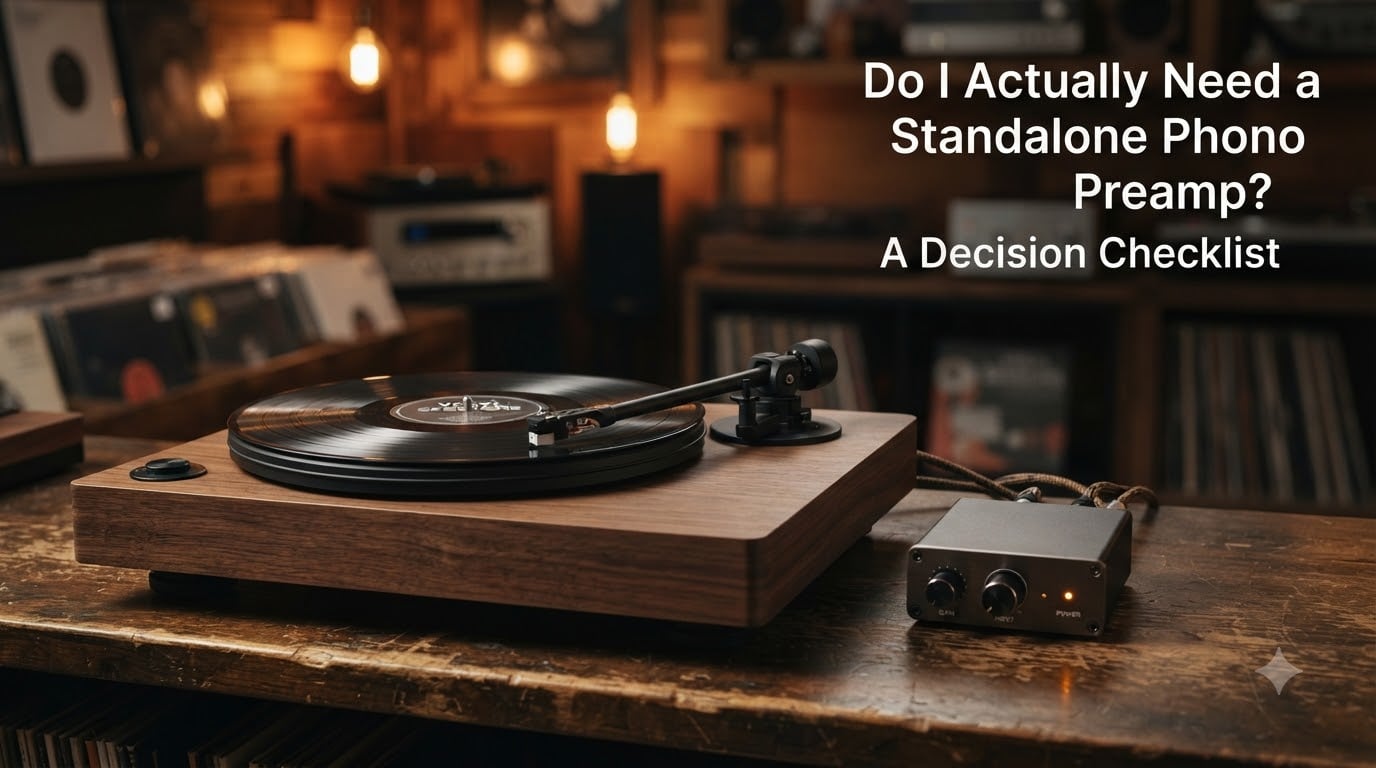
If you just unboxed a turntable and the sound is barely a whisper, you’re probably asking the same question I did years ago: do I actually need a standalone phono preamp? The short answer is maybe, and that’s exactly why I built this guide. Some people need one. Some don’t. The trick is figuring out which camp you fall into before you spend money.
A phono preamp is the small circuit that takes your turntable’s incredibly quiet signal and brings it up to the level every other audio component expects. It also flips the recording curve back to flat so records sound the way the musicians intended. Skip this step and your music will sound hollow, distant, or thin. Go through it and everything clicks into place.
I’ve spent the last few years setting up turntables in my own home and helping friends troubleshoot theirs. I created this checklist so you can answer the question in about five minutes. We’ll walk through where a preamp can live, how to figure out if you already have one, and the honest signs that you should upgrade.
Table of Contents
What Is a Phono Preamp and Why Does It Exist?
A phono preamp (also called a phono stage) is a two-purpose piece of audio gear. It does two jobs that have to happen together: it amplifies the tiny signal from your cartridge, and it applies the RIAA equalization curve in reverse. Without both jobs done at once, your records sound wrong.
The signal from a moving magnet or moving coil cartridge is shockingly weak. We’re talking around 3 to 5 millivolts, while a normal line-level signal runs around 300 millivolts or higher. That’s a roughly 100x difference. Your receiver or powered speakers aren’t built to handle something that small, so they treat it like silence and you get nothing useful.
The RIAA curve is the second half of the puzzle. When records are cut at the mastering studio, the engineer applies a curve that boosts high frequencies and cuts lows. This trick lets more music fit into the groove. Your phono preamp reverses that curve during playback. If you skip the RIAA correction, music sounds muffled and bass-light. If you skip the boost, you hear almost nothing at all.
Together, these two jobs make the phono preamp essential. The only real question is where the preamp lives in your chain, which is what we’ll cover next.
The signal problem phono preamps solve
Most home audio gear expects what’s called line level. CD players, streaming boxes, Blu-ray players, and tape decks all output roughly the same strength signal. Turntables refuse to play along. The physics of a stylus dragging through a groove means the cartridge can’t generate much voltage. So we need a dedicated amplifier stage just for vinyl.
RIAA equalization explained simply
The RIAA curve was standardized in 1954 to solve a real problem. Without it, records would have either tinny highs or rumbling, over-cooked bass. The mastering engineer cuts the record one way, your phono preamp un-cuts it during playback. Done correctly, the music is balanced. Done incorrectly, you’ll know something’s off even if you can’t name what’s wrong.
Where Can a Phono Preamp Be Located?
Here’s the part most guides skip, and it’s the key to answering the main question. A phono preamp can live in one of four places. Identifying which one your system uses is the first step in the decision checklist.
Inside the turntable
Many modern turntables ship with a built-in phono preamp. Brands like Audio-Technica, Pro-Ject, Fluance, and Rega all offer models with a switch labeled “phono/line” on the back. When that switch is set to “line,” the turntable itself is doing the RIAA work and outputting a signal your receiver can use directly.
The advantage is convenience. Plug it into any line input and go. The disadvantage is that built-in stages are usually simpler circuits with cheaper parts. They work, but they’re not always exciting.
Inside the receiver or integrated amp
Older and higher-end receivers, plus most integrated amplifiers, include a phono input on the back. Look for an RCA pair labeled “PHONO” with a small ground screw next to it. If yours has one, the preamp is already built into your amplifier. You just plug the turntable into that specific input and the rest of your system handles it.
This is where my own setup lives. My vintage Marantz receiver has a phono stage that’s perfectly serviceable. No reason to upgrade yet.
Inside powered speakers
Some powered bookshelf speakers, like certain Kanto, Edifier, and Audioengine models, have a phono input built right in. Plug your turntable straight into the speaker and you’re done. No receiver required.
This setup is popular with people who want a clean, simple rig without stacks of boxes. The trade-off is flexibility. If you ever want to upgrade a single piece, you’re stuck replacing the whole speaker.
As a standalone external unit
Finally, you can buy a dedicated phono preamp as its own box. These sit between your turntable and your receiver or speakers. The cartridge outputs go in one side, line-level signal comes out the other. Standalone units range from budget models around $50 to reference designs well into four figures.
A standalone unit makes sense when your turntable has no built-in preamp AND your receiver has no phono input. It also makes sense when you want better sound than either built-in option delivers.
How to Check If Your Setup Already Has a Phono Stage?
Before deciding to buy anything, you need to confirm what’s already in your chain. I’ll walk you through three quick checks that take less than five minutes.
Looking for the phono input on your receiver
Turn your receiver around and look at the back panel. You’re hunting for a pair of RCA jacks labeled “PHONO.” Sometimes there’s also a small thumbscrew nearby labeled “GND” for grounding. If you see it, your receiver has a phono stage. Use that input and you’re done. No external preamp needed.
If you don’t see one, your receiver either has no phono capability, or the input exists but is buried in a menu. Check the owner’s manual or look up your model number online. Some modern receivers hide the phono stage behind a software toggle.
Reading your turntable specs
Check the spec sheet or product page for your turntable. Look for phrases like “built-in phono preamp,” “selectable phono/line output,” or “switchable preamp.” If the turntable has a switch on the back labeled “PHONO/LINE,” it has a built-in stage you can turn on or off.
If it has a fixed RCA output with no switch and no mention of a preamp, the turntable does not include one. You’ll need preamp amplification from somewhere else.
The simple sound test
This is the easiest check. Connect your turntable to a line input on your receiver or speakers (try AUX or CD). Play a record at normal volume.
If you hear full, balanced music, your turntable has a working built-in preamp. If you hear almost nothing even with the volume cranked, the built-in preamp is either off or absent. If you hear music but it sounds thin and lacks bass, you might be missing the RIAA curve, which means the preamp is partially working or you have the wrong input selected.
Built-In vs External Phono Preamp: Honest Comparison
Once you know where your current preamp lives, the next question becomes: should you upgrade? I’ve owned setups with built-in only, external only, and both. Here’s how I think about it.
When built-in is enough
Built-in preamps are perfectly fine for most listeners. If you mostly play records casually, listen at moderate volumes, and your system consists of a turntable and a pair of bookshelf speakers, the built-in stage will serve you well for years. Many audiophiles I respect use built-in stages exclusively and have no complaints.
The thing to remember is that built-in stages have come a long way. A modern built-in preamp in a $300 turntable often outperforms an older external preamp from 15 years ago. Don’t feel pressured to upgrade just because someone on a forum told you built-ins are junk.
When an external standalone preamp is worth it?
An external preamp starts making sense in a few specific situations. You have a high-end cartridge that exposes the limits of your built-in stage. You’re hearing hum or noise you can’t otherwise track down. You’re upgrading the rest of your system and the turntable has become the weak link. Or you simply want more control over loading, gain, and curve accuracy.
The improvement isn’t always dramatic. Expect maybe a 10 to 20 percent improvement in clarity, imaging, and noise floor. That’s real, but it’s not the kind of upgrade that turns a cheap system into a great one. It polishes what’s already good.
MM vs MC cartridge considerations
Your cartridge type matters more than people realize. Moving magnet (MM) cartridges output a stronger signal and use higher impedance. Moving coil (MC) cartridges output a weaker signal and need more gain plus specific impedance matching. Most built-in preamps handle MM only. If you switch to an MC cartridge, you may need either a preamp with MC support or a step-up transformer.
If you don’t know what you have, MM is far more common in the under-$500 range. MC usually shows up in the $500 and up bracket.
Do I Actually Need a Standalone Phono Preamp? The Decision Checklist
This is the part I wish had existed when I started. Walk through these yes/no questions and you’ll have your answer by the end.
Yes, you need one if…
Your turntable does NOT have a built-in preamp (no switch on the back, no mention in specs).
Your receiver or amplifier does NOT have a PHONO input on the back.
Your powered speakers do NOT have a PHONO input.
You’re hearing almost nothing when you plug your turntable into a line input.
You’re hearing music but it sounds thin, harsh, or bass-light (missing RIAA).
If you checked any of these, you need a standalone phono preamp. There’s no way around it. Pick one that matches your cartridge type and budget, plug it in, and your records will come alive.
You probably don’t need one if…
Your turntable has a working built-in preamp (PHONO/LINE switch set to LINE).
Your receiver has a PHONO input and you’re already using it.
Your powered speakers have a PHONO input and you’re already using it.
You hear full, balanced music at normal volume right now.
If all of these are true, save your money. Enjoy your records. A standalone upgrade can wait until you have a specific reason to pursue it.
Maybe consider one if…
You’re upgrading to an MC cartridge and your current preamp only handles MM.
You hear persistent hum or noise even after checking grounding.
You’ve already upgraded speakers, cartridge, and turntable, and the preamp is now the weak link.
You want adjustable loading and gain for cartridge matching.
These are “want to” reasons, not “have to” reasons. A standalone phono preamp at this point is a refinement, not a fix.
What Happens If You Skip the Phono Preamp?
Skipping the preamp is the single most common mistake new vinyl owners make. Here’s what actually goes wrong when you do.
The most obvious symptom is volume. Without the 100x signal boost, your records play back at a tiny fraction of normal volume. You’ll find yourself maxing out the volume knob and still barely hearing anything.
The second symptom is tonal balance. Without RIAA correction, your records sound like they’re being played through a blanket. The bass drops out, the highs get harsh, and the midrange feels recessed. Vocals lose their weight.
The third symptom is hum. Without proper grounding between the turntable and the preamp stage, you get a low-frequency 60-cycle hum that competes with the music. Sometimes you can fix this with a ground wire, but sometimes the missing preamp is the actual culprit.
None of this damages your gear. Your speakers and receiver won’t blow up. But you’ll never enjoy your records until the phono stage is in the chain somewhere.
Common Mistakes to Avoid With Phono Stages
I’ve made a few of these myself and watched friends make the rest. Save yourself the trouble.
Don’t double up the preamp. If your turntable’s built-in preamp is switched ON and you’re plugged into a PHONO input on your receiver, you’ve applied RIAA twice. The result is boomy bass and rolled-off highs. Pick one place for the preamp and disable the others.
Don’t forget the ground wire. Most turntables come with a thin ground wire. Connect it to the GND terminal on your receiver or preamp. Skip this and you’ll hear hum that won’t go away no matter what else you try.
Don’t assume “more expensive” means “sounds better” in your room. A $500 preamp in a poor room with bad speaker placement won’t outperform a $150 preamp in a treated room with proper setup. Spend on acoustics first, gear second.
Don’t match the wrong impedance. If you switch to a low-output MC cartridge, make sure your preamp can handle it. Some preamps need a step-up transformer or specific MC settings. The spec sheet matters.
Don’t upgrade until you can hear what’s wrong. If your current setup sounds fine to you, enjoy it. The audiophile urge to constantly upgrade is real, but it doesn’t always lead to more music enjoyment.
Frequently Asked Questions
Do I need a separate phono preamp?
You need a separate phono preamp only if your turntable has no built-in preamp and your receiver, amplifier, or powered speakers also lack a phono input. If any one of those already includes a phono stage, you don’t need a separate unit.
Do I need a phono preamp if my turntable has a preamp?
No. If your turntable has a built-in phono preamp (often toggled by a PHONO/LINE switch on the back), you can connect it directly to any line-level input on your receiver or powered speakers. The built-in stage handles both amplification and RIAA equalization.
What happens if I don’t use a phono preamp?
Without a phono preamp, your records will play back at extremely low volume and sound thin and bass-light. The cartridge’s millivolt-level signal isn’t strong enough for line inputs, and you’ll miss the RIAA equalization curve that makes vinyl sound balanced.
Do I need a phono preamp and a receiver?
Not necessarily. You can connect a turntable to powered speakers with a built-in phono input, bypassing a traditional receiver entirely. You only need both a separate phono preamp and a receiver if the receiver lacks a phono input and your turntable lacks a built-in preamp.
How do I match a cartridge to a phono preamp?
Check the cartridge type first. Moving magnet (MM) cartridges work with virtually all phono preamps. Moving coil (MC) cartridges need a preamp with MC-compatible gain and adjustable input impedance, or a step-up transformer in front of an MM-only preamp.
When should I upgrade to an external phono preamp?
Upgrade when you’ve maxed out other parts of your system and the built-in preamp is clearly the bottleneck. Signs include persistent hum, lack of detail compared to digital sources, or a desire for adjustable gain and loading for a higher-end cartridge.
The Bottom Line on Standalone Phono Preamps
So, do you actually need a standalone phono preamp? Walk through the checklist above with your current gear in front of you. If your turntable, receiver, or speakers already include a phono stage, you’re covered. Save your money and enjoy the music. If none of them do, a standalone phono preamp isn’t optional, it’s required to hear your records at all. Pick a model that matches your cartridge, set it up with a proper ground connection, and the rest of your vinyl journey opens up.
At 2026, the gear that matters most is the gear that gets you listening. Don’t chase upgrades you don’t need. Build the system that plays what you love, and let your ears be the final judge.