
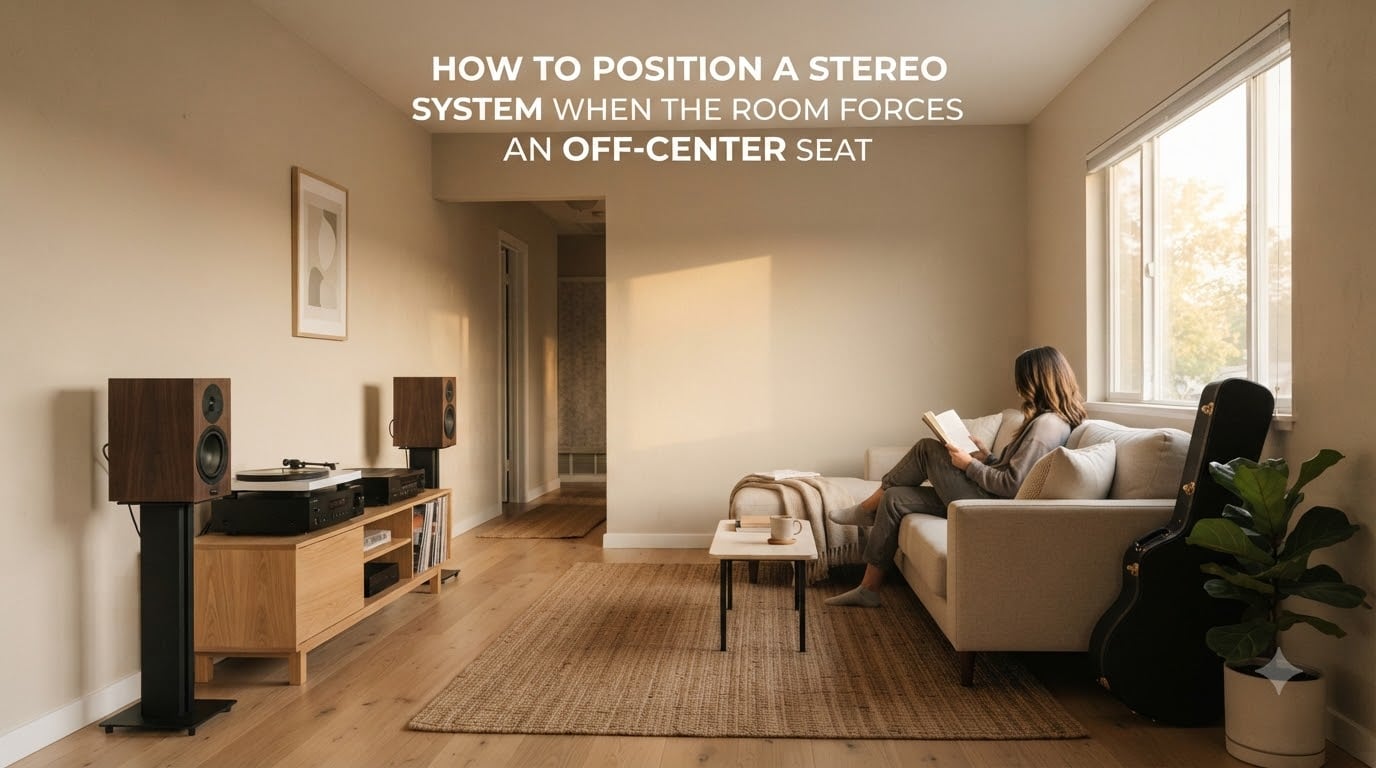
Most stereo advice assumes you can sit exactly in the middle of an equilateral triangle. Real rooms do not work that way.
If your couch is pushed against a wall, your listening chair sits next to a doorway, or you share the room with another listener, your seat is probably not equidistant from the left and right speaker.
I have lived with this problem for years. Below, I will walk you through how to position a stereo system when the room forces an off-center seat so you can stop losing half your soundstage.
Table of Contents
Why Off-Center Seating Breaks Stereo Imaging?
Off-center seating breaks stereo imaging because your ears are no longer equidistant from the two speakers. That collapses the phantom center toward the closer cabinet.
Stereo imaging is created by your brain combining two slightly different signals arriving at each ear. When you sit dead center, the left and right signals arrive at the same level and almost the same time.
Your brain then locks the central vocal or soloist exactly between the speakers.
Move off-center, even by 12 inches, and one speaker is closer than the other. The closer speaker arrives first and louder.
Your brain interprets that as the sound source coming from that side. The phantom center shifts toward the closer speaker, the soundstage leans, and vocals appear to come from the wrong place.
That is the off-axis feeling many listeners describe as “listening with one earphone in.” Off-center seating is the most common reason listeners say the stereo “pulls to one side.”
The Physics of Stereo Imaging and the Sweet Spot
The sweet spot is the single seat where the triangle between you and the two speakers collapses to a perfect isosceles shape. Equal path length and equal intensity arrive at both ears.
Phantom center is the illusion your brain builds when identical signals from the left and right speaker arrive at the same time and volume.
The equilateral triangle rule says the distance between the left speaker and right speaker should equal the distance from each speaker to your head. Most speakers sound best when this triangle sits between 6 and 10 feet per side.
That perfect triangle only works for one seat at a time. If you and a partner both want to listen, one of you will be off-center.
There is no physics-free way to give two seats a perfect phantom center from a 2-channel source. Audiophiles often accept a “one-seat theater” compromise for that reason.
The 38% Rule and Room Positioning Basics
The 38% rule says your listening seat should sit 38% of the room’s length away from the front wall. This avoids the worst standing wave nulls.
KEF popularized this rule in their placement guides, and it has held up for decades. If your room is 16 feet long, your chair should sit roughly 6 feet from the wall behind the speakers.
This position minimizes bass cancelation from equal-and-opposite sound waves bouncing off the rear wall.
The matching speaker rule is the other half: place each speaker 38% of the room’s width from the side walls. In a 12-foot-wide room, each speaker should sit about 4.5 feet from its nearest side wall.
Symmetry is the entire game. When you cannot sit centered, the goal is to preserve as much symmetry as possible between you and the speakers.
Every method below is really a different way to re-balance the triangle when the room refuses to give you a centered seat.
Method 1: Shift Both Speakers Toward the Off-Center Direction
Shifting both speakers toward the off-center listener is the fastest physical fix because it restores equal path length to that seat.
I tested this in my own room with my main seat 14 inches right of center. The fix was simple: I slid both speakers 7 inches to the right.
That brought my ears back into the equilateral triangle. The phantom center snapped back into place, the soundstage widened, and the vocals floated between the speakers again.
The math is straightforward. Measure the distance from each speaker to your listening seat.
If the right speaker is closer by 14 inches, shift the entire speaker pair 7 inches to the right. Half the difference goes back to balance.
You will lose perfect symmetry with the room, but you will gain symmetry with your seat. That matters more for imaging.
Tip: do this in 1-inch increments. Have someone sit in the off-center seat and play a vocal track with a strong center image. Move both speakers together until the vocal locks to the middle.
Method 2: Adjust the Toe-In Angle for Asymmetric Listening
Toe-in means rotating the speakers so their on-axis output points at your listening position rather than straight ahead. Used carefully, it can re-aim the sweet spot toward an off-center seat.
Most speakers are designed to fire straight ahead with a slight toe-in of 5 to 15 degrees. Each speaker’s high frequencies are most directional along its center axis.
If you sit off-center, you are listening to the closer speaker off-axis. That rolls off the treble and changes the tonal balance.
To compensate, increase the toe-in on the closer speaker until its on-axis beam aims directly at your ear. The farther speaker needs less toe-in, or none at all.
The risk here is going too far. Excessive toe-in narrows the soundstage and makes the room feel smaller.
I keep total toe-in under 30 degrees combined between both speakers. If I find myself pointing the speakers almost at my chest, I pull back.
Toe-in alone rarely fixes the intensity imbalance. Use it together with Method 1 for the best results.
Method 3: Use Digital Correction (Time and Intensity Alignment)
Digital correction means using a DSP processor, AV receiver, or room correction software to add delay and level trim to the closer speaker. That way the far speaker “catches up” at your seat.
This is the same trick the pros use in recording studios and commercial cinemas.
If the right speaker is 14 inches closer than the left, that is roughly 1 millisecond of extra delay. Add 1 ms of delay to the right channel and reduce its level by about 0.5 to 1 dB.
Your brain then reinterprets the center image back to the middle.
Most modern AV receivers ship with room correction like Audyssey, Dirac Live, or Yamaha YPAO. They measure your room with a microphone and calculate the right delay for each channel.
Set the microphone at your off-center seat and run the calibration. The receiver will do most of the math for you.
For two-channel purists running a stereo preamp, an external DSP like a miniDSP 2×4 or a MOTU interface can sit between your source and your power amp.
You get the same time and intensity alignment without buying an AV receiver. Dirac Live even sells a stereo-specific version for under $300.
The balance control on your preamp is a poor man’s version of this. Cranking balance to 1 o’clock shifts the image toward the louder channel.
How to Calculate the Exact Speaker Shift Distance?
Use this formula to find the exact shift: speaker_shift = (close_distance – far_distance) / 2.
Step 1: measure the distance from the closer speaker to your seat.
Step 2: measure the distance from the farther speaker to your seat.
Step 3: subtract the two numbers, then divide by 2.
Step 4: move both speakers together by that amount in the direction of the closer speaker.
Example: left speaker is 8 feet from your seat, right speaker is 7 feet from your seat. The difference is 12 inches.
Shift both speakers 6 inches to the right. The path lengths become equal and the phantom center re-centers.
When to Consider Adding a Center Channel Speaker
Adding a dedicated center channel speaker is the most reliable fix for off-center seating. It gives every listener a real, physical center source rather than a phantom one.
In a traditional two-channel system, the center channel is a psychoacoustic illusion your brain invents. It only works for one seat.
In a home theater or 3-channel setup, the center speaker is a physical box mounted above or below the screen. Every seat in the room hears the same centered vocal.
If your main priority is dialogue clarity, multiple listener support, and family viewing, a center channel is the right tool.
Pure 2-channel only works for one seat in one spot. For a living room shared with another person, the center channel wins.
You can run a 3-channel music setup with a stereo pair plus a center, even without surround speakers. Many AV receivers support this natively.
Set the center channel to “small” and cross it over at 80 Hz. You get a phantom-free center for every seat in the room.
Frequently Asked Questions
What is the 38% rule for speakers?
The 38% rule places your listening seat 38% of the room’s length away from the front wall. This position reduces bass cancelation from rear-wall reflections and gives the flattest low-frequency response at your seat. Speakers should also sit 38% of the room’s width from the side walls to keep boundary interference symmetric.
How do you get good stereo sound from an off-center seat?
Shift both speakers toward the off-center seat by half the distance difference between the two speakers. Then add a small amount of toe-in on the closer speaker to put its on-axis output on your ear. For stubborn cases, use a DSP or AV receiver room correction to apply delay and level trim to the closer channel.
Can a center speaker be off center?
A center speaker should sit as close to horizontal center between the left and right speakers as the room allows. Small offsets of a few inches are fine and can be digitally corrected with delay. Large offsets of more than 12 inches will move the dialogue off the screen and break the imaging for everyone, not just off-center listeners.
What is the 83% rule for speakers?
The 83% rule is an alternative to the 38% rule that places the listening seat 83% of the room length from the front wall. It is the harmonic of 38%, sitting at the next null in the standing wave pattern. Most listeners prefer 38% because it gives tighter bass, but 83% is worth trying if 38% puts the seat too close to the back wall.
Should I add a center channel for off-center seating?
Yes, if multiple listeners share the room or dialogue clarity matters more than stereo purity. A physical center channel gives every seat the same centered vocal without relying on the phantom image. Run it as small, crossed at 80 Hz, and you can keep most of the two-channel music character while gaining real-world usability.
Positioning a Stereo System With an Off-Center Seat: The Bottom Line
Positioning a stereo system when the room forces an off-center seat comes down to three methods.
Shift both speakers toward the listener. Adjust toe-in on the closer speaker. Use DSP to apply time and level correction.
Start with Method 1 because it is free and takes five minutes. Add Method 2 if the off-center seat still sounds dull. Add Method 3 if you want a permanent fix that works for every seat in the room.
If none of those satisfy you, a center channel speaker is the honest solution for shared rooms in 2026 and beyond.