
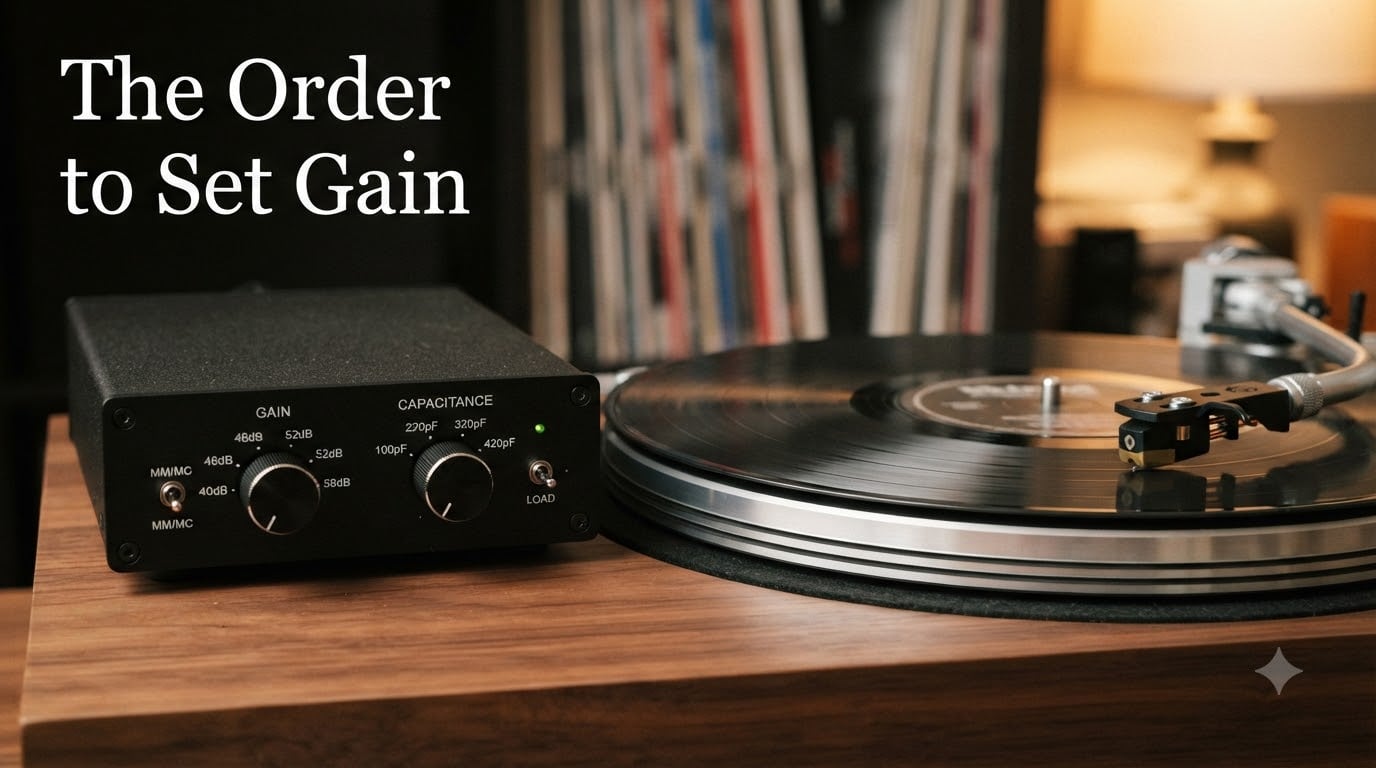
Setting up a phono preamp involves two critical adjustments: gain and capacitance. Get the order wrong, and you will spend hours chasing tonal problems that are actually level problems. The correct order to set gain and capacitance on a phono preamp is gain first, capacitance second. This guide walks through exactly why that sequence matters and how to dial in both settings for accurate, natural vinyl playback.
Whether you are running a moving magnet cartridge like the Ortofon 2M Blue or a low-output moving coil, the procedure follows the same logic. Gain establishes your signal level, and capacitance shapes the frequency response on top of that established level. We have tested this process across multiple turntable setups and consulted audiophile community consensus from forums like r/turntables and Vinyl Engine.
By the end of this guide, you will know how to calculate total system capacitance, choose the right gain stage, and fine-tune the high frequencies using both measurement and listening tests.
Table of Contents
What Is Phono Preamp Gain and Capacitance?
Phono preamp gain and capacitance are two separate controls that affect different parts of your signal chain. Gain controls how much the weak cartridge signal gets amplified to reach line level. Capacitance controls the electrical load the cartridge sees, which directly shapes the high-frequency response.
Gain is measured in decibels (dB). A typical moving magnet cartridge needs around 35 to 45 dB of gain, while a moving coil cartridge may need 55 to 65 dB. Too little gain leaves your music quiet and buried in noise. Too much gain introduces distortion and makes the system sound harsh.
Capacitance is measured in picofarads (pF) and works alongside the standard 47k ohm resistive load. The cartridge coil has inherent inductance, and together with capacitance, this forms a resonant circuit that acts as a low-pass filter. That filter affects frequencies typically between 10 kHz and 20 kHz. Higher capacitance pushes the resonance lower and makes it more pronounced, which can cause a peak in the treble followed by a sharp roll-off.
This is why RIAA equalization alone does not guarantee flat frequency response. The physical interaction between your cartridge, tonearm wiring, interconnect cables, and preamp input capacitance all contribute to the final sound.
Why the Order to Set Gain and Capacitance on a Phono Preamp Matters
The order matters because gain and capacitance interact with your perception of sound in very different ways. Gain affects volume, dynamic range, and signal-to-noise ratio. Capacitance affects tonal balance, specifically the character of the high frequencies. If you try to tune capacitance before gain is correct, you are adjusting tone against an unstable noise floor.
Here is what happens when you set capacitance first: you hear the highs as either bright or dull, so you adjust capacitance to compensate. But if the gain was wrong, some of what you heard was actually distortion or a noise floor problem being misread as a tonal issue. You end up chasing a capacitance setting that masks a gain problem instead of fixing it.
Community consensus from audiophile forums strongly supports the gain-first approach. Users on r/audiophile and r/turntables consistently recommend starting with 47k ohm and 100pF as a baseline, getting the gain dialed in so the volume is comfortable and the noise floor is low, and only then adjusting capacitance to fine-tune the top end.
Think of it like building a house. Gain is the foundation. Capacitance is the paint on the walls. You would not pick paint colors before pouring the concrete.
MM vs MC Cartridges: Different Loading Needs
Moving magnet (MM) and moving coil (MC) cartridges have fundamentally different electrical characteristics, which means they need different gain and loading settings. Understanding your cartridge type is essential before touching any dial.
Moving Magnet Cartridges
MM cartridges have higher output voltage, typically around 4 to 7 millivolts. They need less gain from the preamp, usually in the 35 to 45 dB range. The standard load for MM cartridges is 47k ohms of resistance with a specific capacitance value recommended by the manufacturer.
Capacitance matters a great deal for MM cartridges because their high coil inductance creates a strong resonance with whatever capacitance is in the circuit. Most MM cartridge manufacturers specify a recommended load capacitance, often between 150pF and 300pF total. The Ortofon 2M series, for example, specifies a recommended load capacitance of 150 to 300pF.
Moving Coil Cartridges
MC cartridges have much lower output voltage, typically 0.2 to 0.7 millivolts for low-output models. They require significantly more gain, usually 55 to 65 dB, which means many preamps need a dedicated MC stage or a step-up transformer.
For MC cartridges, capacitance is far less critical. The low coil inductance of MC designs means the capacitance resonance occurs well above the audible range. What matters more for MC cartridges is the resistive load, which audiophiles often adjust in the range of 100 to 500 ohms. Many forum users report that 500 ohm resistive loading yields the flattest frequency response measurements for typical MC cartridges.
Key Differences at a Glance
MM needs about 40 dB gain with 47k ohm load and 150 to 300pF capacitance. MC needs about 60 dB gain with 100 to 500 ohm load, and capacitance is mostly irrelevant. If your phono preamp has both MM and MC settings, always confirm which type your cartridge is before selecting a gain stage.
How to Set Gain and Capacitance on a Phono Preamp: Step by Step
This step-by-step procedure covers the complete setup process, split into two phases. Phase 1 handles gain. Phase 2 handles capacitance. Follow the order exactly.
Phase 1: Setting Gain
Step 1: Check your cartridge specifications. Look up the output voltage of your cartridge in millivolts (mV). This number determines how much gain you need. MM cartridges typically output 4 to 7mV and need about 40 dB. MC cartridges output 0.2 to 0.7mV and need 55 to 65 dB.
Step 2: Set the preamp to the correct gain stage. If your preamp has selectable gain (low, medium, high), start with the setting that matches your cartridge type. For a typical MM cartridge, start with medium gain around 40 dB. For an MC cartridge, start with high gain around 60 dB.
Step 3: Play a familiar record at your normal listening volume. Use an album you know well so you can judge whether the volume level is appropriate. The music should be at a comfortable listening level without the preamp adding audible hiss during quiet passages.
Step 4: Evaluate the noise floor and dynamics. Listen to the silence between tracks. If you hear excessive hiss, your gain may be too high. If the music sounds lifeless or you have to turn your amplifier volume very far up, your gain may be too low. Adjust in one step increments until the balance is right. Lock in the gain setting before moving to capacitance.
Phase 2: Setting Capacitance
Step 5: Calculate your total system capacitance. Total capacitance is the sum of four components: the tonearm wire capacitance (typically 50 to 100pF), the interconnect cable capacitance (varies, often 50 to 150pF), the preamp input capacitance (often 100 to 200pF, sometimes adjustable), and any parasitic capacitance from connectors. Add all of these together to get your real-world capacitance load.
For example, if your tonearm wiring is 80pF, your cable is 100pF, and your preamp is set to 100pF, your total system capacitance is 280pF. Compare this to the cartridge manufacturer’s recommendation to see if you are in range.
Step 6: Set the preamp capacitance to match your cartridge spec. If your preamp has selectable capacitance, choose the setting that brings your total closest to the manufacturer recommendation. Start with the closest available option. For many preamps, the lowest capacitance setting is still higher than ideal once you add cable and tonearm capacitance.
Step 7: Run a listening test focused on high frequencies. Play a record with cymbals, strings, or female vocals. Listen specifically to the treble character. If the highs sound harsh, sibilant, or piercing, your total capacitance may be too low for this cartridge. If the highs sound dull, muffled, or rolled off, your capacitance may be too high.
Step 8: Fine-tune in small increments. Adjust capacitance in steps of 50pF if your preamp allows it. Make one change, listen to the same track again, and compare. Audiophile forum users recommend using a test record with frequency sweep tracks if you want to be precise. When the treble sounds natural and extended without harshness, you have found your setting.
Troubleshooting Common Gain and Capacitance Issues
Even with the right procedure, you may run into problems. Here are the most common issues and how to fix them based on real user experiences from vinyl communities.
Problem: The sound is too bright and fatiguing. This usually means your total capacitance is too low for the cartridge, or the cartridge is naturally bright. Try increasing capacitance in 50pF steps. If your preamp cannot go higher, you may need a higher-capacitance interconnect cable.
Problem: The sound is dull and lifeless. Your total capacitance is likely too high. The high-frequency roll-off from excess capacitance makes everything sound muffled. Reduce preamp capacitance if possible. If the cable is the culprit, switching to a low-capacitance interconnect can restore treble detail.
Problem: Distortion during loud passages. This is almost always a gain issue, not a capacitance issue. Your gain is set too high and the preamp is clipping. Reduce the gain by one step and test again. If the distortion persists, check that your amplifier input is not being overloaded by the preamp output.
Problem: Background hiss is too audible. Your gain is probably set higher than necessary for your cartridge output. Try lowering gain by one step. If you are using an MC cartridge with very low output and the hiss is unavoidable even at correct gain, you may benefit from a step-up transformer for a better signal-to-noise ratio.
Problem: Bass sounds bloated or muddy. This is less commonly related to gain or capacitance and more often a turntable setup issue. Check your tracking force and anti-skate settings first. However, extremely high capacitance can indirectly affect perceived bass by masking high-frequency detail, making the overall balance sound dark.
Frequently Asked Questions
What is the best gain setting for a phono preamp?
The best gain setting depends on your cartridge output. For MM cartridges outputting 4 to 7mV, aim for 35 to 45 dB of gain. For low-output MC cartridges producing 0.2 to 0.7mV, you need 55 to 65 dB. The goal is enough gain for comfortable listening volume without audible hiss during quiet passages.
How to setup a phono preamp?
Start by matching the gain stage to your cartridge type. Set gain for MM or MC, then play a familiar record to confirm comfortable volume with low noise. Once gain is locked in, calculate total system capacitance and set the preamp capacitance to match the cartridge manufacturer recommendation. Always set gain first, then fine-tune capacitance.
How to measure capacitance of phono cable?
You can measure phono cable capacitance using a capacitance meter or multimeter with capacitance mode. Disconnect both ends of the cable, then connect the meter probes to the signal and ground pins. Typical phono interconnect cables measure between 50 and 150pF per channel. Add this to tonearm wire capacitance and preamp input capacitance for your total load.
What is the recommended capacitance for an Ortofon 2M Blue?
Ortofon recommends a load capacitance of 150 to 300pF for the 2M Blue cartridge. Remember this is total system capacitance, so you must account for tonearm wiring (often 50 to 100pF), interconnect cable capacitance, and preamp input capacitance. If your total exceeds 300pF, consider a lower-capacitance cable or preamp setting.
What should preamp gain be set to?
Preamp gain should be set so that your cartridge output reaches standard line level without distortion or excessive noise. For most MM cartridges, set gain to approximately 40 dB. For MC cartridges, set gain to 60 dB or higher. The right setting produces comfortable listening volume at your amplifier’s normal position with a silent background between tracks.
Conclusion
The order to set gain and capacitance on a phono preamp is always gain first, capacitance second. Gain gives you the right signal level and noise floor. Capacitance gives you the right tonal balance on top of that level. Skipping or reversing this order leads to wasted time and settings that do not actually solve your problem.
Start with 47k ohm and 100pF as your baseline. Get the gain dialed in so music is at a comfortable volume with a quiet background. Then calculate your total system capacitance, compare it to the manufacturer spec, and fine-tune in 50pF increments. Your ears and a test record will confirm when you have it right.
Take your time with each step. The difference between a properly loaded cartridge and a poorly loaded one is the difference between vinyl that sounds alive and vinyl that leaves you underwhelmed.