
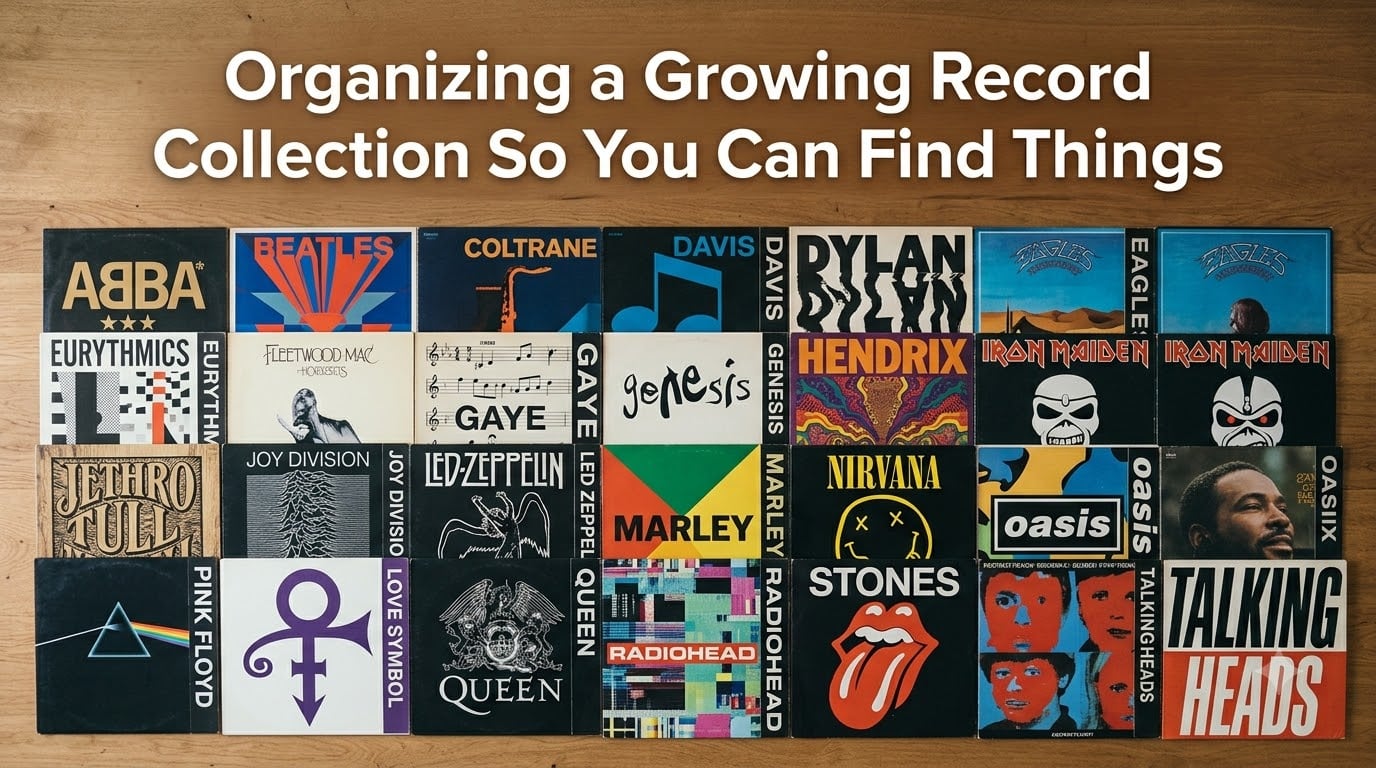
I remember the day my collection tipped past 200 records. I pulled out a Coltrane album I had not played in months, spent 20 minutes digging through stacks, and finally gave up and bought a duplicate at my local shop. That wasted $25 and taught me a hard lesson about organizing vinyl records before your collection outgrows you.
If you are reading this, chances are your own collection is growing faster than your system can handle. Whether you have 75 records or 750, this guide walks you through the methods, tools, and habits I have tested over a decade of collecting. By the end, you will know exactly how to organize a growing record collection so you can find anything in under a minute.
Table of Contents
Why Organizing Your Record Collection Matters?
Organizing a vinyl record collection is not about looking tidy on Instagram. It is about protecting your investment, saving time, and actually enjoying what you own. I have watched friends with 1,000+ records lose access to half their collection because the system broke down.
Here is what proper organization actually does for you. First, it protects record value. Records stored badly warp, scratch, and lose resale worth. A $200 Blue Note reissue today could be a $400 grail tomorrow if you keep it in mint condition.
Second, it saves you money. The average collector I know has bought at least three duplicate albums because they could not find the original. At $20 to $40 per record, that adds up fast.
Third, it transforms browsing from a chore into a pleasure. When you can flip through your shelves and see the full scope of what you own, you rediscover records you forgot you had. That is the real joy of vinyl.
The Three Core Organization Methods
Every system you will ever use comes from one of three core methods. Most serious collectors end up combining elements of all three once their collection passes 500 records. Let me walk you through each one.
Alphabetical Organization Method
Alphabetical sorting by artist surname is the most popular method among serious vinyl collectors. Steve Sexton from Sister Ray Records told me it is the only system that scales beyond 1,000 records without breaking down. The logic is simple: when you want to find something, your brain already searches alphabetically.
The classic debate here is first name versus last name sorting. Western convention sorts by surname, so The Beatles live under “B” and Led Zeppelin under “L”. But Japanese record stores sort by first name, which means John Coltrane sits under “J” and not “C”. I tried the first-name system for six months and kept losing time, so I went back to surname sorting. Stick with what your brain expects.
Within alphabetical sorting, you then sort each artist’s albums chronologically by release year. This keeps The Beatles in this order: Please Please Me, With the Beatles, A Hard Day’s Night, and so on. It feels natural and makes pulling a specific pressing easy.
Genre-Based Organization Method
Genre-based organization sorts your records into broad musical categories first. Common categories include Rock, Jazz, Soul/Funk, Electronic, Classical, Hip-Hop, and World. Within each genre, you then sort alphabetically by artist.
I personally use a genre-first system. When I want something specific, I narrow down to two crates of jazz instead of searching through my entire collection. Funky Moose Records in Canada described the same approach: “I choose to organize my record collection first by genre and then alphabetically within each genre.”
The trade-off is defining your genres clearly. If you have 30 records that could be jazz, soul, or funk, you will waste time second-guessing. My rule: when in doubt, follow the artist’s primary identity, not the album’s crossover style.
Chronological Organization Method
Chronological sorting puts records in order of release year. This works brilliantly for single-genre collections like jazz reissues or classical recordings. Blue Note Tone Poet series collectors often sort this way to follow the label’s evolution.
For mixed collections, pure chronological sorting gets unwieldy fast. Imagine hunting for a 1973 Stevie Wonder album across five decades of releases. Most collectors who try chronological eventually move to a hybrid system.
Comparing the Three Organization Methods
Choosing between alphabetical, genre, and chronological depends on your collection size, listening habits, and whether you collect across genres. Here is a quick comparison to help you decide.
| Method | Best For | Scaling Ability | Main Drawback |
|---|---|---|---|
| Alphabetical (by surname) | Large collections, mixed genres | Excellent past 1,000 records | Hard to browse by mood |
| Genre-First | Genre-specific collectors | Good up to 800 records | Genre-blurring albums cause confusion |
| Chronological (by year) | Single-genre or label collections | Limited for mixed collections | Slow when searching by artist |
| Hybrid (Genre + Alphabetical) | Most collectors over 300 records | Excellent at any size | Takes longer to set up |
For most readers of this guide, I recommend a hybrid approach. Start with genre categories, then sort alphabetically by surname within each genre. Add chronological order for prolific artists. This is what most record stores actually do, and for good reason.
How to Organize Your Vinyl Collection Step by Step
Theory only helps if you apply it. Here is the exact five-step process I use when I reorganize my collection. Budget a full weekend if you have more than 500 records.
Step 1: Pull everything out. Empty every shelf, crate, and stack. Spread records across your floor or table by the dozen. You cannot organize what you cannot see.
Step 2: Take a full inventory. Before sorting, photograph or scan each record into Discogs. I know this feels like extra work, but it gives you a baseline. If your collection ever gets damaged, lost, or stolen, you have proof of what you owned.
Step 3: Sort by your chosen method. Pick one system and commit. Place records into rough piles first, then refine. Do not switch methods halfway through or you will end up with a mess that is worse than where you started.
Step 4: Set up storage with dividers. Place genre dividers at the start of each section. Use alphabetical tabs at the start of each letter within a genre. Add a “New Arrivals” section at the front for records you have not cataloged yet.
Step 5: Maintain the system. Every time you buy a new record, slot it into its correct spot the same day. Do not let a “to file” pile grow. I learned this the hard way when my to-file pile hit 40 records and took an entire Sunday to clear.
Cataloging Your Collection with Discogs
Discogs is the most-used vinyl collection app in the world, and it is free. It started as a database of physical releases and grew into a full cataloging platform with over 500,000 active users. If you only adopt one digital tool for your collection, make it this one.
Setting up Discogs takes about 10 minutes. Create an account, click “Add to Collection,” and search by artist or scan the barcode on the sleeve using the mobile app. Each release has a unique page with cover art, tracklist, label, year, and pressing details.
Beyond basic cataloging, Discogs lets you track collection value based on average sales prices. This is huge for insurance purposes. I check my collection value twice a year and update my homeowner’s policy accordingly.
One Discogs feature I rely on heavily is duplicate detection. When you scan a record, the app flags if you already own a copy. This has saved me from buying duplicates at least six times. You can also create custom folders for “Wantlist,” “For Sale,” and “Playlists.”
Storage Best Practices for Vinyl Records
Organization and storage go hand in hand. Even the best sorting system fails if your records warp in a hot room or get scratched leaning against each other. Here are the storage rules I follow without exception.
Always store records upright, never flat. Flat storage causes warping under the weight of other records. Think of how books sit on a shelf. The same vertical orientation protects vinyl.
Use inner sleeves for every record. Most records ship with cheap paper inner sleeves that scratch over time. Replace them with anti-static polyethylene or rice paper sleeves. The $30 investment for 100 sleeves pays for itself by protecting your collection.
Add outer sleeves for valuable records. Outer plastic sleeves protect the jacket from ring wear, shelf wear, and dust. I use polyethylene sleeves for most records and higher-grade Mylar for anything worth over $50.
Maintain stable climate. Vinyl warps above 90 degrees Fahrenheit and becomes brittle in dry conditions. Keep your collection between 65 and 75 degrees with 45 to 50 percent humidity. Direct sunlight is your enemy. I learned this the hard way when a window-side shelf cooked three records during a heat wave.
Choose sturdy shelving. IKEA Kallax shelves are the gold standard for budget vinyl storage. Each 2×2 cube holds roughly 60 records. The shelves are deep enough for LPs, sturdy enough not to bow, and cheap enough to expand as your collection grows. Other collectors I know swear by similar modular cube systems from Target and Amazon.
Dividers, Labels, and Accessories That Make Organization Easier
Once your shelves are set up, dividers and labels turn a sorted collection into a searchable one. Without them, you still waste time scanning titles.
Genre dividers are the simplest starting point. You can buy pre-made sets or cut your own from cardboard. Each divider marks the start of a new genre section. Jazz, Rock, Soul, Electronic, Classical, and World cover most collections.
Alphabetical dividers sit within each genre section, marking the start of each letter. The cheapest option is printed cardboard tabs. The premium option is metal or acrylic dividers that last decades. I started with cardboard and upgraded after two years.
Custom labels help with sub-categories. For example, within Jazz, you might label “Hard Bop,” “Modal,” “Free Jazz,” and “Spiritual.” Within Rock, you might label “Classic Rock,” “Punk,” “Indie,” and “Post-Punk.” The level of detail is up to you.
Box sets need their own section. A standard 5-LP box set takes the space of 5 to 7 regular records. Mixed in with singles, they create gaps that make browsing frustrating. I keep all box sets on a separate shelf at the bottom of my unit, sorted alphabetically.
Handling Common Organization Challenges
Even with a perfect system, real collections create messy problems. Here are the four challenges I hear about most from other collectors, and how I solve them.
Duplicate records. Discogs catches most duplicates, but not all. When you discover you own two copies of the same album, decide immediately which one to keep and which to sell or trade. I keep the better-conditioned copy and the one with the more desirable pressing. The other goes into my trade pile within a week.
Box sets versus singles. Decide where box sets live before they start arriving. Most collectors separate them from singles because the sizing is inconsistent. A dedicated shelf for box sets keeps the main collection visually clean.
Mixed collections with a partner. If you share shelf space, use color-coded dividers. Each person gets a different color of genre tab, and you can sort within each genre by surname. This avoids arguments and makes browsing faster for both of you.
When to switch methods. If you spend more than five minutes hunting for a specific record, your method has broken down. That is the signal to reorganize. Most collectors switch methods once when they hit 500 records and again at 1,000. Each switch takes less time than the last because you already know what works.
Common Mistakes to Avoid When Organizing Records
After talking to dozens of collectors and going through my own learning curve, I have identified four mistakes that almost everyone makes at least once. Skip them and save yourself the wasted weekends.
Mistake 1: Starting too complex. A 12-category genre system sounds impressive until you have to maintain it. Start with 5 to 7 broad genres and add sub-categories only when your collection demands it. I have watched friends abandon their systems entirely because they tried to categorize everything from day one.
Mistake 2: Skipping the inventory step. Cataloging feels boring when you would rather start sorting. Skip it and you will eventually lose track of what you own. Take the time to scan records into Discogs as part of the initial organization. You will thank yourself later.
Mistake 3: Neglecting protection. Organization without protection is just arranging expensive coasters. Buy inner and outer sleeves before you reorganize. Replace cheap paper sleeves as you handle each record during the sorting process.
Mistake 4: Inconsistency. The biggest killer of organization systems is letting exceptions pile up. If you file most records alphabetically but let a few stay in a “miscellaneous” pile, the pile will grow until your system collapses. File every record the same way, every time.
Frequently Asked Questions About Organizing Vinyl Collections
How should I organize my record collection?
Sort by genre first, then alphabetically by artist surname within each genre, then chronologically by release year within each artist’s catalog. This hybrid system scales to any collection size and matches how your brain naturally searches. Use dividers to mark genre sections and tabs to mark letter breaks.
What is the best app for organizing my record collection?
Discogs is the best free app for vinyl collectors. It catalogs releases with full pressing details, tracks collection value based on market sales, flags duplicates, and works across mobile and desktop. Over 500,000 collectors use it, which means you can also browse what other collectors own and trade with them.
How to keep track of vinyl collection?
Catalog every record into Discogs using the mobile barcode scanner. Add custom folders for Wantlist, For Sale, and Playlists. Check your collection value twice a year for insurance purposes. Update entries whenever you buy, sell, or trade a record so the database stays accurate.
Should I sort records by first name or last name?
Sort by surname (last name). Western convention puts The Beatles under B and Led Zeppelin under L, which matches what your brain expects when searching. Japanese record stores sort by first name, but this confuses most Western collectors. Stick with surname sorting for consistency.
Start Organizing Your Record Collection Today
Organizing a growing record collection comes down to three choices. Pick a method (alphabetical, genre, or hybrid), commit to it for six months, and maintain it every time you bring a new record home.
The hybrid system I described works for collections of any size. Sort by genre first, then alphabetically by surname, then chronologically for prolific artists. Add Discogs cataloging for digital backup and value tracking. Pair it with proper storage in inner and outer sleeves, and your collection will stay browsable for decades.
Your collection is meant to be played, not buried. Pick a weekend, set up your shelves, scan your records into Discogs, and start filing. By the next time friends come over, you will be the collector with the organized crate that everyone admires.