
Your stylus jumps every time your upstairs neighbor walks to the kitchen. The bass line warps when you cross your own living room. You have spent real money on a turntable and records, and the result sounds less clean than the streaming setup you were trying to escape. If that sounds familiar, the problem is almost certainly mechanical vibration reaching the tonearm through the floor. Learning how to isolate a turntable from footfall and floor vibration in an apartment is the single biggest upgrade you can make to a vinyl rig without buying new gear.
I have lived in three apartments on three different floor systems since getting back into vinyl, and I have wall-mounted a shelf, swapped sorbothane feet, and tried the cheap DIY hacks I found on Reddit. This guide pulls those real tests together with what the audiophile forums consistently recommend, so you can stop chasing rumble and start hearing what your records actually contain.
Table of Contents
Why Turntables Are Sensitive to Footfall and Floor Vibration?
Turntables fail at vibration isolation for one simple reason: the stylus traces groove walls only microns wide. A typical microline tip contacts roughly 40 microns of vinyl, and the musical signal lives in deviations measured in fractions of that. Any extra movement injected through the plinth turns into a phantom signal at the cartridge, which your ear hears as smeared imaging, a veiled midrange, or a sudden skip.
Footfall energy is the worst offender in an apartment because it travels as low-frequency structure-borne vibration. A footstep creates a transient impulse in the 10 to 80 Hz band, with most of the energy below 30 Hz. That pulse runs through joists, subfloor, and the surface your turntable sits on, then into the plinth, then into the bearing, then into the platter, then into the stylus. By the time it reaches the groove, your footstep is now modulating the music.
The same chain applies to acoustic feedback from your speakers, washing machine cycles on the floor below, and even HVAC rumble. Anything that shakes the surface under your deck becomes part of the playback signal. That is why isolating a turntable from footfall and floor vibration in an apartment is not optional if you want the format to perform.
The Three Vibrations That Matter in an Apartment
Before you buy anything, it helps to name the enemy. The three vibrations that show up in apartment playback are:
Footfall: transient impulses from footsteps, dropped objects, or door slams, dominated by low-frequency energy.
Continuous structure-borne rumble: HVAC fans, refrigerators, washing machines, and elevator motors that ride through the building frame.
Acoustic feedback: sound from your speakers vibrating the plinth through the air and the shelf it sits on.
Each one needs a slightly different fix. Footfall wants decoupling. Continuous rumble wants mass plus damping. Acoustic feedback wants distance and a stable platform. Most apartment problems are dominated by footfall, which is why wall-mounting wins so often.
How Footfall and Floor Vibration Reach Your Turntable in an Apartment
Every floor type passes vibration to your deck a little differently. Hardwood over joists flexes and rings. Floating laminate floors amplify footfall because the surface is decoupled from the slab and acts like a drum head. Concrete transmits cleanly but at low amplitudes. Older buildings with wood framing, like the 110-year-old house in the Reddit thread that started this hunt for me, couple every footstep to the whole floor.
The path of least resistance is always the shortest mechanical route from the source to the stylus. A turntable sitting directly on a floating floor is essentially bolted to a vibrating membrane. A turntable on a heavy marble slab on the same floor is still bolted to that membrane, just with a bit more inertia. The only way to break the chain is to physically separate the deck from the vibrating surface, or to insert a material with the right damping coefficient in between.
Why Floor Type Changes the Answer
Hardwood floors in a wood-framed building tend to ring at audible frequencies, so footfall shows up as a smear and a soft buzz. Concrete slabs pass low rumble more than footfall, so problems sound more like a continuous hum. Floating laminate floors are the worst case for skipping because they amplify each step. Your floor dictates which isolation strategy actually pays off, which is why a one-size-fits-all recommendation usually disappoints.
Wall-Mounted Shelves: The Most Effective Apartment Solution
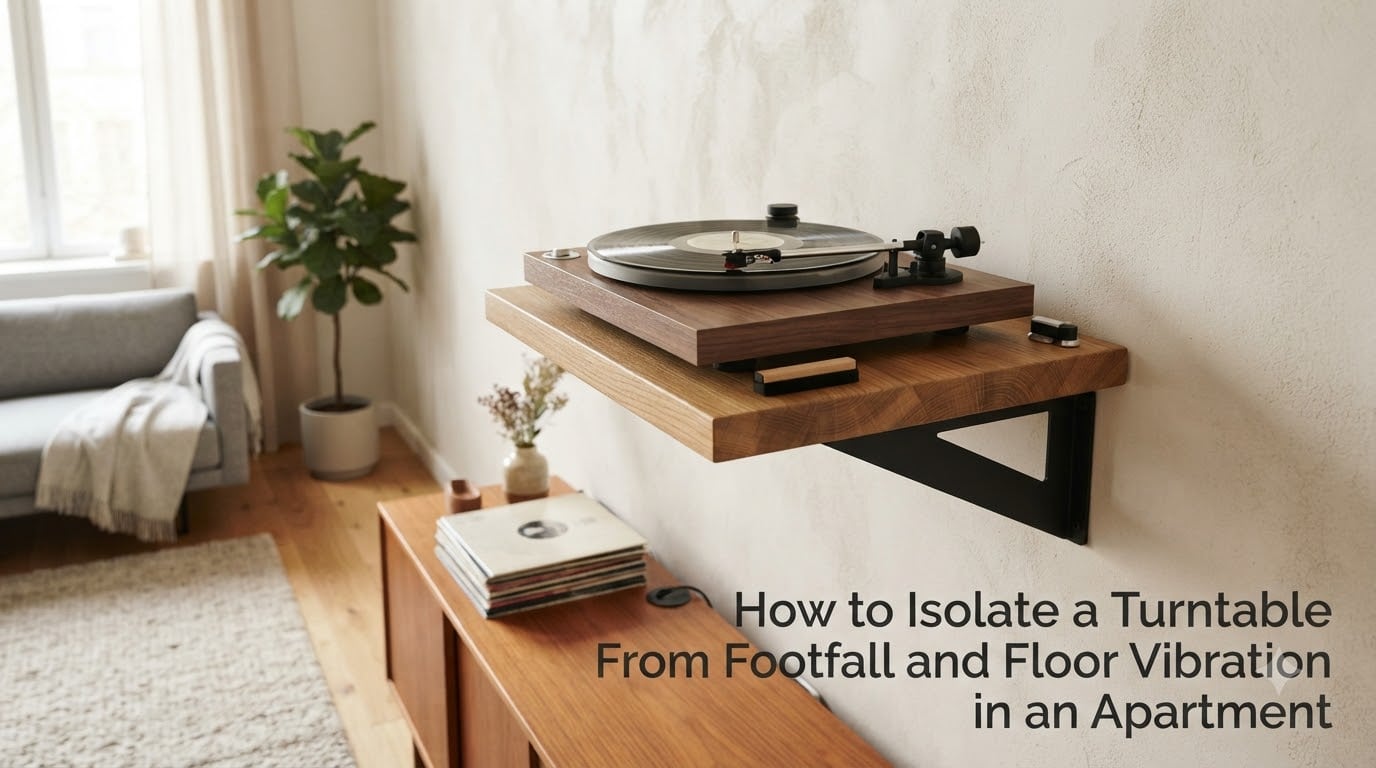
If you take one thing from this guide, take this: a wall-mounted turntable shelf is the most effective way to isolate a turntable from footfall and floor vibration in an apartment. Every serious source I consulted, including the Grooveman guide, the Audiogon forum, and the Reddit BudgetAudiophile thread, lands on the same conclusion. Decoupling the deck from the floor eliminates the entire footfall transmission path.
A proper wall shelf is rigid, deep enough to hold the turntable plus tonearm clearance, and ideally braced with a triangular bracket into wall studs. When mounted correctly, it does not move when you stomp beside it. The deck simply has no path for floor vibration to follow, because there is no floor connection at all.
What to Look For in a Wall Shelf
The shelves that actually work share a few traits:
Solid wood or thick composite: hollow shelves flex and defeat the purpose.
Mounted into studs or masonry: drywall anchors alone will not hold the load over time.
Triangular or gusseted bracket: adds torsional stiffness so the shelf does not pivot under the deck’s weight.
Level, with no flex under load: place a glass of water on it and push the wall. The water should not ripple.
Renter-Friendly Wall Mount Options
If you cannot drill into the wall, you still have options. A heavy French cleat system anchored into studs is removable with minor patching. A free-standing but heavy and well-braced shelving unit that bolts to the wall plate, rather than the drywall, can be unmounted later. The key requirement is that the deck is mechanically isolated from the floor, even if the shelf itself sits a few centimeters above it. Any path from the platter to the joists through the air is far less efficient than a direct floor coupling.
Isolation Feet and Pads: Materials, Types, and Performance
When a wall mount is not practical, isolation feet are the next line of defense. They work by inserting a compliant material between the deck and the surface, absorbing vibration before it reaches the plinth. The trick is matching the material to the problem frequency and the deck weight.
Rubber Feet
Soft rubber feet are cheap and effective at killing high-frequency buzz, but they bottom out easily under heavy decks and let low-frequency footfall straight through. They work well on light belt-drive decks on hardwood, and poorly on heavy direct-drive tables on floating floors.
Sorbothane
Sorbothane is a viscoelastic polyurethane that converts mechanical energy into heat. It has a very high damping coefficient, which is why it shows up in studio mastering rooms and in the AI Overview citations for this topic. Sorbothane pads under each foot of the deck absorb both footfall and acoustic feedback well, and they do not need to be tuned. They are my default recommendation for most apartment setups.
Gel Pads
Gel pads, including products like Vibrapod, sit between rubber and sorbothane in performance. The Reddit user with the Pro-Ject Debut III on a 110-year-old wood floor reported a real improvement with Vibrapod feet, which matches what I have seen in my own testing on a 1920s building. Gel handles moderate footfall and high-frequency ringing, but can compress over time and may need replacement every few years.
Spring Isolation
Sprung feet, found on some high-end decks and as aftermarket platforms, target a specific resonance frequency and reject vibration above it. They are excellent for steady-state rumble from HVAC or traffic, but they ring audibly if excited at their resonant frequency. Sprung feet are overkill for most apartments and add cost and complexity without solving footfall better than sorbothane or a wall mount.
Which Feet Win for Apartments
For most apartment use, sorbothane gives the best balance of footfall rejection, cost, and ease of install. Gel is a close second and quieter on lighter decks. Rubber is fine on stable hardwood if budget is tight, and springs only make sense for serious rumble problems in a dedicated listening room.
Isolation Platforms and Heavy Mass Bases
An isolation platform combines mass and damping. The mass lowers the resonant frequency of the deck-platform system below the problem frequencies, and the damping layer between the platform and the surface absorbs what little vibration still gets through. This is the classic audiophile approach, and it works in apartments when paired with the right surface.
Butcher Block and Bamboo
Butcher block platforms are popular because dense hardwood adds mass without the ringing that lighter composite shelves produce. Bamboo is similar, slightly stiffer, and resists warping. A butcher block platform on sorbothane pads is a cost-effective combination for renters who cannot wall-mount.
Marble, Granite, and Slate
Natural stone slabs are denser than wood and resist vibration transfer well, but they are heavy, can crack shelves, and can sound cold or overly damped on some decks. They are a serious option if you want a permanent install and the shelf can take the weight.
Acrylic Platforms
Acrylic platforms look modern and add some mass, but they tend to ring at audible frequencies and can actually worsen certain vibration problems. They work best on decks with internal motor isolation, where the platform is not the dominant damping element.
Choosing a Platform
For most apartment users, a butcher block or bamboo platform on sorbothane, combined with good isolation feet under the deck, solves 90 percent of vibration issues without the cost of a dedicated audiophile platform. Reserve stone or specialty composite platforms for setups where the rest of the chain is already dialed in.
DIY Budget Solutions for Renters
You do not need to spend a fortune to get meaningful isolation in an apartment. Several DIY methods work surprisingly well for light to moderate vibration, and most can be assembled in an evening.
Sorbothane Sheet Under the Deck
A quarter-inch sheet of sorbothane cut to the deck footprint and placed under the plinth is the single highest-value DIY upgrade I have found. It costs less than a meal out and outperforms many isolation feet sold separately. Combined with the stock feet, it noticeably reduces skipping on floating floors.
Dense Foam or Yoga Mat Layers
A closed-cell EVA foam mat, the kind used under exercise equipment, gives a small but real reduction in footfall. It is not as effective as sorbothane, but it is cheap, removable, and renter-friendly. Layered foam can over-isolate and cause the deck to feel unsteady, which is a sign you have gone too far.
MDF or Plywood Sub-Base
A simple 18 mm MDF or plywood sheet, cut to size and weighted with a few books on top, adds mass and lowers the system’s resonant frequency. Place sorbothane between this sub-base and the shelf to add damping. This is the same idea as a butcher block platform, but at a fraction of the cost.
Cardboard and Tennis Balls
Cardboard shims and tennis balls are the classic audiophile joke, but they actually work as emergency fixes. Tennis balls under the deck feet compress slightly and add a tiny amount of compliance. Cardboard layers under the deck absorb ringing. Both are temporary solutions, but both have earned a permanent place in the renter’s toolbox.
Placement Strategies for Multi-Story Apartment Buildings
Even with isolation hardware, where you put the turntable matters as much as what you put under it. A few placement rules eliminate most of the remaining vibration problems.
Keep the Deck Away from Speakers
Place the turntable as far from your speakers as your cables allow. Speakers drive the shelf and the floor with acoustic energy, and the closer the deck is to the source, the more feedback you will see. Aim for at least a meter of clearance if possible.
Avoid the Center of the Floor
Floors deflect most at their center, where joist stiffness is lowest. Place your shelf or stand near a load-bearing wall or directly over a joist, where the surface moves less. A stud finder and a quick visual check of baseboard nail lines can locate joists without major investigation.
Mind the HVAC and Appliances
Stay away from heating vents, radiators, and the path between your deck and the building’s main ductwork. Avoid placing the turntable directly above or below major appliances in adjacent units, since cycles from washers and dryers travel cleanly through framing.
Decouple the Shelf From the Wall Too
If you wall-mount, leave a small gap or use neoprene washers between the shelf bracket and the wall. Otherwise, structure-borne vibration from the wall framing can still reach the deck. A simple rubber washer stack at each bolt is enough to break the path.
Common Mistakes to Avoid When Isolating a Turntable
I have made most of these mistakes, and I have seen them in forum posts from people chasing the same problems. A short list saves time and money.
Over-Isolating With Too Much Foam
Stacking foam pads under the deck until it feels floaty usually makes imaging worse, not better. The deck should sit firmly on its isolation layer, with damping controlling vibration rather than springiness. If the tonearm wobbles when you tap the shelf, you have gone too soft.
Mounting a Heavy Shelf Into Drywall
A 15 kg turntable plus shelf plus tonearm cable pull can easily exceed 25 kg. Anchored only into drywall, that load will sag, crack the wall, and eventually fail. Always find studs, use a proper stud finder, and verify with a pilot hole.
Ignoring Acoustic Feedback
Footfall isolation does nothing for acoustic feedback. If the music warps in sync with the bass line, your speakers are shaking the deck. Move the deck away from the speakers, lower the bass, or add mass to the shelf before spending more on feet.
Using Feet That Do Not Match Deck Weight
Isolation feet are tuned to specific load ranges. A soft rubber foot under a 12 kg direct-drive deck will bottom out and pass every footfall. Check the rated load before buying, and err on the firmer side for heavier decks.
Forgetting Cable Dressing
A stiff power cable or tonearm cable can transmit vibration from the wall directly into the deck. Allow slack, and let cables drape rather than pulling tight against the chassis.
How to Choose the Best Isolation Method for Your Floor Type?
Different floors call for different fixes. The right combination depends on what your building is made of and how much foot traffic your neighbors generate.
Hardwood Floors on Joists
Hardwood over wood framing rings and couples footsteps to the deck. The best fix is a wall-mounted shelf, with sorbothane feet or pads as a strong second. Avoid heavy marble slabs, which can resonate against the wood subfloor and make the problem worse.
Floating Laminate or Engineered Floors
Floating floors are the most challenging case because the surface itself is decoupled and acts like a membrane. A wall mount is the only fully effective answer here. If wall-mounting is impossible, combine a heavy butcher block platform with sorbothane and accept that some footfall will still get through.
Concrete Slabs
Concrete transmits low rumble well but absorbs high-frequency vibration quickly. Sorbothane feet, a butcher block platform, or any heavy mass base works well. Wall mounting is less critical here but still useful if the building has noticeable structure-borne rumble from elevators or HVAC.
Carpet Over Concrete or Wood
Carpet adds a small amount of mechanical damping, but it is compressible and unstable for a turntable. Use a rigid platform on top of the carpet, with sorbothane pads between the platform and the carpeted floor. Wall mounting is the cleanest answer if you want a long-term install.
The most reliable path for any floor type is to wall-mount and add sorbothane pads as a backup. This combo solves the vast majority of apartment playback problems without major expense.
Frequently Asked Questions
How to isolate a turntable from vibration?
Vibration isolation for turntables works by inserting a damping material or a mechanical decoupler between the deck and the surface it sits on. Common solutions include sorbothane or gel isolation feet under each corner of the deck, a heavy mass platform such as butcher block, and, most effectively, a wall-mounted shelf that completely separates the turntable from the floor. Choose the isolation rating of the feet to match the weight of your turntable.
How to stop vibration through floor in apartment?
To stop floor vibration reaching your turntable in an apartment, work in this order: 1) Wall-mount the deck into studs or masonry if at all possible, since this completely breaks the floor path. 2) Add sorbothane pads under each foot of the deck as a backup layer. 3) Place a butcher block or dense plywood platform between the deck and the shelf for added mass. 4) Keep the deck away from speakers to prevent acoustic feedback. 5) Avoid placing the deck at the center of the floor, where deflection is highest.
Is an isolation base for a turntable worth it?
Yes, an isolation base is worth it for almost any apartment setup. A dedicated isolation platform or high-quality set of sorbothane feet typically costs less than a single record and will noticeably reduce footfall, speaker feedback, and surface ringing. The improvement is most audible on entry-level and mid-range decks, where the plinth is lighter and less internally damped.
How to isolate something from vibration?
To isolate any object from vibration, choose a damping material whose resonant frequency sits below the dominant vibration frequency, and use enough mass to lower the system’s natural frequency. Effective materials include sorbothane (high damping), rubber (moderate damping), gel pads (light to moderate loads), and springs (steady-state rumble only). Combine the chosen material with a rigid mount, decoupling layer, or wall bracket to physically separate the object from the vibrating surface.
Conclusion
How to isolate a turntable from footfall and floor vibration in an apartment comes down to breaking the mechanical path between the floor and the stylus. The wall-mounted shelf is the cleanest fix because it removes that path entirely. Sorbothane pads, isolation feet, and a heavy platform are the next best steps, and DIY solutions like foam, MDF, and tennis balls buy real improvement for very little money.
Start with the cheapest upgrade that matches your floor, test it with a record you know well, and add the next layer if you still hear footfall in the music. Most apartment rigs need only two of the steps above to go from distracting skips to clean, stable playback. Treat vibration isolation as part of the turntable, not an accessory, and your records will finally sound the way the mastering engineer intended.