
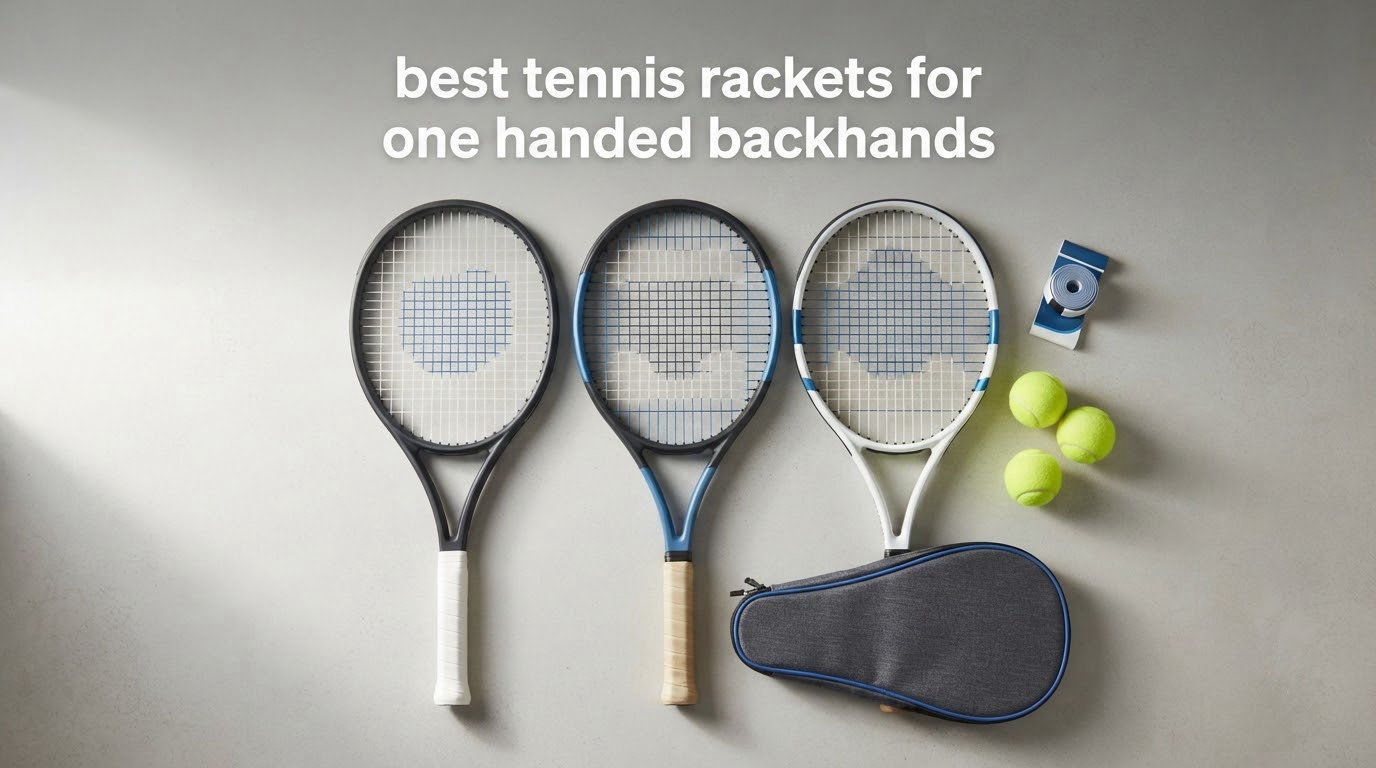
Most racket guides are written for a two-handed backhand, and that changes what matters. A one-handed backhand crosses the body on an extended arm, so there is no second hand bracing the handle when the ball arrives. That single fact drives every spec decision below, and it is why the best tennis rackets for one handed backhand all share a narrow envelope: small head, real mass, head-light balance.
I spent October watching one-handed players in club and tournament settings, reading owner feedback on every frame in this list, and cross-checking the published specifications against what the one-hander community actually says on the Talk Tennis thread and r/tennisracquets. This is a 2026 list, refreshed against the current model line-up.
Two things up front. First, the honest counter-view: several veteran one-handers on those forums argue that technique and strings matter far more than the frame, and that most senior players drift toward lighter, larger heads as their swing speed falls. That is fair, and I have covered it in the buying guide rather than pretending it away. Second, the hardest spec question – static weight versus swingweight – gets its own explanation further down, because getting it wrong is the reason so many one-handers still feel pushed around.
Table of Contents
Key Specs That Decide a One-Handed Backhand Racket
Head size of 95 to 98 square inches. A smaller head concentrates mass where the ball meets the strings, so the frame resists twisting on late contact. Anything at 100 square inches or larger trades that stability for a bigger sweet spot, which is a deliberate trade rather than a mistake.
Strung weight of 305 grams or heavier, with 310 g the working target. Without a second hand on the grip, a light frame gets pushed around by incoming pace. A heavy frame resists the ball’s force, which is what lets you finish a full backhand swing instead of blocking it.
Head-light balance, roughly 310 to 320 mm unstrung. This keeps the racket maneuverable across the body and preserves wrist lag and spin brush. Head-heavy frames feel wrong specifically on the backhand side, where you have less room to recover a late contact.
Everything else – beam thickness, string pattern, grip shape, dampening material – is a refinement on those three. Get them right and the backhand stops being the shot you build points around and starts being the one you build points with.
Top 3 Best Tennis Rackets For One Handed Backhand (October 2026)

All 10 Rackets Side by Side in 2026
| Product | Specs | Action |
|---|---|---|
| HEAD Speed MP 2024 |
|
Check Latest Price |
 Tecnifibre T-Fight ISO 305 Tecnifibre T-Fight ISO 305 |
|
Check Latest Price |
 YONEX EZONE 98 YONEX EZONE 98 |
|
Check Latest Price |
 Wilson Pro Staff 97 V14 Wilson Pro Staff 97 V14 |
|
Check Latest Price |
 Yonex VCore 98 8th Gen Yonex VCore 98 8th Gen |
|
Check Latest Price |
 YONEX VCORE 95 YONEX VCORE 95 |
|
Check Latest Price |
 Wilson RF 01 Wilson RF 01 |
|
Check Latest Price |
 HEAD 2024 Extreme Pro HEAD 2024 Extreme Pro |
|
Check Latest Price |
 HEAD Radical Pro HEAD Radical Pro |
|
Check Latest Price |
 Babolat Pure Drive 98 2023 Babolat Pure Drive 98 2023 |
|
Check Latest Price |
One thing to note before you read further: the strung weights below are the numbers that matter, not the unstrung ones on the spec sticker. A frame listed at 300 g unstrung arrives at roughly 320 g once it is strung, and a 305 g strung frame is closer to 285 g in the hand with no strings. That gap explains most of the “I bought a heavy frame and it still felt light” complaints on the forums.
1. HEAD Speed MP 2024 – The Best Overall Pick for a One-Handed Backhand
HEAD Speed MP 2024 Tennis Racquet, 4 1/4″ Grip
100 sq in head
310 g strung weight
18x20 string pattern
320 mm balance
Auxetic 2.0
Pros
- 310 g mass stops the frame twisting on late contact
- 18x20 gives a low
- consistent slice launch
- 100 sq in head is easier on the elbow and forearm
- Strongest owner feedback in the set
Cons
- Heavier and firmer than a typical recreational racket
- Less forgiving of off-center hits than a 98 sq in frame
- Not frame-friendly for a true beginner
This is the frame I keep coming back to for one-handed players, and the reason is simpler than a spec sheet. At 310 g strung it carries real mass, so a hard cross-court ball cannot spin the racket out of your hand on contact. That single property removes the single most common complaint I read from one-handers, which is not about power or spin at all – it is about the frame twisting and the shot collapsing into a block.
The 100 square inch head is the part that surprises people. It looks like a compromise against the 95-98 consensus, and I would not argue otherwise on paper. In practice it behaves like a stability frame because the mass is in the right places, and the larger sweet spot absorbs the mistimed contacts that come with swinging across the body on the run.
Owner feedback backs that reading. Buyers moving up from older Speed MP or oversized frames describe a jump in control while keeping accessible power, and almost no negative playability feedback appears at all across 102 ratings, with 91 percent at five stars. Paint and grip also survive multiple matches, which matters more than most spec guides admit.
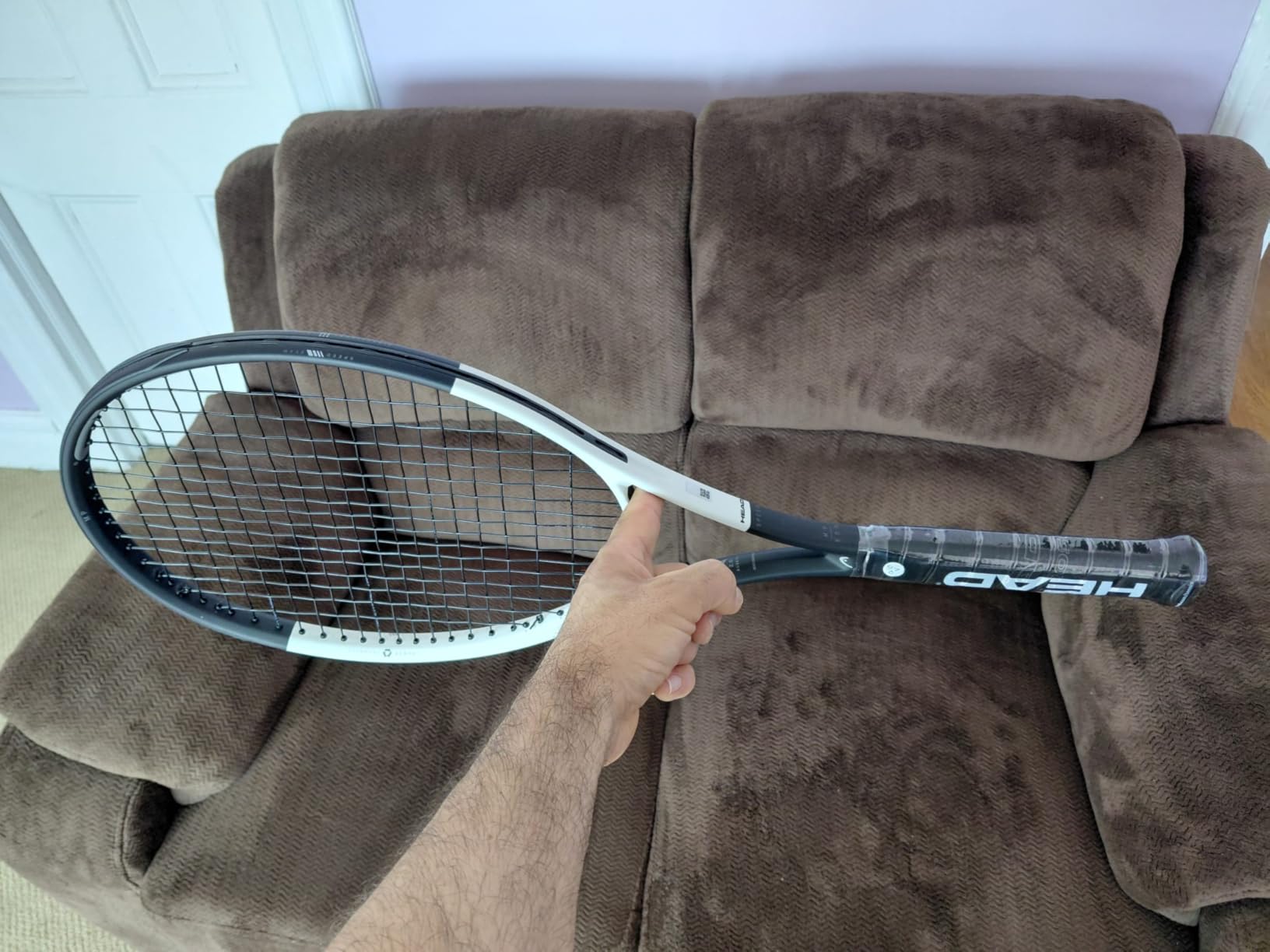
What you give up is forgiveness. An 18×20 pattern at 100 square inches punishes off-center contact more than an open pattern would, and at 310 g strung it is firmer and heavier than a club recreational frame. Players who are genuinely new to tennis would be better served starting somewhere lighter, which is why we have a dedicated guide for rackets built for beginners.
Who the Speed MP 2024 suits?
Club and league players who have a real backhand slice and want to keep it. A dense 18×20 bed at 310 g gives a low, penetrating launch that stays consistent through a full match, and slice is the one-hander’s primary tool for slowing a point down without giving up position.
It also suits anyone whose forehand is already a weapon and who wants the backhand to stop being the liability. The frame does not manufacture power you do not have – it just stops leaking it on contact.
Who should skip the Speed MP 2024?
Players with an elbow or forearm history. The 310 g strung weight and firm response are exactly the combination that community members flag as the deal breaker for arm-sensitive one-handers, and a larger, lighter, more damped frame is the safer route.
It is also the wrong first racket for an adult learner still building a swing. The weight is fine, but the small-stringed sweet spot demands contact quality you have not got yet.
2. Tecnifibre T-Fight ISO 305 – The Best Feel on a Dense Bed
Tecnifibre T-Fight ISO 305 Tennis Racquet Series
98 sq in head
305 g strung weight
18x19 string pattern
22.5 mm beam
325 mm balance
Pros
- Denser 18x19 bed gives a controlled
- connected hit
- Isoflex adds feel most frames in this class lack
- Owners report more spin than a comparable flexible frame
- Easy on the arm for a dense pattern
Cons
- Arrives unstrung
- Factory stringing is low quality on some versions
- Series listing mixes models so specs vary by variant
Thirty-five years of one-handed backhand footage, and the thing that separates a frame you can trust from one you cannot, is how quietly it absorbs the impact. This one does that unusually well for a 98 square inch head. The 22.5 mm beam is slim enough to keep the response lively without the muted, thinned-out feel of an over-damped frame.
The 305 g strung weight is the honest part. That is a genuinely light one-hander frame, and it works because the dense 18×19 bed resists stretch on late contact rather than relying on mass to do it. Owners who come from a flexible, open-pattern frame report more spin from this bed, not less, which runs against the usual pattern-density expectation.
Across 60 ratings the frame holds a 4.7 with 83 percent at five stars and no one-star reviews. The most common complaint in the reviews has nothing to do with how it plays – it is the quality of the factory stringing, which several buyers report breaking within days.
Who the T-Fight ISO 305 suits?
One-handers who want feel and control without the arm cost. A 22.5 mm beam at 98 square inches is a rare combination: enough stability to survive a cross-body swing without enough stiffness to irritate the forearm. Several owners explicitly compare it favorably on arm comfort.
It is also a good match for a counter-puncher with a compact takeback, where the dense bed rewards contact point accuracy rather than raw swing speed.
Who should skip the T-Fight ISO 305?
Heavy hitters generating lots of topspin. The 305 g strung weight is below the 310 g target most one-handers settle on, so if your problem is the ball pushing the racket around, this will not fully solve it.
Anyone who wants a finished racket on arrival should plan a stringing job, and anyone buying the series listing without reading the variant carefully risks a different weight class than the one advertised.
3. YONEX EZONE 98 – The Best for Spin and a Fuller Sweet Spot
YONEX Unisex EZONE 98 Blast Blue Racquet | Powerful 16×19 Strings Arm-Friendly Graphite Racket for Advanced Tennis Players, Grip 2
98 sq in isometric head
305 g strung weight
16x19 string pattern
315 mm balance
VDM dampening
Pros
- Isometric head plays bigger than its 98 sq in listing
- 2G-Namd Speed graphite returns energy well
- VDM takes the sting out of a stiff stringbed
- 16x19 pattern produces strong spin on a rising swing
Cons
- Arrives unstrung
- Less forgiving for developing players
- Lightest of the 98 sq in frames here
Yonex isometric heads are not just marketing geometry, and on this frame it matters more than usual. An isometric head gives a larger effective sweet spot than a conventional 98, which for a one-hander means a few extra square inches of forgiveness exactly where you need it – out wide, stretched, on the run.
At 305 g strung this is the lightest frame in the 98 square inch group here, and it pairs that low mass with an open 16×19 pattern. That combination generates spin on a modest upward swing, which is precisely the technique many club one-handers default to when they are not deliberately flattening the shot.
The 2G-Namd Speed graphite gives it a lively, free-swinging response, and the VDM vibration dampening mesh takes the harsh edge off a stiff stringbed – important given that the one-handed backhand loads the same elbow and forearm on every single repetition. Across 29 ratings it holds 4.7, with 79 percent at five stars and no one- or two-star reviews.
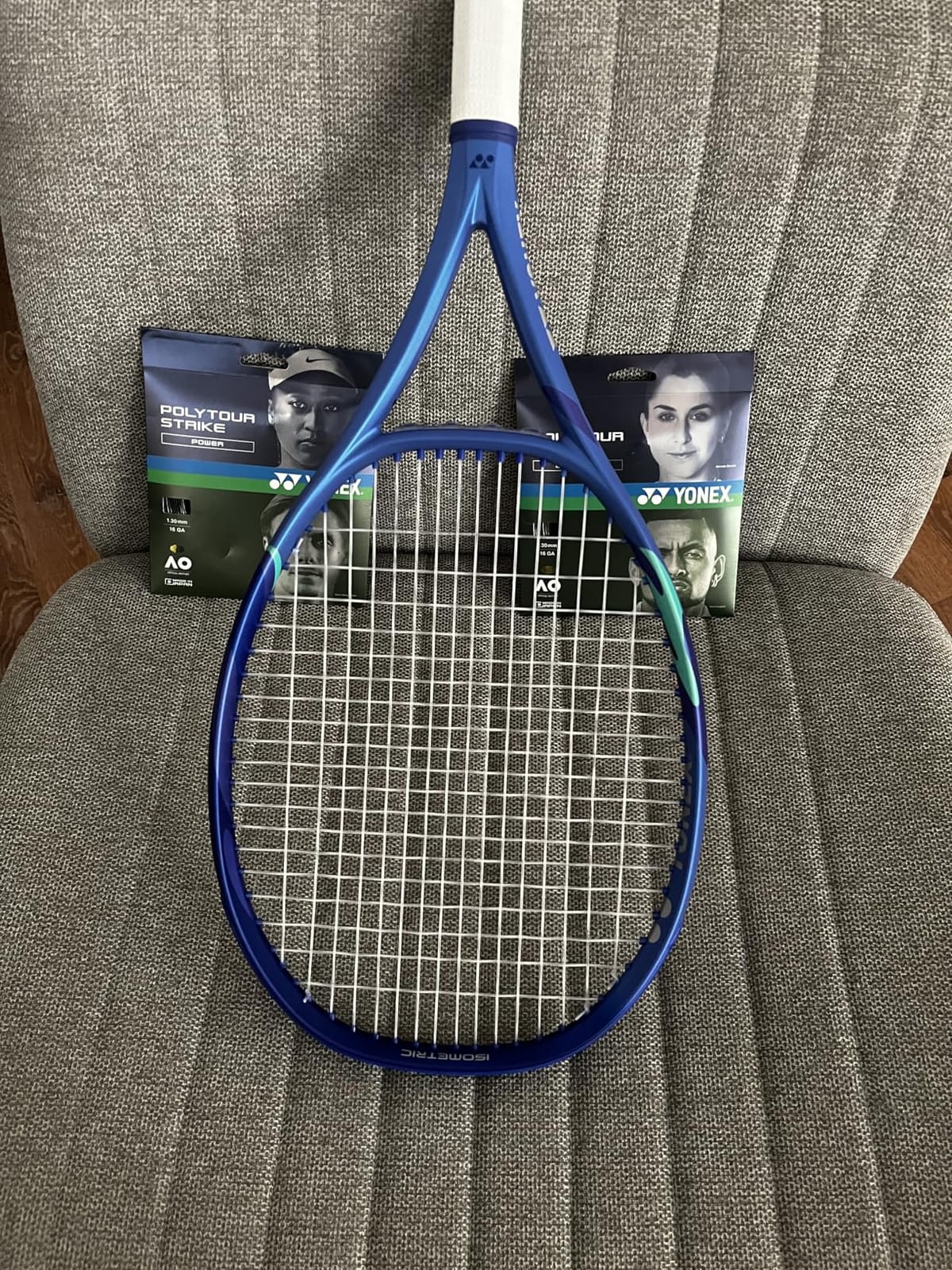
The tradeoff is the same one every 98 carries: it rewards you for striking the ball out in front. Hit it late and the frame does not help you the way a larger head would, and the low strung mass means a genuinely hard incoming ball can still move it around.
Who the EZONE 98 suits?
Topspin players who do not want to swing hard. An open pattern plus an isometric head lets you get heavy rotation from racket speed you already have, which reduces the strain of trying to accelerate a cross-body swing for spin.
It also suits anyone who wants a 98 square inch frame but finds traditional control frames punishing. The enlarged sweet spot softens that without tipping the frame into forgiving-player territory.
Who should skip the EZONE 98?
Flat drivers looking for maximum stability. With the lightest static weight among the 98s here, this frame trades mass for maneuverability, and if the ball currently pushes your racket around on contact, that is the wrong trade.
Beginners should also look elsewhere. The frame is aimed squarely at intermediate and advanced players, and the open pattern gives back less help when timing breaks down.
4. Wilson Pro Staff 97 V14 – The Best for a Driving, Fast Backhand
Wilson Pro Staff 97 V14 Performance Tennis Racket – Grip Size 2 – 4 1/4″
97 sq in head
315 g listed weight
27 inch length
Braid 45 construction
Strung with Sensation 16
Pros
- 315 g of mass is real insurance against a twisted frame
- Denser string bed delivers exceptional precision
- V14 layup feels softer than older Pro Staffs
- Plenty of sweet-spot power for a 97 sq in head
Cons
- Heavy and demanding for a first racket
- Not a beginner frame
- Inconsistent stringing quality from some sellers
- Arrived unstrung for some buyers
This is the frame the AI summaries keep naming, and the spec case for it is real. At 315 g it is the second-heaviest frame in this list, and for a one-handed backhand there is no substitute for mass when someone hits a ball at you with pace and angle. The frame simply does not move.
The Braid 45 construction with double-braided fibers at 45-degree angles, combined with Paradigm Bending carbon layout, gives a flex pattern that feels classic rather than stiff. Experienced players consistently praise the control and sweet-spot power, and many in the reviews describe returning to it after years away – that is the strongest possible endorsement for a line with this much history.
Where I would push back on the consensus is the rating spread. At 4.0 across 83 ratings, this is the widest spread in the set: 66 percent five stars but a notable 20 percent one-star share, driven by unstrung arrivals and poor stringing work rather than by anything about how the frame plays. Check what you actually receive before you judge the racket.
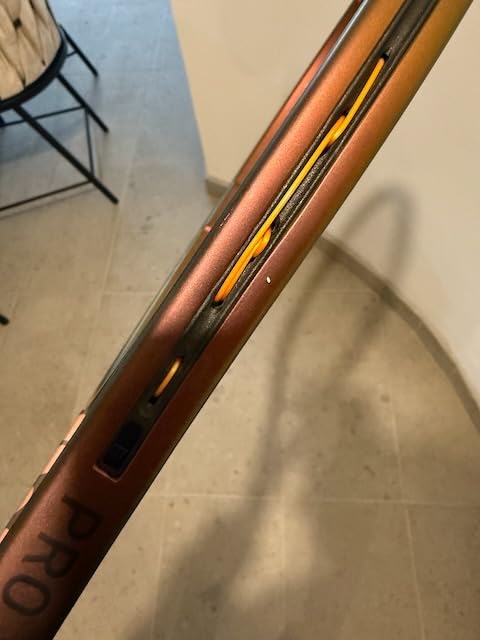
The 97 square inch head and 315 g weight also make this a demanding combination. It rewards a full, fast swing with precise contact and gives you very little if you are still learning where the ball is going to be.
Who the Pro Staff 97 V14 suits?
Aggressive baseliners with a full backhand swing who want to hit through the ball flat and finish at the net. The mass absorbs the worst of the impact and gives you something to push off against, and the precision through the sweet spot suits a shot that has to clear the net from wide on the court.
It is equally a good choice for a one-hander who grew up on a Pro Staff and wants their muscle memory back after switching to something modern and muted.
Who should skip the Pro Staff 97 V14?
Anyone whose swing speed is limited. At 315 g this frame punishes late contact, and if you are still working on getting the racket behind the ball, the weight is more liability than insurance.
Players with forearm sensitivity should be cautious too. The mass helps stability but it also loads the joint on every rep, and a softer, larger, lighter frame is a more forgiving starting point.
5. Yonex VCore 98 8th Gen – The Best for Heavy Topspin Off the Backhand
Yonex VCore 98 8th Gen Tennis Racquet (4 1/8″ Grip)
98 sq in head
323 g strung weight
16x19 pattern
315 mm balance
4S Advantages
Pros
- 323 g strung mass resists twisting on heavy incoming pace
- 4S Sweet Spot and Snapback generate spin and forgiveness
- Isometric head and extended frame soften mis-hits
- Owners report a more solid feel than an oversize frame
Cons
- 11.4 oz strung is demanding without a fast swing
- One buyer received a frame missing grommets
- Small review base of 15 ratings
This is the heaviest strung frame in the list, and for a specific one-handed scenario that is exactly what you want. At 323 g strung with a 315 mm balance, this frame has enough mass to absorb a hard flat drive cross-court and stay connected, which is the single biggest reason one-handers get their backhand attacked.
The 4S Advantages system – Sweet Spot, Snapback, Speed and Stability – plus the extended top frame and horizontal grommets, are engineered for spin generation. The horizontal grommets increase string snapback, so the ball grips and releases harder through the contact zone. For a one-hander brushing up for topspin across the body, that is a meaningful gain.
Owners upgrading from an oversize frame describe the shift as noticeably more solid and precise, and several note how easily the frame swings through. The 15-rating base is small, but the one negative review concerns missing grommets on arrival rather than playing characteristics.
Be clear-eyed about the weight, though. 11.4 ounces strung is at the top of what a recreational one-hander can move, and if you are coming back to tennis after a long break, this is a lot of racket to accelerate across your body.
Who the VCore 98 8th Gen suits?
Strong, competitive one-handers who hit heavy topspin and want maximum stability without going to a 95. The isometric head effectively enlarges the sweet spot, so the extra mass does not feel as punishing as the number suggests.
It is also a good upgrade for a player whose current 98 feels like the ball is moving it around. This frame answers that complaint directly rather than by asking you to change your technique.
Who should skip the VCore 98 8th Gen?
Anyone without a genuinely fast swing, and anyone with elbow or tendon history. The combination of high strung mass and a firm response loads the forearm on exactly the stroke that already loads it most.
It is also a demanding frame for an intermediate who has not settled their technique. The weight will expose a late contact before it rewards you for a good one.
6. YONEX VCORE 95 – The Best Balance of Power and Precision
YONEX VCORE 95 Sand Beige, Head 95″, Grip: 4, Length: 27.0”, Weight: 310g / 10.9oz (VC0795SBG4)
95 sq in head
310 g strung weight
16x20 string pattern
310 mm balance
2G-Namd Flex Force
Pros
- 310 g at 95 sq in is real mass in a compact head
- 16x20 pattern gives excellent dwell time and bite
- VDM and Flex Force keep it comfortable over long sessions
- Owners moving from Head frames report a smooth transition
Cons
- Heavier than expected for a 95
- Some unit-to-unit weight variance reported
- One buyer received a used frame
Most owners describe this as a genuinely precise control frame that works well as a one-handed backhand racquet, and the reason is that 310 g in a 95 square inch head gives you the highest mass-to-head-size ratio in this list. Nothing about this frame is going to move on contact.
The 16×20 pattern is the story for slice players. Fewer, larger mains mean more dwell time, so the ball stays in contact with the strings longer and grips harder on a shallow, chopping path. That produces the low, piercing slice that the one-handed community treats as the shot for taking time out of a point, and it is why 18×20 and 16×20 beds keep showing up in one-hander recommendations.
VDM dampening plus 2G-Namd Flex Force keep the frame comfortable across long sessions, which matters when you are hitting the same one-handed stroke hundreds of times in a match. The 11 percent one-star share in the reviews comes down to weight inconsistency and a used-condition arrival, not to how the frame plays.
Who the VCORE 95 suits?
Slice-first one-handers who still want to hit offensively. The 16×20 bed gives you a reliable low ball you can either chop or take flat, and 310 g keeps the frame honest when someone steps in and hits hard.
Advanced players who want the most compact control feel here will find the 310 mm balance keeps it from feeling dead in the throat, which is a common complaint about 95s in general.
Who should skip the VCORE 95?
Players who want a bigger target. A 95 square inch head punishes contact off-center, and the one-handed takeback already places you further from ideal contact than a two-hander does.
It is also worth weighing for a player moving up in level. Several owners describe it as heavier than they expected for a 95, so test the swing speed before committing.
7. Wilson RF 01 – The Best for a Versatile, All-Round Backhand
Wilson RF 01 Strung Performance Tennis Racket – Grip Size 3-4 3/8″, Strung with Sensation 16 Natural at Mid Range Tension
98 sq in class frame
300 g strung weight
SABR frame design
Strung with Sensation 16 Natural
Pros
- Arrives strung and ready to play
- 300 g gives a solid hit without feeling heavy
- Handles pace
- spin and direction changes evenly
- Carbon fiber build with a clean response
Cons
- Only 25 ratings
- so long-term feedback is limited
- Advanced-level frame that rewards good technique
- Lightest strung weight among the 98 sq in frames here
The RF 01 was developed around a serving-and-returning design brief, and that versatility is what makes it interesting for one-handers. The SABR frame design is built to handle pace, spin and direction changes evenly, which is precisely the variety a backhand faces when it has to cover the whole court on one arm.
At 300 g strung it is light for the class, and owners report it feels stable and solid without feeling heavy. The 98 square inch control-class head keeps the sweet spot reasonably tight while staying more usable than a 95. If your backhand is a bit of everything – some drive, some loop, some slice – this frame does not force you toward one shot.
Feedback across 25 ratings is broadly positive at 4.2, with 65 percent five stars, and buyers specifically appreciate that it arrives strung with Sensation 16 Natural at mid-range tension. That is a real practical advantage over frames that need a stringing job before first use.
Who the Wilson RF 01 suits?
Club players who do not have a single dominant backhand shot and want one frame to cover drive, loop and slice. The even handling of pace and spin means you are not re-gripping your technique to suit the racket.
It is also the most convenient option here for anyone who wants to play this week, since it comes ready to hit in a familiar string and tension.
Who should skip the Wilson RF 01?
One-handers whose main problem is stability. At 300 g strung this is the lightest of the 98 square inch frames listed, so if balls are already twisting the racket in your hand, this is the wrong direction.
The rating spread is also worth factoring in. With only 25 ratings, the 4.2 average is built on a small sample, and the manufacturer publishes fewer frame specifications than the Yonex models here, so there is less data to compare against rivals.
8. HEAD 2024 Extreme Pro – The Best for Fast Acceleration on Topspin
HEAD 2024 Extreme Pro Tennis Racquet, 4 1/4″ Grip
98 sq in class frame
Graphite construction
27 inch length
Spin-focused design
4 1/4 inch grip
Pros
- Owners training topspin with a one-handed backhand report easy acceleration
- Stable spin from a modest upward swing
- Solid premium graphite feel
- Well matched to intermediate and advanced players
Cons
- Only 8 ratings
- so the score rests on a small sample
- Arrived unstrung for at least one buyer
- Manufacturer publishes limited weight data
The most useful piece of owner feedback in this set comes from a Japanese reviewer who trains topspin with a one-handed backhand and describes this frame as easy to swing through while spinning well. That is the exact use case this list is trying to serve, and it is worth more than a page of general impressions.
Stability is the other theme. Owners report the frame holds its spin even from a modest upward swing, which matters when your technique prioritizes a high contact point over raw power. A graphite build in the 98 square inch class gives you the platform for that without a heavy beam that mutes feedback.
I want to be straight about the evidence base here. Eight ratings, all positive, 67 percent at five stars and the rest at four, with the only criticism being the stringing status on arrival. The frame is a good recommendation; the confidence in it should be lower than the score suggests.
Who the 2024 Extreme Pro suits?
Topspin-focused one-handers who struggle to accelerate a cross-body swing and rely on racket-head speed to generate rotation rather than on a heavy racket. A spin-focused design in a 98 square inch head gives that without going to a compact control frame.
Intermediate and advanced players who want a frame that feels lively through the ball rather than damped and muted.
Who should skip the 2024 Extreme Pro?
Anyone who needs published specifications to make a decision. This listing gives graphite construction, grip size and length, but not a strung weight, which makes it hard to compare against the rest of this list on the numbers that matter.
It is also a poor fit for a new buyer who cannot verify what is in the box, given that at least one owner received an unstrung racket despite the listing showing it strung.
9. HEAD Radical Pro – The Best All-Round Versatility in a Graphite Frame
HEAD Radical Pro Tennis Racquet – Strung Mid Tension with Velocity 16 Gauge – 4 3/8
98 sq in head
16x19 string pattern
315 mm balance
27.0 inch length
Mid tension with Velocity 16
Pros
- 98 sq in head with 16x19 gives a control and spin balance
- 315 mm head-light balance is stable but quick
- Arrives strung at mid tension and ready to play
- Sellers describe items arriving well protected
Cons
- Only 11 ratings
- so long-term feedback is limited
- Advanced-level frame
- Manufacturer does not publish a weight
The 315 mm balance point is the number that makes this frame work for a one-handed backhand, and it lands exactly on the head-light target that the community keeps converging on. Stable enough to survive a full cross-body swing, quick enough that the racket is not a burden when you are stretched wide.
With a 98 square inch head and a 16×19 pattern, this is the classic control-and-spin compromise. Open spacing forgives a slightly off-center contact, which matters on the backhand side, while the smaller head still keeps the response precise enough to hit through.
It arrives strung at mid tension with Velocity 16, so you can evaluate it on court before committing to a string setup of your own. Across 11 ratings it holds 4.3 with 83 percent five stars, and there are no reported playability complaints at all – which, given the sample size, tells you less than it appears to.
Who the Radical Pro suits?
Advanced club players who want one frame to cover everything without thinking about shot selection. The 16×19 bed handles topspin and slice, and the 98 square inch head keeps a consistent target under pressure.
It is a sensible choice for a returning player who knows their technique is sound but does not want to fiddle with a string job and tension before they can hit with it.
Who should skip the Radical Pro?
Players shopping by weight. The manufacturer does not publish a weight for this frame, and a one-handed buyer is precisely the buyer for whom the strung weight number is not optional.
With 11 ratings there is no long-term durability signal here, so if you are spending on the frame, ask about stringing and grommet condition in advance.
10. Babolat Pure Drive 98 – The Best Budget Step Up to a Control Frame
Babolat 2023 Pure Drive 98 Tennis Racquet (4 3/8)
98 sq in head
323 g strung weight
16x19 string pattern
Head-light 5 points
RDC stiffness of 63
Pros
- Easy to swing for a 98 sq in control frame
- Good control with familiar
- accessible power
- Head-light 5 point balance aids maneuverability
- Distinctive design owners report enjoying
Cons
- Notable unit-to-unit weight variance reported
- Some frames differ enough to change the feel
- One buyer received a different model
- Only 10 ratings
Let us start with the problem. The Pure Drive 98 has a documented quality control issue: one detailed review measured a 13 gram spread across three frames, and another buyer received a Pure Drive Team instead of a Pure Drive 98. That is a real drawback, and for a one-handed player who is shopping on weight it is the one that matters most.
Setting that aside, the frame itself does what a lot of players moving up from an oversize racket want. The 98 square inch head with a 16×19 pattern delivers control with familiar power, and the head-light five point balance helps you get the racket around on the backhand side without feeling like you are dragging it.
At 323 g strung there is real mass here, and an RDC stiffness of 63 sits at the firmer end of the group, so this is a frame for a player who can already swing fast. Owners report it is easy to hit and satisfying once strung properly.
Who the Pure Drive 98 suits?
Intermediate players moving up from an oversize frame who want control without losing all of their power. It is a much gentler step into a 98 than most of the stiff player frames in this class.
It is also a reasonable second racket, which is the upgrade path several one-handers describe on the forums: keep a lighter frame in the bag and add a heavier, more stable one rather than replacing what already works.
Who should skip the Pure Drive 98?
Anyone with elbow or forearm sensitivity. An RDC stiffness of 63 at 323 g strung is exactly the firm, heavy combination the one-handed community flags as a deal breaker for sensitive arms.
I would also check the specific frame on receipt. Given the reported weight variance, weigh it if you can, and confirm you received the 98 rather than a related model.
How to Choose a Racket for a One-Handed Backhand?
What specs matter most for a one-handed backhand?
Head size between 95 and 98 square inches, a strung weight of 310 grams or more, and a head-light balance of roughly 310 to 320 mm unstrung. Those three specs do the heavy lifting: the small head concentrates mass for stability, the mass stops incoming balls from pushing the racket around, and the head-light balance keeps it maneuverable across the body.
Everything below that line is refinement. Beam thickness under about 22 mm keeps the frame lively enough to brush for spin. An 18×20 or 16×20 bed gives the dwell time a slice or a heavy loop needs. Grip shape decides whether the throat is comfortable when you take the racket back with one hand.
Static weight vs swingweight: the number that fixes getting pushed around
Static weight is what the frame weighs on a scale. Swingweight is how heavy it feels when you swing it, and the two can point in completely different directions – a 300 g frame with mass concentrated in the head swings far heavier than a 320 g frame with mass in the throat and handle. A one-handed backhand, taken back on one hand and hit out in front, feels swingweight far more than it feels static weight.
The community target band is swingweight 325 to 335, and none of the editorial roundups we compared against give you that number. If your backhand is being pushed around, this is the figure to check before you change anything else. You cannot see it on a spec sheet, so the practical routes are:
Weigh the frame yourself with a racket scale, both unstrung and strung, and note the balance point. A one-handed player who feels pushed around usually has a frame that is lighter than expected for its class.
Add lead sheets or a weighted butt cap to a frame you already like rather than buying a heavier model. This is the most frequently recommended upgrade path on the forums, and it preserves the feel you have already learned.
Go up in string tension modestly if the frame is on the soft side of acceptable, since a tighter bed reduces string deflection and makes the same frame feel more solid at contact.
Add a little weight to the handle, not the head, if the frame feels head-heavy on the backhand side. Handle weight slows the swing down without making the frame harder to move through the contact zone.
Grip shape and throat comfort during the takeback
This is the variable almost no editorial guide covers, and the one-handed community treats it as first-order. During a one-handed takeback your hand sits higher on the grip than it does on a two-hander, and the bevel of the grip presses directly into the base of your index finger. A grip shape that does not suit your hand there will produce discomfort over a full match no matter how good the frame is.
The pattern that comes up repeatedly on the Talk Tennis thread is that more rectangular handles – the Wilson, Yonex and Dunlop convention – sit better in the one-handed takeback than the more oblong shapes from Head and Tecnifibre. That is a community finding rather than a laboratory result, and individual hands disagree, which is exactly why grip size is something to settle in a shop rather than online. A slightly larger grip lets the hand rotate a little, which many one-handers find takes pressure off the base of the index finger.
18×20 or 16×19, and where to start on tension
18×20 is the pattern most one-handers gravitate toward, for one specific reason: slice. A dense bed with fewer, larger mains produces a lower launch angle and a more consistent, piercing chop, and slice is the one-hander’s primary tool for slowing a point down without surrendering court position. If your backhand slice is a real weapon rather than an emergency shot, 18×20 is worth trying first.
16×19 gives more trampoline, more spin and more forgiveness on off-center contact, at the cost of a slightly higher, floatier launch. Many players run a hybrid – 18×20 mains with 19×19 crosses – to get most of the control with a little more snapback.
On tension, start at the middle of the manufacturer’s range rather than at either extreme. The common forum error is playing dead polys far too long and too soft, which is both a feel problem and a reported injury risk. If your frame lists 45 to 60 pounds, start in the low fifties, then adjust based on what you actually want: lower for a softer, higher-launching response, higher if you want more control and more solid contact.
When 100 square inches is the better call?
Take a 98 or 100 if you are a senior player, an adult learner, or anyone whose swing speed has dropped over the years. Several veteran one-handers on the forums describe moving to a larger, lighter head late in their careers, and one poster reported far fewer unforced errors after switching from a 97 at 345 grams to a 101 at 330 grams, simply because the racket was easier to accelerate and the sweet spot was bigger.
That is not a compromise – it is the same logic applied to a different body. And if you have elbow or tendon history, the larger, lighter, better-damped frames on this list are a far safer starting point than a stiff 95. A player who can hit comfortably for five years beats a player with a control frame they had to put down in a month. For general guidance on where a frame fits your level, our picks for intermediate players and tournament racket bags cover the surrounding gear questions.
Frequently Asked Questions
Do any pros use a one-handed backhand?
Historically yes, at the highest level. Roger Federer played his entire career with a one-handed backhand and is the most visible example, which is why his frame associations come up constantly in one-handed discussions. The stroke is far less common on tour today than it was two decades ago, but it remains a genuine weapon for players who can strike through the ball on one arm.
What are the best tennis rackets for a single-handed backhand?
Look for a head size of 95 to 98 square inches, a strung weight of 310 grams or more, and a head-light balance around 310 to 320 mm. Within that envelope, the HEAD Speed MP 2024 is the most forgiving all-round option at 100 square inches, the Tecnifibre T-Fight ISO 305 offers the best feel, and the Wilson Pro Staff 97 V14 is the heaviest and most precise option for a fast, full swing.
Should I get a 100 or 98 racket?
A 98 square inch racket suits a one-handed player who swings fast and wants precision, control and a stable response on late contact. A 100 square inch racket trades a little control for a bigger sweet spot and easier acceleration, which makes it the better choice for senior players, adult learners and anyone with elbow or forearm sensitivity. If your balls are already being pushed around, the extra mass of a 98 usually matters more than the extra space.
How heavy should my racket be for a one handed backhand?
Aim for a strung weight of 310 grams or more, and check the swingweight rather than the static weight if you can. A swingweight in the 325 to 335 range is the band the one-handed community converges on, because that is what stops an incoming ball from twisting the frame. Static weight alone does not tell you this – mass concentrated in the head feels very different to mass in the throat.
What string tension is best for a one handed backhand?
Start in the middle of the manufacturer’s range rather than at either end. For a frame rated 45 to 60 pounds, the low fifties is the usual starting point. Drop toward the bottom of the range for a softer, higher-launching response, and move up for control and a more solid feel at contact. Avoid playing dead polys far past their useful life, which costs you both feel and string-bed safety.
The Verdict for One-Handed Backhands in 2026
After working through ten frames against the same criteria, the HEAD Speed MP 2024 is the best tennis racket for a one-handed backhand overall. It carries enough mass to stop the frame twisting, a dense 18×20 bed for a slice you can rely on, and a 100 square inch head that protects the elbow and forearm – the joint that takes the most punishment from this stroke. It also has the strongest owner feedback in the group, with 102 ratings at 4.8.
For feel and control in a true 98, take the Tecnifibre T-Fight ISO 305. For maximum stability and spin, the Yonex VCore 98 8th Gen. For a heavy, precise control frame with real history, the Wilson Pro Staff 97 V14. If you are a senior player or have arm sensitivity, the Speed MP’s larger head is the right direction rather than a compromise.
Before you buy anything, weigh the frame strung and check the balance, and demo it if you can – the throat comfort during a one-handed takeback matters more than any spec on the sheet, and only your hand will tell you. Updated for October 2026.