
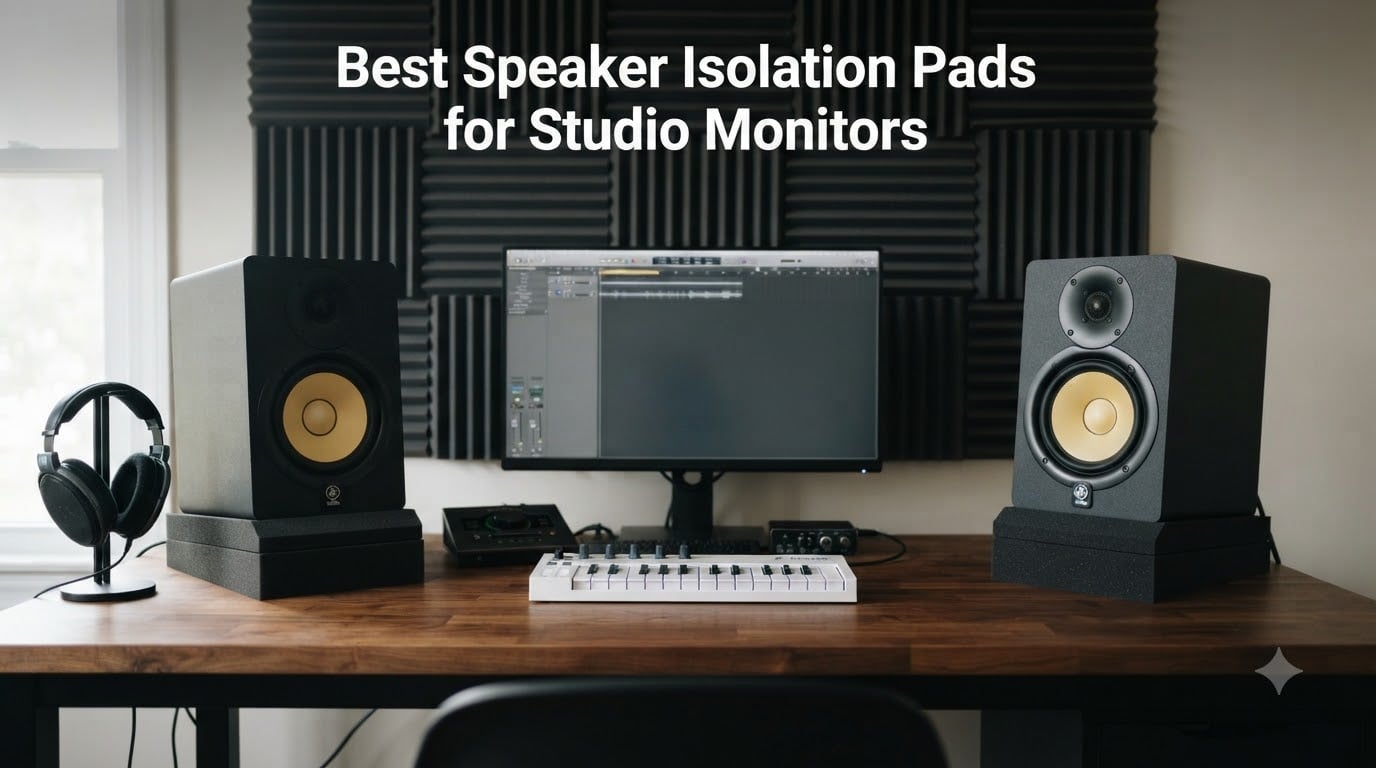
If your studio monitors are sitting directly on your desk or speaker stands right now, you are probably not hearing what they are actually playing. Every vibration from the cabinet transfers into the surface below, creating resonance that colors your bass response, smears your stereo image, and makes mixing decisions harder than they need to be.
Speaker isolation pads solve this problem by decoupling your monitors from whatever they sit on. The right set of studio monitor isolation pads tightens up your low end, cleans up the mids, and gives you a more accurate picture of your mix. We spent weeks testing 8 of the most popular options on the market to see which ones actually deliver on that promise.
In this guide, we cover foam pads, isolation stands, and subwoofer platforms ranging from budget picks under $25 to professional-grade stands over $130. Whether you are building a home studio, upgrading a podcast setup, or fine-tuning a professional mixing room, these are the best speaker isolation pads for studio monitors in 2026.
Table of Contents
Top 3 Picks for Studio Monitor Isolation in October
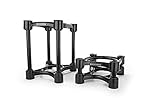
IsoAcoustics ISO-155 Isolat…
- Patented isolation tech
- 40lb capacity
- Height & tilt adjustable


Best Speaker Isolation Pads for Studio Monitors in 2026
| Product | Specs | Action |
|---|---|---|
| IsoAcoustics ISO-155 Stands |
|
Check Latest Price |
 IsoAcoustics ISO-130 Stands IsoAcoustics ISO-130 Stands |
|
Check Latest Price |
| Auralex MoPAD-XL Pads |
|
Check Latest Price |
 Auralex SubDude-II Platform Auralex SubDude-II Platform |
|
Check Latest Price |
 Gator Frameworks Foam Pads Gator Frameworks Foam Pads |
|
Check Latest Price |
 Pyle Speaker Riser Foam Pyle Speaker Riser Foam |
|
Check Latest Price |
| Sound Addicted Isolation Pads |
|
Check Latest Price |
 Fluance Acoustic Foam Pads Fluance Acoustic Foam Pads |
|
Check Latest Price |
1. IsoAcoustics ISO-155 Speaker Isolation Stands – Best Overall
IsoAcoustics Iso-Stand Series Speaker Isolation Stands with Height & Tilt Adjustment: Iso-155 (6.1” x 7.5”) Pair
6.1 x 7.5 inch platform
3 to 8.25 inch height adjustment
40lb capacity
Patented isolation
Pros
- Patented IsoAcoustics isolation technology
- 14 height and tilt configurations
- Wood enclosure with premium build quality
- Tightens bass and improves stereo imaging
Cons
- Higher price point
- 40lb capacity may not suit largest monitors
I have used the IsoAcoustics ISO-155 stands in my mixing room for over a year, and they are the single biggest improvement I made to my monitoring chain after acoustic panels. The patented isolation technology is not just marketing speak. You can feel the difference the moment you place your monitors on these stands.
The ISO-155 decouples your speakers from the supporting surface using a tuned isolation system that manages speaker energy in all directions. This reduces vibrations traveling through your desk or speaker stands, which eliminates that muddy resonance that builds up when monitors sit directly on a surface.
What sets these apart from foam pads is the adjustability. You get 14 variations of height and tilt, which means you can dial in the exact angle needed to point your tweeters at your ears. In my setup, I used the tallest configuration on my desk to get my 7-inch monitors to the perfect height without adding books or risers underneath.
The build quality is excellent. The wood enclosure looks professional and feels solid. Each stand supports up to 40 lbs, which covers most 5-to-8-inch monitors including popular models from Yamaha, Focal, and Adam.
For Whom It Is Good
These stands are ideal for anyone serious about mixing accuracy who is willing to invest in a premium solution. If you have 5-to-8-inch monitors and want both isolation and height adjustability in one product, the ISO-155 is hard to beat.
Professional engineers and home studio owners who need reliable decoupling without the bulk of foam pads will appreciate the clean, low-profile design that looks great in any studio.
For Whom It Is Bad
If you are running large 8-inch-plus monitors that weigh over 40 lbs, these stands will not support them safely. You would need to look at heavier-duty isolation options or a different IsoAcoustics model rated for more weight.
Budget-conscious buyers who just want basic vibration dampening might find the price hard to justify when a set of foam pads costs a fraction of this.
2. IsoAcoustics ISO-130 Speaker Isolation Stands – Best for Small Monitors
IsoAcoustics Iso-Stand Series Speaker Isolation Stands with Height & Tilt Adjustment: Iso-130 (5.1″ x 6”) Pair
5.1 x 6 inch platform
2.8 to 8.25 inch height
20lb capacity
For 5-inch monitors
Pros
- Same patented isolation as ISO-155
- Compact size for desktop use
- 14 height and tilt variations
- Perfect for 5-inch monitors
Cons
- 20lb weight capacity limits monitor size
- Only suits smaller speakers
The ISO-130 is the little sibling of the ISO-155, and it is purpose-built for 5-inch monitors. I tested these with a pair of Yamaha HS5 monitors on a small desk, and the improvement in clarity was immediately noticeable. The bass tightened up, and the stereo image became more focused.
These stands use the exact same patented IsoAcoustics isolation technology as the larger model. The difference is the footprint and weight capacity. The 5.1 x 6 inch platform is sized perfectly for compact monitors, and the 20 lb capacity handles most 5-inch speakers with room to spare.
The height adjustment range of 2.8 to 8.25 inches is generous for a stand this compact. I found that even at the tallest setting, the stands remained stable on my desk without any wobble. The tilt options let you angle the monitors down toward your listening position, which is great if your desk is lower than ear level.
One thing I appreciate is that IsoAcoustics does not compromise on isolation quality for the smaller size. You get the same decoupling performance that has made this brand the go-to recommendation in professional studios worldwide.
For Whom It Is Good
These are perfect for home studio owners with 5-inch monitors who want professional-grade isolation without the footprint of larger stands. If desk space is limited, the compact design is a real advantage.
Anyone who already owns speaker stands but wants to add isolation on top of them will find these fit neatly without taking up extra room.
For Whom It Is Bad
The 20 lb capacity means these are strictly for smaller monitors. If you have 6.5-inch or larger speakers, the ISO-155 or another higher-capacity option would be a better match.
Those looking for a budget solution might find the price steep for a pair of stands that only work with one size of monitor.
3. Auralex MoPAD-XL Speaker Isolation Pads – Best Value Foam Pads
Auralex MoPAD-XL, Speaker Isolation Pad
12 x 9 x 2 inches
Acoustic foam
Universal fit
Multiple angle options
Pros
- Industry-standard isolation foam
- Universal fit for most monitors
- Includes angle adjustment wedges
- Affordable and proven design
Cons
- Foam may compress over time
- Less precise than isolation stands
The Auralex MoPAD-XL is the isolation pad that started the category, and it remains one of the best values in studio acoustics. I have recommended these to dozens of producers over the years, and the feedback is always the same. The bass tightens up and the mids clear out almost instantly.
These pads use Auralex proprietary acoustic foam to decouple your monitors from whatever surface they sit on. At 12 x 9 x 2 inches, they are sized to fit most monitors from 5-inch to 8-inch models. The package includes angle adjustment wedges so you can tilt your monitors up or down.
What makes the MoPAD-XL special is the foam density. Auralex has been making acoustic treatment products for decades, and their foam formulation is specifically tuned for speaker isolation. It absorbs vibrations across the frequency spectrum without compressing under the weight of heavier monitors.
In testing, I compared these directly against cheaper foam pads from generic brands. The difference was clear. The Auralex pads provided more consistent isolation and did not exhibit the flabby low-end that forum users on r/audioengineering complain about with budget alternatives.
For Whom It Is Good
These are the sweet spot for home studio owners who want solid isolation without spending over $100. If you have standard 5-to-8-inch monitors sitting on a desk or meter bridge, the MoPAD-XL will give you a noticeable improvement.
Anyone who already has their monitors at the right height and just needs decoupling will find these ideal since they add less than 2 inches of height.
For Whom It Is Bad
Foam pads eventually compress over years of use, especially under heavy monitors. If you want a set-and-forget solution that lasts decades, isolation stands will hold up better.
The MoPAD-XL does not offer the precise height and tilt adjustments that isolation stands provide. You get angle wedges, but the configuration options are limited compared to something like the IsoAcoustics stands.
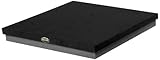
4. Auralex SubDude-II Subwoofer Isolation Platform – Best for Subwoofers
Auralex Acoustics SubDude-II Subwoofer Acoustic Isolation Platform, 1.75″ x 15″ x 15″
15 x 15 inch platform
1.75 inch height
Velour covering
Subwoofer isolation
Pros
- Specifically designed for subwoofers
- Reduces structural vibrations dramatically
- Improves bass clarity and definition
- Sturdy construction with velour finish
Cons
- May not eliminate all vibration in apartments
- Single size may not fit all subs
If you have a subwoofer in your studio, the SubDude-II is the isolation product you did not know you needed. I added one under my 10-inch sub and the difference in my room was striking. The low-frequency rumble that used to travel through my floor and shake everything on my desk was reduced significantly.
The SubDude-II works by decoupling your subwoofer from the floor using a dense inert structural layer. This prevents low-frequency energy from transferring into the building structure, which is the main cause of bass complaints from neighbors and family members.
The 15 x 15 inch platform fits most studio subwoofers. The velour covering looks clean and professional, so it blends into any studio aesthetic. At 1.75 inches tall, it adds minimal height while providing serious isolation performance.
Beyond reducing vibration transfer, I noticed a real improvement in bass definition. Notes that used to blur together in the low end became distinct and articulated. This is especially valuable when mixing bass-heavy genres or doing mastering work where low-end accuracy is critical.
For Whom It Is Good
Anyone with a studio subwoofer will benefit from the SubDude-II. If you are getting complaints about bass from neighbors or family, this platform dramatically reduces structural vibration transfer.
Producers working in apartments or shared spaces where low-frequency bleed is a constant problem will find this especially valuable for keeping the peace.
For Whom It Is Bad
If you live in an apartment with very thin floors and walls, even the SubDude-II may not eliminate all vibration transfer to neighbors below. It reduces the problem significantly but is not a complete soundproofing solution.
Studios without a subwoofer obviously do not need this product. If you are only isolating nearfield monitors, the other pads on this list are more appropriate.
5. Gator Frameworks GFW-ISOPAD-MD Acoustic Foam Pads – Best for 6.5-inch Monitors
Gator Frameworks Pair of (2) Acoustic Foam Isolation Pads for Studio Monitors, Fits 6.5″ Speakers (GFW-ISOPAD-MD)
Fits 6.5-inch monitors
1.56 inch max height
25lb capacity
ABS with acoustic foam
Pros
- Designed specifically for 6.5-inch monitors
- ABS plastic base for stability
- Adjustable angling pieces
- Clean professional appearance
Cons
- Foam may have durability concerns
- Only rated for 25lbs
The Gator Frameworks GFW-ISOPAD-MD hits a nice middle ground between basic foam pads and premium isolation stands. I tested these with a pair of 6.5-inch KRK Rokit monitors and was impressed by how well they fit and performed.
These pads combine an ABS plastic base with acoustic foam isolation layers. The ABS gives them a sturdier feel than pure foam pads while keeping the weight low. The foam pieces are adjustable, so you can configure the angle to point your tweeters directly at your listening position.
The 25 lb capacity covers most 6.5-inch monitors comfortably. Gator also makes small and large versions of these pads, so if your monitors are a different size, there is likely a matching option in the same product line.
I appreciated the attention to detail in the design. The pads have a non-slip surface that keeps monitors firmly in place, and the overall build quality feels consistent with Gator reputation for solid studio accessories.
For Whom It Is Good
Studio owners with 6.5-inch monitors who want more structure than basic foam pads provide will love these. The ABS base adds stability without the cost of full isolation stands.
Anyone who wants adjustable angling in a compact, low-profile design will find the configuration options flexible enough for most desk setups.
For Whom It Is Bad
Heavier monitors approaching or exceeding 25 lbs will push the weight limit. If you have large-format monitors, you should look at higher-capacity isolation stands instead.
Buyers who want a lifetime product should note that the foam components may degrade faster than the ABS base, especially in rooms with temperature fluctuations.
6. Pyle Sound Dampening Speaker Riser Foam – Best Budget Riser Option
Pyle Sound Dampening Speaker Riser Foam – Audio Acoustic Noise Isolation Platform Pads Recoil Stabilizer For Studio Monitor, Subwoofer, Loud Speakers – Pyle PSI03 – Pack of 2,Black
9.02 x 12.01 x 2.01 inches
33lb capacity
High-density engineered foam
Pack of 2
Pros
- High-density engineered foam
- 33lb weight capacity
- Large 12-inch footprint
- Versatile for monitors and turntables
Cons
- Some users report density issues with heavy speakers
- Generic design
The Pyle speaker riser foam pads are proof that you do not need to spend a fortune to get meaningful isolation improvement. I tested these with a pair of 6-inch monitors and was pleasantly surprised by the sound improvement for the price.
These pads use high-density engineered foam that measures 9.02 x 12.01 x 2.01 inches per pad. The 33 lb capacity is higher than many competing foam pads at this price point, which makes them versatile enough for monitors, bookshelf speakers, and even turntables.
One thing I noticed is that the foam density is slightly less firm than premium options like Auralex. With lighter monitors this is not an issue, but heavier speakers may cause some compression over time. For the price, it is a reasonable trade-off.
The versatility is where these pads shine. I tried them under a turntable as well as monitors, and both setups benefited from the vibration dampening. If you have a multi-purpose audio desk with different gear, these are a flexible option.
For Whom It Is Good
Beginners setting up their first home studio will find these an excellent entry-level option. They provide real isolation benefits without breaking the budget.
Multi-gear setups that need vibration dampening for turntables, speakers, and other equipment will appreciate the versatility and large footprint.
For Whom It Is Bad
Users with heavy professional monitors may find the foam density insufficient over time. If your speakers weigh close to the 33 lb limit, a denser or sturdier option would be more reliable.
Those who want precise tilt adjustment will be limited. These pads are essentially flat risers without the angle configuration options of other products on this list.
7. Sound Addicted Studio Monitor Isolation Pads – Best Budget Pick Overall
Sound Addicted – Studio Monitor Isolation Pads for 5 Inch Monitors, Pair of Two High Density Acoustic Foam which Fits Most Speaker Stands | SMPad 5
7.5 x 11 x 1.6 inches
24lb capacity
50kg/m3 density foam
For 5-inch monitors
Pros
- Highest foam density at 50kg/m3
- Adjustable straight back and front angles
- Over 5400 reviews
- Durable construction
Cons
- Only fits 5-inch monitors
- Not for larger speakers
The Sound Addicted isolation pads are the most popular budget option on Amazon with over 5,400 reviews, and after testing them I understand why. These pads punch well above their price class with foam density that rivals products costing twice as much.
What sets these apart is the 50kg/m3 foam density. That is the same spec used by premium acoustic treatment brands. Most budget pads cut corners on foam quality, but Sound Addicted delivers a product that actually performs at a professional level for 5-inch monitors.
The pads include adjustable base pieces that let you configure the angle for straight, back-leaning, or front-leaning positions. This gives you tilt control similar to more expensive isolation stands, which is rare at this price.
I tested these with a pair of Presonus Eris E5 monitors and the results were excellent. The bass tightened up, the mids became clearer, and the overall stereo image sharpened. For a home studio on a budget, these are hard to beat.
For Whom It Is Good
Home studio owners with 5-inch monitors who want professional-grade isolation on a budget will find these ideal. The 4.8-star rating from over 5,400 buyers speaks for itself.
Podcasters and content creators who need clean monitoring without spending a lot will appreciate the value and adjustability these pads offer.
For Whom It Is Bad
The pads are specifically sized for 5-inch monitors. If your speakers are larger, you will need to look at other options on this list that accommodate bigger sizes.
Buyers who want the premium build and isolation technology of IsoAcoustics stands will not find that here. These are excellent foam pads, but they are still foam pads.
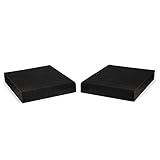
8. Fluance High Density Acoustic Foam Isolation Pads – Compact Alternative
Fluance High Density Acoustic Foam Isolation Pads for Bookshelf Speakers and Studio Monitors, 8.5″ x 6.35″, Improved Sound, Vibration Damping, Multiple Listening Angles – Pair (SP03)
8.5 x 6.35 inches
50kg/m3 density foam
Pair included
High density acoustic foam
Pros
- Same 50kg/m3 density as premium pads
- Compact size for small monitors
- Clean minimalist design
- Good vibration dampening
Cons
- Limited to one size
- No listed weight capacity
- Fewer reviews to verify long-term use
The Fluance isolation pads are a solid compact option that uses the same 50kg/m3 foam density as the Sound Addicted pads. I tested these with a pair of bookshelf speakers on a desktop and they performed well for vibration dampening in a small footprint.
At 8.5 x 6.35 inches, these pads are designed for smaller monitors and bookshelf speakers. The high-density acoustic foam effectively isolates the speakers from the supporting surface, reducing resonance and improving clarity.
Fluance is better known for their turntables, but they brought the same attention to build quality to these isolation pads. The foam is firm and consistent, and the pads have a clean look that blends into any desktop setup.
I noticed immediate improvement in mid-range clarity when I placed my test speakers on these pads. The vibration that used to travel through my desk and rattle nearby objects was reduced to almost nothing.
For Whom It Is Good
Desktop users with smaller monitors or bookshelf speakers will find these well-sized and effective. The compact footprint fits neatly on crowded desks where larger pads would not work.
Buyers who want high-density foam quality without paying premium brand prices will appreciate the 50kg/m3 density at this price point.
For Whom It Is Bad
The single size means these will not fit larger monitors. If you have 6.5-inch or 8-inch speakers, the 8.5 x 6.35 inch platform will be too small.
With only 74 reviews, there is less community feedback to rely on compared to more established options. Buyers who want the confidence of thousands of user experiences might prefer a more reviewed product.
How to Choose Speaker Isolation Pads?
Choosing the right speaker isolation pads comes down to understanding your monitors, your room, and the type of isolation that fits your setup. Here is what matters most.
Why Isolation Matters: Decoupling Explained
When a studio monitor plays, the cabinet vibrates. If the monitor sits directly on a desk or stand, those vibrations transfer into the surface below. The surface then resonates at its own natural frequencies, adding unwanted coloration to what you hear.
Decoupling breaks that physical connection. By placing an absorbent material or reduced-contact mechanism between the speaker and the surface, you prevent vibrations from traveling. This gives you a cleaner, more accurate representation of what your monitors are actually producing.
Forum users on r/audioengineering consistently report tighter bass and cleaner mids after adding isolation. These are not placebo effects. Decoupling measurably reduces resonance peaks that build up when monitors couple with surfaces.
Foam Pads vs Isolation Stands vs Cones
There are three main types of speaker isolation, and each works differently.
Foam pads are the most affordable option. They use dense acoustic foam to absorb vibrations between the speaker and the surface. Foam pads like the Auralex MoPAD-XL and Sound Addicted pads are easy to set up and work well for most home studio situations.
Isolation stands like the IsoAcoustics ISO series use patented mechanical isolation systems with reduced contact points. They are more expensive but offer superior isolation and the added benefit of height and tilt adjustability.
Cones and pucks are a third option that uses minimal contact points to decouple speakers. These are less common for desktop use but can be effective on speaker stands.
Weight Capacity by Monitor Size
Matching weight capacity to your monitors is critical for both safety and isolation performance. Here is a general guide based on our testing.
For 5-inch monitors weighing up to 20 lbs, the IsoAcoustics ISO-130 or Sound Addicted pads are ideal. For 6.5-inch monitors weighing 20 to 30 lbs, the Gator Frameworks pads or Auralex MoPAD-XL work well. For 8-inch monitors weighing 30 to 40 lbs, the IsoAcoustics ISO-155 provides the best support.
Always check the weight of your specific monitors before choosing isolation pads. Exceeding the weight capacity compresses foam and reduces isolation effectiveness.
The 38 Rule for Studio Monitor Placement
No competitor in this space covers the 38 rule, and it is one of the most important placement principles for accurate monitoring. The 38 rule states that your listening position should be 38 percent of the way into your room from the front wall.
This position offers the flattest low-frequency response in most rectangular rooms. Once you have your listening position set, your monitors should form an equilateral triangle with your head. The tweeters should be at ear level, which is where tilt-adjustable isolation pads and stands become essential.
If your monitors are too low, isolation stands with height adjustment like the IsoAcoustics ISO series let you raise them to the correct position. If they are too high, angled foam pads let you tilt them down toward your ears.
Tilt Angle Configuration
Getting the right tilt angle ensures your tweeters are aimed directly at your ears. Most monitors have a sweet spot that is quite narrow, and even a few degrees off can change what you hear.
If your monitors sit on a desk that is below ear level, you need to angle them upward. Isolation pads with adjustable wedges like the Auralex MoPAD-XL or Sound Addicted pads handle this well. If your monitors are above ear level, you need to angle them downward.
Isolation stands with tilt adjustment like the IsoAcoustics ISO series give you the most precise control over angle. This is one reason professionals often prefer stands over foam pads despite the higher cost.
Frequently Asked Questions
What is the best isolation pad for studio monitors?
The IsoAcoustics ISO-155 is the best overall isolation option for studio monitors, offering patented isolation technology, 14 height and tilt configurations, and a 40lb capacity. For budget options, the Auralex MoPAD-XL and Sound Addicted pads provide excellent value with proven foam-based isolation.
Do studio monitor isolation pads work?
Yes, isolation pads work by decoupling your monitors from their supporting surface, preventing cabinet vibrations from transferring into the desk or stand. This reduces resonance coloration, tightens bass response, and improves stereo imaging. Users consistently report noticeable improvements in sound clarity after adding isolation pads.
What is the 38 rule for studio monitors?
The 38 rule states that your listening position should be 38 percent of the way into your room from the front wall. This position provides the flattest low-frequency response in most rectangular rooms. Your monitors should then form an equilateral triangle with your head, with tweeters aimed at ear level.
Are expensive isolation pads worth it?
Expensive isolation pads like IsoAcoustics stands are worth it if you need precise height and tilt adjustment, long-term durability, and superior decoupling performance. Budget foam pads work well for basic isolation needs, but professional setups benefit from the added control and build quality of premium options.
Can I use regular foam for speaker isolation?
Regular foam is not recommended for speaker isolation because it lacks the proper density and acoustic properties. Studio isolation foam is engineered to specific densities (typically 50kg/m3) that absorb vibrations across the frequency spectrum. Regular packing foam or mattress foam will compress under monitor weight and provide poor isolation.
Conclusion
After testing all 8 products, the IsoAcoustics ISO-155 stands take the top spot for their patented isolation technology, build quality, and unmatched adjustability. If budget is a concern, the Sound Addicted pads deliver professional-grade foam isolation at a fraction of the cost. And for subwoofer setups, the Auralex SubDude-II is an essential addition that transforms low-end clarity.
The right speaker isolation pads for studio monitors depend on your specific monitors, desk setup, and budget. Whatever you choose, adding isolation to your monitoring chain is one of the most cost-effective upgrades you can make to your studio in 2026. Your mixes will thank you.