
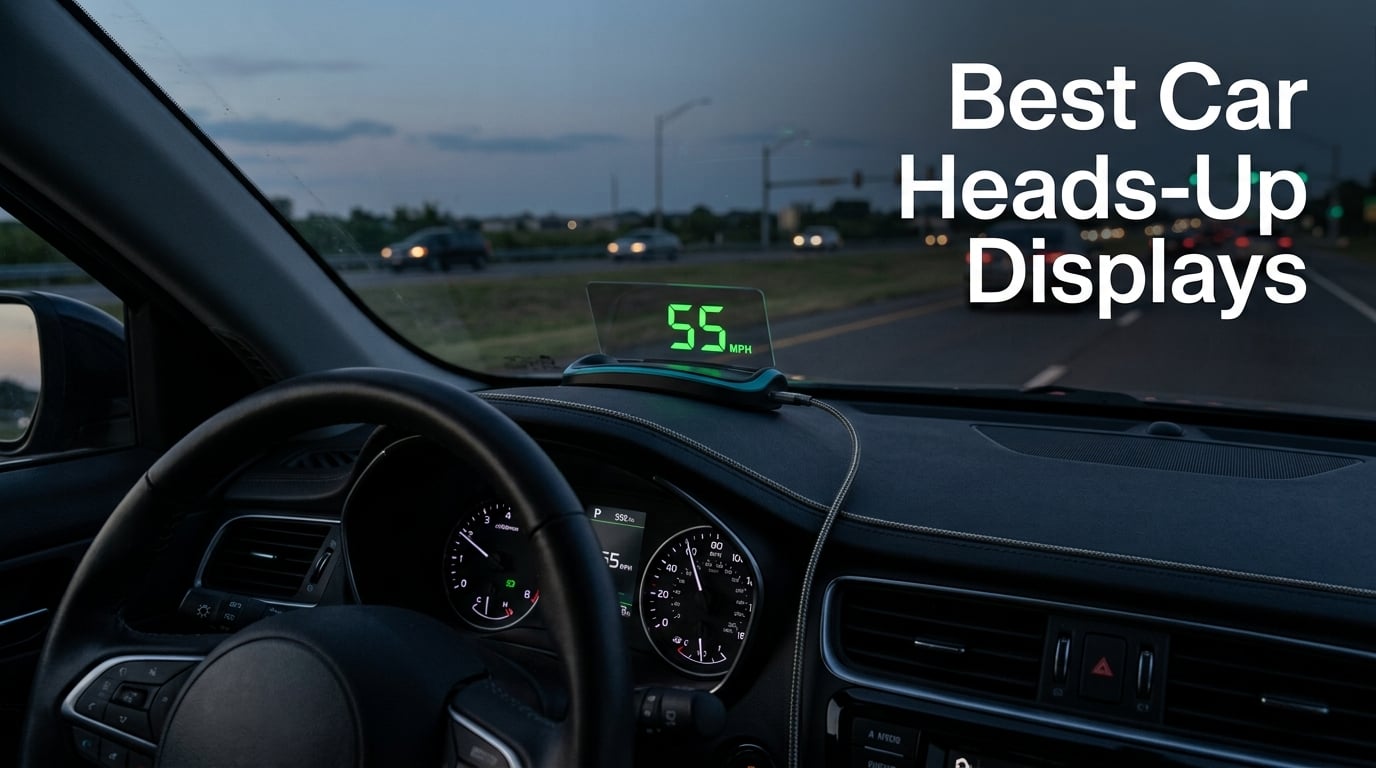
An aftermarket car heads-up display, or HUD, is a small projector that throws speed, compass heading and navigation data onto a reflective screen so you can read it without dropping your eyes off the road. Units get their data from one of three sources: the OBD2 diagnostic port, GPS satellites, or a phone app over Bluetooth. Our overall winner is the SinoTrack G3, a 5.5 inch GPS unit with an automatic light sensor and more than 1500 reviews behind it.
The idea is borrowed straight from fighter jets, where a HUD projects flight data onto the combiner glass just above the instrument panel. In a car the payoff is simpler. Every time you check your speed, your eyes travel down and forward, then back up again. A HUD removes that movement, which is the whole argument for spending money on one.
It only works, though, if the image stays readable at a glance. A cluttered readout is worse than no readout, and a sun-washed one is worse still. That is the filter we applied across the best car heads-up displays in 2026: does the number stay legible in daylight, does the speed agree with the dashboard, and does the unit stay put over rough roads.
One note before we start. If you are still searching for a Navdy or a Garmin HUD, stop. Both product lines are discontinued and no longer supported. The current generation of HUDs is the small GPS and OBD2 dashboard units we cover below.
Table of Contents
Top 3 Picks for Best Car Heads-Up Displays in 2026

SinoTrack G3 5.5 inch GPS HUD
- 5.5 inch large LCD
- Automatic light sensor
- Compass and trip data
- Calibration function

Pyle PHUD19 Smart HUD
- 2.6 inch multicolor LCD
- 8-level auto brightness
- Plug and play power
- Over-speed alarm

VJOYCAR G20 Speed Display
- Single large speed readout
- 10 Hz refresh rate
- No OBD2 needed
- Moves between vehicles
The SinoTrack takes the top slot because it does the most things well and has the largest owner base in the category. The Pyle is the pick if you want an established brand and a compact footprint that will not dominate the dash. The VJOYCAR is the one to buy if you want a single number, big and clear, with nothing else on screen to distract you.
All 10 Heads-Up Displays Compared in 2026
| Product | Specs | Action |
|---|---|---|
| SinoTrack G3 5.5 inch GPS HUD |
|
Check Latest Price |
| Pyle PHUD19 Smart HUD |
|
Check Latest Price |
| VJOYCAR G20 Speed Display |
|
Check Latest Price |
 KUOWEIHUD K1 Mini HUD KUOWEIHUD K1 Mini HUD |
|
Check Latest Price |
 Shkalacar LED Speed HUD Shkalacar LED Speed HUD |
|
Check Latest Price |
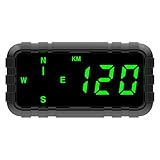 Kingneed C3010 HUD Kingneed C3010 HUD |
|
Check Latest Price |
 Docbraces G21 GPS HUD Docbraces G21 GPS HUD |
|
Check Latest Price |
 Salior LED GPS HUD Salior LED GPS HUD |
|
Check Latest Price |
 OinDoDi C3010 4.2 inch HUD OinDoDi C3010 4.2 inch HUD |
|
Check Latest Price |
 LORPHEIR L5010 OBD2 and GPS HUD LORPHEIR L5010 OBD2 and GPS HUD |
|
Check Latest Price |
1. SinoTrack G3 5.5 Inch GPS HUD – Best Overall
SinoTrack Digital GPS Speedometer Universal Heads Up Display for Car 5.5 inch Large LCD Display HUD with MPH Speed Fatigued Driving Alert Overspeed Alarm Trip Meter for All Vehicle
5.5 inch LCD
GPS speed and compass
Auto light sensor
80 g
1 year warranty
Pros
- Large 5.5 inch screen shows speed and heading at once
- Automatic light sensor handles sun and night
- Calibration function matches your speedometer
- No OBD2 needed so it moves between vehicles
- Dual-core processor for smooth updates
Cons
- Speed reads about 1 mph high before calibration
- Refresh lags real speed by roughly a second
- Trip data resets when the ignition is switched off
The SinoTrack G3 is the unit we keep coming back to. The 5.5 inch screen is the biggest in this group, and it shows speed, compass heading, trip distance, trip time, clock, elevation and satellite count at the same time. The body is only 80 g and measures 6.6 by 1.6 by 1.7 inches, so it disappears on the dash rather than filling it.
It runs on GPS alone, which is the reason it travels so well. There is no OBD2 cable to unplug, so moving it between the family car and a weekend truck takes seconds. It also means you get a speed figure calculated from satellite movement, not straight off the engine, so the reading is independent of your vehicle.
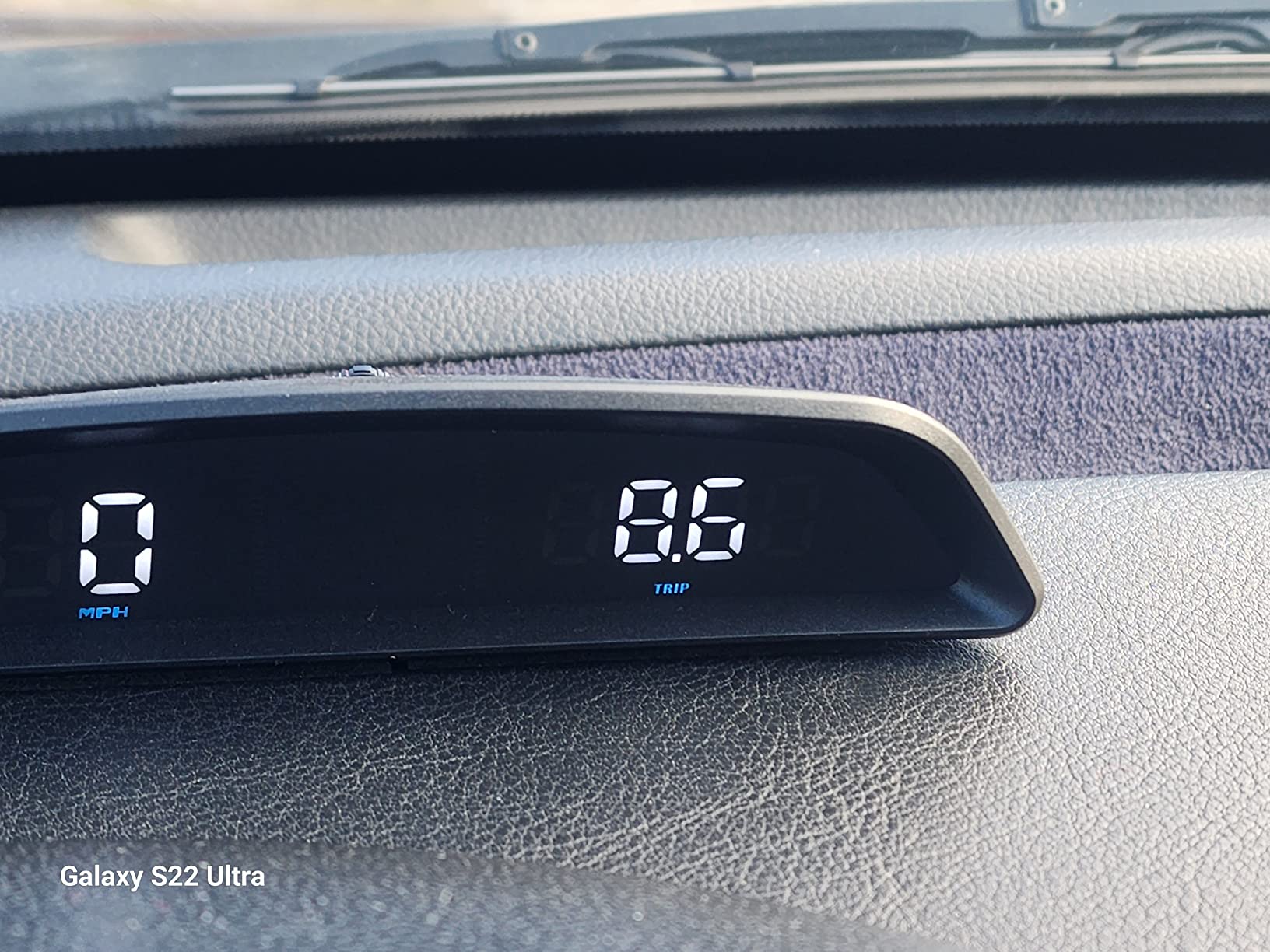
Owners consistently single out two things: the automatic light sensor, which keeps the display readable in direct sun and stops it glaring at night, and the calibration function, which lets you dial the number to match your own speedometer. Set that once and the default 1 mph over-read essentially disappears for most drivers.
There is no internal battery, so a parked car in full sun is not a concern. The listed warranty is one year, and several owners report multi-year durability on a part covered for only 12 months.
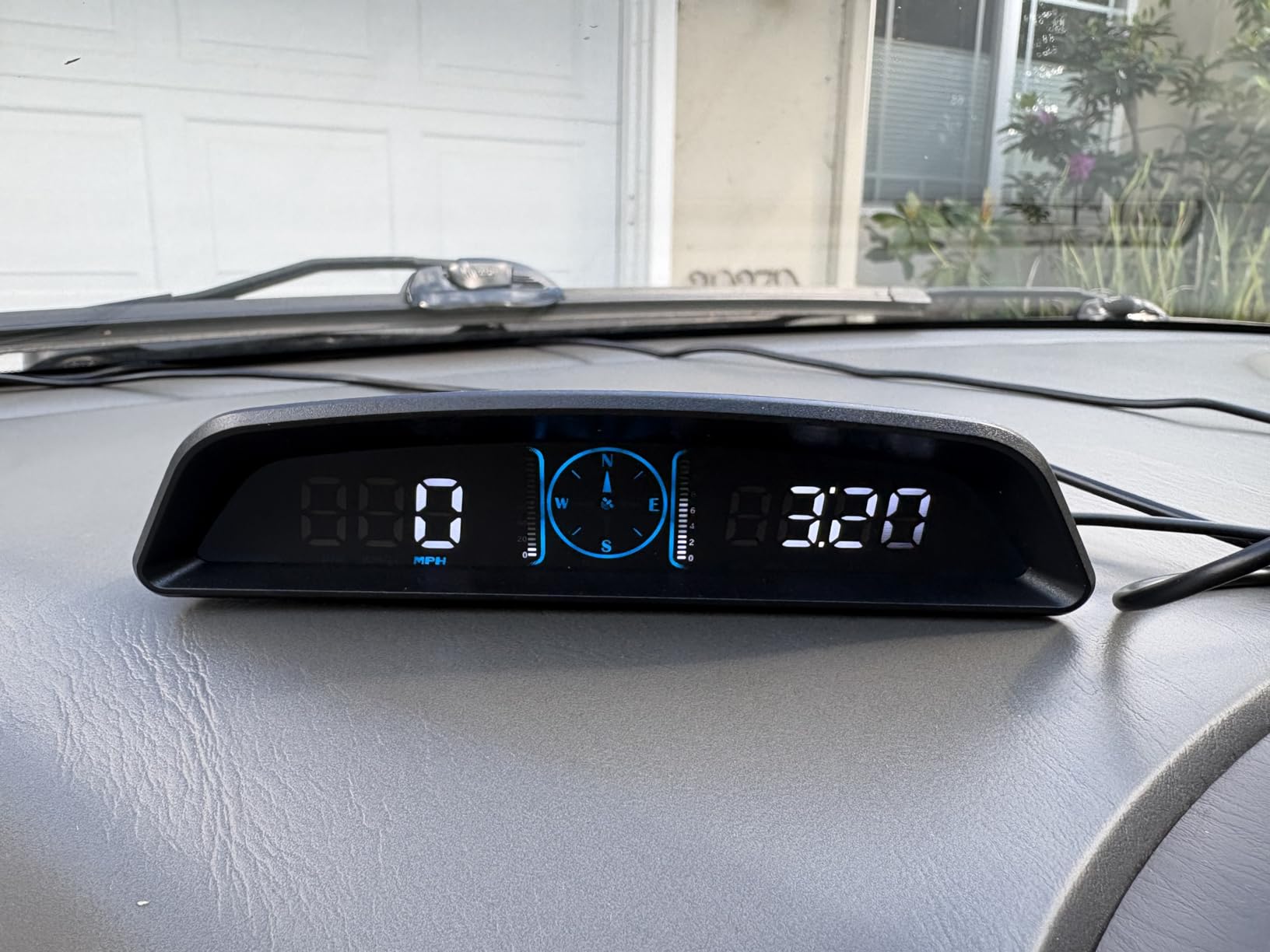
Check the refresh rate before you commit
This is the spec that matters most and the one the marketing rarely mentions. Reviewers report a lag of about a second between your actual speed and the number on screen, which is most obvious under hard acceleration or heavy braking. Cruise at a steady speed and you will never see it.
If you drive mostly motorway, the G3 is the right call. If you spend your time on twisty back roads where speed changes constantly, look at a unit with a 10 Hz refresh instead.
Know what you lose when the engine is off
Because there is no OBD2 link, the G3 can only show mileage for the current trip. Trip records, maximum speed and odometer figures all reset when you switch the ignition off, and the clock pulled from the GPS does not adjust for daylight saving time.
Two smaller quirks worth knowing. The compass only resolves a direction while you are moving, and the unit needs a 5V supply, so plugging it into a fast charger is not the way to go.
2. Pyle PHUD19 Smart HUD – Best Value Multi-Data Unit
Pyle Universal Vehicle Smart HUD Display – 2.6″ Digital Mini Car Dashboard Heads Up Windshield Speedometer Projector System w/ GPS Navigation Compass, Displays Speed, Distance, Time and More – PHUD19
2.6 inch multicolor LCD
GPS compass
Light sensor
USB power
Ignition synced
Pros
- Compact 2.6 inch body hides on the dash
- Shows speed and voltage in one glance
- Plug and play with the included USB cable
- Light sensor with 8-level brightness
- Speed-up and braking test functions
Cons
- Small text needs a closer glance than a 5 inch screen
- Less legible in strong direct sun
- Setup menus take some patience
Pyle is a name you can actually search for, which matters in a category thick with anonymous marketplace listings. The PHUD19 weighs 1.44 ounces and measures under 3 inches on every side, so it takes up almost no dash real estate. That restraint is the whole design brief.
The trade is screen size. At 2.6 inches with multicolor text, this is not a unit you will read at a glance from a relaxed arm position. Owners who are happy with it tend to be happy with a fairly upright seating position and a compact cabin.
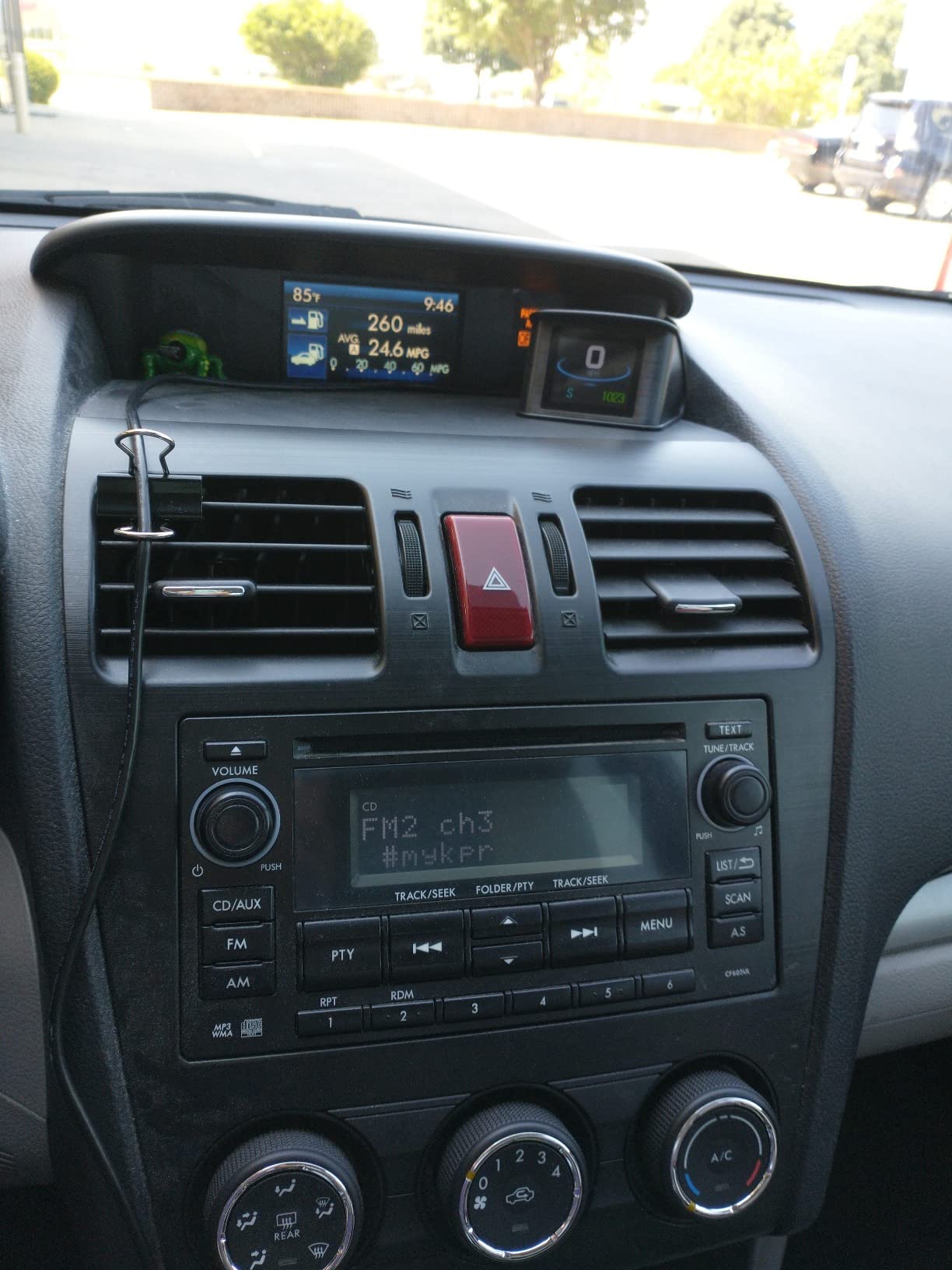
Data-wise it is generous for something this small. Speed, distance, trip time, local time and battery voltage all appear together, with a GPS compass direction indicator alongside. There are also speed-up and braking performance test functions, which is a nice touch if you want to sanity-check your own driving after a long motorway run.
Power is handled cleanly. The included USB cable plugs into a cigarette lighter adapter or a USB port, and the unit syncs on and off with the engine ignition, so there is no standby drain to think about.
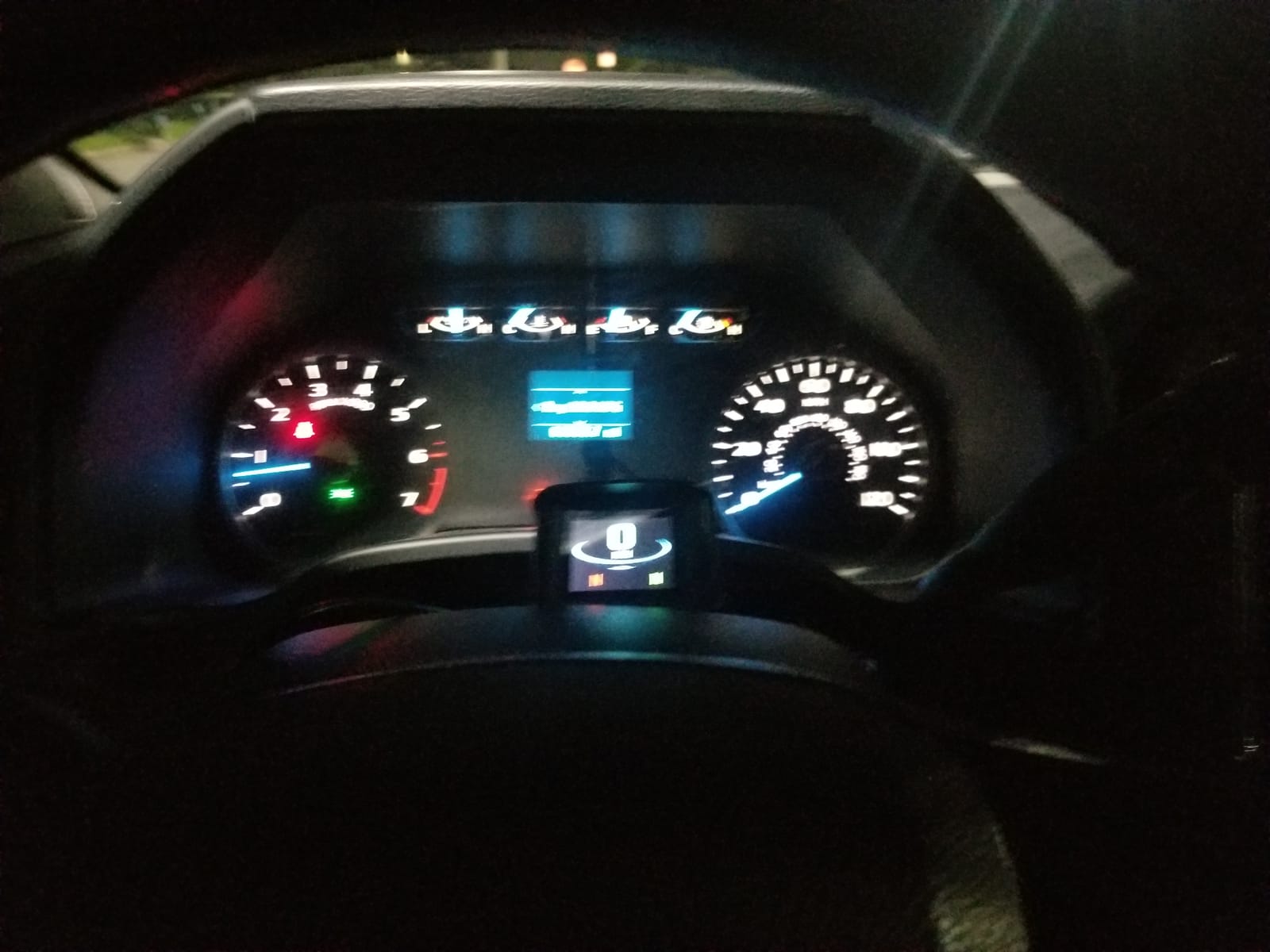
Where this one fits in a car
The small footprint is the reason to buy it. Mount it low on the dash near the windscreen base and it stays out of the mirror’s view and out of the wiper-swept area. It suits small cars, vans and anything where a 5 inch unit would feel like it had been dropped in from a truck.
Because it draws from a USB port rather than the OBD2 socket, it also works in a boat, a golf cart or a motorcycle, which is where the big-screen units tend to struggle.
How the setup menus behave
Owners rate the results once configured but describe the first pass through the menus as fiddly without a walkthrough. Budget ten minutes with it parked before you rely on it in traffic, and turn the brightness sensor on rather than leaving it manual.
The over-speed alarm defaults to 150 MPH, which is effectively off for most drivers. If you want that feature to do anything, set your own threshold during setup.
3. VJOYCAR G20 Speed Display – Best Minimal Most Versatile
VJOYCAR New Speedometer HUD GPS Digital Speed Meter MPH Speedo Head Up Display for Cars Trucks, USB Cable Plug & Play (G20-Only Green)
Single large speed readout
10 Hz refresh
GPS only
USB plug and play
No internal battery
Pros
- One big number with no menus or clutter
- 10 Hz refresh tracks real acceleration
- Long USB cable and no OBD2 hookup
- Bright green digits readable in daylight
- No internal battery so zero standby draw
Cons
- Reads 1-2 mph above the vehicle gauge
- Supplied adhesive pad holds poorly
- Some units lose GPS until power cycled
The G20 does one thing and does it well. There are no buttons, no settings menu and no manual worth reading. You plug in one USB cable and a large green number appears showing your speed in MPH. That restraint is the feature.
It is also the fastest-responding GPS unit in this roundup. The 10 Hz refresh rate means the number keeps pace with hard acceleration and braking instead of trailing behind, which is exactly what you want when the readout exists to stop you drifting over a limit.
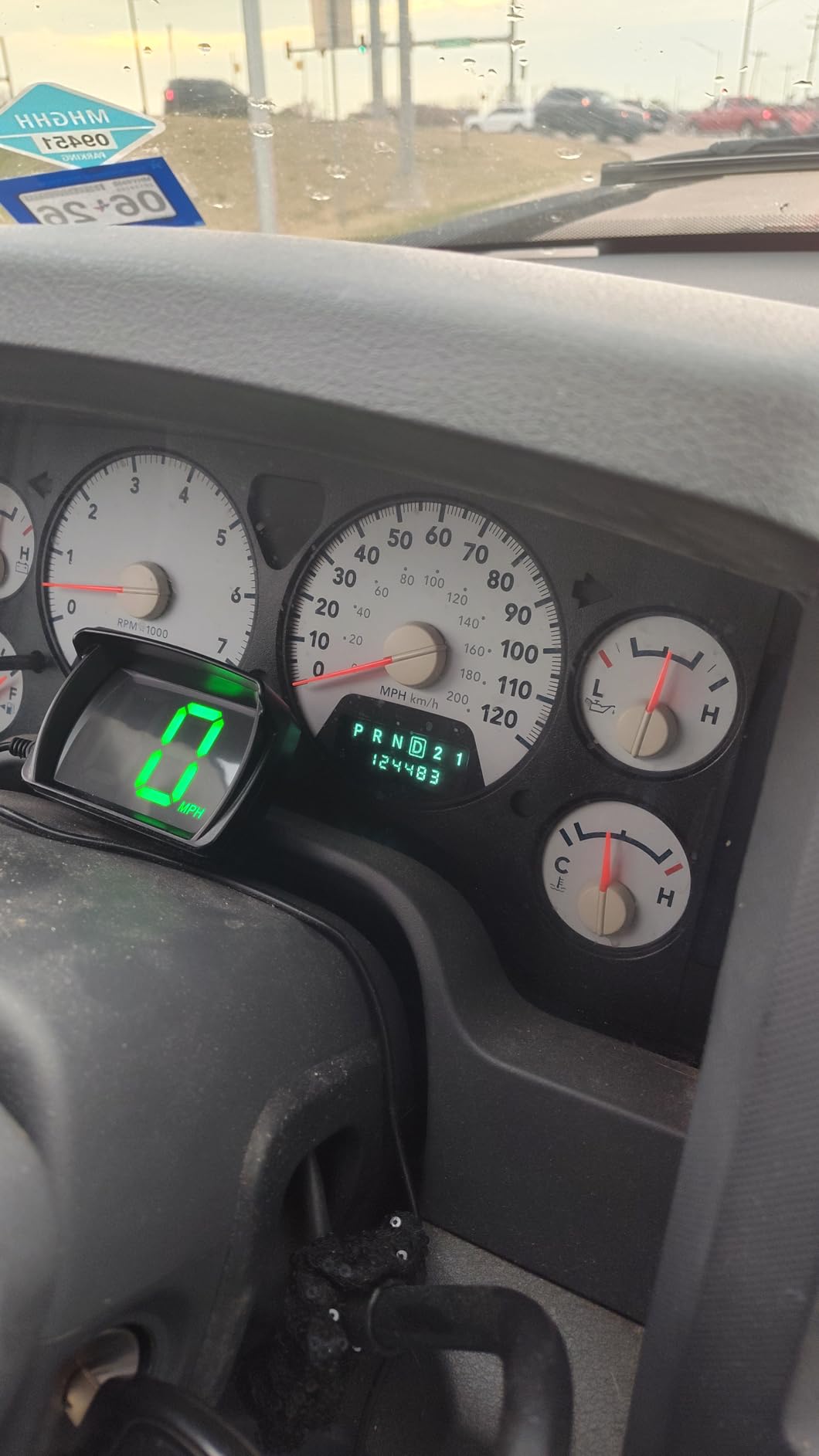
It runs from a 5V USB supply with automatic on and off tied to the accessory circuit. There is no internal battery, so standby draw while parked is zero. That makes it safe to leave installed in a car that sits for days at a time.
Owners pick it up for one specific reason: a dead or unreadable factory speedometer. If that describes your vehicle, this solves the problem for less complexity than any other unit here.
Plan the mounting before you order
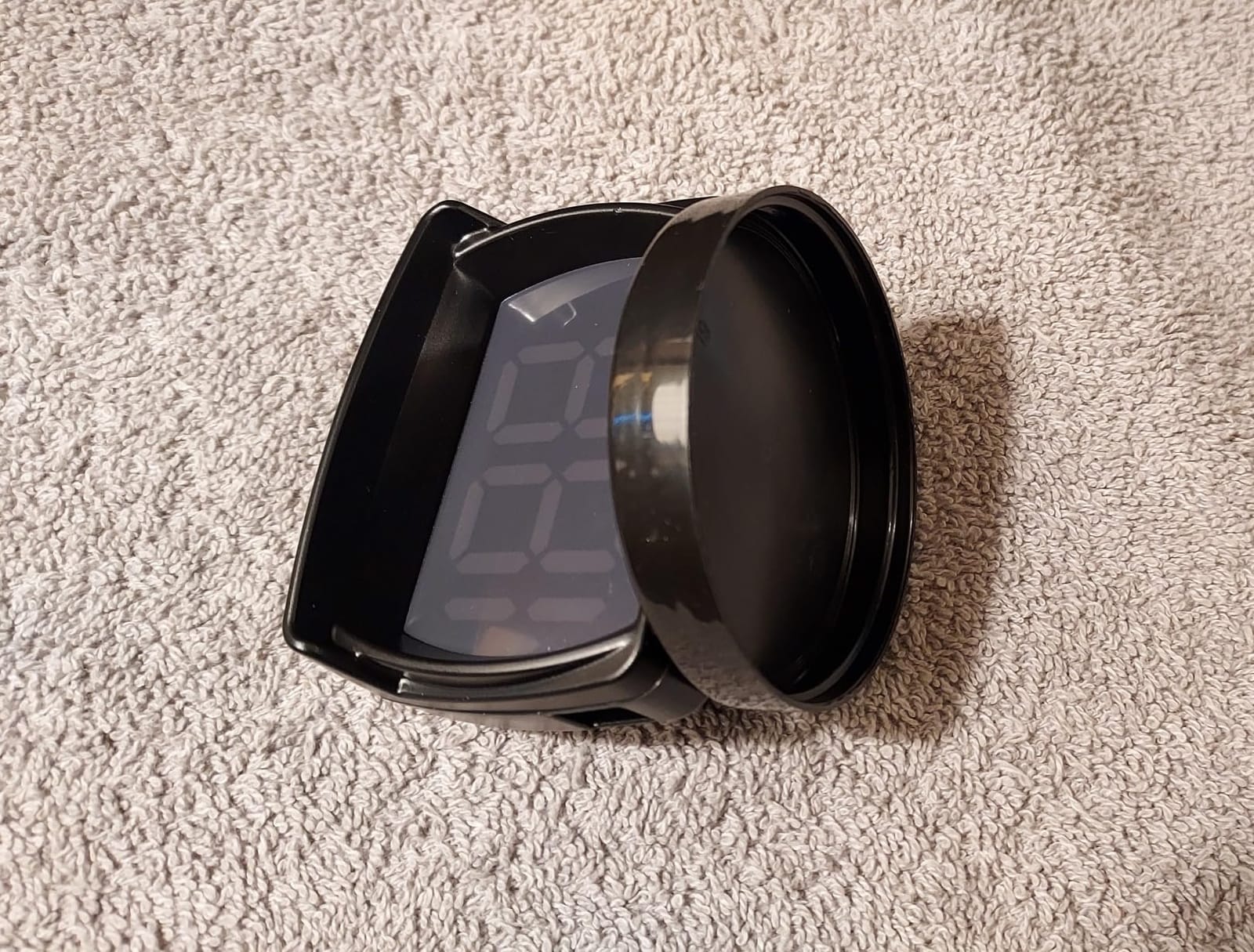
The weakest point is the supplied adhesive pad, which owners report does not hold well and lets the unit tip forward on the dash. Budget for a proper dash mount or a small blob of removable tape rather than trusting what is in the box, and check the angle before you drive away.
Because the readout only makes sense from a fairly precise position, test the viewing angle while parked. A couple of degrees of offset is enough to blur the digits.
Know the limits of what you are buying
You get speed and nothing else. No clock, no trip data, no compass, no calibration. Owners also report a consistent 1 to 2 mph over-read against the dashboard, and a minority of units that drop the GPS reading and show two dashes until you unplug and replug them.
The first GPS lock takes 10 to 30 seconds, so do not expect a number the instant you turn the key. It will not lock indoors, in an underground car park or in a tunnel.
4. KUOWEIHUD K1 – Best for the Smallest Dash Mount
Heads up Display for Cars, Car HUD, GPS Speedometer,Head up Display for Car
18 g body
Dual-mode GPS and BeiDou
10 Hz refresh
Auto brightness
5V USB
Pros
- Weighs only 18 g so it mounts almost anywhere
- Large clean numerals readable in bright sun
- Dual GPS and BeiDou tracking up to 32 satellites
- Very long USB cable for tidy routing
- Good low-cost fix for a dead factory speedometer
Cons
- Reads about 2 mph above actual speed
- Number can fluctuate 1-2 mph at steady speed
- Reportedly runs hot after about 20 minutes
At 18.14 g and 2.76 by 1.69 by 0.79 inches, the K1 is the smallest unit in this group by a distance. It is the one to pick if you drive a car with a shallow dash, a busy cockpit or a windscreen line that leaves nowhere for a 5 inch box to sit.
It is also the current category leader in Automotive Speedometers, which tells you how many people are solving the same problem. The body is ABS, the install is one USB cable, and the long lead is genuinely useful for routing the wire out of sight.
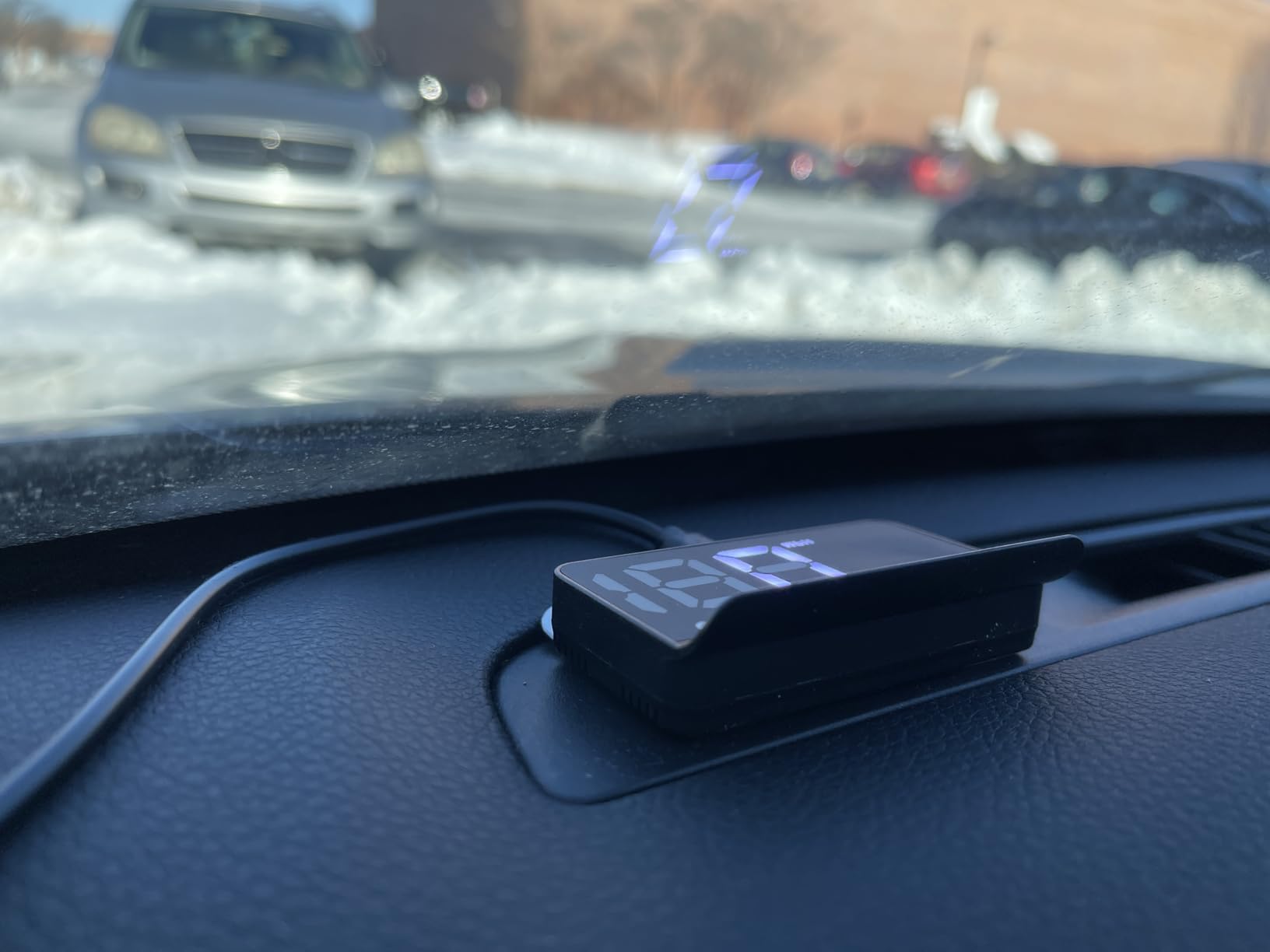
Dual-mode GPS and BeiDou positioning is a step up from a single-constellation receiver. It connects to up to 32 satellites at a 10 Hz refresh rate, which is what keeps the number stable in built-up areas where a basic receiver can wander.
The automatic brightness works well in both directions, dimming for night driving and pushing harder in daylight. The anti-reflective metal shading on the face helps further.
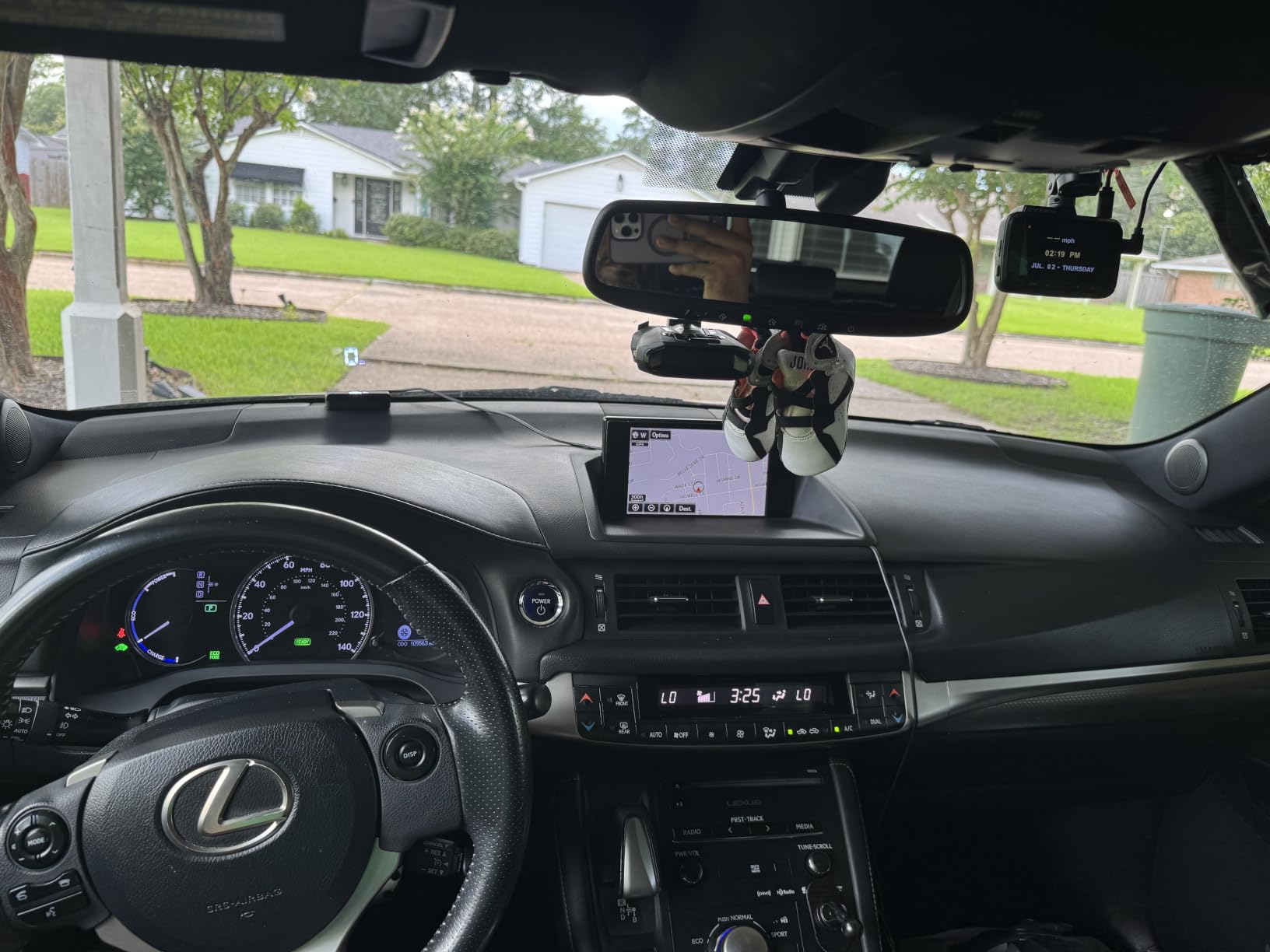
Check the number against your speedometer
Expect a reading about 2 mph above actual, and expect it to wander by a further 1 to 2 mph even at a steady speed on a straight road. The manufacturer states a normal GPS deviation of 0.6 to 1.8 mph, which is the honest way to think about it: close enough for a reminder, not precise enough to police you.
There is no calibration function on this model. If the offset bothers you, treat the display as an approximate prompt to check the cluster rather than a replacement for it.
Three practical warnings
Owners report the unit running hot within about 20 minutes of use. It is not a failure pattern we would call common, but if you park in direct sun with it on the dash, take it down with you.
Second, the default unit is MPH up to 115 MPH, with no km/h option on some variants, so check which version you are ordering if you are outside the US. Third, the windshield reflector plate some listings mention is not required and some buyers report it is simply not in the box.
5. Shkalacar LED Speed HUD – Best for Large LED Numerals
Shkalacar Car HUD Headup Display KM/H MPH GPS Digital Speedometer with LED Large Font Display for Car Truck SUV Motorcycle
LED large font
GPS and BeiDou dual mode
Shading plate included
45 g
USB power
Pros
- Bright LED large-font numerals
- Shading plate cuts glare in daylight
- Light 45 g body that never blocks the view
- Fast satellite lock with low delay
- Available in KM/H and MPH versions
Cons
- Can read 2-5 mph off actual speed
- Display drops to dashes and needs a power cycle
- Unusual body shape limits mounting options
The Shkalacar sits at 4.4 stars from 272 owners, which makes it one of the better-rated units here even though its review base is smaller than the category leaders. The reason is the LED large font, and the included shading plate that keeps glare off the readout in bright conditions.
That shading plate is a real, physical solution to the daylight problem that software brightness alone cannot fully fix. It costs nothing in the box and it works.
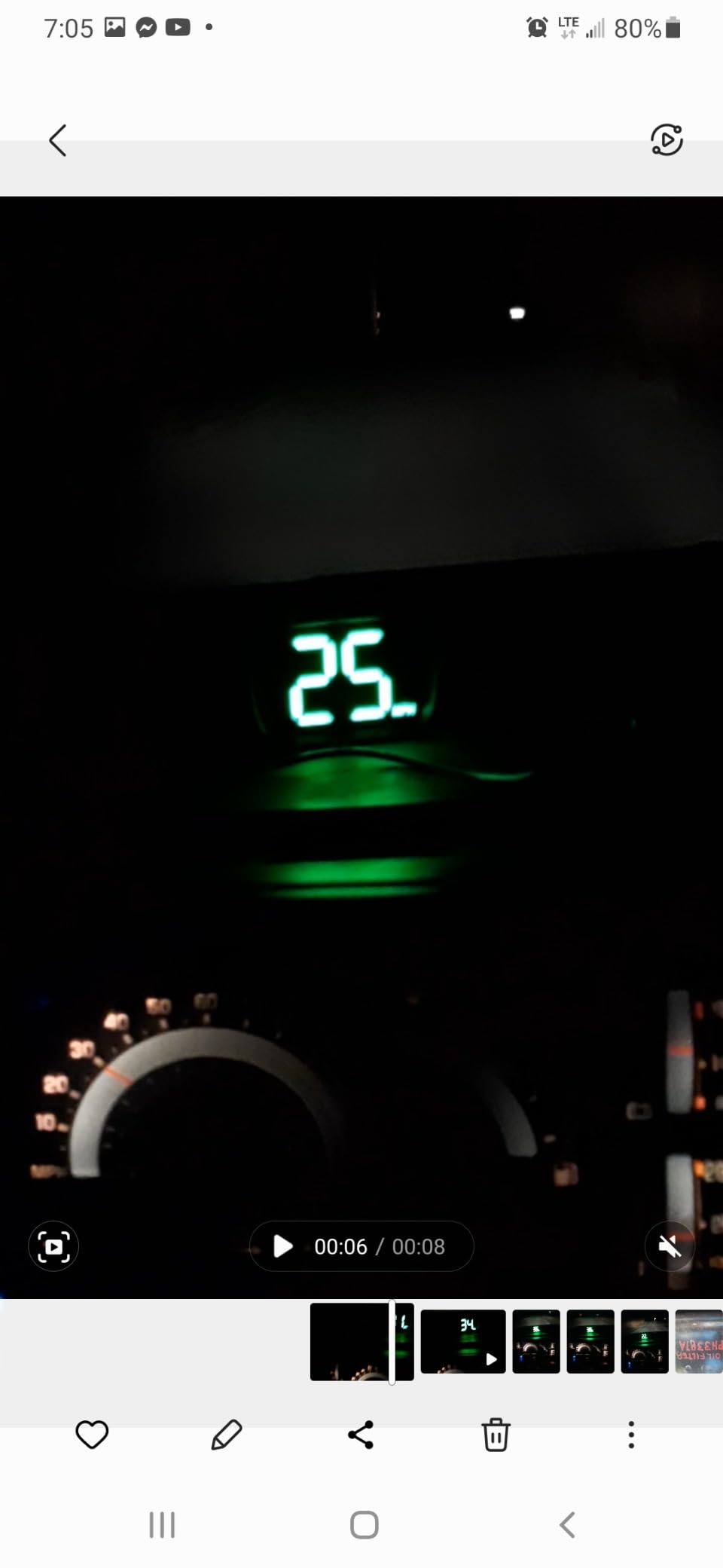
Positioning is dual-mode GPS and BeiDou, which is why owners report quick acquisition and low delay on the speed refresh. At 45 g it is light enough that the mount never has to do much work, and the small body keeps the road view clear.
It powers from USB, starts and stops with the vehicle, and works in cars, trucks, SUVs, buses and motorcycles.
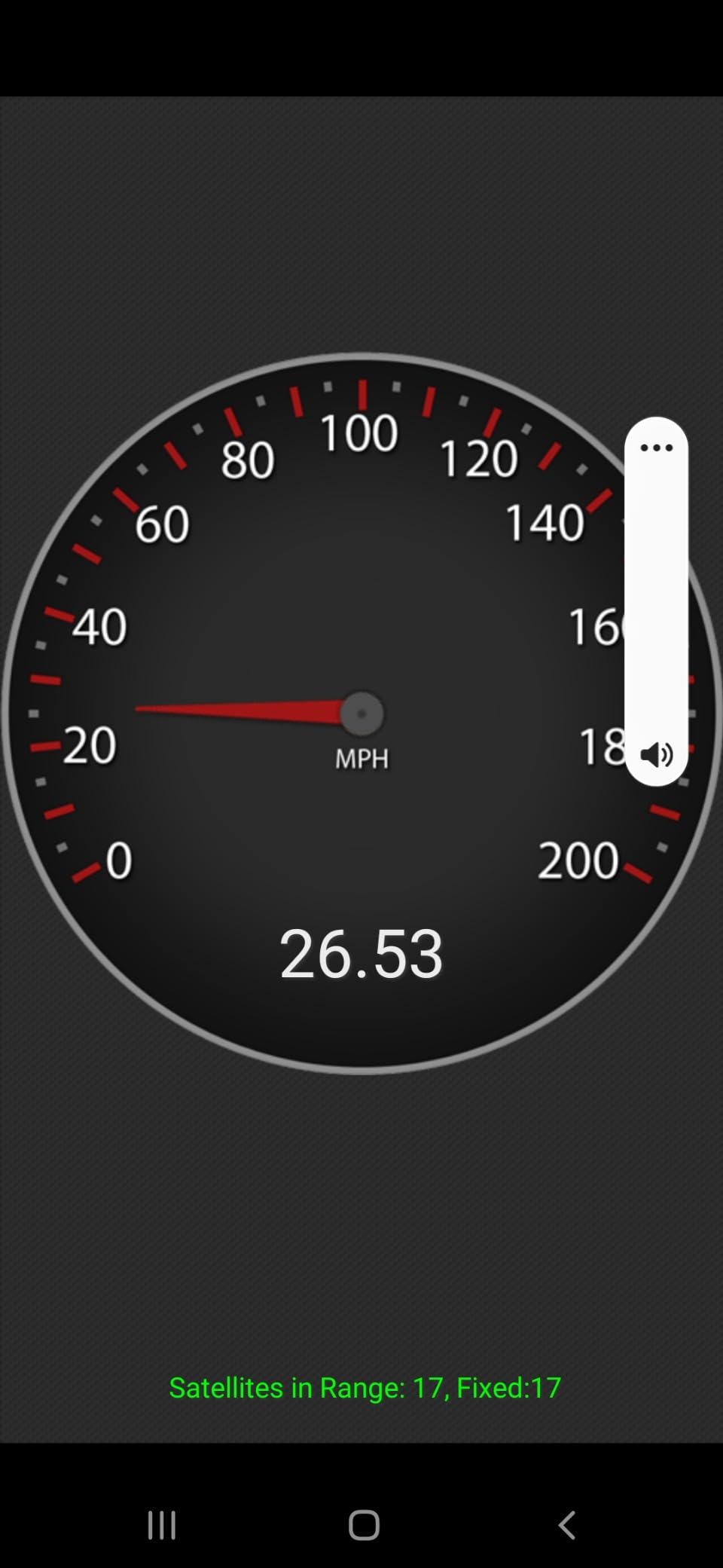
Where the shape matters more than the size
The unusual body is the practical limit here. Owners note it restricts where the unit can be mounted, so before you commit, hold it in your intended position and check you are happy with the footprint on the dash or the windscreen base. It is not a universal-fit shape in the way a rectangle is.
Note also that the power port sits on one side only, which is the detail that catches people out when routing the cable along a particular windscreen pillar.
Reading accuracy and night brightness
Expect a reading roughly 2 to 5 mph off actual speed on some vehicles, which is the widest spread in this group. A minority of units also drop the display to dashes and need a power cycle to recover.
Owners comment that night brightness is stronger than the dash lighting, so you may want to check whether that reads as glare from your driving position before you settle on it.
6. Kingneed C3010 – Best for a GPS-Derived Compass
Kingneed HUD Speedometer Odometer Compass Head Up Display GPS Digital Display Big Fonts Univsersal for All Cars Vehicles New C3010
4.8 inch green LCD
GPS compass
Trip time and mileage
Over-speed and fatigue alarms
200 g
Pros
- Large green numerals easy to read in sunlight
- GPS compass immune to magnetic interference
- Shows speed and heading together
- Adjustable over-speed and fatigue alarms
- No built-in battery so safe in a hot car
Cons
- Compass stays blank without a satellite lock
- Speed can be off by a couple of digits while settling
- Fatigue beep is intrusive and hard to silence
Most people buying a HUD want a compass, and most magnetic compasses are useless in a car full of steel, wiring and electronics. The Kingneed C3010 derives its heading from GPS satellites instead, so the direction it shows is not distorted by the vehicle itself.
That is the reason this unit has a following at all. Owners whose cars lack a built-in compass and whose cheap magnetic ones point the wrong way buy it for exactly that function, and report the headings read correctly.
The screen is 4.8 inches with large green fonts, which is easy on the eyes and readable in sunlight. It shows speed, compass heading, single-trip time and single-trip mileage, with adjustable over-speed and fatigue driving alarms.
It is the heaviest unit here at 200 g, so the mount does matter. At 80 C for three hours the shell will not deform, and with no built-in battery there is no heat-related hazard in a parked car.
Accept that the compass needs sky
This is the compromise built into the design. The compass searches for a signal and can stay blank under tree cover, in mountain valleys or anywhere the satellite view is poor. It also only works while the vehicle is moving.
If you commute through wooded roads regularly, treat the heading as a bonus rather than the reason to buy. If your driving is mostly open highway, it is genuinely useful.
Two smaller gripes
Speed can be off by a couple of digits until the unit settles after you set off, so give it a moment before you trust it. The fatigue alarm beeps roughly every 30 minutes and is not easy to silence once triggered, which several owners find more irritating than useful.
The default alarm threshold is 120 km/h or 120 MPH depending on the variant, so set your own value during setup if you want the over-speed alert to mean anything.
7. Docbraces G21 – Best for Odometer and Trip Tracking
HUD Heads Up Display for Cars 2025 New Universal Digital GPS Speedometer LED Display with MPH Speed Compass Overspeed Alarm Fatigued Driving Alert,USB Cable Plug and Play for All Vehicle
Permanent odometer
6 display modes
Clock and compass
Dual GPS and BeiDou
160 g
Pros
- Only unit here with a permanent odometer plus trip meter
- Clock and compass in the same unit
- Large high-contrast font readable in direct sun
- Anti-slip pad and suction cup both included
- Good for older cars with a dead speedometer
Cons
- Speed accuracy varies and needs repeated calibration
- Unit-to-unit consistency is uneven
- Supplied double-sided adhesive mount is poor
The G21 is the most functionally complete unit in this roundup, and one feature sets it apart from everything else here. It records a permanent odometer that saves automatically when you shut the engine down, alongside a separate trip meter for the current journey.
That matters if you are tracking service intervals on an older vehicle, because the alternative to a working factory odometer is a notebook.
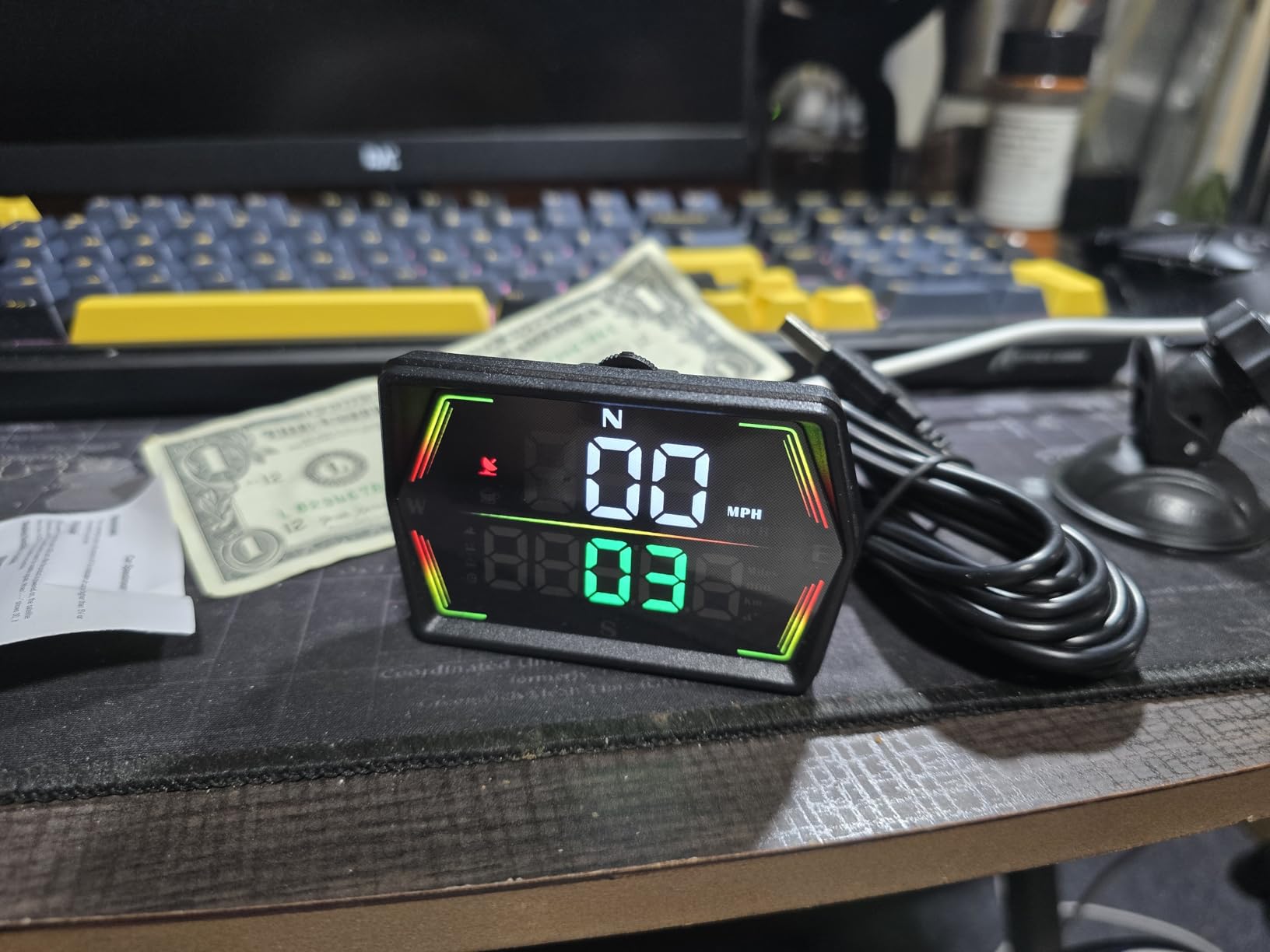
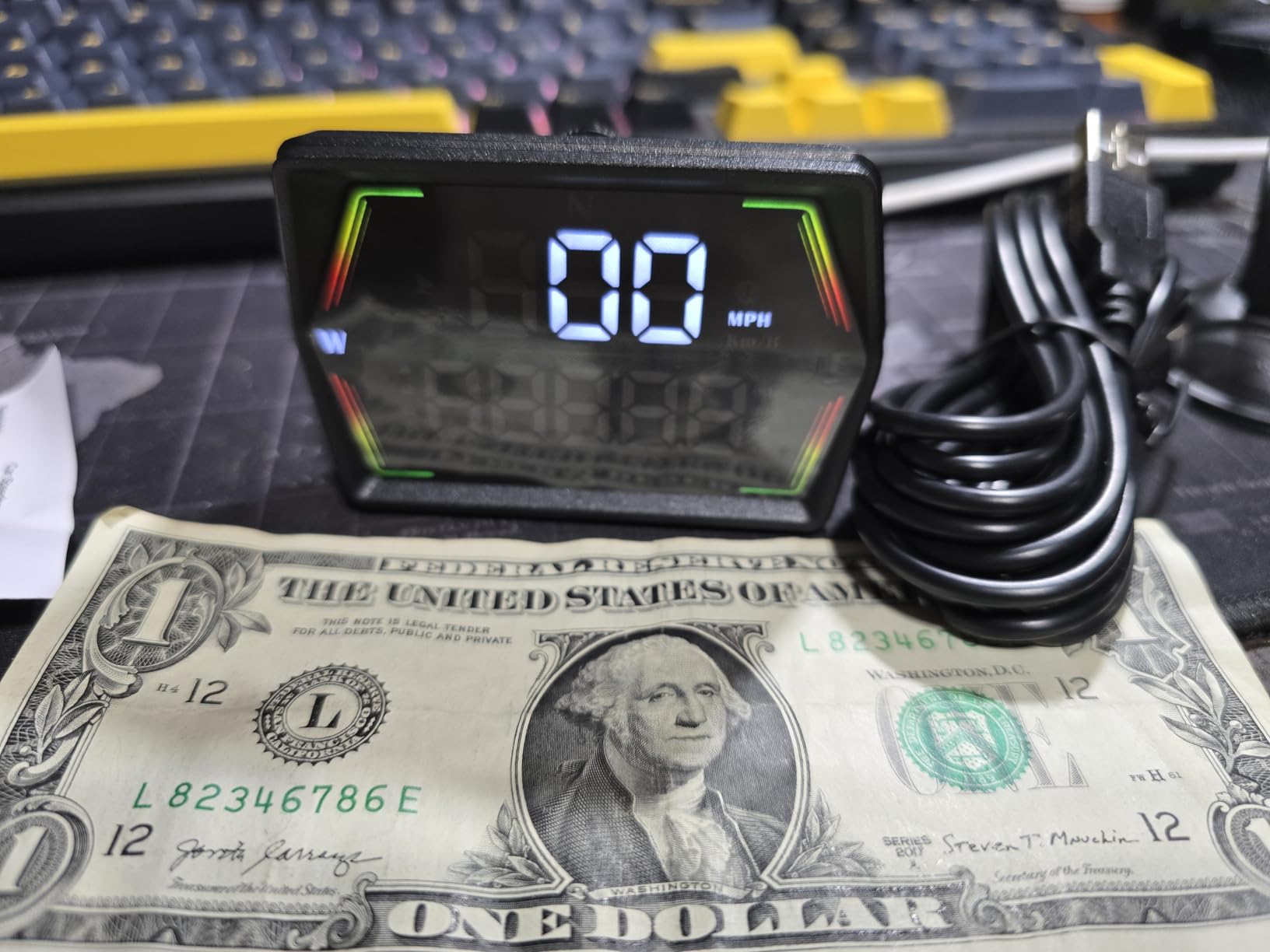
It also carries a built-in clock, a compass and six customizable display modes covering speed, direction and other data. Positioning is dual-mode GPS and BeiDou with a 10 Hz refresh and up to 32 satellites connected, plus an intelligent light sensor for automatic brightness.
Mounting is better thought through than most here. The box includes an anti-slip pad and a suction cup, so you have a non-permanent option that will not damage a dash. The body is 160 g and measures 3.27 by 2.2 by 0.7 inches.
Expect to calibrate more than once
This is the unit with the most owner complaints about speed accuracy, and they cluster around calibration rather than hardware failure. Several owners report needing repeated calibration, especially at highway speeds, and one had an odometer that reset at random.
Quality control also varies. A few arrive with a broken suction cup tab, and some have no working GPS, which leaves you with a display where only the brightness is adjustable.
Set the alerts properly
Two safety features are enabled by default: a speeding alert at 120 km/h and a fatigue reminder after four hours of continuous driving. The speed threshold is adjustable and worth setting to something you actually respect before you rely on it.
The four-hour fatigue prompt is reasonable on a long motorway run, but it fires from the GPS alone, so a stop for coffee with the engine idling will not necessarily reset it. Know that before it starts beeping at you.
8. Salior LED GPS HUD – Best Entry-Level Option
Heads Up Display for Cars Windshield with MPH Speed,HUD Display Digital Speedometer for Car Used USB Plug,Universal GPS Speedometer for Car Accessories Fit for Cars SUVs Trucks (MP/H)
LED screen with no ghosting
USB or 12V power
3 ounces
2.98 by 1.96 inches
MPH default
Pros
- Simplest installation of any unit here
- Compact 3 ounce body fits anywhere in the cabin
- LED screen avoids the ghosting of reflective film
- Large green fonts in a minimalist black case
- Powers on and off with the ignition
Cons
- Weakest rating in the group with more 1-star reviews
- Stated 1% to 5% reading error against the dash
- No calibration and no adjustable settings at all
The Salior is the simplest unit in the roundup, and simplicity is a fair defence of it. Power comes from a USB port or a cigarette lighter adapter, the display switches on and off with the ignition, and there is nothing to configure.
It also avoids the flaw that spoils a lot of cheap HUDs. Because the readout is a genuine LED screen rather than a number reflected off adhesive film, there is no ghosting or double image when your eyes move between the display and the road.
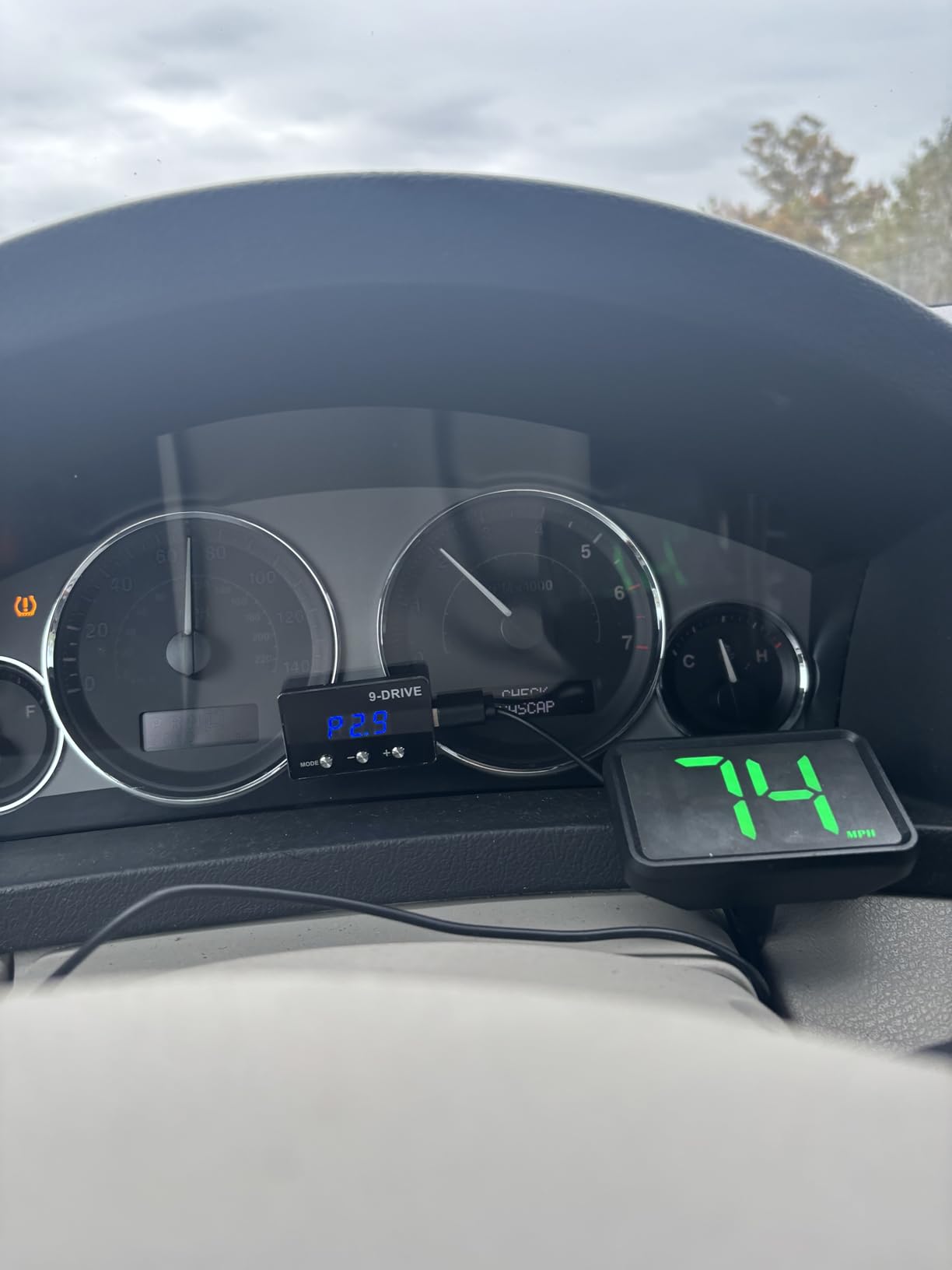
At 3 ounces and 2.98 by 1.96 by 0.63 inches, it is compact enough to sit anywhere in the cabin without blocking the view. The black body with large green fonts blends into most interiors, which is the opposite of what owners said about the reflective-film projectors that some brands push.
Power draw is handled properly, with automatic ignition on and off, so a parked car sitting for days is not a worry.
Know the accuracy before you rely on it
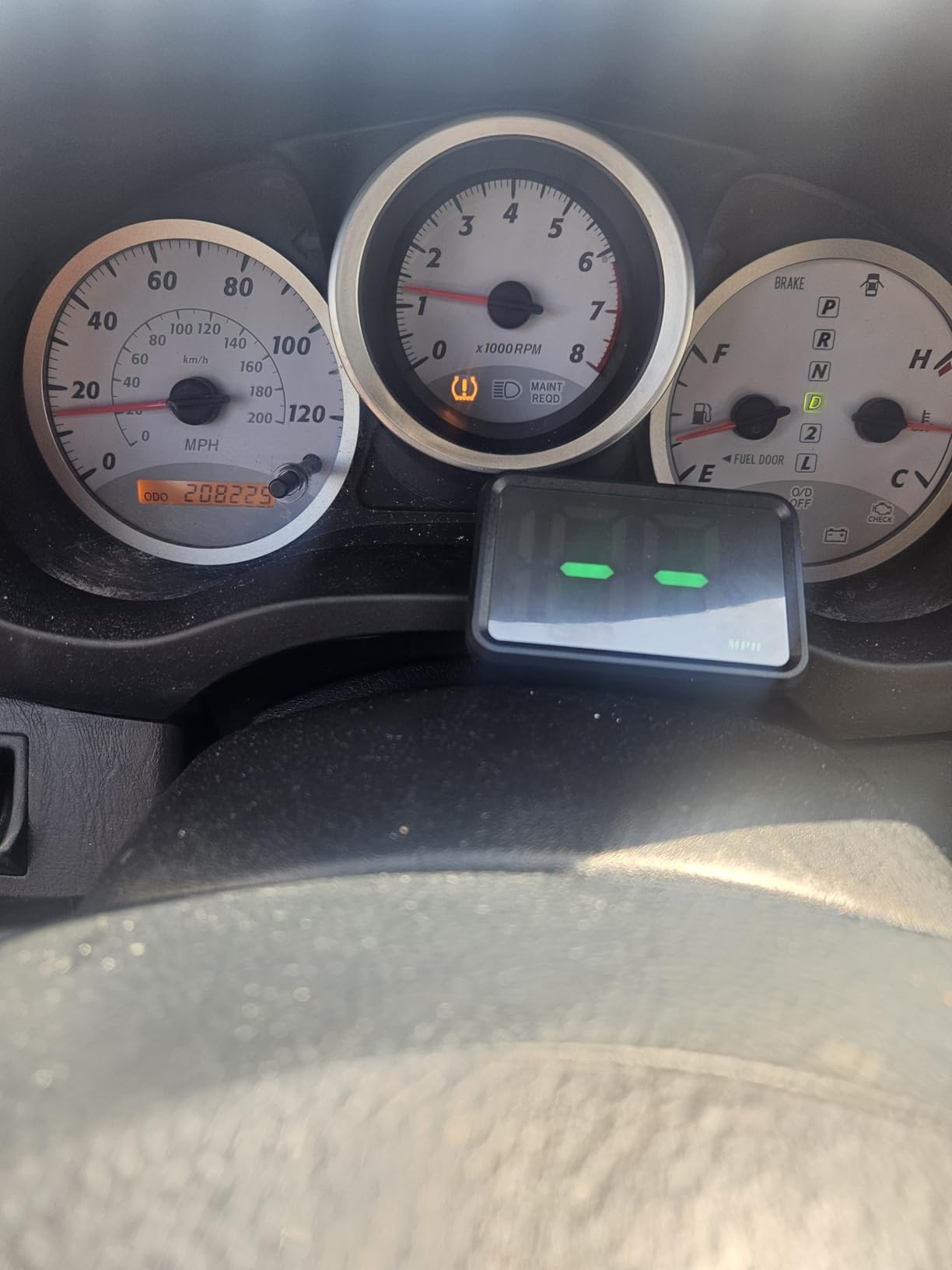
The manufacturer openly states a reading error of 1% to 5% against the vehicle speedometer, and there is no calibration function to correct it. At motorway speeds that is a meaningful gap, so treat this as a prompt to glance at the cluster rather than an instrument.
It is the lowest-rated unit in this group at 4.0 stars, with the largest share of 1-star reviews. That is not disqualifying for a simple speed reminder, but it is not a precision tool.
Two things to check before ordering
Confirm which unit variant you are buying, since the display is MPH unless you specifically choose the KM/H version. Also plan for the startup delay: the first GPS lock takes 10 to 30 seconds, and there is no reception underground, indoors or in tunnels.
The included anti-skid pad is the sensible mounting choice. It holds the unit without leaving adhesive marks on a dash you may want to resell later.
9. OinDoDi C3010 – Best for a Big 4.2 Inch Screen
OinDoDi Heads Up Display for Car Digital GPS Speedometer MPH kit Automotive Compass for Dashboard HUD Fatigued Driving Alert Speeding Alarm for Trucks Golf cart All Vehicles (C3010)
4.2 inch LED screen
Light sensor brightness
Switchable km and mph
USB 5V
160 g
Pros
- Highest rated unit in the roundup at 4.4
- Large 4.2 inch screen with big green fonts
- Light sensor adjusts for day and night
- Switchable kilometres and miles
- Controls on the back keep the face clean
Cons
- Cold starts can take minutes to get a GPS lock
- No way to hide the speedometer readout
- Same C3010 chassis sold under many brand names
The OinDoDi carries the highest rating in this roundup at 4.4 stars, though from a review base of 40 that is a smaller sample than the leaders. What makes it worth the attention is the 4.2 inch LED screen, which is the second largest here and considerably more readable at a glance than a compact unit.
Owners mention older drivers and owners of vans, classic cars and pontoon boats as the people who like it most, which tells you the audience: anyone who wants a big number they can read without leaning.
What the 4.2 inch screen costs you
A screen that large is a commitment to your dash layout. At 4.8 by 1.5 by 2.44 inches and 160 g, this needs a flat mounting surface, and it needs the viewing angle to be roughly right or the digits will not focus.
There is also no display mode that hides the speedometer, so whatever you configure, the speed stays on screen. For some drivers that is a distraction rather than a help.
Two practical notes
Cold starts can take several minutes to acquire a GPS lock after the first use, so the display may sit blank longer than you expect on a cold morning. The compass also needs a successful satellite fix and only works while the vehicle is moving.
The controls sit on the back, which keeps the front face clean and uncluttered. The seven-in-one function set covers speed, compass, driving time, mileage, over-speed alarm, fatigue warning and a kilometres and miles switch, with an ABS and PC flame-retardant case and no built-in battery.
10. LORPHEIR L5010 OBD2 and GPS HUD – Best for Engine Data
OBD2 GPS Dual System Car HUD Display – Digital Speedometer with Water Temp Voltage RPM – Universal Heads Up Display for Most Vehicles
OBD2 plus GPS modes
Over 20 data points
RPM and water temp
360 degree mount
11-18V protection
Pros
- Only unit here reading live engine data
- Shows RPM coolant temperature and voltage
- Useful on cars with no temperature gauge
- Set-able temperature alarm catches overheating
- Dual OBD2 and GPS modes work on older vehicles
Cons
- Speed reading reported about 10 mph off on one vehicle
- One unit showed no RPM at all
- Smaller review base means less proven reliability
Everything else in this roundup shows you speed. The LORPHEIR L5010 reads the engine directly through the OBD2 port and monitors more than 20 parameters, including RPM, water temperature, voltage, fuel consumption, altitude, turbo and intake pressure, oil temperature and navigation coordinates.
That makes it the pick for anyone whose car has no temperature gauge, or who wants to watch engine behaviour under load while towing. Owners report the set-able temperature alarm catching a genuine overheating problem on one vehicle, which is the kind of use that justifies the extra wiring.
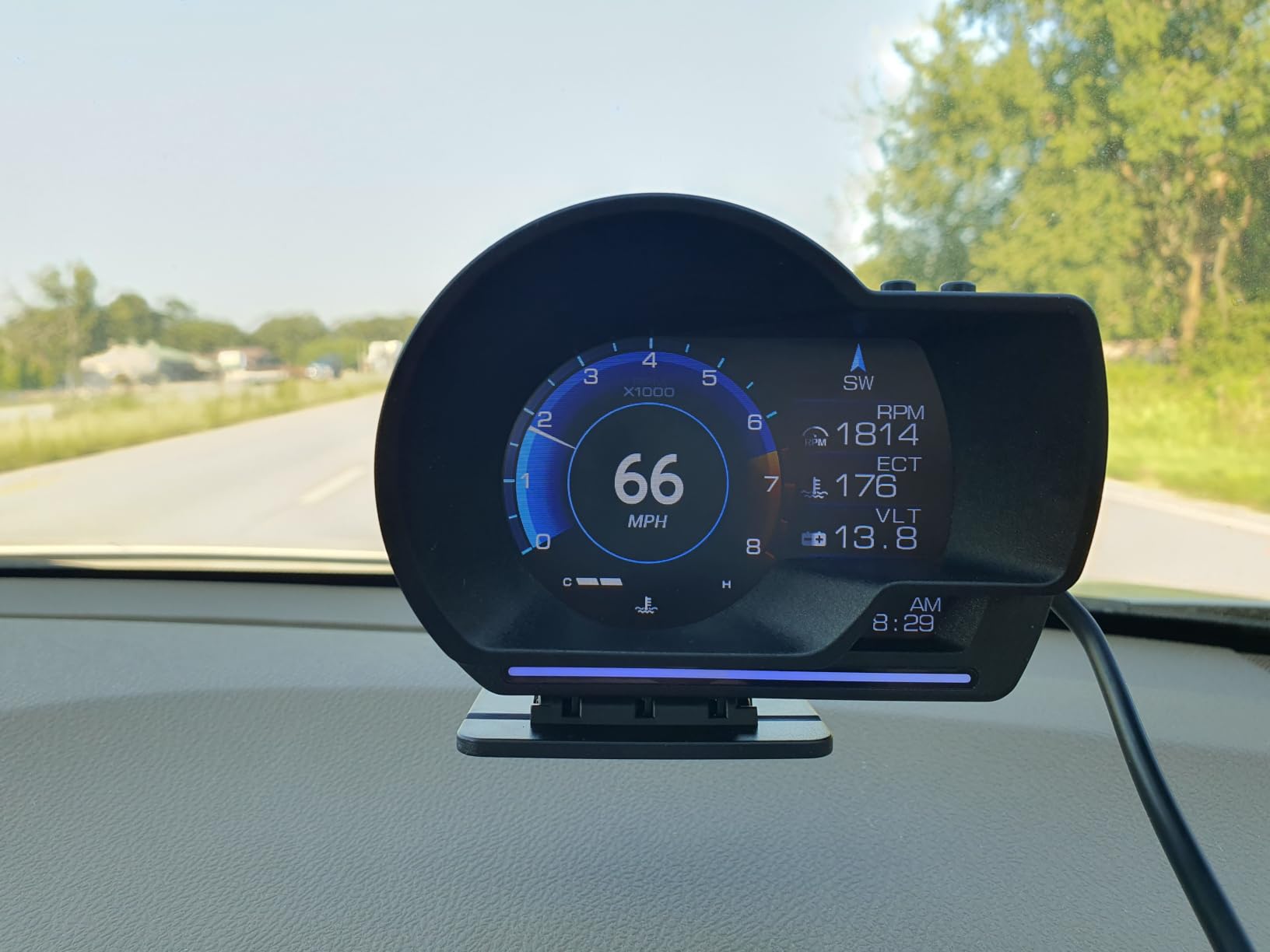
It runs in two modes. OBD2 mode works with most vehicles manufactured after 2008, and GPS mode gives compatibility with older and specialty vehicles, so the unit is not locked out of cars that predate the port or lack one entirely.
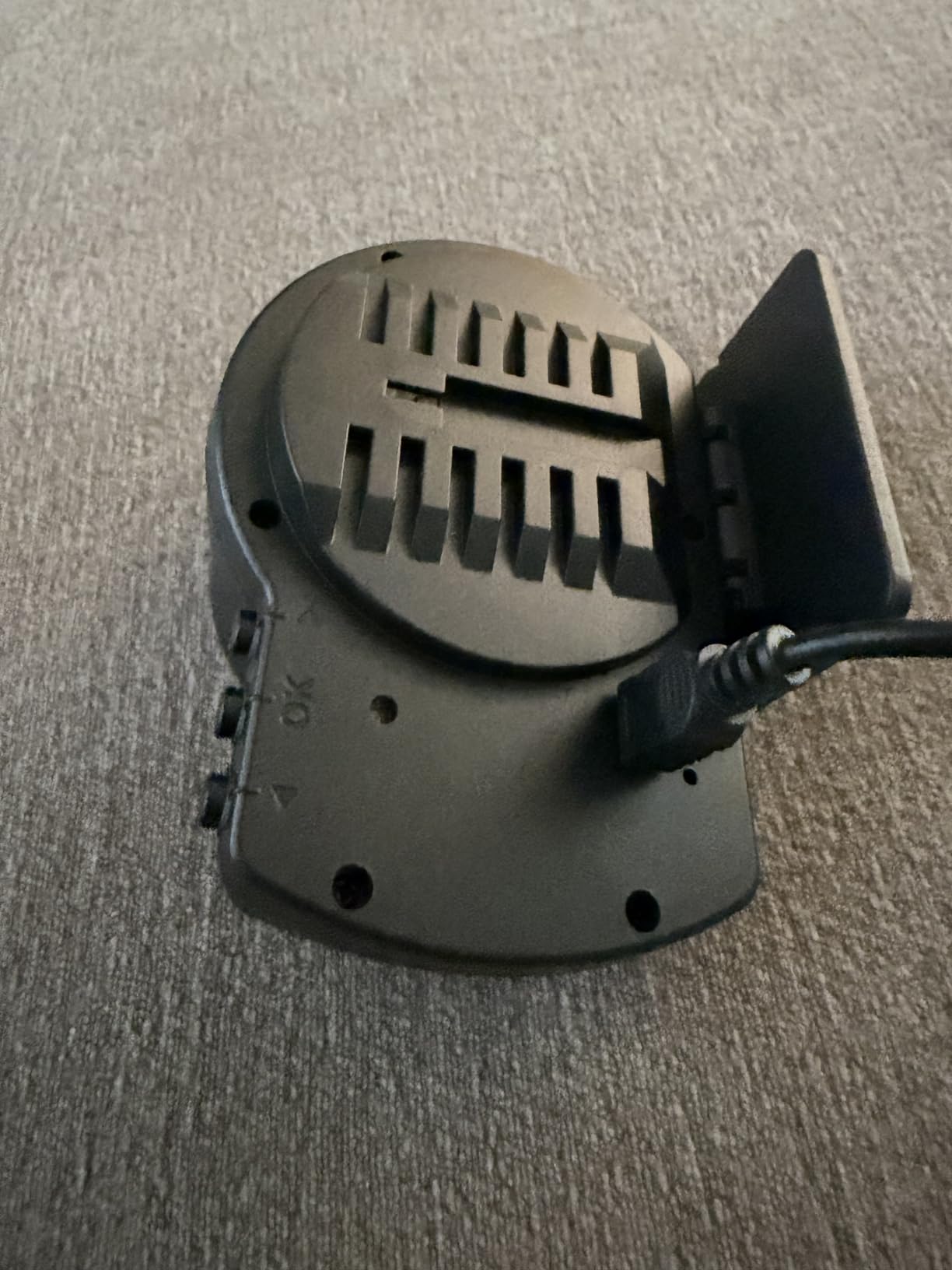
Mounting options are generous: a 360 degree rotating suction cup bracket, a console mounting base and adhesive tape all come in the box. The body is 4 by 3 by 2 inches and 10 ounces.
Where the data comes up short
Owners report the speed reading about 10 mph off on one vehicle, and other monitored parameters can be inaccurate too. One unit showed no RPM at all, which was the main reason for the purchase. Treat the extra data as a bonus rather than an instrument panel replacement.
With 57 reviews, long-term reliability is less proven than the cheaper GPS-only units. The stated accuracy is within 1% variance, but owner experience is the better guide.
Built for harsh conditions
The specification here is genuinely more robust than the rest of the field. It operates from -40 C to +80 C, handles 10% to 95% humidity and includes built-in voltage protection across an 11-18V range, with a dual-core processor and dual-system memory.
It is also the only unit in this roundup that will work on a motorcycle through the OBD2 connection, which is worth knowing if you ride as well as drive.
How to Choose a Heads-Up Display: OBD2 vs GPS vs Bluetooth
Choosing between the three data sources is the decision that actually matters, and getting it wrong is the most common reason a buyer ends up with a unit that does not fit their car. Here is how to work it out in four steps.
Pick OBD2 if you want true engine data. An OBD2 unit plugs into the diagnostic port, usually under the dash on the driver side or near the centre console. It is the only option that gives you RPM, coolant temperature, voltage and fuel consumption, and the speed it shows comes from the vehicle rather than a calculation. The trade is compatibility: the port has to exist and the unit has to speak the same protocol.
Pick GPS if you drive more than one vehicle. A GPS speedometer needs only a USB connection and a clear view of the sky. There is nothing to unplug, so it moves between cars in seconds, and it works in a boat, a golf cart, a scooter or a motorcycle. The trade is accuracy: expect a reading roughly 1 to 2 mph above the dashboard, and no engine data at all.
Pick Bluetooth app-linked if you already use a phone mount. These read speed from a phone app and are worth considering only if you are already running a phone-based HUD. Drivers on car forums frequently repurpose an old Android handset this way, which sets a high bar for what a dedicated unit needs to justify itself.
Skip reflective windshield projectors. Owners on owner forums describe the adhesive-film type as distracting rather than helpful, and they dim heavily under polarized sunglasses. Every unit in this roundup projects to a small screen instead, which is why we chose them.
Check Your OBD2 Port Before You Buy
Three checks, all doable in a parking lot. First, look under the dash on the driver side and around the centre console for a 16-pin trapezoidal socket; that is the standard OBD2 port. Second, if you want a rule of thumb, every car sold in the US from 2004 onward is OBD2 compliant. Third, if you drive a hybrid or an electric vehicle, check what the port actually reports, because the data available on an EV is different and many units are built around combustion engine parameters.
Daylight Readability Is the Number One Buying Factor
Almost every complaint we found about HUDs in general came down to the same thing: the number could not be read in bright afternoon sun. This is a hardware problem before it is a software one, and no amount of screen brightness fully solves it.
Look for an ambient light sensor, because a unit that dims itself at night and pushes output in daylight will beat a fixed-brightness unit every time. SinoTrack, Pyle, KUOWEIHUD, Docbraces and the OinDoDi all include one. Beyond that, screen size is the second lever, and a shading plate, as supplied with the Shkalacar, is the third.
Polarized sunglasses are the related trap. A polarized lens can kill or badly dim a HUD that relies on reflected light, which is another reason the LED-screen units here are safer than reflective film. If you drive in daylight with polarized glasses, test before you commit.
How to Install a Heads-Up Display and Set Eye Height
Installation is a ten-minute job for every unit here, but the part people rush is the one that decides whether they can read it. Four steps, in order.
1. Mount low and centred. Put the unit on the dash near the windscreen base or on a small mount on top of the dash, close to the centre line of the car. Avoid the wiper-swept area of the glass, and keep it clear of your mirror’s field of view.
2. Set eye height before you fine-tune anything else. Sit in your normal driving position and look at where the display lands. It should appear just above the bonnet line, roughly where the road disappears. If it sits over the bonnet, raise the mount; if it floats high, lower it.
3. Adjust the angle until the digits are crisp. A few degrees of offset is enough to blur the number or split it into a double image. This is the single most common complaint from new owners, and it is free to fix.
4. Route the cable and set the brightness. Tuck the USB lead along a pillar or under the trim so it is out of the way, then confirm the unit switches off with the ignition so it is not drawing from a parked battery.
When a Heads-Up Display Is Not Worth It
We would rather tell you when to skip this. If your car already has a factory heads-up display, an aftermarket unit is solving a problem you do not have. If your windscreen is deeply tinted or you wear polarized lenses in daylight, a reflective unit may be unreadable to you specifically.
The more common objection is distraction. At least one long-term owner on an owner forum described a factory HUD as distracting them badly, and that reaction is not unusual. The fix is configuration rather than avoidance: show one metric, hide the rest, and set the brightness low enough that it does not pull your eye. A HUD showing six data fields is a distraction wearing a helpful hat. The G20 on our list shows one number, and that is a feature.
Finally, if your car has no working speedometer, a HUD is not a repair. It is a prompt to look at the cluster, which is still not working.
Frequently Asked Questions
Which car has the best heads-up display?
Factory systems are generally better than anything aftermarket, because the display is integrated into the windscreen, calibrated to the vehicle and positioned for the driver’s eye. Among aftermarket units, the SinoTrack G3 leads on screen size and owner volume, while the LORPHEIR L5010 is the only one here that reads live engine data. For a car with no factory system, an aftermarket unit is the only way to get the feature.
What is the best aftermarket head-up display for cars?
The SinoTrack G3 is our best aftermarket head-up display overall. Its 5.5 inch screen shows speed, compass heading, trip data and satellite count together, the automatic light sensor keeps it readable in direct sun, and a calibration function lets you match your own speedometer. It runs on GPS alone, so it moves between vehicles with no OBD2 cable to unplug.
What is the best aftermarket HUD for my car?
Choose an OBD2 unit if you want RPM, coolant temperature and voltage and your car has a working diagnostic port. Choose a GPS unit if you have no port, drive more than one vehicle, or want something that also works in a boat, cart or motorcycle. Before buying, confirm your car is OBD2 compliant, which covers nearly everything sold in the US from 2004 onward, and check whether your windscreen or sunglasses will dim the image.
Is a head-up display really worth it?
It is worth it if the readout stays legible in daylight and you configure it to show a single metric. A HUD removes the repeated eye travel down to the instrument cluster, which is a real gain on long drives and in heavy traffic. It is not worth it if the image washes out in sun, if you wear polarized sunglasses with a reflective unit, or if you stack six data fields on a screen that then competes for your attention.
Do HUDs work with polarized sunglasses?
Reflective-film HUDs often dim heavily or disappear entirely behind polarized lenses, because the filter blocks the reflected light the display depends on. LED-screen units like the ones in this roundup are far more tolerant, since the number is generated rather than bounced. If you drive in daylight with polarized sunglasses, test the unit from your normal driving position before settling on a model.
Final Verdict for the Best Car Heads-Up Displays in 2026
The SinoTrack G3 is the best car heads-up display for most people in 2026. The 5.5 inch screen, the automatic light sensor and a calibration function solve the two problems that sink most HUDs: sun readability and a speed figure that disagrees with the dashboard. Choose the Pyle PHUD19 if a compact body matters more than screen size, or the VJOYCAR G20 if you want one big number and nothing else.
Go OBD2 only if you need engine data, and only if your car has a working port. Everything else runs on GPS and a USB cable, which also means it moves between vehicles for free.
Whatever you pick, set the eye height before you drive and show yourself one metric. That is the difference between a HUD that helps and one that joins the list of things that distract you.