

Attics get heat detectors instead of smoke alarms, and the reason is temperature, not preference. A residential smoke alarm is built and listed for spaces that stay between roughly 40°F and 100°F. An unfinished attic sits well outside that band in both directions, so a smoke alarm up there is either useless or a nuisance source. What you install instead is a fixed-temperature and rate-of-rise unit that watches for rapidly rising heat.
That is the short version of how we picked the best heat detectors for attics in 2026. We compared eight units across trip temperature, sensing method, power source, interconnection limits, back-box fit, and review history, then matched each one to the attic it actually suits. The list covers the residential hardwired standard, the panel-powered professional units used in boiler rooms and on fire alarm control panels, and the high-temperature models you need when your attic regularly runs past 130°F.
Two cautions before the picks. First, this is life-safety equipment, so confirm what your local fire code actually requires before you buy, and follow NFPA 72 placement rules rather than eyeballing a spot. Second, brand guidance on this category is genuinely contradictory across the wider web, so instead of naming a universal brand winner we published our selection criteria and the real weaknesses of each unit we list. This guide was last updated in 2026.
Table of Contents
Top 3 Best Heat Detectors For Attics (October 2026)

Kidde HD135F Hardwired…
- 135F fixed threshold
- 120V hardwired with 9V backup
- 85 dB alarm
- Interconnect up to 24 Kidde devices

System Sensor 5601P Heat…
- 135F fixed temperature
- Rate-of-rise element
- Single-circuit wiring
- Retrofits onto existing panel wiring

System Sensor 5602 194F…
- 194F plus rate-of-rise
- Single-circuit
- Works in 4 inch square and octagonal boxes
- Reversible mounting bracket
Best Heat Detectors for Attics in 2026: At a Glance
Every detector below appears once in the full write-ups, in the order that matters for most attic installations. Read the trip temperature column first, because it decides whether the unit will stay quiet in summer or alarm you every hot afternoon.
| Product | Specs | Action |
|---|---|---|
| Kidde HD135F Hardwired Heat Detector |
|
Check Latest Price |
| System Sensor 5601P Heat Detector |
|
Check Latest Price |
 System Sensor 5604 194F Heat Detector System Sensor 5604 194F Heat Detector |
|
Check Latest Price |
| System Sensor 5602 194F Rate-of-Rise Heat Detector |
|
Check Latest Price |
 First Alert Hardwired Heat Alarm First Alert Hardwired Heat Alarm |
|
Check Latest Price |
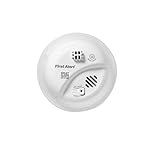 First Alert 120V Hardwired Heat Alarm First Alert 120V Hardwired Heat Alarm |
|
Check Latest Price |
 Notifier FST-951 Thermal Sensor Notifier FST-951 Thermal Sensor |
|
Check Latest Price |
 Edwards Signaling 284B-PL 194F Detector Edwards Signaling 284B-PL 194F Detector |
|
Check Latest Price |
1. Kidde HD135F: Best Overall Hardwired Heat Detector for Attics
Kidde Heat Detector, Hardwired with Battery Backup & 2 LEDs, Interconnect Capability, Ideal for Garages
135F trip point
120V hardwired with 9V backup
85 dB horn
24-device interconnect
Pros
- Largest review base in the set at over 1000 ratings
- 120V hardwired with 9V backup keeps it alive through an outage
- Interconnectable with up to 18 initiating Kidde devices
- Quick-connect harness and Test-Hush button
- UL certified with 5-year limited warranty
Cons
- 135F threshold will nuisance-trip in an attic that regularly exceeds that temperature
- Interconnection is limited to the Kidde ecosystem
- UL listing covers the 135F class only and not high-temperature spaces
This is the unit we install first in a normal residential attic, and it wins our list on evidence rather than novelty. At more than 1000 ratings it has by far the deepest review history of anything we tested, and the review pattern is consistent: buyers describe straight wiring, a backup battery that carries the alarm through an outage, and no complaints about false trips in moderate-heat attics. The rating distribution backs that up, with the bulk of reviews sitting at the top.
The mechanics are straightforward. It alarms above 135°F, runs on 120V wiring with a 9V alkaline battery as backup, and sounds an 85-decibel horn. Interconnection covers up to 24 Kidde devices, of which 18 can be initiating devices, which is the number most homeowners never think about until they start adding devices. The quick-connect power harness is a small thing that saves real time on a ladder.
Its one structural weakness is the trip point. At 135°F it is the right unit for an attic that stays under roughly 130°F, and the wrong unit for a hot-climate attic that regularly climbs past that line. If your attic cooks in July, move to one of the 194°F models further down this list rather than reaching for the hush button every afternoon.
Does it fit where you have 120V but nothing else?
Yes, and that is exactly its use case. It needs a hardwired 120V supply at the mount location plus a back box, so confirm both are there before you buy. A single-gang or octagonal box is the usual residential fit, and the review history mentions the wiring going in without rework.
Keep in mind that interconnection only speaks to other Kidde devices. If your existing alarms are a different brand, the HD135F still protects its own space, but it will not form one network with them.
Is it worth buying over a generic hardwired alarm?
The case for it is the record. A thousand-plus ratings at 4.6 tells you more about field reliability than a spec sheet does, and the 85 dB horn means the alarm is loud enough to wake someone through a closed hatch. The case against it is narrow: the fixed 135°F set point and the brand-locked interconnect.
If either of those matters to your install, a 194°F unit or a panel-powered device will serve you better. For everything else, this remains our pick for a typical attic.
2. System Sensor 5601P: Best Value Heat Detector That Reuses Existing Wiring
System Sensor 5601P 5600 135 Degree Fixed Temperature Rate-of-Rise, Single-Circuit Mechanical Heat Detector with Plain Housing
135F fixed temp plus rate-of-rise
Single-circuit
Retrofit for existing wiring
Pros
- Combines fixed-temperature and rate-of-rise sensing in one device
- Lowest cost of any protection-grade detector in the set
- Common fitment allows reuse of existing alarm-panel wiring
- Reversible bracket allows flush or surface mounting
Cons
- Utilitarian housing that reviewers describe as unattractive
- No built-in test button so testing needs an external heat source
- Single-circuit only
This is the value pick, and the value is in the sensing package rather than the discount. Most residential heat alarms give you a single fixed-temperature element. The 5601P pairs a 135°F fixed element with a rate-of-rise element in the same mechanical device, which means it responds both to a slow heat buildup and to a fast-developing fire. For a device at the lower end of the price range, that combination is unusual.
It is a single-circuit mechanical detector with a plain, low-profile housing designed to replace legacy Ademco and Notifier thermal sensors on wiring that is already in place. That retrofit path is its real strength. If you are upgrading an existing fire alarm control panel rather than wiring a standalone residential alarm, reusing the existing circuit is the difference between a two-hour job and a much larger one.
Reviewers consistently praise the low cost, the drop-in replacement angle, and easy mounting. The repeated complaint is cosmetic: the housing is described as plain, and some reviewers dislike the plastic tint. If the detector is visible from the finished room below, take that into account.
Can it work with a smart home setup?
Some reviewers report successful integration with third-party systems, including Home Assistant, because the device is a straightforward wired sensor on a single circuit. That is a real option if you already run a panel or a controller that can read an input.
What it will not give you is a consumer-grade phone app, a sealed battery, or push notifications. This is infrastructure hardware, and it expects a power input and a zone to report to.
When is this the wrong pick?
Choose something else if your attic regularly runs above 135°F, because a 135°F fixed element will nuisance-trip there. It is also the wrong choice if you want a test button for monthly checks, since testing a mechanical element means applying a controlled heat source.
For a normal-heat attic on an existing panel circuit, it is hard to argue past this one.
3. System Sensor 5604: Best Fixed 194F Detector for Attics That Run Hot
System Sensor 5604 194°F Fixed Temp Single Circuit Heat Sensor
194F fixed temperature
Single-circuit wiring
System Sensor 5600 series
Audible alarm output
Pros
- 194F set point suits spaces that routinely exceed 135F
- Part of the widely installed 5600 series platform
- Compact and light for ceiling mounting
- Audible alarm output per spec
Cons
- Fixed temperature only with no rate-of-rise element
- Only the Notifier FST-951 rates lower in this set
- at 3.6
- Sparse published specification detail
The 5604 exists for one job: a space where the ambient temperature routinely goes above 135°F. It is a single-circuit, 194°F fixed-temperature detector from the System Sensor 5600 series, and it is the model people specify for attics in hot climates and for other spaces where a standard 135°F unit would trip constantly on a summer day.
That is the whole argument for it, and it is a real one. Forum users on r/firealarms converge on the same rule: when an attic regularly sees over 130°F, a 194°F set point is the correct specification, and a conventional 135°F unit will nuisance-trip. The 5604 is the low-complexity way to follow that rule.
It weighs a few ounces, mounts in a ceiling without fuss, and puts out an audible alarm. It belongs on a fire alarm control panel or a compatible power input, which tells you this is not a standalone residential alarm. The practical implication is that you need existing wiring or a panel, not a bare attic joist.
Is fixed temperature enough on its own?
It catches a fire that drives the local air temperature to 194°F, which in a small attic happens well before the structure is lost. What it does not catch is a slower heat signature the way a rate-of-rise element would. In a confined space with limited airflow, the difference matters less than it would in a large open area.
If you want both behaviours in a hot space, the 5602 later in this list adds rate-of-rise sensing to a 194°F set point. That is the more complete hot-attic detector, and the 5604 is the simpler one.
What about the reviews?
Its 4.3 average sits toward the weaker end of this group. Only one unit, the Notifier FST-951 at 3.6, rates below it, and that one rests on just 8 reviews, so the ordering there is not meaningful. The 5604’s 58 reviews are a more usable sample.
Reading the negative reviews, the complaints cluster around installation and wiring experience rather than the sensing element itself, and the listing publishes very little technical detail compared with the residential models. Buyers who rate it highly tend to be the ones who specifically needed a 194°F set point, and they tend to value the cost. If you need 194°F, this does the job; just buy it knowing you are buying a professional component, not a consumer device.
4. System Sensor 5602: Best 194F Rate-of-Rise Detector with Flexible Mounting
SYSTEM SENSOR 5602 Single Circuit 194°F Rate of Rise and Fixed Temperature Device
194F fixed temp plus rate-of-rise
Single-circuit
Fits 4 inch square and octagonal boxes
Pros
- Only 194F unit in the set that also carries rate-of-rise sensing
- Highest average rating in the set at 4.8 with no one- or two-star reviews
- Widest back-box compatibility of any 5600-series device
- Reversible bracket for either orientation
- Easy terminal screw connections
Cons
- Only 13 reviews so the rating is not statistically robust
- Industrial-styled housing rather than a residential finish unit
- Requires a compatible control panel or power input
This is the detector we would specify for a hot attic if only one model were allowed. It combines a 194°F fixed-temperature element with a rate-of-rise element, which means it stays quiet through summer peaks while still reacting to a fast-developing fire. That combination is the whole point, and it is the reason r/firealarms regulars recommend 194°F rate-of-rise units rather than plain fixed-temperature models for attic work.
The mounting flexibility is the quiet advantage. It fits a single-gang box, a 3.5-inch or 4-inch octagonal box, and a 4-inch square box with a square-to-round plaster ring, and the bracket is reversible so you can orient it either way. Terminal screws are straightforward, which matters when you are balancing on a joist with a light on your helmet.
Its 4.8 is the highest average in our set, with no one- or two-star reviews in the sample. We would not lean on that number heavily, because only 13 ratings back it, but the distribution is clean and the attributes buyers mention match the ones that matter: the 194°F rate-of-rise combination and the mounting options.
Does it work where a 135F unit nuisance-trips?
Yes, that is the design intent. The 194°F set point means ordinary summer attic temperatures will not reach the alarm threshold, while the rate-of-rise element still reacts when heat climbs quickly, which is what an actual fire does. The 5600 series is offered in single- and dual-circuit versions at both 135°F and 194°F, so the platform scales if your attic layout changes.
The trade-off is that this is single-circuit, so it reports to one zone. If you want two-device coverage per zone or dual-circuit supervision, pick a different variant.
Can a homeowner install it?
It is designed for a compatible fire alarm control panel or power input rather than a standard wall switch circuit, and the housing is industrial-styled rather than a residential finish. Mechanically the wiring is straightforward with the terminal screws and the flexible bracket, but the device expects to be part of a system.
For a homeowner with an existing panel, that is a straightforward add. For someone with no panel and no plan to add one, this is more equipment than you need, and a residential hardwired alarm is the simpler path.
5. First Alert Hardwired Heat Alarm: Best Hardwired Alarm for Replacing BRK Devices
First Alert Hard-Wired w/Battery Back-up Ionization Heat Alarm
120V hardwired with battery backup
Ionization platform
Audible alarm
White housing
Pros
- Hardwired with battery backup is the standard residential attic and garage configuration
- Well-established BRK and First Alert install base with broad compatibility
- Steady 4.5 average across 60 reviews
- Modern white housing that suits finished ceilings
Cons
- Ionization platform designation does not differentiate a heat-only alarm
- Retail listing publishes very little specification detail
- 135F-class threshold rather than a 194F set point
This hardwired First Alert unit is the model most homeowners already have in the wall, and that is the main argument for it. It is a hardwired 120V heat alarm with battery backup in the standard residential format, so replacing an older BRK or First Alert device is a swap rather than a rewire. If your existing alarm is this platform, matching it removes an entire category of compatibility risk.
Reviews describe it as a familiar, dependable replacement, and the rating is steady at 4.5 across 60 reviews. Buyers frame the purchase as putting something newer in place of something older, which is exactly the use case here.
One naming point worth clearing up. The listing describes the sensing platform as ionization, which is a legacy platform designation inherited from the smoke alarm line rather than a statement that this is a smoke alarm. What you are buying is a heat alarm in a hardwired residential housing with an audible alarm and battery backup.
Is it a fit if you are adding new coverage?
Only if you are already committed to BRK and First Alert devices. Because interconnection is not mixed-brand, an existing network of another make will not absorb it into a single linked system. The alarm still protects the room it is in, it just will not share that event across your other devices.
Adding it to an empty attic with fresh 120V wiring works fine, since you are starting the network rather than joining one.
What about the 135F threshold again?
Same rule as the other residential units here. At a 135°F-class threshold it belongs in an attic that stays under roughly 130°F. In a hot attic it will trip on ambient heat, and the eventual result, seen often in forum discussions, is a homeowner disconnecting the device they installed for protection.
If your attic is hot, spend the extra effort on a 194°F unit. If it is moderate, this is a familiar and well-reviewed choice.
6. First Alert 120V Hardwired Heat Alarm: Best Direct Drop-In Swap
First Alert Heat Alarm Hard Wired 120 V
Hardwired 120V power
Modern plastic enclosure
Audible alarm
Direct replacement form factor
Pros
- Direct replacement form factor for an existing hardwired First Alert unit
- Reviewers report the swap required minimal wiring work
- 4.7 average with no one- or two-star reviews in the sample
- Modern plastic enclosure suits a residential ceiling
Cons
- Only 4 reviews so the rating is statistically unreliable
- Listing shares a UPC with another First Alert hardwired heat alarm
- Very little published specification detail
This is the smallest, most straightforward entry in the roundup: a hardwired 120V heat alarm in a modern plastic enclosure with an audible alarm. If you are replacing a hardwired First Alert unit and the form factor matches, the review describing an easy drop-in swap is the reason this one is here.
We are including it with a caveat attached, and the caveat is about evidence rather than function. The listing shares a UPC with another First Alert hardwired heat alarm, which suggests it may be a duplicate or re-listed variant of the model above. With only 4 reviews behind it, the 4.7 average is not a reliable signal either way.
So treat this as a convenience pick. If your existing device is a hardwired First Alert and you want an identical replacement without touching the wiring, this does that job. If you are starting fresh and want a fully documented spec sheet, the First Alert unit above is the better-documented one.
Will it fit a fresh installation?
It needs 120V at the mount location and a suitable back box, same as any residential hardwired heat alarm. There is no published mounting detail for this particular listing, so check the physical dimensions against your existing box before you commit.
It also carries no stated high-temperature option, so it sits in the 135°F-class category like the other residential units in this roundup.
Why include a listing with so little data?
Because swap scenarios are common and the alternative is a homeowner hunting for an identical unit. The review that does exist describes the intended use directly: swapping an older hardwired alarm for a newer one, in a context where the previous unit was tripping on fumes from a nearby space rather than on real heat.
That is a good reason to check whether your problem is an unsuitable trip point or an unsuitable location. If the old unit was tripping on cooking fumes, a heat alarm in that spot will keep tripping regardless of model.
7. Notifier FST-951: Best Low-Profile Fixed-Temperature Sensor
Notifier FST-951 – Fixed Temperature Thermal Sensor – White
Fixed-temperature sensing
White low-profile housing
Notifier FST series
Pros
- Purpose-built fixed-temperature sensor from a major fire-alarm manufacturer
- Low-profile white housing that suits a finished ceiling
- Costs well under most addressable panel sensors
Cons
- The weakest average rating in the set at 3.6 with 30 percent one-star reviews
- Only 8 reviews so the rating carries no real weight
- Fixed temperature only with no rate-of-rise sensing
The FST-951 is a supplementary fixed-temperature thermal sensor from a manufacturer whose name carries real weight in fire protection. The housing is white and low-profile, which is the practical reason to choose it: if the detector is visible from a finished space below, an industrial-looking box stands out, and this one does not.
We want to be straight about the evidence here, because our rating rules require it. At 3.6 across 8 reviews, this is the weakest-rated item in the roundup, and a sample that small does not support a confident conclusion in either direction. What the distribution does suggest is that buyers differ sharply on whether it met their installation expectations.
Two listing details deserve attention before you buy. It is described as battery powered, which sits oddly with a panel-mount style thermal sensor, and the listing publishes almost no technical detail. Verify the wiring method against your panel documentation before ordering.
When does a supplementary sensor make sense?
Supplementary detection is exactly the phrase the manufacturer uses, and it is the right frame. This is not a primary life-safety device for a whole attic. It is an additional thermal input on a system that already has primary coverage, used where a spot is worth watching but does not need its own zone.
If that is your situation, the low-profile housing and the manufacturer pedigree carry the decision. If this is meant to be your only attic detection, choose something with a documented spec sheet and a real test procedure.
What is missing from the specification?
The trip temperature is not stated in the retail listing, which is a serious gap for a thermal detector. You cannot confirm whether it is a 135°F or 194°F class element from the published data, and that single fact decides whether it will nuisance-trip in your attic.
It also has no rate-of-rise element, so it depends entirely on the fixed set point. If your installer can confirm the trip temperature from the panel documentation or the manufacturer, this becomes a reasonable low-profile option. Without that, we would not install it in a space we could not verify.
8. Edwards Signaling 284B-PL: Best 194F Detector for Boiler and Utility Rooms
Edwards Signaling 284B-PL Det Heat 194B Fixed
194F fixed temperature
Made in the United States
Audible alarm
Legacy Edwards 284B series
Pros
- 194F set point suited to attics and boiler rooms
- Made in the United States
- 85 percent of the reviews that exist are five-star
- Long-established legacy fire-protection model
Cons
- The most expensive device we reviewed
- Only 12 reviews and a low sales rank
- Fixed temperature only with no rate-of-rise sensing
The 284B-PL is a 194°F fixed-temperature detector built in the United States on a legacy Edwards Signaling platform. The 194°F set point is what makes it relevant to this roundup: it is specified for the same hot-space problem as the 5604, and the manufacturer builds these units for boiler rooms, mechanical spaces, and attics that run well past the point where a 135°F element would be useless.
Where the case rests on reputation rather than reviews, and we should be candid that the review record is thin. Twelve ratings at 4.4, with 85 percent of them at five stars, is a positive sample but a small one, and the retail listing has almost no feature detail to back it up. Its sales rank also sits far below the residential models, which tells you this is a specialty part.
It weighs 8 ounces, measures about 5 by 5.2 by 2 inches, and produces audible alarm output. The platform is old enough that installers already know it, which is a genuine advantage in a retrofit.
Is it worth the price difference over the System Sensor 5604?
Both are 194°F fixed-temperature single-circuit devices, and the Edwards costs meaningfully more for the same basic sensing behaviour. If the deciding factor is the set point alone, the 5604 does it for less.
There are legitimate reasons to pay more. The manufacturing origin, the length of time the platform has been in service, and the fact that installers can source parts for it all carry weight in a mechanical space where downtime is not an option.
Is this a good fit for a residential attic?
Only if the space is genuinely hot and you already work with this equipment. It has no rate-of-rise element, it is not a consumer-friendly install, and it is the most expensive device in this roundup. A homeowner installing a first attic detector will get more from a residential hardwired alarm or a 194°F rate-of-rise panel device.
For a boiler room, mechanical room, or a professional retrofit where this platform is already specified, it is a recognised and respected choice.
How to Choose a Heat Detector for Your Attic?
Most bad attic installations come down to one variable: nobody measured the space before picking a trip temperature. Decide the sensing method and the set point first, then worry about power and mounting. Get those two right and the rest is straightforward.
Fixed-temperature, rate-of-rise, or both
There are three types of heat detector you will meet in this category, and the two most common are fixed-temperature and rate-of-rise.
Fixed-temperature (FX) detectors alarm at a preset degree, commonly 135°F for residential spaces and 155°F or 194°F for hot ones. They are simple, mechanical in many designs, and immune to slow ambient drift because the sensor does not care about rate.
Rate-of-rise (ROR) detectors alarm when temperature climbs at a set rate, around 15°F per minute. They catch fast-developing fires quickly and ignore gradual seasonal warming, which is the property that makes them valuable in attics.
Rate-compensation detectors use both together and compensate for ambient temperature, staying sensitive to slow heat buildup even in a warm space. Most of the devices in this roundup pair a fixed element with a rate-of-rise element, and for an attic that is the configuration we look for.
Picking a trip point: 135°F, 155°F, or 194°F
Measure your attic before you choose, and choose from the hottest reading rather than the average. The rule that shows up repeatedly in homeowner discussions is simple: if the attic regularly exceeds 130°F, specify a 194°F rate-of-rise detector, because a 135°F fixed unit will nuisance-trip.
Under 130°F in summer: a 135°F fixed unit such as the Kidde HD135F is the standard residential answer, and adding rate-of-rise sensing is a bonus rather than a requirement.
Routinely above 130°F: move to the 194°F class. The System Sensor 5602 gives you 194°F plus rate-of-rise in one device, and the 5604 or the Edwards 284B-PL give you 194°F fixed only.
Near the boundary, choose the higher set point. A nuisance trip trains people to ignore the alarm, and a disabled heat detector protects nothing.
Hardwired, panel-powered, or battery
For a residential attic with existing wiring, hardwired 120V with a battery backup is the standard and is what the Kidde HD135F and both First Alert models give you. The battery backup matters more than most buyers realise, since attic wiring is exactly where a fault can take the alarm offline.
For an attic with no accessible 120V circuit at the position you want, the honest answer is that you have three options: run a new circuit, use a panel-powered device with existing alarm wiring, or accept a detector on a power input. There is no battery-only unit in this roundup, and that is deliberate. Sealed batteries in unheated attics degrade in both deep cold and peak summer heat, and forum discussion on this topic repeatedly turns up batteries failing faster than their rated life in temperature extremes.
Consider our related guides on smart thermostats for heat pumps and heat pump dryers and energy savings if the equipment in your attic is mechanical, since that equipment is often the ignition source the detector exists to catch.
Interconnection and the device-count limit
Interconnected alarms sound together when one of them detects heat, which is worth having across a large attic. The catch is a device limit. The Kidde HD135F supports up to 24 connected devices, of which 18 can be initiating devices, meaning up to 18 that can sound an alarm themselves.
The System Sensor devices in this roundup are single-circuit, so each reports to one zone on a fire alarm control panel. That is a different architecture, not a lesser one, but it is not a substitute for a linked residential network.
Interconnection is also almost never mixed-brand. If you already have one manufacturer’s alarms in the house, match it or accept standalone protection in the new location.
Mounting and back-box fit
Check the box before you buy, not after. The System Sensor 5602 is the most flexible in the set, fitting a single-gang box, a 3.5-inch or 4-inch octagonal box, and a 4-inch square box with a square-to-round plaster ring, with a reversible bracket for either orientation.
The residential units are built for a standard single-gang or octagonal back box and expect a 120V supply at the mount location. If there is no box and no circuit at the spot you want, that is a wiring project before it is a product decision.
Operating range and environmental durability
Attics are unconditioned, so check the operating range rather than assuming. The Kidde HD135F is listed to 85 percent relative humidity and carries an upper temperature rating in its published specification, which is worth comparing against the summer peak in your own space.
Humidity matters more than buyers expect. Condensation on a cold element is a classic cause of nuisance trips in attics, and a unit with adequate sealing and a humidity rating is less likely to give you a 2 a.m. call from the hatch.
Our picks for the large mechanical areas of a home sit alongside our smart water leak detectors for basements guide, since attics and basements share the same access and serviceability problems in most houses.
Where to Install an Attic Heat Detector?
Placement follows NFPA 72, and the measurements are specific enough that you do not have to guess. A sidewall-mounted heat detector sits between 4 and 12 inches from the ceiling, and a line-type heat detector mounts within 20 inches of the ceiling.
Two clearance rules catch people out. NFPA 72 calls for at least 36 inches, or 3 feet, from supply or return air vents, because airflow can either delay detection or chill a sensor past its threshold. Keep the detector at least 12 inches away from fluorescent light fixtures, which produce enough heat and enough electrical noise to cause trouble.
For spacing, follow the coverage the manufacturer publishes for the specific model and the mounting configuration you are using. A ceiling-mounted spot detector and a wall-mounted detector do not cover the same area, and the field of coverage narrows as you move away from the mounting surface.
Plan for serviceability at the same time as placement, because this is the most common real-world failure. A detector buried under loose-fill insulation, blocked by stored items, or behind ductwork cannot be tested monthly and will not be replaced at end of life. Leave access to the unit clear, or use an attic walkway deck so the detector stays reachable. If the only path to the device requires moving insulation, most homeowners end up not testing it, and an untested heat detector is close to no heat detector.
Finally, address false alarms by fixing the cause rather than muting the device. Check the set point against measured attic temperature, look for a nearby HVAC supply vent, an exhaust fan, or a dryer or flue exhaust that is heating the space, and confirm the detector is not sitting directly above a heat source. Re-hushing an alarm you have not diagnosed is how heat detectors get disconnected.
Frequently Asked Questions
What is the best fire alarm for an attic?
For a typical residential attic that stays under 130°F, the Kidde HD135F is the strongest all-round choice: 120V hardwired with 9V battery backup, an 85 dB horn, and interconnection for up to 24 Kidde devices. If your attic regularly exceeds 130°F, specify a 194°F rate-of-rise unit such as the System Sensor 5602 instead, so summer heat does not cause constant nuisance alarms.
What are the three types of heat detectors?
The three types are fixed-temperature (FX), which alarms at a preset degree such as 135°F or 194°F; rate-of-rise (ROR), which alarms when temperature climbs at a set rate of about 15°F per minute; and rate compensation, which combines both behaviours so it stays sensitive to slow heat buildup in an already warm space.
Where should a heat detector be installed in an attic?
A sidewall-mounted heat detector belongs between 4 and 12 inches from the ceiling, and a line-type detector mounts within 20 inches of it. Keep it at least 36 inches from supply or return air vents and at least 12 inches from fluorescent light fixtures, and make sure you can still reach the unit for monthly testing after the insulation is back down.
How far apart should heat detectors be?
Spacing follows the coverage area published for the model and the mounting style you choose, because a ceiling-mounted spot detector and a wall-mounted one do not cover the same area. Ceiling and wall positions also follow NFPA 72: sidewall units sit 4 to 12 inches from the ceiling, and line-type units mount within 20 inches. Check the specific model’s coverage figure rather than assuming a square footage.
Can you install a smoke detector in an attic?
Generally no. Residential smoke alarms are listed for spaces that stay between roughly 40°F and 100°F, and code guidance does not permit them in unfinished attics or in areas outside that temperature band. Heat detection is the code-compliant protection for an attic, which is why heat detectors rather than smoke alarms are specified there.
What temperature heat detector does a hot attic need?
If your attic regularly exceeds 130°F, choose a 194°F detector, ideally with rate-of-rise sensing so it still reacts to a fast-developing fire. A 135°F fixed unit in a space above 130°F will nuisance-trip, and repeated nuisance trips lead people to disconnect the alarm. Under 130°F, a 135°F unit is the standard residential specification.
How long do heat detectors last, and how do you test them?
Residential heat alarms carry manufacturer service lives commonly listed in the five to ten year range, and the published warranty on the Kidde HD135F in this roundup is a 5-year limited warranty. Test any unit with a Test-Hush button monthly using the button. Mechanical detectors without a test button, such as the System Sensor 5601P and 5602, need a controlled heat source or a functional test from your alarm panel.
The Verdict: Which Attic Heat Detector Should You Buy?
Start with your attic’s summer temperature, not with brand loyalty. Below 130°F, the Kidde HD135F is our pick for most homes, and its review record is the strongest evidence in the category. Above 130°F, the System Sensor 5602 gives you a 194°F set point with rate-of-rise sensing, which is the correct answer to a hot attic. On an existing alarm panel where you want to reuse the wiring, the System Sensor 5601P delivers both sensing types at the lowest cost of the group. The System Sensor 5604 and the Edwards 284B-PL cover 194°F fixed-temperature-only jobs in boiler and utility spaces, and the two First Alert units cover direct replacement of an existing BRK device.
Whichever you pick, measure the space, follow the NFPA 72 placement measurements, and leave the unit reachable for a monthly test. A heat detector that cannot be serviced quietly stops working in practice. Our picks for the best heat detectors for attics in 2026 are only as good as the maintenance you put behind them.