
If you tow a bumper-pull trailer with a loaded tongue weight north of 500 pounds, the jack is the most underrated part of the whole rig. It carries every pound that presses down on the ball, and the factory leg that came with the trailer is usually the first thing to bend, strip, or refuse to crank after a season of mud. We spent weeks comparing the best trailer jacks for heavy trailers side by side, checking rated capacity against real tongue weight, lift travel, drive type, mount style, and the failure modes owners actually report in the forums.
What follows is a spec-first roundup of ten jacks that belong on a heavy trailer, organized so you can pick a capacity tier in seconds instead of scrolling a flat list of twenty. Four are manual cranks, six are 12V powered tongue jacks, and capacities run from 3500 lb to 8000 lb. Every pick includes its real rated capacity, lift range, drive type, and the honest downside that shows up in owner reviews.
A few notes on method before we start. We rated each jack on capacity margin against typical heavy-trailer tongue weights, useful lift travel after the drop leg is set, corrosion resistance, and whether a failed motor can be manually overridden. We also leaned on owner language from trailer forums, because crank effort under a real tongue weight is the thing manufacturers never quantify. For context on the wider trailer hardware ecosystem, our guides to ATV ramps for trailers and kayak trailers cover the other half of the hitching job.
Table of Contents
Best Trailer Jacks for Heavy Trailers at a Glance
The Lippert 3,500 lb Electric Tongue Jack is the best trailer tongue jack for most loaded travel trailers because it pairs 18 inches of stroke, four integrated LED lights, and a hand-crank override with the largest review base in this group. The VEVOR 5,000 lb A-Frame is the best value manual upgrade, and the RAM 3,500 lb Electric Jack with Drop Leg is the quiet pick for solo hitchers who camp at night.

Lippert 3,500 lb Electric…
- 3500 lb capacity
- 18 inch stroke
- 10.75 to 28.75 inch range
- 4 integrated LED lights
- hand crank override

VEVOR 5,000 lb A-Frame…
- 5000 lb capacity
- 9.65 to 24.64 inch lift
- 3-level drop leg
- galvanized tubes
- detachable handle
RAM 3,500 lb Electric Jack…
- 3500 lb capacity
- 9 to 18 inch travel plus 7.5 inch drop leg
- LED light
- hardened steel gears
- Lippert 3,500 lb Electric Tongue Jack – 3500 lb, 18 inch stroke – best overall for loaded travel trailers
- VEVOR 5,000 lb A-Frame Drop Leg Jack – 5000 lb, 9.65 to 24.64 inch lift – best value manual replacement
- RAM 3,500 lb Electric Jack with Drop Leg – 3500 lb, 7-1/2 inch drop leg – best for quiet night hitching
- VEVOR 8,000 lb Square Weld-On Jack – 8000 lb, direct weld-on – best for dump and equipment trailers
- YOMILINK 5,000 lb Trailer Jack – 5000 lb, 23.2 to 45.6 inch height – best manual build quality
- VEVOR 7,500 lb Electric Power Tongue Jack – 7500 lb, 9.84 to 33.85 inch lift – best capacity for boat trailers
- Kohree 5,000 lb Electric Tongue Jack – 5000 lb dynamic, 7500 lb static – best premium electric upgrade
- POLESTAR 5,000 lb Electric Tongue Jack – 5000 lb, ball screw drive – smoothest powered travel
- Bastion 5,000 lb Top-Wind Manual Jack – 5000 lb, 14.8 inch travel – best topwind drop-in
- Bulldog 3,500 lb Powered Jack – 3500 lb, 22 inch total travel – best warranty coverage
One sizing rule before the shortlist, because it decides almost everything. A conventional bumper-pull trailer typically lands between 10 and 15 percent of its GVWR on the ball, so a 10,000 lb trailer usually carries 1,000 to 1,500 lb of tongue weight. Buy a jack rated comfortably above that number rather than at it, and leave yourself margin for a wet campsite pad or a soft shoulder.
All 10 Trailer Jacks Compared Side by Side in 2026
The table below is the short version. All ten jacks, with the rated capacity, lift range, and drive type that determine fit. Every unit is a 12V DC or hand-crank design with a drop leg, swivel, or topwind foot, and all ten bolt or weld to a standard trailer tongue.
| Product | Specs | Action |
|---|---|---|
| Lippert 3,500 lb Electric Tongue Jack |
|
Check Latest Price |
| VEVOR 5,000 lb A-Frame Drop Leg Jack |
|
Check Latest Price |
| RAM 3,500 lb Electric Jack with Drop Leg |
|
Check Latest Price |
 VEVOR 8,000 lb Square Weld-On Jack VEVOR 8,000 lb Square Weld-On Jack |
|
Check Latest Price |
 YOMILINK 5,000 lb Trailer Jack YOMILINK 5,000 lb Trailer Jack |
|
Check Latest Price |
 VEVOR 7,500 lb Electric Power Tongue Jack VEVOR 7,500 lb Electric Power Tongue Jack |
|
Check Latest Price |
 Kohree 5,000 lb Electric Tongue Jack Kohree 5,000 lb Electric Tongue Jack |
|
Check Latest Price |
 POLESTAR 5,000 lb Electric Tongue Jack POLESTAR 5,000 lb Electric Tongue Jack |
|
Check Latest Price |
 Bastion 5,000 lb Top-Wind Manual Jack Bastion 5,000 lb Top-Wind Manual Jack |
|
Check Latest Price |
 Bulldog 3,500 lb Powered Jack Bulldog 3,500 lb Powered Jack |
|
Check Latest Price |
Ratings in this roundup come from the manufacturer and owner review data attached to each product, not from a lab test. We used them as a durability signal, then read the written reviews for the pattern: what breaks, what is missing from the box, and whether the fit issues are fixable with a file and a drill.
1. Lippert 3,500 lb Electric Tongue Jack – Best Overall for Loaded Travel Trailers
Lippert 3,500 lb Electric A-Frame Trailer Tongue Jack, Black, 285318
3500 lb
18 inch stroke
10.75-28.75 inch range
4 LED lights
Hand crank override
Pros
- Push-button lift removes hand cranking entirely
- Very quiet helical-cut gear operation
- Four built-in LEDs light the ball and coupler
- Hand crank included for dead-battery operation
- Fits existing tongue holes in 10-25 minutes
Cons
- Head geometry can block tailgate drop unless rotated 90 degrees
- Lift speed is slower than hand cranking
- Rotating the head moves the LED away from the hitch
- Electrical connectors not included
With 6,184 ratings at a 4.7 average, the Lippert 285318 has the deepest owner history of anything we looked at, and the reviews are unusually consistent about why people keep it. The 12V motor drives helical-cut gears, which is why owners describe it as quiet enough to run at a campground without complaints. Installation is reported at roughly 10 to 25 minutes for most people because the mounting pattern lines up with the holes already drilled in an A-frame tongue.
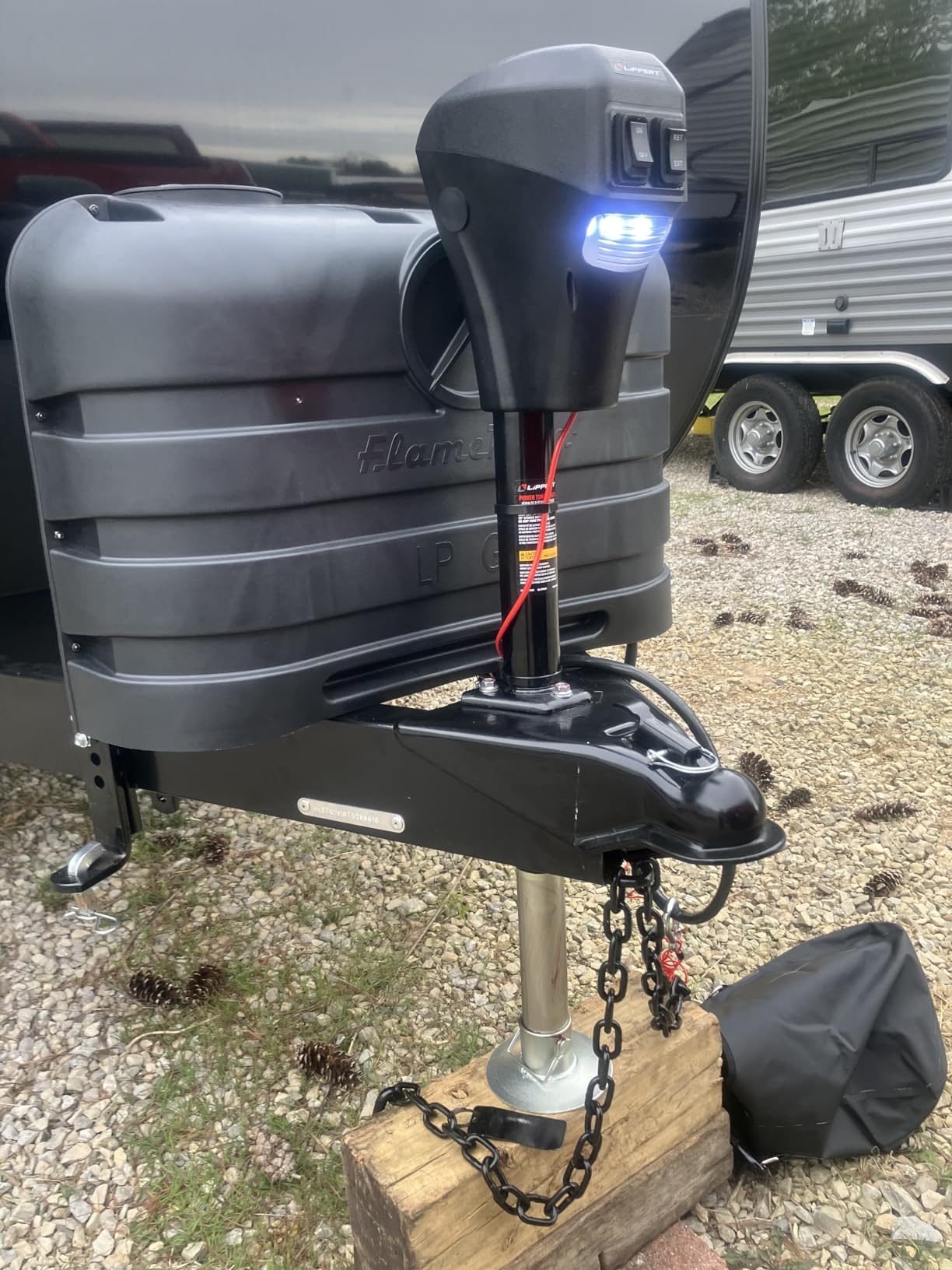
The spec that actually matters for a heavy trailer is the 18 inch stroke with a 10-3/4 inch retracted height and a 28-3/4 inch extended height. That is enough travel to lift a loaded coupler onto a ball sitting high on a truck bed without dropping to the frame. The 5-3/8 inch foot pad, clevis pin, and hairpin cotter pin all ship in the box, along with the hand crank that turns the whole thing into a manual jack when the battery is dead.
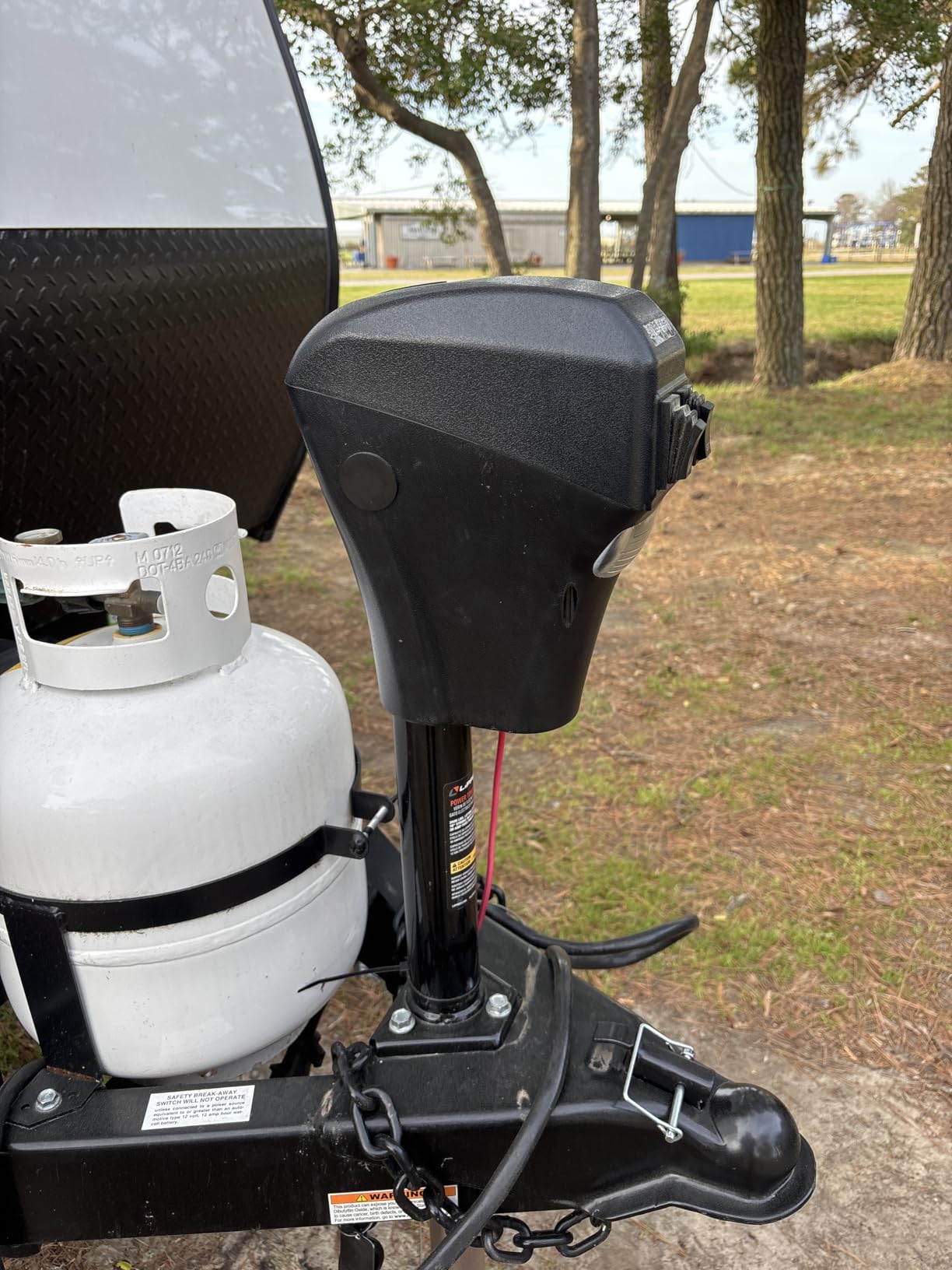
The 30-amp draw is the number to plan your wiring around. On a trailer with a single group 24 battery, expect the jack to be the heaviest load in the circuit during hitching, which is exactly why dual-battery setups became common once powered jacks spread. The gearbox is rated for that draw rather than for continuous running, so reviewers who leave the switch held down report slower travel and eventual heat.
Two caveats sit at the top of the review list. The jack head as shipped can foul a lowered pickup tailgate, and the fix is to rotate the mounting position 90 degrees, which several buyers did successfully. The side effect is that the LED cluster then points away from the coupler, so night lighting is a trade rather than a free win.
Will It Fit Your Hitch Clearance
Check the retracted height against your ball height before you buy. At 10-3/4 inches retracted, the coupler needs roughly that much clearance plus a ball of 2 inches, so a low coupler on a high ball is a problem this jack solves rather than causes.
Measure the vertical distance from the top of the ball to the ground too. If you are leveling on gravel or a soft pad, you want lift travel and a drop leg, not maximum retracted height, and this jack leans toward travel.
Where It Falls Short
This is a 3500 lb jack, so it is honest work for a travel trailer carrying 500 to 900 lb of tongue weight, not for a 12,000 lb equipment trailer at full load. The 1-year manufacturer warranty is also the shortest we saw among the higher-rated electric units.
If you tow solo and cranking is the reason you are shopping, this is the cheapest path to never cranking again. If you need more than 3500 lb of rated capacity, look at the 5000 lb manual options further down or the 7500 lb electric unit.
2. VEVOR 5,000 lb A-Frame Drop Leg Jack – Budget Pick Manual Upgrade
VEVOR 5000 lbs A-Frame Trailer Jack, 15″ Vertical Travel, Adjustable Drop Leg, for Horse, Utility, Yacht Trailers
5000 lb
9.65-24.64 inch lift
3-level drop leg
Galvanized tubes
Detachable handle
Pros
- 5000 lb rated capacity well above typical travel trailer tongue weight
- Carbon steel with galvanized inner and outer tubes
- Three-level drop leg levels the trailer on uneven ground
- Bolts or welds to the tongue and swivels up for clearance
- Detachable handle for emergency manual operation
Cons
- Detachable crank handle rather than a powered unit despite some listing copy
- Mounting hardware may need to be sourced separately
- Tighter internal tube clearances than premium jacks
This is the jack most people end up with when the factory 2000 lb leg starts to feel like it is about to fail. It rates 5000 lb, builds from carbon steel with galvanized inner and outer tubes, and weighs about 5 kg, which is a substantial step up in steel gauge from a lightweight factory swivel.
The lift range of 9.65 to 24.64 inches is generous for a manual jack, and the three-level drop leg is the feature that owners mention most. It lets you level a trailer on a sloped campsite pad without stacking wood or digging a pad flat. The whole jack swivels up parallel to the tongue for ground clearance, and it can be either bolted or welded on depending on whether you want it permanent or removable.
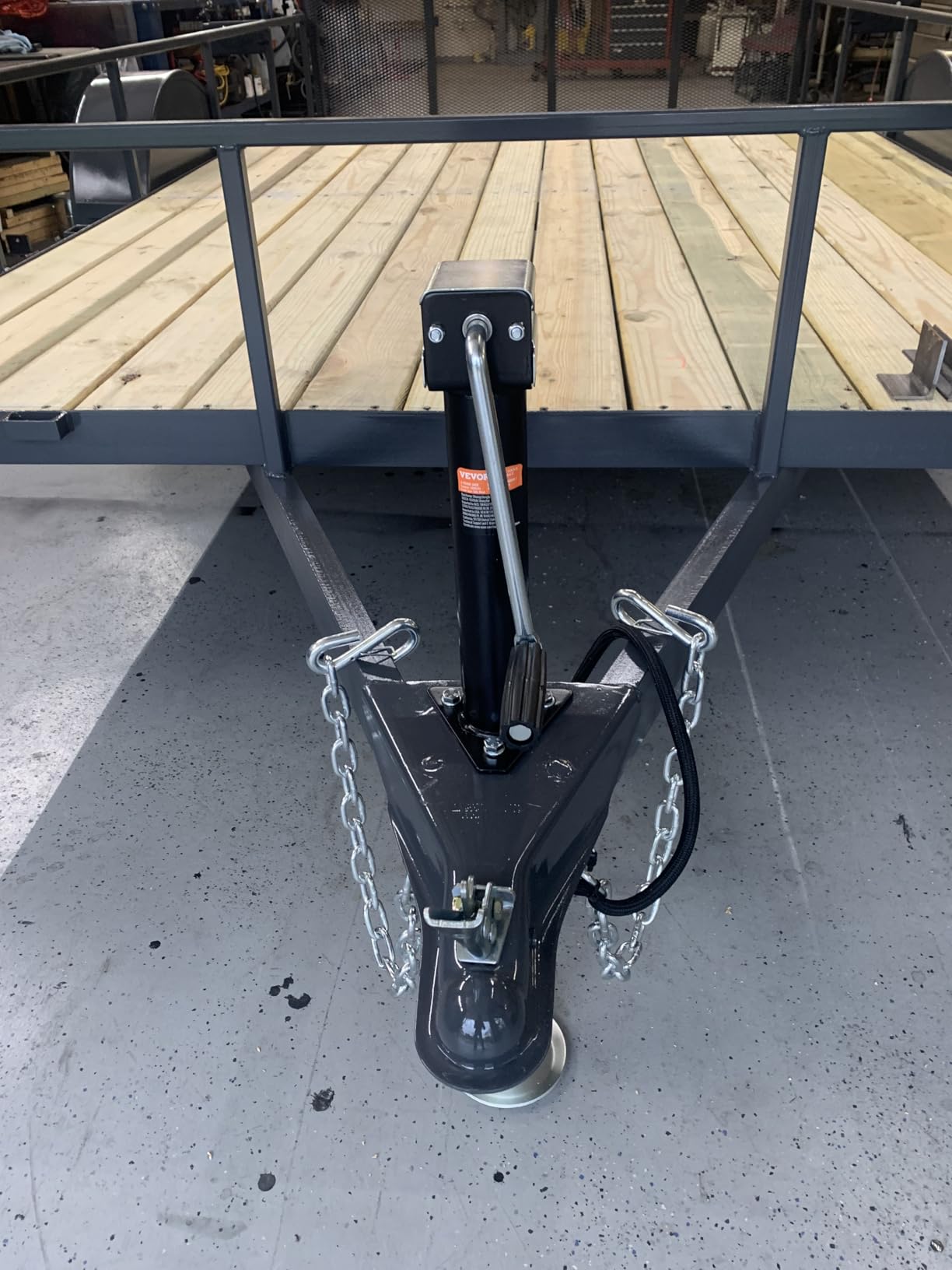
Reviews describe the crank as smooth for a manual unit, with 84 percent five-star ratings across 1,211 ratings. Several owners fitted it to horse and utility trailers as a direct replacement for a lighter jack and reported that cranking felt easier immediately, which is the expected result of moving from a 2000 lb rating to 5000 lb at the same tongue weight.
It also ranks near the top of its category in the retail listings we reviewed, which tells you something about volume. That matters in one specific way: replacement parts and handle assemblies are easier to find for a jack this widely sold than for a small-brand manual jack.
How It Compares on Crank Effort
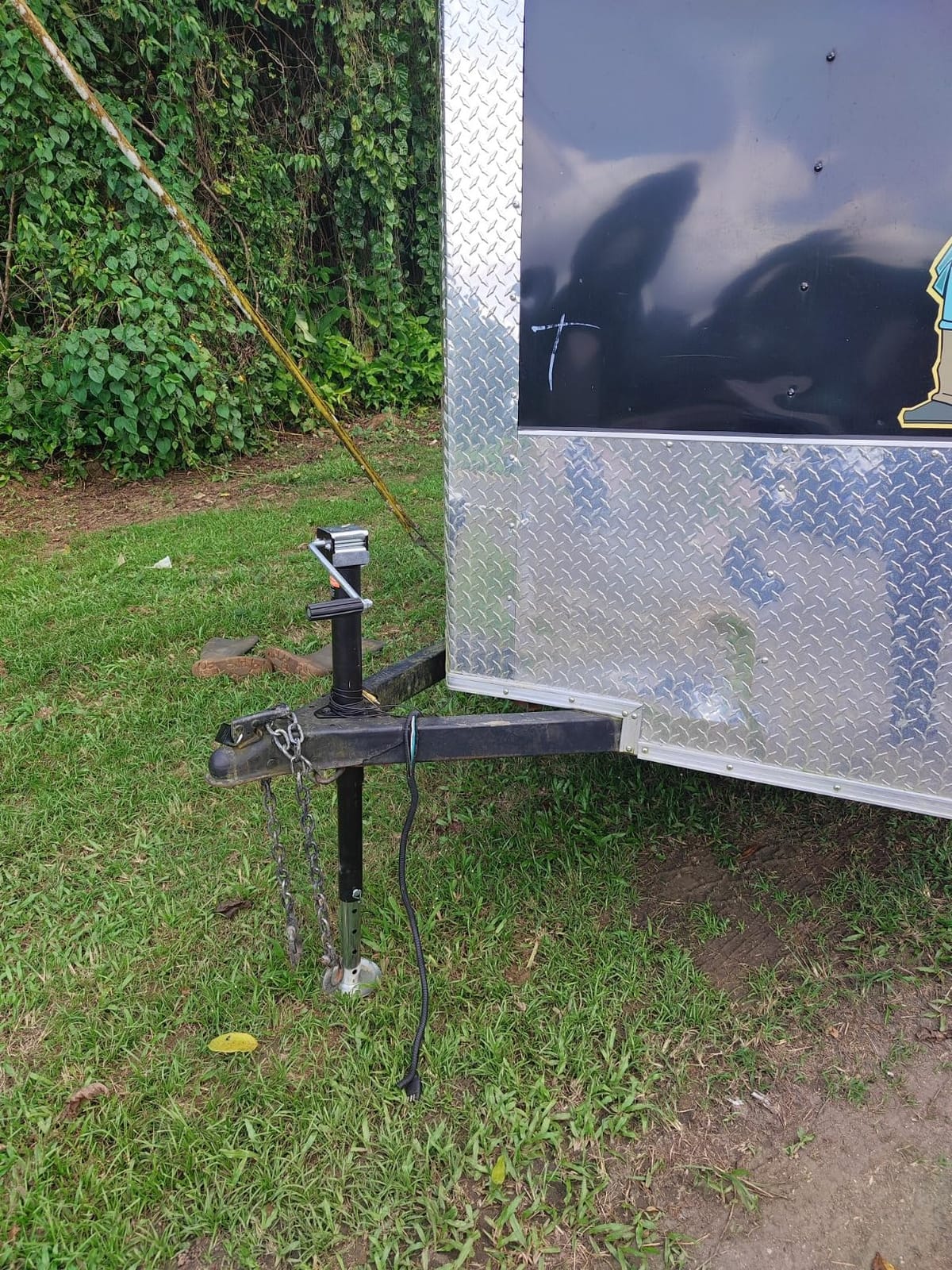
Crank effort is a function of the gear ratio, the tube diameter, and the tongue weight on the ball, not of the capacity label. Doubling your jack capacity while the tongue weight stays constant makes the handle noticeably lighter, which is why owners upgrading from a factory jack describe it as easier rather than merely stronger.
Expect steady resistance rather than a smooth, quiet spin. If you tow a trailer with a tongue weight above 900 lb, add a second person or a bottle jack for the last few inches of hitching.
What It Will Not Do For You
There is no motor here. If you are buying because cranking a 600 lb tongue by hand is the problem, this jack does not solve it, it just solves the durability problem. Owners upgrading purely for solo convenience should look at the electric units instead.
Count on supplying your own mounting hardware if you bolt it on, and check the tight internal tube clearance if you plan to run the inner tube over gravel with debris in play.
3. VEVOR 8,000 lb Square Weld-On Jack – Best for Dump and Equipment Trailers
VEVOR 8000lbs Heavy-Duty Square Direct Weld on RV Jack, 15-1/4 Inches Lift, Adjustable Drop Leg, for Lifting RV, Horse, Utility, Yacht Trailers, TJD-7000S
8000 lb
9.65-24.64 inch lift
Direct weld-on square tube
23.4 lb weight
Pinned drop leg
Pros
- 8000 lb rated capacity covers loaded equipment and dump trailer tongues
- Square tube design reviewers call stronger than round tube
- Welds directly to the tongue or to a fabricated lug
- Pinned drop leg cranks fully down and back up quickly
- Owners report clean welds with nothing missing from the box
Cons
- Fit and finish described as slightly sloppy with tight internal clearances
- Direct weld-on is a permanent installation without a fabricated lug
- One review reported a missing part in the box
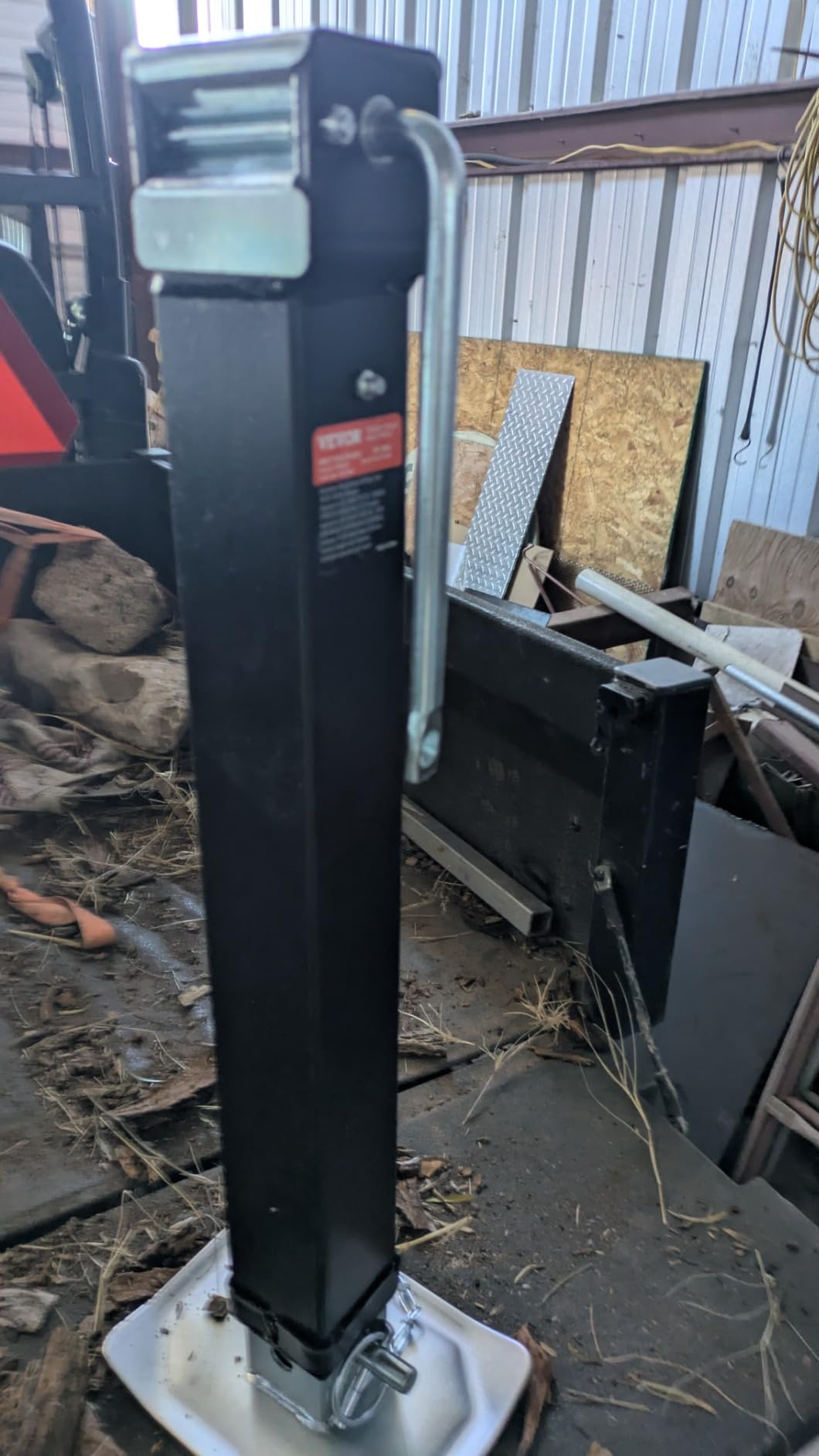
When a dump trailer is fully loaded or an equipment trailer carries a skid steer on the tongue, capacity is the only spec that matters. This square tube jack rates 8000 lb and weighs 23.4 lb, roughly four times the mass of a budget manual jack, and the square tube cross-section is the reason owners building fresh trailers keep choosing it over round tube designs.
The lift range runs 9.65 to 24.64 inches, and the direct weld-on mount is a deliberate choice rather than a compromise. Welding it to a lug plate you fabricate makes it removable later, which is how most builders approach it, and nothing is reported missing from the box in the installs owners describe.
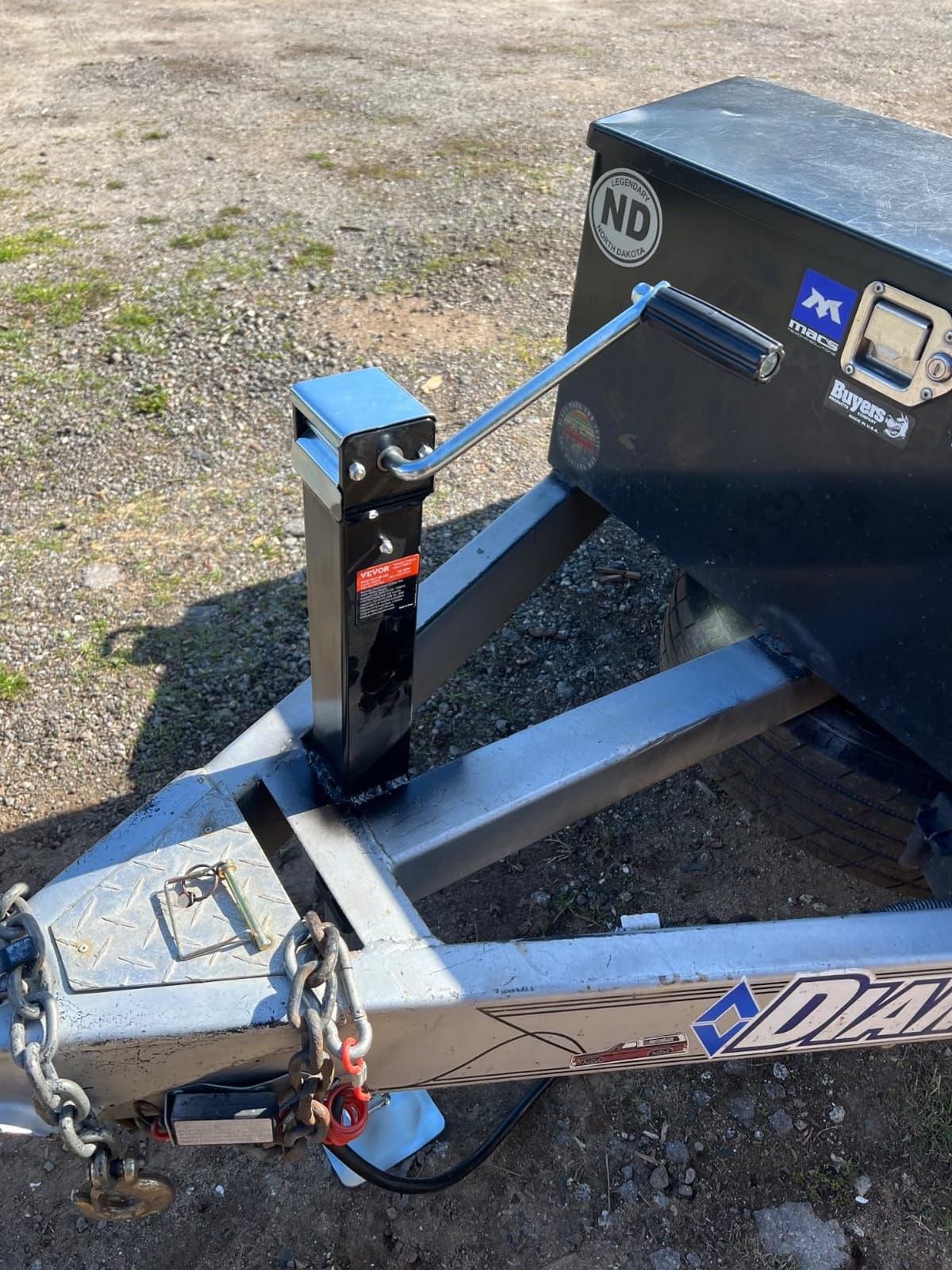
The pinned drop leg is a small design decision with a real payoff. Pin it up when you want the full inner tube stroke for hitching, pin it down when you want to shorten the jack so you can crank it in and out quickly. On a work trailer that gets loaded and unloaded several times a day, that saves more time than it sounds like.
At 419 ratings the review base is the thinnest in this roundup, so treat the 4.7 average as encouraging rather than conclusive. What the written reviews do agree on is that this is a clear step up from the flimsy factory jack on a new build, with square tube strength as the recurring theme.
Whether You Need This Much Capacity
Work out your real loaded tongue weight before committing. Owners on equipment forums size by payload rather than by trailer class, and the general rule is that a loaded tongue should stay near 10 to 15 percent of the trailer’s loaded weight, not its empty weight.
If your tongue weight lands under 1,000 lb, a 5000 lb jack leaves plenty of margin. Go to the 8000 lb class when you are carrying dense material like gravel, concrete, or a machine on the tongue.
Installation Tradeoffs to Accept
A direct weld-on is permanent unless you add your own lug. If you want the ability to remove and swap the jack in an afternoon, plan the lug plate before you order.
Owners also report slightly loose fit-and-finish and tight internal clearances, so budget a little time for alignment during the first crank cycle rather than expecting a plug-and-play fit.
4. YOMILINK 5,000 lb Trailer Jack – Best Manual Build Quality
YOMILINK 5000 lbs A-Frame Trailer Jack, 15″ Lift, Adjustable Drop Leg
5000 lb
23.2-45.6 inch range
5-level drop leg
14 lb weight
Grease nipple
Pros
- 4.8 average rating is the highest in this group
- Vertical crank handle easier to turn than a sidewinder
- Grease nipple included which most competing jacks omit
- Five-level drop leg plus two drainage holes in the base
- Owners describe it as noticeably heavier and better built than the jack it replaced
Cons
- Non-removable bottom plate complicates installs on low-clearance tongues
- Included mounting bolts are short with limited thread length
- No guidance on which grease to use at the nipple
The YOMILINK YM-TJS-5K holds a 4.8 average across 459 ratings with 88 percent five-star marks, and the written reviews explain why: owners keep describing the jack as heavier and more over-engineered than the unit it replaced. At 14 lb it is not a lightweight manual jack, and that mass is the first thing you feel when you pick it up.
Height range is 23.2 to 45.6 inches, which makes it one of the taller manual jacks in the group and a natural fit for taller trailer frames and boat trailer bunks. The five-level drop leg is more granular than the three-level adjustment on most competing jacks, so fine levelling on uneven ground is easier.
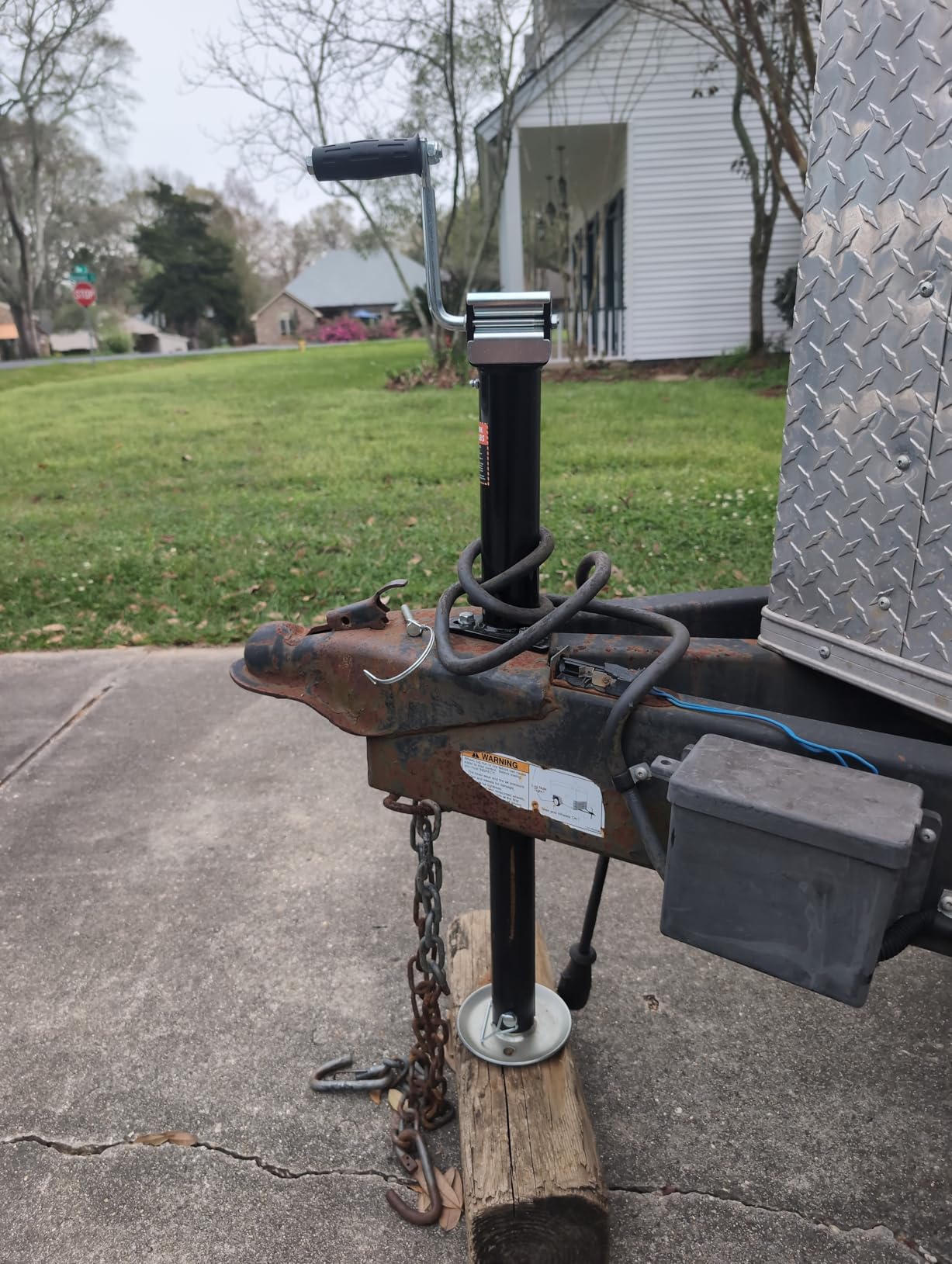
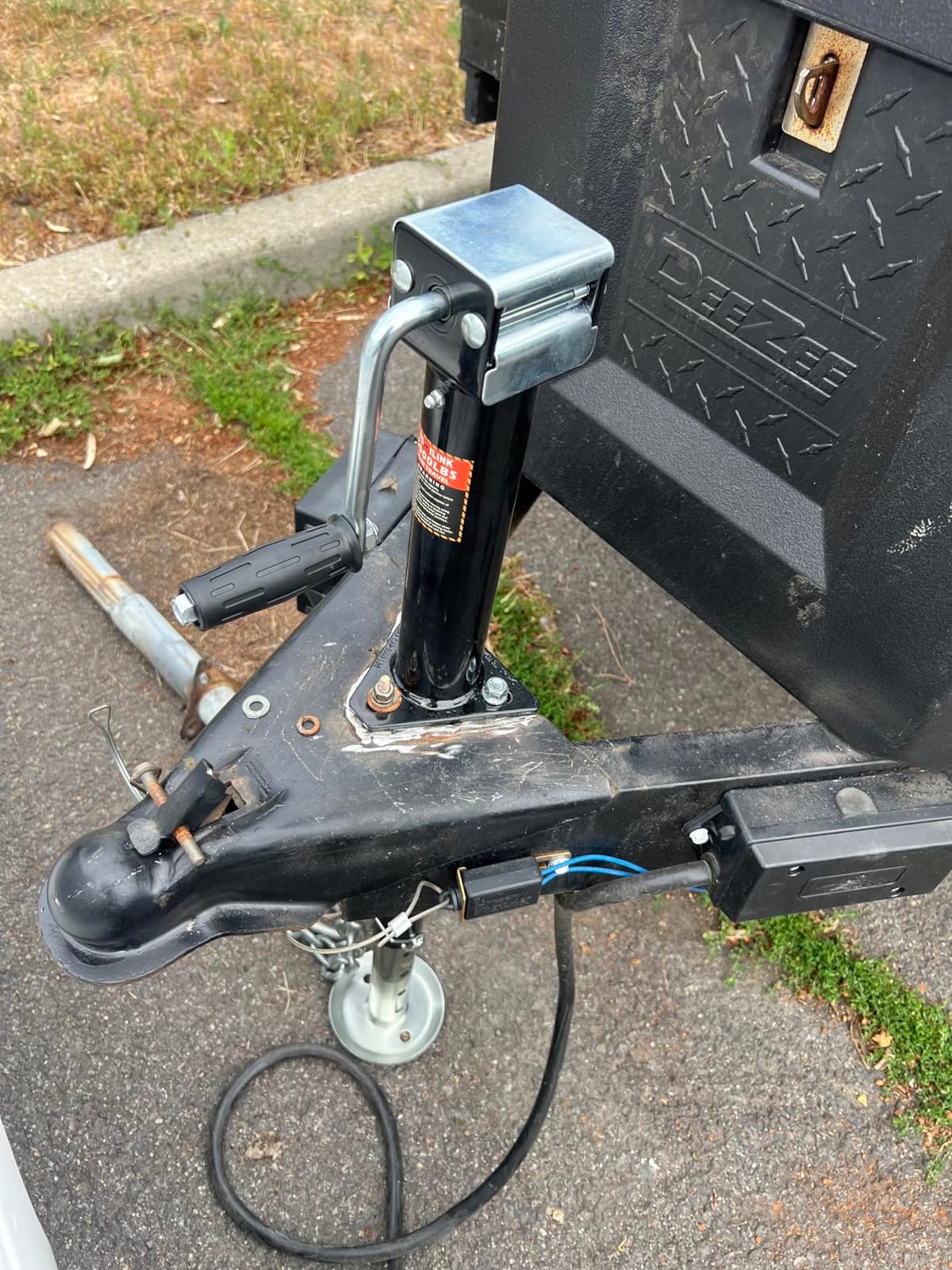
Two details separate it from the manual jack crowd. The vertical crank handle gives more turning force at the top of the stroke than a sidewinder, which matters when you are raising a heavy tongue. And the grease nipple is a genuinely rare inclusion at this level, which means the screw can be serviced instead of being left to seize.
It also bolts or welds to the tongue, uses high carbon steel with galvanized tubes and a powder finish, and comes with Grade 5 or GB 8.8 studs. Owners list compatibility across travel, horse, utility, boat, and marine trailers, and several report flawless operation after long road trips.
Plan Around the Bottom Plate
This is the single most important thing to know before buying. The bottom plate is not removable, so on a low-clearance tongue you may have to raise the tongue with a separate jack to get the unit into position.
Measure your tongue height and mounting clearance before you order. If you have room to work underneath the frame, this installation takes minutes. If you do not, a jack with a removable base is the safer pick.
Why Owners Rate It So Highly
The recurring language is smoothness at the handle and build weight. Several owners note that cranking resistance stays even through the stroke instead of surging, which is what a properly cut screw and a serviceable gearbox look like in use.
The short included bolts and the missing grease guidance are packaging complaints rather than design flaws. Plan to source your own hardware if your tongue plate is thick.
5. VEVOR 7,500 lb Electric Power Tongue Jack – Best for Boat and Heavy Equipment Trailers
VEVOR Electric Trailer Jack, 7500 lbs Capacity, Electric Power Tongue Jack with Waterproof Protective Cover & LED Light for Travel Trailer, Camper, RV, 9.84-33.85 in Lift, 12V DC with Wiring, Black
7500 lb
9.84-33.85 inch lift
5-position drop leg
Handheld remote
90 degree base
Pros
- 7500 lb rating handles loaded boat and equipment trailer tongues
- Handheld remote raises and lowers without bending over the coupler
- 90 degree clockable base holes clear a pickup tailgate with no drilling
- Weather cover
- LED light and top crank included for power loss
- Two-year manufacturer warranty
Cons
- 4.3 average is the lowest in this group with 9 percent one-star reviews
- Lift speed is slow for a power unit
- Remote is another component that can be lost or damaged
- Coated tubes and cover are needed to keep the mechanism protected
At 7500 lb this is the highest-capacity electric unit in the group, which puts it in a different weight class from the 3500 and 5000 lb powered jacks. It is aimed at boat trailers and equipment trailers where the tongue carries a transom, a fuel tank, or a machine, and the lift range of 9.84 to 33.85 inches covers very low to very high couplers.
The five-position drop leg adds 6 inches of adjustment, so the total working range is wide enough that one jack fits a wide spread of trailer geometries. The handheld remote is the feature owners praise most, because you can stand at the driver’s door and watch the coupler rather than crouching at the tongue.
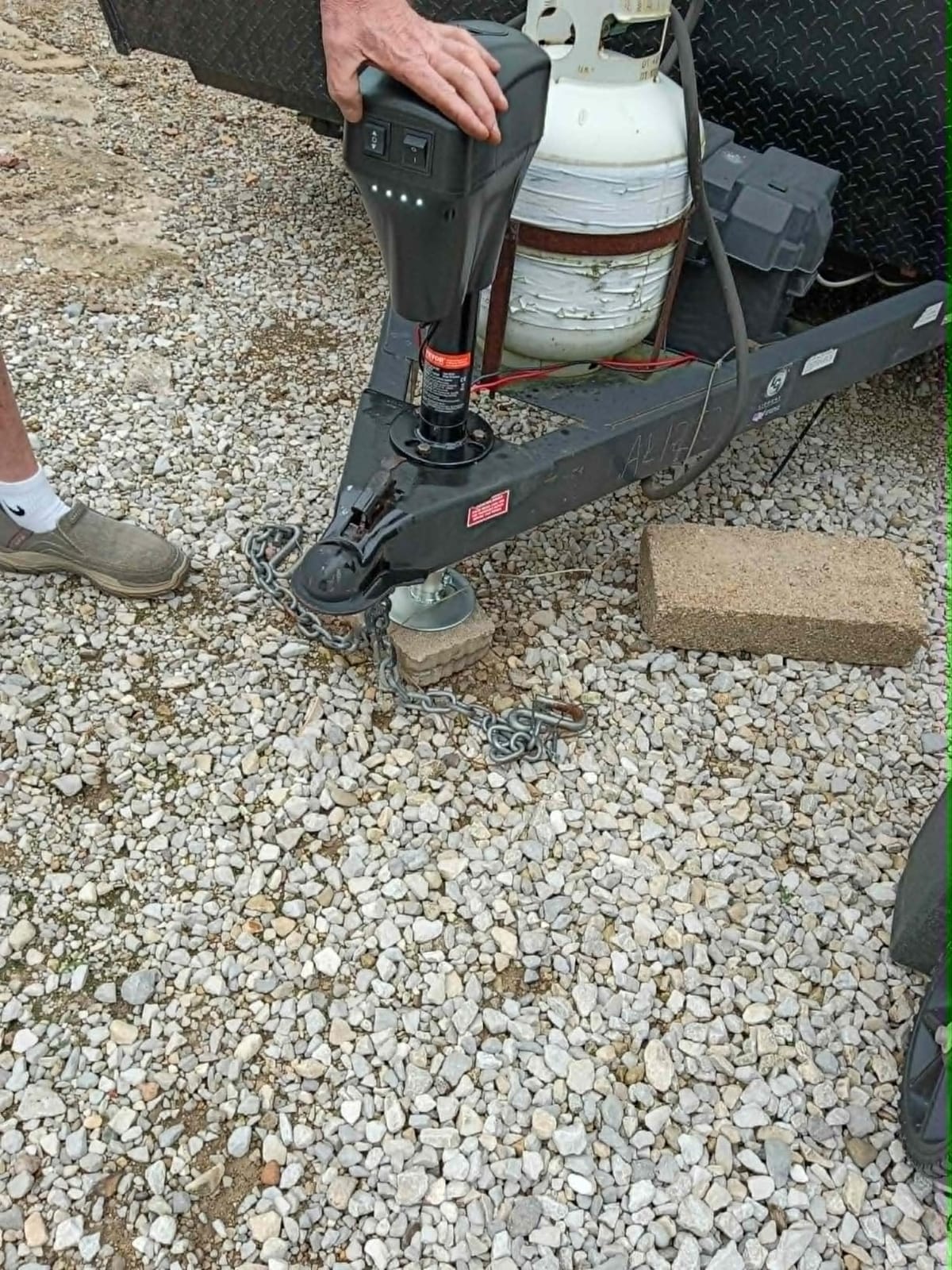
The 90 degree rotating base holes are a thoughtful solution to a problem that generates an enormous number of complaints on other jacks. Instead of drilling the tongue to clear a lowered tailgate, you clock the jack a quarter turn in its existing pattern. That single feature can decide the install for pickup owners.
Power is 12V DC with a wiring harness included, plus a rocker switch and a top-mounted manual crank for the day the battery is flat. A waterproof protective cover and an LED work light are both in the box, and the warranty runs two years.
Reading the Rating Honestly
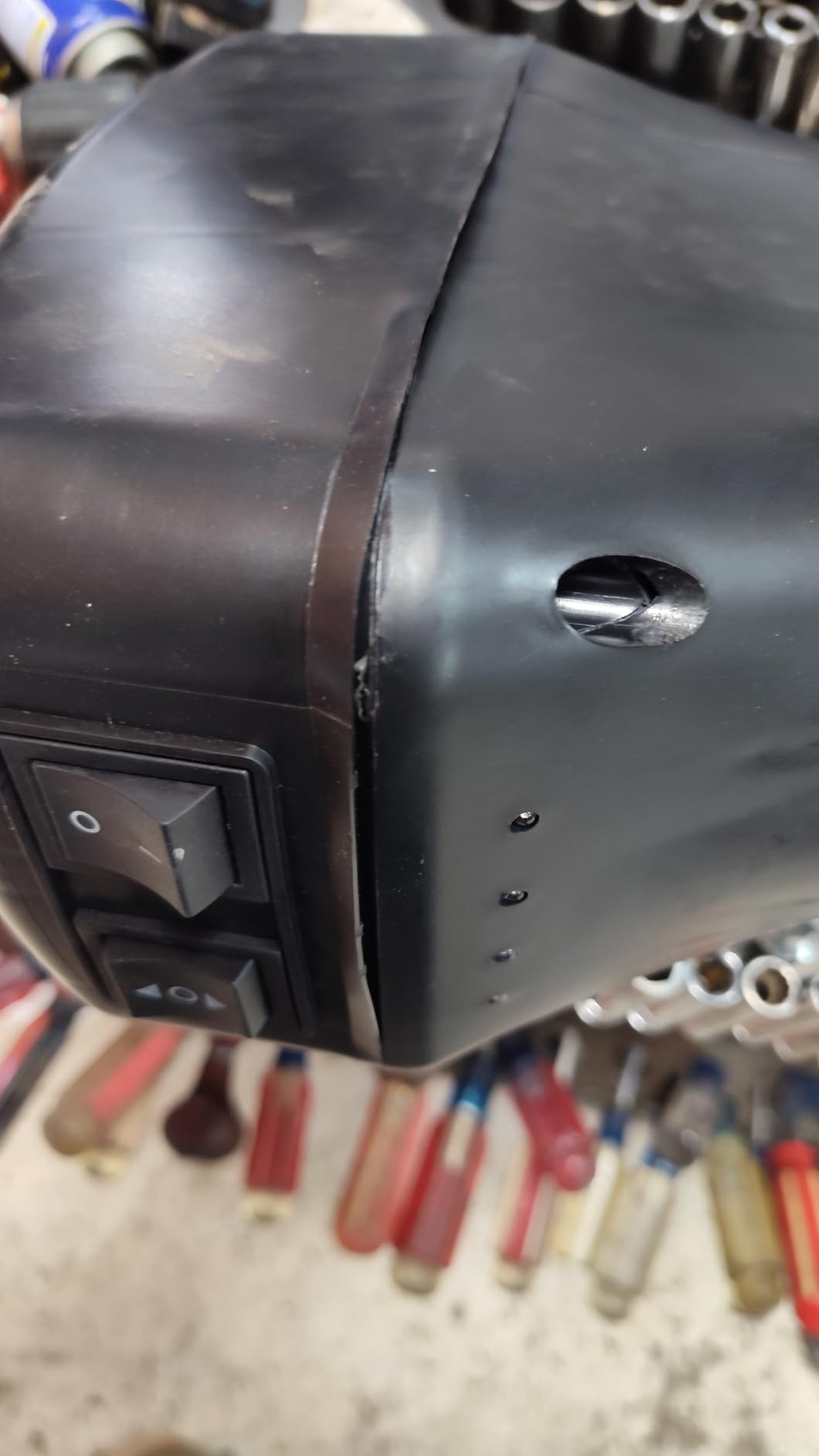
The 4.3 average with 9 percent one-star reviews is the lowest here, and the pattern in the written reviews is consistent: people like the feature set and are less sure about the finish. Durability complaints appear more often in this review set than in the manual jacks.
That is a reasonable trade if you need the capacity and the remote. If your tongue weight is under 900 lb, a 5000 lb unit will carry it with a better long-term record.
Installation and Weathering
Clocking the base to clear a tailgate takes minutes and no drilling, which makes this the easiest install of the large electric units. Plan the wiring run before you mount it, and secure the harness away from the sharp edge of the tongue plate.
Keep the cover on. The coated tubes and the cover are what keep water and road salt out of the gearbox, and coastal owners who leave a powered jack exposed report corrosion problems faster than manual jack owners do.
6. Kohree 5,000 lb Electric Tongue Jack – Best Premium Electric Upgrade
Kohree Electric Trailer Jack 5000lbs with Wiring, Heavy Duty A-Frame
5000 lb dynamic, 7500 lb static
9.8-31.7 inch range
5-gear drop leg
Auto-reset breaker
Pros
- 5000 lb dynamic capacity with 7500 lb static lifting power
- Five-gear drop leg adds 8 inches of adjustment
- Two LED lights and a weatherproof cover in the box
- Circuit breaker auto-resets after about two minutes
- Multiple owners completed installation in under 30 minutes
Cons
- Supplied power wire is too short to reach the battery in some trailers
- Unit cannot be rotated to clear a truck tailgate
- One report of a bent foot pad after three uses
- Running past the marked limit can damage the gears
Splitting the rating into dynamic and static figures is a smarter way to specify an electric jack, and this one is listed at 5000 lb dynamic with 7500 lb static. The static number is the load with the trailer stationary, which is exactly what a tongue jack does. The dynamic figure covers the case where you extend or retract under load.
The five-gear drop leg adds 8 inches, more adjustment than most competitors, and combined with a 9.8 to 31.7 inch range it covers both low and high coupler positions. Two LED lights and a weatherproof cover are included, and the built-in circuit breaker auto-resets after roughly two minutes instead of requiring a fuse swap.
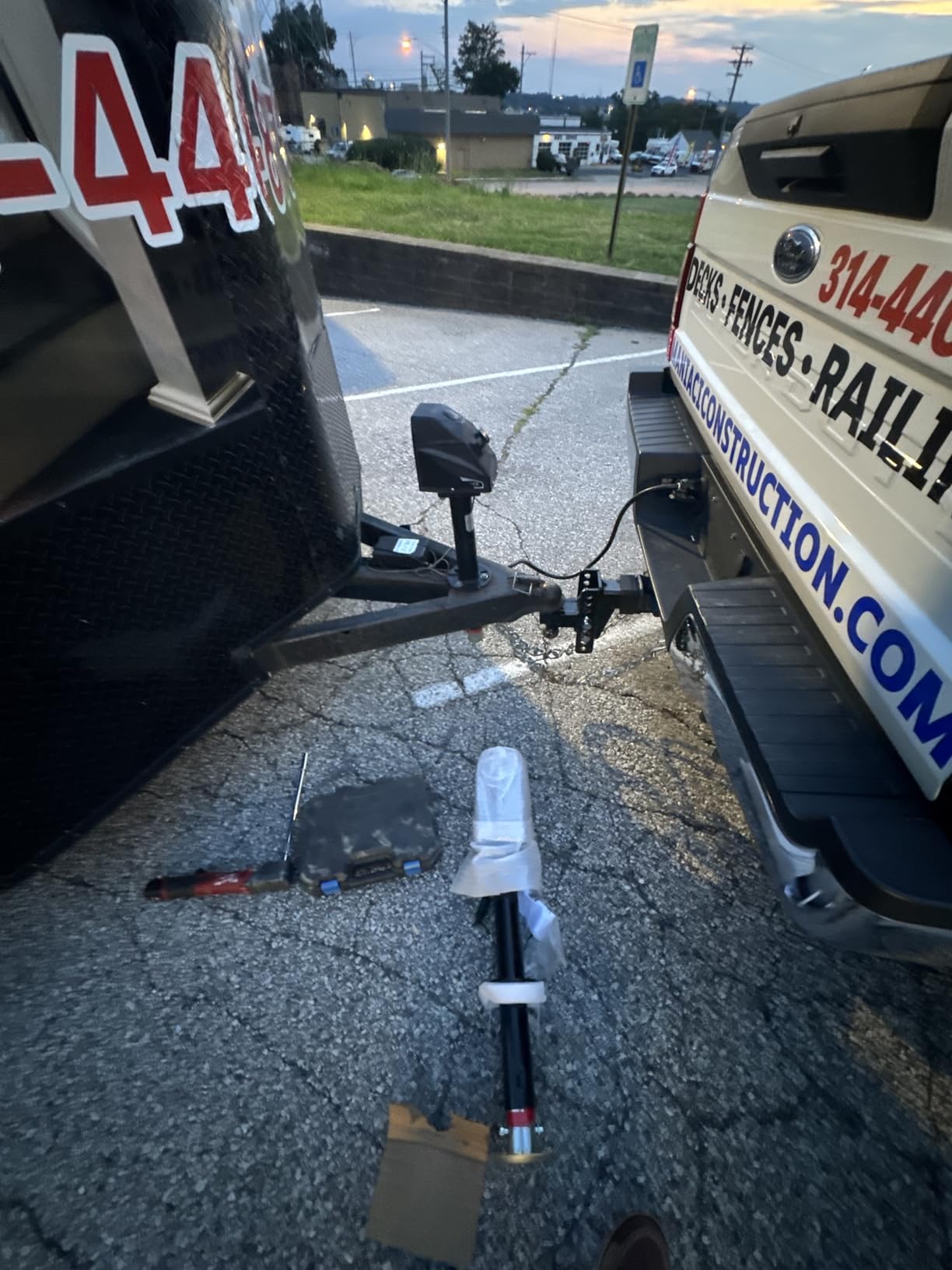
Owners consistently describe this as a worthwhile upgrade from a hand crank, and several mention the setup-time saving in plain terms. The rocker switch is clearly marked retract and extend in white lettering, which sounds trivial until you are cranking around a dark trailer tongue looking for it.
Quiet operation comes up repeatedly in the reviews, and multiple owners report finishing the install in under half an hour with the included mounting bolts, provided the tongue plate pattern matches.
Plan the Wiring Before You Mount
The most common installation complaint is that the supplied power lead is too short to reach the battery on longer trailers. Measure the run from the jack to your battery first, and plan on extending the wire with a proper butt connector and a ring terminal rather than a twist and tape splice.
Size the circuit for the 12V DC motor and use an inline fuse close to the battery. A blown inline fuse is one of the most reported problems on powered jacks, and a fuse that sits in a wet, exposed connector is a fuse that will fail eventually.
What to Watch Long Term
The head is fixed, so it will not clock away from a lowered tailgate. Measure your clearance before buying, and plan where the truck sits relative to the tongue every time you hitch.
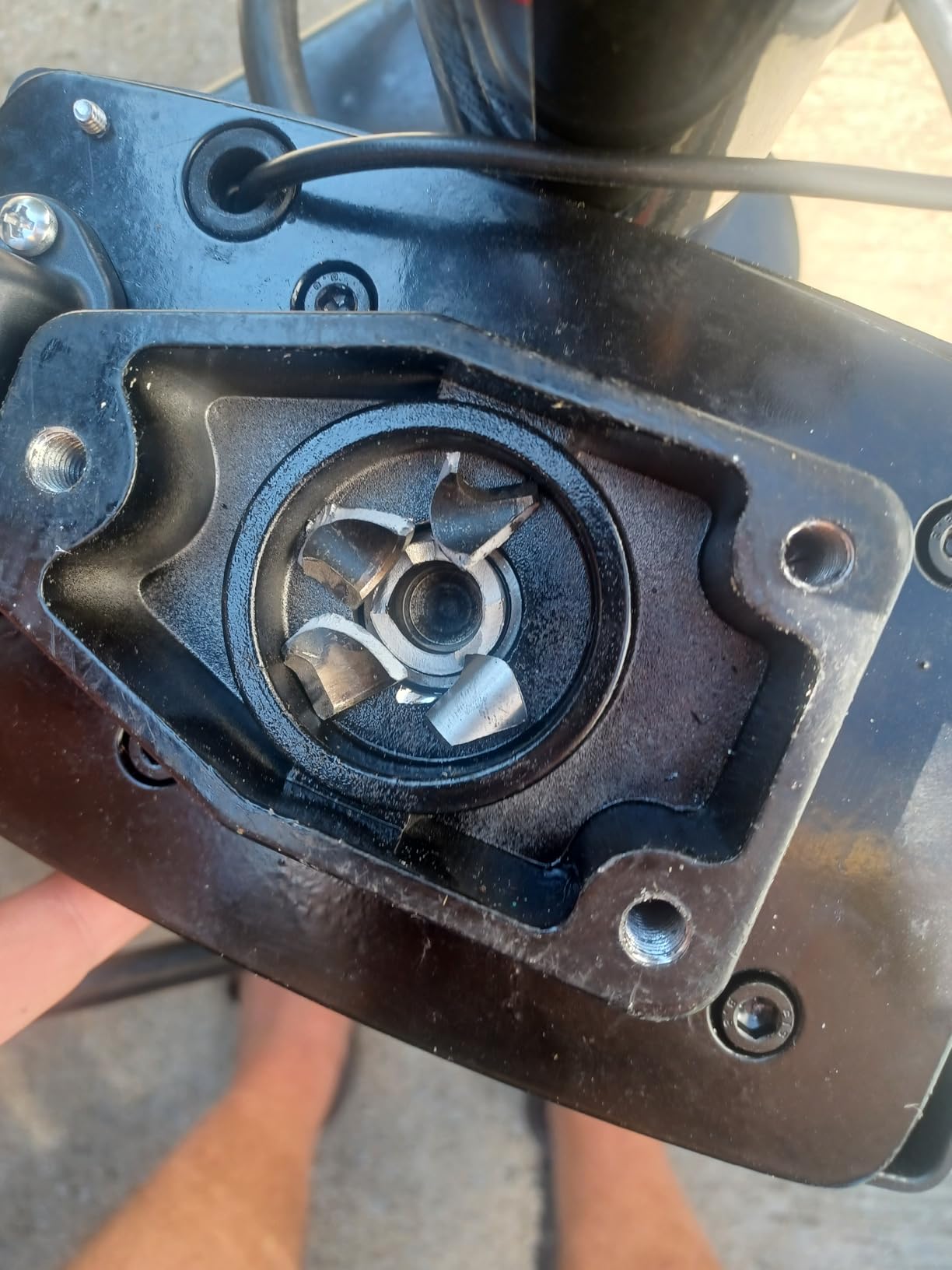
One owner reported a bent foot pad after only three uses with a declined replacement, which is an isolated report rather than a pattern. The more common long-term error is extending past the marked limit, which overtravels the mechanism and damages the gears.
7. POLESTAR 5,000 lb Electric Tongue Jack – Best for Smooth Ball Screw Travel
POLESTAR Electric Trailer Jack, 5000lbs Electric Power A-Frame Tongue Jack
5000 lb dynamic, 7500 lb static
Ball screw drive
9-27 inch travel plus 4.5 inch drop leg
Pros
- Ball screw design gives smoother and quieter travel than screw jacks
- Drops in over standard electric jack footprints without rework
- Owners report it is far quieter than the factory jack it replaced
- Handles a 7000 lb dry-weight trailer and a 3-ton dump trailer
- Rain cover
- crank and LED lighting all included
Cons
- Mounting position is fixed so a lowering tailgate can contact it
- Supplied inline fuse is a non-standard type that is hard to source
- Several reports of the unit going dead after limited use
- Only a one-year warranty
The mechanical difference in this jack is the ball screw paired with a brake motor. A ball screw rolls instead of sliding, which reduces friction and wear, and the brake motor holds position when the power is cut. Owners describe the travel as noticeably smoother, quieter, and more controlled than a conventional screw jack.
It is rated 5000 lb dynamic and 7500 lb static, with a 9 inch retracted to 27 inch extended travel plus a 4.5 inch drop leg for 31.5 inches of total adjustment. Several owners report it handled a 7000 lb dry-weight trailer and a 3-ton dump trailer without complaint, which puts the real-world ceiling above the label.
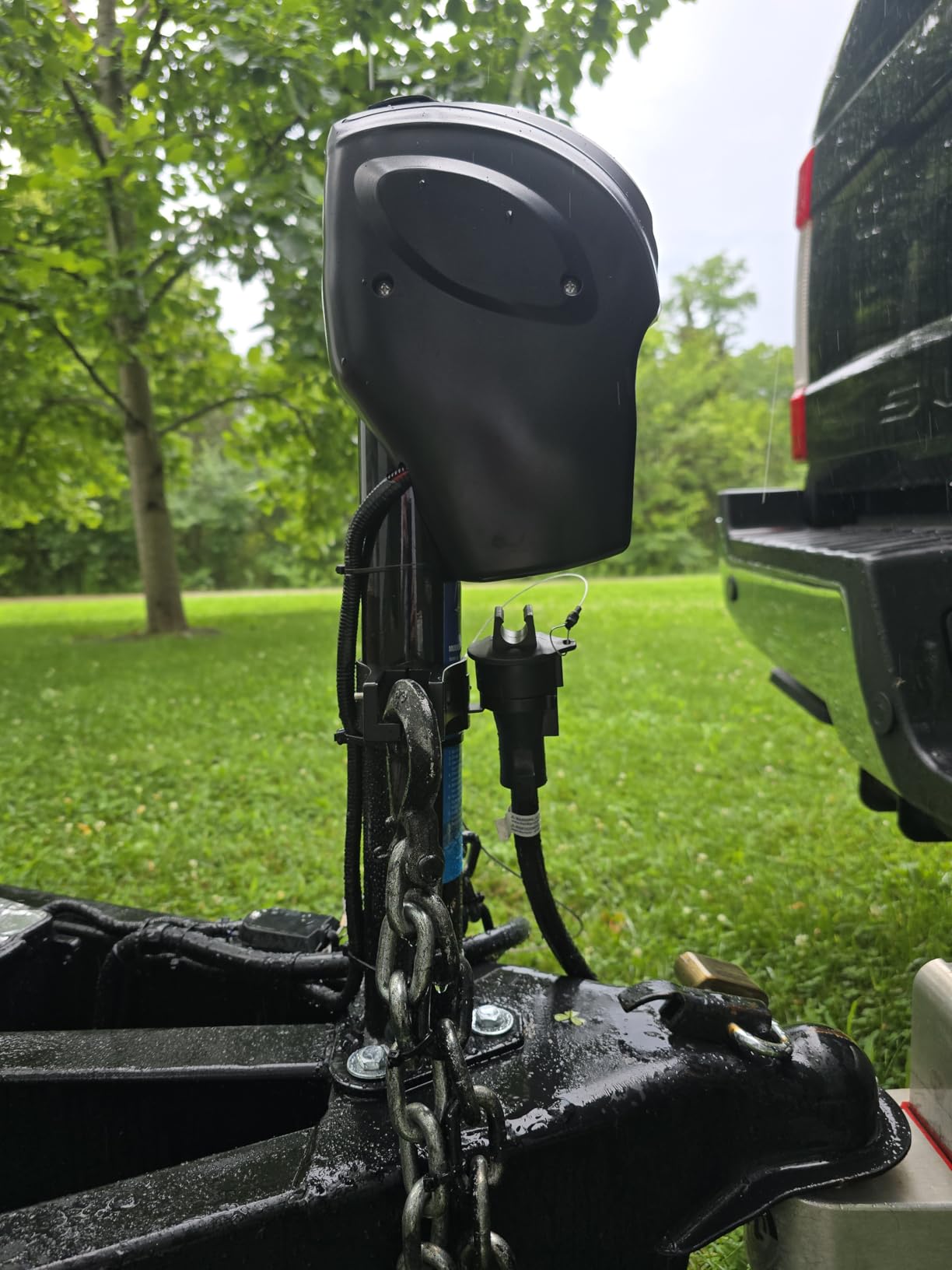
The dimensional overlap is the practical win here. At 7.28 by 9.84 by 32.28 inches, it lines up with standard electric jack footprints, so owners replacing an existing electric jack report a clean swap with minimal tongue modification. The self-grounding arrangement and the included weather cover simplify the install further.
Quiet operation gets specific praise. Owners who replaced a noisy factory jack say the difference is the feature they notice most at a campground, and the LED lighting is a bonus for dark arrivals.
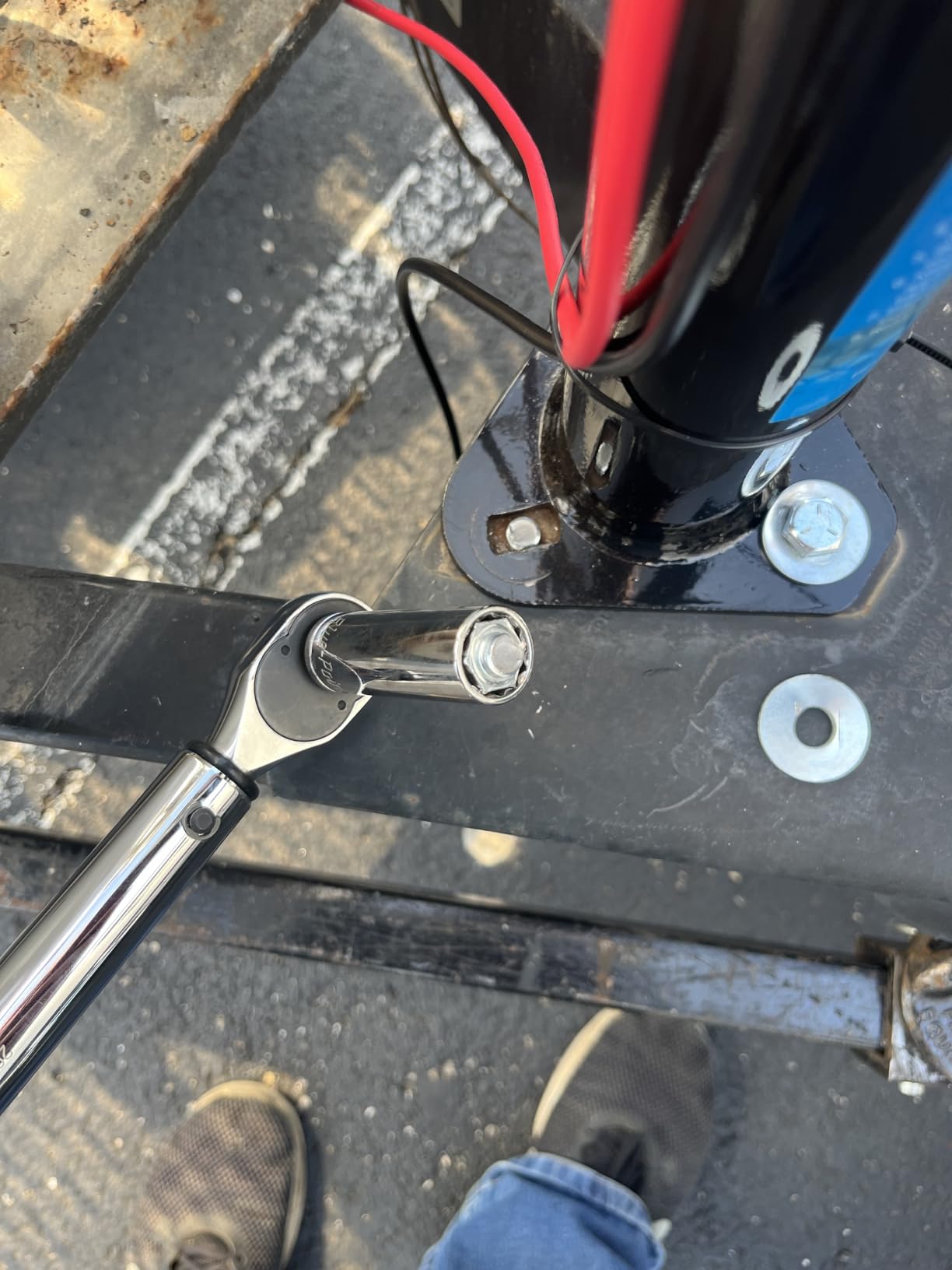
Watch the Inline Fuse Type
One of the more actionable complaints across all powered jacks in this roundup is the inline fuse. On this unit the supplied fuse is a non-standard type, and if it opens you may struggle to find a replacement locally when you need it most.
Find out what the fuse type is before the failure, and carry a spare. Keep the fuse holder above the splash line, away from the lowest point of the tongue, and check it as part of your pre-trip routine.
Reliability Expectations
At 4.4 across 861 ratings, this sits mid-pack for reliability, and the negative reviews cluster on electrical issues. Several reports of the unit going dead after limited use turned out to trace to a trailer-frame circuit breaker rather than the jack itself, which is worth checking first if yours stops responding.
The fixed mounting position is the practical limitation. If your truck has a tailgate that drops lower than the jack head, verify the clearance before ordering.
8. Bastion 5,000 lb Top-Wind Manual Jack – Best Topwind Drop-In Replacement
Bastion Distribution Top-Wind A-Frame Trailer Jack with Rectangular Footpad | 5000 lb Manual Crank Tongue Jack | Great for RVs, Campers, Boats, Utility Trailers & More | BJ-5000TW-1 / RFP
5000 lb
14.8 inch vertical travel
Pre-mounted rectangular footpad
11 lb weight
Pros
- Stepping up to 5000 lb makes cranking noticeably easier
- Rectangular footpad and retaining clip ship pre-assembled
- Build quality exceeds expectations for the price band
- Fits standard trailer mounting holes as a direct replacement
- Backed by a warranty with U.S.-based customer service
Cons
- Cranking effort still rises with heavy tongue weight and gearing feels low
- Mounting bolts are not included
- Only a 6-month warranty
- the shortest in this group
Topwind jacks are the traditional choice for travel trailers and boat trailers, and this 5000 lb unit is a straight upgrade over the 2000 lb leg most of those trailers ship with. The 14.8 inch vertical travel is a useful amount of stroke for coupling up, and the rectangular footpad spreads the load on soft ground better than a small round pad.
What stands out in the reviews is what arrives assembled. The footpad and retaining clip ship pre-mounted, and several owners specifically note that competing jacks at this level omit them. The powder-coated alloy steel also gets called out as better than expected for a jack in this price band.
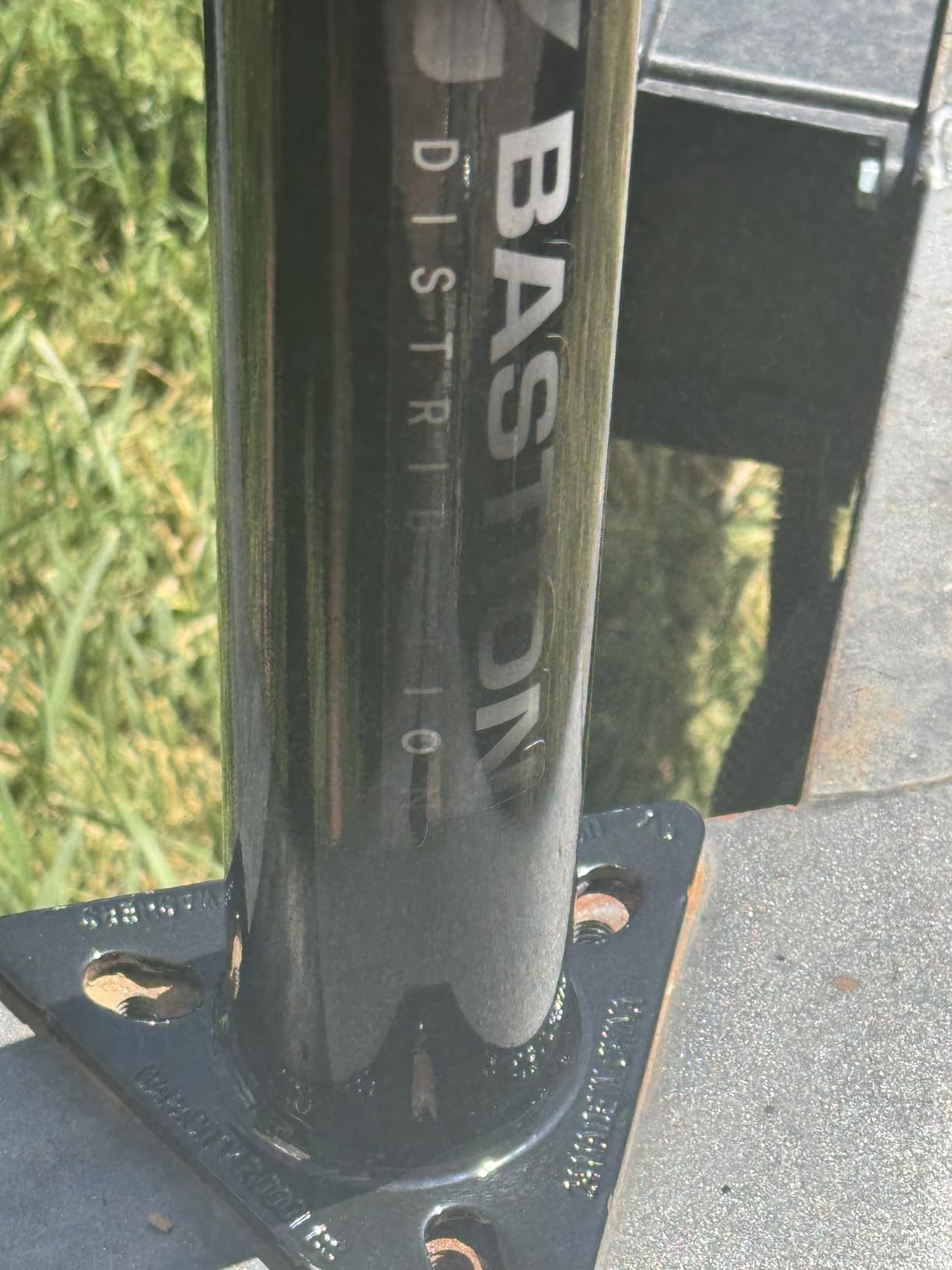
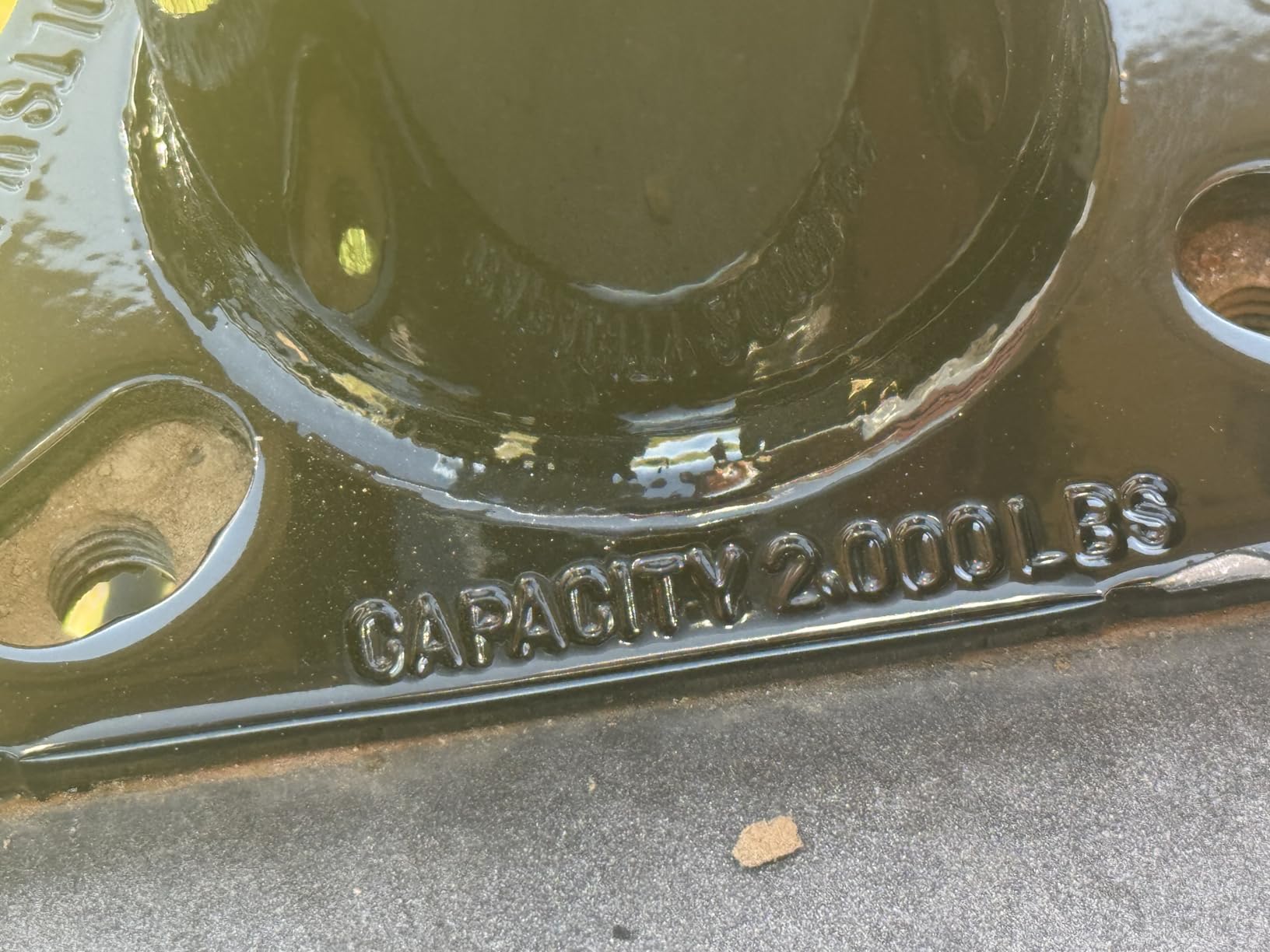
Owners replacing an under-rated factory jack report two things at once: the lift got stronger and the cranking got easier. That is the same mechanical relationship as any capacity upgrade, because crank effort at a given tongue weight falls as the screw and gearbox rating go up.
The 4.7 average across 425 ratings sits alongside the other well-regarded manual jacks here, and the fit as a direct replacement for standard mounting holes means most installs need nothing more than a wrench.
Who This Jack Is Not For
It is not for you if cranking is the reason you are shopping. Owners do report that cranking effort rises noticeably with heavy tongue weight and that the gearing feels low, so a 900 lb tongue is still two-handed work.
If your trailer is a work trailer that gets moved several times a day, look at a powered unit instead. This jack is a durability and capacity fix, not a convenience fix.
Details Worth Checking
Mounting bolts are not included, so factor your own hardware into the install. The footpad geometry also matters on soft ground: a wide rectangular pad sinks into mud less than a narrow round one but still wants a board under it in soft ground.
The warranty is 6 months, the shortest in this roundup, so treat this as a value purchase rather than a long-term investment. At 11 lb it is also the lightest manual jack here, which makes it easier to handle during installation.
9. Bulldog 3,500 lb Powered Jack – Best Warranty Coverage
Bulldog 500187 Powered Trailer Jack, A-Frame, 3,500 lbs. Lift Capacity, Bolt-On, 14 Inch Travel, Black Cover
3500 lb
14 inch lift plus 8 inch drop leg
22 inch total travel
5 year warranty
Pros
- Five-year warranty is the longest in this group
- Multi-hole round mounting plate allows a 90 degree install for tailgate access
- Drop shank shortens the distance the jack must travel
- Integrated gearbox and motor run smooth and quiet
- Installs in about 15 minutes with three bolts and a single wire
Cons
- Highest cost in this group by a wide margin
- Power wire is too short and required splicing on one install
- Included hardware mixes Grade 5 bolts with lower-grade washers and locks
- Display-style shipping box is easily damaged in transit
- Overrunning the travel range can bottom out the jack and bend the coupler
The warranty is the headline here. Five years is the longest in this roundup, and the review that matters most in this category mentions a unit still working reliably after 18 months of monthly trips. Buyers who upgrade from a hand crank or a failing factory jack cite strong torque and smooth travel as the reasons the premium is worth paying.
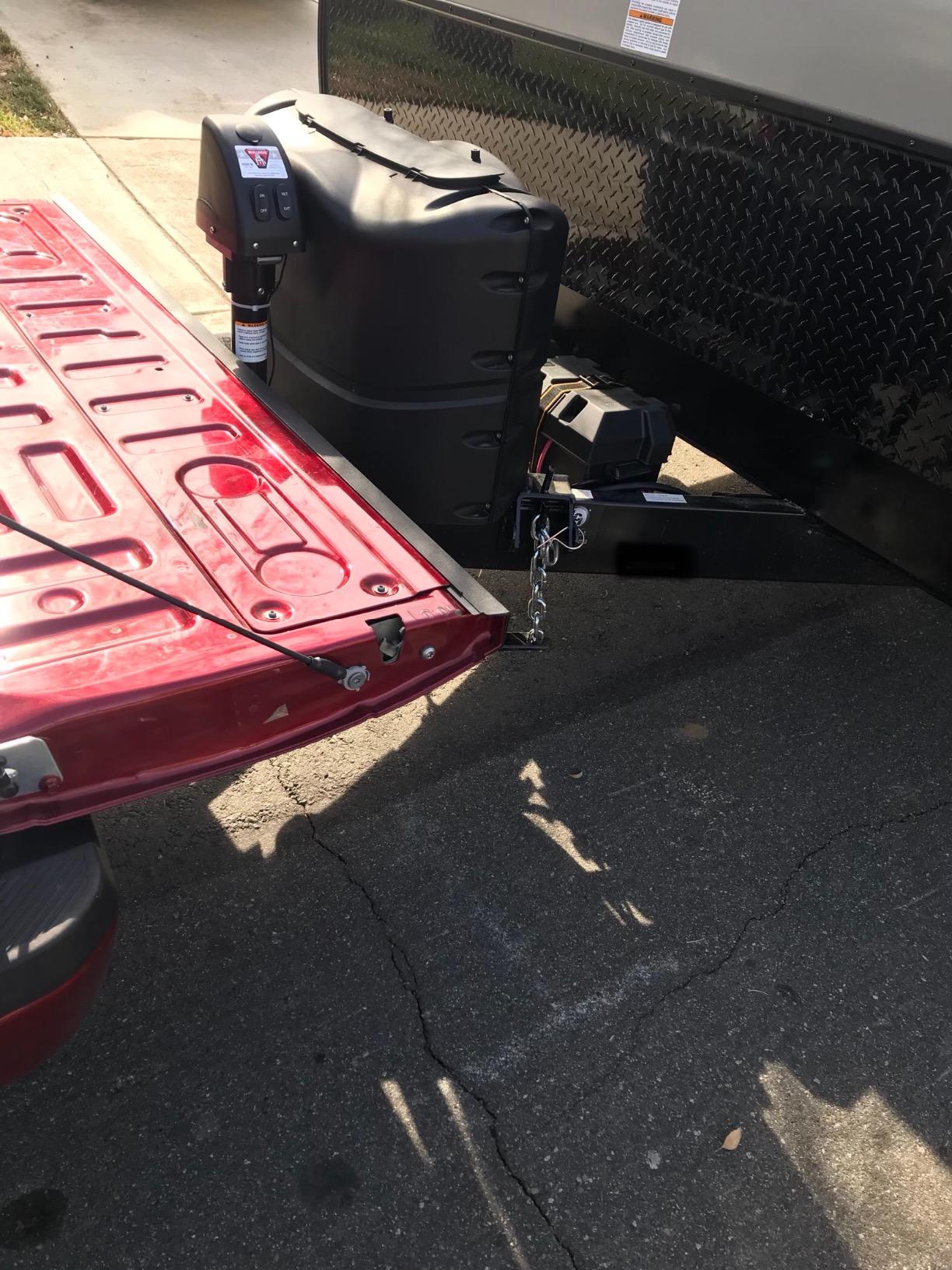
Total travel is 22 inches, made up of 14 inches of lift plus an 8 inch drop leg, and the drop shank cuts the distance the jack has to travel, which speeds up leveling. The multi-hole round mounting plate allows a 90 degree install so the head clears a pickup tailgate without moving the unit.
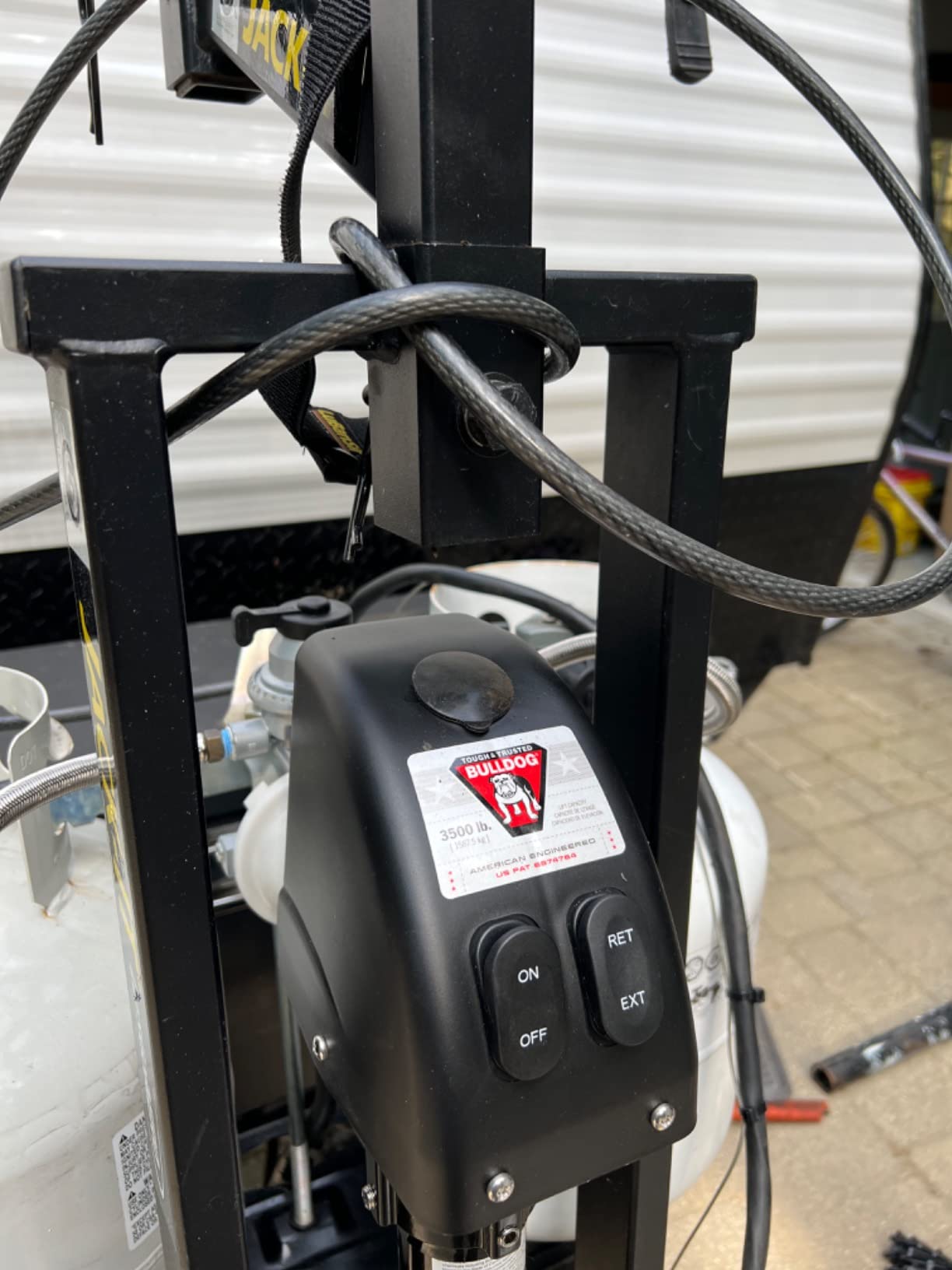
The onboard LED courtesy light is angled to illuminate the coupler, not the ground, which is the correct aim for night hookup. An emergency manual override crank is included, so a dead trailer battery does not strand you on a dark drive-in.
Installation is reported at about 15 minutes with three bolts and a single wire, which is as simple as a powered jack install gets. The integrated gearbox and motor assembly runs smooth and quiet according to owners who replaced much louder units.
Is the Premium Worth It
You are paying for three things: a five-year warranty, a torque curve that does not bog down under load, and hardware you do not have to uprate. Owners who wanted the cheapest possible install often find themselves replacing the supplied washers and locks with Grade 8 hardware anyway.
At 3500 lb rated capacity this suits a travel trailer in the 500 to 900 lb tongue weight band. It does not suit a loaded equipment trailer, regardless of the build quality.
Two Handling Notes
Do not run the jack past its marked travel range. Owners report that overrunning the range can bottom the mechanism out and bend the coupler, which turns a small mistake into an expensive one.
Two other practical points: the power wire is short enough that one install required splicing, and the display-style shipping box is easily damaged in transit, so inspect the unit the day it arrives.
10. RAM 3,500 lb Electric Jack with Drop Leg – Best for Quiet Night Hitching
RAM Trailer Products EJ-3520-BBX 3,500 lb. Electric Trailer Jack with Drop Leg – Black
3500 lb
9-18 inch travel plus 7.5 inch drop leg
Hardened steel gears
LED light
Pros
- Largest review base among the smaller electric jacks at 1888 ratings
- Installs in roughly 15-25 minutes with hardware included
- Self-grounding design means only one power lead to the battery
- Quiet enough to use without waking the family
- Drop leg foot has multiple holes for fine height adjustment
Cons
- Travel speed is slow
- often comparable to hand cranking
- Light-gauge power wire and lighter tubing than the factory jack it replaces
- Some units develop a wobble at full extension that tightening does not fix
- Factory fuse holder molding can block the contacts
With 1,888 ratings this is the most-reviewed option among the compact electric jacks, and the sentiment is favorable in a consistent way. Owners want to stop hand cranking, they install it in 15 to 25 minutes with the included hardware, and they report that it is quiet enough to use at a campsite late at night without disturbing anyone.
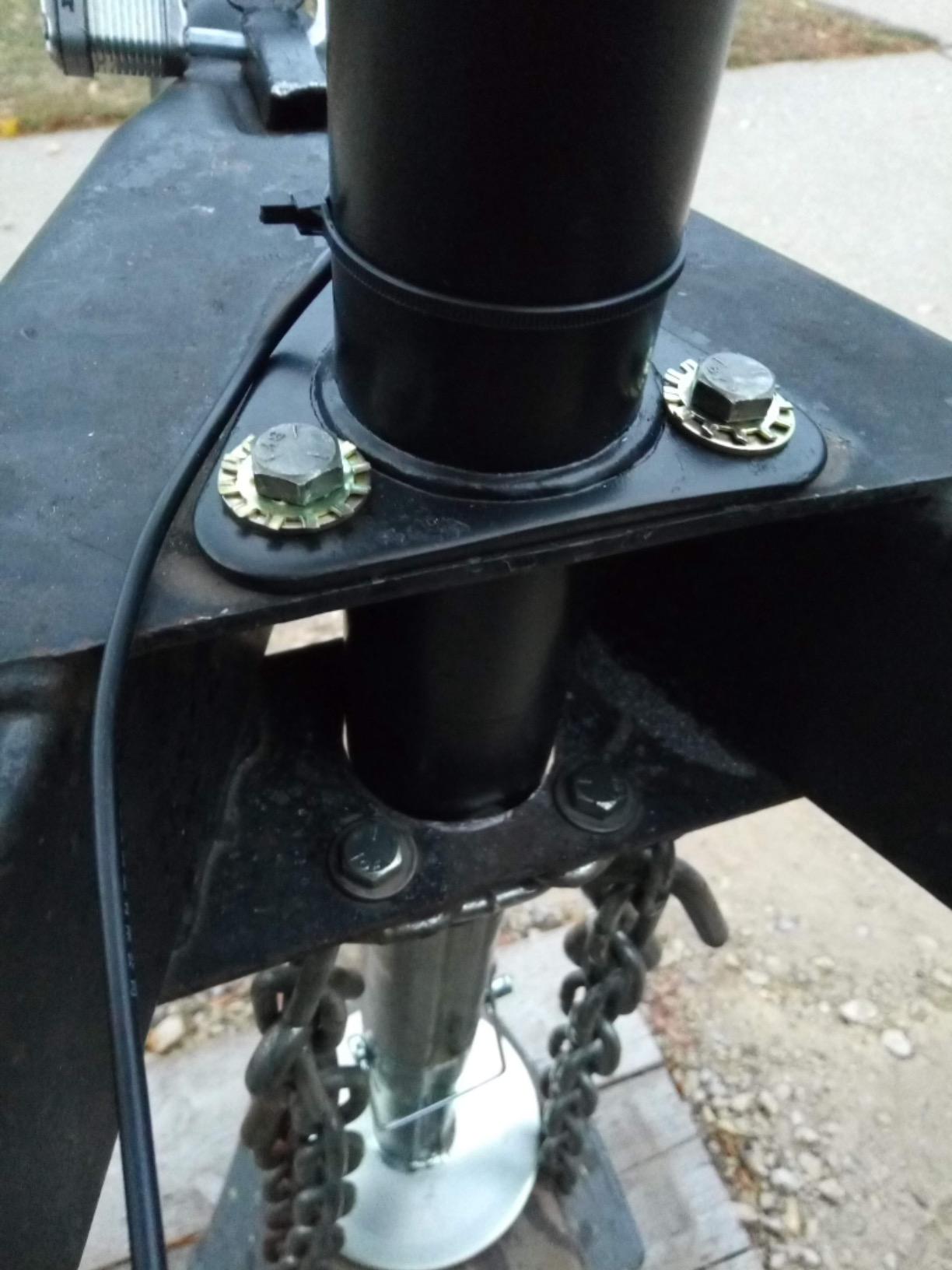
The self-grounding design is the installation detail that stands out. Because the jack grounds through its own mount to the trailer frame, only one power lead runs to the battery, which removes the single most common wiring mistake people make with powered jacks.
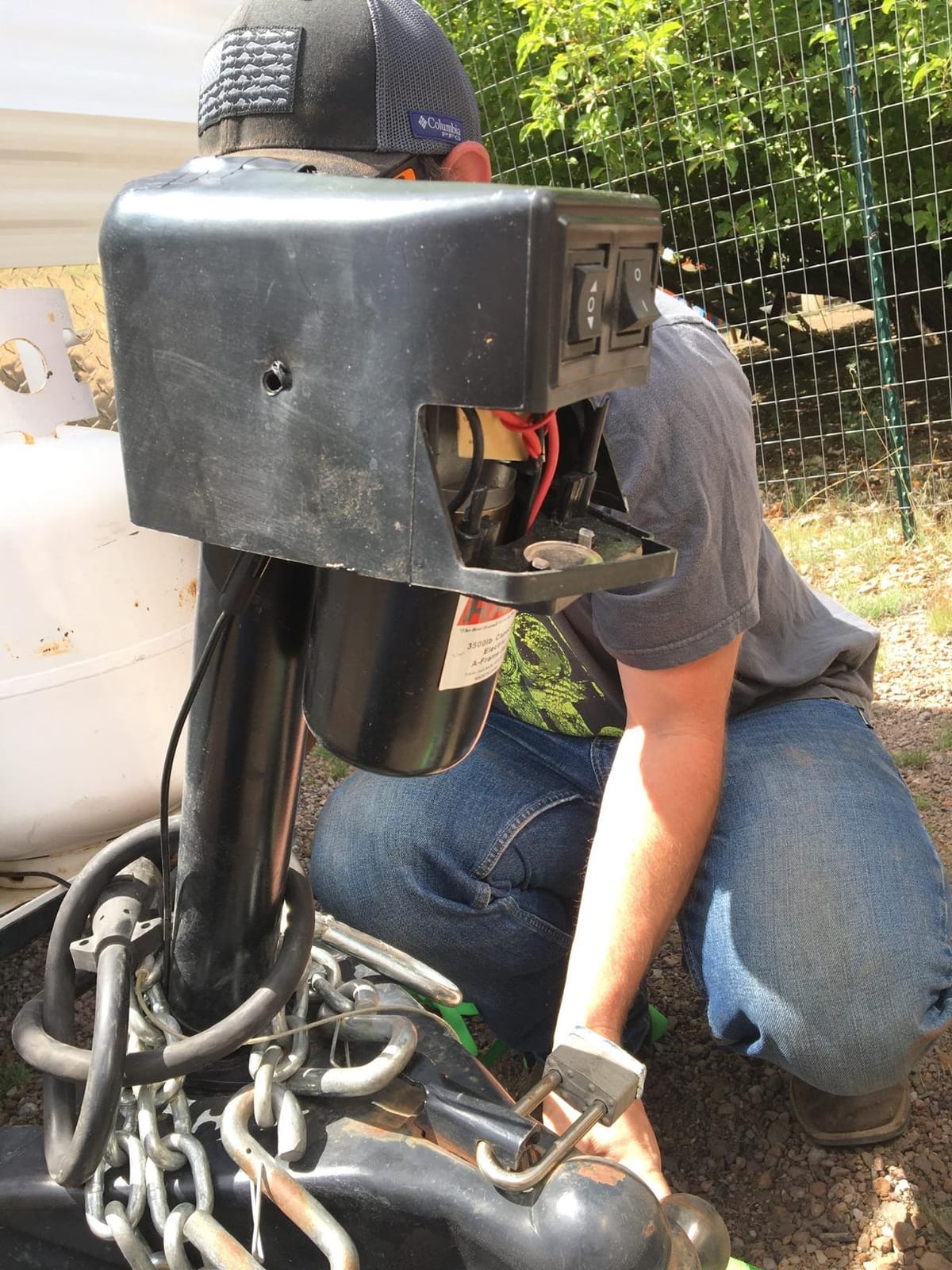
Travel runs 9 inches retracted to 18 inches extended, plus 7-1/2 inches of drop leg adjustment, and the drop leg foot has multiple holes for fine height changes. The gears are hardened steel rather than a soft alloy, which is the right call for a unit that sees a full tongue weight every time you unhitch.
The bright LED light handles the night arrival case well, and the crank handle allows manual operation if power is lost. This is a 3500 lb jack, so it stays in travel trailer territory rather than heavy equipment work.
Where the Slow Travel Bites
Travel speed is the most common complaint, and several owners put it plainly as being comparable to hand cranking. If your tongue weight is at the top of the 3500 lb band, budget extra seconds every time you lower the coupler.
The light-gauge power wire and lighter tubing than the factory jack it replaced are also noted, so if you are running a long cable run to the battery, verify the wire gauge on your install rather than trusting the supplied lead.
Fitment Quirks to Fix Before You Hitch
Two small issues are worth handling at install time. Mounting hole sizes may need filing to fit the tongue plates, and the factory fuse holder molding can block the contacts, which presents as a jack that does nothing at all.
Some units develop a wobble at full extension that tightening does not resolve, so test full travel before you rely on the jack to hold the trailer up on a slope.
How to Choose a Trailer Jack for a Heavy Trailer
Start with real tongue weight, not with the trailer class or the GVWR sticker. A conventional bumper-pull trailer usually puts 10 to 15 percent of its GVWR on the ball, so a 10,000 lb trailer lands around 1,000 to 1,500 lb of tongue weight once it is loaded. Fifth-wheel and gooseneck hitches run higher, commonly 15 to 25 percent, because the kingpin or the neck carries more of the load.
Buy a jack rated roughly double your expected loaded tongue weight. The margin is not about strength, it is about the screw, gearbox, and tube staying well inside their working range on a soft or uneven surface where the jack is working at an angle.
How to Weigh Your Loaded Trailer
Measure the trailer on a certified scale and read the number off the GVWR plate if the trailer is unloaded. That gives you a floor, not an answer, because the tongue gets heavier every time you add gear.
To get the real figure, weigh your tow vehicle fully equipped, then weigh it again fully equipped and hitched with the trailer loaded as you actually tow it. The difference between the two numbers is your true loaded tongue weight.
If a public scale is not convenient, add up what you know: cargo, propane, batteries, water, gear, and the trailer’s own dry weight. Owners regularly find their actual tongue weight runs well above what the empty spec sheet suggests, which is why forum users recommend sizing by payload rather than by class.
Bolt-Thru, Weld-On, or Flange Mount
Bolt-thru mounting passes through the top and bottom plates of the tongue, which makes it removable and is the standard on factory travel trailers. It is the cheapest option and the easiest to reverse.
Weld-on mounting is permanent and is what most builders use on equipment and dump trailers, where the jack is not coming off. If you want the flexibility of bolt-thru with a stronger mount, weld on a lug plate and bolt through that instead.
Flange and plate mounts exist for A-frame and gooseneck applications where the jack sits on a wider plate. Match the mount pattern to the holes already in your tongue and you can usually install in an afternoon.
Lift Range, Drop Leg, and Clearance
Useful lift is the retracted height plus the stroke plus the drop leg adjustment. A jack with 10 inches of stroke and an 8 inch drop leg gives you 18 inches of working range, which is more useful in the field than a taller retracted height you never need.
Check three clearances before ordering: the retracted height against your ball height, the extended height against the underside of the truck bed or bumper, and the foot position against the ground you actually park on. Our bass boat trailer guide covers the boat-specific case, where a deep keel trailer changes the geometry entirely.
Crank Effort and Gear Ratio
Crank effort is the most common complaint on heavy tongues and the least documented by manufacturers. Effort scales with tongue weight and falls as the jack’s rated capacity and screw lead increase, which is why upgrading from a 2000 lb jack to a 5000 lb jack makes the handle feel lighter even though the load is unchanged.
Foot style matters too. A wide tandem or dual-wheel foot spreads the load on soft ground so the foot does not sink and bury itself, and forum owners consistently single out large dual-wheel feet as the feature that makes a heavy manual jack tolerable. A crank sidewinder versus a vertical handle also changes the turning force at the top of the stroke.
Drive Type and Power Supply
A manual jack has no electrical failure mode and no battery draw, which is why owners running trailers in cold climates with dead batteries still keep one on the tongue as a backup. A powered jack trades that simplicity for the ability to raise 800 lb of tongue weight with one hand.
Powered jacks need a charged trailer battery, an inline fuse sized for the motor, and a sound ground path to the trailer frame. If your trailer already has a battery box and a charging circuit, a powered jack is a straightforward addition. If it does not, add a deep-cycle battery with a charger before the jack.
Electric vs Manual vs Hydraulic: Which Drive Type Handles a Heavy Tongue
A manual crank is the most reliable option and the least convenient. Nothing on it can fail electrically, corrosion is slower than on a sealed motor housing, and any owner can fix it with basic tools. The cost is real physical effort proportional to your loaded tongue weight.
An electric 12V DC jack is the best answer for solo hitchers and for anyone whose trailer has a battery system already. The motor turns a gearbox that drives the inner tube, and the lift speed is usually slower than a quick crank, which is the one thing owners of good powered jacks complain about most. A manual override crank should be non-negotiable on a powered jack for a heavy trailer.
A hydraulic jack pressurises a self-contained reservoir against the same tube, which gives very high force with little effort. It is the right answer only when the trailer already has hydraulics plumbed, as some dump trailers and boat trailers do. Adding a hydraulic system to a trailer that has none costs more than the rest of the jack combined, and a conventional bottle jack is a different category of tool from a mounted tongue jack.
For a heavy travel trailer in the 500 to 900 lb tongue weight band, we lean manual if you always hitch with a helper and powered if you hitch alone. For a loaded equipment or dump trailer above 1,000 lb of tongue weight, capacity and a drop leg matter more than drive type.
Common Trailer Jack Failure Modes and How to Prevent Them
Bent inner tubes come from side loading, usually when the trailer is jacked on a slope or while the jack is partially extended and taking a sideways force. Keep the foot on solid, level ground and never use a bent jack.
Stripped gearbox teeth and seized motors are largely corrosion problems. Sealed motor housings trap salt air, and owners on marine and coastal forums report failures that trace directly to water ingress. The protection is the same for every powered jack: keep the weather cover on, keep the fuse holder above the splash line, and rinse the tongue down with fresh water after a salt-heavy beach trip.
Repeatedly blown inline fuses are the most common electrical complaint and the easiest to prevent. A fuse that keeps opening is telling you the circuit is overloaded, the connection is corroded, or the motor is drawing more than it should. Check the connector for green corrosion and the wire for chafing at the tongue edge before you simply fit a bigger fuse. A trailer frame circuit breaker tripping on an electric jack is a related symptom, and owners who assumed the jack had failed found the breaker first.
Cracked foot mounts and stripped bolt-thru fittings come from overloading or from jacking on an angle. Re-thread or replace hardware with Grade 5 or better rather than reusing flattened fasteners, and check the mount welds on a weld-on jack after the first season of hard use.
On brand and build quality, buyers of off-brand and value-tier jacks frequently ask whether the capacity rating can be trusted. The honest answer is that the rating is a design intention and the gauge of the steel is the evidence. Before you buy, look at the tube wall thickness, the gearbox housing, whether a grease fitting is provided, and whether the manufacturer lists a real warranty with a named contact. A jack with a grease nipple and published warranty is usually built to be serviced; a jack with neither is usually built to be replaced. If our floor jack guide is useful for the same kind of spec-first comparison, that is the reasoning we apply there too.
Frequently Asked Questions
What is the best trailer tongue jack?
For a loaded bumper-pull travel trailer, the Lippert 3,500 lb Electric Tongue Jack is the best all-round choice, with 18 inches of stroke, four integrated LED lights, a hand crank override, and the deepest owner review history in its class. For a manual setup, the VEVOR 5,000 lb A-Frame drop leg jack is the strongest value pick.
What is the best heavy-duty jack?
Heavy-duty depends on your loaded tongue weight rather than on a brand. Between 500 and 900 lb of tongue weight, any of the 5000 lb manual or electric jacks in this roundup is appropriate. Between 1000 and 1500 lb, choose 7500 lb or 8000 lb capacity, such as the VEVOR 8,000 lb square weld-on jack or the VEVOR 7,500 lb electric unit.
What is the recommended tongue weight for a 10000 lb trailer?
A conventional 10,000 lb bumper-pull trailer typically carries 1,000 to 1,500 lb of tongue weight once loaded, which is 10 to 15 percent of the GVWR. Fifth-wheel and gooseneck hitches run higher, commonly 15 to 25 percent. Size a jack rated well above that figure so the screw and gearbox stay inside their working range on soft ground.
Will a power tongue jack work without a battery?
No. A power tongue jack needs a charged 12V trailer battery to run, and the motor draws significant current during lifting. Every powered jack worth buying for a heavy trailer includes a manual crank override so you can still raise and lower the tongue once the battery is dead, which is the reason we treat that feature as a requirement rather than a bonus.
What are the most common problems with trailer jacks?
The recurring problems are stripped gearbox teeth, motors seized by salt and water intrusion, bent inner tubes from jacking on a slope, repeated blown inline fuses from corroded connectors or chafed wire, cracked foot mounts, and stripped bolt-thru fittings. Jacking on level ground, keeping the weather cover on, and checking the fuse holder above the splash line prevent most of them.
How do I know what capacity trailer jack I need?
Weigh your tow vehicle fully equipped, then weigh it again fully equipped and hitched to the loaded trailer. The difference between your two numbers is your true loaded tongue weight. As a shortcut, a conventional bumper-pull trailer runs 10 to 15 percent of its GVWR on the ball, and you should buy a jack rated roughly double that figure.
How do I measure my tongue weight before buying a jack?
The most accurate method is a two-weigh test: weigh the tow vehicle fully equipped, then weigh it again with the loaded trailer hitched and the tongue weight on the ball. A trailer scale reading plus a careful cargo inventory gives a good estimate, and it is worth doing because owners regularly find their actual loaded tongue weight runs well above the empty spec sheet.
The Verdict: Which Heavy Trailer Jack Should You Buy
For most owners of a heavy travel trailer, the Lippert 3,500 lb Electric Tongue Jack is the pick, because 18 inches of stroke, four LED lights, a hand crank override, and a 6,184-rating owner history cover the whole use case in one box. If you want to keep a manual jack and just stop worrying about failure, the VEVOR 5,000 lb A-Frame drop leg model is the value move.
If you routinely move a dump trailer or an equipment trailer where the tongue weight passes 1,000 lb, go to the heavy end: the VEVOR 8,000 lb square weld-on for manual work, or the VEVOR 7,500 lb electric unit if you need a remote and the 90 degree base rotation for tailgate clearance. Whatever you pick, measure your real loaded tongue weight first, and treat the manual override crank as a requirement on any powered jack.
We will keep this roundup current as new models land in 2026 and as owner reports accumulate, so check back before you commit to a purchase.