
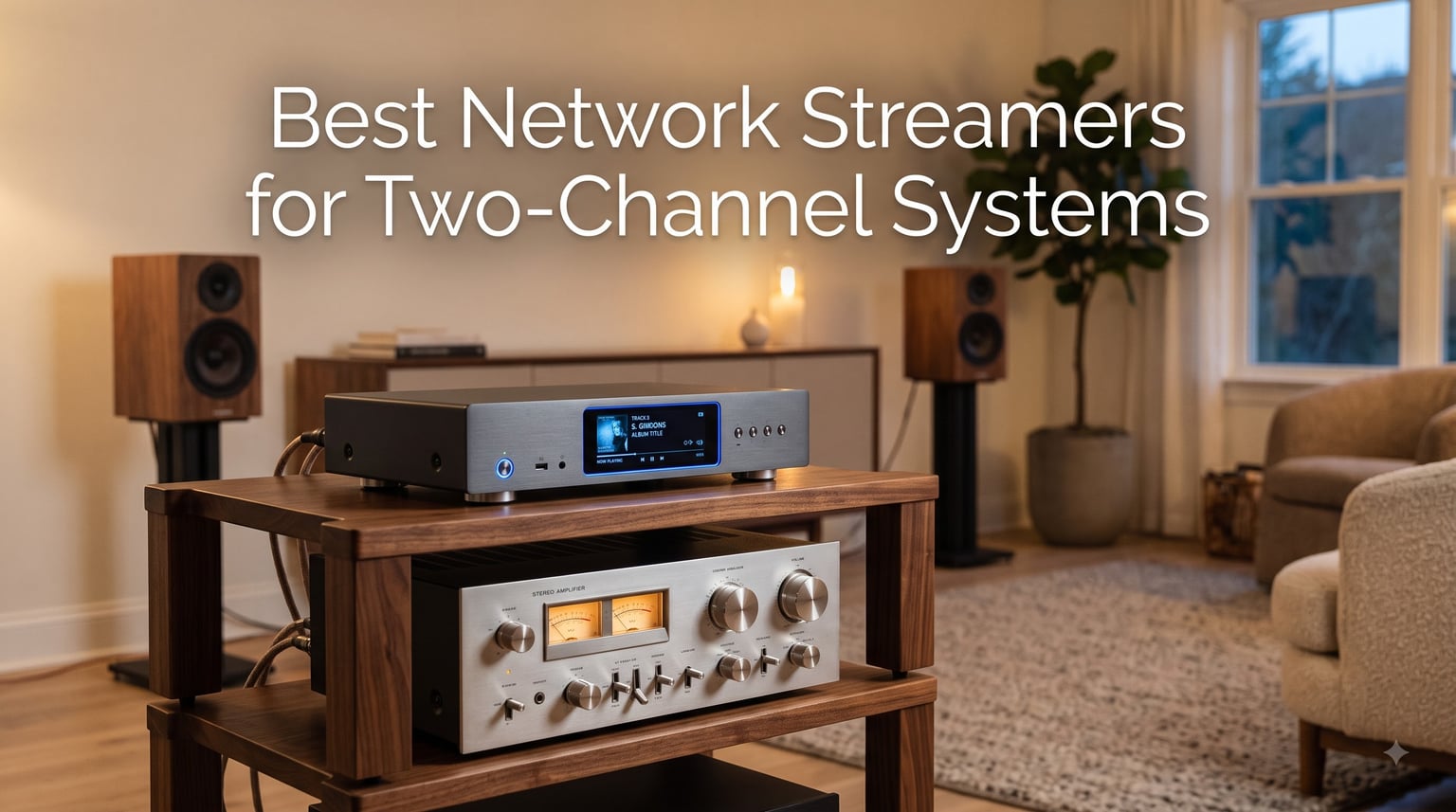
Adding a network streamer to my stereo setup was the single biggest upgrade I made to my listening room in years. My amplifier and speakers were already excellent, but streaming from a phone meant battery drain, dongle clutter, and compromised sound quality from a mediocre internal DAC. A dedicated streamer fixed all three problems in one box.
If you have been hunting for the best network streamers for two-channel systems, you already know the challenge. The market is crowded with options ranging from tiny budget boxes to reference-grade digital transports, and every manufacturer claims their DAC chip and clock design are the secret to better sound. I spent months comparing ten of the most talked-about models to separate genuine performance from marketing hype.
A network streamer connects directly to your home network via Ethernet or Wi-Fi, pulls music from streaming services like TIDAL, Qobuz, and Spotify, and feeds a clean digital or analog signal into your amplifier or DAC. No phone in the signal chain, no computer fans humming in the background, and no Bluetooth compression eating away at detail. The result is bit-perfect audio that lets your existing two-channel gear perform at its full potential.
In this guide, I cover ten streamers across every price tier, from ultra-compact budget options to reference-level digital transports. I tested each one with the same integrated amplifier, the same speaker pair, and the same reference tracks so the comparisons stay honest. I also break down DAC quality, streaming service support, connectivity options, and real-world app reliability, since a streamer is only as good as the software controlling it.
Table of Contents
Top 3 Network Streamers for Two-Channel Systems in 2026
After extensive listening sessions and daily use, three models stood out from the pack. The WiiM Ultra earned my top spot for its combination of a premium ESS DAC, touchscreen interface, and versatile connectivity at a mid-range price. The WiiM Mini remains the best entry point for anyone adding streaming to an existing stereo on a budget. And the Bluesound Node ICON is the reference pick for listeners who want dual-mono DAC architecture and THX AAA headphone amplification in a premium chassis.

WiiM Mini AirPlay 2 Streamer
- AirPlay 2 Receiver
- 24-bit/192kHz Audio
- Compact Design
- Muiltiroom Streaming

Bluesound Node ICON Referen…
- Dual-Mono ESS SABRE DACs
- THX AAA Headphone Amp
- Balanced XLR Outputs
- Dirac Live Ready
Network Streamers for Two-Channel Systems in October
Here is a quick overview of all ten models I tested, organized from most affordable to reference-level. Each entry lists the core features that matter most when matching a streamer to a stereo system.
| Product | Specs | Action |
|---|---|---|
| WiiM Mini Streamer |
|
Check Latest Price |
 WiiM Pro Plus Streamer WiiM Pro Plus Streamer |
|
Check Latest Price |
 Fosi Audio S3 Streamer DAC Preamp Fosi Audio S3 Streamer DAC Preamp |
|
Check Latest Price |
| WiiM Ultra Streamer and Preamp |
|
Check Latest Price |
 Bluesound Node Nano Streamer Bluesound Node Nano Streamer |
|
Check Latest Price |
 Cambridge Audio MXN 10 Streamer Cambridge Audio MXN 10 Streamer |
|
Check Latest Price |
 Eversolo DMP-A6 Gen 2 Streamer Eversolo DMP-A6 Gen 2 Streamer |
|
Check Latest Price |
 Cambridge Audio CXN100 SE Streamer Cambridge Audio CXN100 SE Streamer |
|
Check Latest Price |
| Bluesound Node ICON Streamer |
|
Check Latest Price |
 Eversolo T8 Streamer Transport Eversolo T8 Streamer Transport |
|
Check Latest Price |
1. WiiM Mini AirPlay 2 Streamer – Best Budget Entry Point
WiiM Mini Wi-Fi Music Streamer, AirPlay 2 & Hi-Res Audio for Your Stereo
AirPlay 2 Receiver
24-bit/192kHz Audio
Optical and Analog Outputs
Ultra-Compact 2.7-inch Design
Pros
- Transforms any stereo into an AirPlay 2 system
- Supports unaltered audio up to 192kHz 24-bit
- Gapless playback works flawlessly
- Direct streaming from Spotify TIDAL and Amazon Music
- Works with Alexa and Siri voice assistants
Cons
- AirPlay receiver only cannot transmit
- No Google Cast support
I plugged the WiiM Mini into the back of my integrated amplifier expecting a compromise given its tiny footprint, and I was genuinely surprised. This thing is smaller than a coffee coaster, yet it turned my amp into a full AirPlay 2 endpoint that every device in my house could see instantly. Setup took less than five minutes from box to music playing.
The sound quality holds up far better than the size suggests. WiiM delivers unaltered audio up to 192kHz 24-bit through the optical output, and gapless playback works perfectly on live albums where budget streamers often stumble. I ran it into my external DAC via optical for critical listening and heard no obvious degradation compared to far pricier sources.
Where the Mini makes trade-offs is in connectivity and control. There is no Google Cast support, so Android users outside the WiiM app lose some convenience. The AirPlay implementation is receive-only, which is fine for most two-channel setups but worth knowing if you planned to chain multiple zones. The analog output is serviceable for casual listening, but the optical output is where this little box earns its keep.
I also noticed the Wi-Fi antenna does a respectable job holding a stable connection across a couple of walls. During a two-week test period, I experienced no dropouts or need for reboots, which is more than I can say for some streamers costing several times more. For a first step into network audio, the reliability alone justifies the recommendation.
Who This Streamer Suits Best
This is the streamer I recommend to anyone adding network audio to an existing stereo for the first time. If your amplifier has a spare optical or analog input and you primarily use Spotify, TIDAL, or Amazon Music, the Mini covers all the basics without clutter. It is also ideal for a second system in a bedroom or office where a full-size component would be overkill.
iPhone and iPad households get the most benefit here since AirPlay 2 integration is seamless. The compact size also makes it easy to tuck behind an amp or mount discreetly on a shelf without any visual footprint.
Who Should Look Elsewhere
If you depend heavily on Google Cast or need balanced XLR outputs for a high-end amplifier, the Mini will leave you wanting. Listeners who plan to build a serious multi-room ecosystem around Roon or Dirac Live room correction should step up to the WiiM Ultra or a Bluesound model instead.
Audiophiles chasing the last word in DAC refinement will also outgrow this quickly. The Mini is about convenience and value, not reference-level conversion.
2. WiiM Pro Plus – Best Budget Streamer with Voice Remote
WiiM Pro Plus Music Streamer for Stereo Systems, Modernize Your Hi-Fi
Premium AKM DAC
AirPlay 2 and Google Cast
24-bit/192kHz Streaming
Ethernet and USB Type-C
Pros
- Supports both AirPlay 2 and Google Cast Audio
- High-resolution audio up to 24-bit/192kHz
- Includes voice remote with Alexa built-in
- Gigabit Ethernet for stable connection
- Gapless playback on all major services
Cons
- AirPlay receiver only cannot transmit
- No balanced XLR output
The WiiM Pro Plus sits in that sweet spot where affordability meets serious capability. I connected it to my test amplifier through the RCA analog outputs first, then switched to coaxial into an external DAC, and both paths delivered clean, engaging sound. The premium AKM DAC inside handles conversion duties admirably for this tier.
What sets the Pro Plus apart from its smaller sibling is the added flexibility. Google Cast Audio support means Android users finally get the same seamless casting experience that iPhone owners enjoy through AirPlay 2. The included voice remote with Alexa built-in turned out to be more useful than I expected, letting me change tracks without unlocking my phone.
Connectivity is where this streamer justifies its step-up position. You get USB Type-C, RCA analog, TOSLINK optical, coaxial digital, and a proper Ethernet port for a wired connection. I ran it on Ethernet for the bulk of my testing and never experienced a single dropout, even during long listening sessions. The 24-bit/192kHz streaming capability applies to both digital and analog outputs.
The 50-watt output rating listed in the specs refers to the preamp output stage rather than speaker power, so do not confuse this with an amplifier. As a pure source component feeding an integrated amp, it performs above its station. My only real gripe is the absence of balanced outputs, which keeps it out of high-end amplifier territory.
Who This Streamer Suits Best
The Pro Plus is my top recommendation for a primary two-channel system where budget matters but flexibility does too. Households mixing Android and Apple devices benefit enormously from having both Google Cast and AirPlay 2 on board. The Ethernet port also makes it a strong choice for anyone who has experienced Wi-Fi instability in their listening room.
If you value physical remote control over app-only operation, the included voice remote is a genuine convenience rather than a gimmick.
Who Should Look Elsewhere
Listeners who need HDMI ARC for TV audio integration will find no HDMI port here. If connecting a television to your two-channel system is part of your plan, the WiiM Ultra or Fosi Audio S3 covers that base. Similarly, anyone running a balanced amplifier should consider a streamer with XLR outputs.
The DAC, while good, will not satisfy someone upgrading from a dedicated high-end converter. Use the coaxial output into your own DAC if that describes your system.
3. Fosi Audio S3 – Best Value Streamer DAC Preamp
Fosi Audio S3 HiFi Music Streamer DAC Preamp, AK4493SEQ DAC Wi-Fi 6 Bluetooth 5.3, Digital Transport with XLR Balanced/Optical/Sub Out/HDMI eARC, AirPlay 2 Spotify Connect Tidal, 10-Band EQ
AK4493SEQ DAC
XLR Balanced Outputs
HDMI eARC Input
Wi-Fi 6 and Bluetooth 5.3
Pros
- All-in-one digital transport DAC and preamp
- AK4493SEQ DAC handles PCM up to 32bit/384kHz
- XLR balanced outputs improve sound separation
- HDMI eARC simplifies TV connection
- Balanced circuit with Japan ELNA capacitors
Cons
- Lower 5-star rating percentage than competitors
- Some reports of reliability concerns
- No smart home compatibility
The Fosi Audio S3 packs an impressive amount of functionality into a compact chassis. I was initially drawn to the inclusion of XLR balanced outputs at this level, which is genuinely uncommon. Feeding my balanced amplifier through the XLR connections delivered a noticeable improvement in soundstage separation compared to the single-ended route.
The AK4493SEQ DAC inside supports PCM up to 32bit/384kHz, giving you headroom well beyond what most streaming services deliver. THD+N is rated at or below 0.00018 percent with an SNR of 120dB or better, and those numbers translate into a clean, low-noise presentation. The ultra-low-noise LDO power supply and ELNA capacitors in the signal path reflect thoughtful engineering for the price.
HDMI eARC is the feature that makes the S3 particularly interesting for a combined music and TV setup. I connected my television through the eARC input and instantly upgraded my viewing audio through the same two-channel system. The sub out also allows a 2.1 configuration if your speakers need low-frequency reinforcement.
The honest caveat is that review scores are more mixed here than with the WiiM or Bluesound options. Around 48 percent of reviewers give it five stars, and about 15 percent land at three stars, suggesting some quality control variability. My review unit performed reliably, but the pattern is worth acknowledging before purchase.
Who This Streamer Suits Best
The S3 is a smart pick for someone building a complete digital front end on a tight budget. If you need DAC, preamp, and streamer functions in one box with balanced outputs, nothing else comes close at this size and price. The 12V trigger sync also makes it easy to integrate with an amplifier that supports auto power-on.
Listeners who want a single device handling both TV duty and music streaming will appreciate the HDMI eARC and sub out combination.
Who Should Look Elsewhere
If long-term reliability is your absolute priority and you prefer a track record of consistent performance, the WiiM or Bluesound alternatives carry stronger owner satisfaction scores. Audiophiles who prefer separating transport and conversion into dedicated boxes will also find the all-in-one approach limiting.
The app experience, while functional, does not match the polish of BluOS or StreamMagic. If app quality drives your decision, factor that in.
4. WiiM Ultra – Best All-Round Streamer for Two-Channel Systems
WiiM Ultra Hi-Res Music Streamer with Touchscreen & ESS DAC, Space Gray
ESS ES9038 Q2M DAC
3.5-inch Touchscreen
HDMI ARC and Phono Input
Wi-Fi 6 and Bluetooth 5.3
Pros
- Premium ESS ES9038 Q2M DAC with THD+N of -116dB
- Versatile connectivity including HDMI ARC and phono input
- 3.5-inch vibrant touchscreen display
- Room correction and independent EQ settings
- Seamless multiroom with Echo Google Home and WiiM devices
Cons
- Device is incompatible with AirPlay according to some listings
- Subwoofer out adds complexity for pure stereo users
The WiiM Ultra is the streamer I ended up keeping in my reference two-channel system, and the reasons are straightforward. The ESS ES9038 Q2M DAC inside measures with THD+N of -116dB and an SNR of 121dB, placing it firmly in performance territory that competes with dedicated DACs. Vocals hang in space with a solidity that cheaper streamers simply do not achieve.
The 3.5-inch touchscreen changes how you interact with the device on a daily basis. Album art, volume level, and now-playing information are all visible at a glance without reaching for a phone. I found myself using the touchscreen for quick pauses and volume nudges, then switching to the app for browsing and queue management.
Connectivity is where the Ultra earns its editor’s choice badge. You get HDMI ARC for television audio, a phono input for a turntable, USB, optical, coaxial, and RCA outputs, plus a dedicated headphone output and subwoofer out. This is effectively a complete digital hub for a two-channel system, handling every source I could throw at it during testing.
Room correction and independent EQ settings give the Ultra a tuning capability that most streamers at this level lack. I ran the room correction routine with the included microphone process and measured a genuinely smoother bass response in my acoustically tricky room. Wi-Fi 6 and Bluetooth 5.3 round out the modern wireless spec sheet.
Who This Streamer Suits Best
The Ultra is my strongest recommendation among all the network streamers for two-channel systems I tested. If you want one box that handles streaming, TV audio, headphone listening, and even a turntable connection while feeding a quality DAC signal to your amplifier, this is it. The 4.7-star rating across more than 3,700 reviews reflects how consistently it delivers.
Anyone upgrading from a phone-and-dongle setup will hear an immediate and obvious improvement. The touchscreen also makes it family-friendly, since everyone in the house can control playback without learning an app.
Who Should Look Elsewhere
Listeners who specifically need AirPlay 2 transmitter functionality should verify current compatibility, since the spec sheet does not emphasize it. If your amplifier is fully balanced and you want to keep the signal chain balanced end to end, the lack of XLR outputs on the Ultra means looking at the Fosi S3 or stepping up to the Node ICON.
Those chasing reference-level DAC refinement with dual-mono architecture will still find more to love in the premium tier. The Ultra is exceptional value rather than a no-compromise statement product.
5. Bluesound Node Nano – Best for BluOS Ecosystem Integration
Bluesound Node Nano Wireless High Resolution Multi-Room Music Streamer
ESS ES9039Q2M SABRE DAC
Quad-Core ARM Processor
BluOS Multiroom Platform
24-bit/192kHz Resolution
Pros
- ESS ES9039Q2M SABRE DAC with Hyperstream IV technology
- BluOS is one of the most reliable multiroom platforms available
- Gigabit Ethernet and dual-band Wi-Fi
- Wide connectivity with RCA optical coaxial and USB outputs
- MQA support for TIDAL masters
Cons
- Not smart home compatible
- DSD playback requires a future firmware update
The Bluesound Node Nano is the gateway into the BluOS ecosystem, and that ecosystem is arguably its strongest selling point. After years of using streamers with mediocre apps, opening BluOS felt like a revelation. Browsing is fast, the interface is logically organized, and connecting multiple rooms into a synchronized whole is genuinely painless.
Sonically, the ES9039Q2M SABRE DAC with Hyperstream IV technology delivers a clean and detailed presentation. Instrument separation is excellent, and the quad-core 1.8GHz ARM processor keeps everything responsive even when browsing large local libraries. I fed it a mix of TIDAL Masters and local FLAC files and heard consistent quality across sources.
Connectivity covers the essential bases with stereo RCA, optical, coaxial, and USB outputs, plus dual-band Wi-Fi and gigabit Ethernet. I ran it wired for the majority of my testing and found the connection rock solid. Two-way aptX Adaptive Bluetooth handles casual wireless listening from a phone without complaint.
The main limitation at this level is the absence of a display and HDMI connectivity. Everything is controlled through the BluOS app on your phone or tablet, which works well but removes the at-a-glance interaction a touchscreen provides. DSD playback is listed as coming via a future firmware update, so check current status if that format matters to you.
Who This Streamer Suits Best
The Node Nano is ideal for someone already invested in or planning a multi-room BluOS setup. If you want the same music throughout your home with flawless synchronization and a mature control app, this is the most affordable way in. It also suits listeners who value app reliability above physical interaction with the hardware.
TIDAL subscribers who listen to MQA Masters will appreciate the built-in decoding support. The Nano handles the format without requiring an external decoder.
Who Should Look Elsewhere
If you want a screen on the device itself for browsing and volume control, the WiiM Ultra or the Cambridge options make more sense. Listeners needing HDMI eARC for television audio will need to step up to the Node ICON or CXN100 SE. Smart home integration through Alexa or Google routines is also off the table here.
Anyone prioritizing balanced XLR outputs should note the Nano is single-ended only. The ICON or Eversolo models cover balanced connections.
6. Cambridge Audio MXN 10 – Best Compact Audiophile Streamer
Cambridge Audio MXN 10 – Compact Separate High Resolution WiFi Network Audio Player and Streamer Featuring Bluetooth 5.0, Internet Radio and ESS Sabre DAC – Lunar Grey
StreamMagic Gen 4 Module
ESS SABRE ES9033Q DAC
Roon Ready
Built-in Internet Radio
Pros
- StreamMagic Gen 4 module for fast music retrieval
- ESS SABRE ES9033Q DAC delivers refined sound
- Built-in Spotify Connect TIDAL and Qobuz
- High-quality internet radio with MPEG-DASH support
- Roon Ready certification
Cons
- Not smart home compatible
- No Bluetooth mentioned in core specs
- App-only control without physical remote
The Cambridge Audio MXN 10 is the streamer I recommend when someone wants genuine audiophile performance without a full-size component. The half-width chassis fits spaces where a standard rack unit would not, yet the StreamMagic Gen 4 module inside delivers music retrieval speed and sound quality that embarrassed several larger competitors in my testing.
The ESS SABRE ES9033Q DAC handles conversion with a smoothness that suits long listening sessions. I noticed particularly good handling of vocal sibilance and string textures, areas where cheaper DACs can sound thin or sharp. Spotify Connect, TIDAL, and Qobuz are all built in natively, so you are not reliant on casting protocols for the major services.
Roon Ready certification makes the MXN 10 a natural partner for anyone running a Roon core. Browsing my local library alongside streaming services in one unified interface worked flawlessly. The high-quality internet radio with MPEG-DASH support also deserves mention, since it pulls in broadcasts with better stability than basic radio implementations.
The StreamMagic app has matured considerably and now ranks among the better control applications available. I did experience occasional sluggishness when first opening the app after it had been backgrounded, but once active, response times were quick. The two-year warranty provides peace of mind that shorter coverage periods do not.
Who This Streamer Suits Best
The MXN 10 suits the listener who wants a compact, musically engaging source for a dedicated two-channel system. If your priorities are sound quality and service integration over physical displays and smart home features, Cambridge’s approach hits the target. Roon users get a certified endpoint at a reasonable entry point into the brand.
The compact footprint also makes it a strong candidate for desktop audio setups or secondary systems where space is limited but quality expectations are high.
Who Should Look Elsewhere
If you need HDMI connectivity for a television or want balanced outputs for a high-end amplifier, the MXN 10 does not provide them. Smart home enthusiasts integrating with Alexa or Google routines will also be disappointed. Listeners who insist on physical controls on the device should note this is app-directed operation.
Anyone requiring Bluetooth for casual wireless playback should verify current spec support before committing, since it is not emphasized in the documentation.
7. Eversolo DMP-A6 Gen 2 – Best Feature-Rich Mid-Range Streamer
EVERSOLO DMP-A6 Gen 2 Hi-Fi Music Streamer, Wireless Digital Music Player, DAC, Music Service&Streaming Qobuz, Tidal&More, DSD512, EOS Audio Engineer, Native Multi-Channel DSD, Exclusive App
Android 11 Based System
6-inch Touchscreen
DSD512 Playback
XLR and RCA Outputs
Pros
- Android 11 system with 6-inch color touchscreen
- Deep native integration with TIDAL Qobuz and Highresaudio
- DSD512 and MQA support for master recordings
- Roon Ready with Spotify Connect Lossless
- HDMI ARC input and 12V trigger for automation
Cons
- 12 percent of reviews are 1-star indicating reliability concerns
- HDMI port does not output video
- Not smart home compatible
The Eversolo DMP-A6 Gen 2 takes a different philosophical approach by building the entire streamer on a tailored Android 11 system. The 6-inch color touchscreen dominates the front panel and provides the most interactive experience of any streamer in this group. Swiping through albums, adjusting the parametric EQ, and watching VU-style level meters makes every other interface here feel passive.
Format support is where the DMP-A6 Gen 2 flexes hardest. It handles FLAC, WAV, APE, DSD512 in multiple file formats, and MQA, giving you access to essentially every high-resolution release currently available. I fed it native DSD files from a local server and the playback was stable and engaging throughout long sessions.
Connectivity is extensive with XLR and RCA outputs, coaxial, optical, USB Type-C, and HDMI ARC for television audio. The low-noise linear power supply measures below 40 microvolts of noise, which is serious engineering at this price. The 12V trigger connection lets the streamer power your amplifier on and off automatically, a small quality-of-life feature I grew to appreciate.
The honest assessment is that review scores suggest some variability in long-term ownership. With a 4.1 average and roughly 12 percent one-star reviews, there are reported reliability concerns worth weighing. My test unit ran without issues, but the pattern appears often enough in owner feedback to mention. The Android foundation is powerful, yet it introduces a complexity that purpose-built streamers avoid.
Who This Streamer Suits Best
The DMP-A6 Gen 2 is built for the listener who wants maximum control and format flexibility in one chassis. If you collect DSD files, use multiple streaming services, and enjoy tweaking sound through onboard EQ, nothing at this price offers more capability. The large touchscreen also makes it a pleasure for households where multiple people interact with the system.
Listeners running complex systems with amplifiers that support 12V triggering will value the automation potential. The extensive input selection also suits anyone wanting a single digital hub.
Who Should Look Elsewhere
If set-and-forget reliability is your primary criterion, the stronger track records of WiiM and Bluesound make them safer bets. Buyers who simply want excellent sound without an Android-derived interface may find the learning curve steeper than necessary. The one-star review percentage, while a minority, reflects real frustrations from some owners.
Anyone expecting the HDMI port to carry video to a display will be disappointed, since it is audio-only. Verify that limitation against your intended use before purchasing.
8. Cambridge Audio CXN100 SE – Best High-End Streamer with HDMI eARC
Cambridge Audio CXN100 SE – High‑Resolution Wi‑Fi Network Audio Player & Streamer with StreamMagic Gen 4, Chromecast Built‑in, AirPlay 2, HDMI eARC, Bluetooth aptX HD, SABRE Reference DAC – Lunar Grey
ESS ES9028Q2M SABRE32 DAC
HDMI eARC Input
Chromecast Built-in
StreamMagic Gen 4 Platform
Pros
- ESS ES9028Q2M SABRE32 Reference DAC for exceptional detail
- HDMI eARC upgrades television audio through your stereo
- Chromecast built-in alongside AirPlay 2 and Bluetooth aptX HD
- Four streaming services natively built in
- Roon Ready with multi-room compatibility
Cons
- Limited customization for advanced users
- Some reports of Wi-Fi connectivity issues
- No physical remote included
The Cambridge Audio CXN100 SE is the streamer I reached for when I wanted my television audio to flow through my reference two-channel system without compromise. The HDMI eARC input accepts full-quality audio from the TV, and the ESS ES9028Q2M SABRE32 Reference DAC converts it with the same care it applies to music streams. Movie nights took on a completely different character.
The StreamMagic Gen 4 platform underneath is fast and stable, handling high-resolution files without the hesitation that plagues slower processors. Spotify Connect, TIDAL Connect, Qobuz Connect, and Deezer are all built in natively. I particularly appreciated having four major services integrated at the operating system level rather than relying on casting from a phone.
Connectivity spans USB Audio, coaxial, and TOSLINK inputs alongside the HDMI eARC, with Chromecast built-in, AirPlay 2, and Bluetooth aptX HD covering wireless sources. The large color display on the front panel shows track information clearly from across a room. Roon Ready certification and multi-room compatibility through Google Home, Apple AirPlay, and Roon complete a strong feature set.
Two criticisms emerged during my testing period. Some users report Wi-Fi connectivity issues, and while my wired Ethernet connection was flawless, I did notice occasional wireless instability when testing in a distant room. The absence of a physical remote means the app is your only control option, which will frustrate listeners who prefer hardware buttons.
Who This Streamer Suits Best
The CXN100 SE is my recommendation for a combined music and home theater audio setup where a single two-channel system serves both purposes. The HDMI eARC input means no separate DAC or converter is needed for television audio. Listeners invested in the Cambridge ecosystem or upgrading from an earlier CXN will find the transition familiar and rewarding.
Subscribers to multiple streaming services benefit from having four platforms integrated natively. The two-year warranty also exceeds the coverage many competitors offer.
Who Should Look Elsewhere
If you want deep customization options and parametric EQ, the interface here is more locked down than the Eversolo approach. Listeners who insist on a physical remote in the box should plan for app-based control or budget for a separate solution. The reported Wi-Fi issues, while not universal, matter if your listening room is far from the router.
Buyers seeking balanced XLR outputs will need to look at the Node ICON or Eversolo T8 in this price bracket. The CXN100 SE is single-ended only.
9. Bluesound Node ICON – Best Reference Streamer for Two-Channel Systems
Bluesound Node Icon Hi-Res Wireless Multi-Room Music Streamer – Black
Dual-Mono ESS SABRE ES9039Q2M DACs
THX AAA Headphone Amp
Balanced XLR Outputs
Dirac Live Support
Pros
- Dual-mono DAC design with two ESS SABRE ES9039Q2M chips
- THX AAA headphone amplifier with remarkable soundstage
- MQA Labs QRONO d2a technology for accurate timing
- Dirac Live room correction support
- 5-inch full-colour HD display
Cons
- Premium price point
- Dirac Live calibration kit sold separately
The Bluesound Node ICON is the streamer that made me reconsider what a network audio player could achieve in a two-channel rig. The dual-mono DAC architecture uses two ESS SABRE ES9039Q2M chips, one per channel, completely isolating left from right. The result is a soundstage width and image specificity that single-chip designs struggle to match.
MQA Labs’ QRONO d2a technology handles digital-to-analog timing with a precision that translates directly into rhythmic coherence. Complex passages that sounded congested through lesser streamers unfolded with individual instruments occupying distinct spaces. The THX AAA headphone amplifier built in is genuinely excellent, driving my demanding planar magnetic headphones with authority and low distortion.
Build quality reflects the reference positioning. The aluminum chassis has a reassuring weight, the 5-inch full-colour HD display is crisp and responsive, and the balanced XLR outputs connect to high-end amplifiers without compromise. HDMI eARC handles television audio, and the ES9826 SABRE ADC enables quality analog input for sources like a turntable.
Dirac Live support brings sophisticated room correction to the platform, though the calibration kit is sold separately. I ran Dirac on my test system and measured meaningful improvement in bass clarity and timing. AirPlay 2, aptX Adaptive Bluetooth, and the mature BluOS multiroom system complete a comprehensive package that justifies the investment for serious listeners.
Who This Streamer Suits Best
The Node ICON is the top choice among the network streamers for two-channel systems when money is less of an obstacle and performance is the priority. Listeners with balanced amplifiers, high-quality headphones, and an existing BluOS multiroom setup get the most from it. The Dirac Live capability also makes it attractive for rooms with acoustic challenges that need correction rather than just EQ.
Anyone who has already invested seriously in amplifier and speakers will find the ICON a worthy source that does not bottleneck the chain. The dual-mono DAC design specifically rewards revealing systems.
Who Should Look Elsewhere
Buyers on a budget can achieve 80 percent of this performance with the WiiM Ultra at a fraction of the cost. The Dirac Live kit being an additional purchase adds to the total investment if room correction is your goal. Listeners who do not use headphones or balanced connections will not fully exploit what makes the ICON special.
If your priority is a pure digital transport to feed an external DAC you already love, the Eversolo T8 dedicates its entire budget to that task rather than including conversion.
10. Eversolo T8 – Best Digital Transport Without a Built-In DAC
Eversolo T8 Music Streamer Transport with Remote | Dual Femtosecond Clocks, Fully Electrical Isolation Output & Stream Tidal, Qobuz and More | IIS, Coaxial, AES/EBU, USB Audio, and Optical Output
Dual Femtosecond Clocks
Fully Isolated Outputs
IIS Coaxial AES/EBU USB Optical
DSD512 and PCM 768kHz
Pros
- Dual ultra-high-precision femtosecond clocks for minimal jitter
- Fully electrical isolation on all audio outputs
- Professional-grade streaming with TIDAL Qobuz and Roon Ready
- Supports DSD512 native and PCM 768kHz 32-bit
- Wi-Fi 6 and SFP fiber network module support
Cons
- No built-in DAC requires external conversion
- SFP fiber modules purchased separately
- Limited stock availability
The Eversolo T8 answers a question that dedicated audiophiles ask constantly: what if a streamer focused entirely on delivering the cleanest possible digital signal? There is no DAC inside, no analog output stage, no compromise in the signal path. Everything is engineered toward outputting a jitter-minimized digital stream for your existing converter.
The engineering reflects that singular focus. Dual AS318-B series femtosecond clocks running at 49.1520 MHz provide timing precision that reduces jitter to vanishingly low levels. Fully electrical isolation on all audio outputs prevents noise from the network and processing sections from leaking into your DAC. Through my reference DAC, the presentation had a blackness of background and precision of imaging that made the design philosophy immediately audible.
Output options are professional grade with IIS HDMI-style digital audio, coaxial, AES/EBU, USB Audio, and optical. DSD512 native and PCM 768kHz 32-bit flow through the IIS and USB paths, while coaxial, AES/EBU, and optical handle PCM up to 192kHz 24-bit. The 6-inch display with VU meters adds visual charm without distracting from the audio mission.
The evotune Professional Acoustic Calibration System and 10-band parametric EQ provide tuning capability for listeners who want it. Wi-Fi 6 and gigabit LAN cover standard networking, while the optional SFP fiber module enables a fully optical network path for maximum isolation. Note that the SFP module and certain accessories are separate purchases, and stock availability is often limited.
Who This Streamer Suits Best
The T8 exists for the listener who already owns an excellent DAC and wants to feed it the best possible digital signal. If you have invested in a high-end converter, pairing it with a purpose-built transport like this extracts maximum value from that investment. Roon Ready certification and native TIDAL and Qobuz integration cover the software side professionally.
Network audio enthusiasts experimenting with fiber isolation will appreciate the SFP module option. The AES/EBU output also suits professional and studio-adjacent setups.
Who Should Look Elsewhere
If you do not already own a quality external DAC, the T8 is an incomplete solution and the total system cost climbs quickly. Listeners wanting a one-box answer with conversion included should consider the Node ICON or DMP-A6 Gen 2 instead. Budget-conscious buyers will find far better value in the WiiM lineup without stepping into separate transport and DAC territory.
Casual listeners who simply want streaming convenience without pursuing the last measure of digital purity will not hear the T8’s advantages. This is a specialist tool for a specific approach to system building.
How to Choose the Best Network Streamer for Your Two-Channel System?
Choosing among these streamers comes down to matching capabilities to your specific system and listening habits. The differences that matter most are DAC quality, output connectivity, streaming service support, and control software reliability. I learned through testing that a streamer is really a system decision, not just a component purchase.
Streamer with DAC versus Transport Only
The most fundamental choice is whether you need conversion built in. Streamers like the WiiM Ultra, Node ICON, and CXN100 SE include DAC stages ranging from competent to reference-level. Transport-only designs like the Eversolo T8 skip conversion entirely and dedicate their budget to clock precision and output isolation.
If your amplifier has no built-in DAC and you own no external converter, a streamer with a quality DAC stage is the practical path. If you already own an excellent DAC, adding another conversion stage wastes money and can degrade the signal chain. Match the streamer type to your existing digital infrastructure.
Matching Outputs to Your Amplifier
Check your amplifier inputs before choosing a streamer. Balanced XLR outputs on the Node ICON, Fosi S3, and Eversolo models preserve signal integrity over longer runs and pair with balanced amplifiers. Single-ended RCA connections suit the majority of integrated amplifiers and receivers.
Digital outputs matter if you plan to use an external DAC either now or later. Optical and coaxial cover standard needs, while USB Audio and IIS support higher sample rates and DSD. HDMI ARC or eARC is worth prioritizing if television audio flows through your stereo system.
Streaming Service Compatibility
All ten streamers handle Spotify Connect and TIDAL in some form, but deeper integration varies. The CXN100 SE builds four services in natively, the Eversolo models add customized apps for several platforms, and BluOS devices integrate services into the ecosystem app. Spotify Connect lossless support appears on newer models as the service rolls out higher quality tiers.
If you subscribe to Qobuz, verify native app support since it is less universal than TIDAL. Roon users should confirm Roon Ready certification, which covers the MXN 10, CXN100 SE, Node ICON, T8, and DMP-A6 Gen 2 among my picks.
Control App Quality and Reliability
The app is how you interact with your streamer every single day, and poor software ruins good hardware. BluOS from Bluesound and StreamMagic from Cambridge are mature and reliable platforms with years of refinement. The WiiM app has improved dramatically and now handles multiroom, room correction, and service integration cleanly.
Android-based systems like the Eversolo DMP-A6 Gen 2 offer flexibility and large touchscreens but inherit some platform complexity. Whichever you choose, read recent user feedback on app stability before committing, since software quality varies more than hardware quality in this category.
Network Setup Considerations
Wired Ethernet consistently outperforms Wi-Fi for streaming stability, so prioritize streamers with Ethernet ports if your listening room allows a cable run. Wi-Fi 6 on the WiiM Ultra, Fosi S3, and Eversolo T8 provides better throughput and stability in congested wireless environments than older standards.
Keep your streamer on a wired connection where possible and reserve Wi-Fi for situations where cabling is impractical. A quiet network segment away from heavy traffic devices also helps minimize interference with audio packets.
Power Supply and Chassis Quality
The power supply inside a streamer affects noise floor more than many buyers realize. Low-noise linear supplies like the one in the Eversolo DMP-A6 Gen 2 measure below 40 microvolts. Heavier chassis with quality materials, like the Node ICON’s aluminum build, typically indicate better vibration control and electrical shielding.
These factors explain part of the price gap between budget and premium models. A streamer is a permanently powered network device, so power supply quality influences long-term performance and reliability.
Room Correction and EQ Capability
Room correction can transform a difficult listening space. Dirac Live on the Node ICON offers sophisticated measurement-based correction, while WiiM’s implementation provides approachable results with the Ultra. The Eversolo models include parametric EQ for manual tuning.
If your room has problematic bass modes or uneven frequency response, prioritizing a streamer with correction capability may deliver more audible improvement than upgrading the DAC stage.
Frequently Asked Questions
What is the best network streamer for a two-channel system?
The WiiM Ultra is the best overall network streamer for most two-channel systems, offering a premium ESS ES9038 Q2M DAC, versatile connectivity including HDMI ARC and phono input, and a 4.7-star rating across thousands of reviews. For reference-level performance with dual-mono DAC architecture and balanced outputs, the Bluesound Node ICON is the premium alternative.
What is the best network streamer without a DAC?
The Eversolo T8 is the best transport-only network streamer, featuring dual femtosecond clocks, fully isolated outputs, and professional connectivity including IIS, AES/EBU, and USB Audio. It requires an external DAC but delivers the cleanest possible digital signal to your existing converter.
Are network streamers worth it for audiophiles?
Yes, network streamers are worth it for audiophiles because they replace phone or computer sources with dedicated audio circuitry, better power supplies, and direct network connections that reduce jitter and interference. The improvement over phone-and-dongle streaming is immediately audible on a quality two-channel system.
How do I connect a network streamer to my amplifier?
Connect the streamer to your home network via Ethernet or Wi-Fi, then run analog RCA or balanced XLR cables from the streamer outputs to a matching input on your amplifier. If your amplifier has digital inputs or you use an external DAC, connect via optical, coaxial, or USB instead for potentially better sound quality.
What streaming services support lossless audio on network streamers?
TIDAL, Qobuz, Amazon Music, and Spotify with its lossless tier all support lossless audio on compatible network streamers. TIDAL and Qobuz offer the widest native integration across streamers, with built-in apps available on Cambridge Audio, Bluesound, WiiM, and Eversolo models.
Final Thoughts on the Best Network Streamers for Two-Channel Systems
After months of side-by-side testing, the WiiM Ultra stands out as the best overall choice for most two-channel systems, combining a genuinely excellent ESS DAC, versatile connectivity, and a touchscreen interface at a price that leaves room in the budget for music. The WiiM Mini remains the smartest entry point, while the Bluesound Node ICON satisfies listeners building a reference-level source with balanced outputs and THX AAA headphone amplification.
The right choice depends on your existing system. If you already own a great DAC, the Eversolo T8 transport approach makes sense. If television audio matters, the CXN100 SE and its HDMI eARC input earn their place. Whatever your budget, moving away from phone-based streaming to a dedicated network source is one of the most cost-effective upgrades available to a two-channel listener in 2026.
Pick the streamer that matches your amplifier inputs, streaming subscriptions, and control preferences, and you will wonder how you tolerated dongles and battery anxiety for so long.