
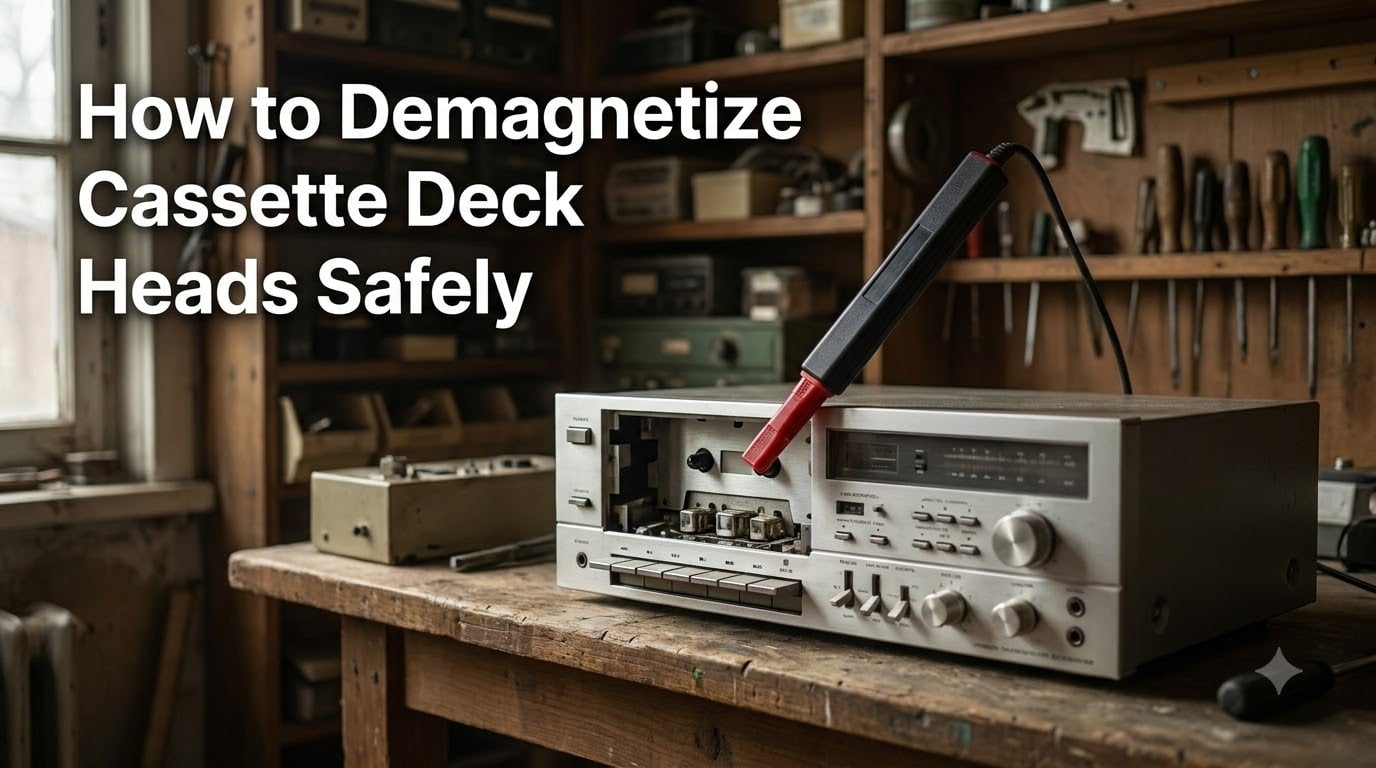
If you want to know how to demagnetize cassette deck heads safely, the short answer is: power off the deck, activate the demagnetizer at least 30 cm (12 inches) away, slowly sweep the tip across all heads and the capstan, then withdraw it just as slowly before switching it off. Use an AC wand-style demagnetizer, never a permanent magnet, and keep your recorded tapes far away during the process.
I’ve been maintaining vintage cassette decks for over a decade, and demagnetization is one of those procedures that sounds intimidating but takes about 90 seconds once you’ve done it a few times. In this guide, I’ll walk you through exactly when demagnetization is needed, which tool to use, and the step-by-step process I use on everything from a Nakamichi Dragon to a basic Sony deck.
Whether you’re chasing that last bit of treble response or just want to maintain a deck you love, this guide covers everything I’ve learned from service manuals, vintage audio forums, and a few mistakes of my own.
Table of Contents
What Is Head Demagnetization and Why It Matters?
Demagnetization is the process of removing residual magnetism from your cassette deck’s tape heads, capstan, and other metal parts in the tape path. Over time, tiny magnetic fields build up on these components from contact with tapes, static electricity, and exposure to magnetic tools.
When heads become magnetized, they act like a weak magnet themselves. This causes several audio problems: high-frequency roll-off (loss of treble), increased background hiss, distortion on loud passages, and in worst cases, partial erasure of high-frequency content on your tapes every time you play them.
According to technical papers referenced in the vintage audio community, even a small amount of residual magnetism (just a few milligauss) can audibly affect playback. That’s why proper AC demagnetization matters if you’re serious about sound quality.
Signs Your Cassette Deck Heads Need Demagnetizing
Not every audio problem is a magnetization issue. Before you reach for the demagnetizer, run through this checklist to confirm it’s actually needed.
Audio Symptoms to Listen For
The most common sign is gradual loss of high-frequency response. If your tapes sound duller than they used to, especially on Type II (chrome) and Type IV (metal) tapes which carry more treble, magnetization is a likely culprit.
Other symptoms include a faint “haze” or background noise that wasn’t there before, distortion on sustained high notes (like cymbals or vocals), and a general lack of “air” in the recording.
Visual and Tactile Clues
If you drag a sensitive analog magnetometer near the heads and get a reading, that’s a clear sign. Without specialized tools, you can sometimes feel a slight pull when bringing a very weak magnet (like a compass) close to a heavily magnetized head.
Dirt and oxide buildup can mimic these symptoms, so always clean the heads with isopropyl alcohol and a cotton swab first. If audio issues persist after a thorough cleaning, demagnetization is the next logical step.
Types of Demagnetizers: Wand vs Cassette
There are two main types of demagnetizers, and choosing the right one matters. Both work, but they suit different situations.
Wand Demagnetizers
A wand demagnetizer is a handheld AC electromagnet that you manually sweep across the heads. These are the professional choice because you can reach every metal component: record head, playback head, erase head, capstan, and tape guides.
Quality wand demagnetizers include the TDK HD-01, the Han-D-Mag, and various Japanese-made units sold under brands like Audio Technica. Look for one with a plastic-tipped probe so you won’t scratch the heads, and confirm it runs on AC (not DC).
Cassette-Style Demagnetizers
A cassette demagnetizer is a special cassette-shaped device you insert like a tape and let run for a few seconds. It’s convenient because you don’t need to open the deck, but it only degausses the heads it physically touches (usually just the play and record heads), missing the capstan and guides.
These are fine for quick maintenance on playback-only decks, but for full cleaning of the tape path, a wand is the better tool.
AC vs DC Demagnetization
Always use an AC demagnetizer. AC (alternating current) creates an alternating magnetic field that naturally decays to zero as you withdraw the wand, leaving the heads magnetically neutral.
DC demagnetizers leave residual magnetism behind and can actually make things worse. If your demagnetizer runs on batteries alone, it might be DC. Look for units that plug into AC mains or use a built-in oscillator with a decaying field.
How to Demagnetize Cassette Deck Heads Safely: Step-by-Step
Here’s the exact procedure I follow. The whole process takes about two minutes from start to finish.
Equipment You Need
You’ll need an AC wand demagnetizer, a well-lit workspace, and access to the cassette well (usually via the eject mechanism with no tape loaded). Keep all your recorded tapes at least one meter (three feet) away from your workspace during this process.
Step 1: Power Down and Unplug the Deck
Turn off the power switch and unplug the deck from the wall outlet. While demagnetizers are designed to be safe, removing power eliminates any risk of damage to the deck’s electronics from stray current.
Step 2: Access the Tape Heads
Open the cassette door and remove any tape. Most decks allow you to see the heads clearly with the door open. If your deck has a removable cover over the heads, take it off. The tape head is usually the prominent metal block in the center of the tape path.
Step 3: Activate the Demagnetizer Away from the Heads
Plug in the demagnetizer and switch it on while holding the tip at least 30 cm (12 inches) away from the deck. This is critical: switching on a demagnetizer near a head delivers a strong magnetic spike that can magnetize components rather than degauss them.
Step 4: Bring the Wand Close and Sweep Slowly
Slowly move the wand’s tip toward the head stack. Make gentle, overlapping circular or up-and-down motions covering the record head, playback head, erase head, capstan, and any metal tape guides. Spend about three to five seconds on each component.
Step 5: Withdraw the Wand Slowly
After covering all metal parts, slowly pull the wand straight back, maintaining the same orientation, until you’re at least 30 cm (12 inches) away. This slow withdrawal is what allows the alternating field to decay to zero and leave the heads magnetically neutral.
Step 6: Power Down the Demagnetizer Away from the Deck
Once you’re a safe distance away, switch off the demagnetizer and unplug it. Only now is the procedure complete. Rushing any of these steps can leave residual magnetism or, worse, add more than you removed.
Head Materials and Their Susceptibility to Magnetization
Not all tape heads are equally susceptible to magnetization. The head material affects how often you’ll need to demagnetize.
Ferrite Heads
Ferrite heads are the most common in mid-range decks. They have relatively high permeability, which makes them efficient at reading tape signals but also slightly more prone to picking up residual magnetism. Demagnetize every 30 to 50 hours of use.
Sendust Heads
Sendust heads offer better high-frequency response and lower magnetization risk than ferrite. Found in many 3-head decks from the late 1980s and 1990s, they need demagnetization less often, perhaps every 50 to 100 hours.
Permalloy Heads
Permalloy heads, common in older and high-end vintage decks, have the highest permeability but are the most susceptible to magnetization. If you own a classic deck with permalloy heads, demagnetize every 20 to 30 hours of use or before any critical recording session.
How Often Should You Demagnetize Cassette Deck Heads?
For most users, demagnetizing every 20 to 50 hours of actual playback time is sufficient. If you use your deck daily for recording, monthly demagnetization is a good rule of thumb.
For occasional listeners who play tapes once a week, every six months is plenty. If you’ve never demagnetized a deck that’s five or more years old, doing it once as a baseline is a good idea regardless of symptoms.
There’s a contrarian view in the vintage audio community that modern decks with well-shielded heads rarely need demagnetization at all. I fall in the middle: routine maintenance won’t hurt anything if done correctly, and it can recover subtle audio quality you might not have noticed was missing.
Common Mistakes and Safety Warnings
I’ve seen people make every one of these mistakes. Avoid them, and you’ll never damage a deck or a recording.
What Happens If You Do It Wrong
Switching the demagnetizer on or off near the heads can leave them more magnetized than before. One forum user with a Nakamichi Dragon reported losing the auto-reverse echo function after improper demagnetization, a reminder that expensive decks have sensitive heads.
Using a permanent magnet (like a fridge magnet) as a “demagnetizer” will magnetize the heads further. Permanent magnets cannot demagnetize; only AC fields can.
Cassette Demagnetizer Mistakes
Cassette-style demagnetizers can leave the heads in a slightly magnetized state if used while the deck is in record mode. Always use them in playback mode only, and never leave one running in the deck for longer than the manufacturer specifies (usually under 10 seconds).
Magnetic Tools and Recorded Tapes
Strong magnets will erase cassettes. Keep recorded tapes at least one meter away from your demagnetizer during use. Also avoid placing tapes on top of speakers, televisions, or other devices with strong magnetic fields.
Common Myths About Demagnetizing Cassette Decks
Let’s clear up a few persistent myths I still see in forums.
Myth 1: “All decks need demagnetization weekly.” False. Modern decks with good head shielding can go months or years without it. Over-demagnetization wastes time and offers no benefit.
Myth 2: “Demagnetizing improves the sound of all tapes.” False. If your tapes sound dull because they’re old, poorly stored, or were recorded on a different deck, demagnetization won’t help.
Myth 3: “You can demagnetize with a soldering iron or hair dryer.” False. Heat from a soldering iron can warp plastic parts and won’t affect magnetism. Some users report DIY attempts with relay coils, but these are risky and unregulated.
Myth 4: “Demagnetizing erases recordings.” False. A properly functioning AC demagnetizer is far too weak to affect a tape’s magnetic coating. Your tapes are safe if you keep them away from the active demagnetizer.
Myth 5: “Only old decks need demagnetizing.” Partly false. Any deck with magnetic tape contact can accumulate residual magnetism, though older permalloy heads are more susceptible than newer designs.
That covers the technical side of how to demagnetize cassette deck heads safely. The procedure is genuinely simple once you understand the principle: bring an AC field close, sweep slowly, withdraw slowly, switch off far away.
For most cassette enthusiasts, demagnetization is a five-minute job you do two or three times a year. Combined with regular cleaning, it keeps your deck sounding its best and protects your tapes from unnecessary wear and partial erasure.
If you found this guide helpful, bookmark it for your next maintenance session. And if your deck still sounds off after a proper cleaning and demagnetization, the issue may be alignment, azimuth, or worn heads, which are topics for another day.
Frequently Asked Questions
How often should I demagnetize tape heads?
For most decks, every 20 to 50 hours of playback is sufficient. Heavy recording users should demagnetize monthly, while occasional listeners can do it every six months. If you’ve never demagnetized an older deck, doing it once as a baseline is a good idea regardless of symptoms.
What are the methods of demagnetization?
The four main methods are: (1) AC wand demagnetization, the most common professional method; (2) cassette-style demagnetizers that you insert like a tape; (3) built-in degauss circuits in some high-end decks that run automatically; and (4) professional servicing with calibrated equipment. AC wand demagnetization is the gold standard for home users.
What is a head demagnetizer for a cassette tape deck?
A head demagnetizer is a handheld AC electromagnet (wand style) or a cassette-shaped device used to remove residual magnetism from tape heads and metal tape path components. It generates an alternating magnetic field that saturates the metal and decays to zero when withdrawn, leaving components magnetically neutral.
Can magnets destroy cassettes?
Yes, strong permanent magnets can erase or damage cassette recordings by disrupting the magnetic particles on the tape. Keep recorded tapes at least one meter (three feet) away from any demagnetizer during use, and never store tapes near speakers, TVs, or other magnetic devices.