
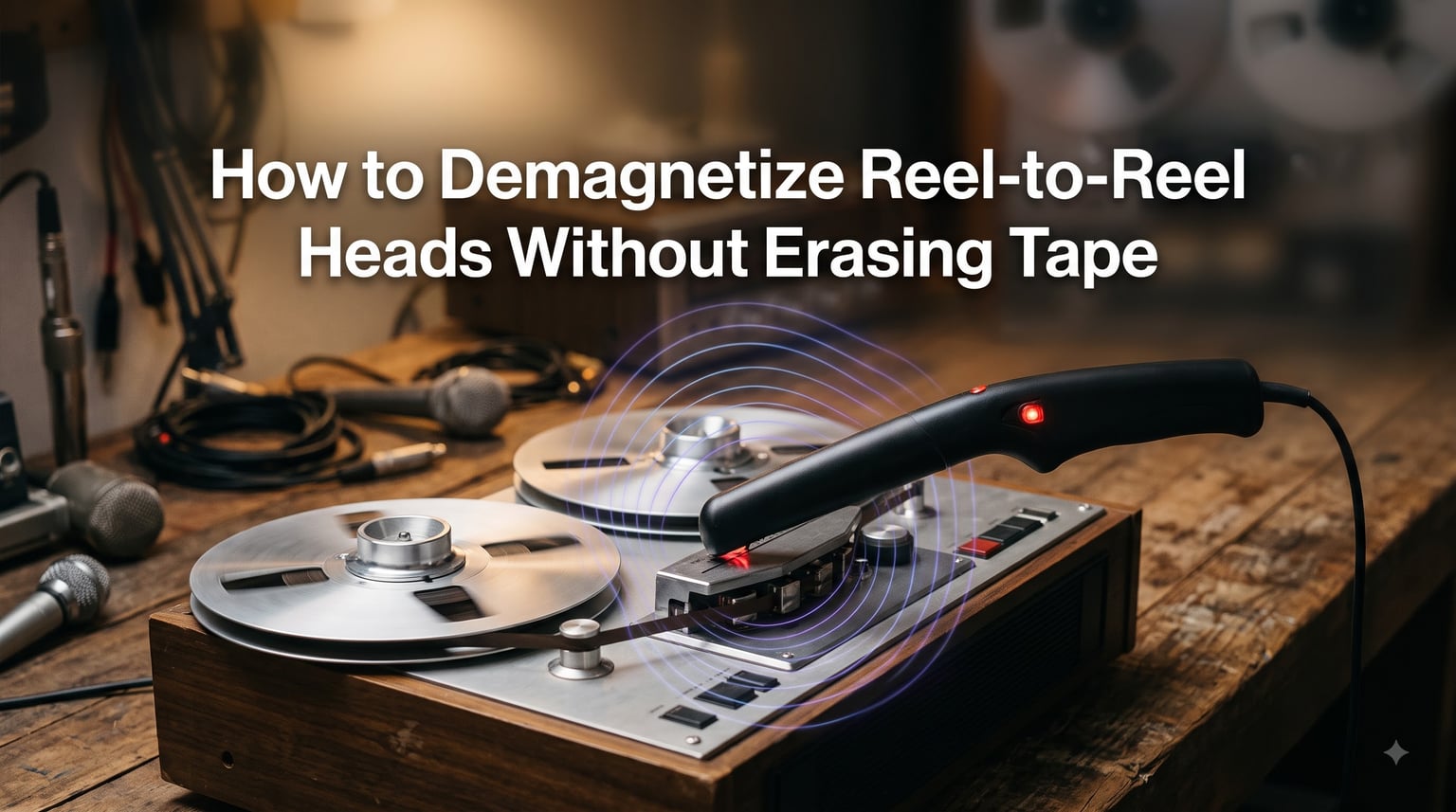
If your reel-to-reel deck suddenly sounds dull, muffled, or noisy, magnetized heads are often the culprit. I have seen plenty of vintage Studer, Teac, and Revox machines lose their top-end clarity simply because no one ran a degaussing wand across the heads. The good news is that learning how to demagnetize reel-to-reel heads without erasing tape is a simple process once you understand the procedure and respect the safety rules.
This guide walks through what demagnetizing does, when you need it, the exact step-by-step method, and how to test whether your work paid off. I have kept the language practical so you can grab your wand and finish the job in under ten minutes.
Table of Contents
What Does Demagnetizing Reel-to-Reel Heads Actually Do?
Demagnetizing reel-to-reel heads means using an alternating magnetic field to neutralize any residual magnetism stuck on the playback head, recording head, and erase head. Every time tape passes across a head, tiny amounts of magnetic energy transfer. Over months of regular playback and recording, that stray flux accumulates until the head itself behaves like a weak magnet.
A magnetized head is bad news for high frequencies. It partially erases the top end on every pass, so playback sounds veiled and dull. Recording through a magnetized head produces recordings that lose brilliance even before they leave the machine. Demagnetizing restores full frequency response and protects the recordings you already have on tape.
The technical term for the process is degaussing, and the wand you use is often called a degaussing wand or tape head demagnetizer. It works by producing an alternating current that decays as you withdraw the wand, scrambling the magnetic domains in the head until they point in random directions. When the domains cancel each other out, no net magnetization remains.
Signs Your Reel-to-Reel Heads Need Demagnetizing
You do not need a meter to know when heads need attention. Your ears usually tell you first. Here are the most common symptoms I have run into on reel-to-reel decks:
Loss of high-frequency sparkle on playback, especially noticeable on cymbals, sibilance, and acoustic guitar
A persistent dull or veiled quality on recordings that never improves after cleaning
New recordings sound noticeably softer than older ones made on the same machine
A faint hum or increased background noise that was not there before
Light paper clips or steel shavings cling to the head stack when the deck is powered off
Reel-to-reel maintenance works best when you catch these symptoms early. A head that has been heavily magnetized for years takes longer to recover and may have permanently altered its magnetic signature in extreme cases. Demagnetize regularly and you avoid the problem altogether.
Tools You Need to Demagnetize Reel-to-Reel Heads Safely
You only need one essential tool: a tape head demagnetizer. The most common style is a handheld wand with a plastic tip and a power switch, often running on AC mains. Brands like Hedden, Recoton, and TDK have produced reliable wands for decades, and you can still find them through vintage audio dealers and specialty shops.
If a commercial demagnetizer is not available, you have a few alternatives. A bulk tape eraser can serve as an oversized head demagnetizer if you use it gently and at safe distances. For 2-head decks, some owners report success recording a sine wave onto a metal tape, which uses the bias oscillator to flush residual magnetism. The bias signal method is less reliable on 3-head machines with separate erase heads.
Whichever tool you choose, never use a permanent magnet, a speaker magnet, or a magnetic screwdriver on tape heads. These will magnetize the heads more, not less. A proper AC demagnetizer is the only safe choice for regular use.
Step-by-Step: How to Demagnetize Reel-to-Reel Heads Without Erasing Tape?
This is the core procedure. Follow these steps in order and your tapes will be safe. The reason the tape never gets erased is that the demagnetizer is never brought near the tape while powered. You only engage the wand at a safe distance, and you only disengage it after withdrawing to the same safe distance.
Remove all tapes from the deck. Set them at least three feet away from the demagnetizer. Tapes that are sitting near a powered demagnetizer can pick up partial erasure.
Power off the reel-to-reel deck completely. Unplugging is even safer. The demagnetizer needs to work against the head, not against powered electronics.
Plug in the demagnetizer at least two feet away from the deck. This is critical. Switching the wand on while it sits near the head sends a surge of magnetic flux that can worsen magnetization.
With the wand still two feet away, turn on its power switch. You should feel a slight buzz if the unit is transformer-based.
Open the head cover or tape door so the heads are accessible. The wand needs to physically contact or nearly contact the head stack.
Slowly bring the wand tip toward the playback head. Take at least five seconds to move from two feet away to touching the head. Slow approach is the entire secret to the process.
Touch the wand tip to the playback head, then to the recording head, and finally to the erase head. Spend two to three seconds on each head.
Repeat the same slow pass across the capstan, the guide rollers, and any other ferrous parts of the tape path. Cover every surface your tape touches.
Now reverse the motion. Withdraw the wand slowly back to the two-foot distance. This slow withdrawal is what leaves the heads in a demagnetized state. Rushing this step is the most common mistake.
Only when the wand is at least two feet away from the deck should you switch it off. Powering down close to the head causes a strong DC pulse that magnetizes everything.
Unplug the demagnetizer, and the procedure is complete.
That is the entire technique. It sounds fussy on paper, but in practice it takes under five minutes once you have done it a couple of times. The two rules to engrave in your memory are: power on at a distance, and power off at a distance.
Demagnetizing the Complete Tape Path
Most articles stop at the heads. In our experience, the full tape path is what really matters. Tape contacts the heads, the guide rollers, the capstan, and the pinch roller in that order. Any of these parts holding residual magnetism will gradually erase your tapes as they wind through the machine.
Run the wand slowly over each guide roller, then along the capstan shaft. The pinch roller on most reel-to-reel decks is rubber-coated so it will not hold significant magnetism, but the metal hub behind it sometimes does. Touch the wand to the hub briefly as part of your pass.
The erase head deserves special attention on 3-head decks. Erase heads see a strong bias signal constantly, which is why they tend to magnetize faster than playback or record heads. Spend an extra few seconds on the erase head if your deck has one.
2-Head vs 3-Head Deck Demagnetizing Differences
The demagnetizing procedure is the same for both designs. The difference lies in how often each type actually needs it. On 2-head decks, where a single combined record/playback head handles both functions, the bias oscillator naturally demagnetizes the head every time you record. Magnetization tends to stay low without intervention.
3-head decks have separate heads for each function. Playback-only heads, especially on machines used for monitoring tape, never see the bias signal and accumulate magnetization steadily. Demagnetize 3-head decks more frequently than 2-head decks, especially if you do a lot of playback-only work.
The same wand technique works either way. Just calibrate your schedule based on the head count in your machine.
How to Test If Demagnetizing Worked
The simplest test is your ears. Play a reference tape you know well, especially one with strong high-frequency content. If cymbals and sibilance sound brighter than before, the procedure worked. If nothing changed, either the heads were not magnetized to begin with, or you may have rushed the slow withdrawal step.
A more precise test uses a calibration tape. Record a 10 kHz signal at reference level, then play it back. Magnetized heads will show measurable high-frequency loss on a meter. Re-run the demagnetizing procedure and compare. You should see at least 1 to 2 dB improvement at 10 kHz on a healthy deck.
A trick we have used on stubborn heads is two passes. Run the demagnetizer once, withdraw slowly, then bring it back in for a second pass. Two slow passes handle most cases that do not respond to a single pass.
How Often Should You Demagnetize Reel-to-Reel Heads?
There is no fixed schedule that fits every deck. A reasonable starting point is every 20 to 30 hours of active tape use. Heavy recording studios might demagnetize weekly, while a hobbyist running a deck once a month can stretch that to every six months. Listen for the symptoms we described earlier. Your ears will tell you when it is time.
Always demagnetize before a critical recording session. There is no downside to running the wand when the heads are already clean, and you do not want to commit a once-in-a-lifetime performance to tape through magnetized heads. As a rule of thumb, demagnetize at the start of any major project.
Common Mistakes That Make Magnetization Worse
The single biggest mistake is switching the wand on or off while it is close to the head stack. Both actions cause sharp magnetic transitions that magnetize ferrous parts instead of demagnetizing them. Always engage power at two feet away, and only disengage it after you have withdrawn to two feet.
Moving the wand too quickly is the next most common error. Quick movements leave the heads in a partially magnetized state because the alternating field never has time to decay smoothly. Slow approach, brief contact, slow withdrawal. That rhythm is what works.
Never use a demagnetizer on a tape that is loaded in the deck. Some owners ask if they can demagnetize heads while running tape to save time. The answer is no. The tape will absorb the strong alternating field and end up partially erased. Always unload tapes before you begin, and keep them well away from the powered wand.
Finally, do not assume that demagnetizing replaces cleaning. Oxidized, sticky, or contaminated heads need cleaning first. Demagnetizing a dirty head works, but the residue will attract more oxide and the symptoms return quickly. Clean and demagnetize in that order for the longest-lasting result.
Frequently Asked Questions
Will demagnetizing my reel-to-reel heads erase my tapes?
No, not if you follow the correct procedure. Keep all tapes at least three feet away from the demagnetizer while it is powered, unload them before you begin, and never engage or disengage the wand near the deck. Doing so keeps your recordings safe throughout the process.
How often should I demagnetize reel-to-reel heads?
Demagnetize roughly every 20 to 30 hours of tape use, or anytime you notice muffled high frequencies or new recordings sounding duller than older ones. Studios often demagnetize weekly, while casual users can do so every few months. Always demagnetize before a critical recording session.
Can I demagnetize reel-to-reel heads without buying a demagnetizer?
Yes, a bulk tape eraser can work as a substitute if used gently and at safe distances. For 2-head decks, some owners record a sine wave onto metal tape to use the bias oscillator as a demagnetizing signal. A dedicated wand is still the most reliable option for routine maintenance.
What are the signs of magnetized tape heads?
The most common symptoms are dull or veiled playback, reduced high-frequency response, increased background noise, and new recordings sounding noticeably softer than older ones. A quick physical check is to see if small steel items cling lightly to the head stack when the deck is powered off.
How do I know if my demagnetizer is actually working?
A working demagnetizer produces a noticeable vibration or buzz when switched on, and the tip attracts a steel screwdriver or paper clip from a small distance. The best end-to-end test is to play a reference tape with strong high frequencies before and after the procedure. A clear improvement in brilliance confirms the wand did its job.
Wrapping Up: Keeping Your Reel-to-Reel Deck Sounding Right
Knowing how to demagnetize reel-to-reel heads without erasing tape comes down to three habits. Move the wand slowly in both directions. Always switch the power on and off at a safe distance. And treat every part of the tape path, not just the heads themselves, as part of the routine.
Run through this procedure every few weeks if you record often, and your tapes will keep their full frequency response for decades. The ten minutes you spend demagnetizing is the cheapest insurance you can buy for any vintage reel-to-reel deck.