
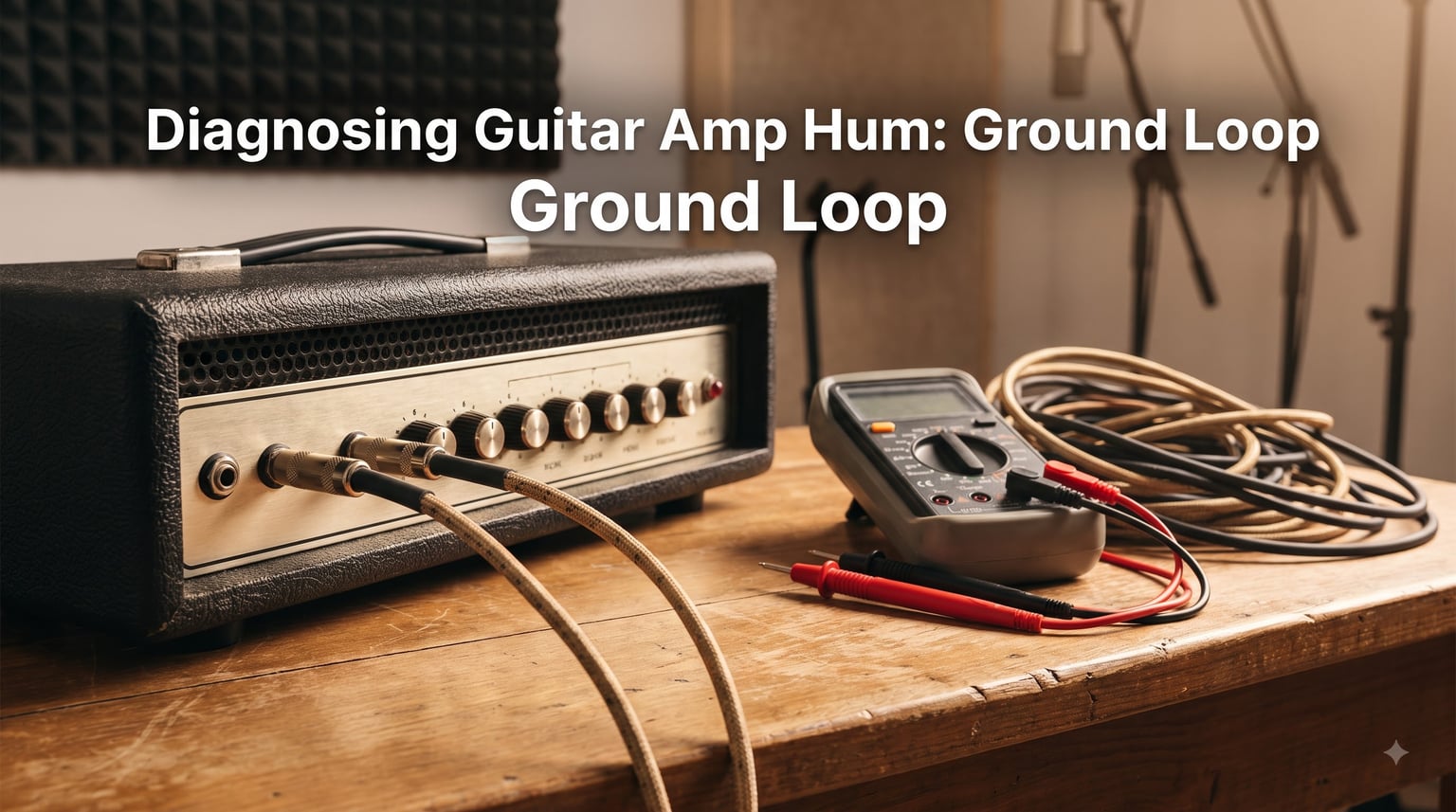
You flip on your guitar amp, plug in, and there it is: that low, steady 60Hz hum that won’t go away no matter how you turn the volume knob. I have been there. I have spent entire evenings chasing phantom buzzes that vanished when I lifted one cable and reconnected it differently. Most of the time, the culprit is a ground loop, and the good news is that you can find it yourself without a repair shop.
This guide is written for players who want to diagnose guitar amp hum caused by ground loops. We will cover what a ground loop actually is, how to tell it apart from other noises, and the exact steps I use to track one down in a guitar rig. You will also get practical fixes for pedalboard setups, effects loops, and those weird environmental hums that seem to come from nowhere.
Table of Contents
What Is a Ground Loop in a Guitar Amp?
A ground loop in a guitar amp happens when your signal ground is connected to earth ground at two or more different points. Each of those earth connections sits at a slightly different electrical potential, so current flows between them through your audio cables. That stray current shows up in your signal as a steady 60Hz hum.
Most guitar amps have two grounds you need to keep straight. The signal ground is the reference point for your audio circuit. The earth ground is the safety ground wired into your AC outlet. Inside a healthy amp, those two meet at one place through the power supply. The trouble starts when another piece of gear, like a pedalboard, audio interface, or second amp, also ties signal ground to earth ground at a different spot. Now you have two paths to earth, and the difference between them becomes a hum you can hear in your speakers.
I first learned this when I plugged my tube combo into the same outlet as my recording interface. The hum was brutal. Touching the metal chassis of the interface made it louder, which is the classic tell. That tiny voltage difference between two ground points was being amplified right along with my guitar.
The key thing to remember is that a ground loop is not a defect in any single piece of gear. It is a symptom of how your rig is wired together. Fixing it means breaking or isolating one of those ground paths without removing the safety ground that protects you from shock.
How to Tell the Difference Between 60Hz Hum and Ground Loop Noise?
Not all hum is a ground loop. Before you start unplugging cables, take 30 seconds to listen carefully. The character of the noise tells you where to look first.
A 60Hz hum is a low, smooth, almost musical tone. It is the frequency of the AC power in your wall. Ground loops almost always produce this kind of hum, often combined with slightly stronger harmonics at 120Hz and 180Hz. If your hum sounds like a slowly turning tuning fork, you are probably chasing a ground loop.
Volume knob behavior matters too. If the hum disappears when you turn the volume down to zero, the noise is entering through your guitar, cable, or pedals. If the hum stays exactly the same loudness regardless of the volume knob, the noise is coming from inside the amp or the power feeding it. Ground loop hum usually matches the volume knob because it enters the signal chain before the amp’s preamp.
Here is a quick comparison to keep in your head:
60Hz hum, soft, vanishes with volume down: Likely a ground loop in your signal chain.
120Hz buzz, harsher, doorbell-like: Usually a faulty filter cap or rectified DC issue, not a ground loop.
High-frequency hiss, constant: Tube or transistor self-noise, unrelated to grounds.
Crackle when you wiggle the cable: Bad cable or dirty jack, not a ground loop.
If your hum is the first kind, the rest of this guide applies. If it is the second or third, you are looking at a different problem.
Common Causes of Ground Loop Hum in Guitar Rigs
Ground loops need at least two devices in your signal chain that each tie signal ground to earth ground. Here are the most common offenders I have encountered in home studios, rehearsal rooms, and live setups.
Multiple Devices Plugged Into Different Outlets
If your amp is in one wall outlet and your pedalboard power supply, audio interface, or computer is in another outlet on a different circuit, you have created two earth points. The voltage difference between those grounds can be small, but it gets amplified into a clear hum. This is the single most common cause of ground loop hum I see on forums.
Pedalboards With Mains-Powered Effects
Many vintage pedals and some modern units use a wall-wart or mains power supply with a grounded plug. Each one of those tied to earth adds another potential ground point. Daisy-chained power supplies on a single multi-tap brick tend to be safer than mixing three or four separate wall-warts.
Effects Loop Connections
When you insert external processors into your amp’s effects loop, you run a send and return cable between two grounded devices. The chassis of the processor and the chassis of the amp are both earthed, and the audio ground between them is at a slightly different potential. Effects loops are a prime suspect whenever hum appears only when something is plugged into the loop.
Audio Interfaces and Computers
Plugging a guitar amp into a laptop or audio interface for recording creates a textbook ground loop. The laptop is grounded through its charger, the amp is grounded through its own outlet, and the TS or TRS cable between them completes the loop. This is the case I mentioned at the start of the article.
Multiple Amplifiers Sharing a Stage
Live setups with two or more amps each plugged into different power circuits are notorious for ground loops. The hum often pulses with the stage lighting, which is a hint that the lighting dimmer is the source of the imbalance.
Step-by-Step Diagnostic Process for Amp Hum
This is the method I use whenever a hum shows up. It takes about 15 minutes and works in any studio or stage setup. I learned this from a senior tech early in my playing days, and it has saved me countless trips to the repair shop.
Start with a stripped-down rig. Unplug everything from your amp except the power cable. Turn the amp on with nothing in the input jack. Listen for 20 seconds. If there is hum already, the noise is inside the amp or in your AC power.
Plug in a known-good instrument cable. Leave the other end of the cable unplugged. If hum appears now, the cable is shorted or the input jack has a ground issue. Try a different cable.
Touch the cable tip to the input jack sleeve. This shorts the signal to ground. If the hum gets louder, the ground in your amp is working. If it disappears, your ground reference is broken.
Plug your guitar in with the volume on zero. Listen. The hum should be quieter than in step 1. If it is louder, the guitar or its cable is contributing.
Turn the guitar volume up halfway. Listen again. Hum may increase because single-coil pickups pick up ambient EMI. This is normal and not a ground loop.
Add pedals one at a time. Reconnect each pedal in your chain, one piece at a time, and listen after each addition. The hum will spike when you hit the offending device. That is your ground loop source.
Try a different wall outlet. Move the amp and the offending device to the same power strip or outlet. If the hum drops, the loop was caused by separate circuits.
Test with a ground lift adapter. Only as a temporary diagnostic step, use a 3-prong to 2-prong adapter on the offending device. If the hum stops, you have confirmed a ground loop. Do not leave the adapter in place permanently because it removes the safety ground.
By the end of these eight steps, you will know whether the hum is a ground loop, which device is causing it, and whether the issue is shared circuits or a wiring mismatch inside a piece of gear.
Solutions and Fixes for Ground Loop Problems
Once you have identified the ground loop, you have several options. Pick the one that matches your situation. There is no single right answer, and serious players often combine two or three of these.
Share a Single Power Outlet
The simplest fix is to plug your amp, pedalboard, and any recording gear into the same power strip fed from one outlet. Equalizing the ground reference usually drops the hum by 80 percent or more. I keep a heavy-duty power strip on hand for exactly this reason.
Use a Ground Loop Isolator
A ground loop isolator is a small inline device that uses transformers to break the ground path while passing the audio signal. Plug it between the two pieces of gear that form the loop. Common spots are between the amp and an audio interface, or between an effects loop processor and the amp. The Ebtech Hum Eliminator is a long-time favorite on forums for this exact job.
Ground loop isolators work best on unbalanced signals. They are also a good solution when you cannot change the wiring of the building you are playing in.
Lift the Ground at One Source Only
Some guitar amps, mixers, and audio interfaces have a ground lift switch on the back. Flip it on one device only, never both. This breaks the loop. If your gear does not have a switch, a ground lift adapter on the AC plug of one device works as a temporary measure, but remember it removes the safety ground.
Isolate the Effects Loop
If your hum only appears when something is plugged into the effects loop, try a hum-eliminator on the send and return. Some amps also let you switch the loop to line level. Match the level of the connected device to the loop’s expected level, since level mismatches can look like hum but are actually solved differently.
Replace Suspect Cables
A cable with a broken shield can act like an antenna and contribute to ground loop problems. Keep a spare set of high-quality instrument and patch cables. I rotate mine out every couple of years because the shielding breaks down with regular gigging.
Upgrade Your Pedalboard Power Supply
If you have multiple pedals each with their own wall-wart, switching to a single isolated-output power supply solves more ground loop problems than any other change. Isolated outputs mean each pedal has its own clean ground reference, and the supply itself only plugs into one outlet.
Pedalboard and Effects Loop Ground Loop Issues
Pedalboards are ground loop magnets. The metal enclosure of the board, the jacks on each pedal, the input and output of the amp, and the power supply all share ground paths. If you hear hum only when pedals are connected, work through these checks in order.
First, count your wall-warts. Two or more separate power supplies on one board is the leading cause. Replace them with a single isolated power supply like a CIOKS, Voodoo Lab, or Truetone 1 SPOT style unit. Second, check that all your patch cables have intact shields. A bad patch cable can ground one pedal to the chassis of the next in unexpected ways.
Effects loop ground loops have a few unique tricks. Some amps offer a ground lift switch on the loop itself. If yours does not, insert a transformer-based isolator between the amp and the first device in the loop. Make sure your loop cables are short and high quality, since long unbalanced cables in an effects loop pick up hum from stage lighting and dimmers.
Environmental EMF Sources and Other Unusual Hum Causes
Sometimes the ground loop is not inside your rig at all. It is in the air around you. Real-world players report bizarre hums that turned out to be from neighbor’s lawnmower robot boundary wires, dimmer switches in the next room, fluorescent light ballasts, and even refrigerators cycling on shared circuits.
One forum poster spent two weeks chasing a hum in their home studio before realizing their neighbor’s robotic lawnmower was running its boundary wire along the shared wall, six meters from the guitar rig. The wire was radiating EMI exactly at the frequency range that single-coil pickups would amplify. Moving the rig to the opposite wall fixed it immediately.
To rule out environmental sources, try your rig in a different room or at a different time of day. If the hum follows the location and not the gear, you are likely dealing with external EMF. Solutions include moving the amp, using shielded cables, switching to humbucking pickups, or shielding the guitar’s control cavity.
Stage lighting dimmers are a classic offender at live shows. They pulse 60Hz or 120Hz depending on the dimmer type, and that signal radiates from every cable run on stage. If your hum changes when the lighting tech moves a fader, dimmers are your culprit.
Frequently Asked Questions
What causes ground loop hum in guitar amps?
A ground loop forms when two or more devices in your signal chain each connect signal ground to earth ground at a different point. The small voltage difference between those ground points causes current to flow through your audio cables, producing a steady 60Hz hum.
How do you fix a ground loop in a guitar amplifier?
Share a single power outlet for all your gear, use a ground loop isolator between the two offending devices, or lift the ground on one device only with its built-in switch. Eliminating the second ground path breaks the loop and removes the hum.
Why does my guitar amp hum when pedals are connected?
Each pedal with its own wall-wart power supply adds another ground reference. When those grounds are at slightly different potentials, current flows between them and shows up as hum. Use a single isolated-output power supply to fix this.
What is the difference between 60Hz hum and ground loop noise?
60Hz hum is a low smooth tone at the AC mains frequency. Ground loop noise is a specific type of 60Hz hum caused by multiple ground paths. All ground loop hum is 60Hz, but not all 60Hz hum is a ground loop. The volume knob behavior and the lighting of dimmer switches help confirm it.
How can I tell if my amp has a ground loop or a defective tube?
Run the eight-step diagnostic above. If hum disappears when you turn the volume knob to zero, the noise is in the signal chain and probably a ground loop. If hum stays the same with the volume at zero, the issue is inside the amp, often a failing filter cap or power tube. Swap tubes one at a time to confirm a tube fault.
Final Thoughts on Diagnosing Guitar Amp Hum Ground Loop Issues
Ground loop hum is annoying, but it is one of the most fixable problems in any guitar rig. Start with the eight-step diagnostic process, identify the second ground path, and break it. Sharing a single outlet is free. An isolated power supply or a ground loop isolator is a small investment that pays off every time you plug in.
If you have worked through the steps and the hum persists, you are probably looking at a tube, filter cap, or other internal amp issue that belongs on a tech’s bench. At that point, take the amp to a qualified repair shop and describe exactly what you heard during the diagnostic. The notes you took will save the technician time and save you money.