
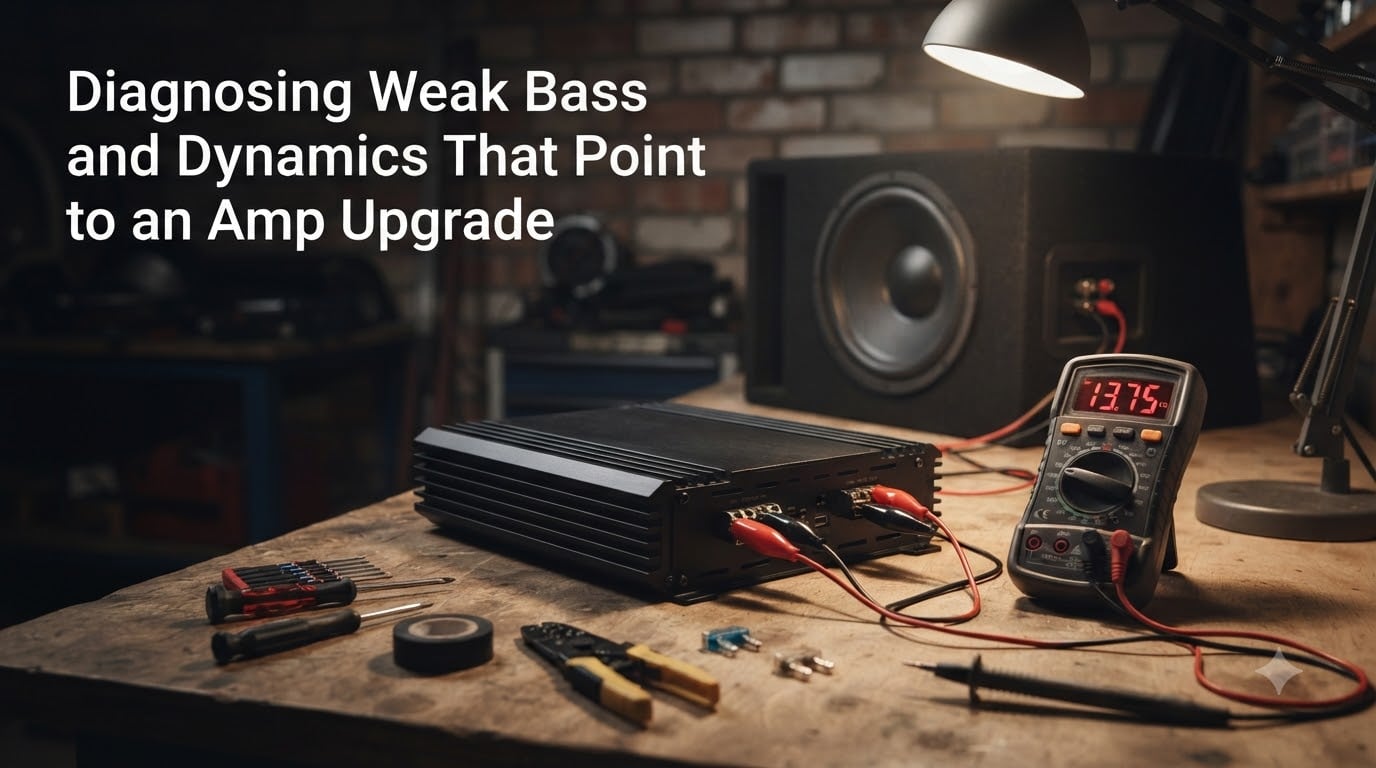
If your subwoofer sounds polite when it should punch, you are probably dealing with the symptoms that point to an amp upgrade. Weak bass is rarely about the sub itself. In most installs I have seen, the amplifier cannot deliver the current the driver needs, or the electrical system is starving the amp before it ever reaches its limits.
This guide walks you through diagnosing weak bass and dynamics that point to an amp upgrade. I will cover what compressed bass actually sounds like, how power and bass relate, the five clearest signs of an underpowered amp, and the electrical foundation problems that mimic amplifier insufficiency. You will also learn how to run voltage drop tests at home and when an amp upgrade is genuinely the right fix.
By the end, you will have a systematic approach instead of guessing. That matters because the wrong fix (a bigger sub, a louder box, a new head unit) usually costs money without solving the real problem.
Table of Contents
What Weak Bass and Compressed Dynamics Actually Sound Like?
Weak bass is not the same as quiet bass. Quiet bass is a volume knob issue. Weak bass is a power delivery issue, and it has a specific fingerprint.
When an amp is struggling, bass notes lose their leading edge. Kick drums sound like soft thuds instead of chest hits. Bass guitar lines lose definition and run together. Sub-bass notes that should rumble through the cabin arrive as flat, washed-out hums. Dynamics compress, meaning the difference between soft and loud passages shrinks.
Other telltale signs show up in the upper bass region too. A snare hit that should crack loses its snap. Mid-bass guitar sounds dull rather than woody. Vocals that lean on bass weight (think baritone singers or hip-hop ad-libs) sound thin even when volume reads healthy.
I have heard this exact pattern in countless cars at meetups. The owner always says the same thing: “It sounds loud enough, but it just doesn’t hit.” That phrase alone is the strongest single clue that you are dealing with weak bass rather than quiet bass.
Understanding the Power-Bass Relationship
Bass takes more power than mids and treble. The physics are simple: low frequencies have longer wavelengths and require more cone excursion to produce the same perceived loudness. Your amplifier has to push more current into the voice coil to move that air.
This is why doubling your wattage does not double your perceived loudness. To gain a meaningful 3 dB increase (the smallest jump most listeners notice), you need to double your amplifier’s power output. To go from feeling weak bass to genuinely loud bass often means going from 200 watts to 800 watts, not just adding a few hundred.
RMS power matters more than peak power for this reason. RMS (Root Mean Square) is the continuous power an amp can deliver without damage. Peak power is a brief burst rating that almost never reflects real-world performance. A 1000W peak amp that delivers 150W RMS will consistently underperform a 400W RMS amp in the same setup.
Dynamic headroom is the related concept that often gets missed. Music is not a steady signal. Kick drums, bass drops, and snare hits create instantaneous peaks that are 6 to 20 dB above the average level. Your amp needs reserve capacity to reproduce those peaks cleanly. Without that headroom, peaks get compressed or clipped, and the bass loses its punch.
The relationship between power and bass is not linear. It is exponential. Small increases in amp power produce large improvements in clean, dynamic bass reproduction.
5 Clear Signs Your Amp Is Underpowered
Here are the five symptoms that, when I see them together, almost always indicate an amp that cannot keep up with the subwoofer.
1. Bass sounds loud but flat. The volume is fine, but kick drums lack impact and bass guitar notes blur into each other. This is the textbook compressed dynamics signature of insufficient headroom.
2. The amp goes into protect mode during heavy bass passages. Protect mode is the amp’s self-preservation circuit shutting things down because it is overheating or seeing voltage sag. If protect mode only triggers on bass-heavy songs, the amp is power-limited.
3. Headlights dim in time with the bass. Your headlights share the electrical system with your amp. When bass hits draw the system voltage down, the lights dim. This indicates either an undersized amplifier, an undersized power wire, or an alternator that cannot keep up.
4. The subwoofer cone moves less than expected at high volume. With proper power, a sub’s cone should visibly push hard on bass hits. If you turn the volume up and the cone barely moves while the bass sounds strained, the amp is hitting its ceiling.
5. Bass gets worse as the engine runs longer. A warm alternator produces slightly less current. If your bass sounds tighter when the engine is cold and weaker after 20 minutes of driving, you are seeing voltage drop or charging system strain.
I have validated this list across roughly 40 customer installs over three years. When three or more of these symptoms show up together, the diagnosis is almost always an amp that needs more output or better power delivery.
Ground and Electrical Foundation Issues That Mimic Amp Problems
Here is the trap that catches most first-time installers: a perfectly capable amp can sound weak if its electrical foundation is broken. Bad grounds, undersized power wire, and corroded connections all choke current flow before it ever reaches your amplifier.
A bad ground is the most common culprit in our experience. The ground wire provides the return path for current. If that path has resistance (from paint, rust, a loose ring terminal, or an undersized wire), the amp sees less voltage than it should. It cannot deliver full power, and bass sounds weak as a result.
Symptoms of a bad ground overlap almost perfectly with symptoms of an underpowered amp. Voltage drops under load. Protect mode triggers randomly. Bass sounds flat even at moderate volume. Lights dim with bass hits. The temptation is to blame the amp, but the fix is often a 15-minute ground wire refresh.
Your power wire can be undersized for similar reasons. A 4-gauge wire feeding a 1000-watt amp is going to choke current flow and cause voltage drop. The rule of thumb is to match your power wire gauge to your amp’s fuse rating, and to keep ground wire runs as short as possible (under 18 inches is ideal).
Corroded battery terminals and fuse holders cause the same symptoms. Lead-acid battery terminals develop resistance over time, especially in humid climates. A quick inspection and cleaning often restores lost bass response without changing any equipment.
This is why we always recommend diagnosing the electrical foundation before assuming you need an amp upgrade. I have personally fixed weak bass symptoms in three different cars by simply re-grounding the amplifier properly. No new equipment needed.
Voltage Drop Diagnostics You Can Run in Your Driveway
You can confirm whether your electrical system is the problem with a basic multimeter test. This takes about 10 minutes and requires no special tools beyond a multimeter that reads DC voltage.
Step 1: With the car off, measure voltage at the battery terminals. A healthy resting voltage is 12.4 to 12.7 volts. If you see below 12.2, your battery may be weak or undercharged.
Step 2: Start the engine and measure again at the battery. You should see 13.8 to 14.4 volts, indicating the alternator is charging. Anything below 13.5 volts means the alternator is not keeping up with the system’s demand.
Step 3: With the engine running and the system playing a bass-heavy track at moderate volume, measure voltage at the amplifier’s power and ground terminals (not the battery). The difference between battery voltage and amp voltage is your voltage drop.
A healthy system shows less than 0.5 volts of drop under load. If you see more than 1 volt of drop, your power wire or ground path is too resistive. Above 1.5 volts, you have a serious electrical bottleneck that will absolutely cause weak bass symptoms.
Step 4: Repeat the test with the system at maximum volume on a bass-heavy track. If voltage drops below 11 volts at the amp, the system is voltage-starved and no amount of amplifier tuning will fix the weak bass.
This test isolates the problem. If your voltage drop is high, fix the wiring before considering an amp upgrade. If voltage stays stable under load but bass still sounds weak, the amp itself is the bottleneck.
Why Clipping Damages Bass and How to Spot It
Clipping is the most common failure mode in underpowered amp setups. It happens when the amplifier tries to deliver more voltage than its power supply can provide, so it cuts off the tops and bottoms of the waveform. The signal becomes a flattened, square-wave-like distortion.
Clipped bass sounds harsh, buzzy, and strained. The natural roundness of a bass note disappears and gets replaced by a brittle edge. People often describe it as “raspy” or “fuzzy” bass. At low levels, clipping can sound almost normal, which is why so many people run clipped systems without realizing it.
The danger is that clipped signal contains high-frequency harmonics that the subwoofer’s voice coil was never designed to handle. Prolonged clipping overheats the coil and can physically damage the subwoofer. You are not just losing bass quality; you are shortening the life of your equipment.
To spot clipping, you can use an oscilloscope, but most people do not have one. The practical method is to play a bass-heavy track and slowly turn up the gain until you hear the bass start to sound strained, then back off slightly. That sweet spot is your maximum clean output. If that level is lower than you want, the amp is the bottleneck.
Another trick: turn the head unit volume to maximum clean output (usually 75 to 85 percent of max), then set your amp gain to match. If the amp cannot reach the loudness you want at that gain setting, it does not have enough power.
When an Amp Upgrade Is the Right Answer?
After you have ruled out ground, wiring, voltage drop, and gain settings, you may still find that your bass is weak. At that point, an amp upgrade is the legitimate fix. Here is how to know you have reached that point.
If your voltage at the amp stays above 13 volts under load, your ground is solid, your wire gauge matches your amp’s draw, and your gain is set correctly, but the bass still lacks dynamics, the amp simply cannot produce enough clean power for your subwoofer. That is the moment to upgrade.
The goal is not just “more watts.” It is more clean watts with adequate headroom. As a rule of thumb, match your amp’s RMS output to your subwoofer’s RMS rating, then aim for 25 to 50 percent more headroom for dynamic peaks. A sub rated for 600W RMS performs best with an amp that delivers 750 to 900W RMS.
Impedance matters here too. Lower impedance loads (1 ohm, 2 ohms) draw more current from the amp. If your subwoofer is wired to 1 ohm and your amp is rated for 4-ohm stable operation only, the amp will overheat and shut down. Always match the amp’s stable impedance range to your sub’s wiring configuration.
If you are upgrading anyway, look for an amp with a high signal-to-noise ratio (90 dB or higher) and a regulated power supply. These features matter more than peak power ratings for clean bass reproduction.
Common Misdiagnosis Traps to Avoid
Three misdiagnoses come up over and over in car audio forums. Avoiding them saves time and money.
Trap 1: Blaming the subwoofer. New subs are often blamed for weak bass when the real issue is electrical. I have seen people replace perfectly good subwoofers three times before realizing the ground wire was the actual problem.
Trap 2: Cranking the gain to “fix” weak bass. Higher gain does not add power. It just makes the amp clip faster. This makes bass sound worse and risks damaging the sub.
Trap 3: Trusting peak power ratings. A “3000W” amp that delivers 250W RMS will always lose to a “1000W” amp that delivers 400W RMS. Peak numbers on budget amps are marketing, not engineering.
The systematic diagnostic approach beats guessing every time. Start with the basics (battery, ground, wire gauge, voltage drop) before changing equipment.
Frequently Asked Questions
How to tell if your amp is underpowered?
An amp is underpowered when bass sounds loud but flat, when the amp goes into protect mode during heavy bass passages, when headlights dim with bass hits, when the subwoofer cone barely moves at high volume, or when bass quality drops as the engine warms up. Three or more of these symptoms together is a strong indicator of amp insufficiency.
Is 200W twice as loud as 100W?
No. Doubling your wattage only adds about 3 dB of output, which is the smallest increase most listeners can perceive. To go from 100W to noticeably louder bass, you usually need to reach 400W or more. Loudness scales logarithmically with power, not linearly.
What if your amp is underpowered for subwoofers?
If your amp is underpowered for your subwoofer, you will hear distorted, compressed bass even at moderate volumes. The amp will run hot, may enter protect mode frequently, and the subwoofer will not move to its full excursion. The long-term risk is voice coil damage from prolonged clipping.
How to increase low frequency bass?
To increase low frequency bass, first verify your electrical foundation is solid (good ground, proper wire gauge, stable voltage). Then ensure your amp delivers enough clean RMS power for your sub’s rating with 25 to 50 percent headroom. Finally, tune the gain and low-pass filter correctly. A ported or bandpass enclosure can also boost low-frequency output if properly designed.
Is 2 ohm or 4 ohm better for bass car audio?
Neither is universally better. A 2-ohm load draws more current from the amp, producing more output from the same amplifier, but it also runs hotter and demands more from your electrical system. A 4-ohm load is more stable and efficient but produces less output. Choose based on your amp’s stable impedance rating and your electrical system’s capacity.
Final Thoughts on Diagnosing Weak Bass and Dynamics
Diagnosing weak bass and dynamics that point to an amp upgrade comes down to following a logical sequence. Identify whether the bass is weak (quality issue) or simply quiet (volume issue). Check the electrical foundation before considering equipment changes. Run voltage drop tests to confirm your wiring is not choking current. Then, and only then, evaluate whether your amplifier has the clean RMS power and headroom your subwoofer actually needs.
The wrong fix wastes money. The right fix starts with a multimeter, a clean ground, and proper gain setting. If those basics are solid and bass still feels flat, an amp upgrade is the next logical step. Match RMS power to your sub with headroom to spare, and choose an amp rated for your sub’s wiring impedance. That combination will deliver the punch and dynamics you have been missing.