
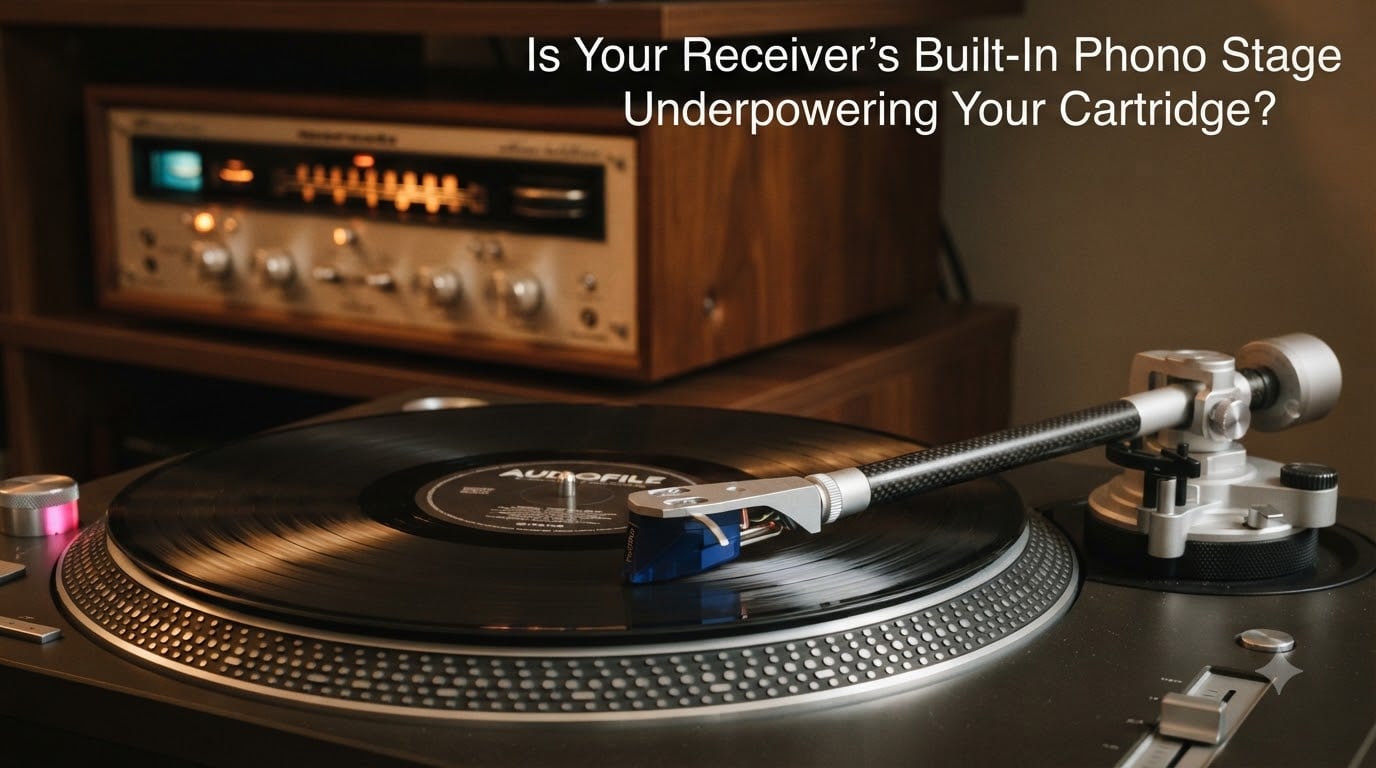
Is your receiver’s built-in phono stage underpowering your cartridge? If your vinyl setup sounds thinner or quieter than expected after upgrading your turntable or cartridge, the built-in phono stage in your receiver might be the weak link in your signal chain.
I’ve spent years testing turntable setups ranging from vintage receivers with phono inputs to dedicated external preamps. In this guide, I’ll walk you through how to diagnose whether your receiver’s built-in phono stage is holding back your cartridge, the specific symptoms to listen for, and what you can do about it.
Table of Contents
What Is a Phono Stage and What Does It Do?
A phono stage (also called a phono preamp) is a specialized preamplifier that performs two critical jobs. It boosts the tiny electrical signal from your turntable’s cartridge up to line level, and it applies the RIAA equalization curve needed for accurate vinyl playback.
Your cartridge outputs a signal measured in millivolts — much weaker than other audio sources like CD players or streamers. Without proper amplification, your records would be barely audible. The phono stage typically provides 35 to 45 dB of gain for moving magnet (MM) cartridges and 55 to 70 dB for moving coil (MC) cartridges.
RIAA equalization matters because records are cut with reduced bass and boosted treble to fit more music into the groove. The phono stage reverses this curve, restoring proper frequency balance. Together, these two functions make vinyl playback sound correct.
Quick Diagnostic Checklist: 5 Signs Your Phono Stage Is the Bottleneck
Yes, a receiver’s built-in phono stage can absolutely underpower a cartridge. Here are five signs that your built-in stage is the limiting factor in your vinyl setup.
- The sound is noticeably quiet. You find yourself turning the volume much higher for records than for other sources. Compare the volume position for your turntable versus your CD player at the same listening level. A big gap means your phono stage is providing insufficient gain.
- The sound is thin or veiled. Audiophiles on forums describe inadequate phono stages as producing “thin” or “veiled” sound — lacking richness, body, and detail. If your records lack the warmth and presence you hear at friends’ setups or in stores, your phono stage may be the reason.
- Dynamics feel compressed. When the music gets loud, it doesn’t have the impact or scale it should. A struggling phono stage runs out of headroom and compresses dynamic peaks. Quiet passages stay quiet, but loud sections lack punch.
- You hear hiss or hum. Built-in phono stages in budget and mid-range receivers often have higher noise floors. If you notice significant hiss during quiet passages or a hum that varies with the volume control, the phono stage design is likely compromising signal-to-noise ratio.
- You upgraded your cartridge but heard no improvement. If you spent more on a better cartridge but your records don’t sound noticeably better, your phono stage is probably masking those improvements. This is one of the most common frustrations reported in audiophile forums.
Understanding Gain: Matching Your Cartridge to Your Phono Stage
The most common cause of a receiver’s built-in phono stage underpowering a cartridge comes down to gain matching. Different cartridge types produce dramatically different output levels, and not all built-in stages can handle the differences.
MM vs MC Cartridge Output Levels
Moving magnet cartridges typically output around 3 to 5 millivolts. Most built-in phono stages are designed with this in mind and provide sufficient gain — usually 35 to 45 dB — to bring the signal up to line level.
Moving coil cartridges output much less — typically 0.2 to 0.5 millivolts. They require 55 to 70 dB of gain to reach line level. Many built-in phono stages either lack enough gain for MC cartridges entirely, or they provide it at the cost of higher noise and distortion.
| Cartridge Type | Typical Output | Gain Needed | Built-In Stage Adequate? |
|---|---|---|---|
| MM (Moving Magnet) | 3 to 5 mV | 35 to 45 dB | Usually yes |
| High-Output MC | 1 to 2 mV | 45 to 55 dB | Sometimes |
| Low-Output MC | 0.2 to 0.5 mV | 55 to 70 dB | Rarely |
If you’re running a low-output MC cartridge into a built-in phono stage designed primarily for MM cartridges, your phono stage is almost certainly underpowering it. This is one of the most common real-world scenarios where built-in stages fail.
What Underpowering Actually Sounds Like
Descriptions of bad phono stage sound appear repeatedly on audiophile forums. The language is consistent: users complain about sound that’s “thin,” “veiled,” “lacking body,” or “compressed.” These aren’t subjective preferences — they reflect what an inadequate gain stage actually does to the signal.
When a phono stage doesn’t provide enough clean gain, the rest of your amplifier chain has to work harder. This pushes other stages closer to their noise floor and distortion limits. The result is a sound that lacks transparency and dynamic range.
One forum thread described it well: a user noted that upgrading their cartridge was “a waste” because the phono stage added “veiling and limitations” that swallowed the improvement. This sentiment appears regularly across vinyl communities.
The same complaint pattern shows up when users compare their built-in receiver stage to an external unit. The external preamp reveals detail, weight, and dynamics that the built-in stage obscured. For many listeners, this comparison is the first time they realize their built-in stage was holding them back.
Impedance and Loading: Why Cartridge Matching Goes Beyond Gain
Gain isn’t the only matching factor. Impedance loading affects how your cartridge’s frequency response and dynamics behave. A cartridge is designed to work into a specific load impedance — and when the load is wrong, the sound changes.
Most MM cartridges want to see a load of 47,000 ohms. Most built-in phono stages are fixed at this value. That works fine for the majority of MM cartridges.
MC cartridges are fussier. Low-output MCs often want loads between 100 and 1,000 ohms. High-output MCs typically prefer 47,000 ohms like MM cartridges. Built-in phono stages usually can’t switch loading, so if your MC cartridge wants a different load, you’re stuck with the default.
The sonic result of wrong impedance loading varies. Too high a load and you might get edgy highs. Too low a load and the sound can become dull or lacking in energy. This is another dimension of “underpowering” that goes beyond just volume.
Quick Diagnostic: How to Test If Your Phono Stage Is the Limiting Factor
Here’s a simple test you can do right now to check if your built-in phono stage is the problem.
Step 1: Play a record you know well at a comfortable listening volume. Note the volume position on your receiver.
Step 2: Switch to another source (CD player, streamer, or radio) and adjust volume to the same perceived loudness. Note that position too.
Step 3: If your volume position for the turntable is dramatically higher than for other sources (more than 20 to 30 percent higher), your phono stage is likely not delivering adequate gain.
Step 4: Listen to a record with wide dynamic range. Pay attention to how the music behaves during loud passages. If the sound becomes harsh or compressed during peaks, your phono stage may be running out of headroom.
The most conclusive test is an A/B comparison with an external phono preamp. Borrow one from a friend or buy from a retailer with a good return policy. If records suddenly sound fuller, more detailed, and more dynamic with the external preamp, you’ve found your bottleneck.
When an External Phono Preamp Makes Sense
Not everyone needs an external phono preamp. Here’s how to decide.
You’re likely fine with your built-in stage if you’re running a moving magnet cartridge at a moderate price point and your music sounds good to you. Modern mid-range receivers from brands like Yamaha, Denon, and Marantz have competent built-in stages that handle MM cartridges well.
You should consider an external preamp if you run any moving coil cartridge, especially low-output MCs. You should also consider one if you’ve upgraded your cartridge to a higher level and haven’t heard meaningful improvement, or if your system’s noise floor bothers you during quiet passages.
The forum consensus is clear: external phono stages outperform built-in stages in most receivers, especially when paired with quality cartridges. Users frequently report that the upgrade is one of the most cost-effective improvements they made to their systems — even more impactful than upgrading cartridges or turntables in some cases.
The good news is that quality external phono preamps are available at reasonable prices. Entry-level options beat most built-in stages, while mid-range units transform the listening experience. If your current setup is limiting your enjoyment of vinyl, this is one upgrade worth prioritizing.
Frequently Asked Questions
What does a built-in phono stage mean?
A built-in phono stage is a phono preamplifier circuit integrated into a receiver, amplifier, or turntable. It performs the same function as an external phono preamp — boosting the cartridge’s low-level signal and applying RIAA equalization — but it’s built into another component rather than being a standalone device.
Is it better to have a built-in preamp or not?
Built-in preamps offer convenience and save space and money. External preamps typically offer better sound quality, more gain, and adjustable loading options. Whether built-in is better depends on your cartridge, your listening standards, and your budget. Many listeners start with built-in and upgrade later.
What is the best gain setting for a phono preamp?
The best gain setting depends on your cartridge type. Moving magnet cartridges typically need 35 to 45 dB of gain. Moving coil cartridges need 55 to 70 dB. The goal is to bring the cartridge’s output up to standard line level (around 300 mV) without adding noise or distortion. Most phono preamps have fixed gain optimized for the intended cartridge type.
How do I know if my record player has a built-in preamp?
Check for a switch or button labeled ‘Phono/Line’ on your turntable. If your turntable has this switch and it’s set to ‘Line,’ the built-in preamp is active. If your turntable only outputs from a ‘Phono’ setting, it doesn’t have a usable built-in preamp. You can also check by looking for RCA outputs labeled ‘Line Out’ versus ‘Phono Out.’
Does an external phono preamp make a difference?
Yes, an external phono preamp typically makes a noticeable difference, especially when paired with a quality cartridge. Improvements include better dynamics, lower noise floor, more detail retrieval, and better frequency balance. The degree of improvement depends on how good your built-in stage is and the quality of the external preamp you choose.
How to match a cartridge to a phono preamp?
Match based on two main factors: gain and impedance loading. Ensure your preamp provides enough gain for your cartridge’s output level (MM needs less, MC needs more). Also check that the preamp’s load impedance setting works with your cartridge’s specifications. Many MC cartridges require specific loading for optimal sound.
What is the typical gain setting for an MM cartridge?
The typical gain setting for a moving magnet cartridge is 40 dB, though acceptable ranges run from 35 to 45 dB. This brings the cartridge’s typical 3 to 5 mV output up to standard line level. Some phono preamps offer switchable gain so you can optimize for your specific cartridge.
Final Verdict: Is Your Receiver’s Phono Stage the Problem?
Whether your receiver’s built-in phono stage is underpowering your cartridge depends on your specific cartridge and how critical your ear is. For most MM cartridge users with mid-range receivers, the built-in stage works adequately. For MC cartridge users or anyone chasing the best sound from a premium cartridge, the built-in stage is likely the limiting factor.
Run through the diagnostic checklist above. If you recognize multiple symptoms — especially the “upgraded the cartridge but heard no improvement” scenario — your phono stage is almost certainly underpowering your cartridge. An external phono preamp is one of the most satisfying upgrades you can make to a vinyl system, and it costs less than you might expect.
Start by identifying whether the issue is gain (volume too low, dynamics compressed) or impedance loading (tonal balance off). Then decide if an external preamp makes sense for your setup and budget. In most cases where the receiver built-in phono stage is underpowering a cartridge, the solution is straightforward and the improvement is immediately obvious.