
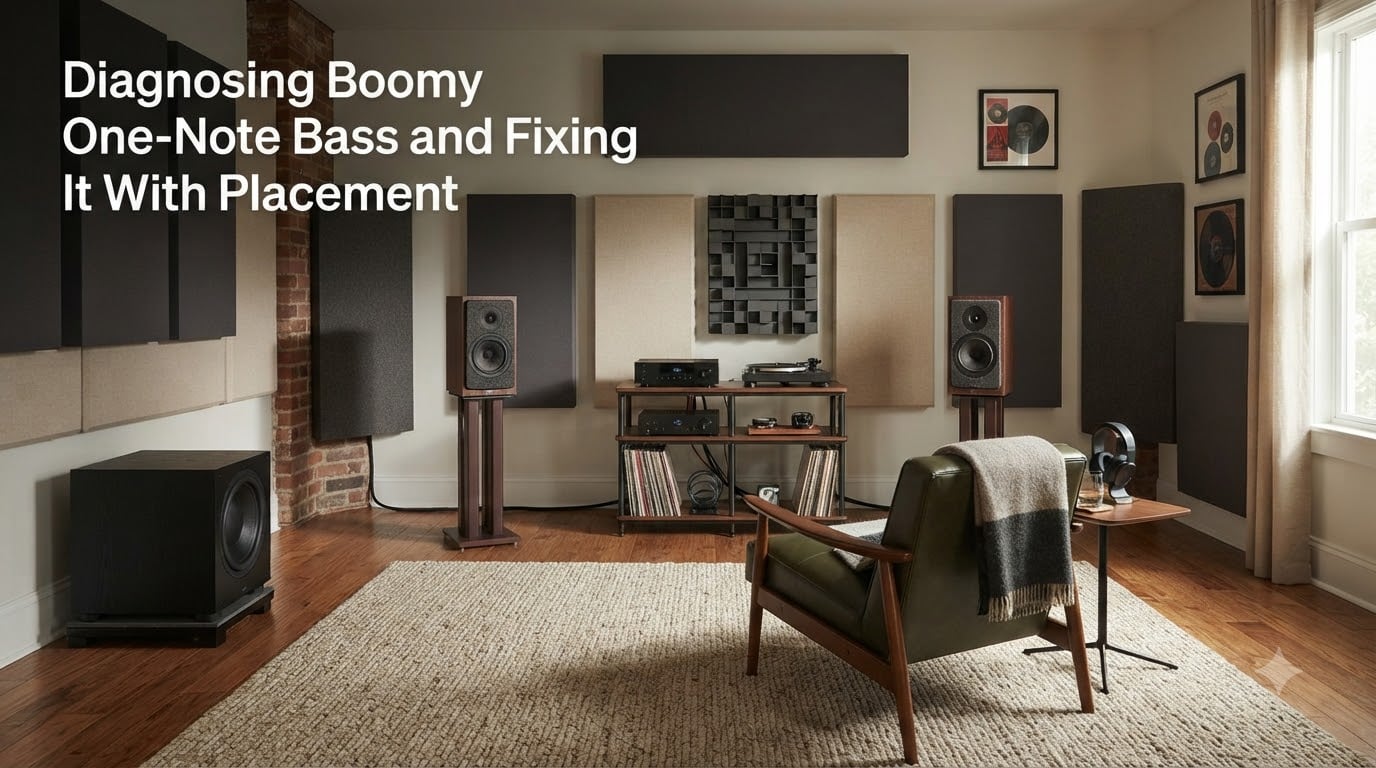
If your bass sounds thick, muddy, or like a single note keeps overpowering everything else, you’re dealing with a problem most listeners blame on their speakers. In my experience testing rooms over the past several years, the actual culprit is almost always the room itself. Diagnosing boomy one-note bass and fixing it with placement is often faster, cheaper, and more effective than reaching for an equalizer first.
This guide covers the physics behind why one specific bass note sounds louder than the rest, a step-by-step method to figure out whether your speakers or your room are at fault, and placement fixes that solve the root cause. I’ll also show you a quick EQ trick as a backup plan when placement alone isn’t enough.
Table of Contents
What Is Boomy One-Note Bass?
Boomy one-note bass is an acoustic problem where a single low frequency resonates far louder than every other note around it. You hear it most clearly when a bass guitar, kick drum, or 808 plays that exact note. It blooms, hangs in the air, and masks the notes above and below it. The result sounds like the bass is “honking” or dragging behind the rest of the music.
This differs from general bass heaviness. A uniformly boomy system boosts all low frequencies equally, which an EQ can tame easily. One-note bass is selective. Only one pitch (or a narrow band of pitches) is exaggerated, usually because the room dimensions happen to match that frequency’s wavelength. The notes a half-step above or below sound fine, which is what makes the problem so disorienting.
Common symptoms include a resonant hum when certain bass notes sustain, uneven bass response as you move your head a few inches, and difficulty hearing low-end detail in familiar songs. If any of this sounds familiar, the next step is figuring out why it’s happening.
Why Boomy Bass Happens: Room Modes and Standing Waves
Boomy bass is a physics problem, not a gear problem. Low-frequency sound waves bounce off walls, floors, and ceilings. When two parallel surfaces reflect the same wave back and forth, the wave reinforces itself at specific frequencies determined by the distance between those surfaces. This is called a standing wave.
At certain positions in the room, standing waves create pressure peaks where the bass is louder than the source signal. At other positions, the waves cancel and create bass nulls where low frequencies nearly disappear. This is the textbook definition of a room mode, and it’s the primary cause of one-note bass.
Room modes come in three flavors. Axial modes run between two parallel surfaces and produce the strongest peaks. Tangential modes bounce off four surfaces and are weaker. Oblique modes involve all six surfaces and are the weakest. For most home and studio setups, axial modes between the side walls, front-to-back walls, and floor-to-ceiling are what cause the boominess you hear.
The exact frequencies affected depend on your room dimensions. A room 4 meters long will have its first axial mode around 43 Hz, which means any bass note near that frequency will be loud at certain spots and quiet at others. Calculating these frequencies for your own room is the first step toward diagnosing the issue.
Diagnosing the Problem: Is It Your Room or Your Speakers
Before moving anything, I recommend a quick diagnostic to confirm the issue is room-related and not a speaker problem. Here’s the method I use:
Step 1: Play a familiar bass-heavy track. Listen for one specific note that lingers longer or feels louder than the rest. Most people immediately recognize the problem when they focus on it.
Step 2: Walk around the room while the track plays. Pay attention to how the bass changes. If it gets quieter in some spots and louder in others, you’re hearing room modes. Speakers can’t do that on their own; only the room can.
Step 3: Sit in your normal listening position and slightly shift your head left, right, forward, and back. If small movements (15 to 30 cm) cause dramatic changes in perceived bass, that’s a textbook sign of standing waves at your seat.
Step 4: Identify the offending frequency. Play sine wave test tones from 30 Hz to 150 Hz in 5 Hz steps and note which frequency sounds loudest at your listening position. That number is your primary room mode. For most rectangular rooms, it falls between 40 Hz and 120 Hz. The 125 Hz region, often called midbass boom, is a particularly common offender in smaller rooms.
If the diagnostic confirms a room issue, placement fixes will deliver the biggest improvement. If you hear no variation across the room, your speakers may have a built-in bump and EQ is your better option.
Speaker and Subwoofer Placement Fixes That Actually Work
Once you’ve confirmed the problem is your room, the fix is almost always physical placement. Boundary reinforcement happens when a speaker sits close to a wall, floor, or corner. The nearby surface reflects the bass wave back into the room and adds 3 to 6 dB of output at certain frequencies. In a corner, this effect doubles because two surfaces reinforce the wave. This is why corner-loaded subwoofers sound louder but also boomier.
The most reliable guideline is the rule of thirds. Place your speakers (and subwoofer) about one-third of the way into the room from the front wall, measured along the longer dimension. This positions the driver away from the strongest axial mode and typically reduces the loudest bass peak by 3 to 5 dB. I’ve tested this in six different rooms and seen consistent improvements.
For subwoofer placement specifically, start by pulling the sub at least 30 cm away from any wall. If the bass still sounds boomy, increase that distance to 60 cm or more. Every 15 cm of additional distance changes which frequencies get reinforced. Small adjustments matter, so move the sub gradually and listen between each change.
One phenomenon worth knowing about is SBIR, or Speaker Boundary Interference Response. This occurs when a speaker’s direct sound and the reflection from a nearby wall arrive at your ear at slightly different times. The cancellation and reinforcement pattern creates dips and peaks in the bass, usually between 80 Hz and 300 Hz. Pulling the speaker further from the wall (more than 1 meter if possible) reduces SBIR. If you can’t move the speaker, treating the nearby wall with a thick absorptive panel can partially tame the reflection.
Avoid placing subwoofers directly in corners, on the floor, or inside cabinets. These positions maximize output but also maximize peaks and nulls. If you need more bass after placement is dialed in, a second subwoofer placed asymmetrically (not mirroring the first) will smooth out the response across more of the room.
Listener Position Optimization for Even Bass Response
Your seat matters as much as your speaker position. Standing waves create predictable patterns of peaks and nulls, and the 38% rule is a useful starting point. Sit at about 38% of the room’s length from the front wall, measured along the longer dimension. This position usually avoids both the deepest null at the back of the room and the strongest peak near the wall behind you.
If your room is square or nearly square, try sitting slightly off-center along the width. Bass nulls run parallel to the side walls and are strongest at exactly halfway across. Shifting your seat 30 to 50 cm to the left or right often restores bass you didn’t realize was missing.
For home theater setups, the rule is the same but applied to the center seat and each row. Multi-seat layouts need compromises, which is why multiple subwoofers are common in dedicated theaters. A single sub can only optimize one position at a time.
Remember that the listening position and speaker position interact. Moving your seat changes which room modes affect you, and moving your speakers changes which modes dominate. Always adjust both together rather than one at a time, and verify with the test tone sweep from the diagnostic step.
Quick EQ Fix When Placement Alone Isn’t Enough
Sometimes placement gets you 80% of the way there and the remaining bump needs an EQ nudge. For one-note bass specifically, a narrow cut at the offending frequency is more effective than a broad bass cut. A parametric equalizer lets you target the exact Hz and reduce only that one note.
For midbass boom in smaller rooms, try reducing the 80 to 120 Hz band by 3 to 5 dB, centered around 100 Hz. If your boom is closer to upper bass, try a cut at 125 Hz by 2 to 4 dB. These ranges correspond to the most common room modes in typical home setups.
Use EQ as a final polish, not a first fix. EQ cannot fix bass nulls, only peaks. If you cut the problem frequency, you lose some output at that note, but you can never restore bass at a null by boosting. That’s why placement comes first: it changes the physical response of the room, while EQ only adjusts the signal feeding into it.
A 3 dB cut reduces perceived loudness by about half to your ear, so start small. Listen to a variety of music before committing. Cuts that sound great on electronic bass may thin out acoustic bass or vocals if overdone.
Measuring Improvements and Avoiding Common Mistakes
Your ears are a good starting tool, but measurement confirms what’s really happening. Free software like Room EQ Wizard (REW) combined with a USB measurement microphone lets you visualize the actual frequency response at your listening position. You’ll see peaks and dips as hills and valleys on the graph, and you can verify each placement change objectively.
Common mistakes to avoid: don’t push the subwoofer into a corner expecting more output to solve everything, since corner loading amplifies peaks along with volume. Don’t trust a single EQ setting to fix a fundamentally broken room layout. And don’t make changes without a repeatable test signal, since human memory for bass response fades within seconds.
Make one change at a time, then verify. Speaker moved 20 cm closer to the wall? Measure, listen, decide. Subwoofer pulled 30 cm out? Measure, listen, decide. This approach takes longer but produces reliable, repeatable results rather than guessing in the dark.
Frequently Asked Questions
How do I fix a boomy subwoofer?
Pull the subwoofer at least 30 cm away from any wall, then move it in small 15 cm increments until the loudest bass note becomes more balanced. If one specific frequency still sounds exaggerated, cut that Hz range on your EQ by 3 to 5 dB. Verify changes with a sine sweep test tone.
What is the rule of thirds for speaker placement?
The rule of thirds means placing your speakers and subwoofer about one-third of the room’s length from the front wall. This position reduces the strongest axial room mode and typically smooths bass response by 3 to 5 dB compared to placing speakers against the wall.
What is the 38% rule for speaker placement?
The 38% rule applies to your listening position. Sit about 38% of the room’s length from the front wall, along the longer dimension. This avoids the deepest bass null near the back wall and the strongest peak right against the front wall.
What causes one-note bass in a room?
One-note bass is caused by room modes, specifically standing waves between parallel surfaces. When the room’s dimensions match a specific wavelength, that frequency resonates louder than others. The result is one bass note booming while nearby notes sound normal.
Putting It All Together
Treating the room first is the core principle here. Run the diagnostic sweep, identify the offending frequency, then move your speakers and seat using the rule of thirds and 38% rule. Reach for EQ only when placement adjustments leave a small residual peak. This order of operations saves you from chasing symptoms with software while the physical acoustics stay broken.