
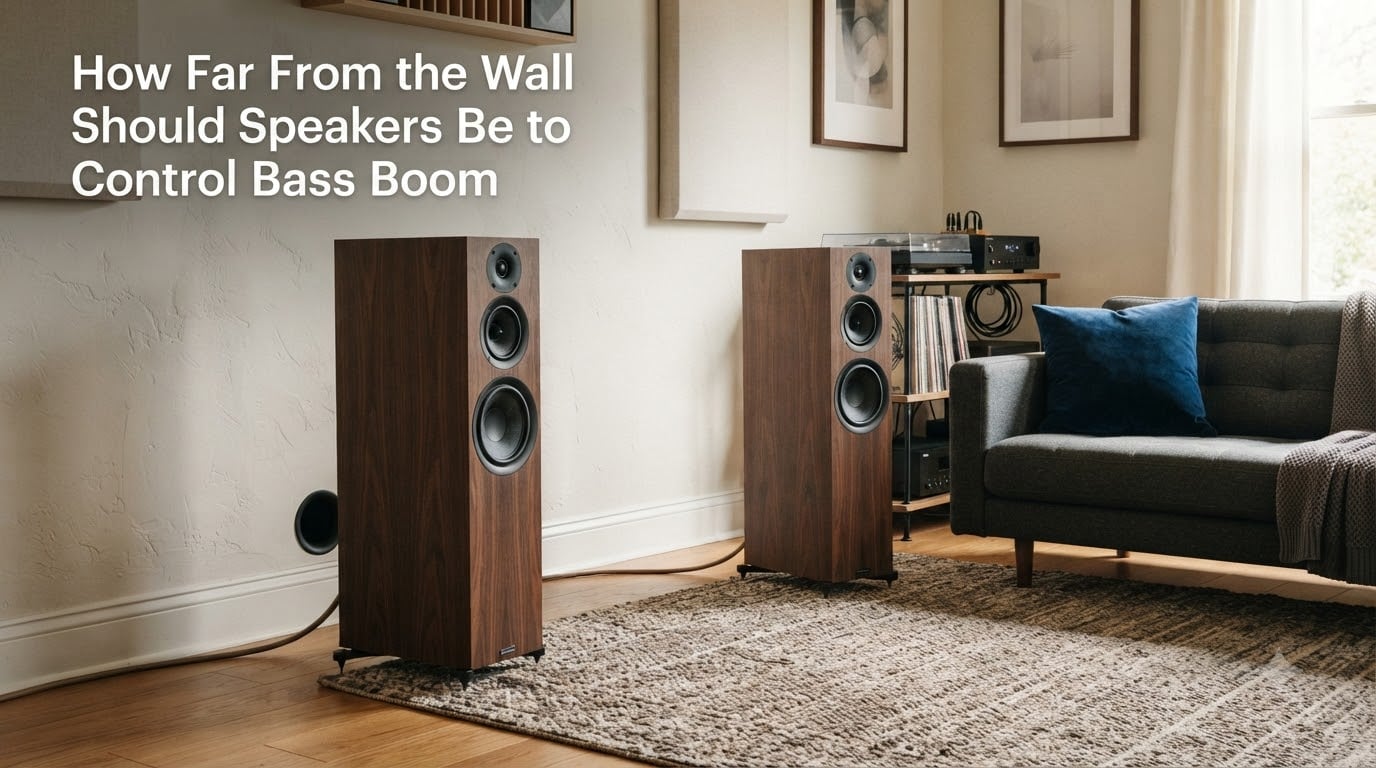
If your music sounds like it’s trapped in a cardboard box, the answer to bass boom usually lives between your speakers and the wall behind them. I’ve spent years tuning listening rooms, and the single biggest improvement you can make to muddy, boomy bass is almost always a matter of inches, not dollars.
In this guide, I’ll walk you through exactly how far from the wall speakers should be to control bass boom. You’ll learn the science behind boundary interference, the practical distances that work in real rooms, and the experimental tuning method I use with my own clients. I’ll also cover the 83% rule, the rule of thirds for subwoofers, and the famous subwoofer crawl technique.
Whether you’re running bookshelf speakers, floorstanding towers, or a dedicated subwoofer, the principles are the same. Let’s fix that bass.
Table of Contents
Why Wall Distance Matters for Bass Control?
Bass frequencies behave differently from everything else your speakers produce. Where treble and midrange shoot forward like a focused beam, low frequencies radiate in every direction at once, including backward, sideways, and even slightly downward.
When a speaker sits close to a wall, the bass that fires backward bounces off that surface and returns to your listening position a few milliseconds later. That reflected wave meets the direct wave coming straight from the speaker cone. Depending on the wavelength, the two waves either stack on top of each other (boosting bass) or fight each other (canceling bass).
This phenomenon is called boundary loading, and it’s why a speaker that sounds thin in the middle of a room suddenly becomes thick and bloated when shoved against a wall. The wall acts like a passive amplifier for the lowest frequencies.
Two surfaces compound the effect. Three surfaces (a corner) make it worse. That’s why corner placement almost always produces the loudest, most uncontrolled bass, and also the least accurate.
The fix is distance. Pulling the speaker away from the wall reduces boundary reinforcement and lets the bass disperse more evenly into the room.
Understanding Boundary Interference and SBIR
The technical name for what I just described is Speaker Boundary Interference Response, or SBIR. It’s the acoustic interference pattern created when direct sound from a speaker combines with reflections from nearby surfaces.
Every reflective surface in your room, walls, floor, ceiling, even a large piece of furniture, contributes to SBIR. The closest surface usually dominates, which is why the rear wall behind your speakers gets most of the attention.
SBIR causes two main problems:
Bass boost: When reflected and direct waves arrive in phase, certain frequencies become louder than the recording intended.
Bass cancellation: When reflected and direct waves arrive out of phase, certain frequencies disappear entirely, leaving audible “holes” in your bass response.
The frequencies affected depend on the distance to the wall. If your speaker sits 1 foot (30 cm) from the wall, you’ll get a cancellation dip around 280 Hz and additional issues below that. At 2 feet (60 cm), the dip moves to around 140 Hz. At 3 feet (90 cm), it shifts to roughly 95 Hz.
That’s why I recommend 2 to 3 feet as a starting point for most speakers. It places the worst cancellation dips low enough that they’re either inaudible or easy to tame with room treatment.
Recommended Wall Distances for Speakers
Here’s the practical guidance I share with everyone who asks. These are starting points, not absolute laws.
Bookshelf Speakers: 6 to 24 Inches (15 to 60 cm)
Most bookshelf speakers benefit from at least 6 inches (15 cm) of clearance from the rear wall. Many modern designs are ported, and rear-firing ports need room to breathe. Anything closer and you’ll hear chuffing or a pressurized “honk” from the port.
For balanced sound, aim for 12 to 18 inches (30 to 45 cm). If your bookshelves sound bright or thin in that position, pull them out another 6 inches and try again.
Floorstanding Speakers: 2 to 3 Feet (60 to 90 cm)
Tower speakers produce more bass energy than bookshelves, which means they need more breathing room. Start at 2 feet (60 cm) from the rear wall. If bass sounds boomy, pull them out toward 3 feet (90 cm).
Some audiophiles go as far as 4 feet (1.2 m) in acoustically treated rooms. Beyond that, you’ll usually lose more than you gain.
Subwoofers: Variable, Use the Rule of Thirds
Subwoofers are special because they produce only low frequencies, and those frequencies are even more sensitive to room placement than full-range speakers. Don’t start the subwoofer where you want it to live. Start by using the rule of thirds or the subwoofer crawl, which I’ll cover below.
Port Type and How It Affects Wall Placement
Check whether your speakers have rear-firing or front-firing ports. This single detail changes how close you can safely place them to a wall.
Rear-firing ports shoot air backward and need clearance to function. Place these speakers at least 6 to 12 inches (15 to 30 cm) from any wall, or you’ll hear a chuffing, “breathing” noise on bass-heavy passages. The closer the wall, the louder the port noise.
Front-firing ports breathe forward, so you have more flexibility. You can place these speakers as close as 2 to 4 inches (5 to 10 cm) from the wall if your room demands it, though you’ll still get boundary bass boost.
Sealed cabinets (no port) are the most forgiving. Without a port to worry about, you can experiment freely with placement based purely on sound.
If you can’t see a port, check the back or front panel of the speaker for a round or slotted opening. The owner’s manual will confirm the type.
The Experimental Tuning Method Step by Step
Theory only takes you so far. Every room is different, so the final tuning always happens by ear. Here’s the method I use with my own system and with clients.
Start at 1 foot from the rear wall. Place each speaker roughly 1 foot (30 cm) from the wall behind it. Keep them at equal distance for now.
Play bass-heavy reference music. Choose three or four tracks you know extremely well, including material with deep bass, mid-bass, and bass guitar. Avoid test tones for this step.
Pull each speaker out 6 inches at a time. After each move, sit in your normal listening position and replay the same tracks. Listen for changes in bass tightness, depth, and clarity.
Stop when bass starts to sound worse. The rule I learned from Dynaudio’s experts is to keep increasing distance until the bass starts to sound worse again. The sweet spot lies just before that point.
Adjust sidewall clearance. Speakers should be at least 2 to 3 feet from the sidewalls. Sidewall reflections muddy stereo imaging and add uneven bass reinforcement.
Fine-tune toe-in. Angle each speaker slightly toward your listening position. More toe-in tightens the image and can reduce sidewall reflections. Less toe-in opens the soundstage.
Mark your final position. Once it sounds right, put a small piece of tape on the floor behind each speaker. Future vibrations or curious pets won’t undo your work.
This process usually takes 30 to 60 minutes. The improvement is often dramatic, especially if your speakers were jammed against the wall.
The 83% Rule and Rule of Thirds for Subwoofers
Two placement rules come up constantly in audio forums, and they apply to different problems.
The 83% Rule (Speakers)
The 83% rule says you should place your speakers at 83% of the room’s length from the front wall, and the same distance from the sidewalls. For a 12-foot-deep room, that means your speakers sit about 10 feet from the wall behind them and 10 feet from each sidewall.
This rule attempts to put your speakers in a position where boundary interference is minimized. It works well in symmetrical, rectangular rooms but falls apart in odd-shaped spaces or rooms with doors and windows.
Think of it as a starting suggestion, not a final answer.
The Rule of Thirds (Subwoofers)
The rule of thirds for subwoofers says to place the sub one-third of the way into the room from any wall. In a 15-foot room, that’s 5 feet from the front or back wall. The principle reduces the impact of standing waves by avoiding symmetrical positions that reinforce room modes.
Combine this with the subwoofer crawl below for the best results.
Subwoofer Crawl and Small Room Tips
The subwoofer crawl is the most reliable way to find where your sub sounds best. It flips the usual problem on its head: instead of moving the sub to find good sound, you move yourself.
Place the subwoofer at your normal listening position. Yes, on the couch or chair where you usually sit.
Play bass-heavy music on repeat. Something with consistent low end, like a synthesizer track or a song with a steady bass line.
Crawl around the room’s perimeter and corners. Get down on your hands and knees so your ears are at subwoofer height. Listen for where the bass sounds fullest, tightest, and most even.
Mark the best-sounding spot. That’s where your subwoofer should live.
Move the subwoofer to that spot. Now return to your listening position and confirm the bass sounds good from there too.
It’s called a “crawl” because you’ll literally be on the floor. It’s unglamorous, but it works.
Tips for Small Rooms
If your room is too small for the recommended distances, you have options.
Use front-ported or sealed speakers. They handle close placement better.
Add bass traps. Thick absorbers in the corners tame the worst boom from boundary reinforcement.
Place the subwoofer inside a cabinet or behind the couch. This reduces its boundary coupling.
Use room correction software. Many AV receivers include automatic EQ that can smooth out bass peaks caused by your room.
Try a diagonal placement. In dual-subwoofer setups, placing subs in opposite corners or on diagonal walls can smooth response in difficult rooms.
Frequently Asked Questions
What is the 83% rule for speakers?
The 83% rule suggests placing your speakers at 83 percent of the room’s length from the front wall, with the same distance from each sidewall. In a 12-foot-deep room, that means speakers roughly 10 feet from the front wall and 10 feet from the sidewalls. The rule aims to minimize boundary interference, but works best in symmetrical rectangular rooms. Treat it as a starting point, not a final answer.
How far away should my speakers be from the wall?
Most speakers sound best when placed 2 to 3 feet (60 to 90 cm) from the rear wall. Bookshelf speakers with rear-firing ports need at least 6 to 12 inches (15 to 30 cm) of clearance. Floorstanding speakers benefit from 2 to 3 feet. Subwoofers should be placed using the rule of thirds or the subwoofer crawl, not by guessing.
What is the rule of thirds for speakers?
The rule of thirds is used for subwoofer placement, not main speakers. It states that the sub should sit one-third of the way into the room from any wall. In a 15-foot room, that means about 5 feet from the front or back wall. This position reduces the impact of standing waves and room modes by avoiding symmetrical wall reflections.
How far from the wall should your subwoofer be?
There is no single correct distance, because subwoofer placement depends on your room. Start by placing the sub one-third of the way into the room from any wall. Then use the subwoofer crawl to fine-tune: put the sub where you sit, crawl around the room, and listen for where the bass sounds smoothest. Place the sub in that spot.
Why does my bass sound muddy when speakers are close to the wall?
Muddy bass happens because low frequencies radiate in every direction, including backward. When a speaker sits close to a wall, the backward-firing bass reflects off the surface and returns to your ears slightly delayed. This reflected wave mixes with the direct sound, creating phase interference. Depending on the wavelength, some frequencies get boosted and others get canceled, producing boomy, undefined bass.
Do rear-ported speakers need more distance from the wall than front-ported ones?
Yes. Rear-ported speakers need at least 6 to 12 inches (15 to 30 cm) of clearance to prevent port chuffing, a pressurized breathing noise. Front-ported speakers can sit as close as 2 to 4 inches (5 to 10 cm) from a wall without port issues, though they still produce boundary bass boost. Sealed cabinets have no port and offer the most placement flexibility.
Final Thoughts on Speaker Wall Distance
Controlling bass boom comes down to managing how low-frequency sound interacts with the boundaries of your room. The simplest and most effective fix is moving your speakers away from the rear wall, ideally 2 to 3 feet (60 to 90 cm) for floorstanding models and 12 to 18 inches (30 to 45 cm) for bookshelves.
For subwoofers, skip the guesswork and use the subwoofer crawl combined with the rule of thirds. The results are usually far better than any placement you’d pick by eye.
If you remember nothing else, remember this: bass frequencies are omnidirectional, walls reflect them, and distance gives them room to behave naturally. Pull those speakers out, give them space to breathe, and your bass will tighten up the same night.