
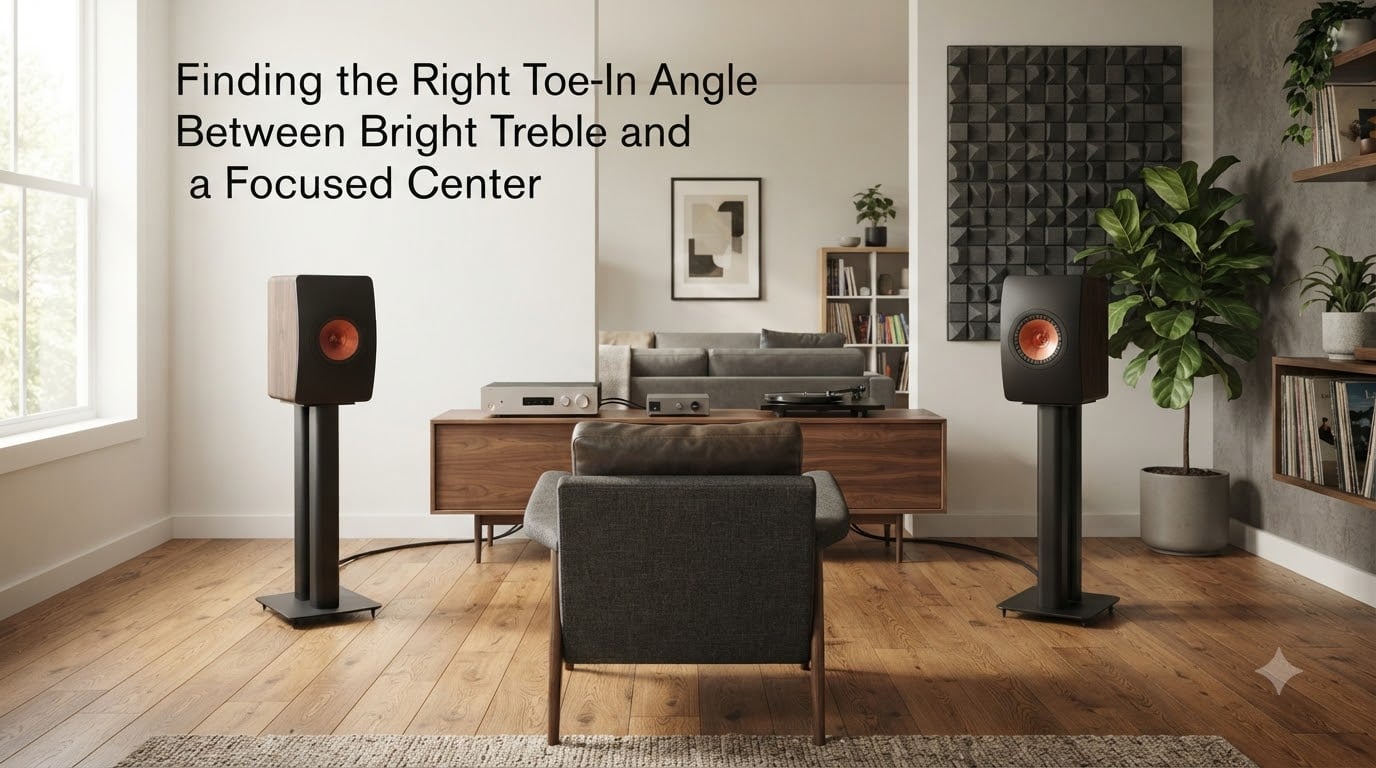
Getting the speaker toe-in angle right is one of the most rewarding tweaks you can make to a stereo system. I spent years treating it like a finishing touch, until I realized it actually decides whether vocals sit front and center or float somewhere off to the side. The catch is that the same toe-in angle that locks in a focused center image also pushes more high-frequency energy straight at your ears, and that is where the bright treble problem begins.
This guide walks through exactly how to find the toe-in angle that balances bright treble with a focused center image. I will cover what toe-in actually does to your speakers, why treble brightens as you angle them inward, and a step-by-step method I have used in dozens of rooms. By the end, you will know how to tune your speakers for both imaging precision and listening comfort.
Table of Contents
What Is Speaker Toe-In and Why It Matters?
Speaker toe-in means rotating each speaker slightly inward so the on-axis output points toward the listening position instead of straight ahead. It is the single most impactful adjustment you can make to stereo imaging, and it costs nothing. Most manuals suggest angling speakers about 30 degrees inward as a starting point, but the ideal angle varies by room and speaker design.
Why does this matter? Because every speaker has a directional high-frequency output. The tweeter fires energy forward in a narrowing beam as frequencies climb. When your speakers face straight ahead, that beam bounces off side walls before reaching your ears. When you angle them inward, the beam reaches you directly. That single change reshapes the entire soundstage.
How Toe-In Changes Direct and Reflected Sound
The acoustic principle behind toe-in is the balance between direct and reflected sound. Direct sound travels from the speaker to your ears without touching a surface. Reflected sound bounces off walls, ceilings, and floors before arriving at your seat.
Without toe-in, your ears receive a mix of direct midrange and treble plus reflected high frequencies from the side walls. The reflected energy smears the stereo image. With toe-in, more treble arrives directly. The image tightens. Vocals lock into a phantom center, and instruments get distinct positions across the stage. The trade-off is that you are now also sitting directly in the path of every harsh frequency the speaker can produce.
The Relationship Between Toe-In Angle and Treble Brightness
Treble brightness scales directly with how aggressively your speakers are toed-in. I learned this the hard way with a pair of metal-dome tweeters that sounded polite when pointed straight ahead and borderline aggressive at full 30-degree toe-in. Nothing changed except the angle, and the perceived treble shifted by what felt like several decibels.
The reason comes down to off-axis response. Most speakers roll off their high-frequency output as you move away from the on-axis line. Aiming the speaker at your listening position keeps you on-axis across the entire treble band. You hear the speaker at its full measured output, including any peaks the designer left in the response curve.
Why High Frequencies Behave Differently Than Lows
Bass frequencies radiate in nearly all directions equally, which is why a subwoofer placement is forgiving. Midrange and treble frequencies become progressively more directional. A tweeter firing at 10 kHz has a much narrower beam than a woofer at 200 Hz.
This directional behavior is the entire mechanism behind toe-in’s treble effect. Aim the speaker inward, and you sit inside the treble beam. Aim it straight, and the treble beam passes you by on its way to the opposite wall. The bass barely changes either way, which is why the imbalance feels so obvious once you start experimenting with angles.
How Toe-In Affects Center Image Focus
Center image focus refers to how solidly a vocal or central instrument appears between your two speakers. With perfect toe-in, the phantom center becomes nearly as tangible as a real speaker. Without enough toe-in, that same vocal sounds diffuse, spread across the middle, or pulled slightly toward the closer speaker.
This effect comes from how your brain processes tiny timing and level differences between your two ears. When both speakers aim directly at your seat, the signals arrive at equal strength and similar timing. Your auditory system fuses them into a single, stable image. Reduce the toe-in and those signals grow less symmetrical. The center image loosens.
Soundstage Width vs Image Focus
Here is the other half of the trade-off. Aggressive toe-in sharpens focus but narrows the soundstage. Gentle toe-in widens the stage but softens the image. I have measured this effect in my own room by switching between zero and 20 degrees of toe-in while playing the same orchestral track.
At zero degrees, instruments spread across a wide arc, but violins in particular lose their pinpoint placement. At 20 degrees, every section has a clear seat on the stage, but the outer edges feel slightly pulled in. The sweet spot for most listeners sits somewhere in between, and your room decides where.
The Core Trade-Off: Brightness vs Center Focus
Now we get to the heart of the topic: how to find the toe-in angle that gives you the imaging you want without the treble fatigue you do not. This is not a problem with one correct answer. It is a balance point that shifts based on your speakers, your room, and your ears.
Speakers with inherently warm or rolled-off treble tolerate aggressive toe-in better than speakers with a forward, revealing top end. A silk-dome tweeter with a smooth response can handle 20 to 25 degrees without complaint. A beryllium or metal-dome tweeter with an elevated treble response may become fatiguing at 15 degrees. Knowing your speaker’s character matters more than chasing a specific angle.
Your listening distance also changes the math. The further you sit, the wider the speaker spread and the more toe-in you typically need to reach a focused center. The closer you sit, the less toe-in you need before direct treble dominates. A desktop setup at three feet needs almost no toe-in for image focus. A couch twelve feet back often needs 15 to 20 degrees.
Quick Comparison: Aggressive vs Gentle Toe-In
Aggressive toe-in (20 to 30 degrees): Maximum center focus, narrowest sweet spot, brightest perceived treble, smallest soundstage width.
Moderate toe-in (10 to 15 degrees): Strong center image with full soundstage, balanced treble energy, comfortable sweet spot size.
Gentle toe-in (0 to 5 degrees): Wide soundstage with relaxed imaging, smooth treble, larger usable listening area.
Zero toe-in: Maximum soundstage width with diffuse imaging, lowest treble energy, best for wide-dispersion speakers and shared seating.
Finding Your Ideal Angle: A Step-by-Step Process
Forget measurements for a moment. Forget audiophile debates about exact angles. The most reliable method I have used across multiple systems and rooms is a four-step listening test. Run through these in order, and you will land on an angle that works.
Step 1: Start With Speakers Pointed Straight Ahead
Set both speakers facing directly forward with zero toe-in. Sit in your normal listening position and play a familiar track with a strong vocal. Note how the center image sounds. Is it diffuse, pulled to one side, or roughly centered? This is your baseline.
Step 2: Increase Toe-In in Small Increments
Toe each speaker inward by about 5 degrees at a time. After each adjustment, return to your seat and replay the same track. Watch for two things: does the center image tighten, and does the treble energy increase. Stop as soon as the treble starts feeling forward. That is your upper bound.
Step 3: Test With Voice and Acoustic Tracks
Use tracks with a centered vocal and natural acoustic instruments. Female vocals, solo piano, and small jazz ensembles work well because they expose both imaging accuracy and treble character. Heavy-produced pop with compressed vocals hides the issues you are trying to hear.
Step 4: Use the Head-Movement Test
From your listening seat, move your head a foot forward, then a foot back, then side to side. The ideal toe-in angle produces a stable center image across this range. If the image collapses or shifts wildly when you move, you have too much toe-in. If the image barely changes, you have room to angle further inward.
Room Acoustics and How They Change the Equation
The same speakers in two different rooms will sound best at different toe-in angles. A room with hard, reflective side walls sends more high-frequency energy back to your ears. That extra reflected treble can make aggressive toe-in feel even brighter. A room with heavy treatment, thick curtains, or bookshelves along the side walls absorbs that reflected energy, so you can usually push toe-in further before treble becomes a problem.
Room size matters too. Small rooms with speakers close to the back wall benefit from less toe-in, because the wall reflection behind the speaker adds bass energy that competes with imaging. Large rooms allow more aggressive toe-in because the reflections are weaker and the listening distance is greater.
One quick test: stand at your listening position and clap your hands once. If you hear a long, ringing echo, your room is reflective, and you should start with gentler toe-in. If the clap dies quickly and cleanly, you have more freedom to experiment.
Common Mistakes to Avoid When Adjusting Toe-In
The first mistake is chasing a number. I have seen forum threads where someone insists on exactly 22.5 degrees as if it were a universal truth. There is no universal angle. The right value is whatever balances imaging and treble in your specific room with your specific speakers.
The second mistake is adjusting toe-in while standing behind the speakers, looking from the front. The angle you see from the front is not the angle the tweeter fires relative to your seat. Always adjust from the listening position, ideally while a partner moves the speakers in small increments.
The third mistake is forgetting to recheck after any other change. Move the speakers closer to the wall, change your seat height, or add a rug, and the ideal toe-in shifts. Treat toe-in as the last adjustment you make after every other placement change.
The fourth mistake is ignoring the speakers themselves. Wide-dispersion designs like certain DALI and Magnepan models are intentionally voiced to need minimal or zero toe-in. Forcing aggressive toe-in on these speakers creates brightness and focus problems their designers specifically avoided. Read your speaker manual before assuming the standard advice applies to you.
Frequently Asked Questions
How should I position my speakers for toe-in?
Toe-in your speakers by rotating each one slightly inward toward your listening position. Start with zero degrees (speakers facing straight ahead), then add 5 degrees at a time until the center image locks in but the treble still feels comfortable. Most rooms end up between 5 and 20 degrees.
How much speaker toe-in is too much?
Toe-in becomes too much when the treble starts sounding forward or harsh, when the soundstage narrows noticeably, or when moving your head even slightly causes the center image to collapse. For most speakers, anything beyond 30 degrees is excessive and rarely improves imaging.
How should desktop speakers be toed-in?
Desktop speakers should be toed-in just enough so each speaker aims slightly past the opposite ear. At a typical nearfield distance of two to three feet, this often means only 5 to 10 degrees of toe-in. More than that and the treble energy becomes intense at such a close listening distance.
How does toe-in affect treble brightness?
Toe-in increases perceived treble brightness because angling the speaker puts your ears directly on-axis with the tweeter. Off-axis listening naturally rolls off high frequencies, so aiming the speaker straight at you delivers the speaker’s full treble output without attenuation.
Why does toe-in improve center image focus?
Toe-in improves center image focus because both speakers deliver more equal signal to your ears when aimed directly at your listening position. Your brain uses matching timing and level cues from both ears to localize sound, and symmetric delivery creates a stable phantom center between the speakers.
Conclusion
The right toe-in angle for balancing bright treble with a focused center image is the one that sounds best in your room, with your speakers, and to your ears. There is no perfect number, but there is a reliable method. Start at zero degrees, work inward in small steps, listen for both image focus and treble comfort, and use the head-movement test to confirm you have a stable sweet spot.
If you remember nothing else, remember this: toe-in is a balance, not a setting. Push for more focus and you trade away treble smoothness. Pull back for smoother treble and you trade away image precision. Trust your ears, adjust slowly, and revisit the angle whenever anything in your room changes. That is how you find the right toe-in angle for 2026 and beyond.