
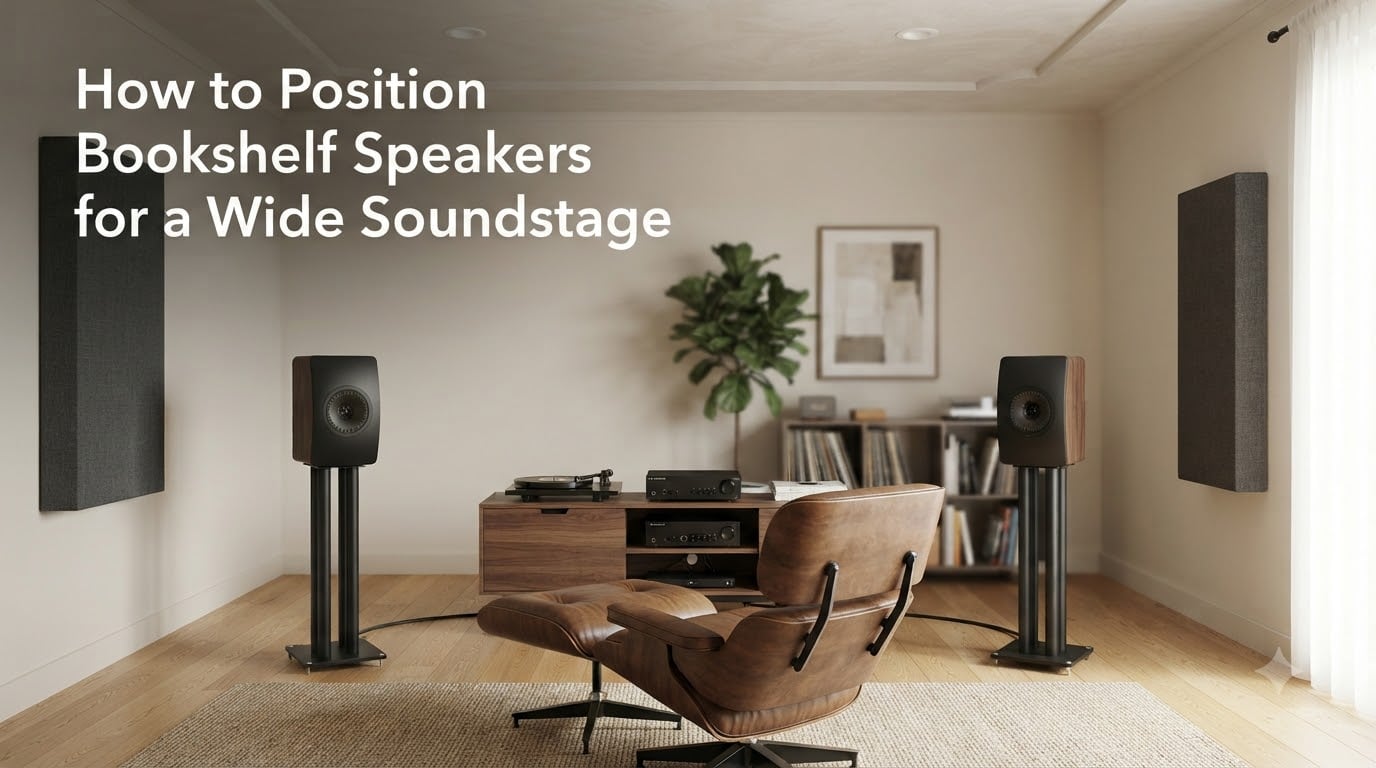
Most bookshelf speakers can sound dramatically better with nothing more than a small amount of repositioning. I have spent the last few years testing speaker setups in rooms as small as 10×10 feet and as large as 18×24 feet, and the difference between a casually placed pair and a properly tuned one is honestly shocking. The same pair of speakers can sound small and confused in one spot and open, holographic, and wide in another, without changing a single piece of equipment.
This guide walks through exactly how to position bookshelf speakers for a wide soundstage. You will learn the geometric rules that professionals use, the acoustic principles behind them, and the practical adjustments that turn a good setup into a great one. By the end, you will have a clear, step-by-step process for making your speakers sound their best in 2026.
Table of Contents
Why Speaker Placement Affects Soundstage Width?
Soundstage is the three-dimensional sonic illusion that your two speakers create between and around them. When you close your eyes listening to a well-recorded track, you should hear vocals floating in front of you, drums placed slightly behind, and instruments spread across a sense of width and depth. That illusion is fragile, and how to position bookshelf speakers for a wide soundstage determines whether your brain receives the right cues to build it.
Your brain builds a stereo image by comparing time differences and level differences between sounds arriving at each ear. When a studio recording is captured with proper microphone technique, the left and right channels contain subtle differences that your brain interprets as spatial position. Your speakers have to deliver those differences cleanly, without distortion from room reflections, without phase cancellation from poor geometry, and without masking from competing sounds.
Three things happen when speakers are placed poorly. First, left and right speaker sounds arrive at the wrong times because the listener is closer to one than the other. Second, nearby walls reflect sound back to the listener, smearing the original stereo difference. Third, bass frequencies pile up against boundaries and create boomy, uneven low-end response. The result is a compressed, unconvincing soundstage.
When you place speakers correctly, the stereo differences reach your ears intact. Reflections arrive late enough that your brain interprets them as room ambience rather than competing with the direct sound. Bass response becomes balanced because the speakers are not amplifying certain frequencies through boundary reinforcement. The result is what audiophiles call a wide, deep, and focused soundstage.
The Equilateral Triangle Rule for Bookshelf Speakers
The single most important rule in speaker placement is the equilateral triangle. Your two speakers and your listening position should form a triangle with three sides of equal length. This is the foundation of how to position bookshelf speakers for a wide soundstage, and ignoring it is the most common mistake I see in casual setups.
If your speakers are 6 feet apart, your listening chair should be 6 feet from each speaker. If they are 8 feet apart, sit 8 feet from each. The exact distance depends on your room size and how far apart you can physically place the speakers, but the principle is non-negotiable. Equal spacing ensures that both speakers arrive at your ears with the same time delay and that the stereo image locks in dead center.
Start with a rough measurement using a tape measure. Place the speakers symmetrically on the front wall, then sit in your primary listening chair. Measure the distance between the speakers and from each speaker to where your head will be. Adjust until all three numbers match. Most listeners find that 6 to 8 feet between speakers works well in a typical living room, but this is not a hard rule. Smaller rooms may need 5 feet, and larger dedicated listening rooms can stretch to 10 feet or more.
Forum users on r/audiophile consistently report that the triangle rule fixes more problems than any other change. The “Four Secrets of Speaker Placements” post, which has been circulating for years, emphasizes starting with the speakers fairly close together and listening for a tightly focused image. If the image is blurred, move the speakers slightly apart. If it is too narrow, bring them closer. The equilateral triangle is your starting reference point, and small adjustments from there let you dial in the exact width you want.
Speaker Height and Ear Level Positioning
Tweeter height is the next critical factor. The tweeter is the small driver that reproduces high frequencies, and your ears are most sensitive to high-frequency directional cues. For the best imaging, the tweeter of each speaker should be at the same height as your ears when you are seated in your listening position.
This is why dedicated speaker stands exist. They raise the speaker to the right height while keeping it stable and isolated from the floor. Most bookshelf speakers are designed with the tweeter positioned so that when the speaker sits on a 24 to 28 inch stand, the tweeter lands at ear level for a seated listener. If you are placing the speakers on a shelf, an entertainment center, or a piece of furniture, measure your seated ear height and adjust accordingly.
Here are the recommended speaker heights for common seating types. Use these as your starting point, then fine-tune based on your own setup.
Standard sofa (seat height 18 inches): Tweeter at 36 to 40 inches from the floor
Recliner or low chair (seat height 15 inches): Tweeter at 33 to 37 inches from the floor
Office chair or tall seat (seat height 20 inches): Tweeter at 38 to 42 inches from the floor
Floor seating or meditation cushions: Tweeter at 28 to 32 inches from the floor
Slight off-axis listening still works. Most speakers have a forgiving vertical dispersion, so being an inch or two above or below the tweeter is fine. More than 3 inches of vertical offset, especially in the high frequencies, will start to dull the sound and reduce the sense of presence. The room correction philosophy in audiophile forums consistently notes that anything that puts the tweeter directly at ear level is the goal.
Toe-In Angle Adjustment for Better Imaging
Toe-in is the practice of angling each speaker slightly inward so that it points directly at the listening position. This is a powerful tool for fine-tuning how to position bookshelf speakers for a wide soundstage, and it works by changing how the sound from each speaker overlaps at your ears.
With speakers pointed straight ahead (no toe-in), the left and right speakers cover your ears from mostly off-axis angles. The sound is wide but can feel diffuse, with less precise imaging. With speakers pointed directly at you (full toe-in), the sound is more focused and intimate, but the wider soundstage effect can collapse. The art of toe-in is finding the angle that gives you the best of both worlds.
A good starting point is to angle each speaker so that the imaginary line extending from the tweeter crosses just behind your head. This is roughly 15 to 30 degrees of toe-in for most setups. In a smaller equilateral triangle, you may need more toe-in. In a larger setup, less toe-in works better.
Once you have an initial angle, listen carefully. The Reddit audiophile community often recommends a specific test: play a mono recording of a single voice. With proper toe-in, the voice should appear to come from a single point directly between the speakers, exactly halfway between them. If the voice sounds split or pulled to one side, increase the toe-in slightly. If the voice sounds too narrow or closed-in, reduce the toe-in. The angle that produces a phantom center image between the speakers is the sweet spot for your room.
Toe-in also affects treble balance. Speakers pointed directly at you tend to sound brighter, with more high-frequency energy. Speakers pointed straight ahead sound slightly warmer but less detailed. Your room’s acoustics and your personal preference should guide the final angle. There is no single correct answer, which is why experienced listeners experiment with small adjustments over several listening sessions.
Wall Distance and Boundary Effects
How close your speakers are to the wall behind them dramatically affects bass response. This is one of the most overlooked aspects of how to position bookshelf speakers for a wide soundstage, and getting it wrong can make even expensive speakers sound boomy and uneven.
Bass frequencies radiate in all directions, including backward. When a speaker sits close to a wall, the backward-radiating bass bounces off the wall and combines with the forward-radiating bass. This boundary reinforcement makes certain bass frequencies louder than they should be. The closer the speaker is to the wall, the stronger the effect. Speakers crammed into a shelf or pushed against the wall almost always sound bass-heavy and unclear.
As a general rule, place your speakers at least 1 to 2 feet away from the back wall and at least 2 to 3 feet from the side walls. The exact distance depends on your room and your speakers, but this is the safe starting range. Some speakers are designed to be placed closer to walls (these have front-firing ports instead of rear-firing ports), while others need more space to breathe.
If your speakers have a rear-firing port, you can sometimes feel air coming out of the back when you hold your hand near it. That port needs clearance to work properly. A port that is too close to the wall creates a “chuffing” or “honky” bass sound that is hard to fix without moving the speaker.
Some audiophiles prefer to pull their speakers very far from the back wall, sometimes 3 to 4 feet or more. This reduces bass reinforcement and creates a more open, less colored sound. The trade-off is that the speakers may sound bass-light, and you lose some of the room-filling warmth. The right balance is personal and depends on your room, your speakers, and your taste. Start with the 1 to 2 foot guideline and adjust from there.
Room Acoustics and First Reflection Points
Your room is the largest component of your sound system. Two identical speakers in different rooms will sound dramatically different, and room acoustics is the reason. Understanding how your room shapes the sound is essential for how to position bookshelf speakers for a wide soundstage.
The first reflection points are the spots on your walls, ceiling, and floor where sound from your speakers bounces first before reaching your ears. These reflections arrive shortly after the direct sound, and your brain interprets them as smearing or blurring of the original signal. The result is reduced clarity and a less precise stereo image.
To find the first reflection points on your side walls, sit in your listening position and have a friend slide a mirror along the wall. When you can see the reflection of the tweeter in the mirror, that is your first reflection point. Mark it. The same principle applies to the ceiling, though ceiling reflections are usually addressed with acoustic panels or rugs rather than repositioning.
Several solutions exist for first reflection problems. Acoustic panels placed at the reflection points absorb the offending sound and let the direct sound dominate. A thick rug on the floor between you and the speakers reduces floor reflections. Heavy curtains on the side walls can also help. Some listeners prefer to keep the room relatively untreated and let the room sound be part of the experience, but for critical listening, addressing first reflections is a major upgrade.
Room modes are another acoustic challenge. These are specific frequencies that resonate in your room based on its dimensions. A room that is 12 feet long will have a fundamental mode around 47 Hz (calculated by dividing the speed of sound by twice the room dimension). If your speakers excite this frequency strongly, you will hear a boom or hum that does not exist in the recording. Room mode problems are usually addressed with bass traps in the corners of the room, which absorb low-frequency energy and smooth out the response.
Speaker Stands and Isolation Basics
How your speakers physically couple to the surface they sit on matters more than most people realize. Vibrations transfer between the speaker and the surface, and those vibrations can color the sound or cause unwanted resonance. Proper decoupling is part of how to position bookshelf speakers for a wide soundstage.
Dedicated speaker stands are the gold standard. They provide a stable, mass-loaded platform that does not move or resonate. They keep the speaker at the right height, and they isolate the cabinet from the floor, which is the main source of unwanted vibration transfer. A solid pair of filled stands makes a noticeable difference compared to placing speakers on a shelf or piece of furniture.
If you cannot use stands, isolation pads or foam decoupling pads are a good alternative. These sit between the speaker and the shelf, absorbing vibrations before they transfer. They are not as effective as stands, but they are a vast improvement over direct placement.
When placing speakers on a shelf, pull them forward so the front baffle is slightly proud of the shelf edge. This prevents the shelf from creating early reflections and lets the speaker breathe. Buried speakers, where the shelf or cabinet surrounds them on three sides, almost always sound muffled and constrained. The forum wisdom on r/BudgetAudiophile consistently recommends pulling speakers out to the front edge of the shelf whenever possible.
Common Mistakes to Avoid
Several common mistakes prevent listeners from getting the wide soundstage they want. Avoiding these pitfalls is a quick way to improve your setup without spending a dime.
Mistake 1: Placing speakers in corners. Corner placement maximizes bass reinforcement, often to the point of overwhelming the rest of the frequency range. Speakers in corners rarely sound balanced, and the soundstage is usually bloated and undefined.
Mistake 2: Pushing speakers flat against the wall. This removes the breathing room speakers need and creates serious bass build-up. Even a few inches of clearance makes a difference, and 1 to 2 feet is much better.
Mistake 3: Ignoring the equilateral triangle. An asymmetric setup, where you are closer to one speaker than the other, breaks the stereo image and creates a lopsided soundstage. Always measure and re-measure to confirm equal distances.
Mistake 4: Blocking the speakers with cabinet doors or grilles. If you place speakers inside a cabinet with doors, close the doors, and expect them to sound good, you will be disappointed. Speakers need to project into open space. Use open shelving or remove cabinet doors entirely.
Mistake 5: Over-toeing the speakers. Excessive toe-in points both speakers directly at your nose and creates a narrow, closed-in soundstage. Start with a moderate toe-in and reduce if the sound feels too focused.
Mistake 6: Skipping the listening test. Measurements matter, but your ears are the final judge. Place speakers according to the rules, then listen critically and adjust. Specifications are a starting point, not the final word.
Testing and Fine-Tuning Your Setup
Once you have an initial placement, you need to test it. Listening tests are how you turn a theoretical setup into a setup that actually works in your room with your speakers. The forum community has strong opinions on what works, and personal testing is always the most valuable tool.
Choose a few well-recorded tracks that you know well. The same album you have listened to for years is the best test material, because you know exactly how it should sound. Pick tracks with strong stereo imaging, focused vocals, and clear instrument placement. Recommended test tracks include:
Steely Dan – “Aja”: Known for precise, focused imaging and clear vocal placement
Norah Jones – “Don’t Know Why”: Excellent for testing vocal center image and warm soundstage
Yosi Horikawa – “Bubbles”: Wide, deep soundstage with precise spatial cues
Hugo Audiophile Test Tracks: Specifically designed for testing imaging and soundstage
Listen for several specific qualities. First, the vocals should appear to come from a single point exactly between the speakers, not from the speakers themselves. Second, instruments should appear in distinct positions across the soundstage, with width and depth. Third, the bass should be tight and even, without boom or hum. Fourth, the high frequencies should be clear and detailed without being harsh.
Adjust one variable at a time. Move the speakers forward or back by an inch. Change the toe-in slightly. Adjust the height of a stand by half an inch. After each adjustment, sit back and listen to the same track. Small changes can produce meaningful results, and isolated changes let you understand what each variable does.
Be patient. Speaker placement is iterative. Most listeners spend several weeks dialing in their setup before it feels right. The good news is that once you have invested the time, the results last for years, and the improvement over a casual placement is well worth the effort.
Frequently Asked Questions
How far apart should bookshelf speakers be for the best soundstage?
Bookshelf speakers should generally be placed 6 to 8 feet apart for the best soundstage in a typical room. The two speakers and your listening position should form an equilateral triangle, so the distance between the speakers should equal the distance from each speaker to your seat. In small rooms, 5 feet may be the maximum workable distance. In larger dedicated rooms, 10 feet or more is possible.
What is the ideal toe-in angle for bookshelf speakers?
The ideal toe-in angle for bookshelf speakers is typically 15 to 30 degrees, with the speaker angled inward so that the imaginary line from the tweeter crosses just behind your head. Start with this range and adjust by ear, listening for a focused phantom center image between the speakers. More toe-in increases focus and treble, while less toe-in creates a wider but less precise soundstage.
How high should bookshelf speakers be positioned?
Bookshelf speakers should be positioned so that the tweeter is at the same height as your ears when seated in your listening position. For a typical sofa with a seat height of 18 inches, the tweeter should be 36 to 40 inches from the floor. Dedicated speaker stands are the best way to achieve proper tweeter height, with 24 to 28 inch stands working for most seating.
How does speaker placement affect soundstage?
Speaker placement affects soundstage by controlling how your brain receives stereo cues. The equilateral triangle position ensures equal time delays to both ears, locking the stereo image in place. Toe-in directs the tweeter energy at the listener for focused imaging. Wall distance prevents bass buildup from boundary reinforcement. Proper placement delivers stereo differences cleanly to your ears, allowing your brain to build a wide, three-dimensional sonic illusion.
Should bookshelf speakers be angled towards the listening position?
Yes, bookshelf speakers should be angled slightly towards the listening position, a technique called toe-in. The amount of toe-in varies by room and speaker, but 15 to 30 degrees is a good starting range. Speakers pointed straight ahead sound wide but diffuse, while speakers with full toe-in sound focused but narrow. The right angle balances both qualities and produces a phantom center image between the speakers.
Final Thoughts on Bookshelf Speaker Positioning
Learning how to position bookshelf speakers for a wide soundstage is one of the highest-value upgrades you can make to your audio system. The principles are simple: form an equilateral triangle, put the tweeters at ear level, angle them slightly toward you, pull them away from walls, and address reflections in your room. None of these cost money, and all of them reward careful attention.
Take your time with the process. Pick a starting position based on the rules in this guide, then listen and adjust. Your room is unique, your speakers are unique, and your taste is unique. The best setup is the one that sounds right to you, and the path to that setup is patient experimentation. Spend a few weekends dialing it in, and you will be enjoying a wide, immersive soundstage for years to come.