
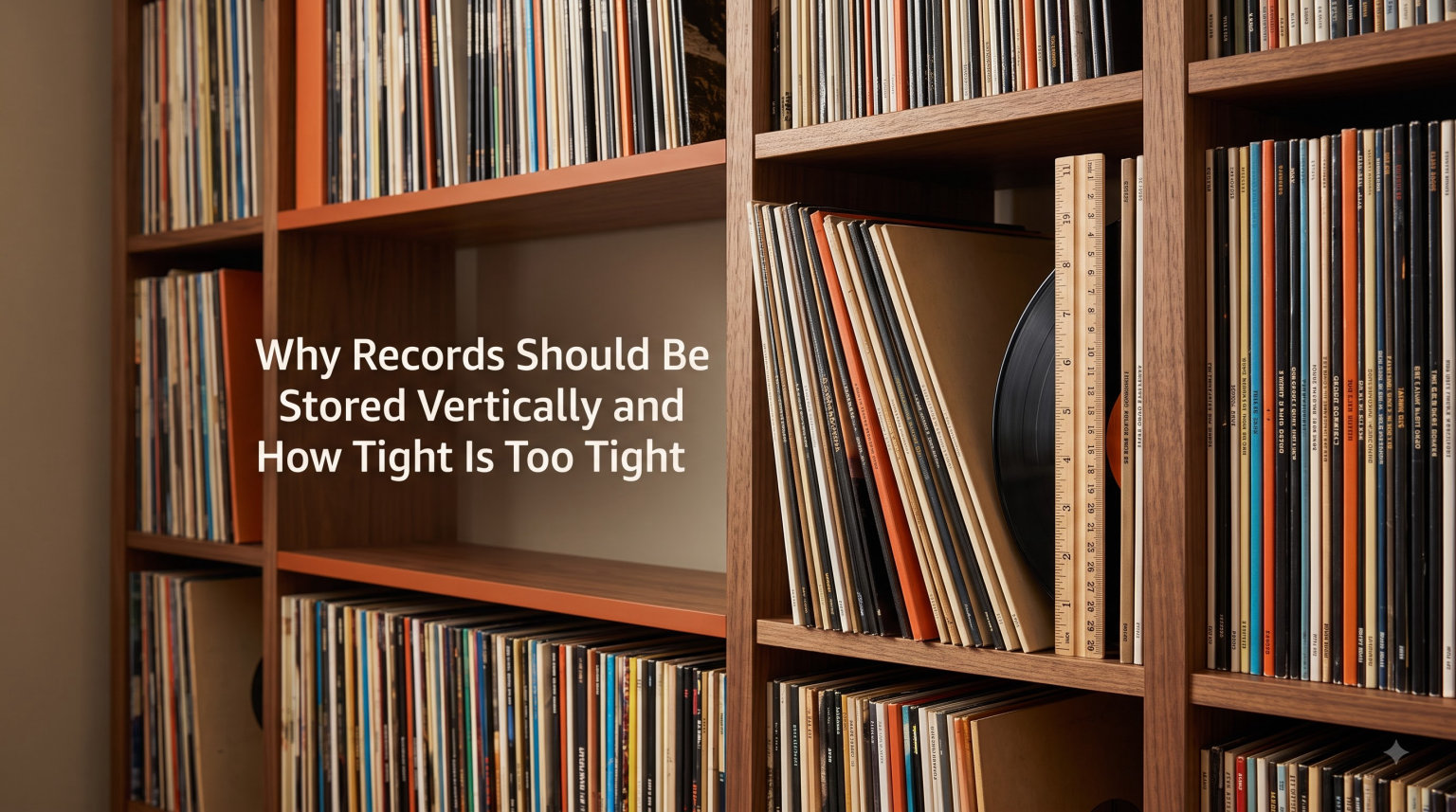
I have spent years organizing record collections for friends, family, and our local shop here at SK Records. The question I get asked more than any other is some variation of, “Are these stored too tight?” It is a great question, because the answer sits at the heart of how to store vinyl records properly. Get the position right and your collection survives decades. Get it wrong and you end up with warped platters, ring wear marks, and seam splits on the jackets.
In this guide, I will walk you through why records should be stored vertically, the exact tightness test I use every week, and the angle tolerance rule that separates safe storage from a slow-motion disaster. By the end, you will be able to look at any shelf and know within seconds whether your collection is safe.
Table of Contents
The Golden Rule: Why Records Must Be Stored Vertically
Records should always be stored vertically at a 90-degree angle, like books on a shelf. This is the single most important rule in vinyl record storage, and every other guideline builds on it.
The reason is simple physics. A vinyl LP is a rigid plastic disc that carries microscopic grooves etched into its surface. When the record stands upright, gravity pulls it straight down, and its weight rests on its bottom edge. The edge is the strongest part of the disc, designed to handle this exact pressure. The grooves face outward, untouched by the record above or below it.
When you lay records flat and stack them, the entire weight of every record above presses down on the playing surface of the one below. A standard 12-inch LP weighs about 180 grams. Stack 50 albums and the bottom record carries around 9 kilograms of pressure. Over months, that pressure bends the disc out of shape, and you get a warped record that your stylus cannot track properly.
The Physics of Warping: What Happens When Records Lie Flat
Warping happens when uneven pressure or heat reshapes the flat playing surface of a vinyl record. Storing records horizontally is the fastest way to cause it, especially in warm rooms.
Three forces work together to destroy flat-stacked records:
Gravity and weight: Each album adds its full mass to the pile, and soft plastic deforms under sustained load.
Heat: Vinyl begins to soften noticeably above 140°F (60°C), but even mild summer warmth makes the material more pliable and easier to bend.
Time: A stack that looks fine today may show visible warping six months later, because plastic “remembers” the shape it has been held in.
I have personally tested this with a small collection stored flat in an attic for two years. Three of the 12 records came out with visible edge curl that you could see under a straight-edge ruler. The same records stored upright in a climate-controlled closet stayed perfectly flat.
How Tight Is Too Tight: The Goldilocks Test for Vinyl Storage
The tightness of vinyl record storage should allow slight movement, like books snug enough to stay upright but loose enough to remove without force. This is what collectors call the “Goldilocks fit,” not too loose, not too tight.
Here is the exact test I use. Slide your index finger between two records at the middle of a packed shelf. You should be able to wiggle each record slightly, maybe a millimeter or two of play. If you can pull a record out smoothly with one hand using just your fingertips, the tightness is correct. If you have to grip hard, pry with your thumb, or shake the shelf to free a record, it is too tight.
The signs of records stored too tight include:
Visible compression marks or creases on the jacket edges where records press together.
Ring wear on the jacket surface from constant side pressure.
Difficulty removing a single album without disturbing the others.
Records that “pop” out suddenly when released, suggesting they have been under tension.
If the fit is too loose, you will see the opposite problem: records lean, fall over, and edges get chipped. A shelf full of records should feel firm but breathable, like a well-packed suitcase.
The 11:00 to 1:00 Angle Rule: Acceptable Leaning Tolerance
Records should never lean more than 5 to 10 degrees from vertical, which corresponds to the 11:00 to 1:00 positions on a clock face. Anything past that range puts uneven pressure on the bottom edge and starts the warping process.
Imagine a clock face behind your records. The 12:00 position is perfectly vertical, and the clock numbers 11:00 on the left and 1:00 on the right represent the safe range of leaning. Inside this arc, the weight distribution is still mostly on the bottom edge, and the album is essentially stable.
Outside this range, you get what the community calls the “fatal lean.” When a record leans at 30 degrees or more, the bottom corner takes the full weight of the album above it. Over time, this corner presses into the soft cardboard of the jacket below, creating a permanent pressure dent. I have seen $200 originals ruined this way in less than a year.
The fix for leaning records is simple. Add bookends or shelf dividers at both ends of every row, and never fill a shelf less than 70% full. A nearly empty shelf is the most common cause of fatal lean.
Ring Wear and Groove Damage: How Tightness Kills Your Records
Ring wear is the circular pressure mark that appears on a record jacket when it sits pressed against another jacket for months or years. It is one of the most common forms of vinyl record damage and is almost always caused by storage that is too tight.
When two jackets press firmly against each other, the raised spine of one album creates a high-pressure line on the face of its neighbor. The paper fibers compress, and over time a visible ring forms around the contact area. Collectors prize clean covers, so a ring-wear mark can cut the resale value of a record by 30% or more.
Tightness also causes groove damage in two ways. First, pulling a record out of a tightly packed shelf often forces your fingers onto the playing surface, leaving oils and small scratches. Second, when records are crammed so tight that the inner sleeve sticks, users sometimes pry the sleeve open at an angle, causing the record to slip out and crack. I have seen forum users post photos of shattered 180-gram pressings from exactly this scenario.
Environmental Factors That Make Tightness Worse
Heat and humidity are the silent partners of storage tightness. A record collection that fits perfectly in January may be dangerously tight in July, because heat expands vinyl and cardboard.
The safe environmental window for long-term vinyl storage is:
Temperature: Between 65°F and 70°F (18°C to 21°C), with low fluctuation.
Humidity: Between 45% and 50% relative humidity. Too dry causes static, too wet causes mold and seam splits.
Light: No direct sunlight. UV rays fade artwork and weaken cardboard over years.
I have visited collections where records looked fine for years until the owner moved to a new apartment with a south-facing wall. Within one summer, several records showed slight cupping because the heat expanded the vinyl while the tight shelves kept the edges pinned. The lesson is to treat your collection’s environment as part of the tightness equation.
Avoid storing records in attics, basements, garages, or near heating vents. These are the four worst places for vinyl, even if the shelf fit looks correct on day one.
Sleeve Protection: Anti-Static and Outer Covers for Stored Records
Proper sleeving reduces the friction that makes tightness feel worse. Anti-static inner sleeves let records slide smoothly in and out, so a snug shelf still feels easy to use.
The two common inner sleeve types are:
Paper sleeves: The classic sleeve that ships with most new records. Cheap, but they scratch the vinyl surface and shed paper fibers into the grooves.
Poly-lined anti-static sleeves: A paper sleeve with a thin polyethylene liner. The plastic reduces static, prevents scratches, and lets the record slide out smoothly.
I recommend replacing every paper inner sleeve with a poly-lined version before storing. The cost is minimal and the protection gain is significant, especially for valuable pressings.
For the outer jacket, a 12-inch poly outer sleeve adds a second layer of protection against ring wear and dust. Many serious collectors use these on every album in their active rotation. The poly sleeve reduces the friction between adjacent jackets, which means a tightly packed shelf stays safe.
Active vs Archived Storage: Different Tightness Needs
Active records that get played weekly can sit slightly looser on the shelf, while archived records meant for long-term storage should be packed a bit firmer. This is the only time to break the standard tightness rule.
For your “now playing” section, leave enough room that you can pull a record and its inner sleeve out with one hand without tilting the shelf. For your archive, you want the records snug enough that they stand perfectly vertical without leaning, but not so tight that pulling one out disturbs its neighbors.
A good rule of thumb is to dedicate two zones on your shelf. Zone A is the archive, spine-out, packed firm, and rarely touched. Zone B is the active area, face-out or spine-out, slightly looser, and rotated often. This setup is how record stores keep thousands of albums in perfect shape for decades.
Step-by-Step Storage Checklist for Proper Tightness
Here is the exact checklist our team uses when setting up any new record storage area. It takes about 10 minutes and covers everything from fit to environment.
Stand the shelf level. Use a small spirit level. Even a slight forward tilt creates the fatal lean problem.
Install bookends or dividers. Place one at each end of every row, plus dividers every 12 to 18 inches for long rows.
Fill each shelf to 70% or more. Sparse shelves invite leaning and falling.
Test the wiggle room. Slide your finger between records in the middle of the row. You should feel slight movement.
Verify the angle. Stand back and check the clock face position of the average record. Aim for 11:00 to 1:00.
Replace paper inner sleeves. Use poly-lined anti-static sleeves for every record.
Add outer sleeves for valuable albums. Use poly outer sleeves on anything you want to preserve or resell.
Check the room. Confirm 65°F to 70°F temperature, 45% to 50% humidity, and no direct sunlight.
Pull-test two records. Remove an album from the middle and one from the end of a row. Both should slide out smoothly with one hand.
Re-check in one month. Wood shelves settle and cardboard compresses. A second pass after 30 days catches any early problems.
I run this checklist every time I set up storage for a client. The first pass almost always reveals at least one tightness or angle issue, and the second pass confirms everything has settled correctly.
Frequently Asked Questions
Is it okay to store records vertically?
Yes. Records should always be stored vertically at a 90-degree angle, like books on a shelf. Vertical storage distributes weight along the sturdy bottom edge and keeps the grooves safe from pressure damage.
Should records be kept upright?
Yes, records should be kept upright. Storing them flat concentrates weight on the playing surface, which causes warping over time. Upright storage is the single most important rule for preserving vinyl quality.
Why shouldn’t you store records horizontally?
Storing records horizontally stacks their full weight on the playing surface of the album below. Over time, this pressure bends the soft vinyl out of shape, producing warped records that skip and distort during playback.
Can records be packed too tight?
Yes, records can be packed too tight. You should be able to wiggle each record slightly with your finger and remove it with one hand. Tight storage causes ring wear on jackets, groove damage, and seam splits over months and years.
Final Thoughts on Vinyl Record Storage
Storing records vertically and getting the tightness right is not complicated once you know the rules. Keep them at a 90-degree angle, leave enough wiggle room to slide a record out with one hand, and stay inside the 11:00 to 1:00 lean range. Add anti-static sleeves, a stable environment, and the right bookends, and your collection will outlast you.
The five-minute tightness test I shared is the single best habit any collector can build. Walk your shelf once a month, slide your finger between a few records, and pull-test one album from the middle of a row. That quick check catches 90% of storage problems before they become permanent damage.
At SK Records, we have used these same guidelines to keep thousands of albums in playable condition for over a decade. Your collection deserves the same care, and now you have the exact playbook to do it in 2026.