
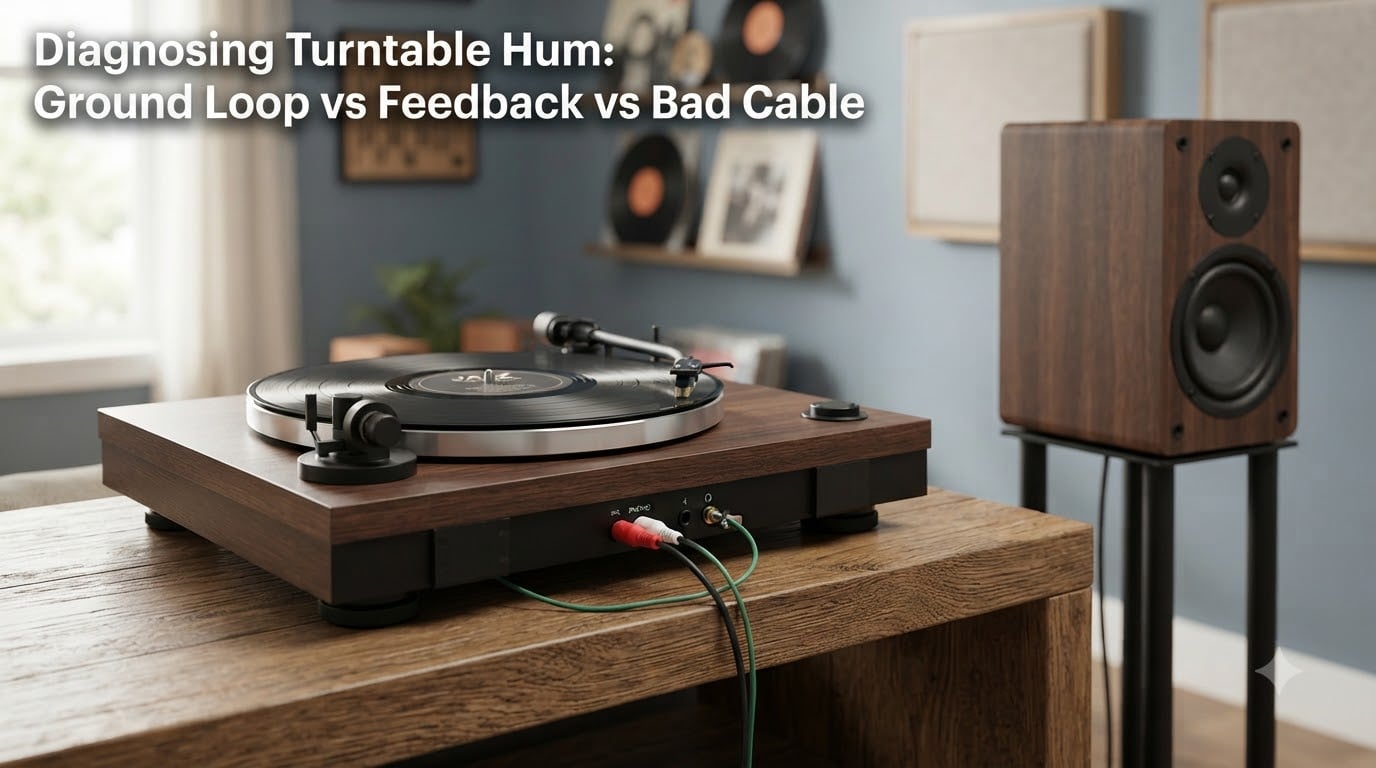
If your turntable hums, you are not alone. That low buzz driving you crazy is one of the most common frustrations in vinyl playback, and it almost always comes from one of three causes: a ground loop, acoustic feedback, or a bad cable. Diagnosing turntable hum correctly saves you hours of guessing and stops you from buying parts you do not need.
In this guide, I will walk you through each of the three causes, show you how to identify which one is yours, and give you a step-by-step isolation method I have used to fix hum on more than a dozen setups. We will cover the exact symptoms, the typical fixes, and the common traps (like the PHONO vs LINE mistake) that send even experienced listeners down the wrong path.
Let me start with the basics. By the end of this article, you will know exactly what is causing your turntable hum and how to silence it for good.
Table of Contents
What Is Turntable Hum?
Turntable hum is a low-frequency electrical noise, typically at 50Hz or 60Hz depending on your country’s AC power standard, that bleeds into your audio signal and plays through your speakers. It sounds like a steady drone, a buzz, or a low rumble that gets louder as you turn up the volume. The hum is different from the gentle surface noise of vinyl itself, which is a higher-frequency hiss rather than a drone.
Hum almost always comes from one of three places: your grounding setup, your speakers vibrating your turntable, or a faulty cable. The catch is that each of these sounds eerily similar at first listen. That is why most people spend way too long trying fixes that do not apply to their specific problem. Diagnosing turntable hum is really about isolating which cause is yours before you start swapping parts.
The Three Main Causes of Turntable Hum
Before we dive into the details, let me give you the quick map. The three causes we will cover in this article are:
- Ground loop — a wiring issue between your turntable and other components, creating a hum at exactly 50Hz or 60Hz.
- Feedback — your speakers vibrating the turntable, which the stylus picks up as a low-frequency hum.
- Bad cable — a damaged or low-quality RCA cable (or tonearm wiring) picking up interference.
Each one has a different signature, and each one has a different fix. Let me walk you through each one in detail.
Ground Loop: The Most Common Culprit
A ground loop is what causes turntable hum in the majority of cases. It happens when two or more pieces of audio equipment are connected to different ground potentials, even though they are all plugged into the same wall. The turntable, the amplifier, and the phono preamp each have their own path to ground, and the small voltage difference between those paths creates a tiny current that travels through your RCA cables as a 50Hz or 60Hz hum.
The signature of a ground loop hum is a constant, steady drone that is present even when the volume is at zero. It does not change when you move closer to or farther from the speakers. It does not change when you tap the tonearm. It is just there, the same volume, all the time.
How to Fix a Ground Loop
Here are the fixes to try, in order from easiest to most involved:
- Check the grounding wire. Most turntables have a thin ground wire, usually green or bare, that needs to be attached to a grounding terminal on your amplifier or phono preamp. If it is loose, disconnected, or frayed, you have found your problem. I have personally fixed hum more times than I can count just by tightening this one screw.
- Plug everything into one power outlet. Use a single power strip or conditioner for the turntable, the preamp, and the amplifier. Different wall outlets can create different ground potentials.
- Try a different outlet. Especially if other circuits in your home are pulling heavy loads (kitchen appliances, HVAC), they can introduce noise into your ground reference.
- Use a ground loop isolator. These are small inline devices that go between your turntable and your preamp. They break the ground path electrically while passing the audio signal. They are a cheap, reliable last resort when nothing else works.
One Reddit user summed up the common frustration this way: “I checked everything twice, swapped every cable, and the hum was still there. Then I realized my grounding wire had never been properly screwed down. Two minutes later, silence.” That story is more common than you might think.
Feedback: When Vibrations Reach the Stylus
Acoustic feedback is the second most common cause of turntable hum. A turntable is a mechanical instrument that reads vibrations from a needle in a record groove. When your speakers vibrate the air, the floor, or the shelf your turntable sits on, those vibrations travel back into the stylus and get amplified. The result is a low-frequency hum or howl that gets louder as you turn up the volume.
The signature of feedback hum is volume-dependent. It is quiet or absent at low volume, and it grows louder as you turn up the volume. It can also turn into a runaway howl if you push the volume too high. If you put your hand on the turntable plinth while the hum is happening and the hum changes, you have found feedback.
How to Fix Feedback Hum
These are the steps I take whenever feedback is the suspected cause:
- Move the speakers off the same surface as the turntable. If your speakers sit on the same shelf or table as the turntable, this is almost always the issue. Move them to a separate stand or wall mount.
- Use a heavy, isolated platform. A wall-mounted shelf, a heavy slab of MDF, or a dedicated isolation platform can dramatically reduce structure-borne vibration.
- Lower the volume while placing the needle. This avoids the initial howl when the stylus first touches the record.
- Move the turntable away from the speakers. Even a few feet of distance can help, especially with subwoofers. Subwoofers near a turntable are a feedback disaster waiting to happen.
- Check your cartridge mounting and tonearm bearings. A loose cartridge or sticky bearing can amplify feedback, so make sure the cartridge is screwed down firmly and the tonearm moves freely.
Forum users regularly report feedback on budget setups where the turntable and speakers share a small desk. The fix is almost always physical separation, not electrical.
Bad Cable: The Hidden Saboteur
The third cause of turntable hum is a bad cable. RCA cables used for turntables carry a very low-level signal, sometimes only a few millivolts, which makes them highly susceptible to interference. A cable that has a broken shield, a loose connector, or poor quality solder joints will pick up hum from nearby power cables, transformers, or even wireless routers.
The signature of a bad cable is hum that changes when you wiggle the cable, move it, or touch the connectors. It can also produce crackling, popping, or one channel dropping out. Intermittent hum that comes and goes is a classic cable symptom.
How to Diagnose and Fix a Bad Cable
Here is the systematic approach I use:
- Inspect the RCA plugs and the cable itself. Look for bent pins, loose connectors, kinks in the cable, or any visible damage.
- Try a different cable. Swap in a known-good set of RCA cables. If the hum goes away, the original cable was the problem. This is the fastest, most reliable test.
- Look at the tonearm wiring. The wires inside the tonearm can also degrade over time, especially on older turntables. If hum is present even with the RCA cables disconnected, the issue is inside the tonearm.
- Check the headshell connections. The four small pins that connect the cartridge to the headshell can oxidize or bend. Cleaning them gently with isopropyl alcohol and a cotton swab often restores clean contact.
One of the most common threads on the turntable forums is “I swapped everything else and the hum was still there, then I changed the cable and it stopped.” RCA cables are cheap, and the cost of replacing them is far less than the time spent chasing the wrong cause.
Diagnosing Turntable Hum: Step-by-Step Isolation Method
Now that you understand the three causes, here is the systematic method I use to identify which one is yours. Work through these steps in order. Most people find their answer before reaching the end.
- Disconnect everything except the turntable and the phono preamp. Unplug other components from the signal chain. If the hum disappears, the issue is something you removed. If it stays, continue.
- Check that the grounding wire is firmly attached. A loose ground wire is the single most common cause of turntable hum. Tighten the screw at both ends.
- Touch the tonearm while the hum is happening. If the hum gets louder when you touch the metal parts of the tonearm, you have a grounding issue. If the hum stays exactly the same, the cause is likely feedback or a cable.
- Test the volume behavior. Set the volume to zero. If the hum is still there at zero volume, it is a ground loop or cable issue. If the hum only appears as you turn the volume up, it is feedback.
- Swap the RCA cables. Replace the existing RCA cables with a known-good set. If the hum goes away, the original cables were the problem.
- Try a different power outlet. Plug the turntable into a different circuit. If the hum changes or disappears, the original outlet was sharing a ground with a noisy appliance.
- Move the turntable. If you suspect feedback, physically move the turntable to a different shelf or room. If the hum follows the location, it is feedback.
By the end of these steps, you will know which of the three causes is yours. The trick is to change only one variable at a time so you can clearly identify which change fixed the problem.
Symptom Comparison: Ground Loop vs Feedback vs Bad Cable
Use this quick reference to match your symptoms to the right cause:
- Ground loop: Constant steady hum at 50Hz or 60Hz, present at all volume levels, does not change when you touch the tonearm, often louder when touching the tonearm, may vary by outlet.
- Feedback: Hum gets louder as you turn up the volume, changes when you put your hand on the turntable, can howl uncontrollably, worsens when speakers are on the same surface.
- Bad cable: Hum changes when you wiggle the cable, intermittent hum, crackling or popping, one channel louder than the other, may disappear with a different cable.
When diagnosing turntable hum, this comparison is your fastest shortcut. Most people read this section and realize their problem in under a minute.
PHONO vs LINE: A Common Source of Confusion
One of the most frequently misdiagnosed “hum” problems is actually a setup error, not a ground loop. If your turntable has a built-in phono preamp and a PHONO/LINE switch, this matters. Plugging a turntable into a PHONO input when the preamp is already on (or vice versa) can produce a loud, distorted hum that looks like a ground loop but is actually a level mismatch.
Here is the rule: a PHONO input expects a very low-level signal and applies RIAA equalization plus additional gain. A LINE input expects a much hotter signal and does not apply any extra gain. If you stack two phono preamps in the chain, you get extreme hum and distortion. If you skip the phono stage entirely, you get thin, quiet audio with no bass.
Check your setup. If you have a turntable with a built-in preamp set to LINE, plug it into a LINE input on your amplifier. If it is set to PHONO, plug it into a PHONO input. If you are using an external phono preamp, turn off the built-in one. Getting this single switch right eliminates one of the most common “phantom hum” issues.
EMI Interference and External Noise Sources
Electromagnetic interference, or EMI, is a related but distinct cause of turntable hum. Unlike a ground loop, which is a wiring issue, EMI is your turntable picking up radio waves from nearby devices. Common culprits include Wi-Fi routers, smartphones, dimmer switches, fluorescent lights, and the power supplies of other electronics.
EMI hum often has a higher-pitched or buzzy quality compared to the steady drone of a ground loop. It may correlate with your phone being near the turntable, or with a dimmer switch being turned on in another room.
To reduce EMI, keep your turntable away from routers, power bricks, and dimmer switches. Use shielded RCA cables, which are designed to reject external interference. If you have a wireless router that sits right next to your turntable, move it a few feet away. The difference can be dramatic.
All-in-One vs Separates: System-Specific Troubleshooting
The troubleshooting approach differs slightly depending on whether you have an all-in-one turntable system or a separates setup with a dedicated phono preamp and amplifier.
All-in-one systems (where the preamp, amp, and speakers are built in or sold as a single package) have fewer ground paths and fewer cable variables. Ground loops are less common, but cable quality and feedback from built-in speakers are more common. If you have an all-in-one, focus your troubleshooting on cable swaps and physical separation between the speakers and the turntable.
Separates systems (a standalone turntable, separate phono preamp, separate amplifier, and separate speakers) offer better sound but introduce more potential ground paths. Ground loops are more common here. The grounding wire is critical, and using a single power strip for all components is often the difference between a humming system and a silent one.
Whatever your setup, the diagnostic flow above applies. The difference is which fixes are most likely to work in your specific case.
FAQ
Why is my turntable making a humming noise?
Turntable hum is a low-frequency electrical noise caused by one of three main issues: a ground loop between your components, acoustic feedback from your speakers vibrating the turntable, or a faulty RCA cable picking up interference. Identifying which one is yours is the first step to fixing it.
How to fix turntable hum when grounded?
If your turntable hums even after you have connected the grounding wire, the issue is likely a ground loop. Try plugging all components into a single power strip, try a different outlet, and use a ground loop isolator between the turntable and preamp as a last resort.
Can a bad ground cause a hum sound?
Yes, a bad ground is the most common cause of turntable hum. A loose, disconnected, or frayed grounding wire creates a ground loop that produces a steady 50Hz or 60Hz hum through your speakers. Tightening both ends of the grounding wire often fixes the problem immediately.
What causes ground loop hum?
Ground loop hum occurs when two or more audio components are connected to different ground potentials, even when plugged into the same outlet. The small voltage difference creates a current that travels through your RCA cables as a low-frequency hum. Using a single power strip or a ground loop isolator breaks the loop.
Why does my turntable hum at high volume only?
Hum that only appears at high volume is almost always acoustic feedback. Your speakers are vibrating the turntable, and the stylus is picking up those vibrations. Move the speakers off the same surface as the turntable, place the turntable on a heavy isolation platform, or move them farther apart.
Conclusion
Diagnosing turntable hum comes down to identifying which of the three causes is yours: a ground loop, acoustic feedback, or a bad cable. Each one has a distinct signature, and each one has a reliable fix. Start with the easiest checks (grounding wire, single power strip, cable swap), and only escalate to a ground loop isolator or platform isolation if you need to.
Use the symptom comparison above and the step-by-step isolation method to find your answer in minutes, not hours. Once you silence the hum, your records will sound the way they were meant to. For more vinyl tips and troubleshooting guides, bookmark our site and check back as we publish more in 2026.