
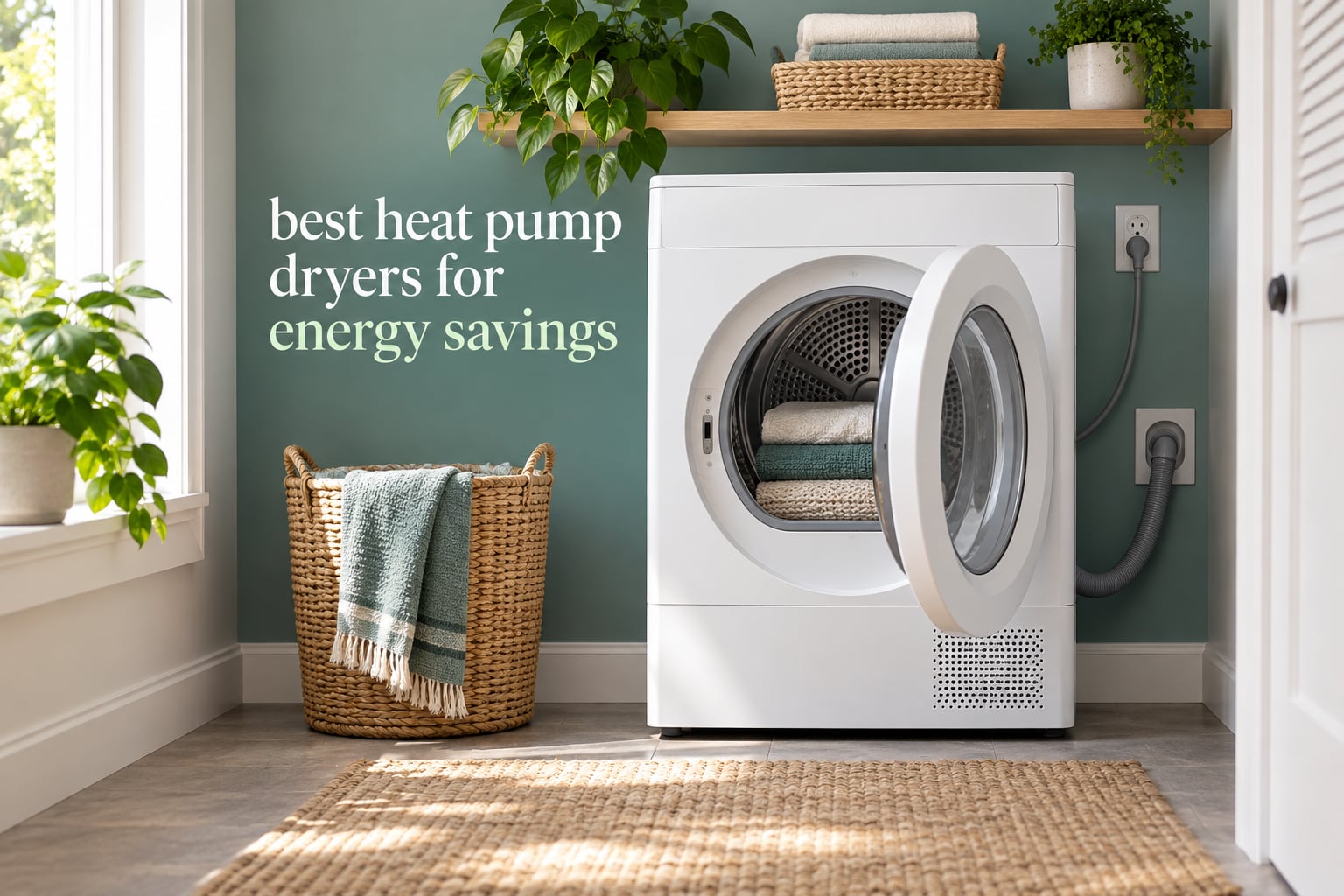
A heat pump dryer uses roughly 40 to 50 percent less electricity than a conventional electric dryer, and it needs no vent duct at all. That combination is why this category keeps growing: you cut the single largest electricity drain in a typical laundry room, and you can put the machine in a closet, a condo, or a converted gas-dryer spot without hiring anyone to cut a hole in an exterior wall.
There is a trade-off nobody hides. Heat pump dryers run cooler and slower than a conventional dryer, most of the units in this roundup hold between 4 and 5.3 cubic feet, and a few require a 240V circuit instead of a standard wall outlet. So the honest question is not whether a heat pump dryer is efficient. It is whether its efficiency fits your laundry volume, your electrical panel, and your patience.
We went through every currently listed heat pump dryer we could find, pulled the EnergyGuide and specification details, and sorted them by what actually matters when you are chasing energy savings. If you are also upgrading the rest of your home’s energy kit, our heat pump water heater guide covers the other major electricity conversion most people make first.
Table of Contents
Top 3 Heat Pump Dryers for Energy Savings (October 2026)
Three units stood out once we lined up capacity, energy data, installation requirements and review history. The Samsung combo leads because it is the only pick with a published annual consumption figure and a standard 120V plug. The Midea and LG compacts cover the small-space end of the market, where ventless design matters most.

Samsung WD53DBA900HZA1 Combo
- Washes and ventless heat pump dries on 120V
- 103 kWh per year
- 5.3 cu. ft. drum
- 98-minute wash and dry

Midea MLE25H7BWW 4.4 cu. ft.
- 24-inch stackable footprint
- Ventless heat pump design
- Dry Smart humidity sensor
- Energy Star qualified

LG DLHC1455W 4.2 cu. ft.
- Dual Inverter HeatPump
- 4.2 cu. ft. in a 24-inch box
- 14 programs
- ThinQ app control
Best Heat Pump Dryers at a Glance in 2026
All six picks are ventless heat pump models. The table below lists every unit we reviewed, with the features that decide whether it fits your laundry space.
| Product | Specs | Action |
|---|---|---|
| Samsung WD53DBA900HZA1 Bespoke AI Combo |
|
Check Latest Price |
| Midea MLE25H7BWW 4.4 cu. ft. |
|
Check Latest Price |
| LG DLHC1455W 4.2 cu. ft. |
|
Check Latest Price |
 Samsung DV25B6900HW/A2 4.0 cu. ft. Samsung DV25B6900HW/A2 4.0 cu. ft. |
|
Check Latest Price |
 ASKO T208HW 4.1 cu. ft. ASKO T208HW 4.1 cu. ft. |
|
Check Latest Price |
 Summit SLDHP344 4.1 cu. ft. Summit SLDHP344 4.1 cu. ft. |
|
Check Latest Price |
1. Samsung Bespoke AI Combo WD53DBA900HZA1 – All-in-One That Needs No Vent
Samsung 5.3 cu. ft. Bespoke AI Laundry Ventless Heat Pump Dryer Combo All-in-One Ultra Capacity Washer with AI Home, Dark Steel, WD53DBA900HZA1
5.3 cu. ft. combo
120 volts
103 kWh per year
Energy Star
317 lb unit
Pros
- Only pick that washes and ventless heat pump dries on a standard 120V outlet
- 103 kWh per year is the lowest published figure in this roundup
- 98-minute wash and dry on the standard cycle
- Flex Auto Dispense covers 47 detergent and 34 softener loads
- 20-year digital inverter motor warranty
Cons
- Heat exchanger cleaning prompts arrive once the one-year parts warranty ends
- Full wash and dry cycles can stretch to roughly six hours on some settings
- At 317 lb it is the heaviest unit here and needs a solid floor
This is the only heat pump dryer in our roundup that also washes your clothes, and that single fact changes how you think about it. Instead of a washer feeding a separate dryer, one 120V machine handles the whole loop, which means no transfer, no laundromat trip, and no second appliance taking up floor space.
The efficiency numbers back up the design. Samsung lists 103 kWh per year, and that figure comes on a machine with a 5.3 cubic foot drum rather than the 4 cubic foot norm in this category. That headroom matters, because it means the drying side is not working against a half-empty drum to hit its consumption target.
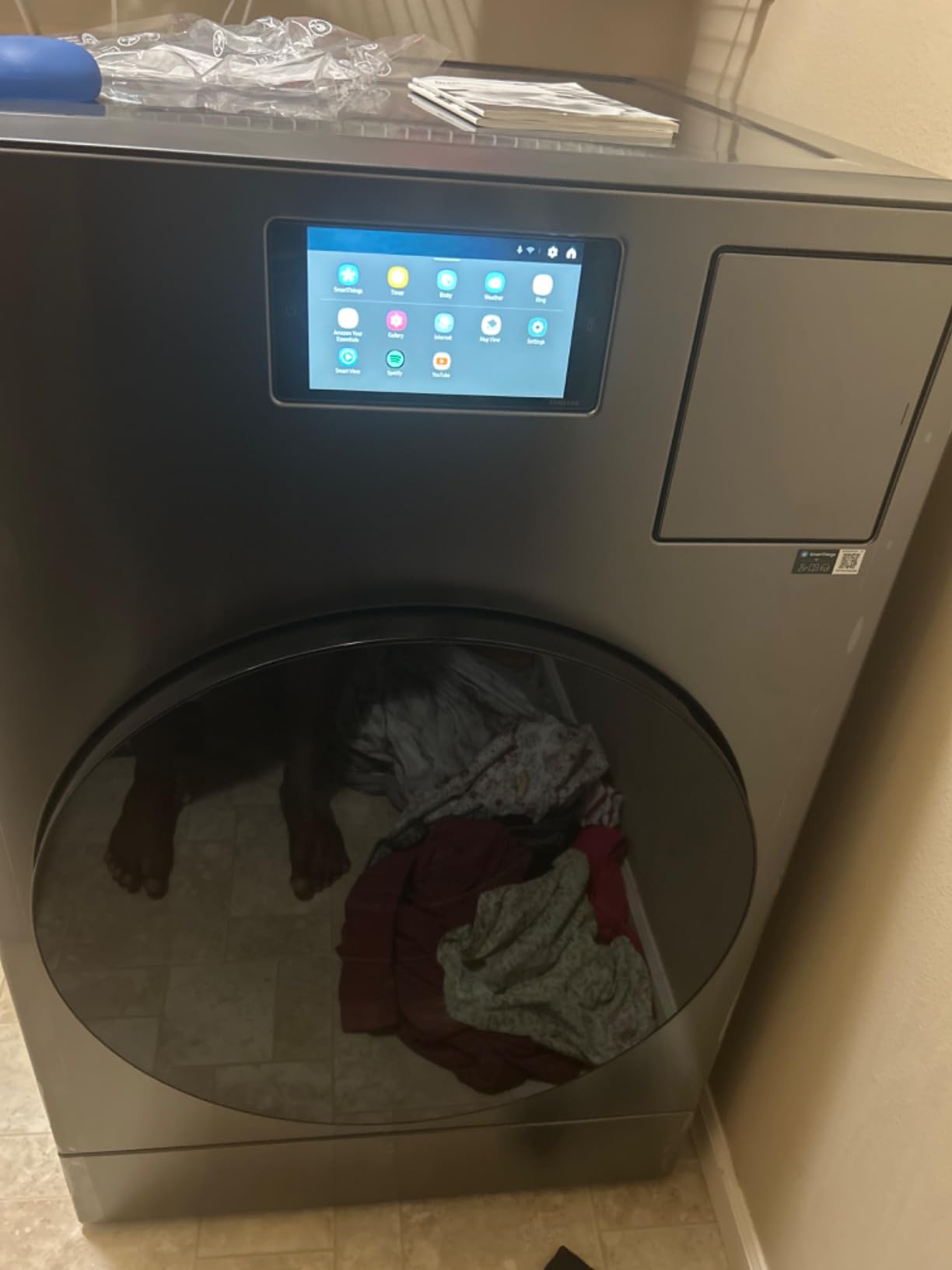
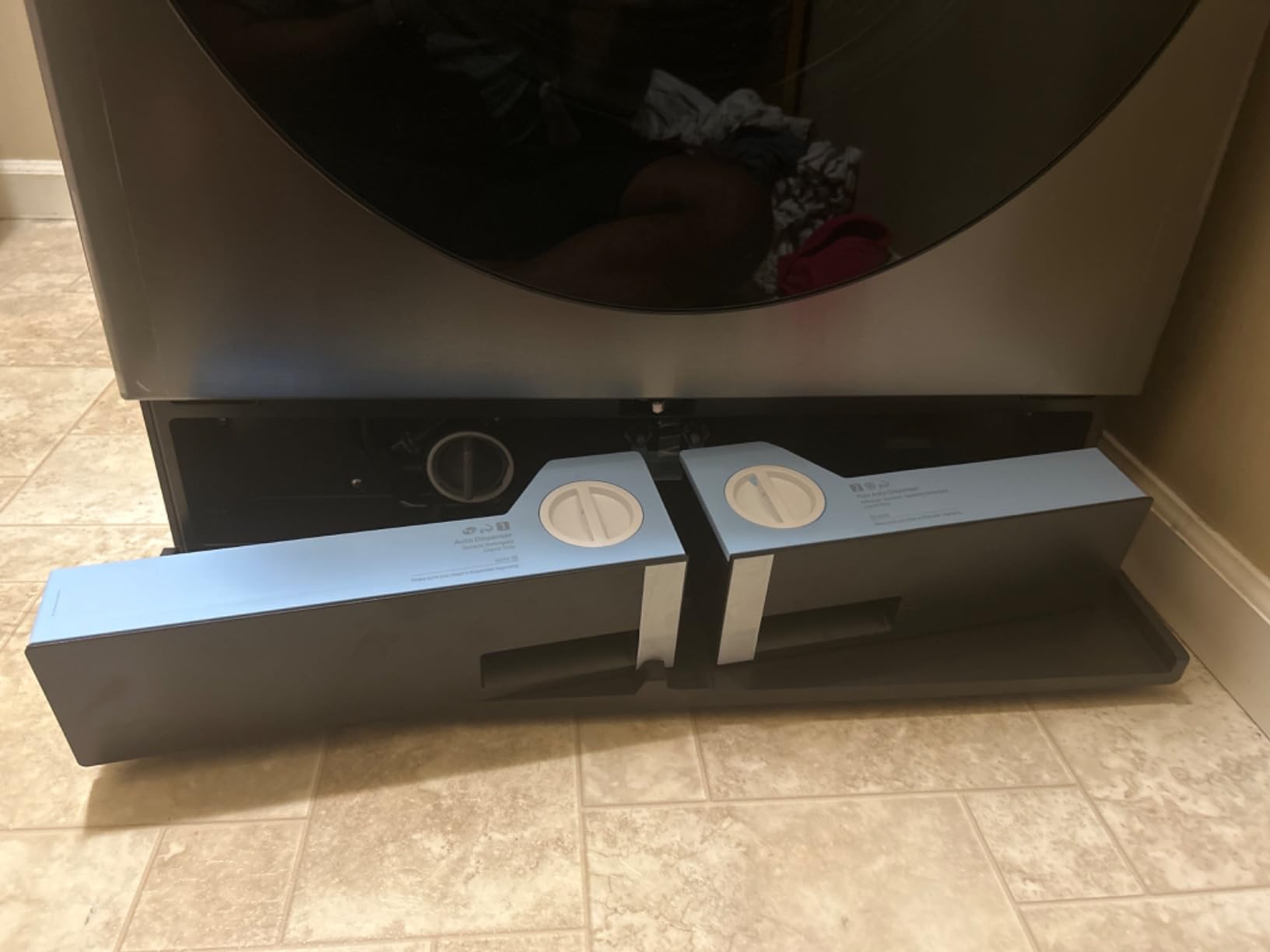
AI Opti Wash and Dry reads soil level and fabric type, then sets water, temperature and time on its own. Flex Auto Dispense doses detergent and softener automatically and holds roughly 47 detergent loads, so the machine mostly runs itself once it is loaded. Cycle options include Active Steam, Auto Dry, Sensor Dry and a delicates setting, and the drum is stainless steel spinning to 900 rpm.
The honest catch is cycle length. Owners report whole wash-and-dry runs near two hours on the standard program, and a full wash and dry can stretch toward six hours on the longest settings. That is not a flaw unique to this machine, but on a combo it is harder to shrug off because the wash is locked in behind the dry.
Why we picked it over the rest
Two reasons, and both are hard to argue around. First, it is the only unit here that runs on a standard 120V outlet, so you avoid a 240V circuit or a panel upgrade entirely, which is the single most common install surprise buyers hit. Second, 103 kWh per year is the lowest published annual consumption figure in this roundup, and it is achieved on a larger drum than its competitors.
The warranty structure also has depth: one year parts and labour, three years on the stainless steel tub, and twenty years on the digital inverter motor. Compressor-driven machines live or die on that motor, and twenty years is the longest coverage in this group.
Where it falls short
The recurring complaint theme on this listing is heat exchanger maintenance prompts once the one-year parts and labour warranty ends. Ventless machines collect condensate, and the heat exchanger needs periodic cleaning, so budget for that service beyond year one rather than assuming the warranty covers the most failure-prone part of the system.
At 317 pounds it is by far the heaviest unit here, measuring 34.4 inches deep by 27 inches wide by 43.7 inches high. That floor-loading weight matters in an upper-floor apartment where a lighter machine is easier to move, and the review base of 31 ratings is the largest here but still thin by appliance standards.
2. Midea MLE25H7BWW 4.4 cu. ft. – Compact Heat Pump for Closets
Midea Heat Pump Ventless Front Load Dryer Stackable 4.4 Cu.ft White
4.4 cu. ft.
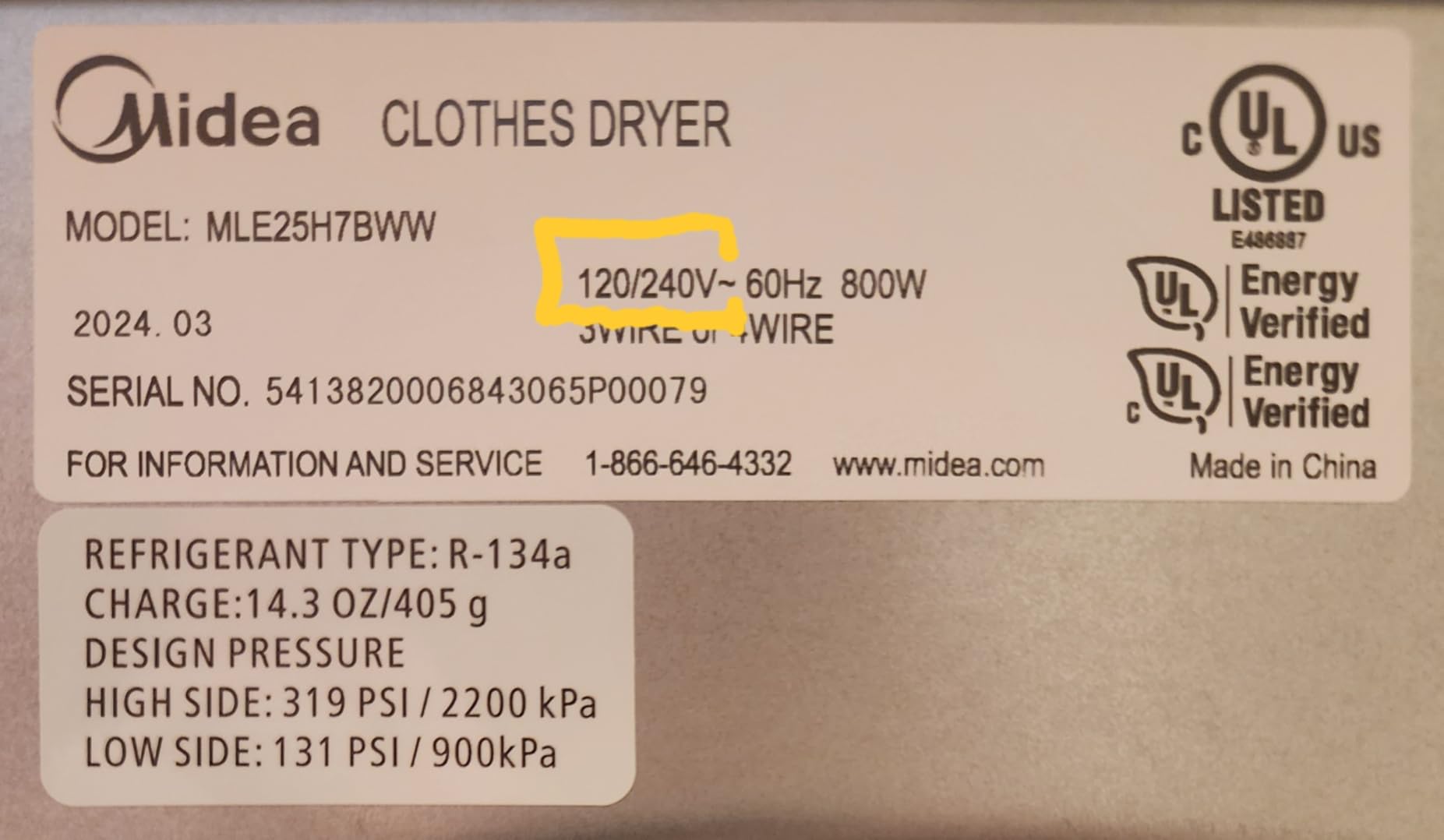
240V required
24-inch wide
Energy Star
Stackable
Pros
- Compact 24-inch footprint stacks above a Midea washer
- Uses at least 28 percent less energy than standard dryers
- Dry Smart humidity sensor stops the cycle automatically
- Ventless install suits closets and apartments
- Back-up drain hose included
Cons
- 240V power cord must be bought separately
- About a third of star votes land at the bottom
- Condensed water needs a routed drain hose
- Wrinkle Care adds roughly 90 minutes of unheated tumbling
Midea’s MLE25H7BWW is built for the situation most heat pump dryer buyers actually have: a laundry closet that was never vented. It measures 22.5 inches deep by 23.5 inches wide by 33.5 inches high, stacks above a Midea washer, and needs no exterior exhaust. If your laundry area has a door that barely opens, that footprint is the whole argument.
Midea rates it at a minimum of 28 percent less energy than standard dryers, and the machine is Energy Star qualified. It dries at low temperatures, which is genuinely useful for wool, synthetics and anything you would normally pull before the high-heat cycle.
The Dry Smart humidity sensor measures how much moisture is left in the load and adjusts the cycle rather than running a fixed timer. Wrinkle Care adds roughly 90 minutes of unheated tumbling at the end to shake out creases instead of cooking them in, which is a reasonable trade when you are not using heat anyway.
Warranty coverage is one year manufacturer, and a back-up drain hose is included in the box. The drum and cabinet combine plastic and stainless steel, and the door orientation is not documented in the listing, so confirm that before a tight closet install.
Where this compact dryer earns its place
If you are replacing a gas dryer and want to go all-electric without touching the electrical panel, this is one of the few compact heat pump options that fits. It also stacks, which means a single closet can hold a washer and dryer front to back.
The low-temperature drying is the quiet advantage nobody markets. Heat pump dryers run cooler by design, and owners on appliance forums generally report gentler treatment of garments than a conventional dryer at full heat.
What gives us pause
The 3.4-star average across 17 ratings is the second-lowest score in this roundup, with roughly a third of votes landing at one star. Those critical reviews point at overall reliability and at setup friction rather than at drying performance, and the sample is small enough that the picture could shift either way.
The 240V power cord is not included and must be purchased separately, which is an easy day-one surprise if you assumed the machine came ready to plug in. The condensate also has to leave the machine, so you need a drain hose routed somewhere sensible rather than relying on the reservoir alone.
3. LG DLHC1455W 4.2 cu. ft. – Smart Compact Dryer for Apartments
LG DLHC1455W 24 in. W 4.2 Cu. Ft. Ventless Stackable Compact Smart Electric Dryer in White with Dual Inverter HeatPump Technology
4.2 cu. ft.
24-inch wide
127.9 lb
14 programs
Sensor Dry
Pros
- Dual Inverter HeatPump moves heat instead of generating it
- 4.2 cu. ft. capacity inside a 24-inch footprint
- 14 built-in programs including wool and delicates
- Sensor Dry adjusts cycle length from measured moisture
- ThinQ app adds remote start and cycle alerts
- Reversible door swing for awkward closet layouts
Cons
- Reviewers report a failure well inside the one-year warranty
- Some owners report noticeable garment shrinkage
- After-sales service was criticized for offering paid repairs
- An internal crack reportedly appeared after about two years
LG’s DLHC1455W packs the most control hardware into the smallest useful footprint in this roundup. It is 4.2 cubic feet inside a 24-inch wide, 27.25 inch deep cabinet weighing 127.9 pounds, and it carries Dual Inverter HeatPump technology, which is LG’s name for the variable-speed compressor loop that runs the whole drying cycle.
Sensor Dry measures moisture in the drum and adjusts the cycle length, which is the feature that actually converts the heat pump hardware into electricity savings. Without it, you run to a timer and waste the last stretch of every cycle heating already-dry fabric. There are 14 built-in programs covering everything from wool to air fluff.
The ThinQ app gives you remote start, cycle alerts and finish notifications. For a ventless dryer in a small space, that matters more than usual, because you can start a long low-temperature cycle and leave the room while it works.
Why LG works in a ventless apartment
Owners of LG heat pump dryers on Hearth.com describe the machine as very quiet, with a self-cleaning heat exchanger and effectively zero maintenance beyond the lint screens. That directly addresses the most common heat pump dryer complaint thread, which is condenser upkeep.
The 24-inch footprint and reversible door also make this one of the easiest of the picks to install in a tight closet, and ventless operation means no duct work if you are in a condo or a rental where you cannot modify an exterior wall.
The weak spots
The review base is six ratings, and it splits 74 percent five-star against 26 percent one-star. Two negative reviews describe a unit that stopped working properly well inside the one-year manufacturer warranty, noticeable garment shrinkage in the drum, and customer service pushing paid repairs rather than fixing the fault. Another reports an internal crack developing after roughly two years of use.
One happy owner still flags high power draw, which sits oddly next to the efficiency pitch. With six ratings, this is a machine where you are buying the engineering on the spec sheet rather than a proven field record, so keep the warranty paperwork and register the unit the day it arrives.
4. Samsung DV25B6900HW/A2 4.0 cu. ft. – Fastest Express Cycle in a Small Box
Samsung 4.0 Cu Ft Heat Pump Dryer, Compact Clothes Drying Machine, Stackable for Small Spaces w/Sensor Dry, 12 Preset Cycles, 40 Minute Express Dry, DV25B6900HW/A2, White
4.0 cu. ft.
Energy Star
12 preset cycles
40-minute Express
Reversible door
Pros
- 40-minute Express Cycle finishes a 2 lb mini load ready to wear
- Sensor Dry optimizes both time and temperature
- 12 preset cycles cover everyday laundry
- Compact 4.0 cu. ft. stackable footprint fits small spaces
- Smart Care app runs diagnostics and suggests fixes
- Reversible door for flexible room layouts
Cons
- Only six ratings
- so long-term reliability is unproven
- Express Cycle is limited to very small loads
- Full-size loads still run long at low heat
Everything else in this category dries slowly by design. This Samsung stands out because of one specific program: a 40-minute Express Cycle that takes a 2 pound load from damp to ready to wear. For someone who needs one shirt dry before work rather than a full basket, that is the difference between owning a heat pump dryer and resenting it.
It is a compact 4.0 cubic foot front-load that stacks, measures 25.81 inches deep by 23.63 inches wide by 35 inches high, and carries an Energy Star specification met. The door swing is reversible, so it can be flipped to suit a narrow alcove.
Sensor Dry does the efficiency work by optimizing cycle time and temperature rather than running a fixed programme, and the Smart Care app performs immediate diagnostics and offers quick solutions when something misbehaves. There are 12 preset cycles in total.
Where the Express Cycle pays off
The strongest case for this machine is a mixed household: adults who need something dry in under an hour, alongside a heat pump system that handles the big loads overnight. Splitting loads by urgency rather than running everything on one long programme is also the single most effective way to keep cycle times manageable on any heat pump dryer.
Smart Care diagnostics are a small thing that saves real time. When a ventless machine behaves oddly, the app can often identify the problem without a service call.
What to know before you commit
Six ratings, and the 3.5-star average includes a 26 percent one-star share. Appliance forums are blunt about this: a heat pump dryer with no established field record is a harder sell than one with two years of owner history behind it, because the sealed refrigerant loop is a repair nobody wants to attempt twice.
One of the more thoughtful reviews on this listing raises the thermodynamic reality directly. A heat pump moves heat rather than generating it, so in winter the air entering the machine comes from your room, and you are effectively reclaiming heat the furnace already paid for. That is not a fault, but it explains why a heat pump dryer in a cold garage can feel slow while the same machine performs well in a warm interior.
5. ASKO T208HW 4.1 cu. ft. – The No-Surprises 24-Inch Cabinet
Asko T208HW Classic Series 24 Inch Wide 4.1 Cu Ft. Energy Star Rated Electric Classic Heat Pump Dryer
4.1 cu. ft.
24-inch wide
Front load
Energy Star rated
Ventless
Pros
- Straightforward ventless heat pump layout with nothing extra to learn
- Energy Star rated for lower energy consumption
- 24-inch width fits standard appliance slots
- Front-load access with a 4.1 cu. ft. drum
Cons
- No customer ratings or reviews are published
- Full specification block and weight are not published
- Field performance is entirely undocumented
The ASKO T208HW from the Classic Series is the simplest proposition in this roundup: a 4.1 cubic foot front-load heat pump dryer in a 24-inch wide cabinet, Energy Star rated, with no exterior vent required. If you want the efficiency win without app controls or program menus to learn, this is the shape of machine that fits.
That simplicity is also the limitation. There are no published customer ratings or reviews for this listing, no detailed specification block, no confirmed weight and no dimensions beyond the 24-inch cabinet width. You are buying on the manufacturer’s Energy Star heat pump specification alone.
ASKO appliances generally sit in the premium appliance tier, so this is not the budget doorway into heat pump drying. It competes on build and simplicity rather than on features per dollar.
When the plain approach makes sense
If you have already decided on heat pump drying and you want the fewest moving parts between you and a dry load, the T208HW is a reasonable target. A 24-inch front-load cabinet is a standard footprint, so it slots into existing appliance openings without measuring gymnastics.
Ventless operation means no duct modification, which is the deciding factor in apartments, condos and any room where you cannot or will not cut an exterior wall.
Why we are not recommending it more strongly
Zero published reviews is the honest headline. Every other pick in this roundup has at least some owner history, however thin, and owner history is the only real signal on how a sealed heat pump loop ages. Without it, you have no field data on condenser fouling, drain pump longevity or long-cycle consistency.
Because specifications are incomplete, you cannot plan the install properly from the listing alone. Confirm breaker requirements, drain routing and full dimensions with the manufacturer before you commit. If you want a documented machine instead, the Midea or the LG compact covers the same 24-inch footprint with published detail.
6. Summit SLDHP344 4.1 cu. ft. – Full Program Set for 240V Homes
Summit 4.1 cu.ft. Heat Pump Dryer, ENERYSTAR Certified, 208-240V, 19.8 lbs. lbs Load, 24” Width, White – SLDHP344
4.1 cu. ft.
208-240V
ENERGY STAR
14 programs
120 lb unit
Pros
- ENERGY STAR certified heat pump dryer
- Fourteen dry programs including wool
- jeans
- delicates and air fluff
- Eco-dry plus extra dry
- anti-crease and timed dry options
- 24-hour delay start helps you run on off-peak rates
- Large lint filter mounted in the door for easy access
- Same 24-inch chassis offered in a vented variant
Cons
- Requires a 208-240V supply so it cannot use a 120V circuit
- No customer ratings or reviews are published
- Field reliability is unproven
Summit’s SLDHP344 is the most fully specified dryer in this roundup, and the documentation is the reason to look at it. It is a 4.1 cubic foot stainless steel drum, 116 litres, in a cabinet measuring 26.13 inches deep by 23.5 inches wide by 33.13 inches high at 120 pounds, ENERGY STAR certified, running on a 208-240V supply.
Fourteen dry programs cover wool, air fluff, jeans, delicates and permanent press, plus eco-dry, extra dry, anti-crease and timed dry functions. Convenience features include a child lock, a mute function, 24-hour delay start and an add-garment option, and the large lint filter sits in the door so you can reach it without pulling the drum open.
The 24-hour delay start is genuinely useful for an energy-saving purchase, because you can schedule a full cycle into an off-peak electricity window and let it run while the rest of the house sleeps.
Why the 240V requirement is not a problem here
Several forum threads centre on the shock of buying an efficient dryer and discovering it needs a 240V circuit. That objection does not apply to this machine, because it already requires 208-240V. If your laundry room is being converted from a gas dryer, you likely already have a 240V outlet or a nearby gas connection point that can be reused.
Worth knowing: the same 24-inch chassis is offered in a vented variant, so if you later decide you want a conventional vented machine, the footprint question is already answered.
What we cannot tell you
There are no customer ratings or reviews on this listing, so field reliability is entirely unproven. Same caveat as the ASKO, but the Summit is at least honest about capacity, voltage, dimensions, weight and program count, which makes planning an install far easier.
Reviewers of heat pump dryers in general flag two recurring themes worth weighing: condenser coil cleaning on a schedule, and drain pump failures. A forum owner of a different heat pump dryer reported a pump failure within the first few cycles, under warranty, and another noted poor parts availability for repairs. Confirm regional service support for the model before buying a machine with no field history.
How Much Does a Heat Pump Dryer Actually Save?
The short version: on typical household usage, a heat pump dryer uses roughly a quarter of the electricity of a conventional electric dryer. Appliance owners comparing EnergyGuide tags on Hearth.com report figures near 600 kWh per year for a conventional dryer, near 300 kWh per year for a condensing dryer, and near 150 kWh per year for a heat pump dryer.
Work the math on a rate of roughly 18 cents per kWh and a household doing four loads a week, about 208 cycles a year. A conventional dryer at 600 kWh runs close to 108 dollars a year. A heat pump dryer in that band runs closer to 27 dollars. That gap of roughly 80 dollars a year is the number to divide by your upfront premium when you work out payback.
Now the honest part. One forum user ran that same calculation for their own situation and arrived at a 22-year payback, and bought a conventional dryer on sale instead. That is not a math error. Payback only works when you dry a lot of laundry, and it fails badly when you dry a lot in a room heated by electricity anyway, because you are paying twice for the same kilowatt hour.
So here is the three-step method. First, find your current dryer’s annual kWh on its EnergyGuide label. Second, subtract the heat pump figure for the machine you are considering. Third, divide that difference by your actual electricity rate, then divide the annual saving into the upfront premium. If the answer is more than about five years, buy on features and capacity instead of energy.
One more variable that rewards attention: scheduling. Delay start, which both the Summit and the LG offer through their apps, lets a full cycle run during an off-peak window. Pair that with an energy-monitoring smart plug and you can verify real consumption rather than trusting a label.
Who Should Skip a Heat Pump Dryer
High-volume households should think twice. If you run six or more loads a week, doubling cycle time to save kilowatt hours is a bad trade, and forum users consistently report dry times stretching well past a conventional machine’s.
Cold garages and unheated basements are the second group to avoid. Heat pump dryers depend on drawing ambient air, and performance drops in spaces below roughly 50 degrees. If the machine lives outside your insulated envelope, you are asking the compressor to work against the weather.
Bulky bedding is the third. Every machine here holds 4 to 5.3 cubic feet, well short of a large-capacity conventional dryer, and a comforter that fills the drum has no room to tumble. Homes switching from gas to electric while converting the whole house should also read our smart thermostat guide, since heating is where the bigger all-electric savings usually sit.
What to Check Before You Buy a Heat Pump Dryer
Check the breaker before anything else. It is the number one install surprise, and it is the question buyers most often get wrong. Some models here run on a standard 120V outlet, some require 240V, and the Summit needs a 208-240V supply. If your current dryer is gas, converting to electric means a new outlet and possibly a panel change, and that cost belongs in your payback calculation.
Plan the drain next. Ventless machines condense water out of the air, and that water has to go somewhere. Some use a reservoir you empty by hand, others include a back-up drain hose like the Midea. Know which one you have before the machine is installed.
Confirm capacity against your real load size. All six picks sit between 4.0 and 5.3 cubic feet. If your weekly basket fills a larger drum, the efficiency gain gets eaten by running two smaller loads instead of one.
Think about ambient temperature. Heat pump dryers draw room air, so a warm interior is part of how they work. Placement below roughly 50 degrees is where cycle times start climbing and complaints begin.
Finally, budget for the heat exchanger. Condenser cleaning is a real recurring task, and on at least one machine in this roundup the prompts arrive right after the one-year parts warranty ends. A ventless dryer has no duct cleaning bill to offset that, but it is not maintenance-free either.
Frequently Asked Questions
Which heat pump dryer is the most energy efficient?
Among the models we reviewed, the Samsung WD53DBA900HZA1 Bespoke AI combo has the lowest published consumption at 103 kWh per year, and it reaches that figure on a 5.3 cu. ft. drum rather than a small 4 cu. ft. one. Across the category generally, the figure to compare is kilowatt hours per 100 cycles on the EnergyGuide label, not wattage at the plug.
Do heat pump dryers save electricity?
Yes. A heat pump dryer typically uses about 40 to 50 percent less electricity than a conventional electric dryer. Appliance owners reporting EnergyGuide tag figures put a conventional dryer near 600 kWh per year and a heat pump dryer near 150 kWh per year at typical household usage. The saving comes from moving heat with a sealed refrigerant loop instead of generating it with a heating element.
What is the downside of a heat pump dryer?
The main downsides are longer cycle times, smaller drums than conventional dryers, and a required circuit check before install. Some models need a 240V supply, which can mean a new outlet or panel work. Ventless machines also collect condensate, so the heat exchanger needs periodic cleaning, often after the one-year parts warranty ends. Very high-volume households and cold garage installs are the worst fits.
Why does my heat pump dryer take so long to dry clothes?
Heat pump dryers run at lower temperatures by design, so they need more time than a conventional dryer on the same load. Overloading the drum makes it much worse because clothes cannot tumble freely. Clean the heat exchanger on schedule, run large items separately, and use sensor dry or moisture-based programmes so the cycle stops when the load is actually dry instead of running to a fixed timer.
Do heat pump dryers need a vent?
No. That is the main installation advantage. A heat pump dryer recirculates air through a sealed refrigerant loop and condenses moisture onto a cold evaporator coil, so nothing is exhausted outdoors. You do need somewhere for the collected condensate to drain, either into a routed hose or into a reservoir you empty by hand.
What size breaker does a heat pump dryer need?
It depends on the model. Several compact heat pump dryers in this roundup run on a standard 120V outlet, which means an ordinary household branch circuit. Others, including the Summit SLDHP344, require a 208-240V supply and therefore a dedicated high-amperage circuit. Check the installation manual for your specific model before ordering, since converting from a gas dryer means no outlet may exist at all.
The Bottom Line on Heat Pump Dryer Energy Savings
Heat pump dryers are the most efficient drying option available and they remove the vent from the equation entirely, but the saving only pays back when you dry a lot of laundry in a properly sized space. Check your circuit before you shop, not after.
For most people the Samsung WD53DBA900HZA1 is the pick: lowest published consumption at 103 kWh per year, a 5.3 cubic foot drum, and a standard 120V plug that avoids panel work. Renters and small-space households should look at the Midea MLE25H7BWW for its 24-inch stackable footprint, and apartment dwellers who want app control should check the LG DLHC1455W. If you already have a 240V circuit, the Summit SLDHP344 gives you the most complete program set in the group.
Skip a heat pump dryer if you run six or more loads a week, plan to install it in a cold garage, or wash bulky bedding weekly. In those cases a conventional dryer with a clean vent is the more sensible purchase.