
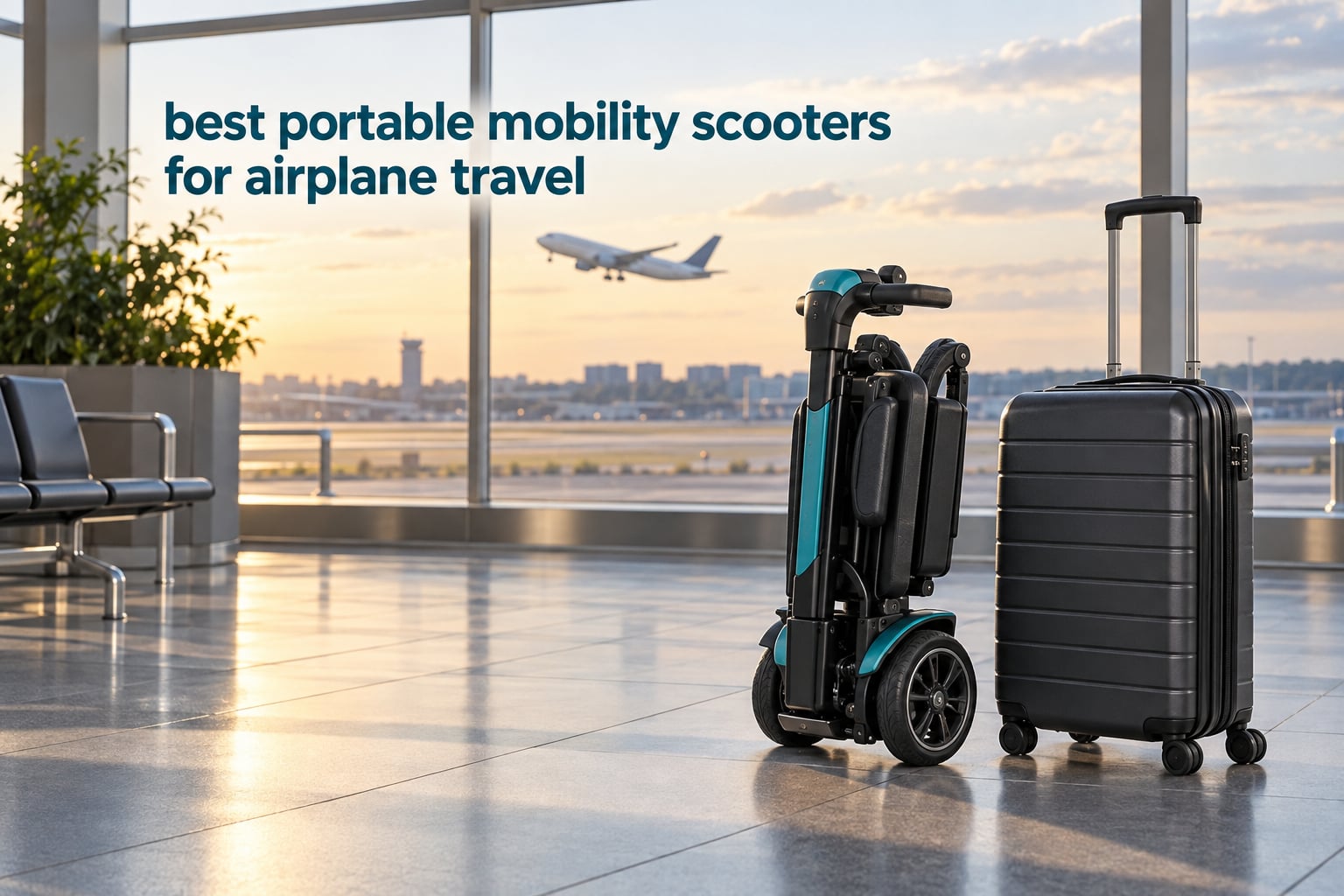
Trying to find the best portable mobility scooters for airplane travel is mostly a numbers problem, not a brand problem. A scooter flies when it folds small, weighs little, and carries a lithium battery you can remove and hand-carry — the same three things that make it fit a sedan trunk. We compared ten of them on weight, battery type, folded footprint, range, rider capacity, and the practical details reviewers mention after a real trip.
The single biggest deal-breaker we found is weight. Two of the ten models on this list are 84 and 89 pounds, which is perfectly fine for driving around a neighborhood and hopeless at a gate. If you are buying specifically to fly, look only at the models under about 65 pounds and confirm the weight of the heaviest single piece, not just the total.
We also read the forums, where travelers repeat the same advice: call the airline’s medical-equipment desk at least 48 hours before departure, and never assume a gate agent will know the lithium rules for your battery. The short version of the airline rulebook is below, and it is worth ten minutes of your time before you book anything.
If you want the broader picture first, our guide to the best folding mobility scooters for travel covers the folding mechanisms in more detail, and our mobility scooters for seniors roundup is better on comfort and seating for daily use.
Table of Contents
Top 3 Portable Mobility Scooters for Airplane Travel in 2026
The SuperHandy Passport takes our top slot because it has the largest review base on this list and the most documented history of being flown, gate-checked and returned. The Great Circle G is the lightest frame we could find and the simplest to break down, and the Aotedor is the one four-wheeler here that folds without pulling the seat off.

SuperHandy Passport 3-Wheel
- 35 lb assembled
- 13 mile range
- dual removable 44.4V lithium batteries
- folds to 24 by 22.4 by 16.5 inches

Great Circle G 3-Wheel
- 26 lb aluminum frame
- five-piece disassembly
- detachable 48V lithium battery
- 6.5 mile range
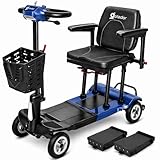
Aotedor Lightweight Scooter
- 36 lb magnesium frame
- two 10Ah lithium batteries
- 22 mile range
- folds and rolls on one hand
Portable Mobility Scooters for Airplane Travel in 2026
Every scooter below is listed with the figures that decide whether it flies, not with marketing adjectives. The heaviest single component matters more than the total weight, because that is the piece a handler lifts onto the belt and a companion lifts into a trunk.
| Product | Specs | Action |
|---|---|---|
| SuperHandy Passport 3-Wheel |
|
Check Latest Price |
| Great Circle G 3-Wheel |
|
Check Latest Price |
 Sugogo YL-985 Sugogo YL-985 |
|
Check Latest Price |
 Rascal Venture 3-Wheel Rascal Venture 3-Wheel |
|
Check Latest Price |
 PAISEEC S3 PAISEEC S3 |
|
Check Latest Price |
 FreeWink Carbon Fiber FreeWink Carbon Fiber |
|
Check Latest Price |
 Ecomobi M3 Ecomobi M3 |
|
Check Latest Price |
| Aotedor Lightweight |
|
Check Latest Price |
 Rylox YL-07 Rylox YL-07 |
|
Check Latest Price |
 Serianie 4-Wheel Serianie 4-Wheel |
|
Check Latest Price |
One line to remember when you scan that table: the 27.5 lb carbon fiber frame and the 26 lb aluminum frame are the two lightest bodies here, and the 84 lb and 89 lb four-wheelers are not air travel products at all, however well they perform in a parking lot.
1. SuperHandy Passport Is Our Best Overall Pick for Flying
SuperHandy Passport Mobility Scooter for Adults- Foldable, 3 Wheel, Airline Travel Friendly – 13 Mile Range, Includes 2 Removable 44.4V Lithium-ion Batteries & Charger (275 Lbs)
35 lb assembled
13 mile range
275 lb capacity
Folds to 24 by 22.4 by 16.5 in
Pros
- Two removable 2.5 lb lithium batteries swap in seconds
- 1.5 hour recharge
- largest review base in the group at 1446
- tight turning radius in airports and ship corridors
- documented successful gate-checks
Cons
- Small hard tires with no suspension rough on grass and cracks
- tippy three-wheel base on curbs and inclines
- handlebar brake will not hold on steep grades
At 35 pounds assembled, the Passport is light enough that a spouse or caregiver can load it, and it breaks down into a 27 pound frame, an 8.2 pound seat and a 2 pound battery. That decomposition is what makes the air travel story work: the battery comes out in seconds, travels separately, and the remaining parts are all pieces an able-bodied traveler can actually manage.
The 4.2 rating across 1446 reviews is the largest review base of any scooter in this roundup, which matters more here than a higher average on a newer listing. Buyers repeatedly describe the same pattern. It folds with one hand, the batteries charge away from the scooter in an hour and a half, and the range holds up for a full day around a theme park or a cruise port.
Travelers also document the flight itself. Multiple reviews describe riding the scooter down the gangway, handing it over to be tagged like a stroller, and collecting it again on landing. That is the outcome you are buying, and it is worth more than any feature that sounds good in a showroom.

The 4.2 average is not hiding a defect. It reflects mechanical limits that reviewers describe in plain terms: 6.75 inch solid tires with no suspension that transmit every crack in a sidewalk, a three-wheel chassis that needs caution on slopes, and a handlebar brake that will not hold the scooter on a steep grade. None of that matters much in a flat terminal. All of it matters on a ramp in Rome.
Range deserves an honest note. The manufacturer claims 13 miles per charge on a single battery, and the dual-battery configuration roughly doubles what you carry. In practice, treat that as a full-morning figure rather than an all-day one, particularly with a heavier rider or on hills.
What the Passport does well at an airport
The two removable 44.4V 2Ah lithium batteries are the core of it. Each weighs about 2.5 pounds, both can be charged off the scooter, and a spare simply extends the day. For a traveler with a long layover or a destination with no charging access, that flexibility is the difference between independence and waiting.
Second, the folded footprint of 24 by 22.4 by 16.5 inches is genuinely small. It fits a closet, a trunk and the narrow luggage slots on a small aircraft without a fight, and the handlebar adjusts from 29.5 to 35.4 inches so two different riders can share one scooter on the same trip.
Where the Passport will frustrate you
The 275 lb capacity ceiling is the first thing to check. If you or your travel companion weighs more than that, this scooter is not a candidate no matter how well it flies, and the sensible move is to look at a 300 or 330 pound model further down.
The ride quality is the other limitation. Buyers with limited hand strength report that the pop-button power control and the battery seat are fiddly, and there is no key, so the scooter has no secure lock of its own. Several owners also report that later production units drop into standby after 15 minutes and drain charge while you wait at the gate. Leave it switched off between legs.
2. Great Circle G Is the Best Value Scooter for Travelers on a Weight Limit
G Mobility Scooter – 3 Wheels, 35 lb Folding Aluminum Frame, Anti-Tip Footrests, Includes (1) 48V 2Ah Li-Ion Battery and Charger, Supports 275 lbs, Airline Friendly
26 lb aluminum frame
6.5 mile range
275 lb capacity
Five-piece breakdown
Pros
- Exceptionally light 26 lb aluminum frame
- battery swaps in seconds
- sharp turning radius in tight indoor aisles
- thumb-drive accelerator reduces wrist fatigue
- stowaway bag included
Cons
- Only 6.5 miles of range
- the shortest listed here
- no armrests
- users need to be able to lift roughly 35 lb to load it
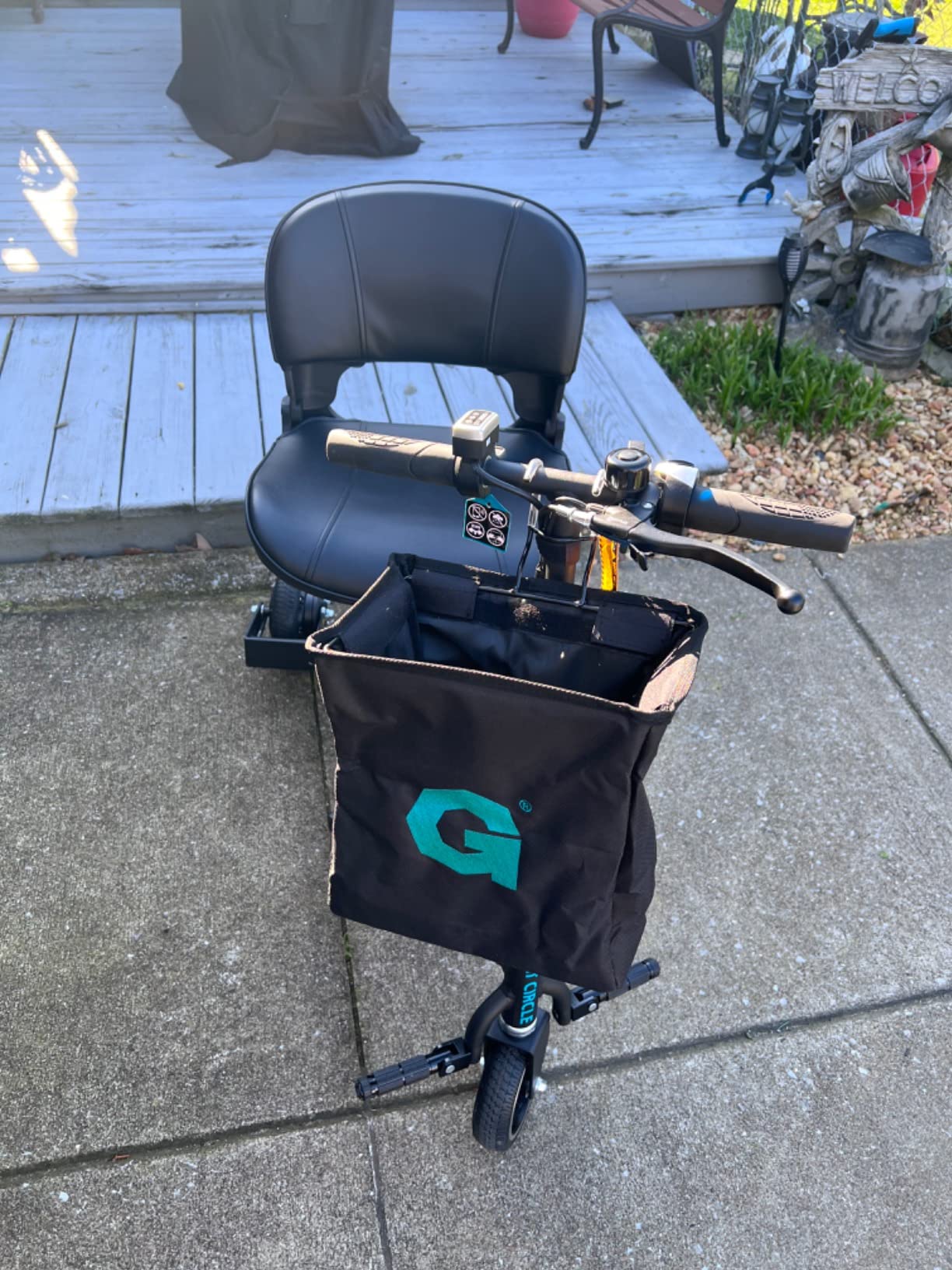
At 26 pounds, this is the lowest frame weight in the group, and that number is the whole argument. When the difference between a scooter you can put in a taxi boot and one you cannot is nine pounds, weight becomes the deciding specification rather than a tie-breaker.
It disassembles into five lightweight pieces, and the detachable 48V lithium-ion battery removes in seconds. Those two features together mean the scooter breaks down into objects that are genuinely portable rather than merely foldable, which is what makes it workable on a small regional aircraft and in a hotel room with limited floor space.
With 217 reviews at 4.2 and roughly 72 percent of them at five stars, the feedback is consistent about what people value. The 26 pound weight and the fast battery swap come up constantly, along with the 16.9 inch padded seat and the thumb-drive accelerator that lets you drive without gripping a twist handle.
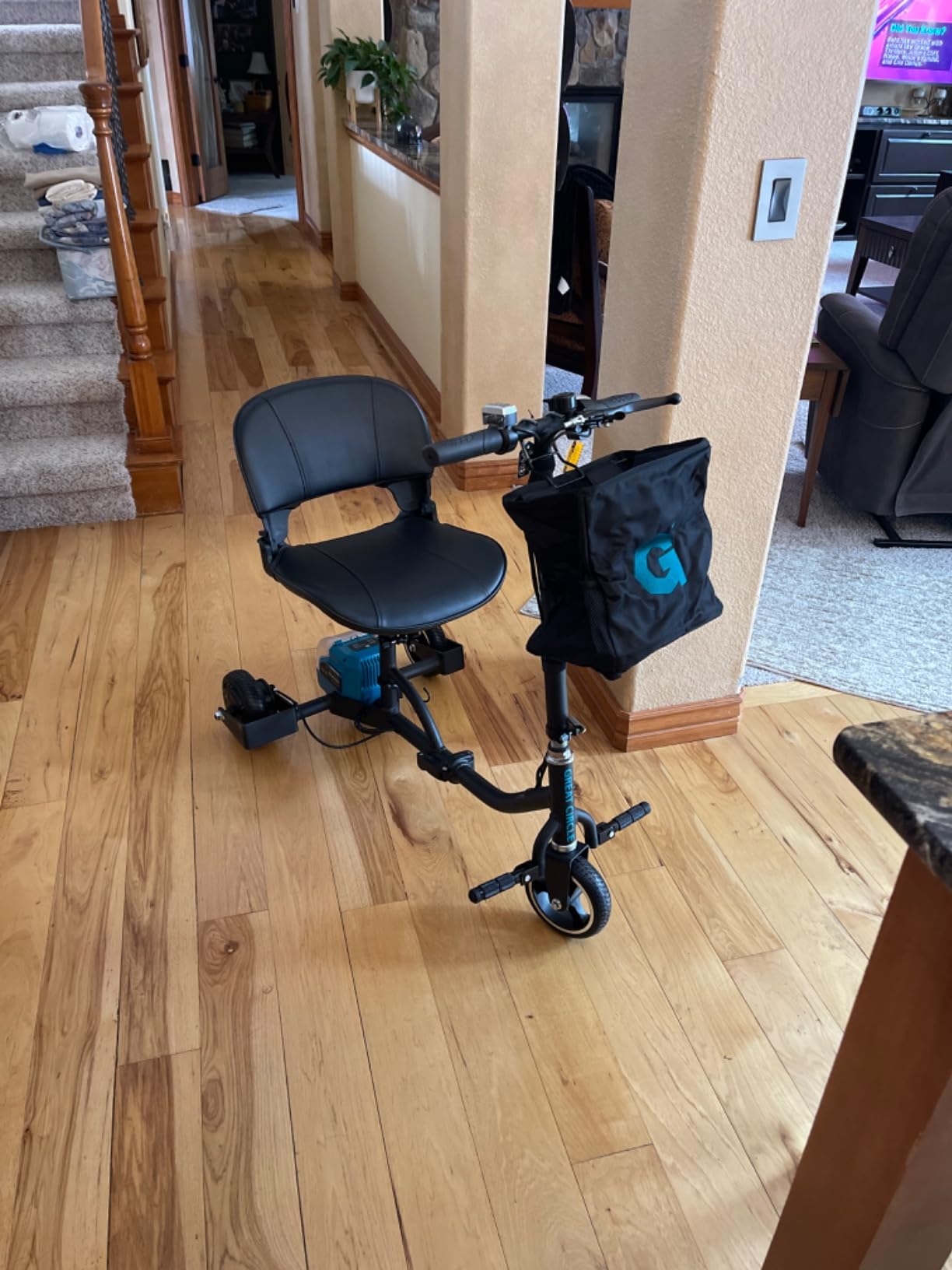
It is also an honest, no-frills design. The listing’s own pre-purchase guidance flags the two recurring caveats, and both are worth reading before you order. There are no armrests, so a rider holds their arms out during use, and you need to be able to lift about 35 pounds to get it into a vehicle.
Range is the compromise. Six and a half miles per charge is enough to get from a hotel to a convention center, a museum and back, and not much more. On a trip with a full day outdoors and no charging access, pair it with a second battery or pick a longer-range model.
Why the light frame matters on a flying trip
Lifting weight is the hidden variable in air travel. A handler takes the scooter, but a companion may have to lift it into a trunk, over a curb cut, onto a ship gangway, or into a rental car. At 26 pounds for the frame, a caregiver without back or shoulder problems can manage all of that in one go.
It also matters at security. A lighter folded package is easier to inspect, easier to stow and far less likely to trigger a request to open the battery compartment. Less attention at the counter means fewer questions about watt-hours.
What you give up for the weight
The armrest gap is the most commonly mentioned comfort complaint. Riders who transfer from a wheelchair or who have shoulder mobility limits find that holding the arms up or out for a whole day is tiring, and a caregiver cannot assist with a supported posture.
The second gap is range. Six and a half miles is roughly a quarter of what the long-range models here deliver, and a full day of sightseeing without a charging opportunity will use it up. Brand and manufacturer naming on the listing is also inconsistent, which is a small signal about support if something goes wrong.
3. Sugogo YL-985 Is the Best Pick for Riders at the 300 Pound Mark
Lightweight Mobility Scooter for Adult & Seniors Cruise & Airline Approved
300 lb capacity
43 lb frame
5 lb battery
12.4 mile range
Pros
- 4.7 average across 87 reviews with about 85 percent at five stars
- folds in three steps with no tools
- assembles in about three minutes
- 270 degree flip-up armrests and reinforced seat base
- 12 degree slope capability
- five color options
Cons
- 43 lb frame is heavy for solo handling
- only one battery included with a spare sold separately
- new 2026 listing with a short review history
The 300 pound capacity is what separates this from the ultralight three-wheelers. Most of the sub-40 pound models on this list cap at 275 pounds, which is a real ceiling for a meaningful number of travelers. If you are near or above 300 pounds, this is one of only two models here rated for you at a flyable weight.
The battery is a 24V 12Ah removable lithium pack weighing 5 pounds, and the manufacturer notes it is around 72 percent lighter than a comparable lead-acid pack. It folds in three steps to 38 by 20 by 13.5 inches and assembles in roughly three minutes with no tools, which is a better fold-to-floor ratio than most competitors manage.
At 4.7 across 87 reviews, this is the highest average rating in the roundup, with about 85 percent of reviews at five stars and a number two sales rank in powered mobility scooters. Buyers specifically call out the folding speed, the stability of the ride and the 270 degree flip-up armrests, which matter for anyone who transfers sideways.
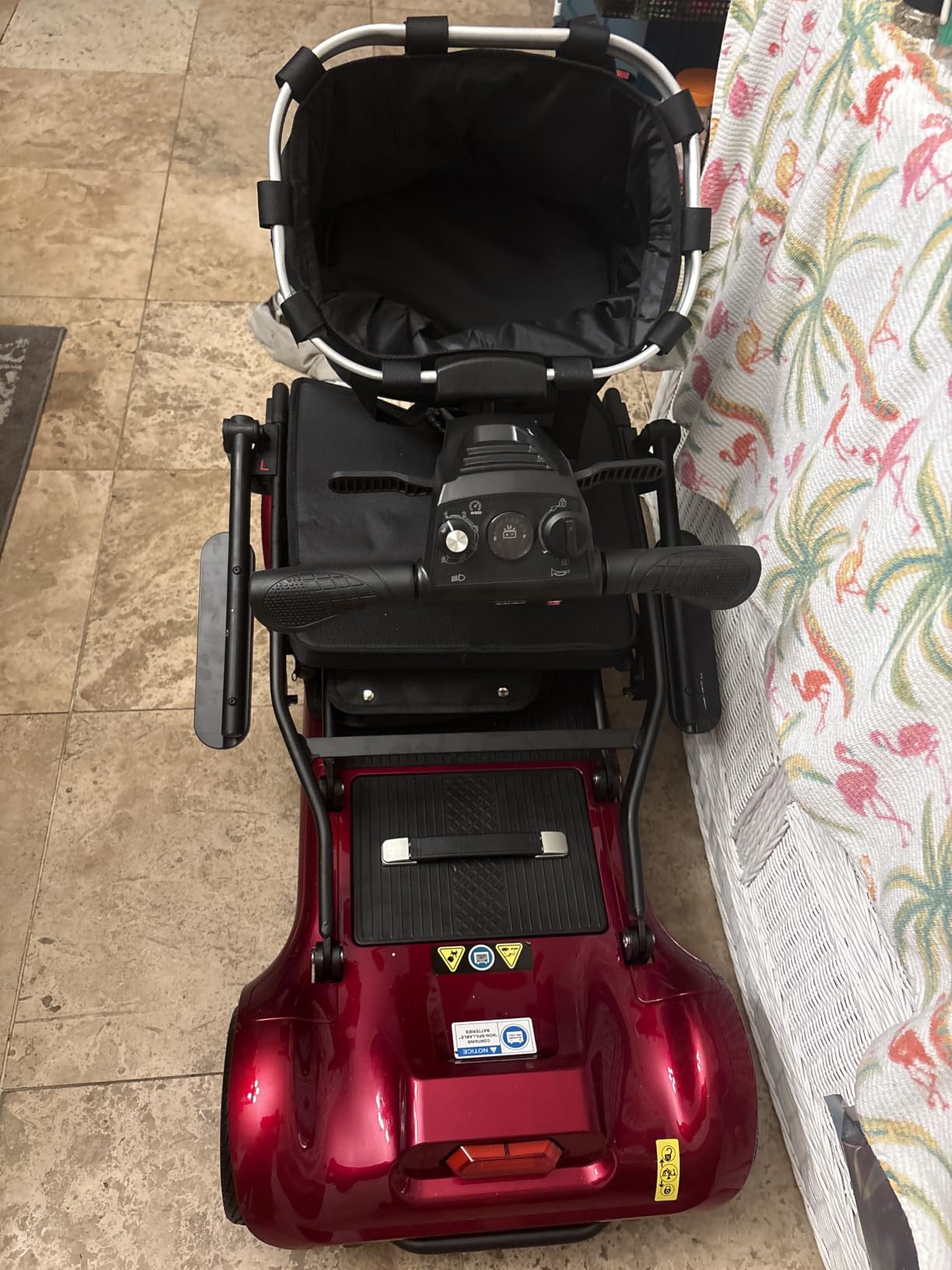
There is a straight tradeoff here, and it is weight. The aluminum alloy frame is 43 pounds without the battery, which puts it between the ultralight three-wheelers and the full-size four-wheelers. That is fine if you travel with someone who can help, and awkward if you do not.
Range is listed at up to 12.4 miles on a three hour charge from a 270W brushless motor that handles slopes up to 12 degrees and speeds from 0 to 6.2 mph. The 8 inch flat-free tires and the electromagnetic brake with a 0.5 second response time are both more reassuring on a ramp than a small-tire three-wheeler.
Where it holds up in a terminal
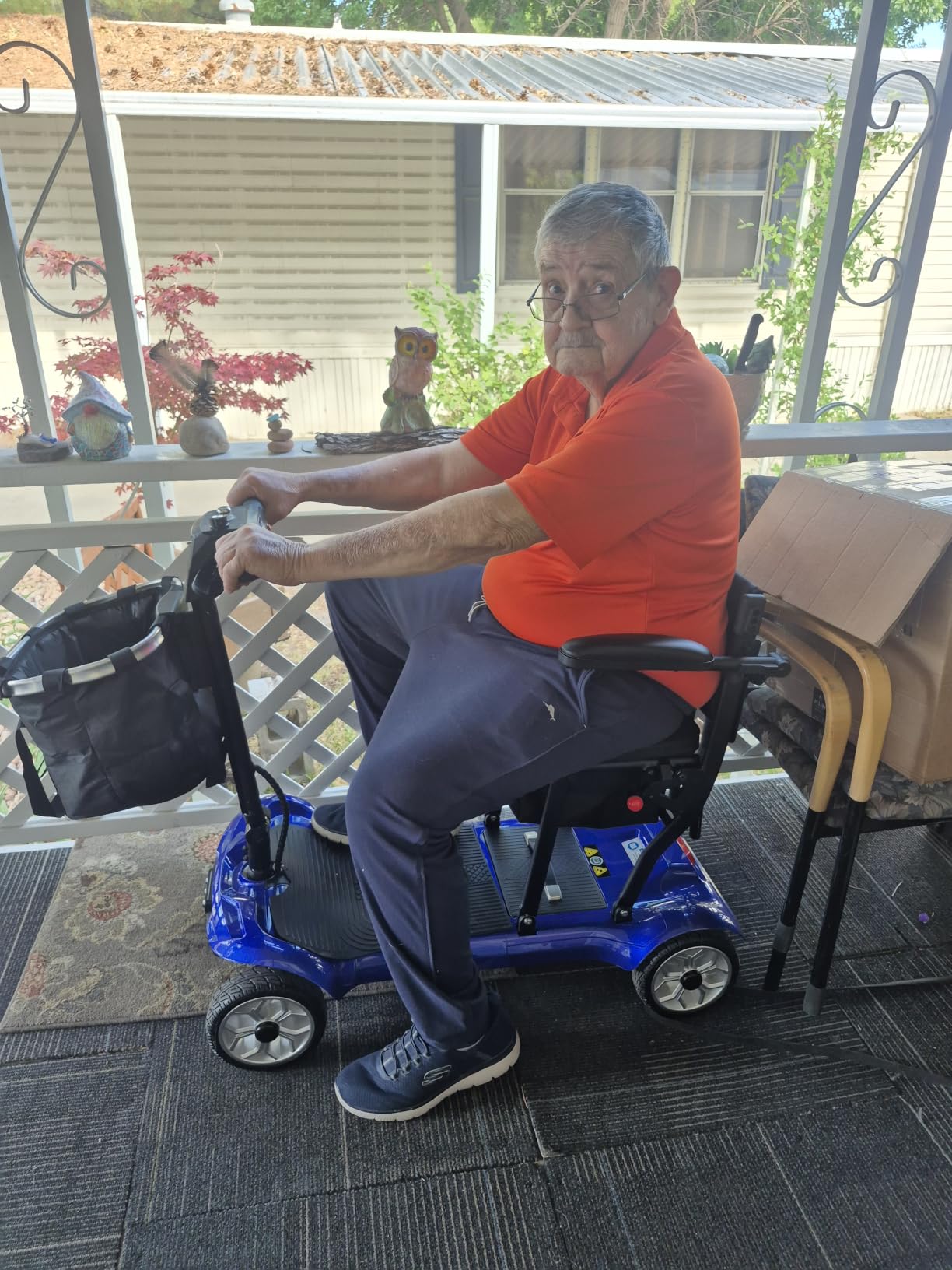
The 300 pound rating plus 12 degree slope capability is a genuinely useful pair of numbers. Airport ramps, parking garage ramps and ship gangways are where lighter three-wheelers start to feel nervous, and this one has the motor and the base width to handle them without drama.
The reinforced four-point seat base and flip-up armrests also make transfers more forgiving, and the extra battery slot means you can carry a spare if the carrier will let you.
Where it falls short
One battery is included. A spare is sold separately, and on a multi-leg trip with long ground transfers you will probably want one, so factor that into your plan before the first flight rather than at the airport.
The 87-review history is shorter than the established models on this list, and it is a recent listing. Longer owner reports simply do not exist yet, which is normal for anything new in this category and worth factoring into how confident you feel about a long-term purchase.
4. Rascal Venture 3-Wheel Is the Best Warranty and Medical-Grade Backing
Rascal Venture 3-Wheel Portable Mobility Scooter for Travel, Easy Disassembly, Compact Design, 300 lb Capacity, Battery Included
300 lb capacity
10 mile range
Heaviest piece 29.5 lb
3 year frame warranty
Pros
- Only FDA Class II medical device listed here
- strongest warranty in the group at 3 year frame and 2 year drivetrain
- 300 lb capacity
- up to 10 miles per charge
- adjustable seat height and tiller
- swivel seat for transfers
Cons
- 96.5 lb total weight needs a full five-piece breakdown
- 33 inch turn radius is wide
- 4 mph top speed is slow
- three-wheel chassis still needs care on ramps
This is the only scooter in the roundup with an FDA Class II medical device classification, and it is the only one backed by a warranty of real length: three years on the structural frame, two years on the drivetrain and electrical, and six months on the battery, handled through an authorized Mega Motion provider. For a machine you intend to gate-check repeatedly, that coverage is the argument for buying it.
It reaches 10 miles per charge at up to 4 mph, and it disassembles into five lightweight pieces with the heaviest at 29.5 pounds. That heaviest-piece figure is the important number, and it is far more manageable than the 96.5 pound total suggests. The catch is that you still have to complete the full five-piece disassembly before it will fit a trunk.
At 4.7 across 111 reviews, with 84 percent at five stars, the sentiment centers on durability and adjustability. The seat height, armrest position and steering tiller all adjust, and the swivel seat makes transfers straightforward, which is the kind of thing a lighter travel scooter usually drops first.

Rascal also has a brake system worth noting: both regenerative and electromechanical brakes, rather than the single drum or handlebar arrangement on the budget models. On a descent at an airport or a museum with a step-free path down a hill, that is a real difference in how the scooter feels under you.
Range, once again, deserves a reality check. Ten miles is a claimed figure under ideal conditions, and most travel-class scooters land below their headline number once a heavier rider, hills and a cold battery are in the mix. Plan charging rather than assuming a full day.
Why the warranty matters more than the weight here
Gate-checking is a hard use. Cargo handling involves drops, conveyor belts, stacking and a climate-controlled hold. A scooter that holds a three-year frame warranty is telling you the manufacturer expects it to survive that, and an authorized provider network means a repair does not mean a replacement.
For a rider whose mobility depends on the device rather than preferring it, that is a meaningfully different risk profile from an unbranded import with no service path at the destination.
Where it is the wrong choice
If you travel alone and handle your own scooter, the five-piece breakdown is a genuine obstacle. Nothing here lifts as one unit, and the 33 inch turn radius is wider than the ultralight three-wheelers, which makes tight ship corridors and crowded museum spaces less comfortable.
The 4 mph top speed is also the slowest of the travel-class models here, and the 8 inch mag wheels mean a hard ride on anything other than smooth pavement. It is a comfort-and-support machine that flies, not a nimble one.
5. PAISEEC S3 Is the Best Scooter for Long Trips Between Charging Points
PAISEEC S3 Mobility Scooter for Seniors, 25/40 Mi, 2-Step Fold, Lightweight
Up to 40 miles on dual batteries
300 lb capacity
61 lb folded weight
Two-step fold
Pros
- Dual detachable lithium batteries with all-day real-world endurance
- patented two-step tool-free fold
- 10 inch rear and 9 inch front air-filled tires for real ride comfort
- documented long-haul travel history
- support described as fast
Cons
- 61 lb heaviest part is hard to lift solo
- seat has no adjustability and does not swivel
- short footrest and cramped seat for taller riders
- wide four-wheel turning radius
Range is the entire pitch here, and it is backed by detail rather than adjectives. Two detachable lithium batteries give up to 40 miles total in the dual-battery configuration, with a 25-mile base setup and an additional airline-approved battery pack rated at up to 15 miles per charge once installed. One reviewer reports covering full days at two large theme parks on a single charge, and another flew this scooter to Italy and brought it back through several plane and bus trips intact.
The fold is genuinely clever. A patented two-step mechanism collapses it to 39 by 22 by 17 inches with no tools, and the front wheels roll when it is folded, so you can position it rather than drag it. That detail matters more at a gate than it sounds.
It is also the only model here on air-filled tires at this size, with 10 inch rear and 9 inch front. That is the single biggest ride-quality difference in the roundup, and it is the reason the comfort complaints are about ergonomics rather than bruising.
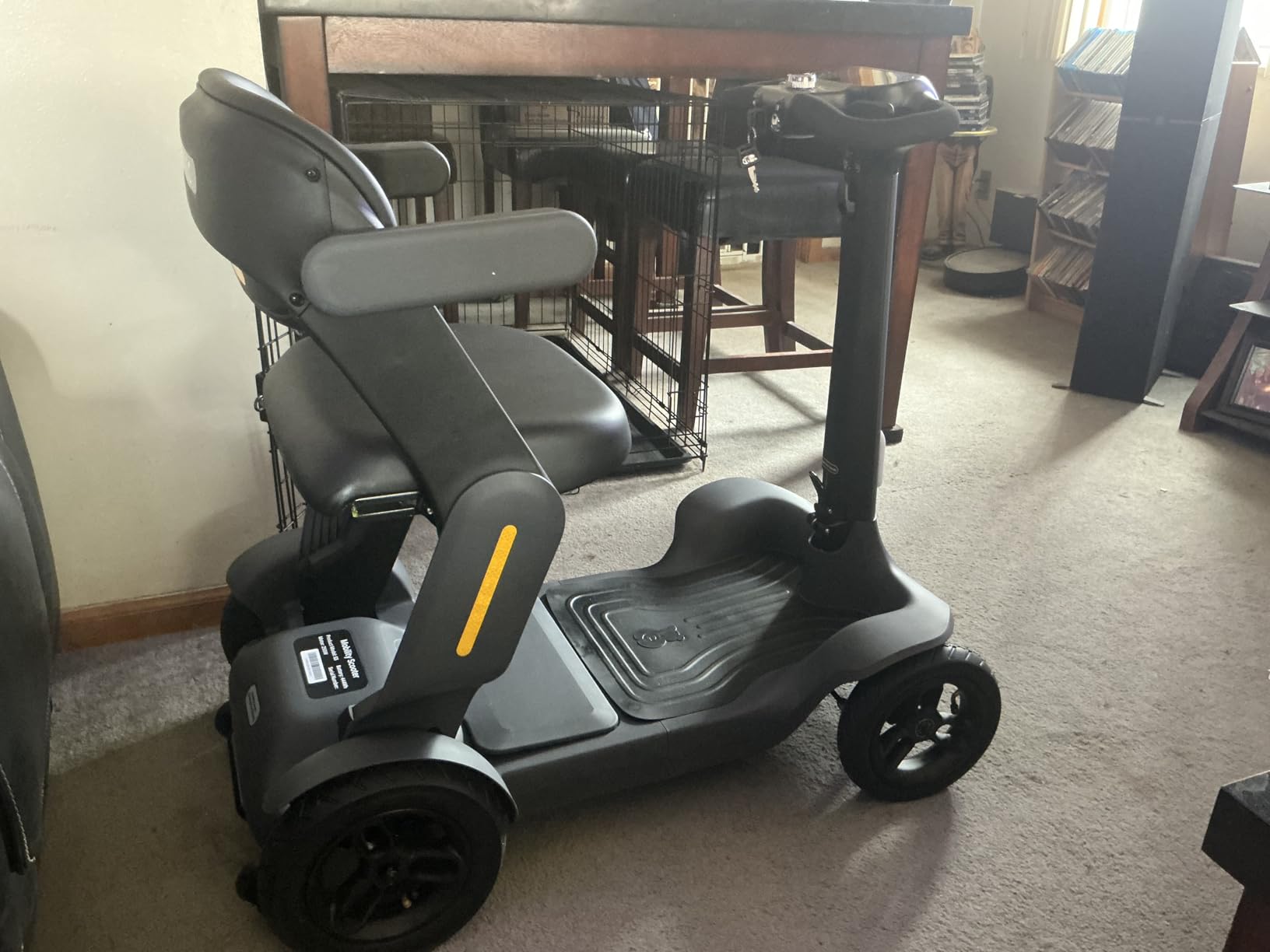
Weight is the price. At 61 pounds for the folded unit and 70 pounds total, this is one of the harder models here for one person to load into a vehicle. If you travel with assistance, that is an acceptable tradeoff for genuine all-day range. If you do not, think hard about it.
The 4.4 average across 96 reviews is driven by ergonomics rather than electronics. Support is repeatedly described as fast and helpful, and the electronics and battery system are rarely criticized. The complaints are about the chair: multiple reviews flag that the seat does not adjust and does not swivel, which is a real problem for anyone with restricted knee or back mobility, and the footrest is too short for shorter riders.

Where it earns its keep
Long days without charging access. A destination where the nearest outlet is back at the hotel, a convention with a sprawling campus, a national park with no services and no spare battery in the second pack. This is the scooter for trips where the alternative is planning the itinerary around a 20 percent battery reserve.
The air-filled tires and 12 degree-plus usable ground clearance also make it the most forgiving of rough surfaces among the mid-weight models, which matters at theme parks, boardwalks and older European streets.
Where it will let you down
Seat ergonomics, plainly. A non-swiveling, non-adjustable seat with a short footrest and controls close to the handlebar is a poor match for anyone with knee, hip or back limitations, and for taller riders. If transfers matter to you, this is the wrong scooter even with the range.
Also note the four-wheel turning radius, which requires wide swings or three-point turns, and that a seat-back latch is easy to miss when raising the seat. Read the fold instructions before you need them at a gate.
6. FreeWink Carbon Fiber Is the Best Ultralight Frame for Air Travel
Mobility Scooters for Adults & Seniors – Ultra Lightweight 27.5 lbs Carbon Fiber Folding Electric Scooter – Airlines Approved All-Terrain Portable Scooter with Basket and Charger Included-Purple
27.5 lb carbon fiber frame
18 inch width
Auto-fold
UL 2272 tested braking
Pros
- Carbon fiber construction at only 27.5 lbs
- auto-folding design that fits trunks and airplane luggage compartments
- UL 2272 safety tested electromagnetic braking that engages on handle release
- front and rear anti-collision guards with anti-tip rear wheels
- 18 inch width clears standard doorways
- basket and charger included
Cons
- All-terrain tire claim not borne out on grass
- folding tiller can spring up if not secured
- carbon frame feels flimsy to some
- battery hard to remove until packaging film is worked loose
Carbon fiber is the reason this one exists. A 27.5 pound complete frame puts it in the lightest tier alongside the 26 pound aluminum model above, and it reaches that with a rigid material rather than by thinning the components. If lifting effort is your binding constraint, that is the number to shop around.
The folding is automatic and takes under two minutes once the battery is out. At 18 inches wide, it passes through standard doorways and aircraft gates, and the narrow, responsive steering works in both interiors and outside, which is a good combination in an airport where you are moving between a curb, a terminal, a jet bridge and a shuttle.
At 4.6 across 55 reviews, with roughly 85 percent at five stars, the reviews are enthusiastic and notably specific. One buyer with a single viable foot used it on European streets with carry-on luggage stored under the seat. Another explicitly confirmed the battery size and rating against two named airlines before buying, which is exactly the diligence this category rewards.
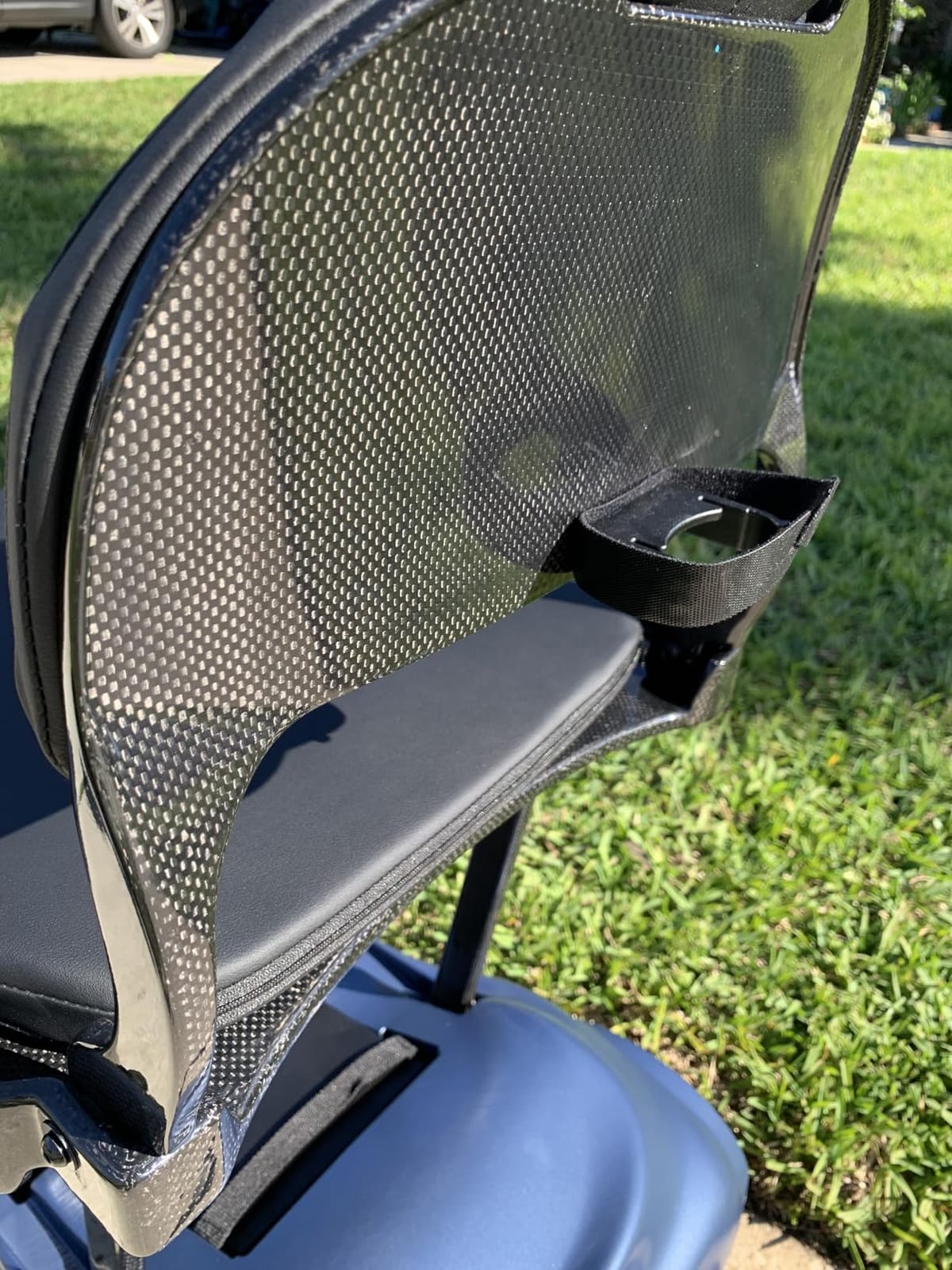
Safety hardware is worth a mention. The electromagnetic brake is UL 2272 safety tested and stops the scooter when you release the handle, and there are front and rear anti-collision guards plus anti-tip rear wheels. On a scooter light enough to carry one-handed, automatic braking is a meaningful safeguard.
The 55-review base is the smallest in the roundup, which means long-term durability data simply does not exist yet. Treat that as a normal consideration for a recent listing rather than a warning sign, but factor it into how much of your mobility plan depends on one unit.

What the ultralight frame changes
Weight changes your options in three specific ways. It decides whether a companion can load it, whether you can carry it up a ship gangway or a hotel stair, and whether the folded package clears an aircraft cargo door. At 27.5 pounds, this clears the threshold where all three usually become problems.
It also reduces fatigue during the unglamorous parts of travel, which is the majority of it. Terminals are long, gates are far, and a scooter you can manage yourself is a different travel day from one you need help with.
Two cautions before you order
The all-terrain claim does not hold on grass. A reviewer tested it and reported it could not handle grass as advertised, so treat the tire description as marketing rather than a specification and plan on paved surfaces and paths.
More seriously, the folding tiller is poorly secured in the lower position and can spring upward into the rider’s face; one user reported an eye injury. Check that the latch is engaged every time before you sit, and take it to the manufacturer if the catch feels loose. A separate complaint is that the carbon frame feels flimsy to some riders who expected rigidity at 27.5 pounds.
7. Ecomobi M3 Is the Best Choice When You Need Range Options
Light Weight Mobility Scooter for Adults, 3 Wheel Mobility Scooter
30 lb frame
8 inch wheels
One-lift tool-free fold
15 to 32 mile options
Pros
- One-piece
- one-lift tool-free folding with no disassembly
- 30 lb frame with 8 inch wheels for a smoother ride than small-tire rivals
- folds narrow enough for closets and trunks
- range options of 15
- 24 and 32 miles
- under-seat storage basket
- customer support repeatedly praised
Cons
- Real-world range fell well short of the advertised figure for some buyers
- carrying two batteries aboard may conflict with some airline rules
- some plastic body panels cracked early
- basket must be screwed on and off each time
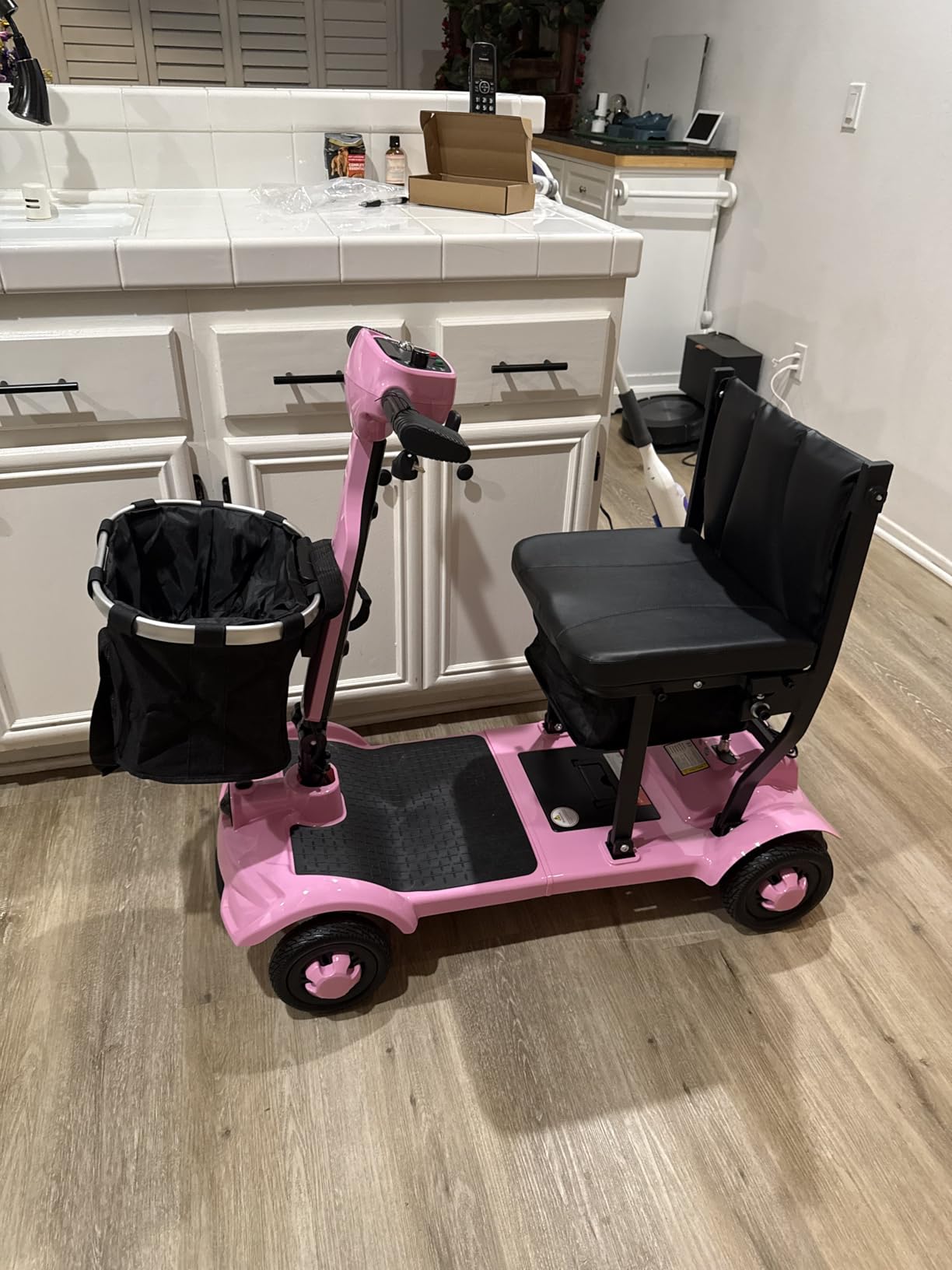
One lever, one lift, and it folds. There is no disassembly and no sequence to memorize, which means you can go from riding to stowed in seconds at a gate without help. At 30 pounds and folding to 11.8 by 19.7 by 33.8 inches, it is also one of the smallest folded packages in the roundup, narrow enough for a closet or a small trunk.
The 8 inch wheels are the quiet advantage. Most of the ultralight three-wheelers run small hard tires with no suspension, and users report feeling every expansion joint. The M3 rides noticeably smoother and more stably, and one owner took it over a 10 degree dock ramp at 250 pounds without trouble.
The range configuration is the practical reason to pick it. Variants give you 15, 24 or 32 miles, and the listed version includes two 8Ah batteries, so you can choose the battery load that matches your itinerary rather than accepting a fixed configuration.
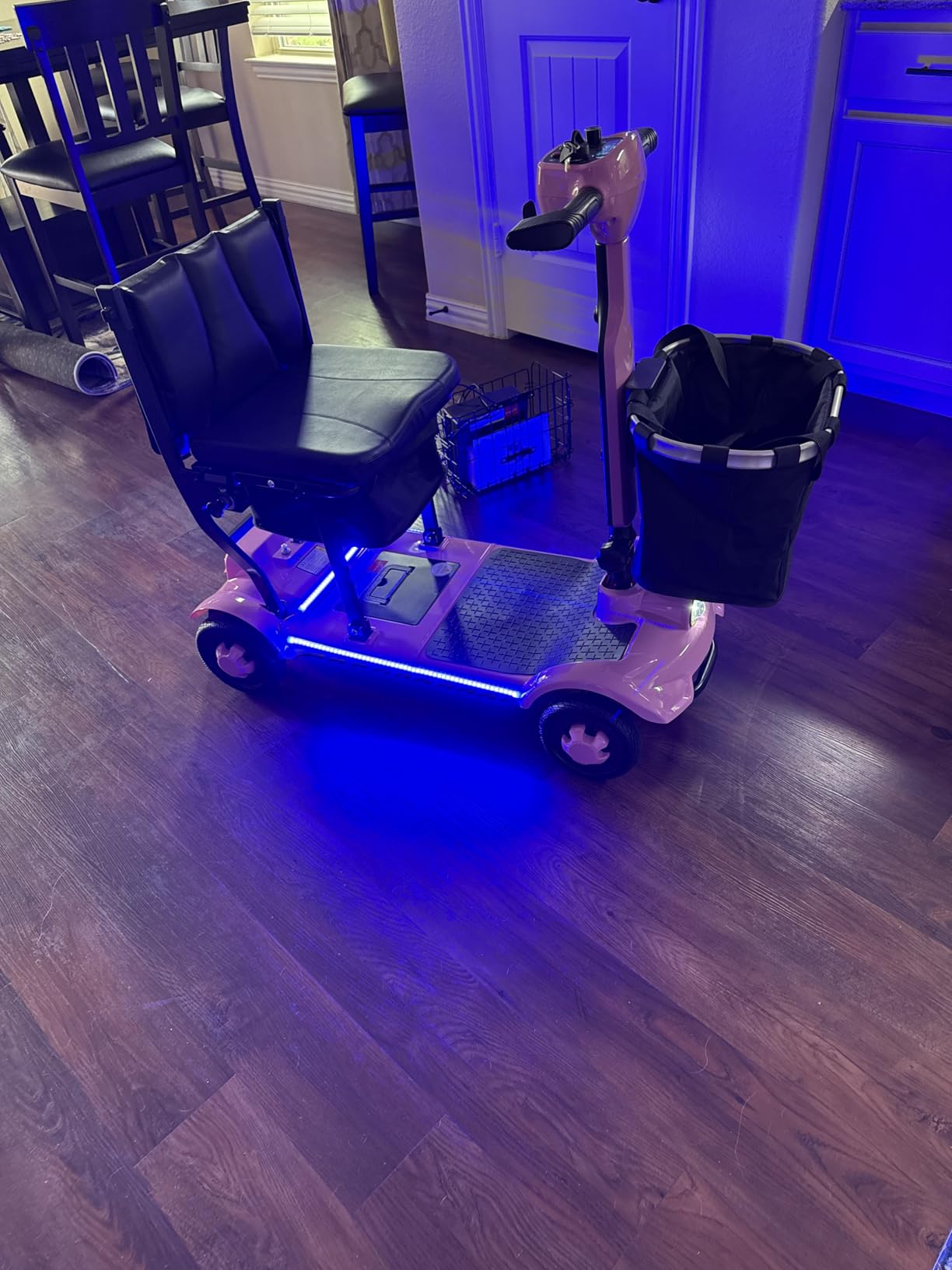
At 4.7 across 58 reviews, with about 80 percent at five stars and a number five sales rank, the feedback is strong on the fold and the ride. Support is described as excellent and easy to reach, and the simple mechanical design with no complex folding mechanism is appreciated by people who did not want to learn a folding procedure.
Build quality is the main reservation. Some buyers report plastic body panels cracking soon after purchase, and reviewers note the chassis feels heavier in practice than the listed 30 pounds, to the point where a ramp is needed to load it. If you are buying this for air travel, a ramp does not help at a gate.
Why the fold speed matters at the gate
Airlines tag and stow mobility devices at the aircraft door. The shorter the time between you deciding to stop riding and the scooter being tagged, the less of a problem you create. A one-lever fold is a meaningful practical advantage over designs that require removing the seat, collapsing a post or unscrewing a bracket.
The narrow folded width also means it stores in a hotel closet, a rental car boot or a ship cabin without displacing everything else, which matters on a two-week trip more than on a single flight.
What to check with your airline first
The two-battery configuration is the item to raise on the call. Buyers report that airline rules may restrict carrying two batteries aboard, and it varies by carrier. If the second battery is the difference between a full day of independence and a half day, confirm the policy before you buy, not at the counter.
Also plan on real-world range being lower than the headline figure; at least one buyer on the 32 mile variant reported a large shortfall. And expect to attach and detach the metal basket every time you use it, which is a small daily irritation that becomes obvious on day four of a trip.
8. Aotedor Lightweight Is the Best Four-Wheel Fold for Travelers
Aotedor Lightweight Mobility Scooter for Seniors, 36 lbs, 22-Mile Range
36 lb magnesium frame
22 mile range
Four-wheel chassis
Tool-free rolling fold
Pros
- Folds without removing the seat and rolls on one hand like luggage
- two removable 10Ah lithium batteries with an onboard spare bay
- armrest width adjusts independently from 15 to 24 inches
- four-wheel chassis is more stable than the three-wheelers
- 202 reviews at 4.6
Cons
- 36 lb before batteries is heavier than the 26 to 30 lb models
- solid anti-slip tires limit ride comfort
- 3.7 mph top speed is the slowest listed
- airline and cruise battery carrying rules still need advance confirmation
This is the model that answers a specific complaint we heard repeatedly about four-wheel travel scooters. It folds and unfolds without removing the seat or using tools, and then rolls like luggage on a one-hand pull. For a four-wheeler, that is the feature that turns an unwieldy machine into something you can actually move through an airport alone.
The battery arrangement is the other thing that stands out. Two independent removable 10Ah lithium batteries give up to 22 miles total, and there is a dedicated onboard compartment for the spare, so the second battery travels with the scooter rather than needing its own bag. That is a deliberate design choice aimed squarely at air and cruise travel.
At 4.6 across 202 reviews, with 79 percent at five stars, this has one of the larger review bases among the folding models here. Owners favor the no-disassembly fold, the onboard spare bay, and the armrests, which adjust independently from 15 to 24 inches so a caregiver can fit the rider without tools.

The stability story is real. A four-wheel chassis is a wider, more forgiving base than the three-wheelers on this list, and riders with balance concerns or a fear of tipping generally find it calmer at low speed on ramps and slopes. The electromagnetic brake engages on lever release, which is reassuring on a descent.
The magnesium alloy main frame is listed at 36 pounds without batteries or detachable accessories, and the seat is 14.5 inches wide with an adjustable tiller height. That is a comfortable, adjustable package for a travel scooter, which is more than several others in this roundup manage.

Why the rolling fold is a real advantage
It changes who can travel alone. A four-wheel scooter that must be partially disassembled at every terminal effectively requires a helper. One that folds in place and rolls on one castor-style pull can be managed by one person, with help when it is available and dignity when it is not.
It also shortens the gate interaction. Fewer pieces to remove means less to hand over, less to explain, and fewer chances for a handler to mis-assemble something on arrival.
Where the tradeoffs sit
Solid anti-slip tires instead of air-filled ones means less absorption on uneven paving, and the 3.7 mph top speed is the slowest in this roundup. Neither matters much inside a terminal, and both matter on a rough approach road or a long campus walkway.
At 36 pounds before batteries, it is heavier than the 26 to 30 pound ultralight options, so solo loaders should factor that in. And the same airline battery-carrying rules apply to everyone: confirm them with the accessibility desk before you book.
9. Rylox YL-07 Is the Best 330 Pound Scooter for Local and Vehicle Use
Foldable 4-Wheel Mobility Scooter for Adults – Portable Motorized Scooter with 330 lbs Capacity, Detachable Battery, Dual Baskets, Cup & Phone Holder, Blue
330 lb capacity
15 mile range
89 lb total weight
Breaks into 4 pieces
Pros
- 330 lb weight capacity
- 8 inch puncture-proof tires with anti-tip structure
- detachable battery with off-board charging for up to 15 miles
- 360 degree swivel seat with adjustable height and flip-up armrests
- dual removable baskets plus cup and phone holder
Cons
- 89 lb total with a 50 lb heaviest piece is far outside air travel limits
- wide four-wheel turning radius
- seat and steering column can feel wobbly
- folding requires removing the seat post bolt
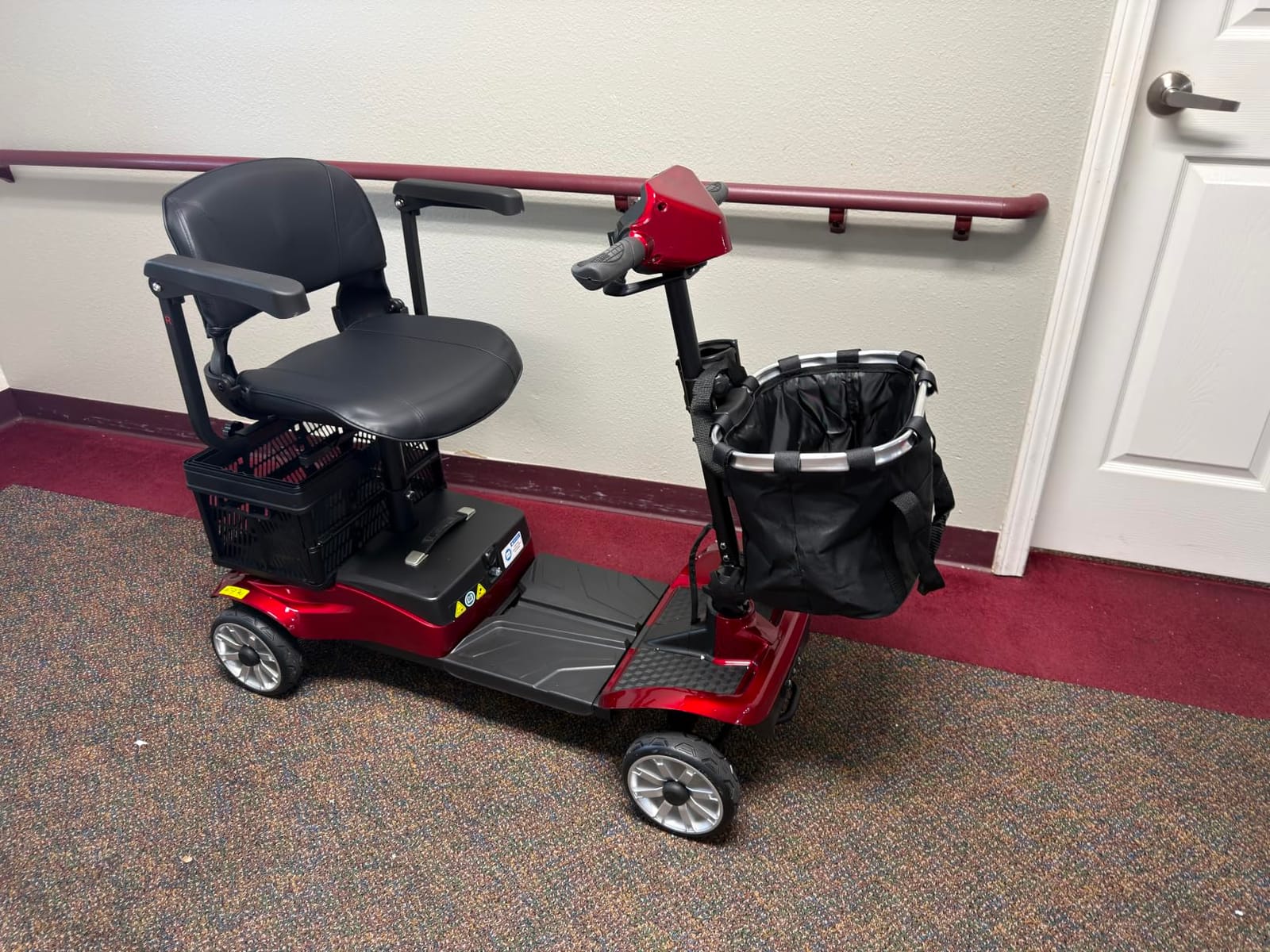
Let us be direct about this one, because the name suggests it is a travel scooter and it is not. At 89 pounds total with a 50 pound heaviest component, this is a local-use and vehicle-transport machine. It will not pass an airline weight check for a mobility device, and if you buy it hoping to fly with it you will be disappointed.
What it does exceptionally well is everything at ground level. The 330 pound capacity is the highest figure in the roundup, and reviewers at 275 pounds report it carrying them without complaint. The four-wheel chassis is stable enough that at least one buyer upgraded specifically because his previous three-wheeler kept tipping, and he reports this one does not.
Storage is the quiet standout. Dual removable baskets plus an integrated cup and phone holder give it more carrying capacity than any other pick here, and there is 8 inches more legroom than competing models, which matters for longer riders. The detachable battery charges off-board for up to 15 miles on a six hour charge.
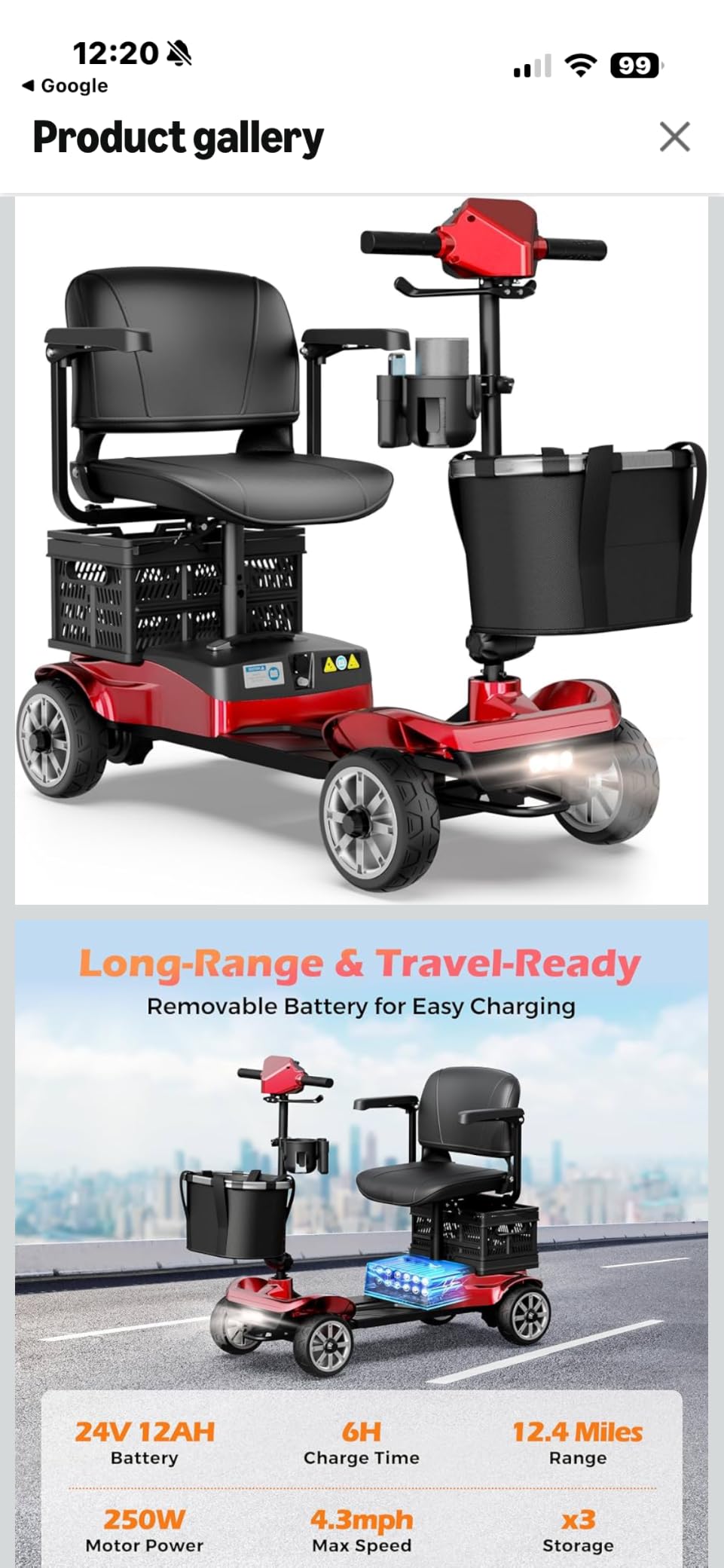
With 267 reviews at 4.4, this is a well-documented product rather than a new listing. The pattern in the feedback is straightforward: strong on capacity, storage and stability, with the honest caveat that the weight puts it outside cabin-eligible air travel.
It also holds the number one best-seller position in powered mobility scooters on Amazon, which tells you something about how many people are using it for the purpose it is actually good at: getting around a home, a yard, a campus or a large property.
When this is the right scooter
If your mobility needs are local and your air travel is handled by a wheelchair or a rental device, this is a strong buy. Higher riders, heavier riders and anyone who spends time on uneven ground will appreciate the 8 inch puncture-proof tires, the 15 degree incline capability and the stable base.
It is also a reasonable second vehicle. It breaks into four pieces, folds to 40 by 19 by 14 inches, and the reinforced bumper and LED headlight make it usable outdoors and at dusk.
Why it does not work for flying
A 50 pound heaviest component is the deal-breaker, not the total. Handlers have size and weight ceilings for gate-checked mobility devices, and a component that heavy both risks refusal and creates the lift problem that a scooter purchase is meant to solve.
Even setting weight aside, the four-wheel layout has a wide, non-tight turning radius that requires backing up to complete tight turns, the seat and steering column can feel wobbly at higher speed settings, and the handle tilts without raising. If your goal is a plane ticket, choose one of the models under 65 pounds above.
10. Serianie 4-Wheel Is the Best FSA and HSA Eligible Option
Foldable Mobility Scooters for Seniors, FSA&HSA Eligible, 330LBS Capacity 4 Wheel Lightweight Mobility Scooters for Adults, Powered Electric Mobility Scooters, Folding Travel Motorized Scooters-Pink
FSA and HSA eligible
330 lb capacity
15.5 mile range
84.22 lb weight
Pros
- Only FSA and HSA eligible scooter listed
- which can reduce the effective cost for eligible buyers
- 10 km/h maximum speed
- 15 degree incline capability
- dedicated security key activation prevents unauthorized startup
- contoured seat with 360 degree swivel and adjustable armrests
- reflective rear lighting
Cons
- 84.22 lb weight is far outside airline limits
- wide four-wheel turning radius
- only one battery configuration with a less clearly documented charging arrangement
- new 2026 listing with a short review history
Health savings arrangement eligibility is the distinguishing feature here. It is the only model in the roundup listed as FSA and HSA eligible, and for a buyer who can use those accounts, that changes the real cost of the purchase more than any spec on the page. Check your plan documents before assuming, because eligibility rules vary by account type and by retailer.
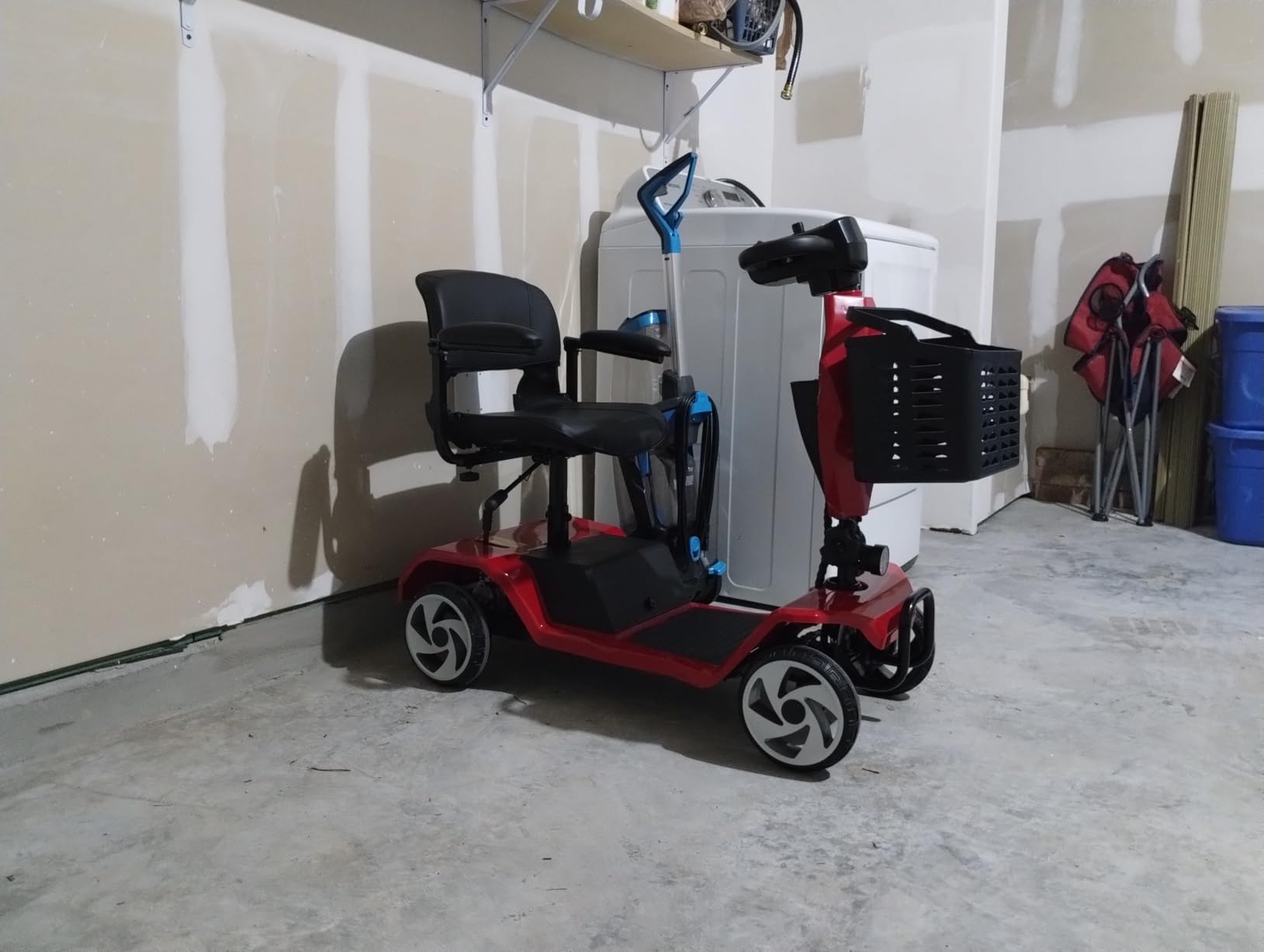
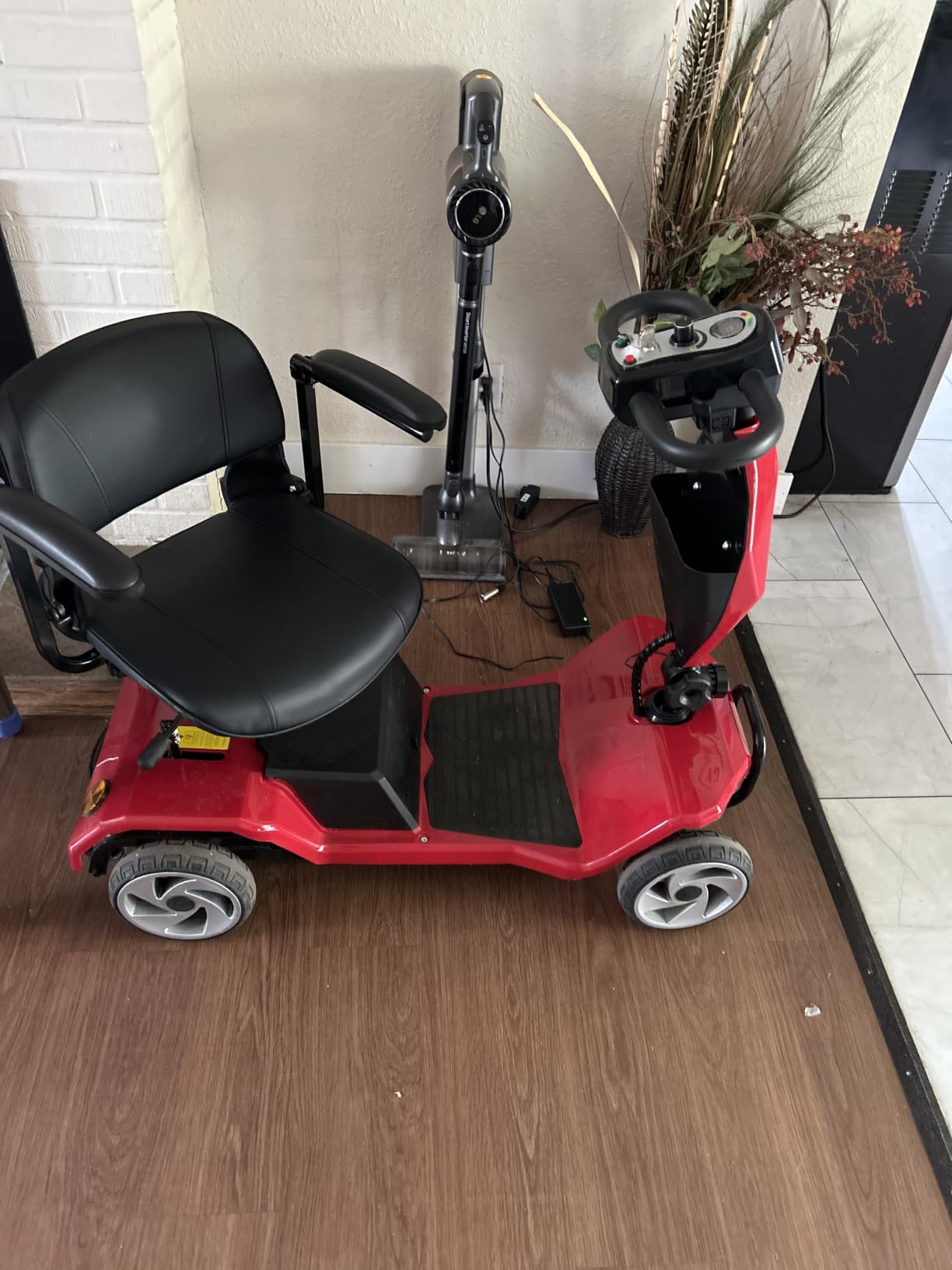
The feature set is the standard travel-scooter package with a few additions. A reinforced frame rated to 330 pounds, 300W motors, 15 degree incline capability, a 15.5 mile range, a contoured seat with 360 degree swivel and adjustable armrests, and a control panel with forward and reverse switches, a speed dial, a battery indicator and LED and horn controls.
Two details stand out for daily use. The dedicated security key activation prevents unauthorized startup, which several other picks on this list lack entirely, and the reflective rear lighting system improves visibility outdoors in the evening.
At 4.3 across 188 reviews with about 72 percent at five stars, sentiment is positive and unremarkable in the best way. The complaints are the standard ones for this class rather than failures of any particular feature, and the support picture is neutral.
Its 10 km/h maximum speed matches the fastest figure stated by any model here, which some riders appreciate for keeping pace on a long walkway. Others find it twitchy, and combined with the instant acceleration on this class of scooter it is worth testing before committing.
When account eligibility changes the math
For anyone who can use pre-tax health spending accounts, this is worth working through carefully. The eligibility designation lowers the out-of-pocket figure in a way that can outweigh a hundred dollars of feature differences, and no other model on this list carries it.
It also pairs well with a plan. If you fly occasionally but use a scooter daily at home, a heavier 330 pound model with a security key and a swivel seat is a better daily machine than a 30 pound travel folder, and the two uses do not have to be the same device.
Why it is not an air travel pick
At 84.22 pounds, this is one of the heaviest models here and firmly outside practical airline limits for gate-checked mobility devices. As with the Rylox, treat it as a local and vehicle-transport option.
The other limitations are ordinary: a four-wheel layout means a wide turning radius compared with three-wheel travel scooters, and only one battery configuration is offered with a detachable charging arrangement that is less clearly documented than on the models above. As a newer 2026 listing, its review history is shorter than the established names in this category.
Buying Guide: 8 Criteria That Decide Travel Suitability
Weighing in priority order is what saves money here, because these criteria disqualify models faster than they select them.
1. Total weight and heaviest single component
Ask for both numbers, because they are rarely the same. The heaviest piece is what a handler lifts and what a companion lifts. Above roughly 50 pounds, plan on assistance at every terminal. Below 35 pounds, you can usually manage alone.
2. Rider weight capacity, measured against your own weight
Travel-class scooters cluster at 275 pounds, with 300 and 330 pound models above them. This is the number that quietly ends most searches, and it costs nothing to check first. Our heavy-duty mobility scooter guide covers the higher end.
3. Battery type, watt-hours and removability
Lithium-ion keeps weight down and simplifies handling. A pack at or under 100 Wh is the easiest category to fly; up to 160 Wh is broadly accepted; up to 300 Wh is where carrier policies get specific. Removability without tools is what lets you hand the battery to a gate agent or carry it for screening.
4. Folded dimensions
Measure the folded width against your narrowest constraint, which is usually a doorframe, a ship cabin or a small trunk rather than the aircraft itself. The FreeWink at 18 inches wide and the Ecomobi folding to under 12 inches wide are the two that clear the most awkward openings.
5. Real-world range, not claimed range
Manufacturer figures assume a test rider, level ground and a warm battery. For planning, take roughly two-thirds of the claimed number as your usable range, and treat anything above 25 miles as a day-long figure rather than a trip-long one. Riders on Reddit and in reviews consistently report real distances below the headline numbers.
6. Ride comfort over the surfaces you will actually meet
Airports are smooth until they are not. Expansion joints, cobbles, older European paving and ship gangways are where small hard tires transmit every impact. Air-filled tires, larger wheels and four-wheel bases are all more comfortable, and all three cost you weight. Decide which compromise suits your itinerary.
7. Seat adjustability, armrests and swivel
Travel scooters save weight by dropping these first. If you transfer from a wheelchair, have restricted knee or back motion, or travel with a caregiver, armrests and a swivel seat are not optional extras. They are access equipment, and several models in this roundup lack all three.
8. Support, warranty and whether a repair is realistic at your destination
The Rascal Venture is the only one in the roundup listing multi-year warranty coverage. For everyone else, assume you may need a rental at your destination if something fails, and check whether your travel insurance or health plan covers a replacement device. If you are flying with a mobility aid you depend on, that fallback is not a detail.
One more practical point: renting at the destination instead of flying your own scooter is a legitimate strategy, and the only competitor ranking on this search argues it openly. On Reddit r/wheelchairs, travelers flying powerchairs often conclude that renting at the arrival airport is safer than risking their own device through multiple handling points. For a two-leg trip to a city with a good rental agency, that may be the right call. For a week in a rural area, bring yours.
Frequently Asked Questions
What type of mobility scooter can I take on a plane?
A lightweight folding three- or four-wheel scooter with a removable lithium-ion battery is what flies. It should fold to roughly sedan-trunk size, keep the battery under the carrier’s watt-hour ceiling, and break down so the heaviest piece is manageable. A scooter that exceeds the airline’s weight or size limits will be refused at the counter, which is why weight is the first thing to check.
Are you allowed to take a mobility scooter on an airplane?
Yes. Airlines carry mobility scooters as gate-checked medical devices at no charge, and you travel as a passenger rather than as baggage. Call the airline’s accessibility or medical-equipment desk at least 48 hours before departure, arrive early, and expect to collect the scooter at the jet bridge or baggage claim on arrival.
What makes a mobility scooter airline approved?
Airline approval depends on three things: a removable battery within the carrier’s watt-hour limit, a folded unit that meets the airline’s size and weight ceilings, and a model the airline’s staff are willing to tag. No government agency approves an individual scooter, so treat the phrase on a product page as a manufacturer’s claim rather than a certification.
What electric scooter can I take on a plane?
A mobility scooter and a stand-up electric scooter are treated completely differently. A mobility scooter is a seated medical device with a tiller and flies as a mobility aid. A stand-up e-scooter is rideable equipment with a deck and handlebars, and airlines treat it as ordinary baggage, with limits that frequently mean it cannot travel on a passenger aircraft at all.
Which mobility scooter is best for taking on a plane?
Among the ten models we compared, the SuperHandy Passport is the strongest all-round choice at 35 pounds assembled with two removable lithium batteries and a 13 mile claimed range. The Great Circle G is the lightest at a 26 pound frame, and the Aotedor is the best four-wheel fold for riders who want more stability without losing a tool-free fold.
What is the lightest travel mobility scooter?
The lowest frame weight we found is 26 pounds on the Great Circle G aluminum frame, and the lightest complete body is 27.5 pounds on the FreeWink carbon fiber scooter. Both fold small and carry removable lithium batteries. Below 30 pounds, most travelers can load and unload a scooter without assistance.
Does TSA check for lithium batteries in checked luggage?
Yes, and mobility devices get specific handling. On a mobility scooter, the battery is usually removed and carried with you or handed over for screening rather than traveling inside the tagged device. Forum travelers report that the added screening takes roughly five to fifteen minutes, and that agents are often unfamiliar with mobility-device rules, so removing and labeling the battery yourself speeds things up.
If you also plan to travel with a portable oxygen concentrator, our guide to portable oxygen concentrators for travel covers a different set of airline rules that are easy to confuse with scooter battery rules. For travelers who want outdoor power rather than flight-ready folding, our mobility trikes roundup is the better read.
Conclusion: The Best Portable Mobility Scooters for Air Travel in 2026
The SuperHandy Passport is our pick for the best portable mobility scooters for airplane travel because it combines the largest review base in the category with the most complete documentation of real gate-checks. At 35 pounds assembled, with two 2.5 pound removable lithium batteries and a 1.5 hour recharge, it is light enough to manage alone and flexible enough for a long day away from an outlet. Its small hard tires and tippy three-wheel base are real limitations, and on rough ground you will feel them.
If you need less weight, the Great Circle G at a 26 pound frame is the value answer, at the cost of range and armrests. If you are at or near 300 pounds, the Sugogo YL-985 is the model to look at. If you ride a scooter every day and fly only occasionally, the Aotedor’s tool-free rolling fold and adjustable armrests make it the better year-round machine.
Whatever you choose, call the airline’s accessibility desk at least 48 hours ahead, confirm the battery watt-hours against their policy, and photograph the scooter before you hand it over. Those three steps prevent nearly every problem travelers report in this category — and in 2026, that preparation matters more than any specification on a product page.