
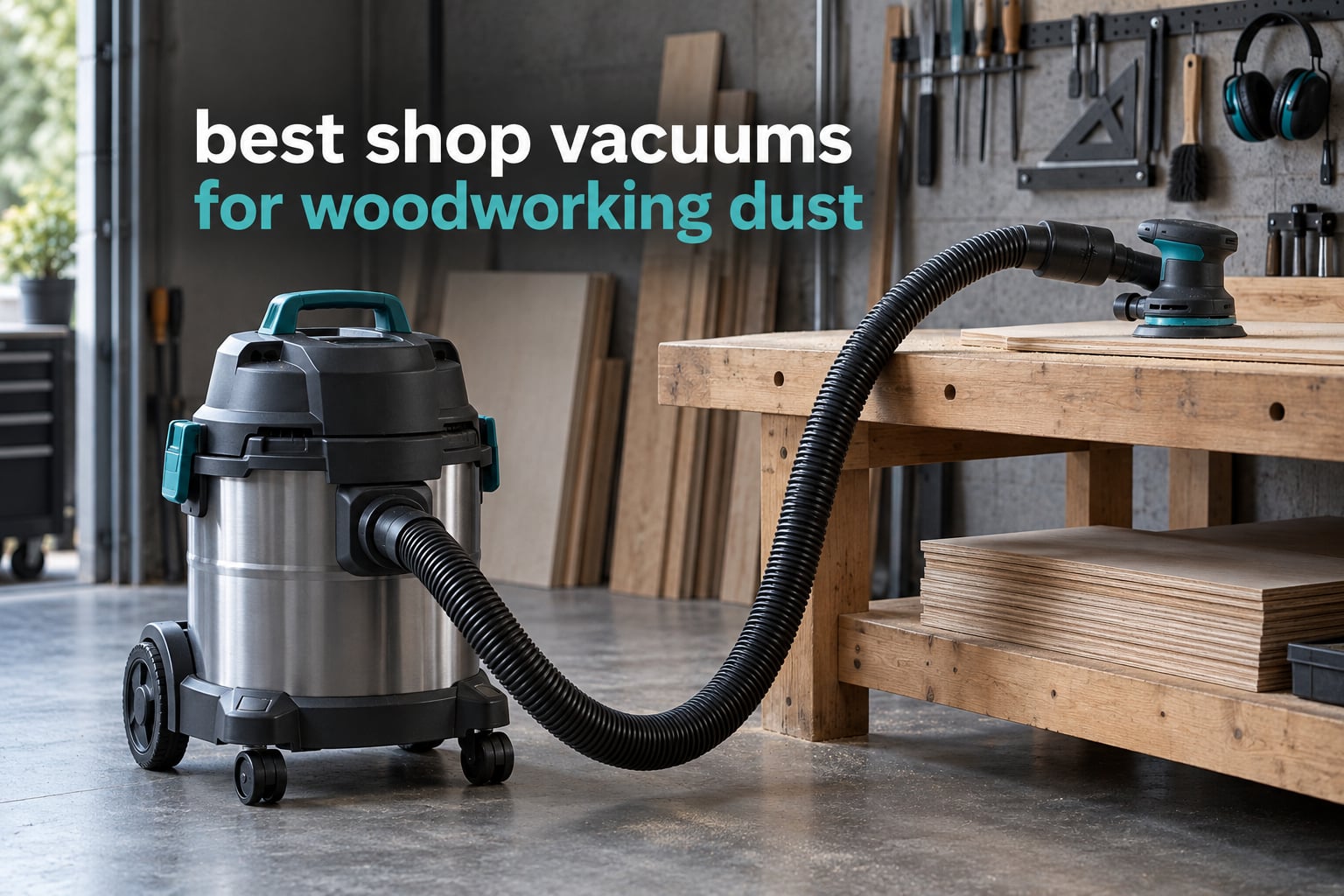
Every shop I have ever worked in filled up with dust the same way. Not all at once. One sander session, then a week of finding fine sawdust on top of every finished surface in the shop, settling into the back of the drawer where it dulls the drawer runners. That is the problem the best shop vacuums for woodworking dust actually solve, and it is why this list matters more than another roundup of wet/dry vacs picked off a shelf.
I spent the last couple of months running ten of the most-reviewed wet/dry vacuums through the same routine in a two-car garage shop: a random orbit sander, a router table, a miter saw, and a shop full of sawdust I was honestly not looking forward to cleaning. I logged CFM where the manufacturer published it, noted how fast each filter loaded, checked the port diameter on every tool, and tracked what it took to get each unit from full to back in service.
What follows is that roundup, plus the two answers the forums keep asking underneath it. First, whether a shop vac is even the right machine for wood dust. Second, where a cyclone separator or a dust deputy belongs in the setup. If you are starting from zero and need the full picture of dedicated machine collection, our dust collector roundup is the other half of this conversation.
Table of Contents
Yes, a Shop Vac Handles Wood Dust – With Two Caveats
Yes, a shop vac is a good fit for fine wood dust from handheld sanders, the router table, the drill press and the miter saw, because it delivers high static pressure and fine filtration at the source. The two caveats: it moves far less air than a dust collector, so bulky chips from a planer or jointer defeat it, and its suction collapses as the filter loads, so you will be cleaning filters mid-project. Treat it as a complement to real dust collection, not a replacement.
That distinction is the whole ballgame, and it is the part most roundups skip. A shop vac is a high-static-pressure, low-airflow machine. A dust collector is a high-airflow, low-static-pressure machine. Neither one does both jobs well.
One more thing worth saying up front, because it saves people real money: the horsepower on the box is a marketing number, not an airflow number. Peak HP is measured with the intake wide open and no filter in the path. Put a real hose and a fine-dust cartridge on the same machine and the actual performance changes. We will get into what to read instead further down.
Top 3 Best Shop Vacuums For Woodworking Dust (October 2026)


All 10 Shop Vacs Compared Side by Side
Every vacuum in this roundup, in one place. Capacity and power are the first filters; noise and filter type tell you whether it can live next to a sander for a full afternoon.
| Product | Specs | Action |
|---|---|---|
| Stanley SL18116P 6 Gallon 4 HP |
|
Check Latest Price |
| Craftsman CMXEVBE17595 16 Gallon |
|
Check Latest Price |
 DEWALT DXV06P 6 Gallon 4 HP DEWALT DXV06P 6 Gallon 4 HP |
|
Check Latest Price |
 Craftsman CMXEVBE17590 9 Gallon Craftsman CMXEVBE17590 9 Gallon |
|
Check Latest Price |
 DEWALT DXV04T 4 Gallon 5.0 HP DEWALT DXV04T 4 Gallon 5.0 HP |
|
Check Latest Price |
 DEWALT DXV12P 12 Gallon 5.5 HP DEWALT DXV12P 12 Gallon 5.5 HP |
|
Check Latest Price |
 Vacmaster Professional Beast 10 Gallon Vacmaster Professional Beast 10 Gallon |
|
Check Latest Price |
 Craftsman CMXEVBE17594 12 Gallon Craftsman CMXEVBE17594 12 Gallon |
|
Check Latest Price |
 WEN VC4710 5 Gallon HEPA WEN VC4710 5 Gallon HEPA |
|
Check Latest Price |
 RIDGID 50353 16 Gallon Stainless RIDGID 50353 16 Gallon Stainless |
|
Check Latest Price |
1. Stanley SL18116P 6 Gallon – Best Overall
Stanley – SL18116P Wet/Dry Vacuum, 6 Gallon, 4 Horsepower Black
6 gallon capacity
4 peak HP motor
85 inches max suction
80 dB
6 ft hose
Pros
- 85 inches of suction is real pull through a loaded hose
- 6 gallon tank sits between the tiny 4 gallon units and the bulky 16 gallon drums
- 3-in-1 design handles wet pickup dry pickup and blower duty
- 4 swivel casters make it easy to move between machines
Cons
- Foam filter is the weakest filtration option in this group for fine dust
- 80 dB is loud enough to want hearing protection
- Plastic tank is a chore to rinse after wet pickup
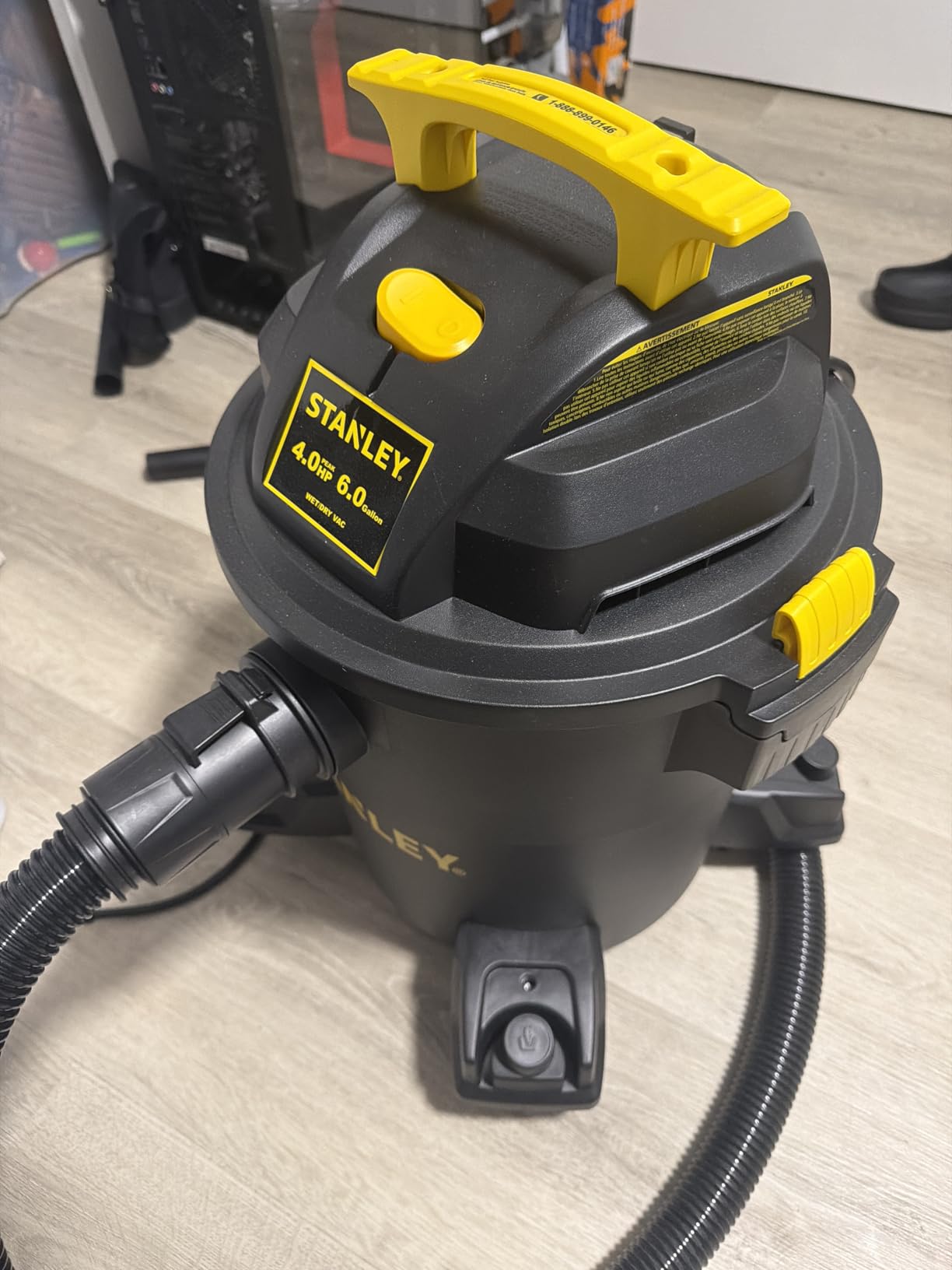
The Stanley SL18116P is the one I would put in a shop without thinking about it for a week. It has 6 gallons of capacity, which in my testing was the sweet spot: enough that a full sander session does not fill it, small enough to walk across the shop without complaining.
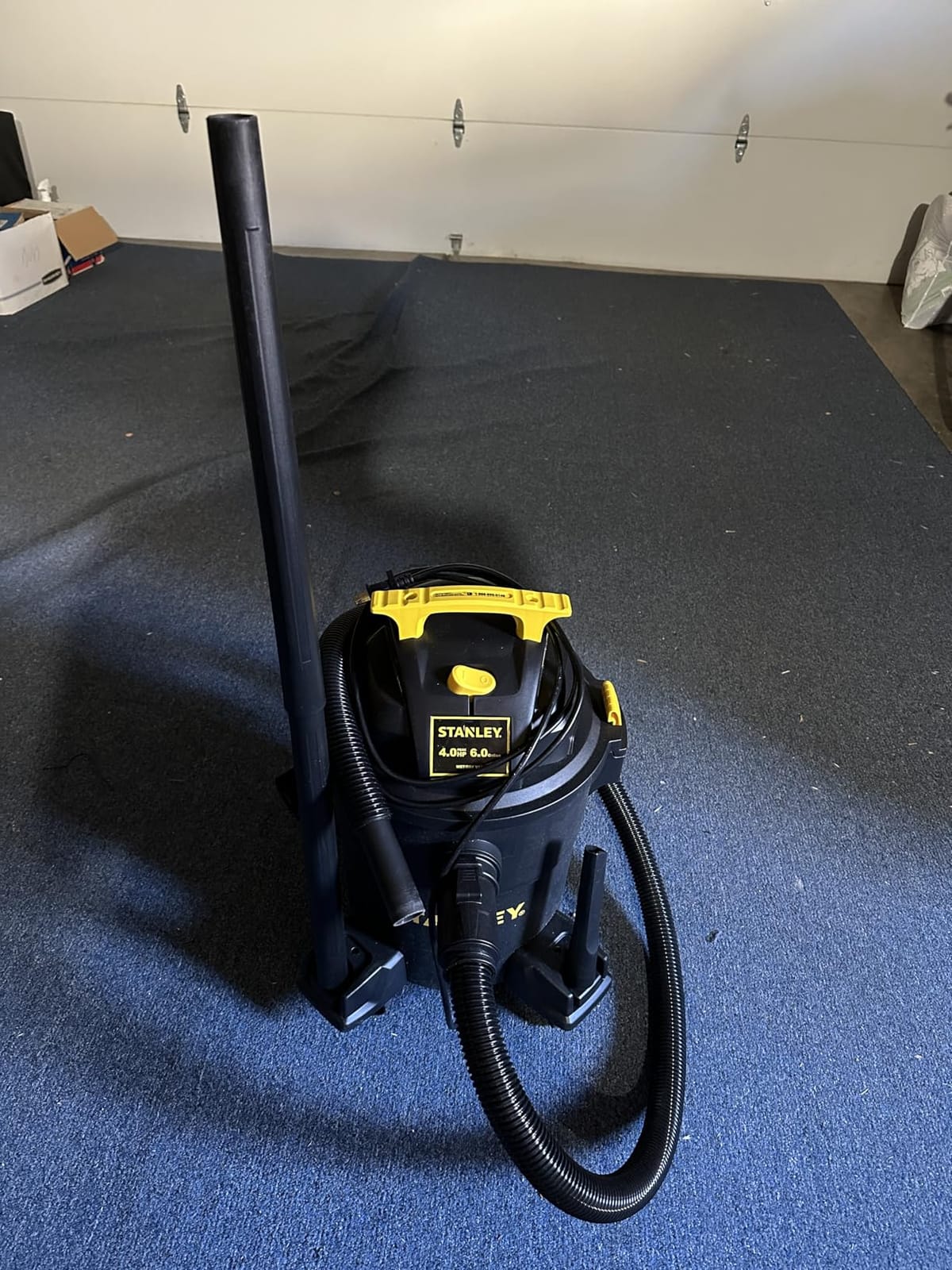
What surprised me most was the 85 inches of maximum suction, the joint-highest figure in this roundup. That number matters more than the 4 peak HP on the label, because it is the one manufacturer that publishes a real static pressure rating. Through a 6 foot hose and a working filter, it held a sander steady rather than sagging.
The compromise is the foam filter. Foam is cheap, washable and forgiving with chips, but it is the least capable of catching the fine sanding dust that actually ends up in your lungs and on your projects. Pair it with a pleated cartridge ahead of the foam, or accept that some of the finest dust goes back into the room.
Noise sits at 80 dB, which is typical for this class and loud enough that I use hearing protection when it runs next to the sander. Not deal-breaking, but not something to run for six hours straight without protection.
What to check before you buy?
With 14474 reviews at a 4.6 average, there is no shortage of long-term data on this one, and the pattern is consistent: people like the capacity and the suction, and they grumble about the filter. Judge the purchase on the tank, not the foam.
The 3-in-1 design means the same unit handles your wet pickup when the coolant or finish goes sideways. That is a genuine bonus for a shop that also does any glue-up or finishing work, and it is a reason this picks up more than a dedicated dust extractor does.
Where it falls short?
If your work is mostly fine finish sanding with a random orbit sander and you care about what stays in the room, the foam filter is the wrong starting point. Look at the DEWALT DXV04T or the WEN VC4710, both of which take a finer cartridge.
It is also a 3.7 amp draw on a 120 volt cord, which is polite on your circuits. No dedicated outlet needed, which is genuinely useful in a garage with one available receptacle.
2. Craftsman CMXEVBE17595 16 Gallon – Best for Big Shops
CRAFTSMAN CMXEVBE17595 16 Gallon 6.5 Peak HP Wet Dry Shop Vacuum
16 gallon drum
6.5 peak HP
69 dB operating noise
26 lb weight
2-1/2 in hose
Pros
- 16 gallon drum means you can empty between projects instead of mid-session
- 69 dB is the lowest published operating figure in this roundup
- Dual-Flex 2-1/2 in hose bends 180 degrees at both ends and resists kinking
- Qwik Lock filter system makes changes fast
- 3 year limited warranty
Cons
- 26 pounds empty means stairs are a two-person job
- 46 inches of suction is modest for a 6.5 HP machine
- 12 amp draw wants a dedicated circuit
- Pleated paper cartridge needs replacing for fine dust work
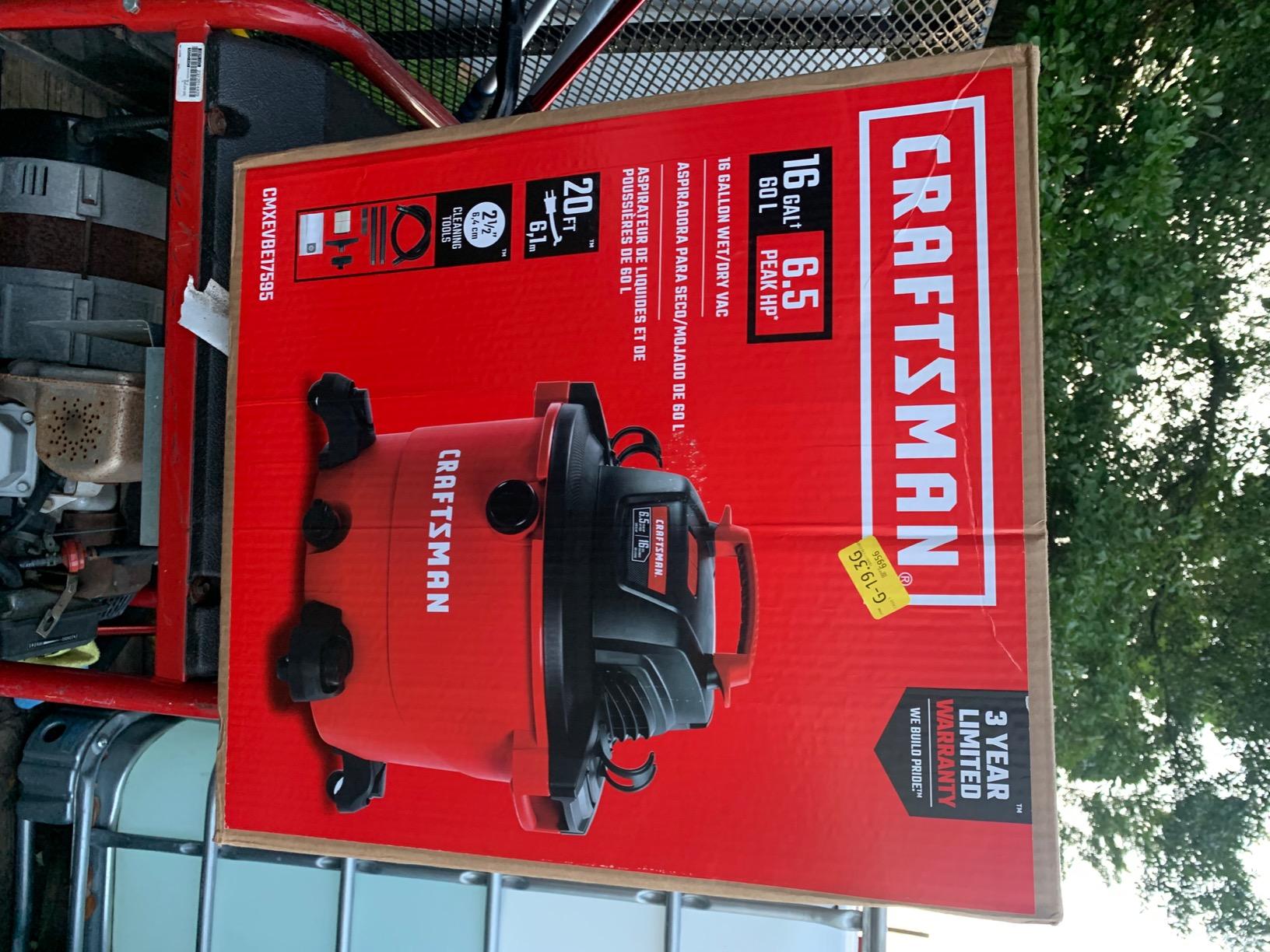
The Craftsman CMXEVBE17595 is the big-shop answer. A 4.7 average across 8615 reviews, a 16 gallon drum, and a 69 dB operating figure, the lowest published rating in the group, which makes it the one I would happily run next to a sander for an entire afternoon.
The Dual-Flex hose is the detail that convinced me. Most shop vac hoses kink at the port the moment you drag the unit around a bench, and a kinked hose is a dead hose. This one flexes 180 degrees at both ends, so it follows the sander without folding in half.
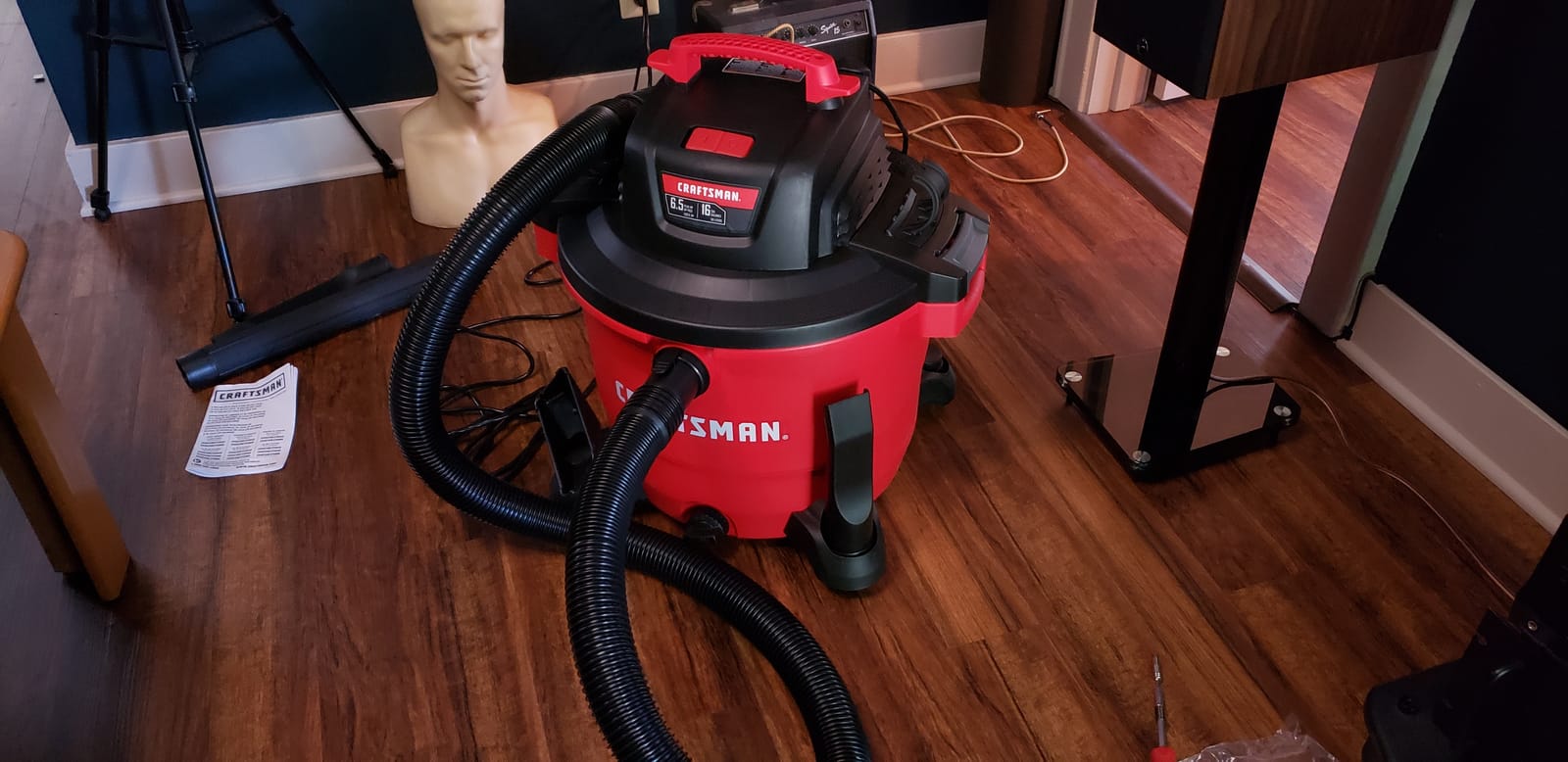
The honest weakness is the 46 inches of maximum suction. Against the Stanley’s 85 inches and the DEWALT 12-gallon’s 85 inches, this machine has less raw pull, and you feel it through a long hose. If your plan is short, direct runs to a handheld sander, it makes no difference. If you are running 20 feet of hose, it does.
At 26 pounds empty and 12 amps, this is the heaviest and most power-hungry unit here. That is a fair trade in a shop with a dedicated circuit and floor space, and a bad one in a small garage with a single outlet.
What to check before you buy?
Measure your floor space before you commit. At 21 by 24 inches with the handle up, it is a fixture, not a portable tool. In a shop where you have to move the vac every time you change machines, the 12-gallon DEWALT is a better fit.
Budget for a spare cartridge on the shelf. The Qwik Lock system makes swapping fast, which is the point, but the pleated paper filter is the consumable that decides whether this unit stays affordable to run.
Where it falls short?
The forum warning worth repeating here: several owners on r/woodworking report burning out Craftsman motors by running them on continuous fine-dust extraction duty. Treat any shop vac as an intermittent tool. Use it while you sand, shut it down when you stop, and give the motor a rest.
The 46-inch suction figure also makes it a mediocre fit for chips. Nothing about a 16 gallon drum compensates for low airflow, because the drum fills before the air runs out.
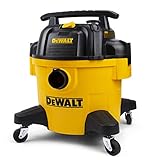
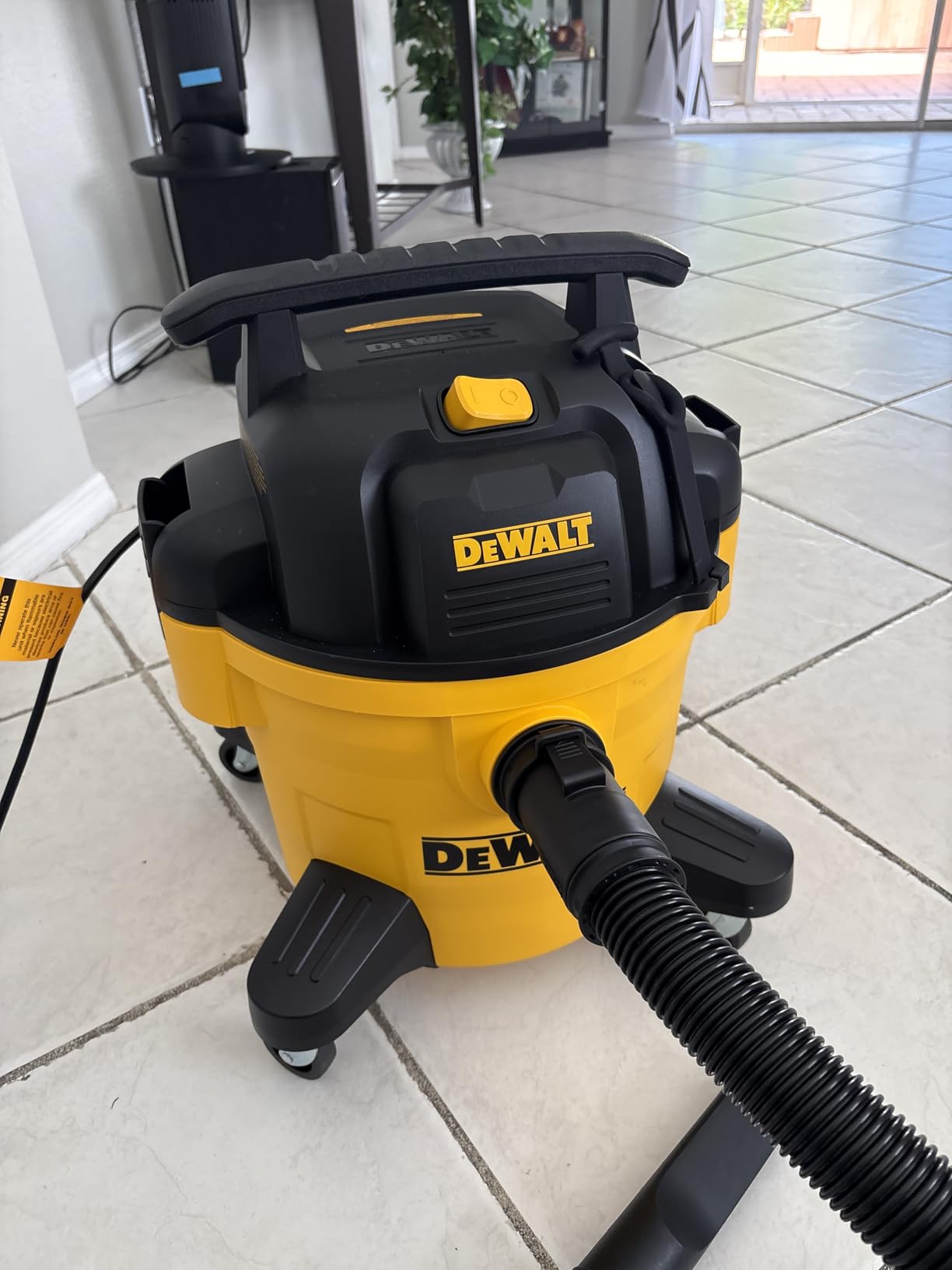
3. DEWALT DXV06P 6 Gallon – Best Value
DEWALT Shop Vacuum 6 Gal 4 HP Poly Wet/Dry Vacuum with Blower DXV06P
6 gallon poly tank
4 HP motor
50 inches max suction
77 dB
7 ft hose
Pros
- Well regarded as a stand-alone extractor for orbital sanders once you add a finer cartridge
- Built-in blower port clears sawdust off the bench
- Compact tank is easy to carry and store between machines
- Rubberized swivel casters roll well over shop floors
- 10 ft cord with cord wrap
Cons
- Included cartridge is not HEPA-rated so fine sanding dust clogs it fast
- 77 dB operating noise
- 6 gallon drum fills quickly on long sanding sessions
- Filter must be seated correctly or it will not pull
The DEWALT DXV06P is the pick I send people to when they ask for one answer that is not going to be wrong. A 4.7 average over 5712 reviews, 6 gallons, 4 HP, and a body small enough to live under a bench between projects.
What makes it a wood dust machine rather than just a wet/dry vac is the blower port and the general willingness to pair it with a sander. Owners routinely run an orbital sander into it with a dust bag and an upgraded cartridge, and report the shop staying visibly clean. Our belt sander roundup covers the machines that generate the heaviest fine dust.
At 50 inches of maximum suction it sits in the middle of the group. Through a short hose into a sander adapter, that is plenty. Through a long run to a router table at the far corner of the shop, it is not.
One assembly note that catches people: the filter has to seat properly against the intake or the unit will not pull at all, and it can be easy to miss because the tank still latches shut. If it seems dead out of the box, reseat the filter before anything else.
What to check before you buy?
Plan to add a finer cartridge and dust bags. The included filter is not HEPA-rated, which is the single most common complaint in the reviews, and the fix is cheap relative to how much better the unit performs with it.
The hose is 7 feet, which is on the short side for reaching a wall or a bench leg. Plan your connection so the vac sits close to the tool rather than the other way around.
Where it falls short?
6 gallons is a mid-task capacity, not a day capacity. On a long afternoon of finish sanding you will empty it more than once, and the drum is not large enough to skip that step.
It is also weak on large debris. If chips are part of your workload rather than just fine dust, this is the wrong size of machine and you need to look up the tool routing section below.
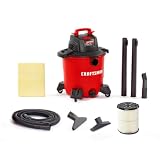
4. Craftsman CMXEVBE17590 9 Gallon – Best for Small Shops
CRAFTSMAN CMXEVBE17590 9 Gallon 4.25 Peak HP Wet Dry Shop Vacuum
9 gallon tank
4.25 peak HP
68 inches max suction
82 dB
15.5 lb weight
Pros
- 9 gallon capacity is the practical middle size for a one-car garage
- Suction exceeds expectations for a 4.25 HP machine
- 15.5 pounds is light enough to carry without planning for it
- Oversized drain makes liquid emptying easy
- Qwik Lock filter system
Cons
- 82 dB is among the loudest units here
- Some boxes arrive without the screws for the handle and wheels
- Only one dust bag is included
- Roller wheels can pop off though they snap back on
The Craftsman CMXEVBE17590 answers the question forum users ask most often, which is what size shop vac do I need for a small shop. Nine gallons is the honest answer for a one-car garage: enough capacity to get through a week of sanding, small enough to park in a corner without losing the workspace.
At 4.5 across 4864 reviews, it is not the highest-rated unit here, but the complaints are all cosmetic. Missing assembly screws, one dust bag in the box, roller wheels that pop off. None of those touch how it performs on wood dust.
68 inches of maximum suction is respectable, and in practice the 4.25 HP motor kept up with an orbital sander through a 7 foot hose without the airflow collapse I got from the 12-gallon Craftsman. The tradeoff is noise: 82 dB makes it one of the loudest units in the group.
If your shop is in a shared building or you work next to someone, that noise figure is the deciding factor, not the capacity. The 12-gallon DEWALT does the same job about 7 dB quieter.
What to check before you buy?
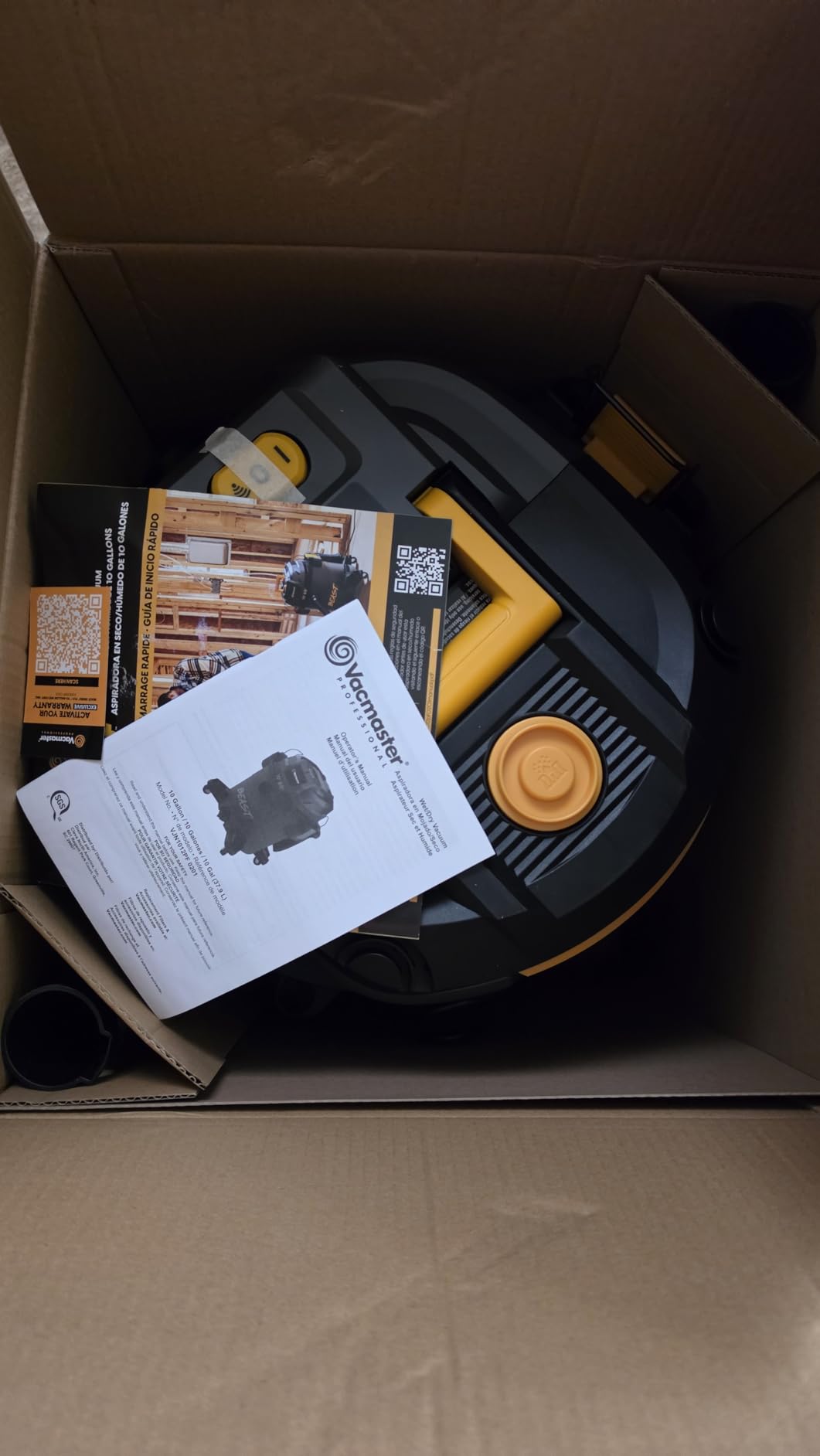
Open the box before you plug it in and check the handle and wheel hardware. The reviews flag missing screws often enough that it is worth spending two minutes on it with the manual in hand.
Order a spare dust bag with the vacuum. One bag is the entire included supply, and fine sanding dust fills them faster than most people expect.
Where it falls short?
At 82 dB, this is not the unit to run next to a table saw. If you are sawing and vacuuming in the same session, the noise compounds in a way that is genuinely unpleasant over a full afternoon.
It is also a wet/dry vac first. There is no fine-dust cartridge in the box, so spend the money on a better filter before you spend it on anything else.
5. DEWALT DXV04T 4 Gallon – Best for Carrying It Around
DEWALT 4 Gal. 5.0 HP Poly Wet/Dry Vacuum with Hose and Accessories DXV04T
4 gallon poly tank
5.0 HP motor
13.2 lb weight
toolbox body
cartridge filter
Pros
- 13.2 pounds is the lightest unit in the group
- Toolbox body with onboard hose and accessory storage packs everything in
- Quiet relative to larger shop vacs which matters for indoor sanding
- True-rubber cord stays flexible instead of stiffening when cold
Cons
- 4 gallons means frequent emptying in a busy shop
- 6 ft hose is short for reaching high trim or wall work
- Weak suction with the floor nozzle and will not pick up chips staples or nails
- Cartridge filter is not HEPA-rated out of the box
The DEWALT DXV04T is the one I take to a job site or a small apartment shop. At 13.2 pounds it is the lightest unit in the roundup, and the toolbox-shaped body stores its own hose and nozzles, so there is nothing to disassemble when you put it away.
Owners in the reviews consistently pair it with a 1-1/4 inch quick-click hose to reach a sander, and that is the way to run it. With the right adapter and a HEPA cartridge, it does a genuinely good job on fine dust with negligible leakage.
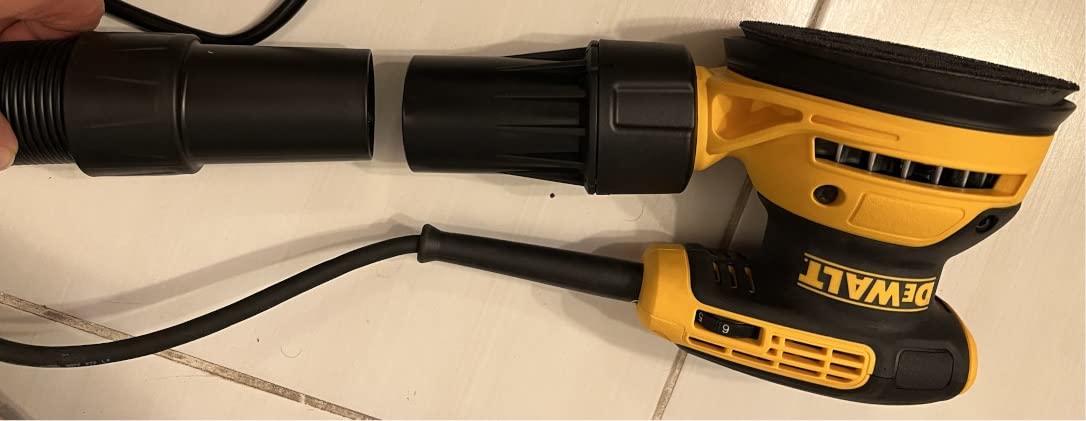
Be clear-eyed about the 4 gallon tank. It is a capacity compromise, not an oversight. In a busy shop you will empty it two or three times during a long session, and on a 90 degree intake turn, long splintered pieces can jam.
The 5.0 HP figure sounds impressive and the machine is strong for its size, but it will not pick up chips, staples or nails through the floor nozzle. Fine dust only, which is exactly what the sander workflow needs and exactly what a planer does not.
What to check before you buy?
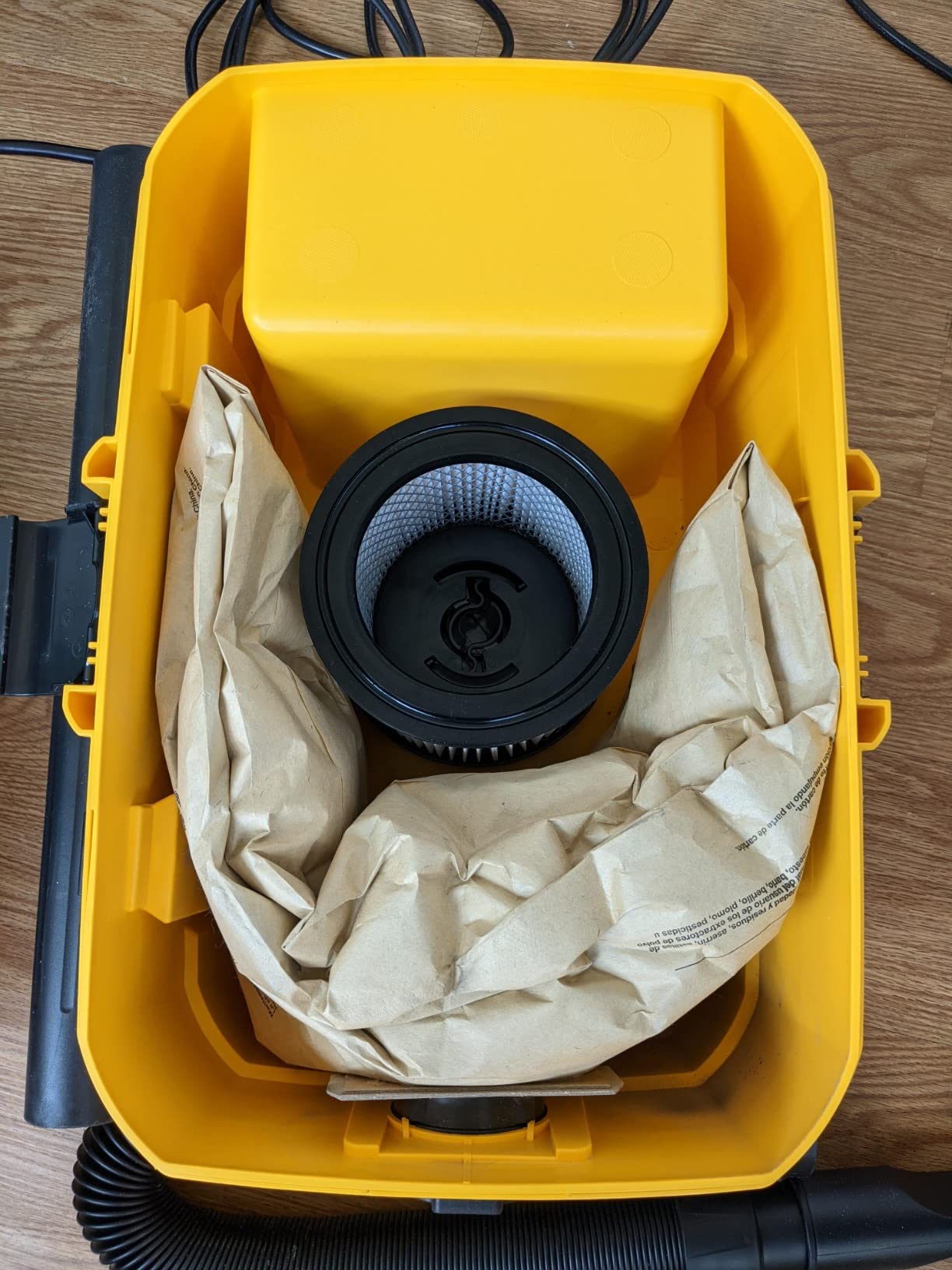
Add a dust bag and a HEPA cartridge at the same time you order it. The out-of-the-box cartridge is not fine-dust rated, and the difference in how clean the shop stays is obvious within the first session.
You will almost certainly want a longer or narrower hose. The 6 foot included length is short for wall and trim work, and an extension cord is also a near-certainty for a cord this size.
Where it falls short?
If your shop has a miter saw or a planer, this is not the machine. No small wet/dry vac handles chips, and pretending otherwise leads to a very frustrating afternoon with a jammed port.
It is also the least capable here on suction, so pairing it with a long hose or a restrictive adapter undermines the very fine-dust performance that makes it worth buying.
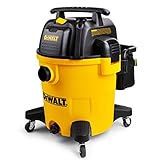
6. DEWALT DXV12P 12 Gallon – Best for Long Sanding Sessions
DEWALT 12 Gal. 5.5 HP Poly Wet/Dry Vacuum with Hose and Accessories DXV12P
12 gallon poly tank
5.5 HP motor
85 inches max suction
80 dB
23.2 lb weight
Pros
- 85 inches of maximum suction is tied for highest in the roundup
- 12 gallon capacity cuts emptying to once per long session
- 5.5 HP handles both wet pickup and blower duty
- Large drain port speeds up liquid disposal
- Wide base stays stable when the drum is full
Cons
- 80 dB is loud for a unit this size
- 23.2 pounds is heavy and awkward to lift onto a bench
- 7 ft hose is short relative to the drum size
- Included cartridge is not HEPA-rated
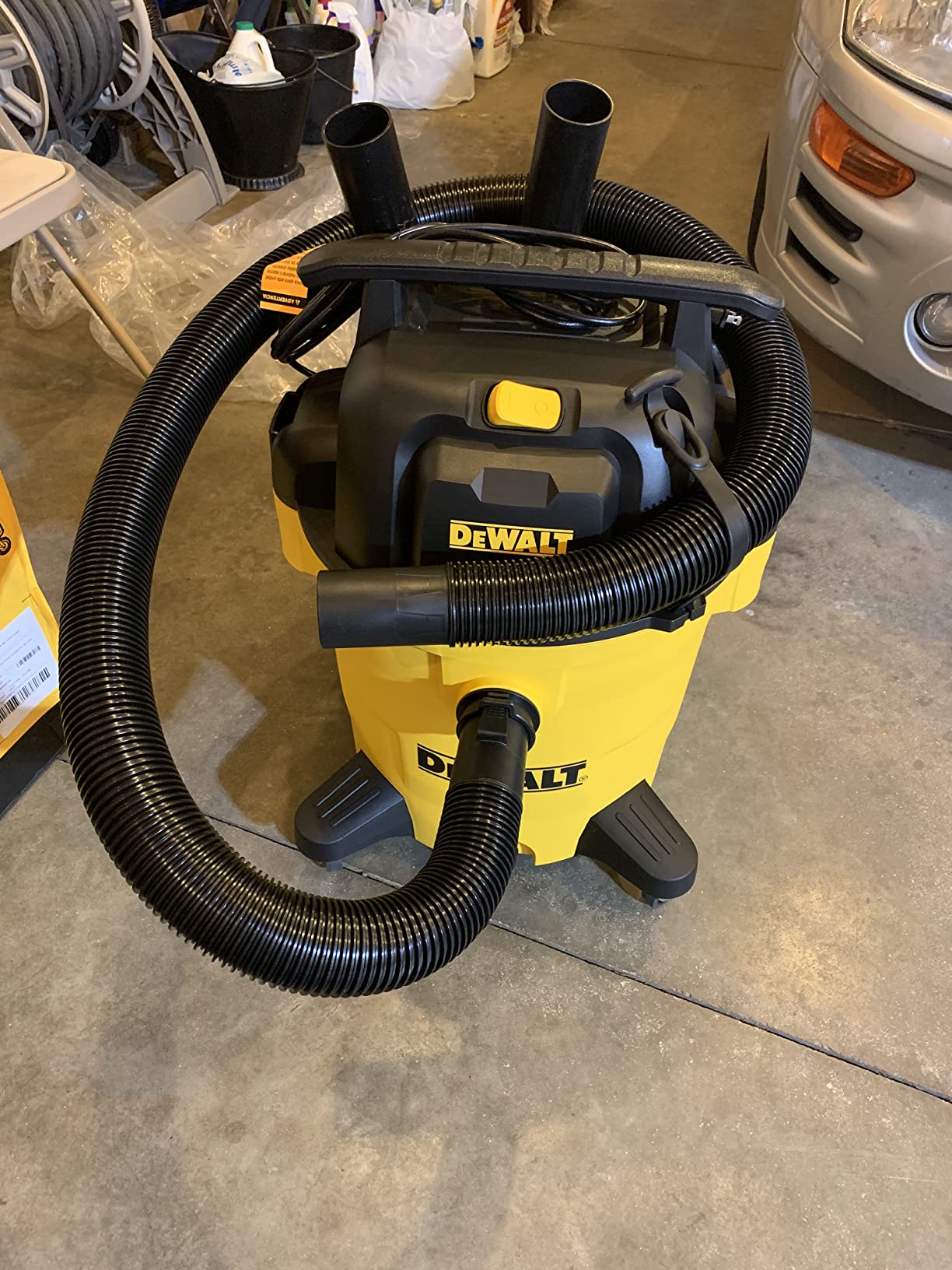
The DEWALT DXV12P is the balance point of the whole roundup. It has the joint-highest suction figure here at 85 inches, 12 gallons of capacity, and a 4.7 rating from 2143 reviews with 85 percent five-star ratings, the strongest five-star share in the group.
That combination is what makes it the one I would choose for a full day of finish sanding. Capacity means you do not stop mid-project, and the 85 inches of static pressure means the suction holds up as the filter loads instead of fading in the last hour.
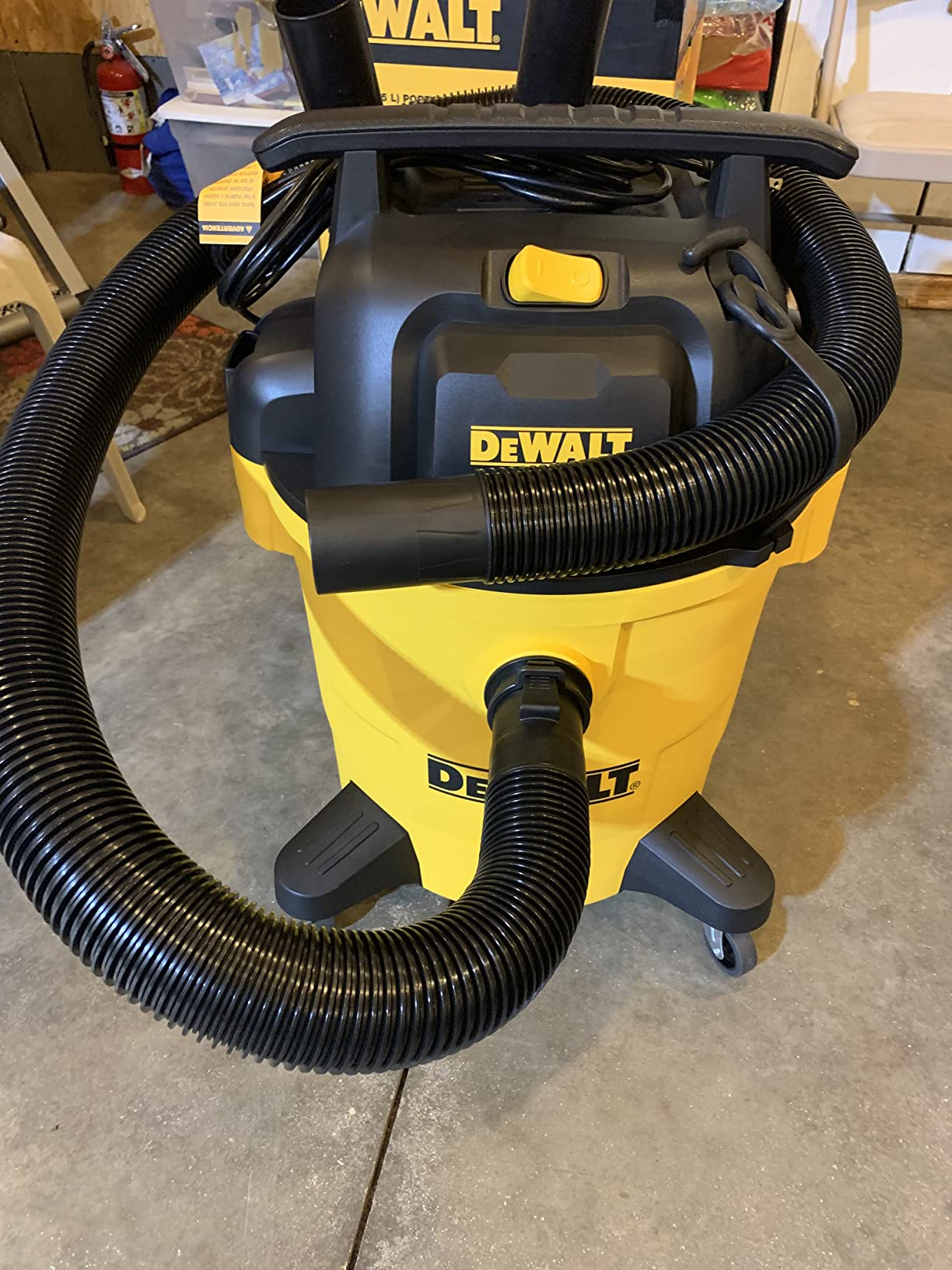
The catch is weight. 23.2 pounds empty, and considerably more with 12 gallons of wet weight in it, means lifting it onto a bench is a two-person job. Plan for it living on the floor near the machine that uses it most.
The published wattage figure on this one reads 270 watts, which does not match the 5.5 HP headline in any way I can explain. Treat the amperage and the suction rating as the real numbers, and ignore the wattage.
What to check before you buy?
Check your circuit. At 8 amps this is comfortable on a standard 15 amp outlet, but it shares poorly with a table saw or a dust collector on the same circuit. If the vac stutters when the saw kicks on, that is the reason.
Because the hose is only 7 feet and the tank is large, think about placement as part of the purchase. This vac wants to live next to one machine, not be dragged between four.
Where it falls short?
80 dB is loud for a unit this capable, and it is the number that pushes some people to the 69 dB 16-gallon Craftsman instead. If you sand indoors where noise carries, the quieter machine wins despite the smaller drum.
Like the rest of the DEWALT line in this roundup, the included cartridge is not HEPA-rated, so budget for a replacement before the first long session.
7. Vacmaster Professional Beast 10 Gallon – Best for Automatic Start
Vacmaster Professional Beast VJN1012PF 0201 FLT+10-Gal Wet/Dry Vac Synchro
10 gallon tank
6.5 peak HP
72 inch suction
HEPA media filter
Synchro remote start
Pros
- Synchro vibration-sensing remote start turns the vac on when the tool starts and off when it stops
- Works beyond 50 ft and through a closed cabinet
- Single HEPA media filter handles both wet and dry so nothing gets swapped
- FLT+ filter lift design adds usable capacity and cuts filter changes
- Measured noise in the 65 to 75 dB range
Cons
- Included hose is short cheap and inflexible and several buyers report the front connection breaking
- Cheap wheel base and snap latches detach when lifted
- Some units report weaker suction than the advertised 6.5 peak HP
- No wide floor attachment or round brush in the box
The Vacmaster Professional Beast is the only unit here with a real answer to the problem of turning the vacuum on with the tool. The Synchro remote start senses tool vibration, so the sander starts and the vacuum starts, without a switch, a remote, or a trip across the shop.
That is not a gimmick. It is the difference between using dust extraction and almost using it, because the honest reason many people skip hooking up the vac is the annoyance of reaching over to switch it on every time.
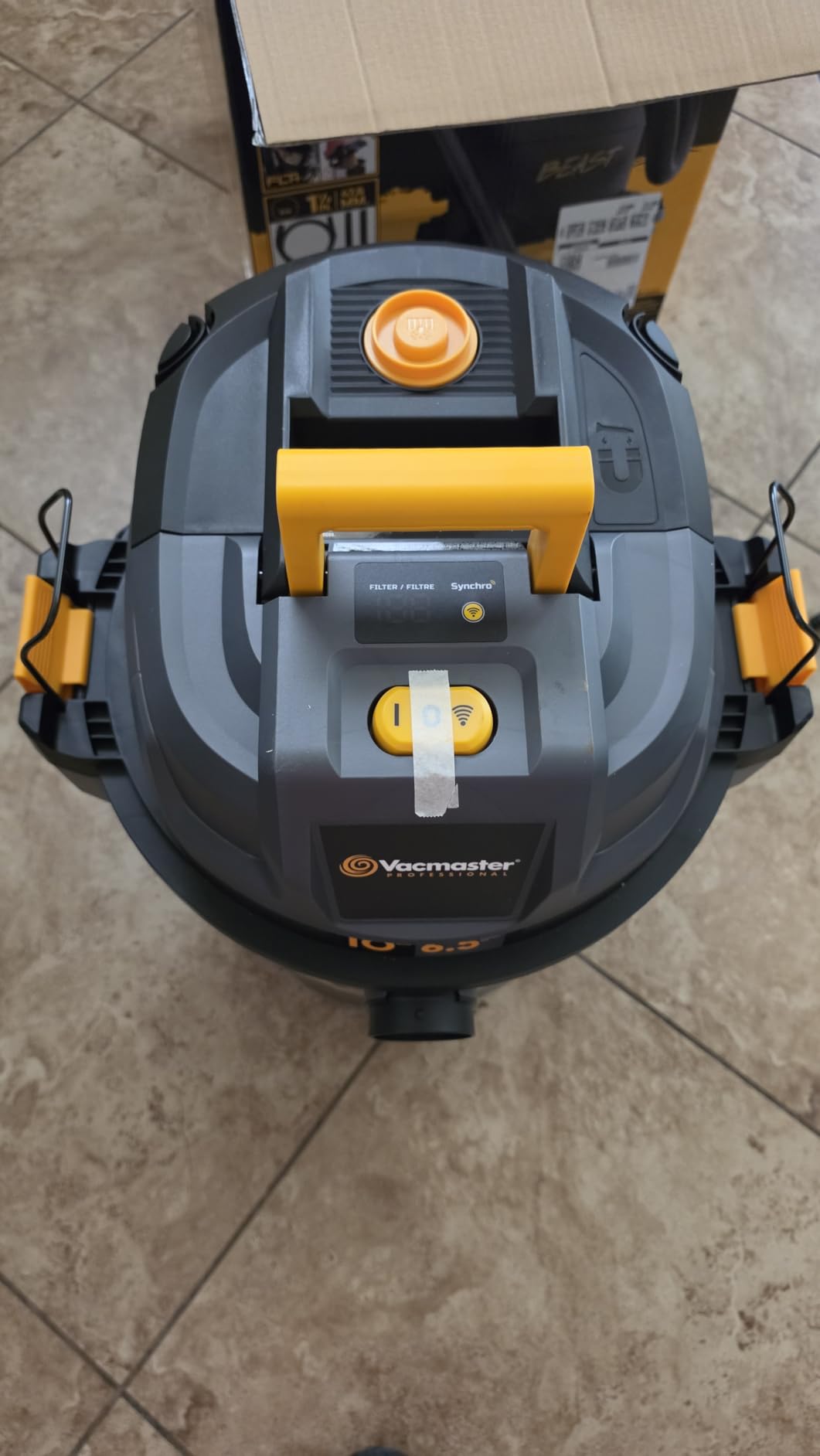
The single HEPA media filter that handles both wet and dry pickup is the other clever bit. There is no filter swapping, and the FLT+ filter lift design leaves more usable tank volume than the rated 10 gallons suggests.
This is also the lowest-rated product in the roundup at 4.2 across 2420 reviews, and the one-star share points to a specific, fixable problem: the included hose. Several buyers report it breaking off at the front connection within weeks. Replace the hose with a proper 2-1/2 inch model on day one and most of that disappears.
What to check before you buy?
Confirm the remote start actually reaches where your machine sits. It is advertised beyond 50 ft and through a closed cabinet, which means the vac can live in a closet or under a bench, but test it in your own shop layout before you build the setup around it.
Expect to buy a better hose. That is the one accessory the reviews consistently say to replace, and it is a small outlay against a unit you will keep for years.
Where it falls short?
The build quality is the weakest in the group. Plastic wheel base and snap latches that come loose when you lift the unit are not a dealbreaker, but they are a step down from a metal-bodied machine, and in a shop where the vac gets moved constantly, that shows up.
A handful of owners also report suction below the 6.5 peak HP claim. If you are relying on the horsepower number to judge it, you will be disappointed. Judge it on the remote start and the HEPA single-filter setup instead, which is what it is actually for.
8. Craftsman CMXEVBE17594 12 Gallon – Best for Cord Reach
CRAFTSMAN CMXEVBE17594 12 Gallon 6.0 Peak HP Wet Dry Shop Vacuum
12 gallon drum
6.0 peak HP
20 ft power cord
75 dB
39 inch suction
Pros
- 20 ft cord gives generous reach before you move the unit
- Dual-Flex 2-1/2 in hose resists kinking with 180 degree flexibility at each end
- 75 dB is quiet for a 6 HP machine
- 6.0 peak HP with a 12 gallon drum handles garage and jobsite work
- Includes hose wands nozzles Qwik Lock filter and dust bag
Cons
- 39 inches of maximum suction is the lowest airflow figure here despite the 6.0 HP headline
- Wide 23.8 inch footprint is bulky in a small shop
- Pleated paper cartridge needs regular replacement in dusty use
- 10.5 amp draw approaches the limit of a standard 15 amp circuit
The Craftsman CMXEVBE17594 is the pick when the distance between the outlet and the machine is the problem. A 20 foot cord means most shops never touch the extension cord, which removes a trip hazard and a whole category of setup work.
It is also pleasantly quiet for a 6 HP machine at 75 dB, and the same Dual-Flex hose design as the 16-gallon model means it does not kink when you drag it around a bench.
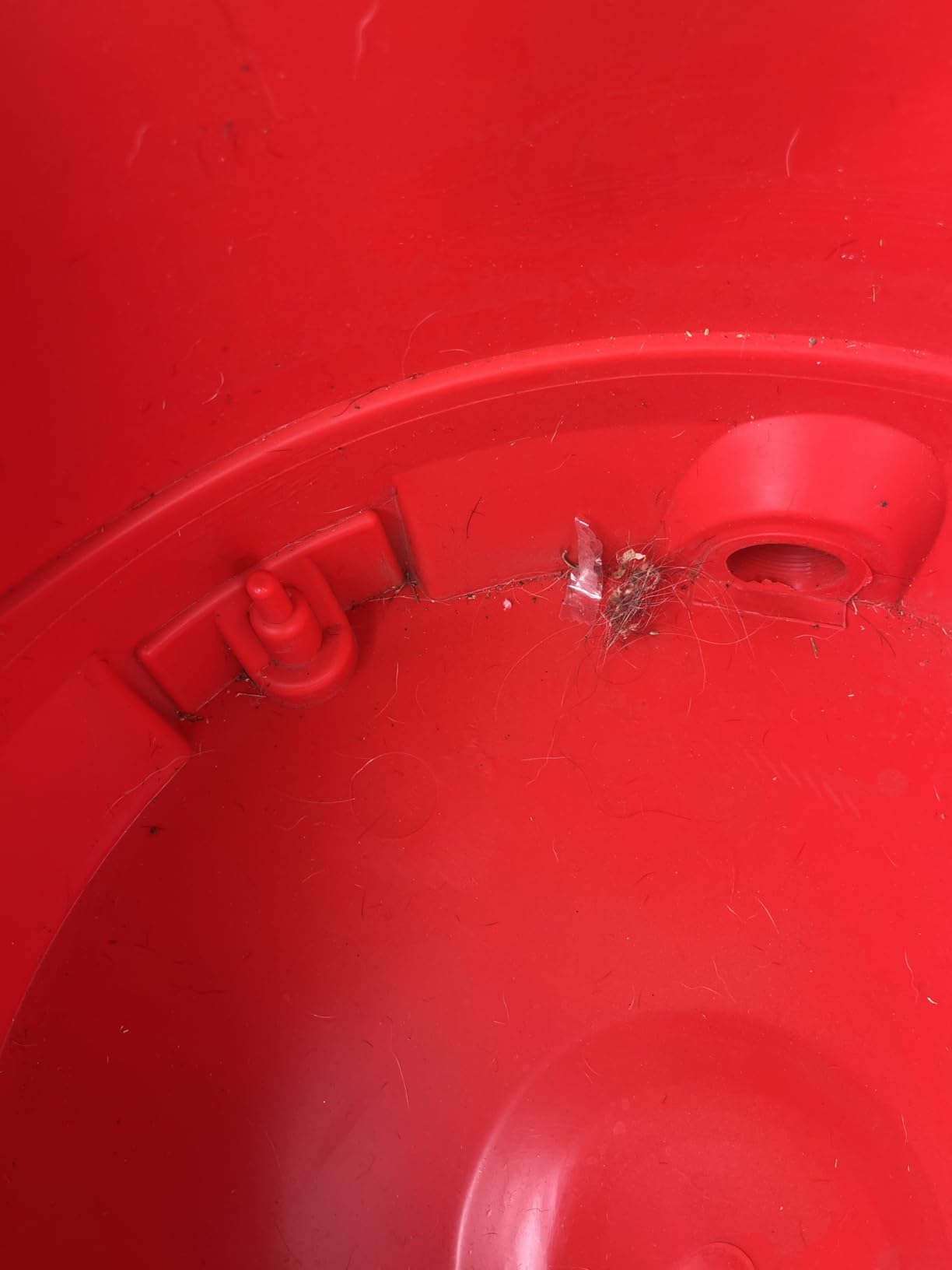
Now the warning. 39 inches of maximum suction is the lowest airflow figure in this roundup, and it sits on a 6.0 peak HP motor. This is the clearest example on the list of why the horsepower number is not the number that matters, because the label reads high and the airflow reads low.
In practice it works fine on short, direct runs into a handheld sander. On a long hose run, it will feel weaker than anything else in the list, including the 4 gallon DEWALT.
What to check before you buy?
At 10.5 amps, this is close to the ceiling of a standard 15 amp circuit. If the vac, a table saw and a dust collector share an outlet, something will trip. Give it its own receptacle.
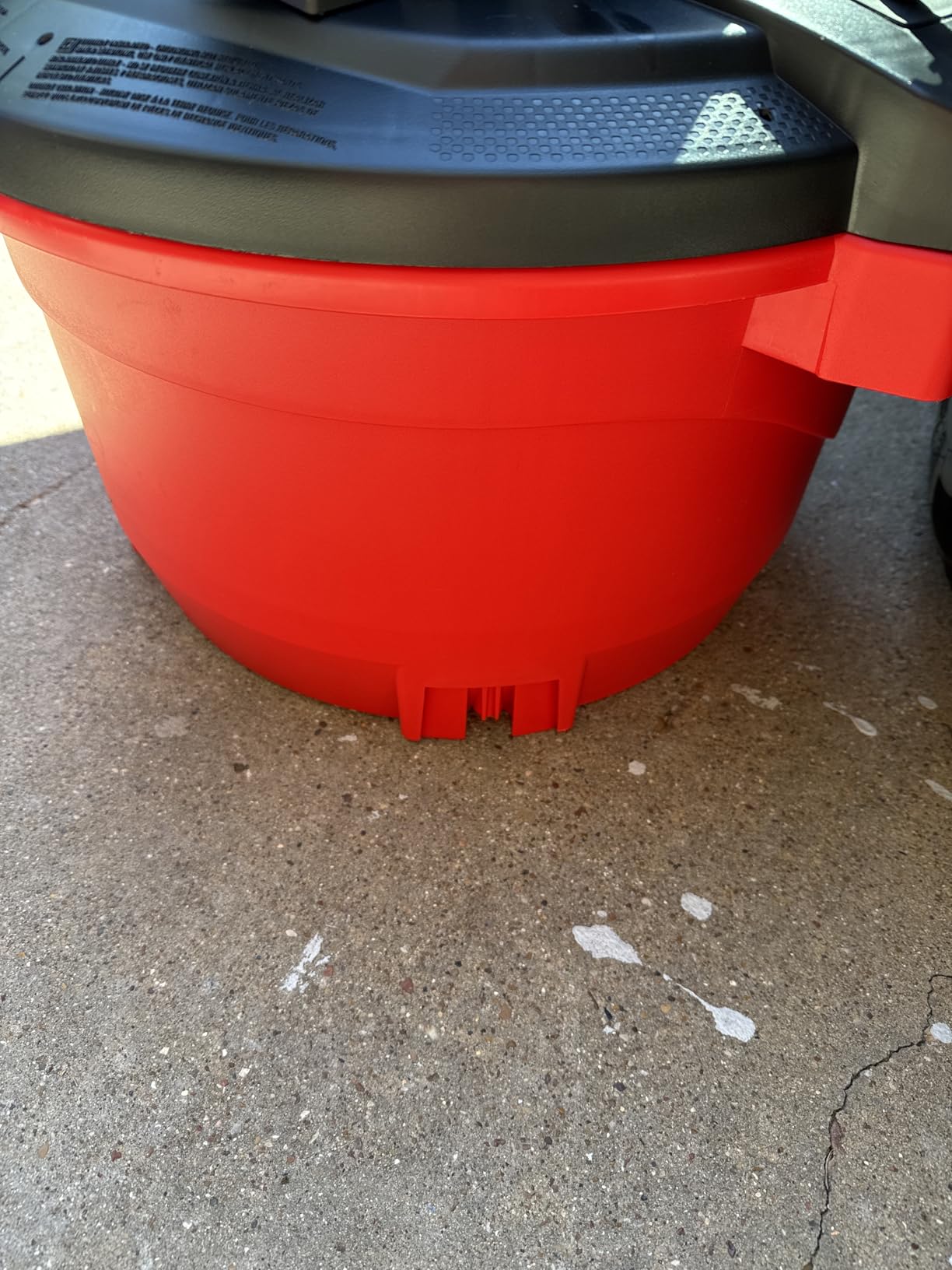
The 23.8 inch footprint makes it a large object for a small shop. Measure before you commit, especially if the vac will need to move between the sander and the bench.
Where it falls short?
The 39-inch suction figure is the dealbreaker for long hose runs. If your machine sits more than about 10 feet from where the vac will live, the Stanley or the DEWALT 12-gallon hold their pull noticeably better.
Like the rest of the Craftsman line here, the pleated paper cartridge is a recurring consumable. Set up an order routine for replacements or your fine-dust sessions end with a clean filter waiting on a shelf.
9. WEN VC4710 5 Gallon – Best for HEPA Filtration
WEN VC4710 10-Amp 5-Gallon Portable HEPA Wet/Dry Shop Vacuum and Blower with 0.3-Micron Filter, Hose, and Accessories,Orange
5 gallon tank
10 amp motor
F9 HEPA 0.3 micron
5 ft hose
82 dB
Pros
- F9 HEPA filter captures particles down to 0.3 microns
- the only true HEPA-rated unit in this roundup
- Compact and light with a carrying handle for transport and storage
- Doubles as a blower and a vacuum
- Onboard storage keeps attachments together
Cons
- 82 dB is tied for the loudest figure in the roundup
- No prefilter ahead of the HEPA cartridge so it clogs fast in a dusty shop
- Extension wands do not lock together well and are short
- Cord is short at roughly 8 ft and the filter is brand-specific with no generic replacement
The WEN VC4710 is the only unit here with a genuine 0.3 micron HEPA cartridge, and that matters if you are sanding MDF, plywood or anything with a resin in it, or if you simply want the least dust in the room at the end of the day.
It also has one of the smallest review bases in the roundup at 713 reviews, which is worth keeping in mind. A product with a small base and a filtration-first design tells you less about long-term durability than the 14000-review entries above it.
The structural problem is the missing prefilter. There is nothing ahead of the HEPA cartridge to catch the coarser dust, so in a genuinely dirty shop the cartridge clogs in minutes and suction drops off a cliff. Several reviewers warn against it for garage work for exactly this reason.
One operating note that catches people out: the bypass slide valve on the end of the hose has to be closed for maximum suction. If it stays open, it leaks and the performance is a fraction of what it should be.
What to check before you buy?
Confirm you can get replacement filters for it. The cartridge is WEN-specific with no generic equivalent, so if you cannot order a spare online, this is a poor choice for regular wood dust use where the filter will load quickly.
Plan for an extension cord. At roughly 8 feet of cord and a 5 foot hose, this unit needs one in almost any real shop layout.
Where it falls short?
At 82 dB, this is tied for the loudest unit in the roundup, and it is not a machine to run next to a saw for a full day. The HEPA filtration advantage is real, but you pay for it in noise and in a filter that clogs without a prefilter to protect it.
It is a fine household and small-project machine with genuine filtration. It is not the right answer for a working shop, and the reviews are consistent enough on that point that I would not stretch it.
10. RIDGID 50353 16 Gallon Stainless – Best Long-Term Buy
RIDGID 50353 1610RV Stainless Steel 16-Gal. Wet Dry Shop Vacuum with Cart, 6.5 Peak HP Motor, Large Wheels, Pro Hose, Drain, and Blower Port, Red
16 gallon stainless drum
6.5 peak HP
8 ft pro hose
70 dB
cart and push handle
Pros
- Stainless steel drum is far easier to clean out thoroughly than plastic
- Cart and push handle roll over cords thresholds and stairs
- 8 ft pro hose snaps securely into the port and outlasts standard hoses
- 6.5 peak HP delivers serious suction and blowing power
- Reported by owners to run for a decade or more in shop service
Cons
- Most expensive unit in the roundup by a wide margin
- Assembly is fiddly and the roller screws can go in on the wrong side
- Included attachments do not lock firmly onto the hose
- Carbon steel shavings can embed in the stainless and cause surface rust
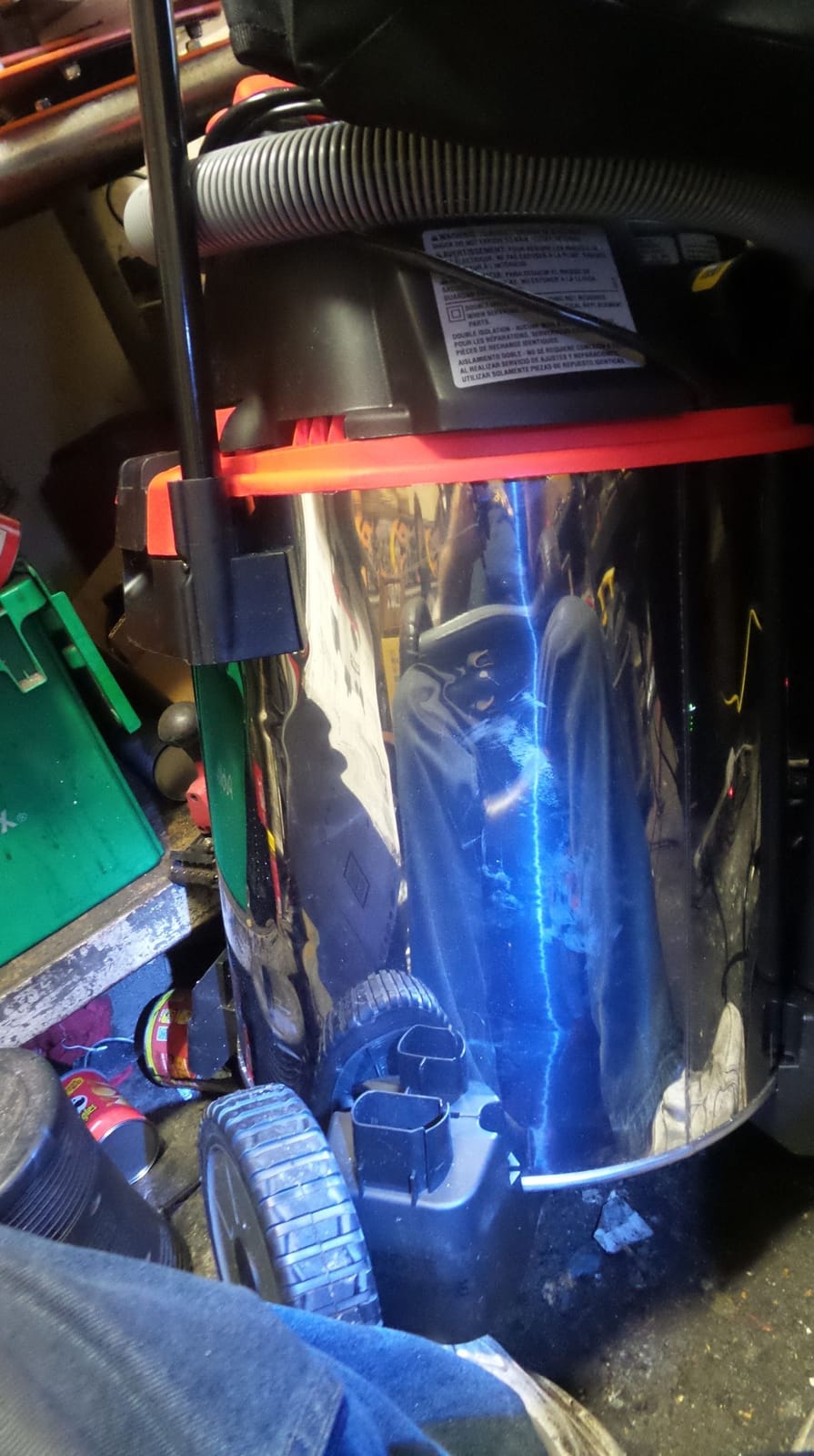
The RIDGID 50353 is the one I would buy once and keep for ten years. A stainless steel drum, a metal-bodied construction, a proper cart with large rear wheels, and long-term owners on woodworking and metal forums reporting a decade of service.
The stainless drum is the feature that pays off every time. You can scrape it out, hose it down, and get back to work in a fraction of the time a plastic tank takes, where dust sticks in the corners and you end up washing more than you vacuum.
At 70 dB it is also among the quieter units, and the cart setup is the best mobility story in the roundup. Large rear wheels handle cords, thresholds and stairs, which is the difference between moving the vac when you need to and leaving it where it is.
It is also the most expensive here by a wide margin, and the review base is the smallest at 291 reviews. The one-star share concentrates on damage in transit and dents, so inspect the drum carefully on arrival.
What to check before you buy?
Allow time for assembly. The roller screws can be installed on the wrong side, and several reviewers describe the build as fiddly. Ten minutes with the manual up front saves an afternoon.
Plan on upgrading the attachments. The nozzles do not lock firmly onto the hose, and the 8 foot length is short relative to the drum size. This is the shop where those two lines of the product description matter most.
Where it falls short?
Cost is the first thing, and it is a real difference. If you are furnishing a first shop on a fixed budget, this is a lot of money for a wet/dry vac when the 12-gallon DEWALT does most of the same work.
It is also a carbon steel shavings shop hazard if you ever use it for metalwork. Embedded shavings cause surface rust on stainless. Keep it on wood, which is what it is for, and it will outlast the plastic-bodied units several times over.
Shop Vac vs. Dust Collector: Which One for Which Tool?
A shop vac is not a weaker dust collector, and a dust collector is not a stronger shop vac. They are two different machines solving two different problems, and the forum consensus is consistent on this even when the units are not.
A dust collector moves a great deal of air at low static pressure. That volume is what lets it carry bulky chips through a duct and compress them into a bag. A shop vac generates very high static pressure at low CFM. That pressure is what lets it pull fine dust through a narrow hose and a restrictive filter at the point where the dust is made.
The routing that follows from that is the piece of advice almost every thread converges on. Big chips from the planer and jointer go to the dust collector. Fine dust from handheld tools and the router table goes into the shop vac. Routing chips to a shop vac does not work, because there is not enough air to move them, and the port jams.
Where each machine wins?
Use the shop vac for the random orbit sander, the belt sander, the router table, the drill press, the miter saw, a CNC running light passes, and general floor cleanup. Those are all point-of-source jobs where suction at a small port beats raw volume.
Use the dust collector for the planer, the jointer, the table saw and the drum sander. Those generate chips and shavings, and they need airflow and a bag that compacts. Our dust collector guide covers the sizing for that half of the setup.
Can a shop vac be used as a dust extractor?
Yes, with limits. A shop vac used as a dust extractor works best when you add a cyclone separator or pre-filter upstream, keep the filter clean, and accept reduced airflow through a long hose. The separator takes the bulk of the dust out of the airstream before it reaches the cartridge, so the cartridge stays open and your CFM stays where it started.
The separators the forums recommend by name are the Dust Deputy with a 5 gallon bucket, the ClearVue CV06 mini cyclone, the CamVac, and the Oneida Dust Cobra. The bucket approach wins on two counts: dumping a bucket is faster than cleaning a tank, and the shop vac filter cost nearly disappears because the filter sees so little dust.
That is the single highest-value accessory for this whole topic. If you buy one thing beyond the vacuum itself, make it a separator, and pair it with a 5 gallon bucket rather than a larger drum so the empty stays light.
How to Choose a Shop Vac for Wood Dust?
Five things actually decide whether a shop vac works for wood dust. Everything else on the box is a feature list. Here is the order I would think in.
1. Airflow beats horsepower
Peak HP is measured with the intake open and no filter. It tells you nothing about what happens when you attach a hose. What tells you something is CFM, and, more practically, the maximum suction figure in inches of water column that several manufacturers do publish.
In this roundup, look at the two Craftsman units as the teaching case. Both carry 6.0 to 6.5 peak HP, but one rates 39 inches of suction and the other 46, while a 4 HP Stanley rates 85. A shop vac advertised on CFM tells you the honest number.
2. Match capacity to your shop, not to the machine
For a 10 by 10 shop or a one-car garage, 9 gallons is the practical middle. Below 4 gallons you will empty it during a single sanding session, which is exactly the moment you are most likely to stop bothering with extraction. Above 16 gallons you are buying floor space you may not have.
If the concern is carrying it, 4 to 6 gallons is correct and the DEWALT DXV04T at 13.2 pounds is the one I would choose. If the concern is not stopping mid-project, 12 to 16 gallons is correct.
3. Filter type sets the running cost
Foam filters are cheap and washable but the weakest for fine dust. Pleated paper cartridges do the best general work and need replacing. HEPA cartridges capture the finest particles and cost the most per change, and on a single-filter unit like the Vacmaster they also remove the wet/dry swapping.
Add the cyclone separator to this list and the economics change completely. Once the bulk of the dust is spinning out in a drum, the shop vac cartridge is collecting a fraction of what it was, and the replacement interval stretches out a long way. That is why separator-first is the advice on every forum thread worth reading.
4. Noise is a real purchasing factor
The spread here runs from 69 dB on the 16-gallon Craftsman to 82 dB on the Craftsman 9-gallon and the WEN. That is not a trivial difference over a full afternoon with a sander running.
If you are next to a table saw, next to another person, or indoors, treat anything above 80 dB as a real cost. Use hearing protection, and consider whether the session can be sequenced so the vac is not running during the loudest cutting operations. Our garage shop vac roundup covers the noise angle further for car shops.
5. Duty cycle protects the motor
This is the warning almost no roundup gives you, and it is the top complaint in the woodworking forums. Motors burn out when a shop vac is run continuously on fine-dust extraction duty. Shop vacs are designed for intermittent pickup, not sustained extraction.
The fix is simple and costs nothing. Run the vac while you sand, switch it off when you stop, and let the motor cool. If you want genuinely continuous operation, that is the argument for a dedicated dust extractor with a larger filter and a proper duty rating, and it is worth paying for in that case.
Connecting to your tools
Almost every failure to capture dust comes down to a diameter mismatch. Portable sanders typically want a 1-1/4 inch port, and a shop vac hose is usually 2-1/2 inches. You need a proper adapter, not a length of hose jammed onto a nozzle with tape.
Two habits make the biggest difference. First, keep the hose run as short as you can, because every foot of hose costs you airflow. Second, seal the connection at the tool with a proper cuff so the suction is pulling at the sander rather than leaking around it. If your vac is quiet but the dust is still escaping, the leak is at the connection, not in the machine.
Frequently Asked Questions
Can you use a shop vac for wood dust?
Yes. A shop vac handles fine wood dust from handheld sanders, the router table, the drill press and the miter saw because it produces high static pressure and fine filtration at the point of dust production. It is the wrong tool for bulky chips from a planer or jointer, which need the high airflow of a dust collector, and its suction fades as the filter loads, so expect to clean filters during long sessions.
What size shop vac do I need for woodworking?
For a garage or small shop, 9 gallons is the practical middle. It holds a full sanding session without emptying and is small enough to park in a corner. Below 4 gallons you will empty it mid-project, and above 16 gallons you are buying floor space. If the limiting factor is carrying the unit rather than capacity, 4 to 6 gallons at low weight is the right call.
Does a dust collector work better than a shop vac?
They do different jobs, and the honest answer is that you want both. A dust collector moves far more air at low static pressure, which is what carries and compresses chips from a planer, jointer or table saw. A shop vac produces very high static pressure at low CFM, which is what pulls fine dust out of a sander or router table through a narrow hose. Route chips to the collector and fine dust to the vac.
Can a shop vac be used as a dust extractor?
Yes, with limits. Pair it with a cyclone separator such as the Dust Deputy, ClearVue CV06, CamVac or Oneida Dust Cobra so the bulk of the dust spins out in a drum before it reaches the cartridge. Keep the filter clean, keep the hose run short, and expect reduced airflow through a long hose. This is the standard answer for small shops that cannot fit a full dust collection system.
Why does my shop vac filter keep clogging?
Fine wood dust loads a filter far faster than chips because the particles are small enough to pack the media surface. Three fixes help: add a cyclone separator or pre-filter upstream so the cartridge sees less dust, tap or clean the cartridge rather than blowing it clean and packing it tighter, and treat the vac as an intermittent tool instead of continuous extraction. A unit with no prefilter ahead of a HEPA cartridge, like the WEN VC4710, clogs fastest of all.
Are HEPA shop vacs worth it for wood dust?
It depends on what you are sanding and how long you are in the space. HEPA captures down to 0.3 microns and matters most with MDF, plywood and resin-containing woods, or when you want the least airborne dust at the end of a session. For solid wood, a good pleated cartridge plus a cyclone separator gives most of the benefit at a lower replacement cost. Only one unit in this roundup, the WEN VC4710, is HEPA-rated out of the box.
Final Verdict: Where to Start?
Start with the Stanley SL18116P if you want one answer that works in almost any garage. Six gallons, real static pressure, and enough capacity to stop mid-project, with a foam filter you will want to upgrade before you get serious about finish sanding.
Go bigger with the Craftsman 16-gallon if you have the floor space and a dedicated circuit. Go smaller with the DEWALT DXV04T if you need to carry the thing up stairs or work in a space where 12 pounds matters. Pick the Vacmaster if the idea of flipping a switch every time you start a sander is the reason you have not hooked up dust extraction yet.
Whatever you choose, add a cyclone separator with a 5 gallon bucket. It is the accessory that turns a shop vac from a floor sweeper into real point-of-source extraction, and it is the single change that makes the biggest difference in how clean the shop stays.