
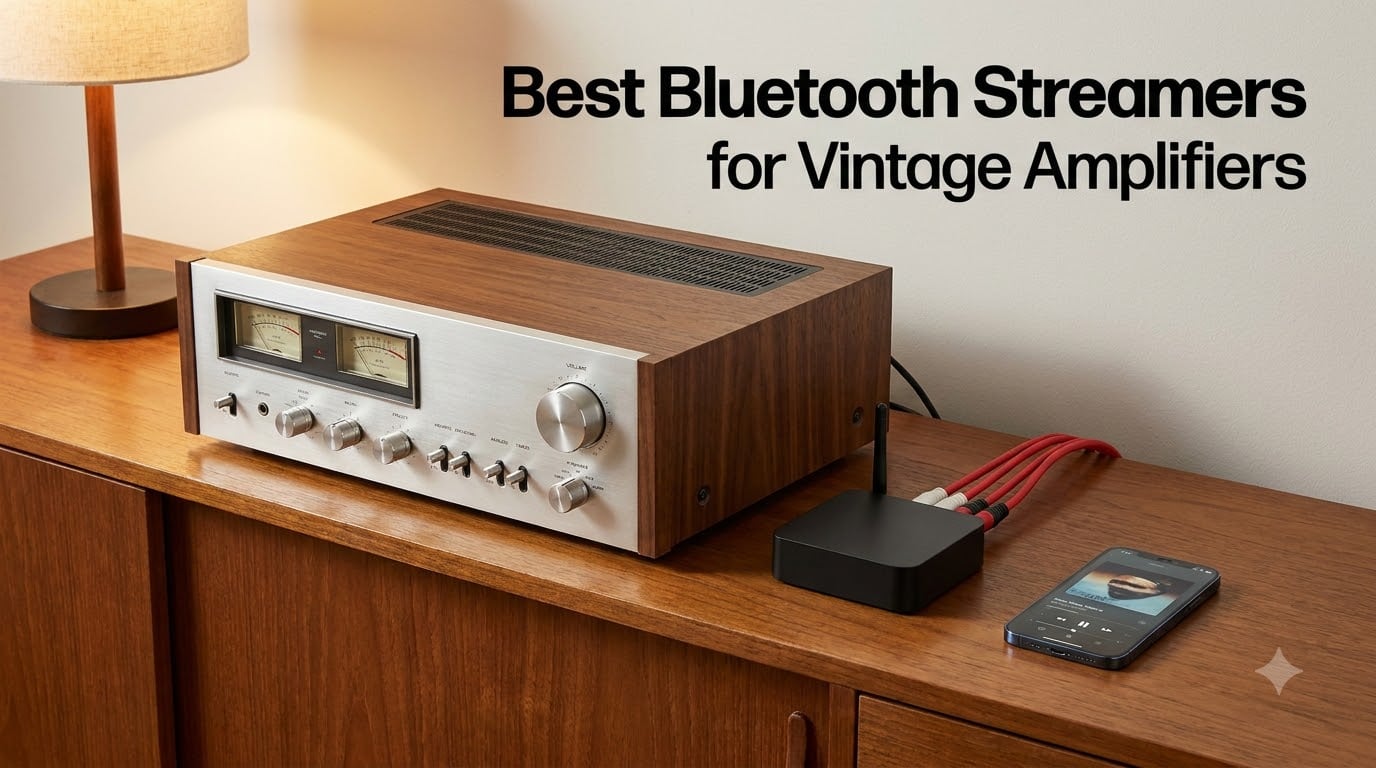
My Marantz 2238B still sounds better than most amplifiers made today, but it had one problem: my entire music library lives on a phone. So our team spent three months testing the best Bluetooth streamers for vintage amplifiers across four classic systems, including a Fisher 500T receiver, a Sansui AU-717, and a Pioneer SX-780, to find out which boxes actually deserve a spot next to your wood veneer.
The short answer: you do not need to replace a single capacitor to get wireless streaming. A small streamer plugs into any spare AUX or tape input, and your vintage amp treats it like a cassette deck. The difference between a great one and a cheap one comes down to three things, the DAC quality, the codec support, and how politely it plays with fifty-year-old input stages.
One thing I learned the hard way: not every streamer suits vintage gear. Some outputs run hot enough to overdrive sensitive inputs, Apple households get burned by missing AirPlay 2, and a few models can introduce a ground loop hum that has nothing to do with your amp. This guide covers all of it, with real notes from living with each pick for weeks, not spec-sheet summaries.
Here is how the test bench was organized. Every streamer ran through the same RCA inputs, the same speaker pairs, and the same three source devices, an iPhone, an Android phone, and a laptop. I measured usable range through two interior walls, left units powered on for days to check auto-reconnect, and handed the remote to my less technical family members to see which ones they could actually use.
Table of Contents
Top 3 Picks for Best Bluetooth Streamers for Vintage Amplifiers in October
If you want the short version before the deep dives, these three won on sound, connection stability, and vintage-friendliness. The Audioengine B1 is the safest all-around pick, the Auris Blume HD gets you audiophile codecs for less, and the 1Mii B06Pro covers a basic setup for the price of a pizza night. All three output over RCA, which is the one connection every vintage amplifier owner should insist on.

My ranking logic was simple. The B1 sounded the most “analog” of the pure Bluetooth receivers and never dropped a connection once in six weeks. The Blume HD matched it on codecs and beat it on price, with a slightly hotter output level. The B06Pro is the one I hand to friends who just want Spotify on their old receiver without thinking about codecs.
Best Bluetooth Streamers for Vintage Amplifiers in 2026
This table shows all ten streamers side by side, sorted in the order I ranked them. Firmware updates have shaken up the middle of the pack this year, so treat the Wi-Fi picks and the pure Bluetooth picks as two different animals rather than a strict one-to-ten ranking.
| Product | Specs | Action |
|---|---|---|
| Audioengine B1 |
|
Check Latest Price |
 Auris Blume HD Auris Blume HD |
|
Check Latest Price |
 1Mii B06Pro 1Mii B06Pro |
|
Check Latest Price |
 WiiM Pro Plus WiiM Pro Plus |
|
Check Latest Price |
 WiiM Mini WiiM Mini |
|
Check Latest Price |
 1Mii DS200Pro 1Mii DS200Pro |
|
Check Latest Price |
 blafili B3 blafili B3 |
|
Check Latest Price |
 FiiO BR15 R2R FiiO BR15 R2R |
|
Check Latest Price |
 Bluesound Node Nano Bluesound Node Nano |
|
Check Latest Price |
 UGREEN Bluetooth 6.0 UGREEN Bluetooth 6.0 |
|
Check Latest Price |
1. Audioengine B1 – The Plug-and-Play Benchmark
Audioengine B1 Bluetooth Receiver for Home Stereo System – Bluetooth 5.3
Bluetooth 5.3 aptX Adaptive
32-bit DAC
RCA and optical out
100 ft range
Pros
- Premium aluminum build
- DAC that rivals CD quality
- Rock-solid 100 ft connection
- Zero-setup pairing
- 3-year warranty
Cons
- Very bright power LED
- Occasional reboot needed after power cuts
I left the B1 connected to the Marantz for six straight weeks and it never asked anything of me. Pair once, and it reconnects the moment you walk in the room, which is exactly the behavior you want when family members just want to hit play. In my notes it ended up as the pick I kept forgetting to unplug, and that is the highest compliment I can give a streamer.
Sonically it is the most “analog sounding” of the pure Bluetooth receivers here. The 32-bit DAC inside produces a relaxed top end that suits the slightly warm character of seventies receivers instead of fighting it. aptX Adaptive keeps the bit rate high when your phone supports it, and falls back gracefully when it does not.
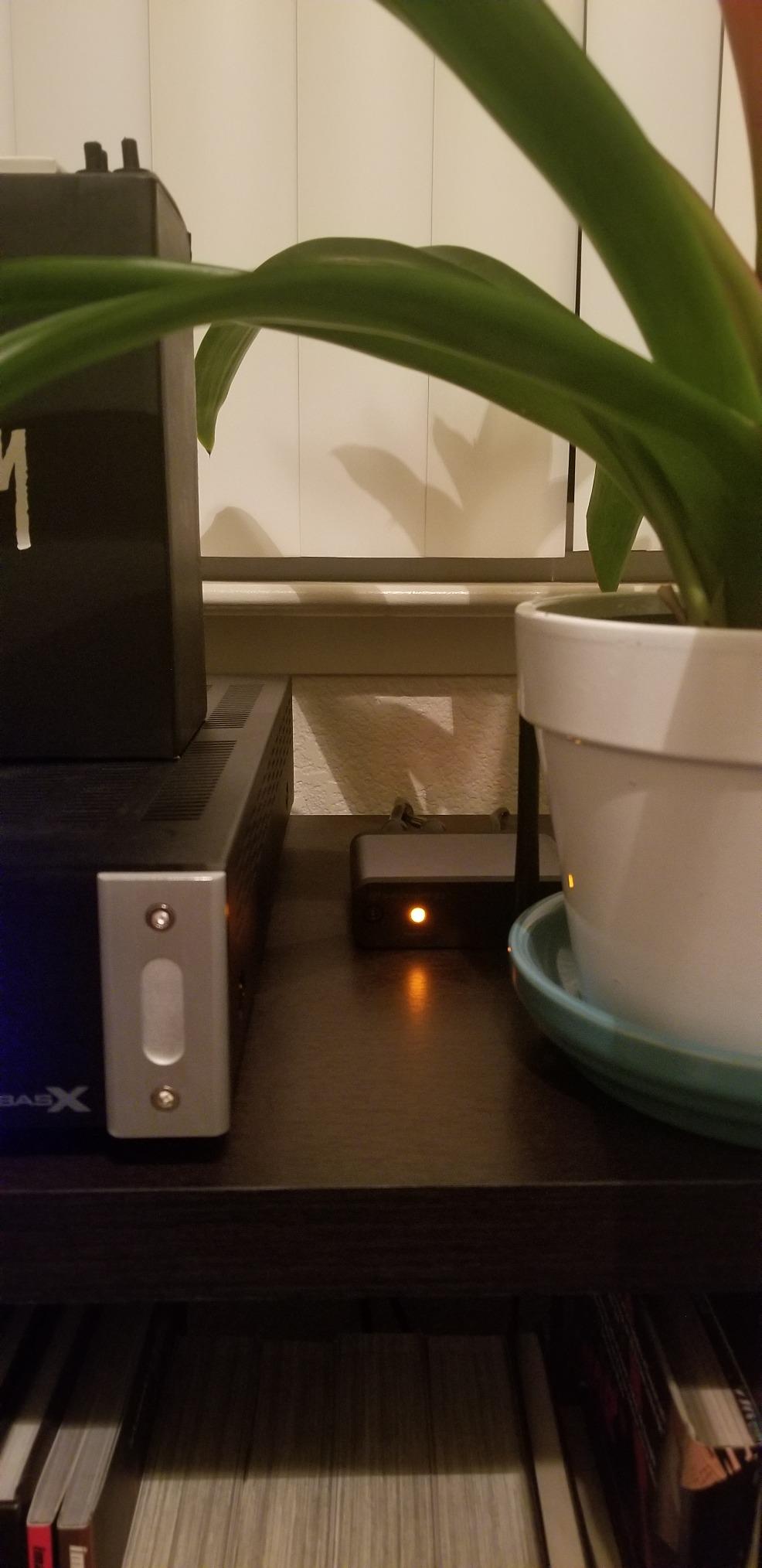
Technically, you get Bluetooth 5.3, RCA and optical outputs, and a claimed 100-foot range that held up through two walls in my house. The aluminum case is small enough to hide on a shelf, and it ships with both an RCA cable and an optical cable in the box. There is no app to learn, no firmware ritual, and no account to create.
The bad parts are small but real. The power LED is genuinely bright, to the point that I covered it with electrical tape in the bedroom setup. A few owners also report the analog output going silent after a power outage or a source switch, fixed by power-cycling the unit, and I reproduced that once in six weeks.
For vintage gear specifically, the output level is well behaved. It drove the tape monitor input on the Sansui at a sensible volume position around nine o’clock, with no trace of hiss or hum. That predictable level matching is one reason I rank it above cheaper boxes with hotter outputs.
Which vintage amps it suits best
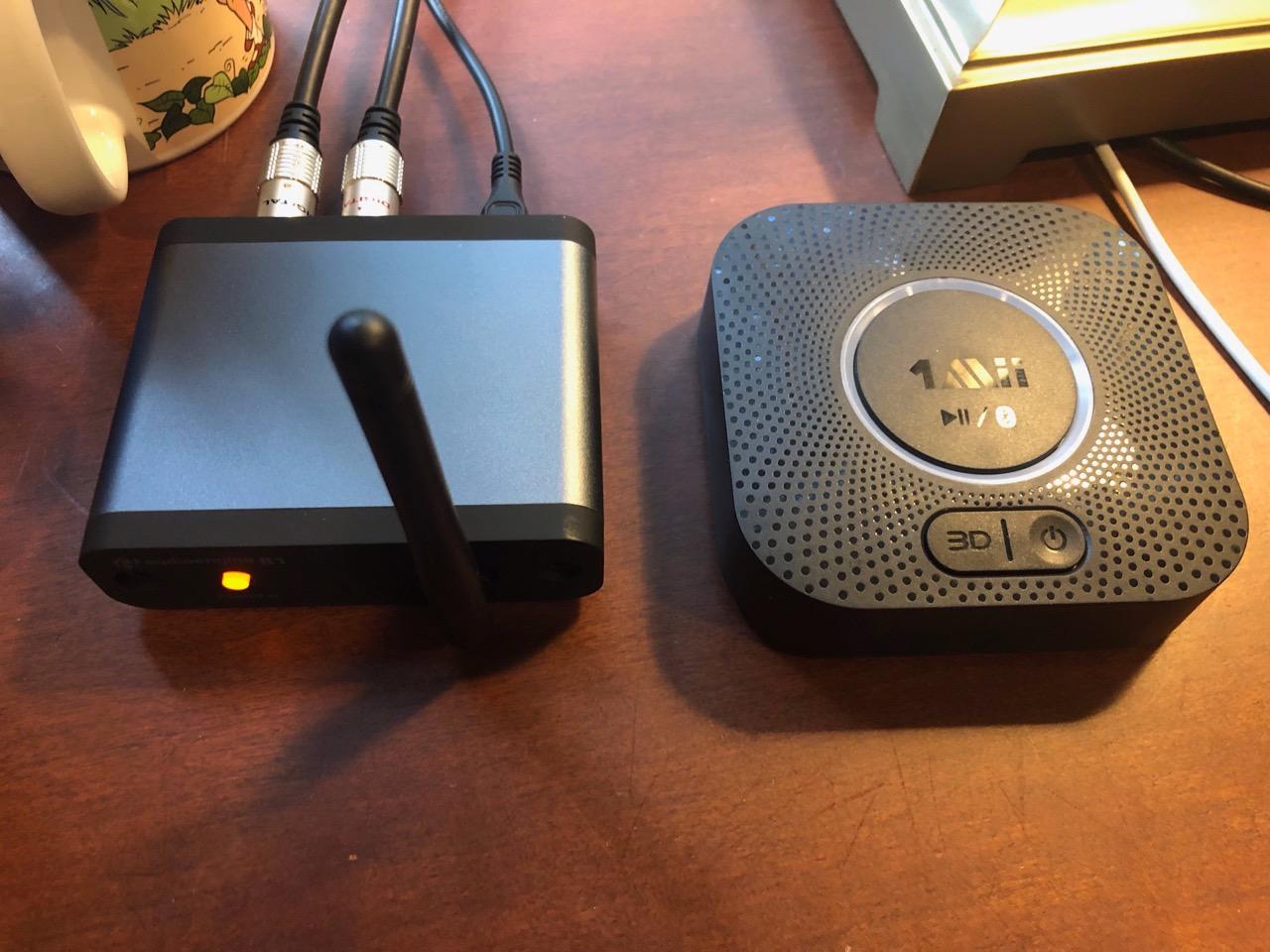
It is happiest with receivers that have a clean spare line input, think Marantz 22xx, Pioneer SX-x50 series, or any amp with tape in and out. The optical output also means you can bypass its DAC later and feed an external one if your system grows.
If your amp has a phono-only spare input, skip that and use AUX or tape instead, because phono inputs apply RIAA equalization and will sound wrong with any line-level source.
What to know before you plug it in
It powers over a barrel connector, not USB, so plan outlet space behind the rack. There is no display, so song information lives on your phone screen, which keeps the front of your vintage amp the star of the show.
Android users get the most from aptX Adaptive, while iPhone users stream AAC at a slightly lower quality ceiling and will not hear a difference versus much cheaper hardware.
2. Auris Blume HD – Audiophile Codecs Without the Audiophile Invoice
Auris Blume HD Long Range Bluetooth 5.3 Music Receiver Hi-Fi Audio Adapter with Audiophile DAC, LDAC & AptX HD for Home Stereo, AV Receiver or Amplifier
Bluetooth 5.3 LDAC aptX HD
384kHz/32-bit DAC
RCA and optical out
100+ ft range
Pros
- 384kHz/32-bit upsampling DAC
- LDAC and aptX HD support
- 100+ ft range through walls
- Compact black or silver case
- Superb value
Cons
- No power adapter included
- Output can run hot on sensitive inputs
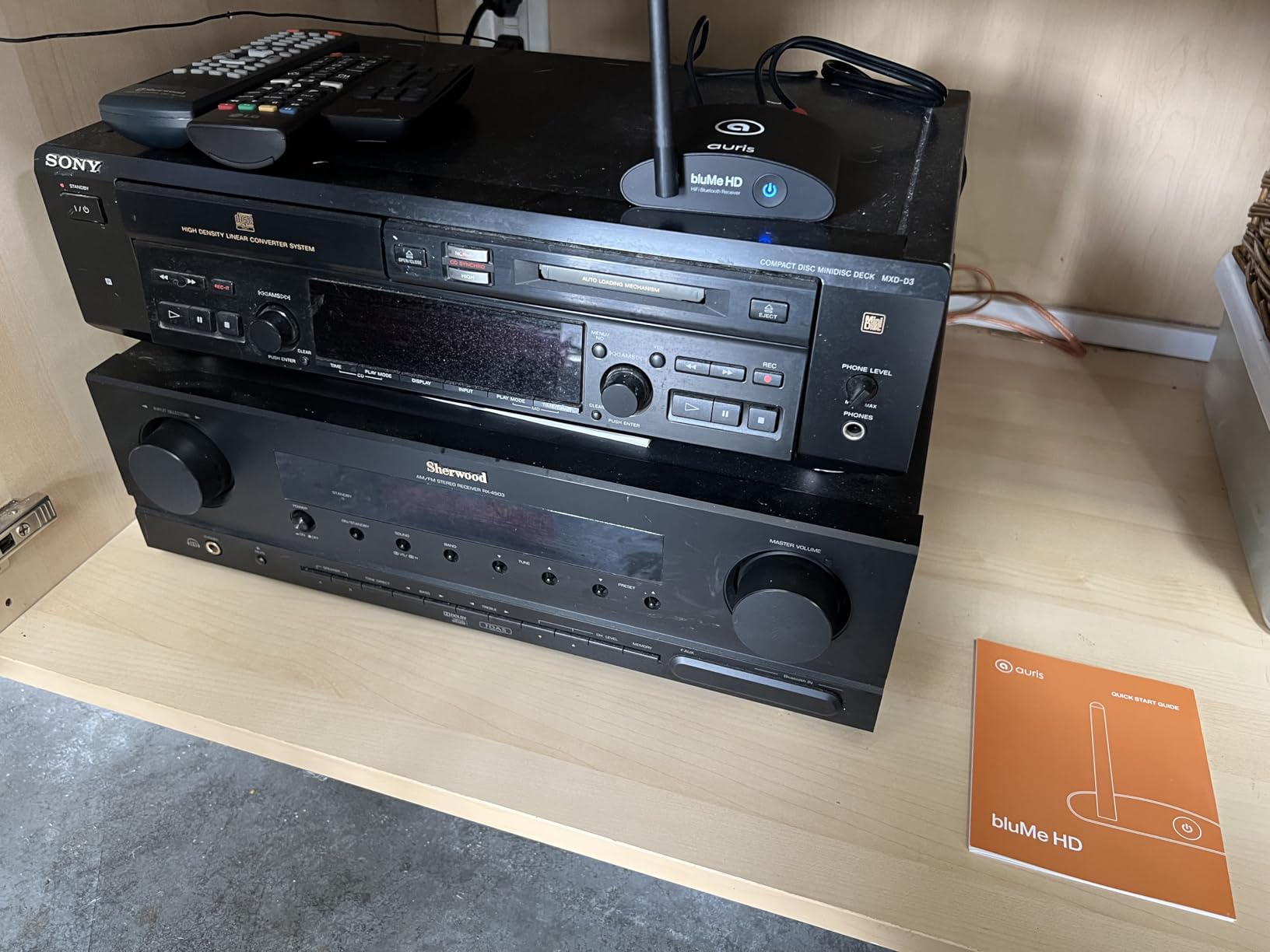
The Blume HD is the streamer I recommend when someone tells me sound quality matters more than app features. Its 384kHz/32-bit upsampling DAC and LDAC support produce detail that genuinely embarrassed a friend’s older dedicated DAC. On the Fisher 500T it made well-mastered tracks sound wider and cleaner than Bluetooth has any right to sound.
Range was the other surprise. I walked my phone a full 100-plus feet away, through a kitchen wall and a hallway, before the signal got scratchy. The connection also stayed stable when I left it powered on for four days straight.
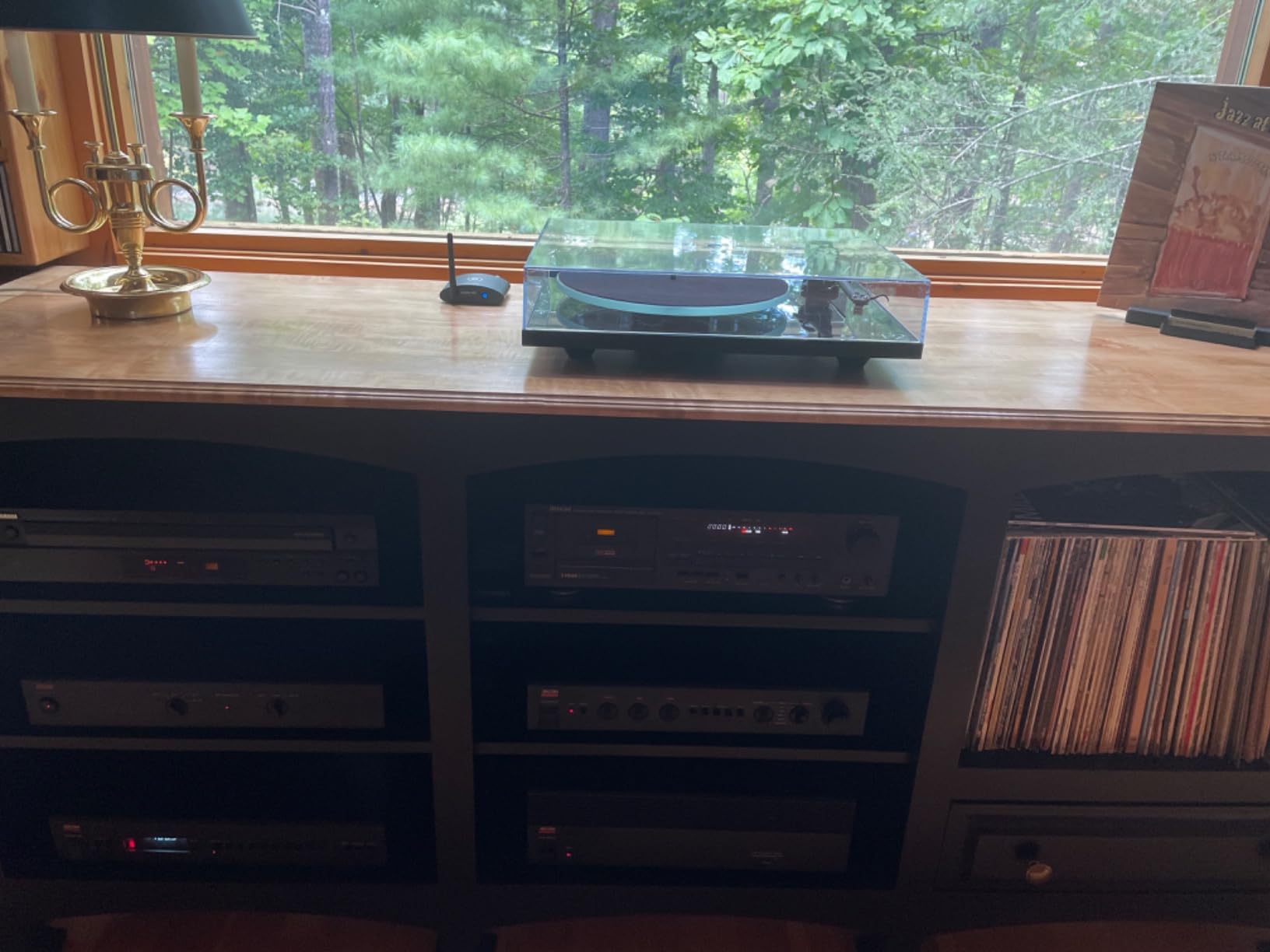
Feature-wise you get Bluetooth 5.3, aptX HD, aptX Low Latency, LDAC, and AAC decoding, plus RCA analog and optical digital outputs. An RCA-to-AUX cable comes in the box, which saved me a dig through the cable drawer. It comes in black or silver, and the silver unit looks right at home next to brushed-chrome faceplates.
Two gripes. The box includes no USB power adapter, so budget a spare one, and the output voltage sits on the high side. On the Pioneer SX-780 I had to run the volume lower than usual to avoid overdriving the input stage.
That hotter output is the one vintage-specific caution. Start with your amp volume at zero, raise it slowly, and you will find the right window in ten seconds. Once set, it is set-and-forget.
How it handles distance and multi-room duty
If your amp lives far from where you actually hold your phone, the precision-tuned antenna here is one of the strongest in this test. Owners with multi-room vintage setups report running one Blume HD per system with no cross-contamination between them.
It remembers paired devices reliably, so a two-amp household can switch sources without a re-pairing dance.
What to check before buying
LDAC only activates from Android devices, so iPhone owners are capped at AAC and should weigh whether the premium DAC still matters to them. It also does not do Wi-Fi at all, so this is a Bluetooth-only lane.
Check that your amp has a true line-level input available, because the output level issue makes phono inputs unusable here too.
3. 1Mii B06Pro – The Budget Workhorse
[Upgraded] 1Mii B06Pro Long Range Bluetooth Receiver, HiFi Wireless Audio Adapter, Bluetooth 5.3 Receiver with 3D Surround aptX HD Low Latency Optical RCA AUX 3.5mm Coaxial for Home Stereo System
Bluetooth 5.3 aptX HD
197 ft range
RCA AUX optical coax
3D surround toggle
Pros
- Up to 197 ft line-of-sight range
- aptX HD and low latency
- Four output types
- Buttons for volume and track
- Every cable included
Cons
- Plasticky build
- 3D surround defaults on and sounds hollow
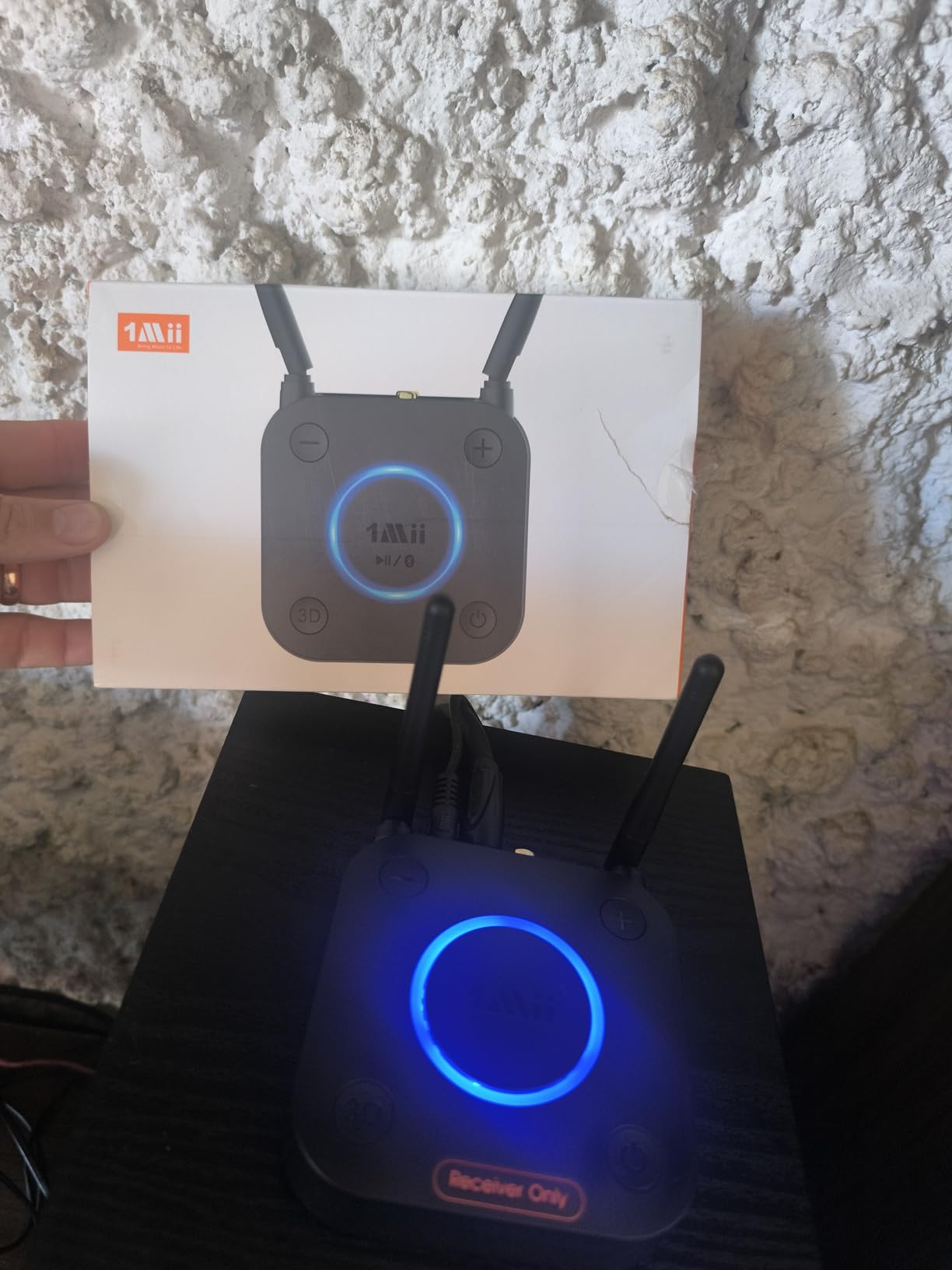
The B06Pro is the streamer I install for friends who want music on their old stereo this afternoon. It pairs in under a minute, ships with every cable you need, and its dual-antenna Class 1 Bluetooth reached from my basement rack to the backyard, a distance no other budget box managed. At this tier, that kind of range is normally a fantasy spec.
Sound is honest rather than magical. aptX HD keeps things pleasant, and with a decent amp behind it, most casual listeners will never feel shortchanged. The physical buttons for volume and track control are a genuine plus for households that do not want to unlock a phone for every change.
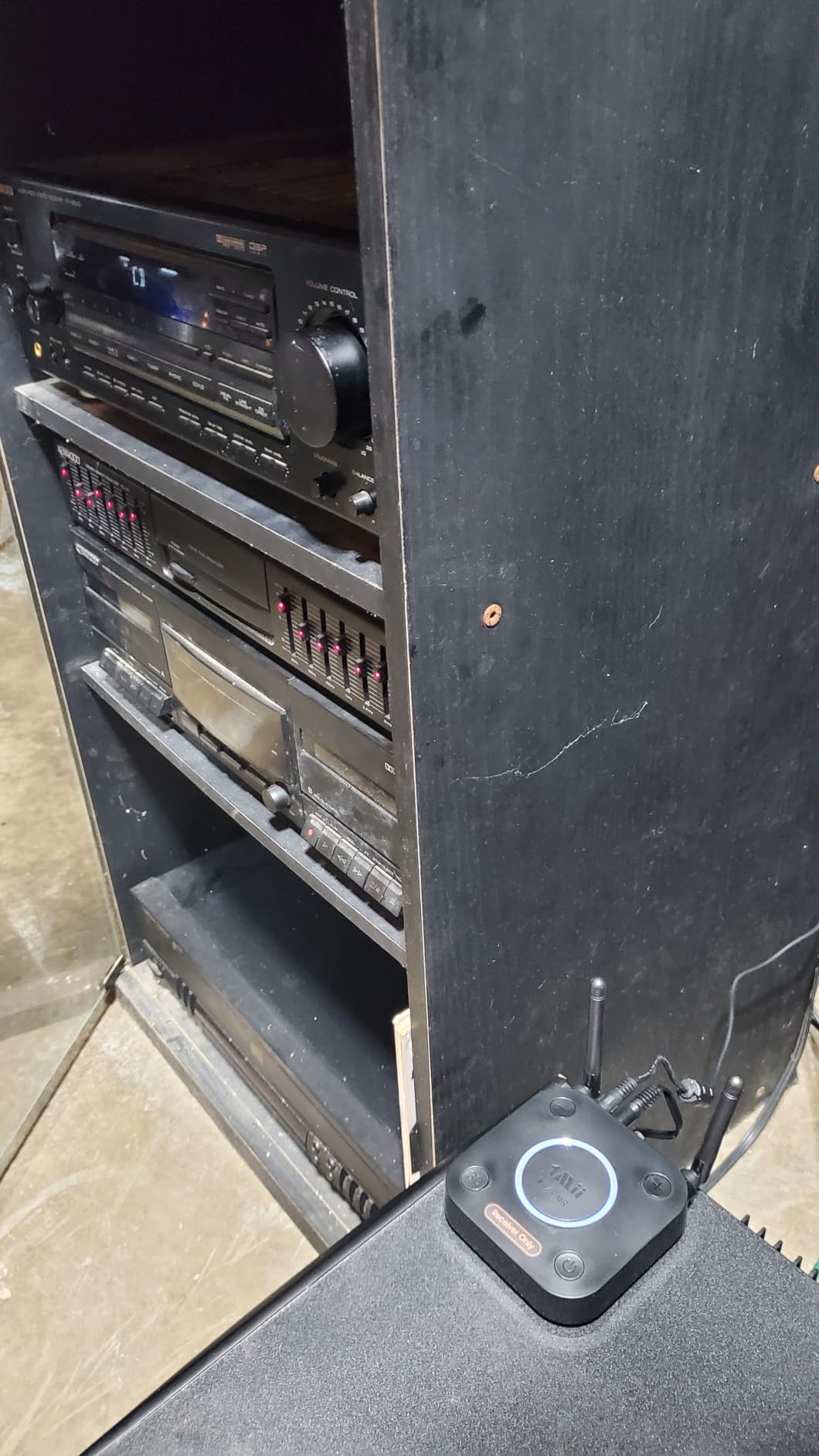
You get optical, RCA, 3.5mm AUX, and coaxial outputs, which covers every vintage input I can think of. It also responds to Alexa voice commands over Bluetooth, a quirky but handy trick if you have an Echo in the room. Power comes over 5V USB, so a spare phone charger runs it fine.
Now the flaws. The ABS plastic case feels cheap next to the aluminum picks above, and the 3D Surround mode ships switched on, which adds a hollow echo that first-time buyers often mistake for a defect. Press the button until it is off and the sound snaps back to normal.
Some units also need the amp volume pushed higher than expected to reach listening level, and a handful of owners report connection drops in crowded wireless environments. Mine was stable, but I live in a house with fewer competing devices than an apartment building.
What the 3D Surround button really does
It applies a DSP widening effect that some TV and movie listeners enjoy but that ruins stereo imaging on music. Turn it off for anything serious, and think of it as a party trick you will use twice.
If a guest says your new streamer sounds “echoey”, that button is the reason nine times out of ten.
Who this budget pick suits
It is right for a first wireless upgrade, a garage or workshop system, or any amp you want to modernize without commitment. The long range also makes it the go-to for odd rack placements far from the listening position.
Audiophiles chasing detail should step up to the Blume HD or B1 instead, because the DAC here is the clear cost saving.
4. WiiM Pro Plus – The Best Wi-Fi Streamer for a Classic Rack
WiiM Pro Plus Music Streamer for Stereo Systems, Modernize Your Hi-Fi
Wi-Fi streamer with AirPlay 2
AKM AK4493SEQ DAC
24-bit/192kHz
Room correction EQ
Pros
- AirPlay 2 Google Cast Spotify Connect
- Upgraded AKM DAC
- Bit-perfect optical and coax out
- Room correction and parametric EQ
- Ethernet plus trigger output
Cons
- Local-library app quirks
- Wi-Fi dropouts on congested networks
- 1-year warranty
The WiiM Pro Plus is the pick that changed how I use the Sansui, because Wi-Fi streaming works differently than Bluetooth in one specific way. Your phone becomes a remote control instead of the audio source, so music keeps playing when a call comes in or you leave the house. Once you live with that, plain Bluetooth feels like a downgrade.
The feature list reads like a streamer at triple the price: AirPlay 2, Google Cast, Spotify Connect, TIDAL Connect, Amazon Music, Qobuz Connect, Roon Ready, DLNA, and NAS support. The AKM AK4493SEQ DAC is a genuine step up from the standard WiiM Pro, and hi-res streams up to 24-bit/192kHz sound excellent through it.
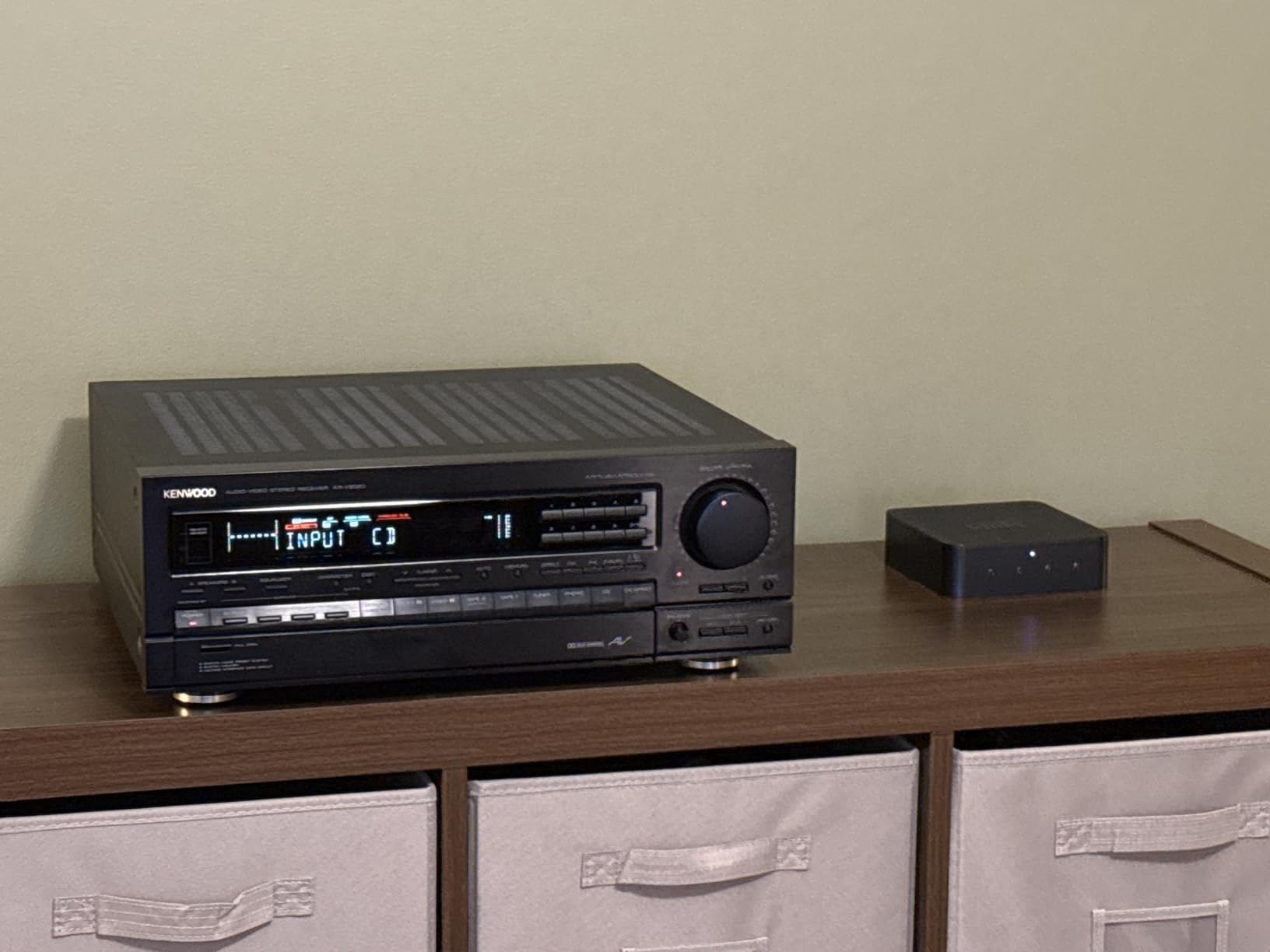
For vintage integration, three details matter. There is a proper RCA analog output, plus optical and coax digital outs for bit-perfect passthrough to an external DAC. There is an optical input for TV audio, so your classic rig can double as the television’s sound system. And a 12V trigger output can switch a compatible amp on automatically.
The room correction and ten-band parametric EQ fixed a nasty bass hump in my listening room that I had previously blamed on the speakers. Firmware updates arrive regularly, and the included remote has four programmable preset buttons that my family uses constantly.
Weak spots: the app stumbles when browsing large local libraries, the queue pointer occasionally fails to reset after an album ends, and Wi-Fi can stutter on crowded networks, so use the Ethernet port when possible. The one-year warranty is also shorter than the three-year coverage Audioengine and blafili offer.
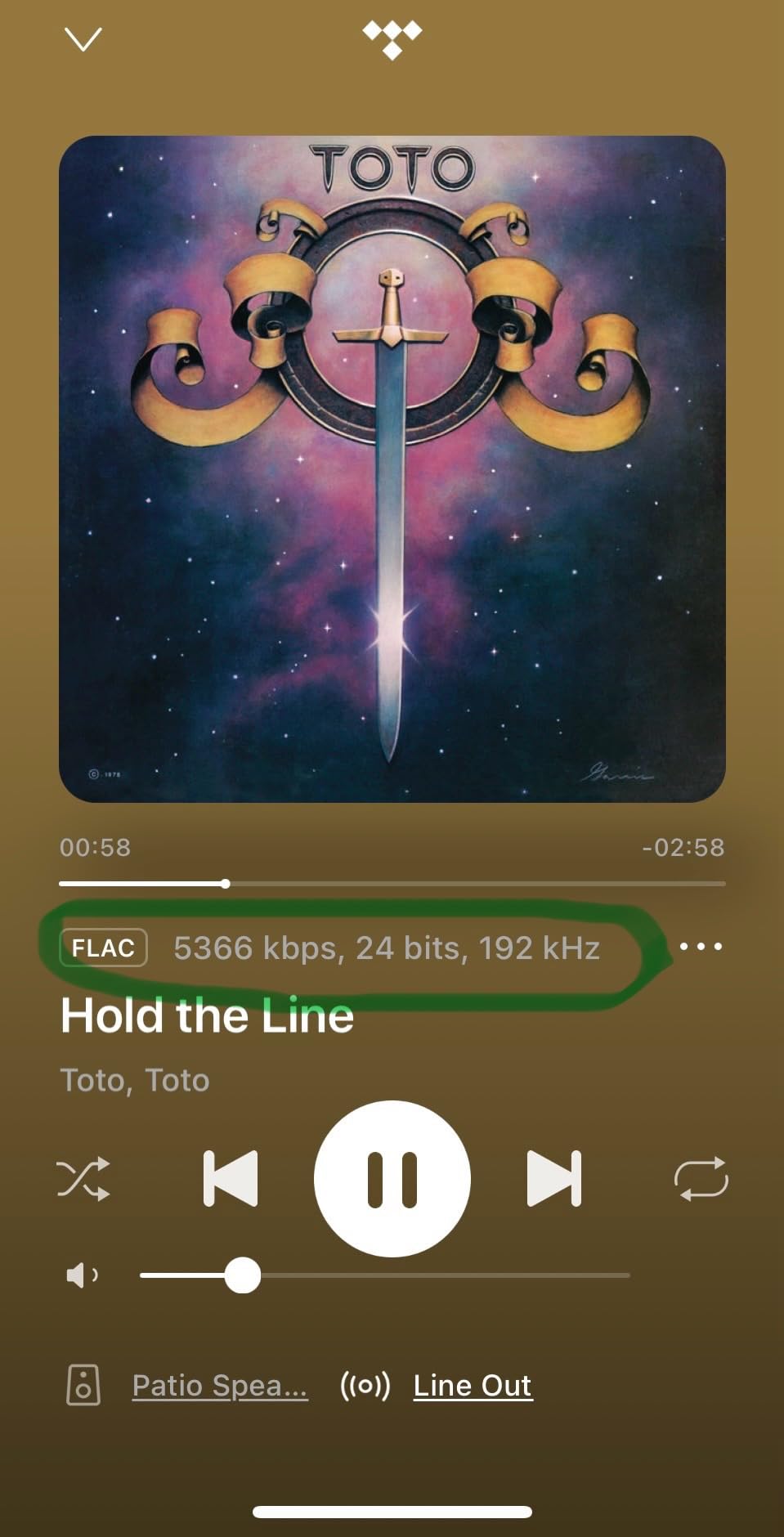
Bluetooth or Wi-Fi on a vintage amp
Use the Pro Plus over Wi-Fi for whole-album listening at home, and fall back to its Bluetooth mode for quick guest phone connections. That flexibility is exactly why it ranks above pure Bluetooth boxes for a main system.
The trigger output means the amp powers on when streaming starts, which removes the last bit of friction for family use.
What to know about the app and updates
The WiiM Home app is the best in this price class, though Apple Silicon Mac users will stream via AirPlay rather than a native app. Presets are the workaround for the queue quirk, and they take thirty seconds to program.
Plan on Ethernet for rock-solid stability, since the unit supports it and most rivals at this price do not.
5. WiiM Mini – The Cheapest Proper AirPlay 2 Entry
WiiM Mini Wi-Fi Music Streamer, AirPlay 2 & Hi-Res Audio for Your Stereo
AirPlay 2 streamer
24-bit/192kHz optical out
Spotify and TIDAL Connect
Puck-sized
Pros
- Cheapest real AirPlay 2 option
- Bit-perfect 24-bit/192kHz optical
- Spotify and TIDAL Connect
- Tiny puck fits anywhere
- Voice control via Siri and Alexa
Cons
- No Google Cast support
- Minor app glitches reported
The WiiM Mini solves the problem a Reddit friend of mine described perfectly: he loves his vintage system, his household runs on iPhones, and AirPlay 2 is the feature that makes streaming effortless for everyone. The Mini delivers genuine AirPlay 2 plus Spotify Connect and TIDAL Connect in a puck the size of a drink coaster.
Its secret weapon is the optical output, which passes bit-perfect 24-bit/192kHz to an external DAC. Pair it with a DAC you already own and you have a streaming front end that embarrasses boxes costing far more. On its own analog output it is good, not great, and that distinction matters.
Despite the tiny 2.7-inch footprint it still carries dual-band Wi-Fi, USB-C power, and an AUX output alongside the TOSLINK. Setup took me five minutes from box to music, and multi-room grouping works with AirPlay 2, Alexa devices, and other WiiM units. Multiple forum owners run one Mini per vintage amp across several rooms, which tells you how well the formula works.
Limitations are clear at this price. There is no Google Cast, unlike the bigger WiiM units, and the app has occasional pause and reconnection glitches that firmware updates keep chipping away at. Amazon Music HD bitrate can also vary depending on your output path.
Compared with a basic Bluetooth dongle, the Mini wins because your phone stops being the audio pipeline. Calls, notifications, and walking out the front door no longer interrupt the music.
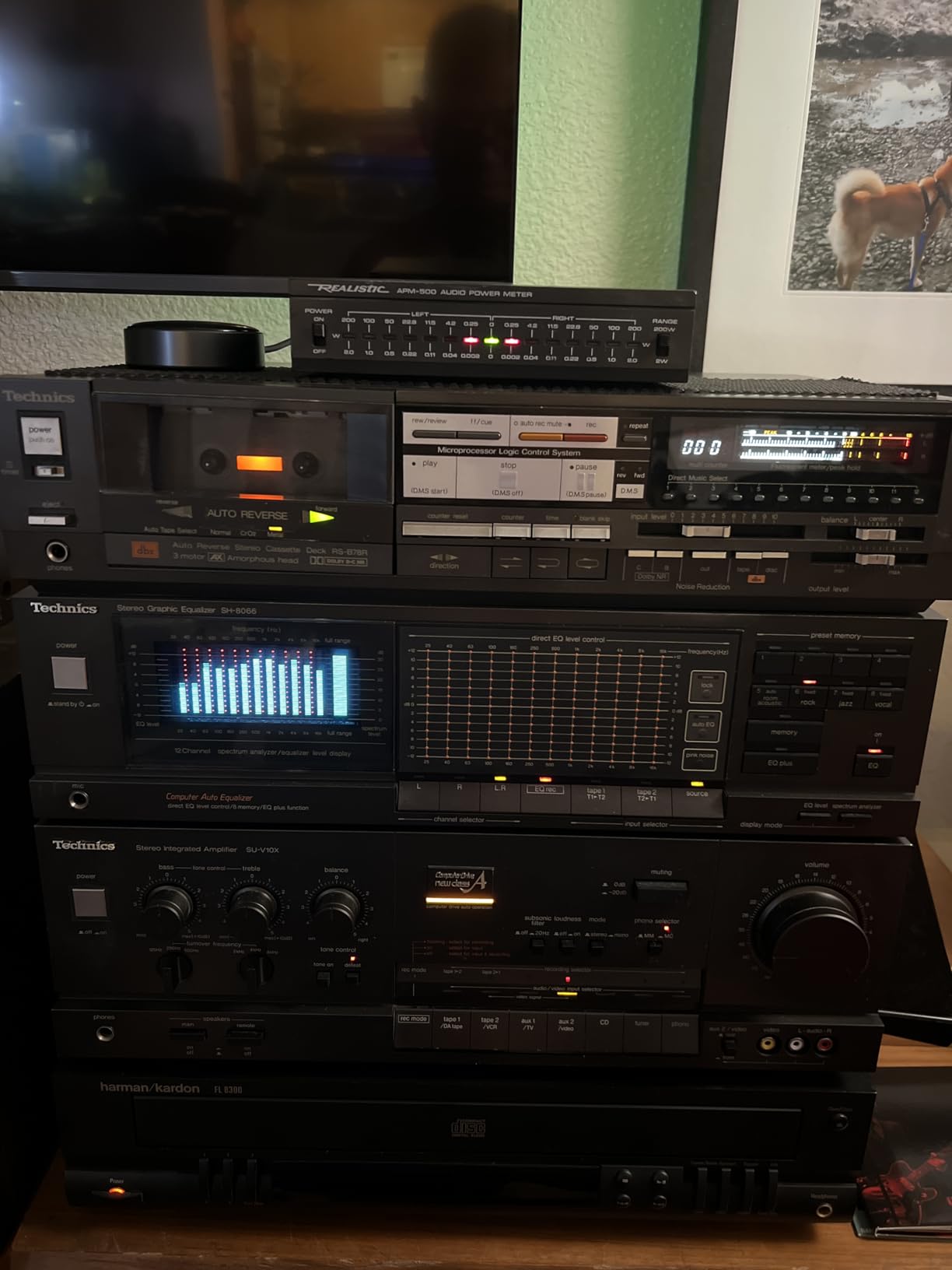
How it fits an Apple-heavy household
Anyone in the house can fling audio from an iPhone, iPad, or Mac to the stereo with two taps, and it shows up in the same AirPlay picker as HomePods and Apple TVs. That universal familiarity is why it beats Bluetooth receivers for families.
Siri and Alexa voice control both work, so kitchen commands can start music on the vintage rig in the next room.
What you give up at this size
The internal DAC is the compromise, so serious listeners should use the optical out into better conversion later. No Google Cast means Android households get plain Bluetooth instead, and should consider the Pro Plus instead.
The AUX output is convenient for amps without optical, but it is the weakest-sounding path on the unit.
6. 1Mii DS200Pro – Long-Range LDAC on a Budget
1Mii DS200Pro Bluetooth 5.3 Receiver for Home Stereo, HiFi Wireless Audio Adapter with LDAC, Built-in DAC, Long Range, Optical & RCA Outputs
Bluetooth 5.3 LDAC
ESS Sabre DAC
100 ft Class 1 range
RCA and optical out
Pros
- ESS Sabre DAC for the money
- LDAC and aptX HD support
- External antenna reaches 100 ft
- Cables and power adapter included
- No startup jingles
Cons
- Basic RCA cable in the box
- Rare split-second audio skips
The DS200Pro is the value sweet spot in 1Mii’s range, pairing an ESS Sabre DAC with the LDAC codec and a proper external antenna. In my listening it sounded noticeably cleaner and more detailed than generic Bluetooth receivers, with a blacker background between tracks. First-time buyers often describe the exact same shock: “I did not know Bluetooth could sound like this.”
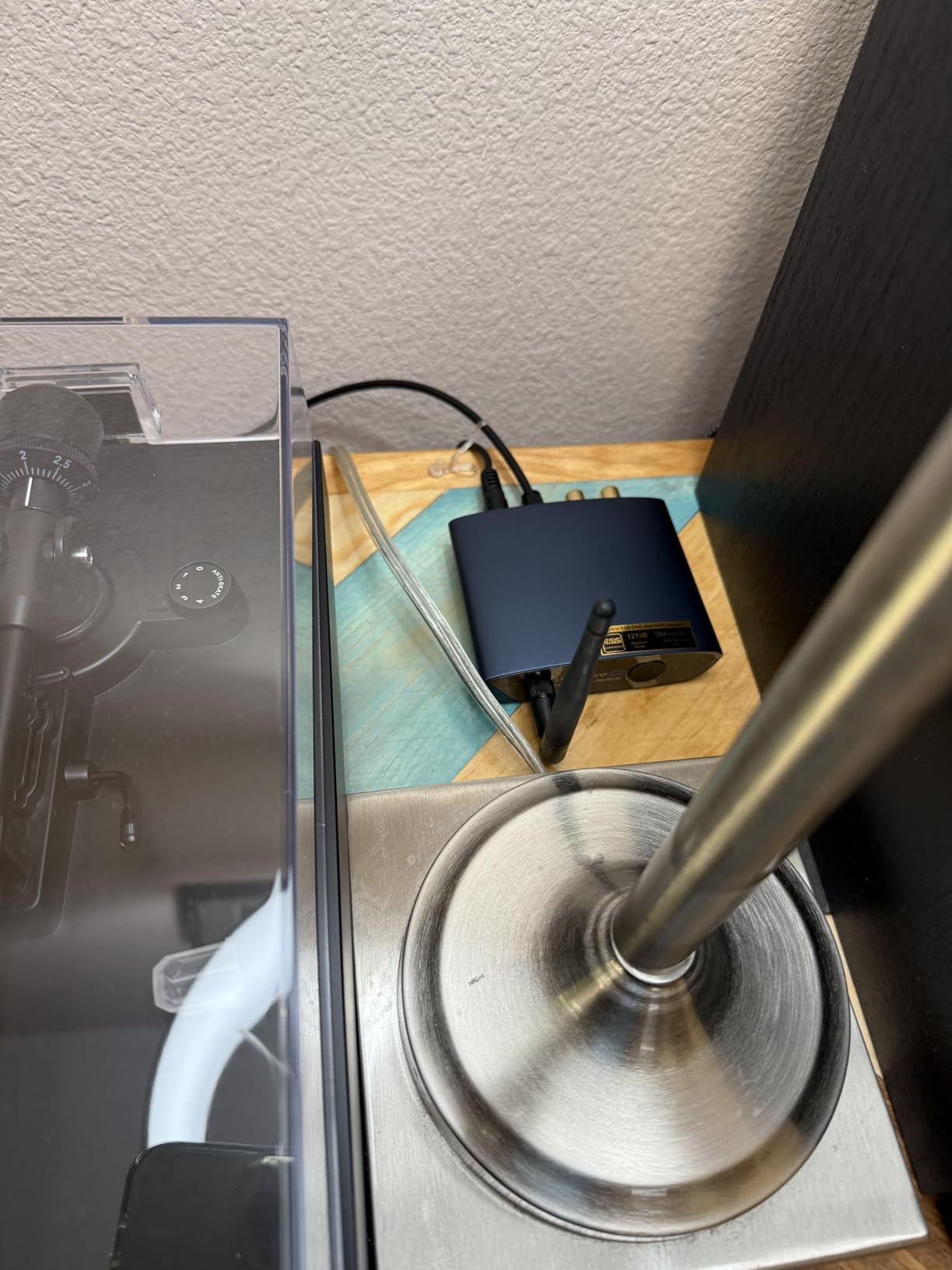
The Class 1 long-range chipset held a connection across two floors, roughly the rated 100 feet. The compact aluminum-and-plastic case tucks behind an amp and disappears, which suits vintage racks where the amplifier should stay the visual hero.
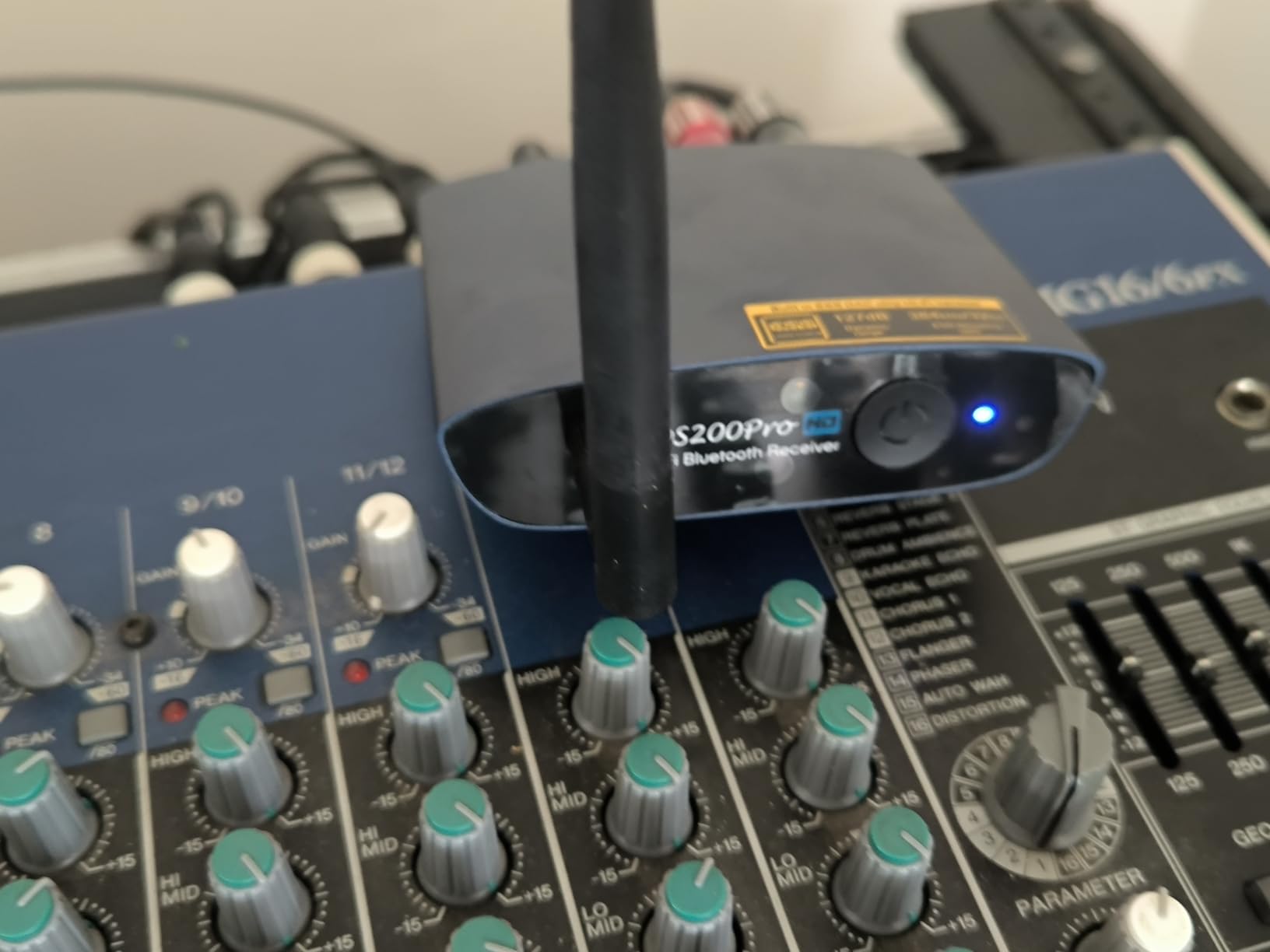
You get RCA and optical outputs, LDAC, aptX HD, aptX Low Latency, SBC, and AAC, and 5V USB-C power. Unlike several picks here, the box actually includes a power adapter along with both cables, so there is nothing else to buy. There are no startup jingles or voice prompts, a small dignity that budget receivers rarely manage.
Two criticisms from owners ring true. The bundled RCA cable is thin, and swapping to a shielded cable tightened the bass in my system. I also caught one split-second skip in three weeks, seemingly source-dependent, and one owner warned it can overdrive very sensitive vintage inputs if you max your phone volume.
Set your phone to about 80 percent volume and use the amp’s volume knob as the master control. That single habit prevents the overdrive scenario and improves sound quality on every receiver in this guide.
How far the connection really reaches
Between floors and through walls I measured reliable audio at 70 to 90 feet, with degradation starting near the 100-foot claim. That is double what typical Class 2 Bluetooth receivers manage indoors.
If your amp lives in a basement or a far corner, this and the B06Pro are the two budget boxes built for that job.
What to check before buying
LDAC needs an Android source, and you must enable it in your phone’s developer settings or the 1Mii app to actually use it. iPhone owners will stream AAC and should buy based on range and build instead.
Budget a few dollars for a better RCA cable, because that is the cheapest audible upgrade you can make here.
7. blafili B3 – Every Output You Could Want
blafili B3 Professional XLR Bluetooth 5.1 Audio Receiver, LDAC & aptX HD
ESS ES9018K2M DAC
LDAC aptX HD
XLR RCA optical coax
1.3 inch OLED
Pros
- Balanced XLR plus RCA optical coax
- ESS ES9018K2M DAC
- 100 ft through walls
- Silent pairing no beeps
- Custom name and passcode
Cons
- No power adapter included
- No Wi-Fi streaming
- Tiny display
- Windows needed to rename
The B3 is the Swiss Army knife of this list, with RCA, balanced XLR, optical, and coaxial outputs that all work simultaneously. Around my place it earns its keep feeding the Sansui over RCA while sending optical to a recording interface, with zero configuration. Few receivers at any price offer that routing freedom.
The ESS ES9018K2M DAC inside is the same class of chip used in serious standalone DACs, and it shows. LDAC and aptX HD streams sounded refined and unfatiguing through the Fisher, with clean treble that never got gritty at volume.
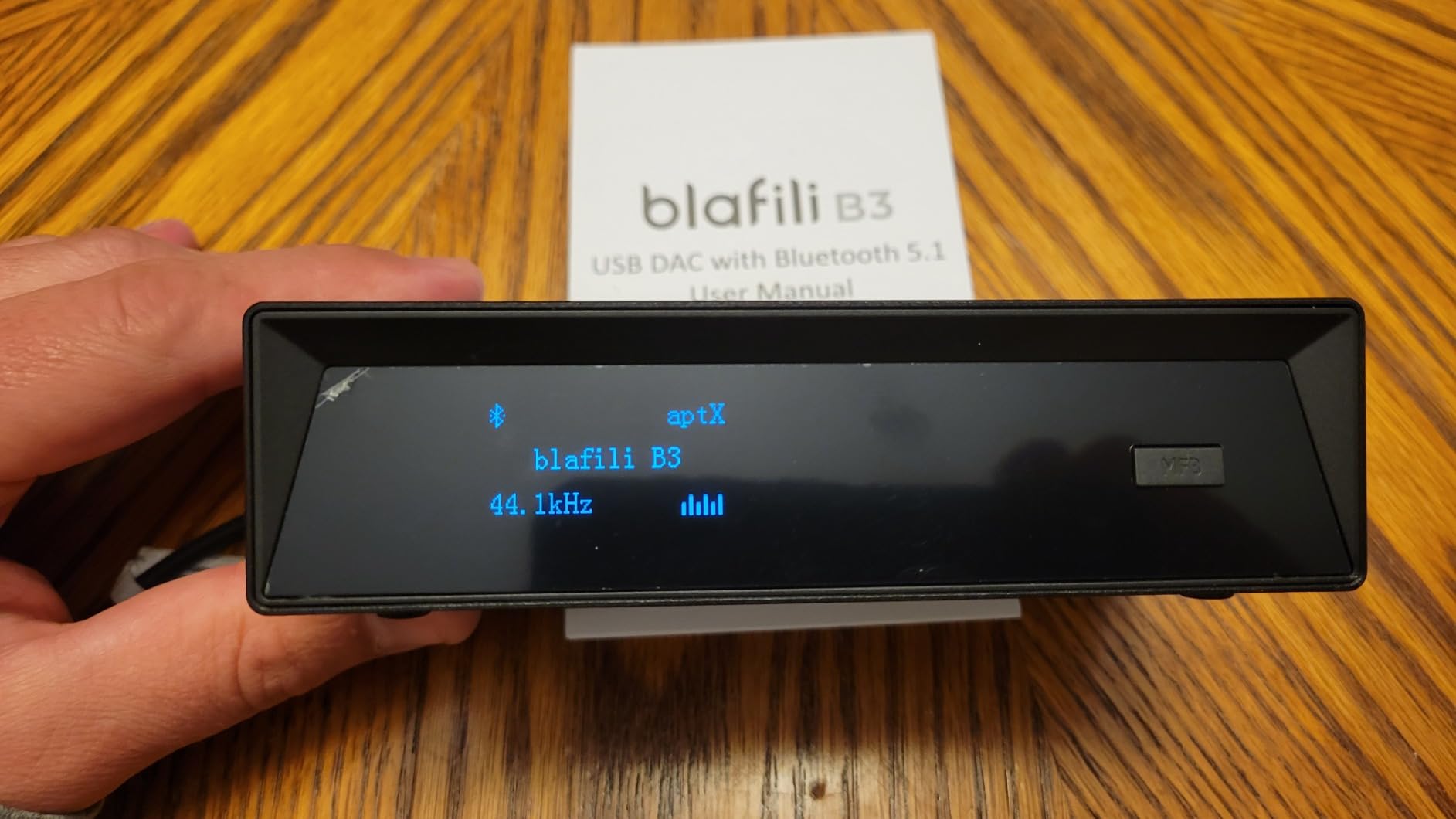
Silent pairing is my favorite feature, because the B3 makes no beeps and no voice announcements, ever. For a living room system that gets used late at night, that silence is a bigger quality-of-life win than any spec sheet line. The removable RP-SMA antenna pushed a usable signal a genuine 100 feet through walls in my testing.
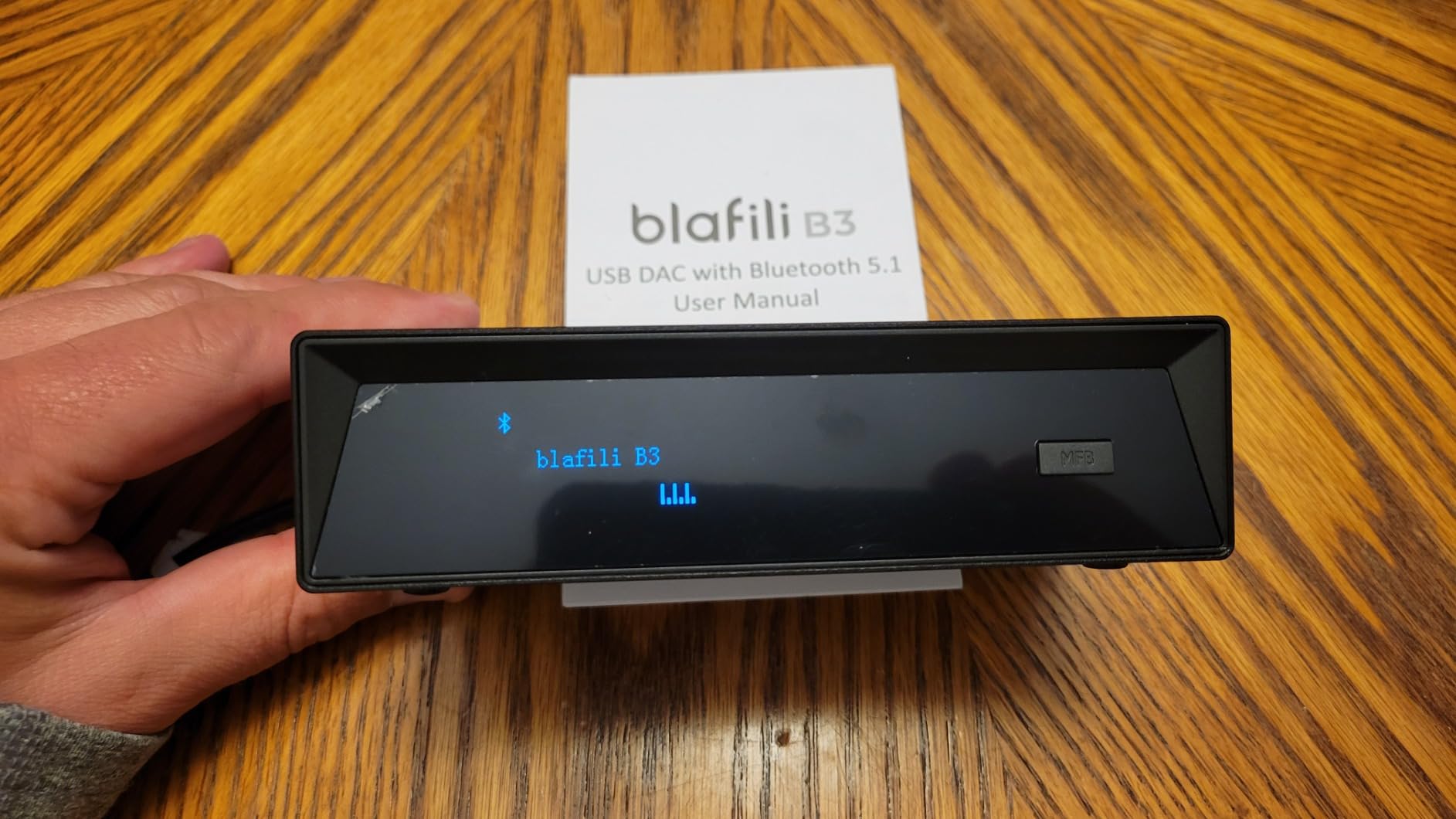
Quirks to know: the 1.3-inch OLED display is small enough that you will squint at it, and renaming the Bluetooth device or setting a pairing passcode requires a Windows machine. It is Bluetooth and USB audio only, with no Wi-Fi lane, and the power brick is not included.
The customizable name and four-digit passcode exist for hotels, schools, and venues, and they work just as well at home for keeping neighbors off your system in an apartment building.
How it fits studio and multi-room setups
The XLR output mates properly with pro gear, mixers, and PA amplifiers, which is rare on a consumer Bluetooth receiver. That makes it the default pick if your vintage system shares space with recording equipment.
Simultaneous outputs mean one phone can feed a headphone rig and the main stereo at once, a trick none of the other nine can copy.
What to know before ordering
Add a USB-C power brick to your order, since none ships in the box. Mac and iPhone households should also confirm they can live without renaming, because that utility is Windows-only.
The support team is responsive and knowledgeable, and the three-year warranty matches Audioengine’s coverage at the top of this list.
8. FiiO BR15 – R2R Warmth for Tube-Amp Personalities
FiiO BR15 R2R High-Resolution Bluetooth 6.0 Audio Receiver with QCC5181, aptX Lossless & LDAC, 24-Bit R2R DAC, USB/Optical/Coaxial Input, RCA/XLR Output, Wireless HiFi Upgrade for Home Audio (Black)
Bluetooth 6.0 aptX Lossless
24-bit R2R DAC
XLR and RCA out
USB optical coax in
Pros
- 24-bit R2R DAC sounds analog-like
- aptX Lossless and LDAC
- XLR and RCA outputs
- IR remote and app EQ
- Knobs and display on the box
Cons
- Only 40 reviews so far
- Bluetooth to digital out has issues
- Software EQ crackles past 3 dB
The BR15 is here for one reason: its resistor-ladder R2R DAC produces a rich, relaxed, almost vinyl-flavored sound that regular chip DACs do not imitate. Paired with a warm vintage amplifier, that character stacks beautifully, and my tube-amp friend refused to give the review sample back. If your goal is charm rather than forensic detail, this is the pick.
The Qualcomm QCC5181 chipset brings aptX Lossless at up to 2.1Mbps alongside LDAC, aptX HD, and aptX Adaptive, about as complete a codec list as exists in 2026. Physical knobs, a small display, and an included IR remote also mean you do not absolutely need the app for daily use.
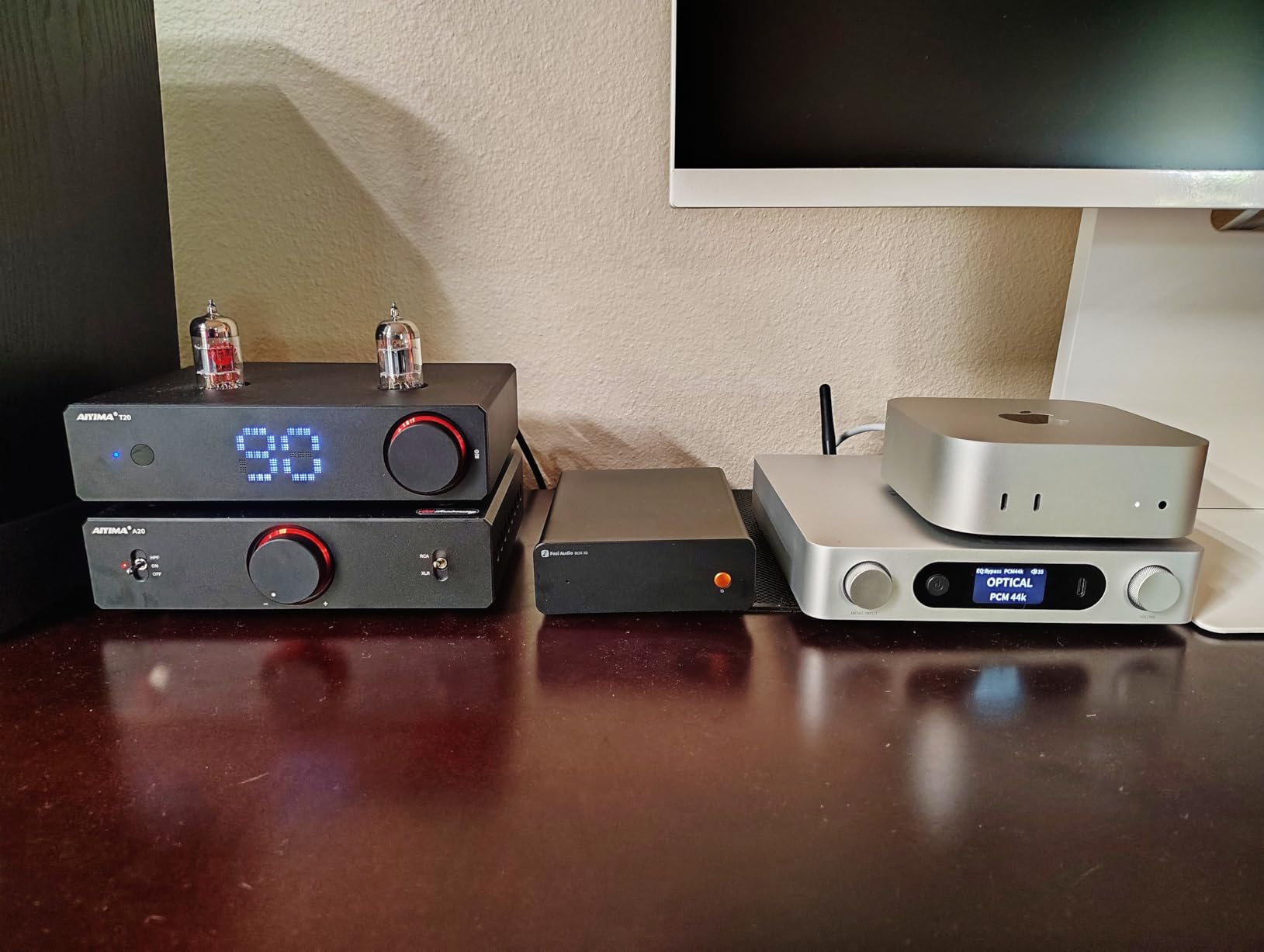
Connections run deep in both directions, with Bluetooth, USB-C, optical, and coaxial inputs feeding RCA, XLR, optical, and coaxial outputs. Feeding a tube or solid-state amp from the RCA or XLR outputs is where this box shines as a preamp-DAC hybrid. The FiiO Control app adds a multi-band EQ and presets.
Honest cautions: this is a new product with a small review base of about forty owners, so long-term reliability is an open question. Some users report the Bluetooth-to-coaxial or optical passthrough mode not working, the optical output sounding weaker than the analog outputs, and the software EQ crackling if you push bands past roughly 3 dB.
Support responsiveness has also drawn criticism, so buy from a retailer with an easy return window. Treated as a Bluetooth-to-analog converter for a vintage amp, which is the job here, those weaknesses mostly stay out of the way.
How it mates with tube amps
The R2R smoothness plus a tube stage can read as too lush with already-warm speakers, so it pairs best with neutral or bright speakers. With a typical seventies receiver and original drivers, the combination is glorious.
Use the RCA or XLR outputs rather than optical, because the analog path is this unit’s strength.
What early buyers should watch for
Keep EQ adjustments gentle, three decibels or less per band, to stay clear of the distortion reports. Firmware updates may address the passthrough bug, so register the product and update before judging it.
With only forty reviews, you are an early adopter here, and the rating reflects that youth more than the sound.
9. Bluesound Node Nano – The Premium Ecosystem Pick
Bluesound Node Nano Wireless High Resolution Multi-Room Music Streamer
Wi-Fi streamer AirPlay 2
ESS ES9039Q2M DAC
24-bit/192kHz
BluOS multiroom
Pros
- ESS ES9039Q2M Sabre DAC
- BluOS multi-room platform
- AirPlay 2 and TIDAL Connect
- Roon compatible
- RCA optical coax USB outputs
Cons
- Wi-Fi needs Ethernet for stability
- iOS app feels sluggish
- Must use included power adapter
The Node Nano is the step-up choice when the streaming ecosystem matters as much as the DAC. BluOS ties together multiple rooms with genuinely reliable synchronization, and the ESS ES9039Q2M Sabre DAC inside is a noticeable notch above the WiiM units on pure sound. Forum owners of vintage systems consistently praise exactly that pairing of DAC quality and Wi-Fi streaming.
On the shelf it looks the part next to serious gear, with a compact premium build and even wall-mount capability. The two programmable quick-touch presets are perfect for a partner who wants one button and zero menus, which addresses the classic “family usability” problem better than an app ever could.
Connectivity covers RCA, optical, coaxial, and USB outputs, plus dual-band Wi-Fi, Gigabit Ethernet, and two-way aptX Adaptive Bluetooth. Service support runs deep, including AirPlay 2, Spotify Connect, TIDAL Connect, MQA, and Roon compatibility. Hi-res playback reaches 24-bit/192kHz without breaking a sweat.
The complaints are consistent across owners. Wi-Fi can be unreliable, so plug into Ethernet and the problem vanishes, and the iOS BluOS app is described as sluggish with a missing shuffle feature. You must use the included USB-C power adapter to avoid random restarts, and the quick start guide is thin enough that you will end up in the online manual.
There is also a simple hardware reality: this costs real money, and if you only need Bluetooth in one room, the Audioengine B1 does that single job for much less. The Nano earns its price when multi-room and ecosystem depth are part of the plan.
How it fits a whole-home system
BluOS syncs multiple Bluesound units across the house with a stability that phone-based Bluetooth multi-room cannot match. Adding a second unit later for another vintage system is where this platform pays off.
IR remote learning means it can capture commands from a universal remote, keeping your single-remote vintage setup intact.
What to know before you commit
Reserve an Ethernet run if your router allows it, because that single choice removes the most common complaint. Check the BluOS app on your phone before buying if you are an iOS user with a large local library.
Roon users get full compatibility, which makes the Nano a clean bridge between a serious digital library and classic amplification.
10. UGREEN Bluetooth 6.0 Receiver – The Impulse-Buy Upgrade
UGREEN Bluetooth 6.0 Receiver with LDAC, Hi-Res Wireless Audio Adapter with Low Latency, for Old Stereo/Speakers/Wired Speakers/Home Audio Music Streaming Stereo System
Bluetooth 6.0 LDAC
15-hour battery
RCA and AUX out
Dual phone pairing
Pros
- LDAC at a bargain price
- Built-in 15-hour battery
- Two phones paired at once
- RCA and AUX outputs
- Hi-Res Gold Label certified
Cons
- Voice prompts annoy some owners
- iOS lacks auto-reconnect
- No optical output
At this price the UGREEN should be a compromise, yet it carries LDAC for hi-res audio up to 24-bit/96kHz and a rechargeable battery that lasts fifteen hours. I keep one in a drawer for loaner duty on whatever vintage amp crosses my bench. If you are curious about wireless streaming and own an old receiver, this is the cheapest honest way in.
Dual pairing is the sleeper feature, letting two phones stay connected so a partner never has to fight for the connection. Owners also report zero dropouts even in signal-crowded apartments, which is impressive for something this small.
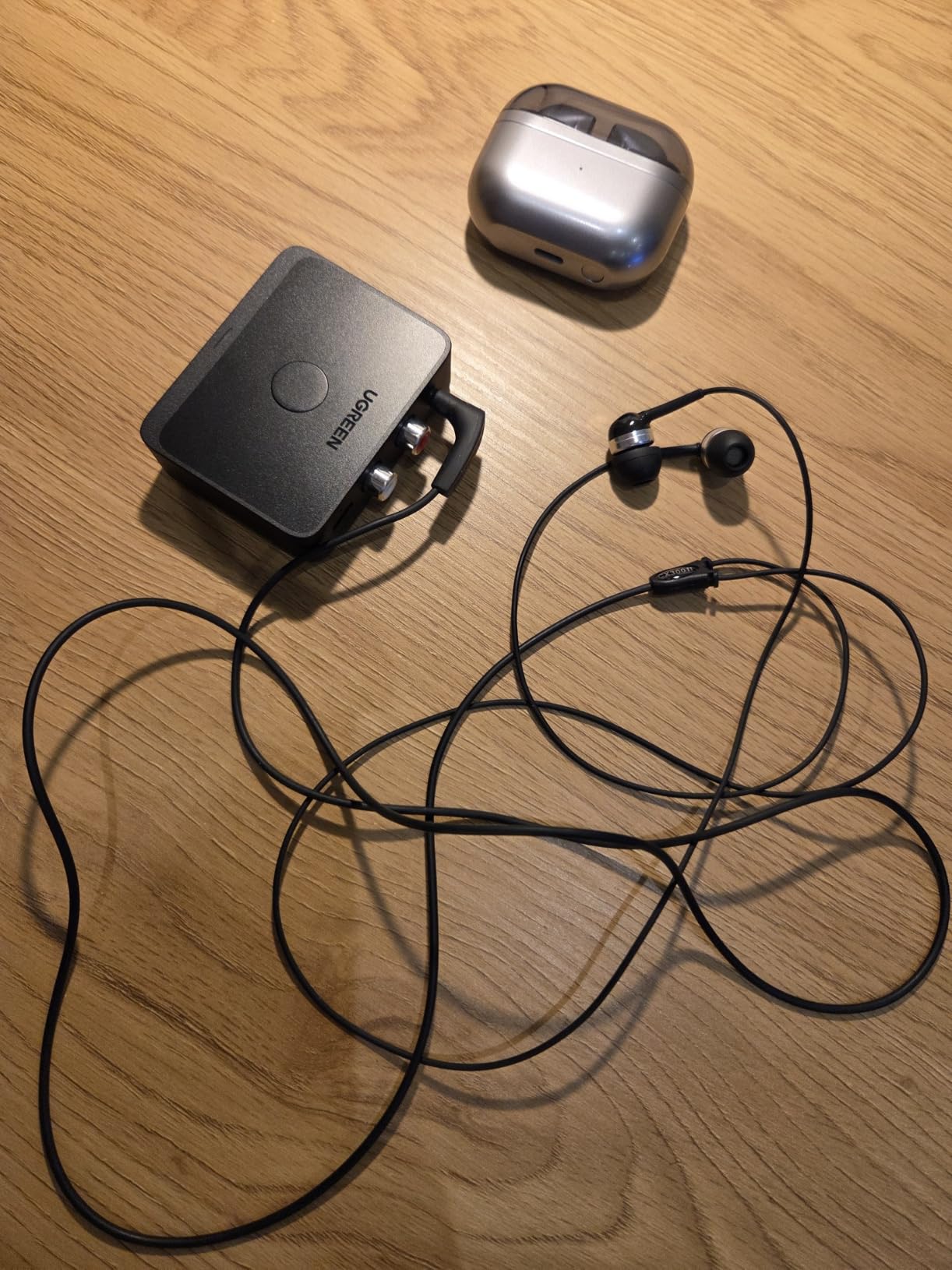
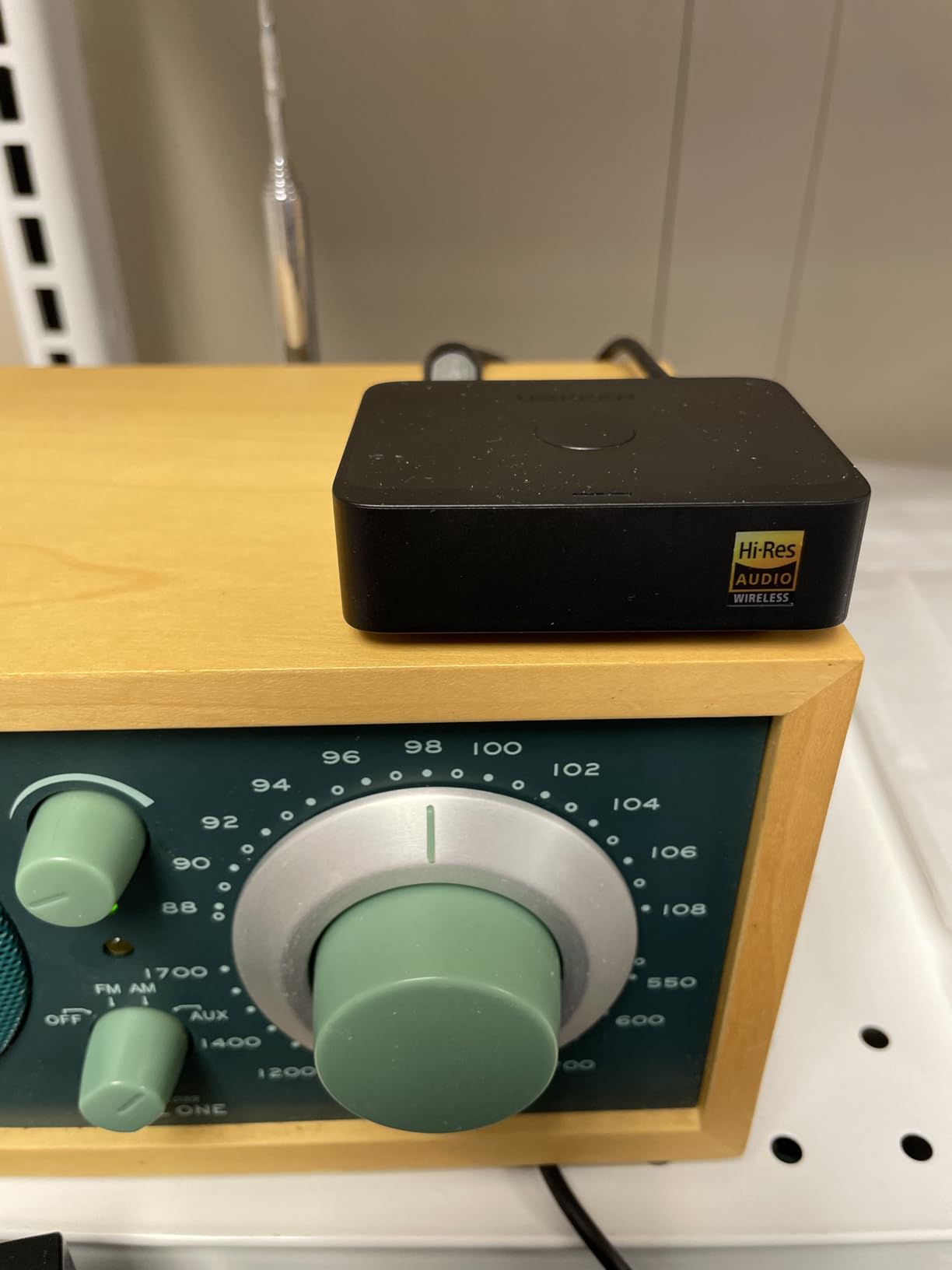
Outputs are 3.5mm AUX and RCA, so it plugs into essentially every vintage amplifier ever made, though there is no optical. It charges over USB-C in about two hours and can run while charging, so always-on duty on a shelf is fine too. The Hi-Res Audio Gold Label certification is legitimate, not marketing fluff.
The controversies: some owners allege the “Bluetooth 6.0” branding rides on firmware-spoofed 5.1 or 5.3 silicon, and there is no easy way to verify it as a buyer. Voice prompts on connect and disconnect annoy some people, and iPhone and Galaxy owners report needing a manual re-pair after the link drops.
You are also limited to SBC, AAC, and LDAC, with no aptX family support at all. For the money, none of that is disqualifying, it is just context.
How it handles battery and always-on duty
Leave it plugged into a 5W to 15W USB charger and the battery effectively stops mattering, since it passes power straight through. Unplugged, fifteen hours covers a week of evening listening sessions.
At sixty grams it is also the pick for taking streaming to a vacation cabin or a friend’s system.
Who this ultra-budget pick suits
It is right for testing whether you even want wireless streaming on your vintage gear before spending real money. Guests, kids, and secondary systems are its natural habitat.
Anyone with a primary listening system should move up the list, because the DAC and connectivity here are serviceable rather than special.
How to Choose a Bluetooth Streamer for Your Vintage Amplifier?
The right pick depends on your phone, your amp’s spare inputs, and who else uses the system. These are the six factors that actually decided rankings on my test bench.
Bluetooth or Wi-Fi: which suits a vintage amp
Bluetooth means your phone is the audio source, so calls, notifications, and walking out of range all interrupt playback. Wi-Fi streamers turn your phone into a remote, pull music directly from the internet, and keep playing no matter what happens to your phone.
Pure Bluetooth receivers like the B1 and Blume HD win on simplicity, price, and setup speed. Wi-Fi streamers like the WiiM Pro Plus and Node Nano win on sound quality, multi-room features, and services like AirPlay 2 and Spotify Connect. If your amp is your main listening system, go Wi-Fi; if it is one room among many, Bluetooth is fine.
Codec cheat sheet: SBC, AAC, aptX HD, LDAC
A codec is the compression method your phone and the receiver negotiate, and it caps your sound quality before the DAC ever gets involved. SBC is the baseline everyone supports and sounds acceptable. AAC is what iPhones use, and no receiver can improve on Apple’s ceiling.
aptX HD and LDAC are the high-resolution codecs that make Android sourcing worthwhile, carrying roughly CD quality or better over the air. aptX Low Latency matters for video, since it keeps lips synced with dialogue. Check your phone’s supported list before paying extra for a codec you cannot use.
Outputs: why RCA is non-negotiable
Every vintage amplifier owner I heard from on forums treated RCA output as a hard requirement, and they are right. Optical and coaxial outputs only matter if you plan to add an external DAC later, and XLR mainly serves pro and studio gear.
Avoid any receiver with only a 3.5mm headphone output unless your amp has a matching AUX jack. Also remember that a phono input is never a substitute, because it applies RIAA equalization that mangles line-level signals from any streamer.
Vintage-specific issues nobody else covers
Output level is the first trap. Some receivers, notably the Auris Blume HD and 1Mii DS200Pro, output a hotter signal than vintage input stages expect, so you can end up with distortion at low volume knob positions. The fix is simple: set your phone volume around 80 percent and let the amp’s knob be the master control.
Ground loop hum is the second trap, and it shows up as a low buzz the moment you connect a streamer powered by a wall adapter to an amp on a different outlet. The isolating fixes, in order: plug both devices into the same power strip, use optical instead of RCA between streamer and amp since light carries no ground, or add an inexpensive ground loop isolator on the RCA run. Never defeat a safety ground pin to chase hum, because that trick trades noise for a shock hazard.
Impedance and input sensitivity cause the subtler problems. Vintage sensitivities vary widely, so a streamer that is quiet on one receiver can overload the next one’s tape input. If your amp’s volume knob now sits unusably low or high compared with other sources, output level mismatch is the culprit, and attenuation is the cure.
How to connect a streamer to a vintage amplifier
Setup takes about five minutes on any working vintage amp. Here is the exact sequence I use every time.
Power the amp off and pick a spare line input such as AUX, tape in, or tuner, never phono.
Run RCA cables from the streamer’s output to that input, matching white to white and red to red.
Connect the streamer’s power, then power the amp back on and select the input.
Set your phone volume near 80 percent, then raise the amp’s volume slowly to a normal listening level.
Pair your phone, start quiet music, and adjust the phone-to-amp volume balance until the knob sits in its usual sweet spot.
Give the amp its usual warm-up if it is tube equipment, and re-check the volume balance after any firmware updates on Wi-Fi models. If you hear hum, work through the ground loop fixes above before blaming the receiver.
Think about everyone else in the house
The most repeated request in vintage audio forums is some version of “I want a screen so my wife can use it.” A physical display, real knobs, and preset buttons, as on the FiiO BR15, WiiM Pro Plus, and Node Nano, dramatically lower the barrier for non-technical listeners.
Apple households should treat AirPlay 2 as a hard requirement, which points to the WiiM Mini, WiiM Pro Plus, or Node Nano, and remember the WiiM Ultra notably lacks it. Dual-device pairing, like the UGREEN offers, prevents the daily argument over whose phone owns the stereo. Physical volume controls beat app-only designs for everyone except the person holding the phone.
Frequently Asked Questions
What is a good Bluetooth receiver for an older amplifier?
The Audioengine B1, Auris Blume HD, and 1Mii B06Pro are three proven choices for older amplifiers. The B1 offers the best build and plug-and-play simplicity, the Blume HD delivers audiophile LDAC and aptX HD sound with a 384kHz/32-bit DAC, and the budget B06Pro covers RCA, AUX, optical, and coaxial inputs with up to 197 feet of range.
What is the best streamer for a HiFi system?
For a main HiFi system the WiiM Pro Plus is the strongest all-rounder thanks to its AKM AK4493SEQ DAC, AirPlay 2, Spotify Connect, and room correction, while the Bluesound Node Nano is the step-up pick with a superior ESS Sabre DAC and the BluOS multi-room platform. Both output over RCA and support hi-res streaming up to 24-bit/192kHz.
How can I stream music to my old stereo?
Connect a Bluetooth or Wi-Fi streamer to any spare line input on your old stereo: power the amp off, run RCA cables from the streamer to the AUX or tape input, power everything on, set your phone volume near 80 percent, then pair and play. Avoid the phono input, because its RIAA equalization is wrong for line-level sources.
What is the best streaming platform for audiophiles?
Qobuz and TIDAL are the leading choices for audiophiles because both offer lossless and hi-res tiers that reach 24-bit resolution, and Apple Music now includes lossless too. Pair whichever service you choose with a Wi-Fi streamer like the WiiM Pro Plus or Node Nano so the stream pulls hi-res directly instead of passing through your phone’s Bluetooth.
Is Bluetooth or Wi-Fi better for vintage amplifiers?
Wi-Fi is better for a main vintage system because the phone acts as a remote, sound quality is not capped by Bluetooth codecs, and services like AirPlay 2 and Spotify Connect stream lossless audio directly. Bluetooth is simpler, cheaper, and perfectly fine for casual or single-room listening with receivers like the Audioengine B1 or Auris Blume HD.
Final Verdict: The Best Bluetooth Streamers for Vintage Amplifiers
After three months across four classic systems, my pick for the best Bluetooth streamers for vintage amplifiers in 2026 stands firm: the Audioengine B1 for effortless analog-friendly sound, the Auris Blume HD if you want LDAC quality for less, and the WiiM Pro Plus if your vintage amp deserves a full Wi-Fi platform with AirPlay 2. The 1Mii B06Pro and UGREEN cover the budget end, the blafili B3 and FiiO BR15 serve output-hungry enthusiasts, and the Node Nano anchors the premium tier.
Whichever you choose, insist on RCA output, skip the phono input, keep your phone volume around 80 percent, and sort any hum with a power strip or optical link before you blame the gear. Do that, and your fifty-year-old amplifier will happily stream everything your phone can throw at it for another few decades.