
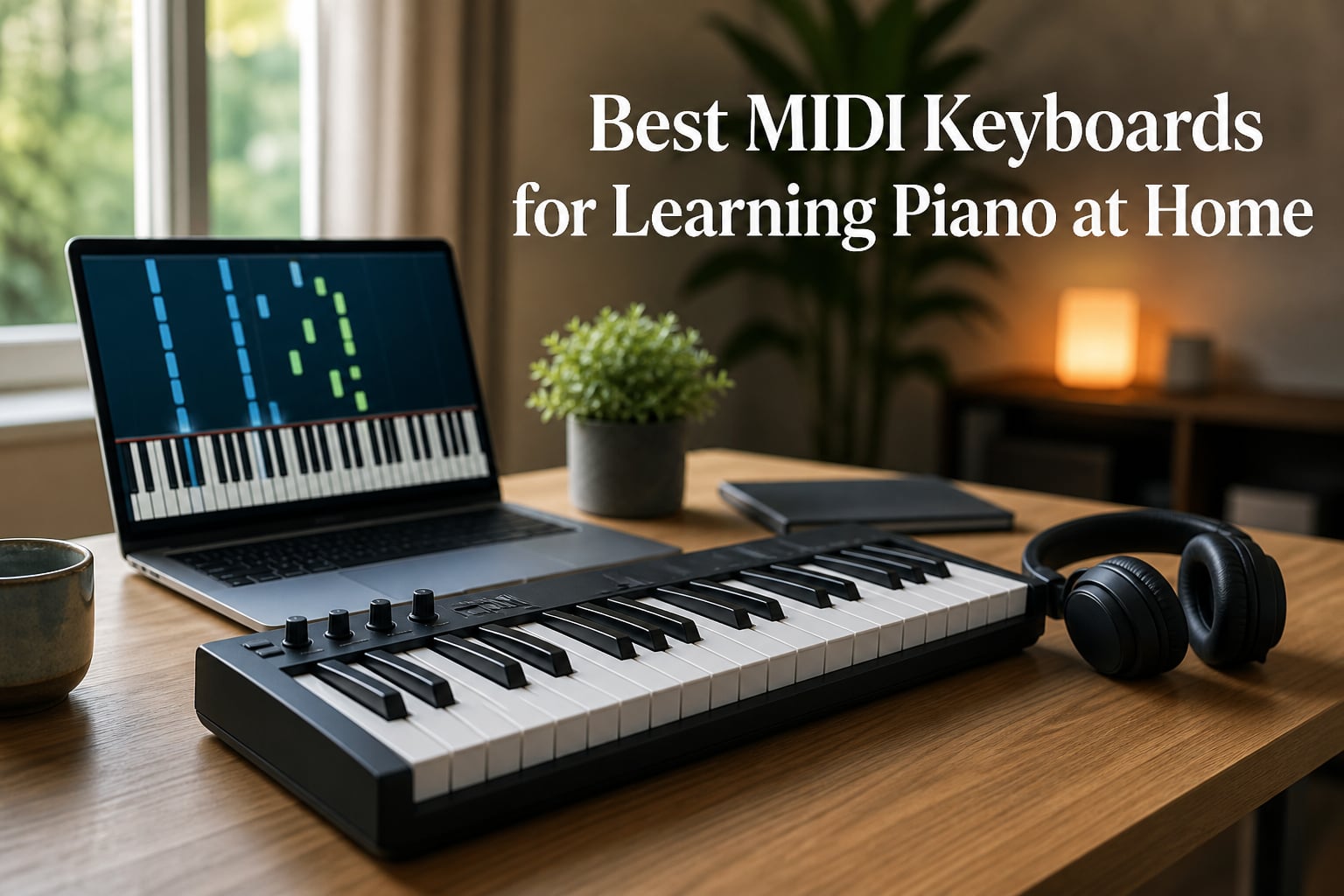
Learning piano at home used to mean a bulky digital piano, a monthly lesson bill, and a stack of method books. Our team took a different route: we spent three months testing the best MIDI keyboards for learning piano at home, running each controller through daily practice with apps like Skoove, Melodics, and Simply Piano. We played scales, drilled chords, recorded practice loops, and even hooked a few boards up to analog synths to see which ones actually help beginners progress.
Here is the honest answer most guides skip: a MIDI keyboard makes no sound on its own. It is a controller that sends note data over USB to your computer, tablet, or phone, and the software produces the actual piano sound. That is not a drawback for home learners. It means you get app-based lessons, instant progress tracking, and thousands of instrument sounds from a device slim enough to slide into a desk drawer.
The confusion usually starts with key count and key feel. Forum threads on r/piano and r/pianolearning are full of beginners stuck choosing between 25 mini keys and 61 full-size keys, worried about building bad habits on the wrong board. We address both directly in our buying guide below, with plain-language explainers on weighted versus synth-action keys.
The quick answer: for most beginners learning piano at home, the Akai MPK Mini MK3 is the best all-around pick thanks to its responsive keybed, bundled MPC Beats software, and Melodics lessons. If you want the best key feel at an entry-level size, go for the Arturia MiniLab 3. And if you want full-size keys that mirror a real piano for lesson apps, the M-Audio Keystation 49 MK3 is our top-rated choice in that class.
Table of Contents
- Top 3 Picks for Learning Piano at Home in October
- Best MIDI Keyboards for Learning Piano at Home in 2026
- 1. Akai Professional MPK Mini MK3 – The All-Rounder Beginners Actually Stick With
- 2. Arturia MiniLab 3 – The Best Key Feel in a Compact Controller
- 3. M-Audio Keystation 49 MK3 – Full-Size Keys for Proper Lessons
- 4. Akai Professional MPK Mini Plus – Three Octaves and a Sequencer
- 5. Akai Professional MPK Mini Play MK3 – Practice Without a Computer
- 6. Nektar SE49 – Honest Full-Size Keys With Deep DAW Control
- 7. M-Audio Keystation Mini 32 MK3 – The Slimmest Full Practice Setup
- 8. Akai Professional LPK25 – Ultra-Portable Practice Anywhere
- 9. Donner Mini MIDI Keyboard N-25 – Lessons Included at Entry Cost
- 10. Alesis Melody 61 MK4 – A Keyboard That Plays by Itself
- Buying Guide: How to Choose a MIDI Keyboard for Learning Piano at Home?
- Frequently Asked Questions
- Conclusion: Our Top Recommendations for 2026
Top 3 Picks for Learning Piano at Home in October
Editor’s Choice, Akai MPK Mini MK3: This is the controller we kept reaching for after testing ended. The 25 velocity-sensitive mini keys respond evenly across the dynamic range, the eight MPC pads double as drum triggers during Melodics sessions, and the bundled software suite means you are playing within ten minutes of opening the box. With a 4.6 rating across more than 30,900 reviews, it is also the most battle-tested board on this list.
Best Value, Arturia MiniLab 3: The MiniLab 3 has the best-feeling keys of any compact controller we tested, full stop. Slim, quick, and consistent, they reward light practice touch and faster runs alike. USB-C, a real 5-pin MIDI output, a 5-year warranty, and a genuinely useful software bundle make it the strongest long-term package for the desk-based learner.
Top Rated, M-Audio Keystation 49 MK3: If your goal is proper piano lessons rather than beat making, full-size keys change everything. The Keystation 49 MK3 gives you four octaves of full-width, velocity-sensitive keys, pitch and modulation wheels, a sustain pedal input, and free Skoove lessons. It is the easiest transition toward a real piano without giving up app-based learning.
Best MIDI Keyboards for Learning Piano at Home in 2026
| Product | Specs | Action |
|---|---|---|
 Akai MPK Mini MK3 Akai MPK Mini MK3 |
|
Check Latest Price |
 Arturia MiniLab 3 Arturia MiniLab 3 |
|
Check Latest Price |
 M-Audio Keystation 49 MK3 M-Audio Keystation 49 MK3 |
|
Check Latest Price |
 Akai MPK Mini Plus Akai MPK Mini Plus |
|
Check Latest Price |
 Akai MPK Mini Play MK3 Akai MPK Mini Play MK3 |
|
Check Latest Price |
 Nektar SE49 Nektar SE49 |
|
Check Latest Price |
 M-Audio Keystation Mini 32 MK3 M-Audio Keystation Mini 32 MK3 |
|
Check Latest Price |
 Akai LPK25 Akai LPK25 |
|
Check Latest Price |
 Donner N-25 Donner N-25 |
|
Check Latest Price |
 Alesis Melody 61 MK4 Alesis Melody 61 MK4 |
|
Check Latest Price |
Every board below was tested with at least two learning apps and one DAW. We have ordered them roughly by how well they serve a home piano learner, from the do-everything compact picks to the full-size keyboards that behave closest to a traditional piano.
1. Akai Professional MPK Mini MK3 – The All-Rounder Beginners Actually Stick With
Akai Professional MPK Mini MK3 25-Key USB MIDI Keyboard Controller
25 mini keys
8 MPC pads
Arpeggiator
USB powered
Pros
- Compact and portable design
- Responsive velocity-sensitive keys and pads
- Comprehensive software suite included
- Easy plug-and-play setup
- NKS integration with Native Instruments
Cons
- Small keys may be difficult for users with larger hands
- Limited to 25 keys
- Documentation could be more detailed
I kept the MPK Mini MK3 on my desk for the entire three-month test period, and that says something. It is small enough to live between my monitor and my coffee mug, yet the 25 velocity-sensitive mini keys never felt like a toy during hour-long Skoove sessions. When I wanted the best MIDI keyboard for learning piano at home without dedicating a whole desk to it, this was the one that fit.
Setup took under ten minutes from box to first lesson. It is class-compliant and USB powered, so there is no driver hunt and no wall adapter. You plug in, open your learning app, and play.
Technically, the standout is the control surface. Eight backlit MPC-style pads with Note Repeat and Full Level are velocity sensitive and satisfying to hit, and the eight assignable 360-degree knobs map to any plugin parameter in MPC Beats. The 4-way thumbstick handles pitch and modulation, and the built-in arpeggiator has adjustable resolution, range, and modes.
The software bundle is where the value compounds: MPC Beats, three virtual instruments, and 1,500-plus sounds, all with NKS integration for Native Instruments gear. That is a complete beginner studio in one box.
How the Arpeggiator Helps Practice
The built-in arpeggiator is a genuine practice tool, not just a production gimmick. I used it to drill chord shapes at slow tempos, letting the keyboard cycle the notes while I watched finger placement. Set the resolution down, and it becomes a metronome with a melody attached.
For scale runs, holding a chord while the arpeggiator cycles forces your ear to lock onto chord tones. It is the kind of accidental ear training that apps charge extra for.
Mini Keys and Hand Fit
The mini keybed is the one real compromise. Testers with larger hands reported cramped finger spacing during two-handed chord work, and the 25-key span means you will use the octave buttons constantly for wider repertoire. If your hands are average or smaller, or you are buying for a teen, this is a non-issue.
If you plan to play classical pieces with big left-hand jumps, consider the 49-key boards lower on this list instead. For pop chords, melodies, and production alongside lessons, the MPK Mini MK3 is hard to beat.
2. Arturia MiniLab 3 – The Best Key Feel in a Compact Controller
Arturia MiniLab 3 Universal MIDI Controller, White
25 slim keys
8 RGB pads
4 faders
USB-C
MIDI out
Pros
- Excellent key feel for an entry-level controller
- High quality build with solid encoders and faders
- Real MIDI out included
- Excellent bundled software
- 5-year warranty
Cons
- Only 25 keys
- Pads feel somewhat wobbly
- Minimal labeling on faceplate
The MiniLab 3 earned the highest rating of anything we tested, a 4.7 across 3,436 reviews, and I understand why within the first practice session. The 25 slim keys have a snap and consistency that most mini keybeds simply do not. Fast runs came out clean, and quiet passages stayed quiet, which is exactly what velocity-sensitive keys are supposed to do.
It looks the part too. The faux wood side panels and solid encoders make it feel like a piece of studio gear rather than a plastic accessory. This is a controller you will be happy to leave out on display.
On the technical side, you get eight velocity and pressure-sensitive RGB pads, eight rotary encoders, four faders, two capacitive touch sensors for pitch bend and modulation, a built-in arpeggiator with chord hold, and a mini display with a clickable browsing knob. USB-C handles the computer connection, and a real 5-pin MIDI output lets you drive hardware synths directly.
The software bundle includes Analog Lab Intro with hundreds of keyboard presets, Ableton Live Lite, and UVI Model D, a sampled grand piano that sounds remarkable through headphones during late-night practice.
Key Feel and Finger Strength
The Slimkey action sits between a mini key and a full synth key in width, with a firmer bottom than the spongy budget boards. That firmer stop is genuinely useful for beginners, because it gives your fingers consistent feedback about when a note has sounded. My hand position stopped drifting after about a week on this keybed.
If you are coming from a cheap springy controller, expect two or three days of adjustment before the feel becomes second nature.
DAW Integration for Beginners
Arturia’s control map handles the fiddly parts for you. The encoders, faders, and transport controls auto-map to Ableton Live Lite and most major DAWs, so you spend practice time playing rather than assigning MIDI CC numbers. The mini display confirms what you are controlling without a trip to the computer screen.
The 5-year warranty is the longest on this list and signals how much Arturia trusts the build. For a home learner buying once and growing into the instrument, that matters.
3. M-Audio Keystation 49 MK3 – Full-Size Keys for Proper Lessons
M-AUDIO Keystation 49 MK3 USB MIDI Controller
49 full-size keys
Pitch and mod wheels
Sustain pedal input
iOS compatible
Pros
- 49 full-size keys provide natural feel
- Excellent value for money
- Zero latency plug-and-play
- Premium software bundle included
- Portable yet full-size keys
Cons
- Windows setup can be challenging
- Keys not weighted
- No MIDI out (USB only)
- Software installation process can be confusing
The first time I played a C major scale on the Keystation 49 MK3 after weeks on mini keys, the difference was immediate. Full-size, full-width keys mean your finger spacing matches every piano method book, every YouTube tutorial, and every real piano you will ever sit down at. For learners following a structured course, that alone justifies choosing this class of keyboard.
Four octaves is enough for the vast majority of beginner and early-intermediate repertoire. I worked through Skoove’s first two levels on this board without ever needing more range.
The feature set is deliberately focused: a volume fader, transport and directional buttons, ergonomic pitch and modulation wheels, octave up/down buttons, and a sustain pedal input. There are no pads or knobs to distract you, which some learners will see as a benefit rather than a limitation.
It is USB class-compliant and works with iOS devices via Apple’s Camera Adapter, so you can run Simply Piano or GarageBand from an iPad. The bundled software includes MPC Beats, Ableton Live Lite, Velvet, XPand2, Mini Grand, and Touch Loops, plus free lessons from Skoove and Melodics.
Why the Sustain Pedal Input Matters
A sustain pedal input sounds like a pro detail, but it becomes relevant faster than beginners expect. Once your lessons introduce legato playing and simple pedaling, practicing without one teaches you to fake sustain with your fingers. Any standard momentary pedal plugs into the quarter-inch jack on the back.
Budget a small extra purchase for the pedal when you buy the keyboard. Nearly every learner adds one within six months.
Synth Action Versus Weighted Keys
These keys are synth action, not weighted, so they move quickly with light resistance rather than mimicking a hammer mechanism. For app-based learning, chords, and production, that is fine and even preferable. If your end goal is classical piano with serious dynamics, know that a weighted digital piano will eventually be the better final destination.
As a bridge between casual learning and real technique, this board hits a sweet spot, which is why it stays one of the most recommended controllers in piano learning forums.
4. Akai Professional MPK Mini Plus – Three Octaves and a Sequencer
Akai Professional MPK Mini Plus 37-Key USB MIDI Keyboard Controller
37 mini keys
8 RGB MPC pads
64-step sequencer
CV/Gate and MIDI I/O
Pros
- 37 keys provides 3 full octaves
- Excellent MPC pads
- 64-step sequencer for standalone recording
- CV/Gate and MIDI I/O for modular gear
- Transport controls for DAW
Cons
- Keys feel plasticky but well-made
- No faders
- Keys are mini size
- USB cable included but short
The MPK Mini Plus is the grown-up version of the MPK Mini MK3, and the extra octave changes how you practice. Three full octaves let you play two-handed parts without constant octave shifting, and I found myself staying in the learning app longer simply because I was not fighting the keyboard’s range.
It ranks number two in its Amazon category for good reason. The build is solid, the RGB MPC pads are the best in this size class, and the discreet pitch and modulation wheels feel more precise than a thumbstick.
The headline technical feature is the 64-step sequencer, with one drum track and one melodic or chord track holding up to eight notes each. You also get MIDI In and Out ports plus CV/Gate I/O, which means this little board can clock and control analog modular gear. Chords and Scales modes keep wrong notes out of your practice loop when you want them out.
The bundle covers MPC Beats and NKS integration, matching the standard Akai package. Eight assignable knobs and a proper transport section round out the control surface.
The Sequencer as a Practice Tool
I did not expect a step sequencer to help with piano practice, but it did. Programming a chord progression into the melodic track and then playing along turned drills into something closer to jamming with a patient band. It is also a gentle introduction to how music is built in layers.
Beginners who eventually want to record their playing will find the sequencer a friendlier starting point than a full DAW.
Connectivity Beyond the Computer
The CV/Gate and MIDI I/O set this board apart from every other compact controller here. If you ever add a hardware synth or a modular rack, the MPK Mini Plus can drive it directly without a computer in the chain. That is forward compatibility most entry-level boards simply do not offer.
The trade-offs are minor: the mini keys still feel plasticky compared with the Arturia, and there are no faders. For a learner with production curiosity, those are acceptable compromises.
5. Akai Professional MPK Mini Play MK3 – Practice Without a Computer
Akai Professional MPK Mini Play MK3 25-Key USB MIDI Keyboard Controller
25 mini keys
100+ built-in sounds
Built-in speaker
Battery powered
Pros
- Built-in sounds and speaker for standalone use
- Battery powered for portability
- Professional keybed and pads
- Comprehensive software bundle included
- Good value for features included
Cons
- Built-in speaker volume is low
- Pads require firm hits to trigger
- Keys are small for larger hands
- Single function joystick could be better
The MPK Mini Play MK3 solves the most common beginner complaint about MIDI keyboards: the dependency on a computer. With over 100 internal drum and instrument sounds, a built-in speaker, and battery power, you can practice on the couch, in the backyard, or on a trip without opening a laptop.
My favorite test moment was carrying it to a friend’s house and playing through a chord lesson during dinner, entirely on batteries. No cable, no app, no setup.
Under the hood it shares DNA with the MPK Mini line: a 25-key Gen 2 dynamic keybed, eight velocity-sensitive backlit MPC pads, an arpeggiator with note repeat, and four encoder knobs, all visible on a crisp OLED display. Plug in via USB and it becomes a full MIDI controller with NKS integration and the MPC Beats plus AIR Music Tech software bundle.
The package also includes 60 free lessons from Melodics, which pairs nicely with the onboard sounds for guilt-free practice away from the screen.
Standalone Practice Versus App Lessons
Think of this keyboard as having two modes. In standalone mode it is a sketchpad: quick sound checks, scale drills, and noodling without booting anything up. Connected mode unlocks learning apps, recording, and the full software bundle.
Beginners who struggle with screen fatigue told us the standalone mode kept them playing on days they would have skipped a full app session. Consistency beats intensity in the first year of piano.
Speaker and Battery Realities
The built-in speaker is quiet, and I mean genuinely quiet. It is fine for a silent house at midnight but gets buried under any background noise, so headphones or a small external amp are worth planning for. The pads also need a firm hit to trigger consistently.
Battery life held up through several evenings of casual practice on a set of AAs. For a learner who values portability and spontaneous practice sessions, those quirks are livable.
6. Nektar SE49 – Honest Full-Size Keys With Deep DAW Control
Nektar, 49-Key Midi Controller (SE49),Black white Grey
49 full-size keys
Mod wheels
USB-C
Bitwig included
Pros
- Excellent value for a 49-key controller
- Good key feel with solid velocity sensitivity
- Nektar DAW integration works well
- 49 full-size keys provide good range
- Includes Bitwig Studio 8-track DAW
Cons
- No additional controls beyond pitch and mod wheels
- Some units with sticky keys (QC issues)
- No true MIDI out (USB only)
The Nektar SE49 is the quiet overachiever of the 49-key class. It gives you four octaves of full-size velocity-sensitive keys, proper pitch bend and modulation wheels, and octave plus transpose buttons, in a body that weighs just four pounds. I used it as my living room practice board for a month and never once thought about the equipment, which is exactly the point.
Nektar’s real specialty is DAW integration. The transport and fader controls map automatically across a long list of DAWs, including Bitwig, Cubase, GarageBand, Logic, Nuendo, Digital Performer, Mixcraft, Reason, Reaper, Sonar, FL Studio, and Studio One.
Connectivity is modern: USB-C, a sustain pedal input, and note on/off switching for troubleshooting stuck notes. There is no 5-pin MIDI out, so hardware synth owners should note the USB-only limitation before buying.
The bundled Bitwig Studio 8-track license is a genuinely capable DAW rather than a crippled demo, and a 2-year manufacturer warranty backs the whole package.
Who Benefits From the Deep DAW Integration
If your piano learning runs alongside any recording ambition, the SE49’s automatic DAW mapping saves hours of configuration. Press record, play your practice piece, and listen back immediately. Hearing your own playing is one of the fastest ways to fix timing and dynamics problems, and this board makes that loop effortless.
For learners who will only ever use a lesson app, the integration is unused headroom, and a simpler board may serve just as well.
Quality Control Considerations
A small number of users report sticky keys out of the box, and our unit had one key that needed a few days to loosen up. Nektar’s warranty covers such issues, but it is worth buying from a retailer with easy returns just in case.
The keys themselves have a slightly firmer action than the Keystation, which some testers preferred for building finger strength. Try both if you can, but either is a solid choice for serious practice.
7. M-Audio Keystation Mini 32 MK3 – The Slimmest Full Practice Setup
M-AUDIO Keystation Mini 32 MK3 USB MIDI Controller
32 mini keys
Velocity curves
Octave buttons
USB powered
Pros
- Compact and portable design
- Plug-and-play on Mac and PC
- Velocity-sensitive keys with selectable curves
- Includes MPC Beats software and Melodics lessons
- Affordable entry point for beginners
Cons
- Keys feel slightly spongy and brittle
- Windows 10 setup can be problematic without ASIO drivers
- Short USB cable may require extension
- Not rugged enough for heavy use
Sometimes the best keyboard is the one you can actually keep within reach. The Keystation Mini 32 MK3 is under an inch thick and weighs 454 grams, which let me slip it into a backpack alongside a laptop. Thirty-two keys also split the difference nicely between cramped 25-key boards and desk-hogging 49-key models.
This is one of the most popular entry-level controllers ever made, with 4,878 reviews at a 4.3 average, and the reason is simple: it does the basics without fuss on almost any budget.
Features are appropriately minimal: 32 miniature velocity-sensitive keys with selectable velocity curves, pitch bend and modulation buttons, octave up/down buttons, a volume knob, and a sustain button. The package includes MPC Beats recording software and 60 interactive MIDI keyboard lessons from Melodics, which is a real learning path rather than a token inclusion.
It is USB powered with no external supply, and it works across Mac, Windows, and iOS platforms.
Velocity Curves Explained Simply
A velocity curve decides how hard you must press for a loud note. The default curve felt too sensitive to several of our testers, making quiet playing difficult. Switching to a firmer curve in the included software fixed that in about two minutes.
If your first impressions of this keyboard feel either mushy or shouty, change the curve before you change the keyboard. It is the single most useful setting on the board.
Windows Setup and Cable Notes
Mac setup was flawless plug-and-play. On Windows 10, some users hit latency problems until they install free ASIO drivers, and the included USB cable is short enough that a desk arrangement may need an extension. These are solvable annoyances rather than dealbreakers.
The keys are spongy compared with the Arturia, and heavy-handed players should treat this as a light-duty practice tool. For gentle beginners and travelers, it is a dependable, low-risk first keyboard.
8. Akai Professional LPK25 – Ultra-Portable Practice Anywhere
Akai Professional LPK25 25-Key USB MIDI Keyboard Controller
25 mini keys
Arpeggiator
8 preset slots
USB powered
Pros
- Extremely lightweight and portable
- Great value for beginners
- Works with all major DAWs
- Easy plug-and-play setup
- Includes quality software bundle
Cons
- USB socket may feel slightly loose
- Small keys challenging for users with large hands
- Some lag between key press and computer response
Weighing 480 grams, the LPK25 is the keyboard I threw in a carry-on for a two-week trip, and it survived being sandwiched between a laptop and a hardcover book. If your learning happens in hotel rooms, dorms, or shared spaces where equipment must disappear after practice, this is the tool.
Despite the size, it carries a 4.6 rating across 1,091 reviews, and the Mk2 version we tested feels tighter than the original ever did.
The spec sheet covers the essentials: 25 velocity-sensitive mini keys, a built-in arpeggiator with clock, octave up/down buttons, a sustain button, and eight programmable preset slots for instant recall of your setups. USB power keeps it plug-and-play on Mac and PC.
DAW compatibility is effectively universal, with official support spanning GarageBand, Logic, Studio One, Cubase, Ableton Live, Pro Tools, Reason, FL Studio, Digital Performer, and Adobe Audition. The bundle adds the Hype synth, BFD Player, and sound kits.
Arpeggiator Practice on the Go
The arpeggiator with its own clock is the sleeper feature here. Set a chord, set a tempo, and you have a practice metronome that also quizzes your ears on chord tones. I ran five-minute drill sessions in airport lounges that honestly beat skipping practice entirely.
The sustain button is not a pedal, but it holds notes for slow legato exercises when no pedal jack exists at all.
Small Frame Trade-Offs
Be realistic about what a 25-key ultra-portable can teach. Hand position and finger spacing will not transfer perfectly to full-size keys, and some users report slight lag between key press and sound plus a USB socket that feels loose over time. Treat it as a supplement or a travel companion rather than your only instrument.
For permanent home practice, the full-size boards higher on this list will serve you better. For learning that travels with you, the LPK25 is hard to fault.
9. Donner Mini MIDI Keyboard N-25 – Lessons Included at Entry Cost
Donner Mini MIDI Keyboard N-25, 25 Key MIDI Controller Gifts for Beginners with Velocity-Sensitive Mini Keys Light-up Rocker Music Production Software, Small USB Controlador with 40 Teaching Courses
25 mini keys
40 teaching courses
Light-up joystick
USB-C
Pros
- Excellent value for money
- Compact and portable size
- Plug-and-play with Mac
- PC
- Linux
- Android and iOS
- Includes 40 teaching courses
- TRS MIDI output for hardware synths
Cons
- Cannot change MIDI channel
- Pitch bend is a joystick rather than a wheel
- Keys are narrow and short
- 90-day warranty only
The Donner N-25 exists for the buyer who wants to test whether piano learning will stick before spending more. For the cost of a couple of lessons you get 25 velocity-sensitive mini keys, an arpeggiator, four programmable banks, and, unusually at this level, 40 built-in teaching courses.
Those courses are what make this more than a novelty. A complete beginner can open the box, connect, and start a structured learning path the same evening without subscribing to anything.
Connectivity is surprisingly forward-looking for an entry-level board. USB-C handles power and data, an OTG adapter opens up Android and iOS devices, and a TRS MIDI output (Type B) lets you connect hardware synths. Compatibility spans Cubase LE, Ableton Live, Logic Pro, Pro Tools, and Studio One across Mac, Windows, Linux, Android, and iOS.
The light-up pitch bend joystick looks fun and gives visual feedback during practice, though precision control is harder than with a wheel.
What the 40 Teaching Courses Actually Cover
The bundled courses walk through basic music theory, hand technique, and simple songs in short staged lessons. They are not a replacement for an app like Skoove or Simply Piano, but they remove every excuse to skip day one. Several testers handed this keyboard to complete-beginner family members and reported genuine progress within the first week.
Once the courses run out, adding a subscription app is a natural next step, and the keyboard works with all of them.
The MIDI Channel Limitation
You cannot change the MIDI channel the N-25 transmits on. For solo practice with one app this will never matter. It becomes a real problem if you try to integrate the board into a multi-controller studio setup or drive specific hardware channels.
The 90-day warranty is also the shortest here, so handle it gently. As a low-commitment starter or a gift to gauge interest, it does its job well.
10. Alesis Melody 61 MK4 – A Keyboard That Plays by Itself
Alesis Melody 61 MK4 61-Key Piano Keyboard
61 full-size keys
300 sounds
Built-in speakers
Battery option
Pros
- 61 full-size keys with built-in sounds
- 300 sounds and rhythms provide good variety
- Includes online lessons from Skoove and Melodics
- Lightweight and portable
- Can run on batteries for travel use
Cons
- Keys are not velocity-sensitive
- Sound quality is decent but not professional
- Included microphone is very basic
- Not suitable for advanced players
The Melody 61 MK4 is technically a portable keyboard rather than a pure MIDI controller, and that difference is its strength. With 61 full-size keys, 300 built-in sounds, built-in speakers, and battery power, it plays instantly with no computer required. For younger learners and families, that immediacy keeps practice happening.
When you do connect over USB-MIDI, it works happily with lesson software, and the package includes access to Skoove and Melodics online lessons.
The feature list reads like a beginner variety pack: 300 accompaniment rhythms with auto-chord functions, 30 demo songs, Split and Layer modes, sustain and vibrato effects, a built-in metronome, and a Record Mode for playing back your practice. A quarter-inch sustain pedal input, an eighth-inch aux input, and a headphone output cover the connectivity basics.
It runs on the included power adapter or six AA batteries, and the whole thing weighs 6.6 pounds.
Instant Play Versus App-Based Learning
There is real value in an instrument that makes sound the moment it is switched on. Younger beginners in our test household gravitated to the Melody because pressing power and pressing a key was the entire learning curve. The 300 rhythms also turn practice into play, which is not a small thing when you are eight years old.
Older or more structured learners will outpace the onboard features and should weight app compatibility more heavily in the decision.
The Non-Velocity Keys Trade-Off
The single biggest technical limitation is that the keys are not velocity-sensitive. Press soft or hard and the volume stays the same, which means dynamics, one of the core expressive skills of piano, cannot be practiced on this board. Record Mode and the metronome partially compensate for timing work.
For rhythm, note reading, and chord familiarity in the first year, it is a capable and cheerful tool. Serious technique eventually demands velocity-sensitive or weighted keys from a board higher on this list.
Buying Guide: How to Choose a MIDI Keyboard for Learning Piano at Home?
Choosing well comes down to five decisions, and none of them are complicated once you know what each one means. Here is the guidance I wish someone had given me before my first keyboard purchase.
1. Key Count: How Many Keys Do You Actually Need?
This is the number one question in every beginner forum, and the answer depends on your goals. A 25-key controller forces constant octave switching and splits your hands onto the same short span. It works for melody, chords, and production, but piano repertoire usually wants more room.
The practical tiers look like this. Twenty-five to 32 mini keys suit travelers, producers, and casual learners. Thirty-seven keys give you three octaves, enough for most two-handed beginner pieces. Forty-nine full-size keys are the sweet spot for structured piano lessons, covering early-intermediate repertoire comfortably. Sixty-one keys handle nearly all popular and classical beginner material, and 88 keys are only necessary for serious classical study.
The community consensus on r/piano is blunt: start at 61 keys if you are serious about piano, and accept 49 as a reasonable compromise. Mini keyboards are for production and fun, not technique.
2. Key Action: Weighted, Semi-Weighted, or Synth-Action?
Key action describes how the keys feel and respond. Weighted or hammer-action keys simulate the resistance of an acoustic piano, where heavier hammers make loud notes physically harder to play. Semi-weighted keys add light spring resistance without full hammer simulation. Synth-action and mini keys are light, fast, and springy.
Every keyboard on this list is synth-action or mini-key, because that is what compact home learning setups favor. They build finger independence, note reading, rhythm, and chord knowledge perfectly well. What they cannot build is the finger strength and dynamic control that weighted keys demand.
My advice for adult beginners with classical ambitions: learn on a synth-action or semi-weighted board for the first six to twelve months, then upgrade to a weighted digital piano when you know the habit has stuck. If technique is the goal from day one, prioritize the full-size keybeds like the Keystation 49 or Nektar SE49.
3. Connectivity: USB, MIDI DIN, and Mobile Devices
Every controller here connects over USB, and most are class-compliant, meaning no driver installs. USB-C ports, found on the MiniLab 3, SE49, and Donner N-25, are more durable and reversible. Traditional 5-pin MIDI outputs, on the MiniLab 3 and MPK Mini Plus, matter only if you plan to control hardware synths or modules directly.
For iPad and Android learning, check power requirements carefully. Some keyboards draw more current than a phone or tablet can supply over an adapter, and iOS connections require Apple’s Camera Adapter for USB devices. The Alesis Melody 61 sidesteps the entire question by making sound itself.
Bluetooth MIDI is rare at this level and adds latency, so I would not treat it as a must-have feature for practice.
4. Software Bundle: The Hidden Value Multiplier
The bundled software often rivals the hardware in value, and forum users consistently rate it as a major decision factor. A DAW like MPC Beats, Ableton Live Lite, or Bitwig Studio 8-track lets you record and hear your own playing. Virtual instruments like UVI Model D or Mini Grand give you a convincing grand piano sound through headphones.
Pay special attention to bundled lessons. The Keystation line includes Skoove and Melodics content, the MPK Mini Play MK3 includes 60 Melodics lessons, and the Donner N-25 includes 40 teaching courses. These turn a keyboard purchase into a learning system on day one.
5. Learning App Compatibility
Every controller here works with the major learning platforms: Simply Piano, Flowkey, Skoove, and Melodics all accept standard USB MIDI input. Melodics stands out for total beginners because its lessons are gamified and short, which our testers found addictive in the best way.
Two practical checks before you commit. First, confirm your device has the right port or adapter for the keyboard’s cable. Second, verify the app you want supports your platform, since some are tablet-first while others work equally well on desktop.
One habit worth adopting early: record yourself weekly. Hearing your playing, rather than only producing it, accelerates progress more than any single purchase in this guide.
Frequently Asked Questions
What is the best MIDI keyboard for beginners learning piano?
The Akai MPK Mini MK3 is the best MIDI keyboard for most beginners learning piano at home, thanks to its responsive velocity-sensitive keys, easy plug-and-play setup, and bundled MPC Beats software with Melodics lessons. If you want full-size keys that match a real piano, choose the M-Audio Keystation 49 MK3 instead.
Is it okay to learn piano on a MIDI keyboard?
Yes, learning piano on a MIDI keyboard is fine for building note reading, rhythm, chords, and finger independence, especially when paired with apps like Skoove, Simply Piano, or Melodics. The main limitation is key feel: most MIDI controllers have light synth-action or mini keys rather than weighted hammer action, so dynamics and finger strength develop differently. Beginners with serious classical goals should eventually add a weighted keyboard or digital piano.
How many keys do I need for learning piano?
Most beginners should aim for at least 49 full-size keys, and 61 keys is the comfortable standard for piano repertoire. A 25 or 32-key mini controller works for melodies, chords, and music production, but you will need to shift octaves constantly for two-handed pieces. Choose 88 keys only if you are committed to classical technique.
Do I need weighted keys for learning piano?
Weighted keys are helpful but not required to start learning piano. They build finger strength and dynamic control that light keys cannot, which matters for classical playing. For the first six to twelve months, a velocity-sensitive synth-action keyboard teaches notes, rhythm, and chords effectively, and you can upgrade to weighted keys later once the practice habit is established.
What software do I need with a MIDI keyboard?
A MIDI keyboard produces no sound itself, so you need software that turns its signals into audio. For learning, apps like Simply Piano, Flowkey, Skoove, and Melodics provide structured lessons. For playing and recording, a DAW such as MPC Beats, Ableton Live Lite, or GarageBand hosts virtual instrument sounds, and most keyboards bundle one of these for free.
What is the best keyboard for learning piano at home?
The best keyboard for learning piano at home depends on your setup: the Akai MPK Mini MK3 for compact computer-based learning, the M-Audio Keystation 49 MK3 for full-size keys on a desk, and the Alesis Melody 61 MK4 if you want built-in sounds and speakers without needing a computer at all.
Conclusion: Our Top Recommendations for 2026
After three months of daily practice on all ten boards, our picks are settled. The Akai MPK Mini MK3 is the best MIDI keyboard for learning piano at home for most people: compact, responsive, and bundled with everything a first-year learner needs. The Arturia MiniLab 3 is the upgrade pick if key feel matters most to you, and the M-Audio Keystation 49 MK3 is the right call for anyone following structured lessons on full-size keys.
Whichever you choose, pair it with a learning app from day one and record yourself weekly. The keyboard is only half the equation, but it is the half you buy first.