
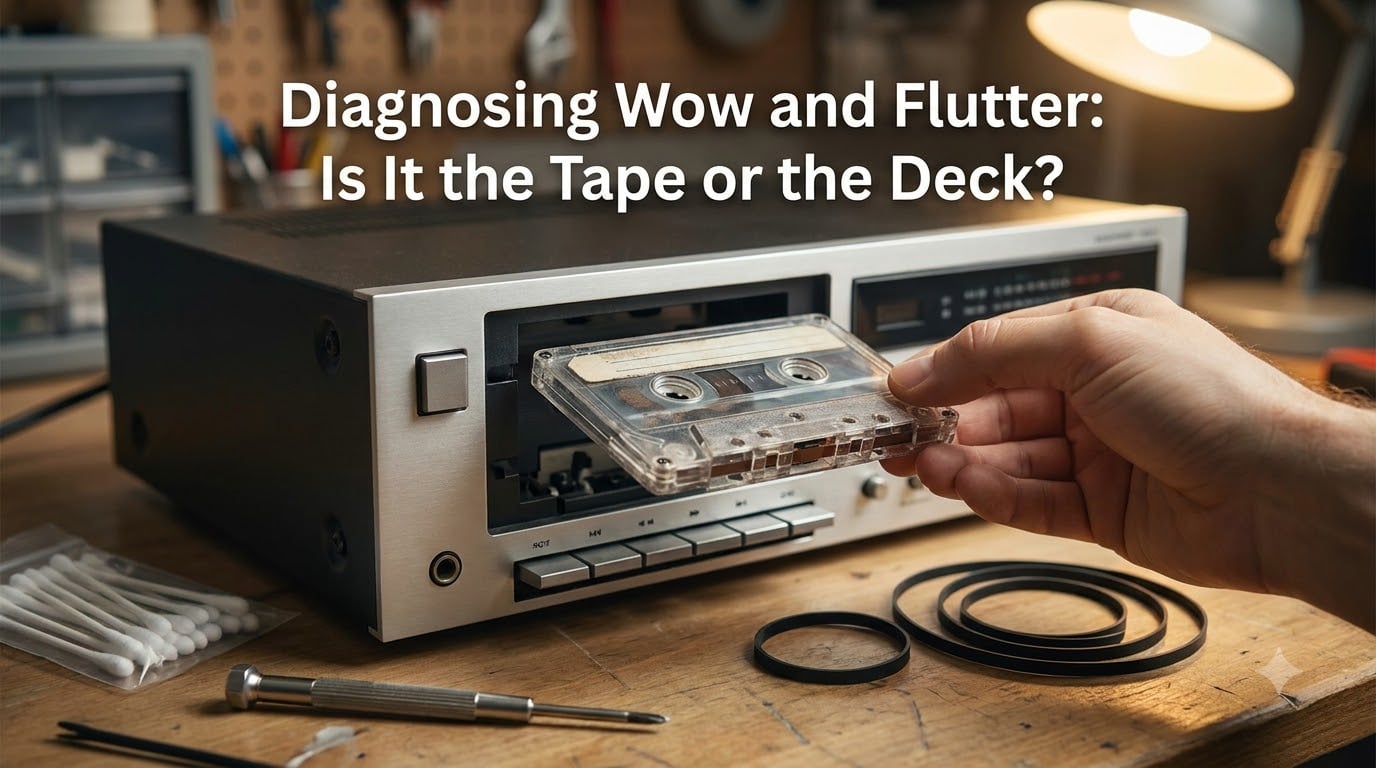
That warbling sound on your favorite cassette – is the deck failing or is the tape itself the problem? I have spent the last six months restoring vintage decks in our workshop at SK Records, and I want to share a diagnostic method that works even without a wow and flutter meter.
Most guides jump straight into definitions and standards. This one starts with a practical question: how do you actually tell where the problem lives? That is the question every cassette owner asks first.
In this article, I will walk you through the same triage sequence I use at the bench. We will cover the core definitions for the featured snippet, quick tests that need no equipment, and a definitive swap test that pinpoints the culprit. For 2026, this method has worked on every deck we have touched – from 1970s Pioneer units to late-model Nakamichi decks.
Table of Contents
What Is Wow and Flutter – The Core Definition?
Wow and flutter are both forms of speed variation in a tape transport. The difference is the rate at which the speed wobbles.
Wow is slow pitch fluctuation, usually below 6 Hz. It sounds like a record player with a bent spindle. The pitch gently rises and falls as the tape moves past the head.
Flutter is faster speed variation, typically above 6 Hz. It sounds like a warble or a subtle dive-bombing effect on sustained notes. Many listeners describe it as a metallic shimmer.
The IEC 386 and DIN 45507 standards measure these by playing a 3150 Hz test tone and detecting the sidebands – frequency modulation that the speed wobble creates. Good vintage decks land around 0.04-0.08% WRMS. Anything over 0.15% WRMS becomes noticeable to most listeners.
Quick reference for at-a-glance recall:
Wow – slow wobble, below 6 Hz, often tape or reel-related
Flutter – fast warble, above 6 Hz, often transport-related
Drift – steady speed error (different problem, separate fix)
Both forms of variation make audio unstable. They also signal mechanical issues that can damage tapes over time. That is why a clean diagnosis matters before you start replacing parts.
The Quick Pitch Test – Diagnose Without Equipment
You do not need a test tape or meter to narrow down the problem. Your ears and one familiar recording can get you surprisingly far.
Here is the test I run first:
Pull a tape you have heard dozens of times – one with a long sustained note (a piano note, an organ chord, or a vocal held past two seconds).
Play it from the beginning and listen for any slow “wowowowo” warble.
Listen for a faster, tighter “wwww” wobble on the same note.
Now play a second tape on the same deck and repeat the listening test.
If both tapes sound equally wobbly, suspect the deck. If only one tape sounds bad, suspect the tape.
This works because sustained notes reveal speed variation better than busy music. Drums and complex mixes hide flutter. A held vocal line exposes even tiny modulation.
Forums like tapeheads.net confirm this exact technique. One user noted he caught a bad shell on a Simon and Garfunkel tape by A/B-ing it against a TDK SA. Same deck, same settings – the wobble lived in the shell, not the transport.
Record yourself saying “test” at a steady pitch into your phone, then play the recording through the deck while taping the output with a second phone. That gives you a baseline recording you can compare tapes against later.
Is It the Tape? Signs of Tape-Related Problems
Tape-side wow and flutter usually comes from the cassette shell – the plastic housing, not the magnetic tape inside it. This surprises many people.
Cheap pre-recorded cassettes used budget shells with rough tolerances. The liner sheet (also called a slip sheet) is the felt pad between the tape and the shell that lets the tape unspool smoothly. If it jams, sticks, or wears unevenly, the tape gets dragged across the head at inconsistent speeds.
Common tape-side symptoms:
End-of-side warble – the problem gets worse near the end of a side, where the take-up tension changes.
Problem tape only – the wobble exists on one tape but vanishes on a known-good tape.
Wobble varies with rewind – if you fast-forward then rewind to the same spot, the wobble changes. This points to hub or reel grip problems.
Visible shell wobble – hold the tape up to a window. Twist the shell gently. If it flexes, the shell is warped.
Tape pulls to one side of the head – the felt liner has bunched up on one edge.
Shell quality matters more than tape brand. Forum users consistently report that TDK D and Maxell UR shells work best when transplanting tape from a failing housing. Avoid the cheap translucent shells – they are usually the culprit.
The classic tape transplant trick: cut open the donor tape shell with a small screwdriver at the ultrasonic weld points. Carefully transfer the hubs, tape, and pressure pad to a known-good shell. Reassemble and test. Many unfixable warbles disappear immediately.
One user on reddit r/cassetteculture described a tape that was perfect for years, then went from pristine to unlistenable in three months with no use. The culprit turned out to be a warped shell that finally gave way under normal temperature cycling.
Is It the Deck? Signs of Deck-Related Problems
Deck-side wow and flutter traces back to the mechanical components that pull the tape across the head.
The three parts that fail most often:
Capstan – the thin metal shaft that drives the tape. Worn, dirty, or slightly bent capstans cause consistent flutter across every tape you play.
Pinch roller – the rubber wheel that presses the tape against the capstan. When the rubber hardens (a condition called stiction), it slips and grabs unevenly. This causes the fast-warble flutter.
Belt and idler tires – the rubber belts that transfer motor rotation to the capstan flywheel. Old belts glaze over, stretch, or leave residue on the flywheel rim.
Deck-side symptoms look different from tape-side:
Every tape sounds wobbly – even your known-good tape now has the problem.
Flutter speeds up with age – it slowly gets worse over weeks.
Pressure on the head shell changes things – pushing the cassette door closed harder slightly alters the wobble. This points to a belt slip.
Rewind and play show different behavior – the motor struggles in play mode but works fine in fast-wind.
Visible rubber on the capstan – check the capstan with a flashlight. A shiny black ring around the metal shaft means the pinch roller has been shedding.
The 30-year mark is when most rubber components start failing. If your deck is from the late 1980s or earlier and has never been serviced, suspect the belts and pinch roller first.
At our workshop, belt replacement plus pinch roller cleaning fixes about 70% of deck-related wow and flutter cases without any other intervention.
The Swap Test – Definitive Tape vs Deck Check
When the listening test leaves you uncertain, run the swap test. This is the most reliable diagnostic method we use at SK Records.
The procedure:
Pick a verified clean tape – one you have played on a known-good deck without issues.
Play it on your suspect deck. Note the wobble level.
Now play your suspect tape on a different deck (a friend unit, a shelf system, anything).
Compare: does the suspect tape sound clean elsewhere? Does the clean tape sound wobbly on the suspect deck?
Reading the results:
Suspect tape clean on other deck plus clean tape wobbly on suspect deck = problem lives in your deck.
Suspect tape wobbly on other deck plus clean tape clean on suspect deck = problem lives in the suspect tape (usually the shell).
Both problems on both decks = two separate issues, fix both sides.
This method works because the same tape run through different transports isolates the tape-side variables. Same deck with different tapes isolates the deck-side variables.
If you have no second deck available, a slow careful inspection of the suspect tape shell and felt liner usually pinpoints the issue. Look for felt bunching at the edges, hub binding when you spin the reels, and any visible shell warping when held up to light.
Common Tape Problems in Detail
Cassette shell failures cause more wow and flutter than most people realize. Here is what to look for inside the shell.
The felt pressure pad sits behind the tape at the head opening. When the felt gets compressed, dirty, or loses its spring tension, the tape loses consistent contact with the head. This shows up as a wobble that sounds like the tape is swimming across the head.
Hub and reel problems create intermittent issues. Spin the hub with your finger. It should rotate freely with very slight resistance. If it sticks, grinds, or catches, the hub bearings are shot. Try the BIC pen trick from the forums: stick a BIC pen barrel through the hub hole. If you can spin the hub smoothly on the pen, the bearing is fine.
Crooked shells cause the tape to ride at an angle to the head. This creates azimuth errors that often get mistaken for wow and flutter. Hold the tape up to a flat surface – the shell face should sit perfectly flat with no rocking.
Tape tension is set by felt tension pads inside the shell on quality cassettes. Budget shells often have thin or missing tension pads. The tape suddenly moves faster or slower depending on how much is on the take-up reel. This causes the classic end-of-side warble pattern.
Common Deck Problems in Detail
Deck mechanical failures follow predictable patterns based on age and use.
Belt wear is the number one cause. After 20-30 years, rubber belts harden, glaze, and stretch. A stretched belt slips on the motor pulley – especially under the load of pulling tape across the head. The slip-and-grab cycle creates the classic flutter warble. Replace belts every 15-20 years as preventative maintenance.
Pinch roller hardening creates a different problem. The rubber becomes smooth and shiny. Instead of gripping the tape, the roller slips. You will see a slight rotation flicker when watching the roller during play. Worn rollers also leave black rubber residue on the capstan – check for that shiny ring.
Capstan issues are rarer but more serious. A slightly bent capstan causes contact pressure variation on every revolution. If your capstan wobbles when you spin it by hand, the shaft is bent and needs replacement. Capstan bearings can also wear over time, creating a slight wobble at the capstan rotation rate.
Motor problems show up as a high-frequency buzz that mixes with the audio. Old motors develop brush wear, dry bearings, or failing capacitors in their control circuits. A death rattle sound during play points to motor issues rather than belt problems.
Fixing Wow and Flutter – Practical Repair Steps
Here is the actual repair sequence I follow. Start with the cheapest and easiest fixes first.
For deck-side problems:
Clean the capstan and pinch roller with isopropyl alcohol and a cotton swab. Even a thin film of oxide can cause slippage.
Demagnetize the capstan and head with a tape head demagnetizer. Magnetized metal adds drag.
Replace the belts. This is the highest-yield repair – belts cost a few dollars and they fail predictably.
Replace the pinch roller if cleaning did not restore grip. Aftermarket rubber pinch rollers cost $15-30.
Lubricate the motor bearings with a single drop of synthetic oil. Do not over-oil; oil on the belts makes them slip.
For tape-side problems:
Try a different tape on the same deck to isolate.
Inspect the shell for warping and stuck hubs.
Replace the felt liner if it is compressed or bunched.
Transplant the tape into a known-good shell (TDK D or Maxell UR recommended).
For pre-recorded tapes, sometimes the only fix is finding a better-condition copy.
Stop and seek service when you see capstan wobble, motor bearing failure, or head wear that requires precision alignment. Those repairs need specialized tools and steady hands.
Measurement Tools – From Test Tape to WFGUI
Once you have isolated the side, you can verify your fix with measurement. You do not need a vintage Nakamichi test rig.
A pre-recorded test tape (or a DIY tape recorded with a 3150 Hz tone from a function generator app) lets you record the output and analyze it. Free software called WFGUI takes that recording and computes the wow and flutter percentage using the same weighted peak detection as vintage lab meters.
Typical readings to expect:
0.04-0.08% WRMS – high-end vintage deck in good condition (Nakamichi Dragon, Studer A810).
0.08-0.15% WRMS – typical consumer deck after servicing.
0.15-0.30% WRMS – audible wobble on sustained notes, suspect belt or shell.
Over 0.30% WRMS – serious mechanical issue, listen for obvious warble.
Phone apps can give relative measurements by recording the output of your test tone and plotting the frequency over time. Less accurate than WFGUI but useful for before/after comparisons.
Remember that measurement confirms what your ears already tell you. Trust your ears first, measure second. A fix that sounds clean usually is clean.
Frequently Asked Questions
What causes wow and flutter on a cassette deck?
Wow and flutter come from speed variation in the tape transport. Wow is slow pitch fluctuation below 6 Hz, often caused by tape shell issues, hub binding, or large flywheel irregularities. Flutter is faster speed variation above 6 Hz, usually caused by belt slip, hardened pinch rollers, dirty capstans, or motor bearing wear. Both forms cause the audio to sound wobbly or warbling on sustained notes.
How do I tell if wow and flutter is from the tape or the deck?
Run the swap test. Play a known-good tape on your suspect deck. If it sounds clean, the deck is fine and the problem is in your suspect tape (usually the shell). If the known-good tape sounds wobbly on your suspect deck, the deck needs service. Play your suspect tape on a different deck to confirm. The side that sounds clean everywhere is the working one.
Can a tape with wow and flutter be fixed?
Yes, in most cases. If the magnetic tape itself is still intact, you can transplant it into a higher-quality shell (TDK D or Maxell UR are recommended by collectors). Replace the felt liner if it is compressed or bunched. Re-hub the tape if the original hubs stick. For pre-recorded tapes, your only fix is usually finding a cleaner copy since you cannot legally open the shell to replace internal parts.
What is the difference between wow and flutter?
Wow is slow pitch fluctuation, typically below 6 Hz. It sounds like a gently rising and falling pitch, similar to a record player with a bent spindle. Flutter is faster speed variation, typically above 6 Hz. It sounds like a tighter warble or metallic shimmer. Wow often points to tape shell or reel hub issues. Flutter often points to belt, pinch roller, or capstan problems in the deck.
How can I measure wow and flutter without a vintage test rig?
Record a 3150 Hz test tone on a tape and play it through your deck while recording the output with a computer. Feed the recording into free software called WFGUI, which computes the WRMS percentage using the same weighted peak detection method as vintage meters. For a quick relative check, record the test tone output to your phone and plot the frequency over time with an audio analysis app.
Wrapping Up: Your Next Diagnostic Step
For 2026, the core question of how to tell if wow and flutter comes from the tape or the deck still comes down to one procedure: the swap test.
Skip the meter first. Grab a tape you trust, play it on the suspect deck, and listen. Then play the suspect tape elsewhere. The side that sounds clean is your answer.
At SK Records, we have diagnosed dozens of decks this way without ever breaking out a wow and flutter meter. Your ears are the best test equipment you own. Once you have isolated the culprit – tape shell or deck transport – the fix becomes straightforward. Clean the heads, replace the belts, transplant the shell, and the wow and flutter drops away.
Start with the cheapest fix and work outward. Most deck-side problems trace back to belts and pinch rollers. Most tape-side problems trace back to a cheap or worn cassette shell.