
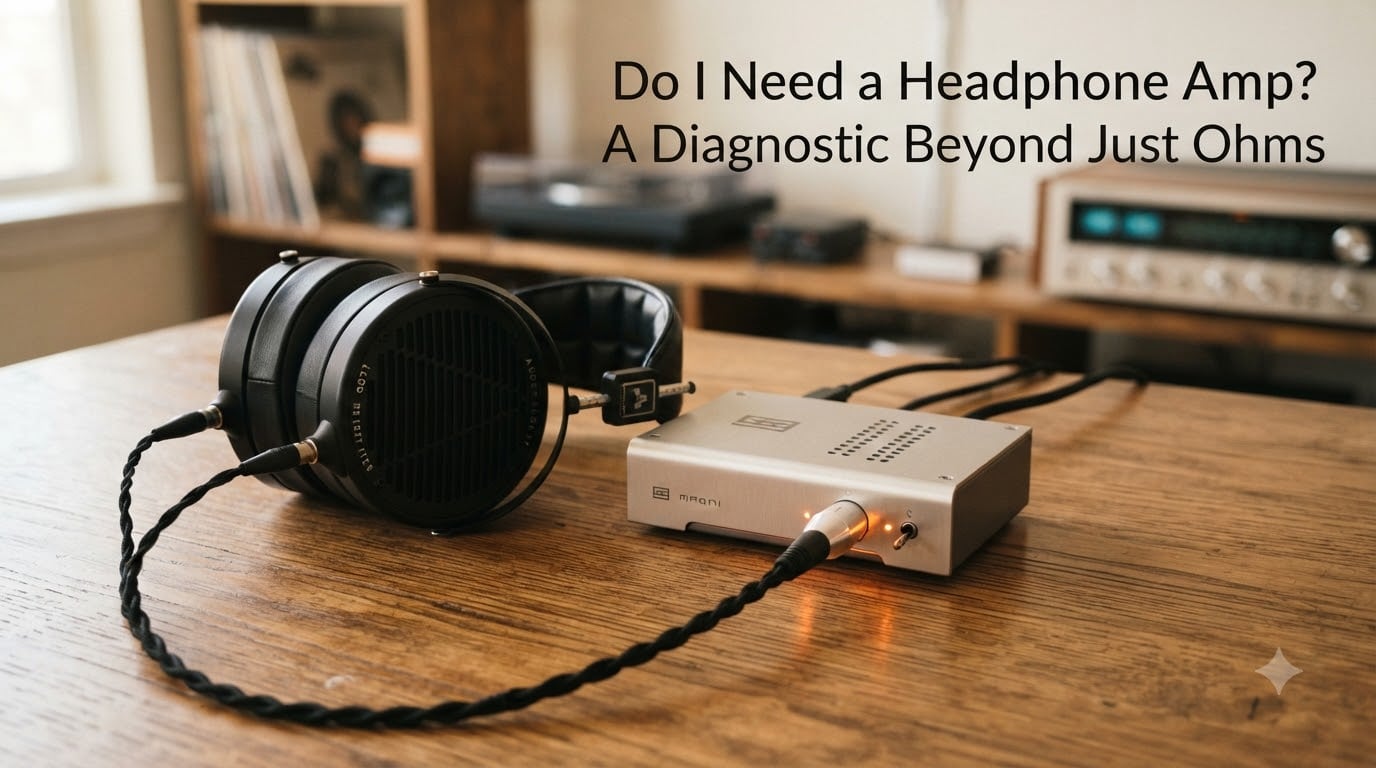
Every headphone forum has the same conversation. Someone asks “Do I need a headphone amp?” and ten people reply with “What’s the impedance?” as if that single number tells the whole story. It doesn’t.
Here is the reality: impedance is just one variable in a two-variable equation. Sensitivity, voltage demands, current delivery, and your source’s output impedance all matter just as much. A 32-ohm headphone can be harder to drive than a 250-ohm one, depending on the sensitivity rating. I have seen this confuse people for years.
If you are asking whether you need a headphone amp, this guide gives you a real diagnostic process, not just a chart of ohm numbers. I will walk you through the voltage versus current distinction, the volume knob misconception that trips up almost everyone, and practical tests you can run right now without spending a dollar.
By the end, you will know exactly whether your setup is leaving performance on the table or working just fine as-is.
Table of Contents
Quick Diagnostic: Do I Need a Headphone Amp?
Before we get into the science, let me give you a fast way to answer the question. Run through this checklist honestly.
1. Are your headphones high impedance (100 ohms or above)? If yes, you almost certainly need an amp. Headphones like the Sennheiser HD 600 (300 ohms) or Beyerdynamic DT 990 (250 ohms) need significant voltage swing that most laptop and phone jacks simply cannot deliver.
2. Are your headphones planar magnetic? Planar magnetic headphones (like the Hifiman Sundara or Audeze LCD-2) often have low impedance but demand enormous current. Even if the spec sheet says 32 ohms, your phone will likely struggle to control them properly.
3. Do you hear distortion or flabby bass at your normal listening volume? This is a classic sign of an underpowered setup. The driver is not getting enough current to maintain control during demanding passages.
4. Is your volume knob maxed out or nearly maxed out? If you are listening at 90 to 100 percent volume and still wanting more headroom, your source is running out of gas.
5. Do you hear a noticeable background hiss? This points to a noise floor issue, often caused by a source that was not designed for sensitive headphones. Ironically, an amp with a cleaner output can solve this.
If you answered yes to any of these, keep reading. The details below will tell you exactly why and what to do about it.
What Does a Headphone Amp Actually Do?
A headphone amplifier takes a weak audio signal and increases its power so your headphones can produce sound at proper volume levels with clean dynamics. That sounds simple, but the word “power” is doing a lot of heavy lifting in that sentence.
Power is made up of two components: voltage and current. Think of voltage as the pressure pushing the audio signal and current as the flow behind it. Different headphones need these two ingredients in very different proportions. A high-impedance headphone needs lots of voltage to reach adequate volume. A low-impedance headphone needs lots of current to control the driver properly.
Your laptop headphone jack, your phone, and your motherboard audio all have built-in amplifiers. The question is not whether you have an amp. You always do. The question is whether that built-in amp can deliver enough voltage, enough current, and do both cleanly without distortion.
Most built-in headphone jacks are designed for earbuds and efficient consumer headphones. They are small, cheap, and powered by a 3.3-volt or 5-volt rail inside your device. When you connect demanding headphones to them, they run out of either voltage or current and the sound suffers in ways you might not immediately recognize as a power problem.
Why Impedance (Ohms) Alone Is Not Enough?
The single most common advice on audio forums is “check the ohms.” If it is above some arbitrary number, usually somewhere between 80 and 100, you need an amp. If it is below, you are fine. This advice is incomplete and sometimes flat wrong.
Impedance tells you how much the headphone resists the flow of electrical current. But it tells you nothing about how efficiently the headphone converts that electrical power into sound. That efficiency is called sensitivity, and it is measured in decibels per milliwatt (dB/mW) or decibels per volt (dB/V).
Here is why this matters. The Beyerdynamic DT 770 Pro comes in 32-ohm, 80-ohm, and 250-ohm versions. Following the simple ohms rule, you would assume the 32-ohm version definitely does not need an amp. But the 32-ohm version has a sensitivity of about 96 dB/mW, while the 250-ohm version is rated at about 100 dB/mW. The 250-ohm version is actually more efficient at converting power into sound.
Now consider the Hifiman HE6. It has an impedance of 50 ohms, which sounds easy. But its sensitivity is only 83.5 dB/mW, which is absurdly low. This headphone is notoriously difficult to drive and some enthusiasts have literally connected them to speaker amplifiers. The ohms number alone would never tell you that.
The lesson is simple: you need both numbers. Impedance tells you the type of power needed (voltage or current). Sensitivity tells you how much total power is needed. Together they give you the full picture.
As a rough guide for sensitivity: anything rated 100 dB/mW or higher is quite easy to drive. Headphones in the 90 to 100 dB/mW range are moderate and may benefit from an amp depending on your source. Anything below 90 dB/mW is demanding and will almost certainly need a dedicated amplifier.
Voltage vs Current: What Your Headphones Actually Need
This is where most explanations stop, and it is exactly where the real understanding begins. Let me break this down without turning it into a physics textbook.
Power in watts equals voltage multiplied by current. This is the fundamental formula: watts = volts x amps. Every headphone needs a certain amount of power to reach a given loudness. How that power is delivered, as voltage or as current, depends on impedance.
High-impedance headphones (100+ ohms) need voltage. They draw relatively little current, but they need a large voltage swing to reach adequate volume. Think of it like a high-pressure, low-flow system. Your phone’s 1-volt output is not enough. You need an amp capable of delivering 5 to 10 volts to properly drive something like the Sennheiser HD 600 at 300 ohms.
Low-impedance headphones (under 50 ohms) need current. This is where people get confused. A 32-ohm headphone does not need much voltage to get loud. But it draws a lot of current, especially planar magnetic designs. If your source cannot supply that current, the bass goes soft and dynamics get compressed even though the volume seems fine.
Planar magnetic headphones are a special case. Most planars have a flat impedance curve, meaning their impedance does not change across frequencies. This sounds like it should make them easy to drive. But planars tend to have low sensitivity and demand sustained current that battery-powered devices struggle to deliver. The Hifiman Susvara, at 60 ohms and 83 dB/mW sensitivity, is one of the most demanding headphones on the market despite its seemingly reasonable impedance.
Dynamic driver headphones (like most Sennheiser, Beyerdynamic, and Audio-Technica models) typically have a voice coil impedance that varies with frequency. They generally need more voltage than planars but less current. A good quality medium-gain amp handles most of these well.
The practical takeaway: if you have high-impedance headphones, look for an amp with high voltage output. If you have low-impedance planars, look for an amp with strong current delivery. These are not the same thing.
The Volume Knob Misconception Explained
This is the myth that costs people the most money, either by buying an amp they do not need or by skipping one they do. Here it is: “If my headphones get loud enough, I do not need an amp.”
This is wrong, and understanding why will change how you think about headphone power forever.
Reaching a comfortable listening volume only means your source can provide enough average power. It says nothing about whether your source can handle the peaks. Music is not a steady signal. A drum hit, an orchestral crescendo, or a snare drum crack requires brief, intense bursts of power that can be 10 to 20 decibels louder than the average level.
If your source cannot deliver those peaks, two things happen. First, the peaks get clipped, which introduces audible harshness and distortion. Second, the bass loses impact because low frequencies require the most driver excursion and therefore the most instantaneous current. Your music still sounds “loud enough” but it sounds flat, compressed, and lifeless compared to what it should sound like.
I have experienced this firsthand. I ran a pair of 250-ohm Beyerdynamic DT 990 Pros from my laptop for months. They got loud enough. I thought I was fine. Then I plugged them into a dedicated desktop amp and the difference was immediately obvious. The bass had punch and texture I had never heard before. Transients were snappier. The soundstage opened up. Same headphones, same volume level, completely different experience.
This is the headroom concept. A good amplifier does not just make your headphones louder. It gives them the dynamic range to handle musical peaks without compressing or distorting. You are not paying for more volume. You are paying for the ability to handle the moments between the notes.
Here are the symptoms of an underpowered setup that people often mistake for headphone characteristics rather than source limitations:
Flabby or boomy bass that lacks definition and punch. This is the number one sign. Bass requires the most driver movement, which means it demands the most instantaneous current. An underpowered amp simply cannot control the driver during low-frequency transients.
Harsh or grainy treble, especially on vocals and cymbals. When an amp clips during musical peaks, the distortion products land in the upper midrange and treble region. Many people blame their headphones for sounding harsh when the real culprit is their source.
A compressed or flat presentation. If your music sounds dynamically squashed, like the quiet parts and loud parts are too close together, your amp may be running out of headroom. This is subtle but once you hear the difference with a proper amp, you cannot unhear it.
Narrow soundstage and poor instrument separation. Underpowered headphones tend to sound congested because the drivers cannot make the micro-movements needed to create spatial detail.
When You Definitely Need an Amp?
Based on everything above, here are the scenarios where a dedicated headphone amp is not optional if you want your headphones to perform as designed.
High-impedance dynamic headphones (100+ ohms). The Sennheiser HD 600 and HD 650 (300 ohms), Beyerdynamic DT 880 and DT 990 (250 ohms), and AKG K712 Pro (62 ohms but low sensitivity) all fall into this category. Your laptop jack simply cannot swing enough voltage to drive these properly.
Low-sensitivity headphones (below 90 dB/mW). Regardless of impedance, if the sensitivity is low, the headphone needs a lot of power. The Audeze LCD-2 (70 ohms, 101 dB/mW) is manageable. The Audeze LCD-4 (200 ohms, 97 dB/mW) is not.
Most planar magnetic headphones above entry level. The Hifiman Sundara, Focal Clear, and especially the Hifiman Susvara and HE6 all benefit significantly from dedicated amplification. Even “easy” planars like the entry-level Hifiman HE400se draw more current than most phones can comfortably provide.
Any setup where you hear distortion at normal volumes. If your headphones distort at your listening level, something is wrong. It might be the headphones, but more often it is the source running out of power.
When You Probably Don’t Need an Amp
Let me save you some money. In many cases, a dedicated amp is unnecessary and will not improve your experience.
Active noise-cancelling headphones. The Sony WH-1000XM series, Bose QuietComfort line, and Apple AirPods Max all have built-in amplification and DSP. Adding an external amp does nothing because the headphone’s internal electronics are already handling the amplification. You are just amplifying a signal that then gets re-amplified internally.
IEMs and earbuds. Most in-ear monitors are extremely sensitive (110+ dB/mW) and low impedance. They need almost no power. In fact, connecting sensitive IEMs to a powerful desktop amp can introduce audible hiss from the amp’s noise floor.
Most gaming headsets. Gaming headsets from HyperX, SteelSeries, Logitech, and Razer are designed to work from USB or standard headphone jacks. They have high sensitivity and low impedance specifically so they work with anything.
Consumer headphones under 64 ohms with sensitivity above 100 dB/mW. The Audio-Technica ATH-M50x (38 ohms, 99 dB/mW) works fine from most sources. The Grado SR80x (38 ohms, 99.8 dB/mW) is similarly easy to drive.
If your headphones fall into these categories and you are happy with the sound, save your money. An amp will not transform them.
Damping Factor and Output Impedance: The Hidden Variables
Two specs that almost no one talks about but affect your sound significantly: output impedance and damping factor.
Output impedance is the internal resistance of your headphone jack or amplifier output. Every source has one. Your laptop jack might have an output impedance of 10 to 75 ohms. A good dedicated amp might have 0.1 to 1 ohm.
This matters because of the interaction between output impedance and headphone impedance. There is a well-established guideline called the “one-eighth rule”: your source’s output impedance should be no more than one-eighth of your headphone’s impedance. So if you have 32-ohm headphones, your source output impedance should be 4 ohms or less.
If this rule is violated, the frequency response of dynamic driver headphones can change. Low frequencies in particular may become bloated or boosted because the varying impedance of the voice coil interacts with the high output impedance. Your headphones are no longer reproducing the frequency response the manufacturer intended.
Damping factor is the flip side of this coin. It is the ratio of headphone impedance to source output impedance. A damping factor of 8 or higher is generally considered acceptable, though higher is better. Low damping factor means the amplifier has less control over the driver, resulting in looser bass and reduced clarity.
This is why plugging the same headphones into different sources can sound noticeably different. It is not magic or burn-in or cable quality. It is often just output impedance interacting with your headphone’s impedance curve.
How to Test If You Need an Amp (Without Buying Anything)
Before you spend money, run these four tests. They will tell you more about your setup than any spec sheet.
Test 1: The Volume Test. Plug your headphones into your current source and play a well-recorded track at your normal listening volume. Note where the volume knob sits. If you are above 80 percent of maximum, your source is near its limits and you would benefit from an amp. If you are below 50 percent, you have plenty of headroom for volume.
Test 2: The Bass Response Test. Listen to a track with deep, well-defined bass. Electronic music, hip-hop, or orchestral pieces with prominent low frequencies work well. Pay attention to whether the bass sounds tight and textured or boomy and indistinct. Then listen for whether bass notes start and stop cleanly or linger and blur into each other. Sloppy bass that bleeds into the midrange is a classic underpowered symptom.
Test 3: The Noise Floor Test. Put your headphones on with nothing playing. Listen in a quiet room. Do you hear hiss? If yes, your source has a high noise floor relative to your headphone sensitivity. A quality amp with a lower noise floor would eliminate this. This is especially common with sensitive IEMs plugged into desktop motherboards.
Test 4: The Direct Comparison Test. If you have access to a friend’s amp, an audio interface, or even a different device, plug your headphones in and listen to the same track. The differences will be most apparent in bass impact, transient speed, and overall clarity. If you do not hear a difference, you do not need an amp. Trust your ears, not the spec sheet.
One more practical tip from the forums: audio interface headphone outputs (like the Focusrite Scarlett or MOTU M2) are often significantly more powerful than laptop jacks. If you already own an interface for recording, try plugging your headphones in there before buying a standalone amp.
Frequently Asked Questions
Do you really need a headphone amp?
You need a headphone amp if your headphones are high impedance (100+ ohms), low sensitivity (below 90 dB/mW), planar magnetic, or if you hear distortion and flabby bass at normal listening volumes. You do not need one for noise-cancelling headphones, most IEMs, or efficient consumer headphones that already sound clean at moderate volume levels.
Do I need an amp for 250 ohm headphones?
Yes, 250-ohm headphones like the Beyerdynamic DT 990 Pro or DT 880 generally need a dedicated amp. While some users report they work from laptop jacks or audio interfaces at adequate volume, the headphones will not perform to their potential without sufficient voltage swing. You will notice tighter bass, cleaner transients, and better dynamics with a proper amp.
Can I use 80 ohm headphones without an amp?
80-ohm headphones like the Beyerdynamic DT 770 Pro 80-ohm version can work without a dedicated amp from most laptop and phone jacks, and they will reach comfortable listening volume. However, they will still benefit from amplification in terms of bass control and dynamic headroom. An audio interface or dedicated amp will noticeably improve their performance.
Do you need an amp for 48 ohm headphones?
Generally no. 48-ohm headphones typically have high enough sensitivity that they work well from phones, laptops, and standard headphone jacks. However, check the sensitivity rating too. If the sensitivity is below 95 dB/mW, the headphone may still benefit from amplification despite the moderate impedance. Always consider both specs together.
What is the purpose of a headphone amplifier?
A headphone amplifier increases the power of an audio signal to properly drive headphones. It provides the voltage needed for high-impedance headphones and the current needed for low-impedance headphones. The goal is not just louder volume but clean dynamic headroom, proper bass control, and distortion-free reproduction of musical peaks.
How to choose an amp for headphones?
Match the amp to your headphone’s needs. For high-impedance headphones (100+ ohms), prioritize voltage output (look for 5V or higher). For low-impedance planar magnetic headphones, prioritize current delivery. Check that the amp’s output impedance is less than one-eighth of your headphone impedance for proper damping factor. Consider portability, input options (USB, optical, RCA), and whether you also need a built-in DAC.
Conclusion
Figuring out whether you need a headphone amp comes down to understanding two things: what your headphones need (voltage, current, or both) and what your source can actually provide. Impedance alone never tells the full story. You need to look at sensitivity, driver type, and the quality of your current source output.
Run the four tests I described above. Listen critically for flabby bass, harsh treble, and compressed dynamics. If everything sounds clean, tight, and dynamic at your normal listening volume, you do not need an amp. If you hear any of the warning signs, a quality amplifier will make a bigger difference than any cable upgrade or DAC swap ever could.
Trust your ears. The specs are a starting point, but the real diagnostic happens when you sit down and listen.