
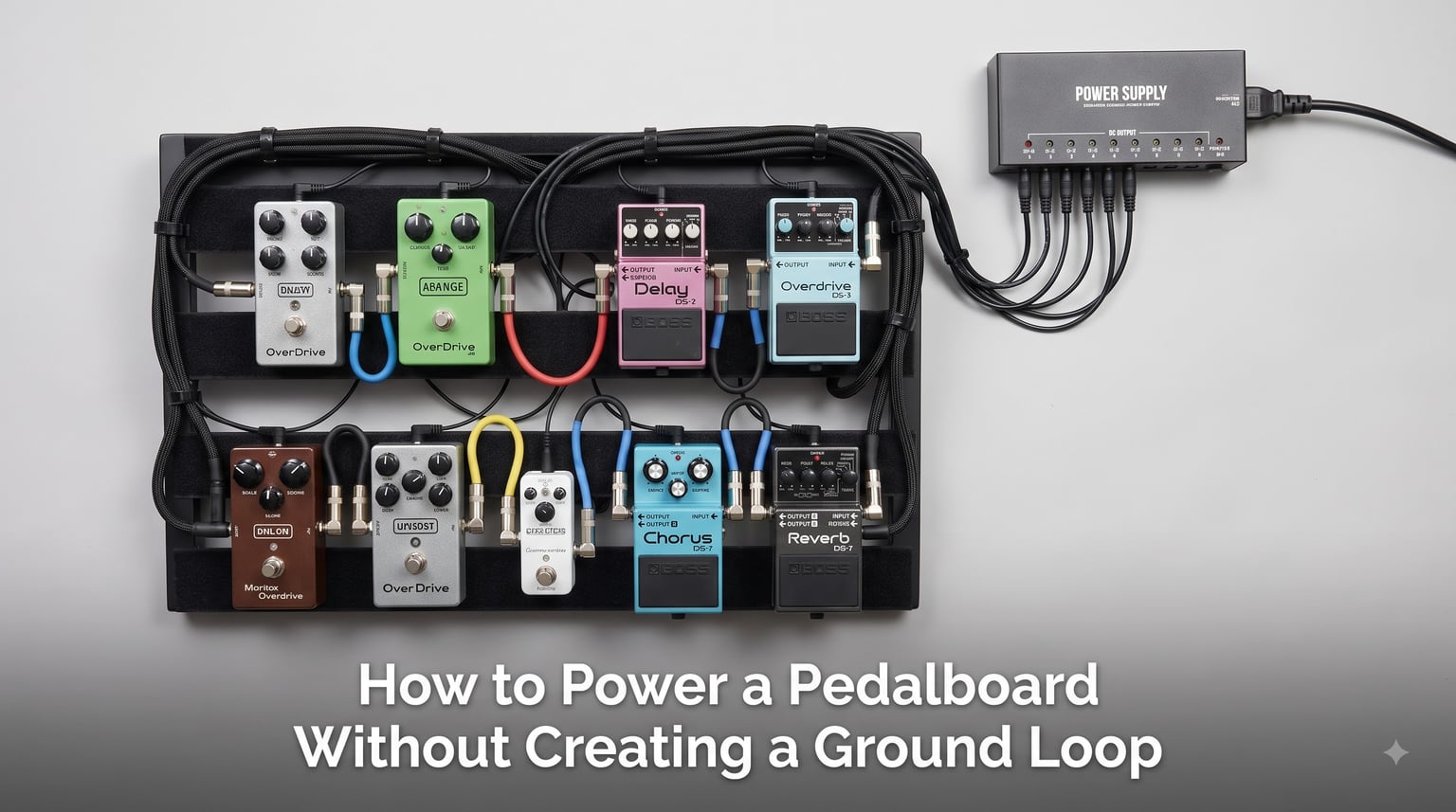
You finish building your dream pedalboard. Twelve pedals, perfectly arranged, patched in with quality cables. You plug everything in, hit your first chord, and there it is: a loud, persistent 60Hz hum drowning out your tone. If this sounds familiar, you are dealing with a ground loop.
Learning how to power a pedalboard without creating a ground loop is one of the most important skills for any guitarist. Ground loop hum can wreck a live performance, ruin a recording session, and make you question your entire rig. I have spent years building, troubleshooting, and rebuilding pedalboards, and I can tell you that almost every noise problem traces back to how power flows through your signal chain.
This guide breaks down what ground loops are, why they form on pedalboards, and the exact steps to eliminate them. Whether you are running three pedals or thirty, the solutions below will help you achieve a dead-quiet rig.
Table of Contents
What Is a Ground Loop?
A ground loop is created when two electrical circuits that should share the same ground potential actually have a small voltage difference between them. That difference drives unwanted current through your audio cables, which your amplifier picks up as hum or buzz.
In a properly grounded system, every component sits at the same ground reference voltage: zero volts. When two paths to ground exist and those paths have different resistances, current flows between them. That circulating current is the loop, and your audio signal becomes part of the circuit it travels through.
Ground loop noise typically manifests as a 60Hz hum in North America or a 50Hz hum in regions with different mains voltage frequency. It sounds different from single-coil pickup hum, which is higher-pitched and shifts as you move around the room. Ground loop hum stays constant regardless of your position.
The key distinction: buzz often indicates a grounding fault or dirty power, while a steady low hum usually points to a loop. Both are fixable, but the solutions differ.
Why Ground Loops Happen in Pedalboards?
Ground loops form on pedalboards when your signal chain creates multiple paths to electrical ground. Every pedal connects to ground through its power supply and again through its audio cables. When those two ground paths are not at the same potential, current flows between them through your signal chain.
The most common scenario involves daisy-chained power. A single power supply feeds multiple pedals through a chain cable. Each pedal shares the same ground wire, but the resistance increases with each connection along the chain. The pedal at the end of the chain sits at a slightly different ground potential than the first pedal, even though they share the same supply.
Now add audio cables. Your guitar connects to pedal one, which connects to pedal two, and so on. Each audio cable has its own ground shield. Those shields create additional ground paths between pedals. When you combine shared power grounds with shared audio grounds, the current has multiple routes to travel, and a loop forms.
Electromagnetic interference makes things worse. Power cables running near audio cables act as antennas. The electromagnetic field from your power supply induces small voltages in nearby audio cables, adding noise to the signal. This is why cable routing matters as much as power supply choice.
Multiple outlets compound the problem. If your amplifier plugs into one wall outlet and your pedalboard plugs into another, the ground potential between those two outlets may differ. Current flows from one to the other through the audio cable connecting your pedalboard to your amp, creating a ground loop that no pedal swap will fix.
The Daisy Chain Power Problem
Daisy chain power is the most common and most problematic way to power a pedalboard. A single power brick sends voltage through a cable that splits to multiple barrel connectors, feeding each pedal from the same output. It is cheap, simple, and the leading cause of pedalboard noise.
The problem is that daisy chains share both power and ground across every pedal. Analog pedals like overdrives and fuzzes can sometimes tolerate this arrangement. They draw modest current and operate at similar impedances, so the shared ground stays relatively clean.
Digital pedals are a different story. Digital delays, reverbs, and multi-effects units switch their internal circuitry at high frequencies, dumping noise into the shared power line. That noise travels through the daisy chain to every other pedal. This is why mixing digital and analog pedals on a daisy chain almost guarantees noise.
Users on guitar pedal forums consistently report the same finding: when they switch from a daisy chain to isolated outputs, the noise disappears. I have replicated this result on my own board multiple times. The daisy chain is not defective; it is simply the wrong tool for anything beyond a small all-analog rig.
Daisy chains also struggle with current demands. A power brick rated for 500mA total will not deliver enough current if you add several power-hungry digital pedals. Undervoltage causes pedals to malfunction, adding crackling noise or causing digital artifacts.
When are daisy chains acceptable? Small boards with three or four analog pedals, no digital effects, and no connection to multiple amplifiers can work fine with a daisy chain. The moment you add a digital pedal, a second amp, or an expression pedal, you need isolated power.
Solution: Isolated Power Supplies
An isolated power supply is the single most effective solution for ground loop problems. Each output on an isolated supply has its own dedicated transformer winding, meaning the ground connections between outputs are physically separated. No shared ground path means no ground loop.
Here is how it works technically. Inside an isolated power supply, each output passes through its own transformer. The transformer uses electromagnetic induction to transfer voltage from the input to the output without a direct electrical connection. The primary and secondary windings never touch physically. This galvanic isolation breaks any ground loop path between outputs.
Filtered power matters too. Quality isolated supplies include filtering circuitry on each output that smooths out ripple and noise from the AC-to-DC conversion. This reduces high-frequency noise that can bleed into your audio signal even without a ground loop.
Linear versus switching power supplies is worth understanding. Linear supplies use a large transformer to step down AC voltage, then rectify and filter it to DC. They are heavier and bulkier but produce very clean, low-noise power. Switching supplies convert power at high frequencies, which makes them smaller and lighter but requires more filtering to eliminate switching noise.
For audio applications, linear supplies are generally quieter. However, modern switching supplies with proper filtering can match linear performance. Look for supplies that specifically advertise low-noise filtering on each output.
The investment in an isolated supply pays off immediately. Players who switch report not just hum elimination but improved overall tone clarity. When noise floor drops, pedals sound more defined, and the entire rig opens up. I noticed this the first time I upgraded from a daisy chain to a multi-output isolated supply: the difference was not subtle.
How to Power a Pedalboard Without Creating a Ground Loop: Step-by-Step Troubleshooting
If your pedalboard is humming right now, follow this sequence to find and fix the problem. I have used this exact method dozens of times, and it works for almost every ground loop scenario.
Step 1: Confirm the problem is power-related. Unplug your pedalboard power supply and run your pedals on batteries if possible. If the hum disappears, you have confirmed a power-related ground loop. If the hum persists, the issue is elsewhere in your signal chain or amplifier setup.
Step 2: Isolate the offending pedal. Plug in your power supply and remove pedals one at a time from the chain, starting from the last pedal before your amp. Play after each removal. When the hum stops, the pedal you just removed is your culprit. Digital pedals and pedals with internal clock circuits are the most common offenders.
Step 3: Check your power supply type. If you are using a daisy chain, that is likely your problem. Replace it with an isolated power supply where each output has its own transformer. This single change resolves the majority of ground loop issues.
Step 4: Verify all pedals run from the same outlet. Plug your amplifier and your pedalboard power supply into the same wall outlet or power strip. Different outlets on different circuits can have different ground potentials, creating a loop through your audio cable.
Step 5: Route cables away from each other. Separate your power cables from your audio cables. Run them on opposite sides of your pedalboard. If they must cross, cross them at right angles to minimize electromagnetic coupling. This reduces EMI-induced noise that mimics ground loop hum.
Step 6: Check each patch cable. A faulty or cheap patch cable with a compromised ground shield can introduce noise. Swap cables one at a time to rule out a defective connection. Molded plastic patch cables are common culprits.
Step 7: Test expression pedals separately. Expression pedals connect to your pedals through TRS cables, which carry their own ground reference. Disconnect any expression pedals and see if the hum stops. If it does, the expression pedal is creating a ground loop through its TRS connection.
Step 8: Add a ground lift if needed. If you are running multiple amplifiers, a ground lift adapter on one amp can break the loop. Use this as a last resort, never as a first step, and never lift the ground on your main amplifier. Safety comes first.
Additional Fixes: True Bypass Loopers, Buffers, and Isolators
Beyond isolated power supplies, several other tools can help eliminate ground loop noise and clean up your signal chain.
True Bypass Loopers
A true bypass looper lets you take pedals out of your signal chain entirely when they are not in use. This helps because every pedal in your chain, even when bypassed, adds length to your ground path. A looper physically disconnects unused pedals, shortening the ground loop and reducing noise.
Loopers are especially useful for vintage pedals that lack true bypass switching. A vintage pedal in bypass mode still loads your signal and can pick up noise. Putting it in a looper loop removes it completely when you are not using it.
Buffer Pedals
A buffer converts your guitar signal from high impedance to low impedance. Low impedance signals are far more resistant to noise picked up along long cable runs. Placing a buffer first in your chain, right after your guitar, preserves signal strength and reduces noise susceptibility across the entire pedalboard.
If your pedalboard has more than fifteen feet of cable total, including patch cables, a buffer will make an audible difference. Some players notice their tone sounds darker and noisier without a buffer, then brighter and cleaner once they add one.
Ground Loop Isolators
A ground loop isolator is a device that uses a transformer to break the ground connection between two points in your signal chain. You place it inline between two components that are creating a loop, typically between your pedalboard output and your amplifier input.
Isolators work by transformer coupling, the same principle used in isolated power supplies. The audio signal passes through magnetic induction rather than a direct electrical connection, breaking the ground loop while preserving the audio.
Be aware that cheap isolators can degrade tone, rolling off high frequencies and adding phase shift. Quality isolators with properly designed transformers are transparent, but they cost more. Use isolators when you cannot solve a loop through power supply upgrades alone, such as in multi-amp rigs.
Multi-Amp and Complex Rig Considerations
Multi-amp setups are ground loop magnets. When you split your signal to two amplifiers plugged into different circuits, each amp provides a separate ground path. The voltage difference between those grounds drives current through your signal cables, creating hum that no isolated power supply will fix.
The standard solution is a single output feeding both amps through a quality splitter, combined with a ground lift on one amp. This breaks the loop while maintaining signal integrity. Some players use an isolated splitter box with transformer-isolated outputs to avoid ground lifts entirely.
Expression pedals deserve special attention. They connect to your pedals through TRS cables, and the sleeve of that TRS cable carries ground. If your expression pedal is powered separately or connected to a pedal on a different ground path, it can introduce a loop. Always power expression pedals from the same supply as the pedal they control.
Mixing vintage and digital pedals creates another layer of complexity. Vintage pedals often have outdated grounding schemes and minimal internal shielding. Digital pedals dump switching noise into shared power lines. Together on a daisy chain, they are a recipe for noise. Isolated power is essential here, with digital pedals getting their own dedicated isolated outputs.
For studio recording, consider running your pedalboard into a dedicated audio interface rather than an amplifier. This changes the ground topology and can sometimes eliminate ground loops that plague live setups. Always power your interface and pedalboard from the same circuit in the studio.
Frequently Asked Questions
How to avoid ground looping?
To avoid ground looping, use an isolated power supply where each output has its own transformer. Keep all pedals and your amplifier plugged into the same electrical outlet or power strip. Route power cables away from audio cables, and avoid daisy-chaining digital pedals with analog pedals.
Do you need an effects loop for pedalboard?
No, you do not need an effects loop for a pedalboard. Effects loops are designed for time-based effects like delay and reverb placed after your amplifier’s preamp stage. For most pedalboard setups, pedals go between your guitar and amplifier input. An effects loop only matters if you want certain effects after your amp’s distortion.
How to eliminate ground loop?
To eliminate a ground loop, first confirm the issue is power-related by running pedals on batteries. Replace daisy chain power with an isolated power supply. Ensure your amplifier and pedalboard share the same wall outlet. Check patch cables for faulty grounds. For multi-amp setups, use a ground lift on one amplifier or a transformer-isolated splitter box.
What is the best way to power a pedal board?
The best way to power a pedalboard is with an isolated power supply that provides individually transformer-isolated outputs for each pedal. This prevents ground loops, eliminates cross-talk between pedals, and provides clean filtered DC power. Match the current rating of each output to the pedal it feeds, and keep digital pedals on their own dedicated outputs.
Will an isolated power supply fix all pedalboard hum?
An isolated power supply fixes most ground loop hum but not all noise. It eliminates hum caused by shared ground paths between pedals. However, single-coil pickup hum, EMI from fluorescent lights, and noise from defective cables require different solutions. If hum persists after upgrading to isolated power, check your cables, pickups, and environment.
Why does my pedalboard hum stop when I use batteries?
Batteries are completely isolated power sources with no connection to mains ground. When you run pedals on batteries, there is no shared ground path to create a loop, so the hum disappears. This confirms that your hum is power-related and that upgrading to an isolated power supply will likely solve it.
Conclusion
Learning how to power a pedalboard without creating a ground loop comes down to one core principle: eliminate shared ground paths between your pedals. An isolated power supply with transformer-isolated outputs is the most reliable way to achieve this and should be your first upgrade from any daisy chain setup.
Pair that isolated supply with smart cable routing, proper buffer placement, and a consistent single-outlet power strategy, and you will eliminate the vast majority of pedalboard noise. For complex rigs with multiple amplifiers, transformer-isolated splitters and ground lifts provide the final layer of protection.
Your tone deserves a quiet foundation. Take the time to troubleshoot methodically using the steps above, and your pedalboard will sound exactly the way you designed it: clean, clear, and hum-free.