
A warped vinyl record is one of the most heartbreaking finds a collector can pull from the shelf. The good news is that many warped records can be saved at home using careful, controlled techniques — and we have tested the most common methods ourselves over the past few years. The key is knowing how to safely flatten a warped record at home without cooking the grooves, melting the surface, or cracking the disc.
We have watched friends destroy original-pressing Beatles albums trying to “fix” them with a hair dryer, and we have also seen a $5 thrift-store copy of Rumours come back from a brutal edge warp looking brand new. The difference was always method, temperature control, and realistic expectations.
This guide walks through every warp type, the two safest home methods we recommend, the warning signs that you should stop, and — just as importantly — the situations where you should not attempt flattening at all. Vinyl is PVC, and PVC has a narrow thermal sweet spot around 130 to 140 degrees Fahrenheit. Push past that, even briefly, and you can permanently damage the grooves that hold the music.
By the end you will know exactly which method matches your warp, what temperature to use, how long to cool, and when to walk away. Let’s start with the science behind why records warp in the first place.
Table of Contents
What Causes a Vinyl Record to Warp in the First Place?
Vinyl records warp because PVC — the plastic they are pressed from — softens and reshapes when exposed to heat above roughly 130 degrees Fahrenheit. Above that threshold, the material becomes pliable enough that gravity, pressure, or uneven support can pull it out of its flat, pressed shape permanently.
The four most common causes we see, in order of frequency, are:
Heat exposure from sunlight or a hot car. Leaving a record on the back seat in summer is the number-one cause of the dramatic taco warps we get asked about. Direct sun through a window can push a record past its thermal threshold in under an hour.
Improper storage. Stacking records flat in a tall pile, leaning them at an angle, or wedging them too tightly into a shelf all apply uneven pressure that slowly deforms the disc.
Humidity and temperature swings. Attics, garages, and basements with seasonal temperature swings stress the PVC over months and years, especially for vintage pressings from the 1970s.
Manufacturing inconsistencies. Some pressings — especially thin Dynaflex records from the late 1960s and early 1970s — came out of the sleeve already warped.
Understanding which cause applies to your record matters, because heat warps tend to be the most severe and the least responsive to home flattening. Storage warps are usually mild and respond beautifully to the no-heat glass sandwich method.
First, Identify Your Warp Type (Edge, Dish, Ripple, or Taco)
Before you attempt any fix, you need to know what kind of warp you are dealing with — because the method that flattens a gentle edge warp will not touch a deep taco warp. Lay your record flat on a clean surface, look at it from eye level, and then spin it slowly while watching the edge.
Here are the four warp types you will encounter, from easiest to hardest to fix:
Edge warp (most fixable): The outer rim lifts or dips slightly, usually less than a quarter inch. The record often still plays through it with minor tone-arm bounce. This is the easiest type to flatten at home.
Dish warp (fixable with patience): The entire record has a shallow bowl shape — one side is concave, the other convex. It will not sit flat on the platter without a clamp. The glass sandwich method handles dish warps reliably with enough time.
Ripple warp (harder, takes multiple cycles): The edge rises and falls in a wave pattern as the record spins, like a potato chip. Ripples often require repeated flattening cycles with a controlled heat method.
Taco warp (rarely worth attempting): The record folds across its diameter like a hard-shell taco. The deflection is dramatic — sometimes over an inch. Most tacos are heat-induced and, in our experience and the consensus across r/vinyl and Audiokarma, are not worth the risk of home repair.
Assess the Severity Before Touching Anything
Not every warp needs to be flattened. A surprising number of warped records play perfectly fine, and the safest fix is always no fix at all. Before doing anything, give your record an honest severity check.
First, place the record on a flat turntable platter and watch the tone arm. If the needle tracks cleanly through the warp with only gentle vertical movement and no skipping, you probably do not need to flatten it at all. Many audiophiles live with mild edge warps permanently.
Second, hold the record up to a light and look across the surface from the edge. A deflection under a quarter inch is mild and almost always safe to attempt. A quarter to half inch is moderate and worth a careful try. Anything beyond half an inch is severe, and you should weigh the value of the record against the cost of professional flattening before going further.
Finally, ask yourself honestly: is this a $3 thrift find or a sealed first pressing worth $300? The answer should directly influence how aggressive you get with heat.
When NOT to Attempt Flattening a Record at Home?
This is the section most guides skip, and it is the one we want you to read carefully. There are specific situations where attempting to flatten a warped record at home will almost certainly destroy it, and the right move is to either send it to a professional or accept the loss.
Do not attempt home flattening if any of the following apply:
The record has a severe taco warp. The amount of heat and pressure needed to reverse a deep fold will almost certainly deform the grooves. Forum consensus across r/vinyl, Discogs, and Audiokarma is consistent on this — tacos are the least recoverable.
You can see visible groove damage, scuffing, or melting. Flattening fixes shape, not groove integrity. If the grooves are already deformed, no amount of pressure will restore the audio.
The record is a sealed collectible or rare first pressing. The value loss from a failed DIY attempt far exceeds the $30 to $60 cost of a professional flattening service.
It is a picture disc or unusual colored vinyl. Picture discs are layered constructions with a printed film, and they react to heat very differently than standard black PVC. The image layer can separate, bubble, or shift.
The record is unusually thin (Dynaflex, late-60s RCA) or unusually thick (200g audiophile pressings). Both have narrower thermal margins and require specialized handling.
If any of those conditions apply, we strongly recommend either sending the record to a professional service or simply replacing the copy. The risk-reward math is not in your favor.
The Glass Sandwich Method (No-Heat, Safest Option)
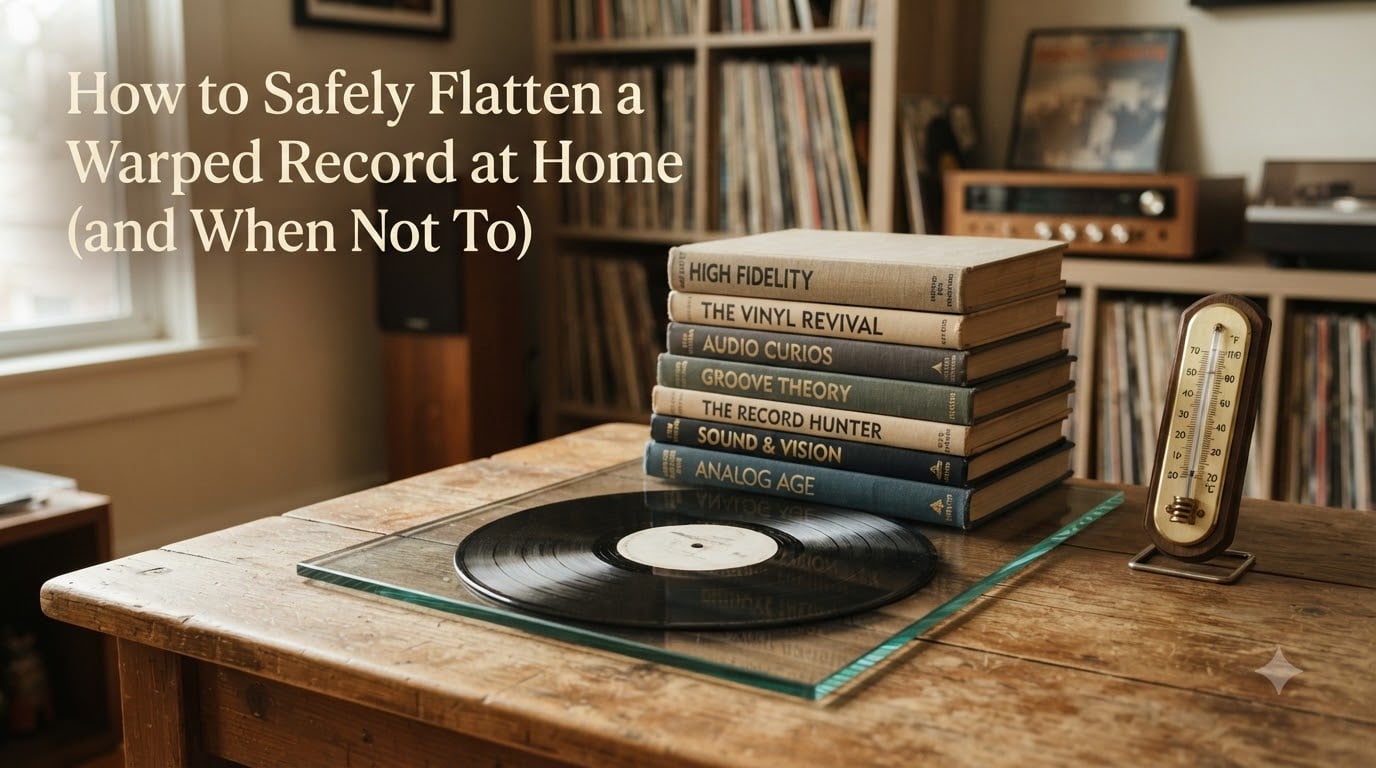
The glass sandwich method is the safest home technique because it uses no heat at all — only sustained, even pressure over a period of days. It is our default recommendation for mild to moderate edge, dish, and shallow ripple warps, and it is the method we reach for first whenever a record is irreplaceable.
What you need:
Two pieces of float glass, each at least 12 inches square and at least a quarter inch thick (picture frame glass from a hardware store works, but thicker is better)
A perfectly flat, level surface that will not be disturbed
Clean, lint-free inner sleeves or wax paper to protect the record from the glass
A heavy, evenly distributed weight — 15 to 25 pounds of books or a dumbbell works
Patience: this method takes 3 to 7 days minimum
Step-by-step:
Clean the record completely. Any grit trapped between the record and the glass will imprint into the vinyl under pressure.
Lay the first sheet of glass flat. Use a level to confirm the surface is truly flat.
Place a clean protective layer on the glass. A fresh inner sleeve or wax paper prevents direct contact.
Set the warped record on top, centered. Make sure the label sits flat and there are no overhangs.
Add a second protective layer over the record. Same material as the bottom layer.
Lower the second sheet of glass squarely on top. The two sheets should align edge to edge so pressure is uniform.
Place your weight dead center on the top glass. Distribute it as evenly as possible.
Leave it undisturbed for 3 full days minimum, 5 to 7 for moderate warps. Resist the urge to check.
Remove the weight and glass, then let the record rest at room temperature for another 12 hours before playing. This resting period helps the PVC settle into its new shape.
If the warp is still visible after a week, you can repeat the cycle once. For a stubborn dish warp, two cycles of five days each usually does the job. If three cycles have not worked, the warp is too deep for the no-heat method and you should consider a controlled heat method or professional help.
The Low-Heat Oven Method (Use With Extreme Caution)
The low-heat oven method works because it brings the PVC just past its softening point so that gentle pressure can reshape it. It is dramatically faster than the glass sandwich, but it carries real risk of permanent damage if you overshoot the temperature or leave the record in too long. We only recommend this method for records of low value, or for collectors who are willing to accept the risk.
Critical safety notes before you start:
Use a separate oven thermometer. Most home ovens run 15 to 25 degrees hotter than their dial setting, and at the temperatures we are working with, that margin is the difference between success and a melted record.
Never exceed 140 degrees Fahrenheit. The community-confirmed safe window is 130 to 140 degrees.
Never use the broiler, never use the oven’s self-clean cycle, and never walk away from the kitchen while a record is inside.
Use only standard black PVC. Skip this method entirely for picture discs and colored vinyl.
What you need:
Two pieces of glass (same as the sandwich method, ideally thicker)
Protective inner sleeves or wax paper
A standalone oven thermometer
A flat baking sheet
Oven mitts
Step-by-step:
Preheat the oven to 130 degrees Fahrenheit using the oven thermometer, not the dial. If your oven’s lowest setting is higher than 140, prop the door open slightly to hold the temperature in range.
Assemble the record inside the glass sandwich exactly as described in the no-heat method, with protective layers on both sides.
Place the assembled sandwich flat on a baking sheet. The sheet is just for safe handling, not for pressing weight.
Add a modest weight on top of the upper glass — about 5 to 10 pounds. Do not use the full 20-pound stack you would use cold.
Slide the sheet into the center of the oven and close the door gently.
Set a timer for 3 minutes. For a mild warp, 3 to 4 minutes is usually enough. For a moderate dish warp, do not exceed 5 minutes total.
Turn the oven off but do not open the door. Let the record cool inside the oven for at least 2 hours. Sudden temperature changes are how records re-warp or crack.
After 2 hours, open the door and let it rest another hour until the glass is fully at room temperature.
Remove the sandwich and let the record sit, still under the weight, for another 12 hours before playing.
For stubborn warps, you can run a second cycle the next day. Three cycles is our absolute ceiling — beyond that, the record is telling you it needs professional help.
Other Pressure-Only Methods Worth Considering
Not everyone has float glass sitting around. A few lower-effort alternatives work for very mild warps, though they are slower and less reliable.
The simplest is the weighted flat-stack method. Place the warped record in a clean inner sleeve, lay it flat on a known-flat surface, and stack 20 to 30 pounds of evenly distributed weight on top — heavy books or a board with a dumbbell work well. Leave it for a week. This works for shallow edge warps and is essentially the glass sandwich method without the precision of glass.
Another option is the two-flat-object sandwich using two large hardcover books, marble cutting boards, or ceramic floor tiles instead of glass. The principle is identical; the result is just slightly less precise because the surfaces are rarely as perfectly flat as float glass.
We do not recommend the hair dryer method that circulates on YouTube. It applies heat unevenly, it is almost impossible to control the temperature, and we have seen more records ruined than saved by it. If you are going to use heat, use the oven method with a thermometer.
Why Cooling Time Matters More Than Heating Time?
If there is one step collectors consistently underestimate, it is the cooling period. Heating the record only softens it — the actual reshaping happens as the PVC cools under pressure. Rushing this step is the single most common reason flattening attempts fail.
Think of it like tempering chocolate or cooling a forged tool. The material “remembers” the shape it cools into, so if you remove the pressure while it is still warm, the warp will partially or fully return. Slow, weighted cooling inside the oven (or under the sandwich for the no-heat method) is what locks the new flat shape into the PVC.
The minimum cooling window we recommend is 2 hours inside the closed oven plus another hour at room temperature, followed by 12 hours of weighted rest. For the no-heat method, the entire cycle is essentially cooling under sustained pressure, which is why it takes days instead of minutes.
Never cool a warm record in the refrigerator or freezer. The sudden temperature drop can crack the vinyl or create micro-warping along the grooves.
Warning Signs You Are Damaging the Record
Whether you are using heat or just pressure, watch for these red flags. Stopping at the first sign of trouble is the difference between a salvaged record and a coaster.
Smell. A faint chemical or “warm plastic” smell during the oven method is normal. A sharp, acrid smell means the temperature is too high — turn the oven off immediately and leave the record inside to cool.
Surface sheen changes. If the vinyl develops a glossy or wavy patch, the surface has started to flow. This is permanent groove damage.
Color shift. Any change in color, particularly a foggy or milky appearance on colored vinyl, indicates the plasticizers have separated.
Bubbles or blistering. This is a clear sign of overheating and is non-reversible.
Increased warp after a cycle. If the record is more warped coming out than going in, the temperature or pressure was uneven. Stop and reassess before any further attempts.
Cracking or creaking sounds. Discontinue immediately and let the record warm or cool gradually.
Prevention Is Easier Than Any Fix
The best flattening method is never needing to flatten in the first place. Every record we have lost to a warp could have been saved by better storage, and the same is almost certainly true for your collection.
Store vertically, never flat. Records should stand on edge like books, with enough shelf space that they are not wedged tight. Aim for roughly an inch of slack per 25 records so the spines are not under compression.
Keep the temperature stable. The ideal storage range is 65 to 70 degrees Fahrenheit. Avoid attics, garages, cars, and any room with large daily temperature swings. Direct sunlight through a window is the most common single cause of severe warping.
Control humidity. Aim for 35 to 45 percent relative humidity. Too dry and the cardboard sleeves degrade, too damp and mold can attack the PVC.
Use inner and outer sleeves. Anti-static inner sleeves protect the playing surface, and a sturdy outer sleeve protects against pressure and dust. Both are cheap insurance.
Never stack records flat in a pile. Even a short pile of five records applies enough uneven pressure to start a slow dish warp over months.
Acclimate new purchases. If you buy a record mail-order in winter or summer, let it sit unopened in the shipping box at room temperature for 24 hours before pulling it out. This prevents condensation and thermal shock.
When Professional Flattening Is the Better Choice
For valuable or stubbornly warped records, professional flattening services are often the smartest investment. They use precision-controlled equipment that maintains exact temperature, even pressure, and slow cooling in ways home methods cannot match.
The most widely used consumer-grade tool is the Vinyl Flat record flattener, which pairs with a heated Groovy Pouch. It runs roughly $200 and uses precise 130-degree heating with built-in cooling. We have seen consistently good results reported across r/vinyl and Audiokarma for owners who flatten more than two or three records a year.
Beyond home equipment, dedicated flattening services will diagnose the warp, recommend a strategy, and process the record for a typical fee of $30 to $60 plus shipping. For a sealed collectible or a rare first pressing, this is almost always cheaper than the value lost from a botched DIY attempt. If your warped record is worth more than $100, send it out.
Frequently Asked Questions
Can you flatten a slightly warped record?
Yes. Mild edge warps under a quarter inch respond very well to the no-heat glass sandwich method, which uses sustained pressure over 3 to 7 days. No heat means no risk of groove damage, and most slight warps flatten out fully within one cycle.
How long does it take to flatten a warped record without heat?
Expect 3 to 7 days for a mild warp using the glass sandwich method, and up to two weeks for a moderate dish warp using repeated cycles. Pressure-only methods are slower than heat, but they are the safest option and carry essentially no risk of groove damage.
Is it safe to put a vinyl record in the oven?
It is safe only if you keep the temperature between 130 and 140 degrees Fahrenheit using a separate oven thermometer, never exceed 140 degrees, limit exposure to 3 to 5 minutes, and let the record cool slowly inside the closed oven. Higher temperatures, longer times, or sudden cooling can permanently ruin the record.
When is a warped record too far gone to fix?
A record is generally beyond home repair when it has a severe taco warp (over half an inch of deflection), visible groove damage or scuffing, unusual layered construction like a picture disc, or collector value above $100. In those cases professional flattening or replacement is the safer choice.
Final Thoughts on Flattening Warped Records
Knowing how to safely flatten a warped record at home is a skill every vinyl collector should develop, but the more important skill is knowing when not to. The glass sandwich method covers most mild and moderate warps safely. The low-heat oven method handles stubborn cases when you are willing to accept the risk. Everything beyond that belongs in the hands of a professional flattening service or, in the worst cases, on the shelf as a learning experience.
Treat every record with the assumption that prevention is cheaper than any repair. Store vertically, control temperature and humidity, keep records out of hot cars and direct sunlight, and acclimate mail-order purchases slowly. A few simple habits will save you more records than any flattening method ever could.
If you take one thing from this guide, let it be this: patience beats heat, every time. The slow no-heat method saves records that the fast oven method destroys. Start there, work your way up only if you need to, and your collection will outlast all of us.