
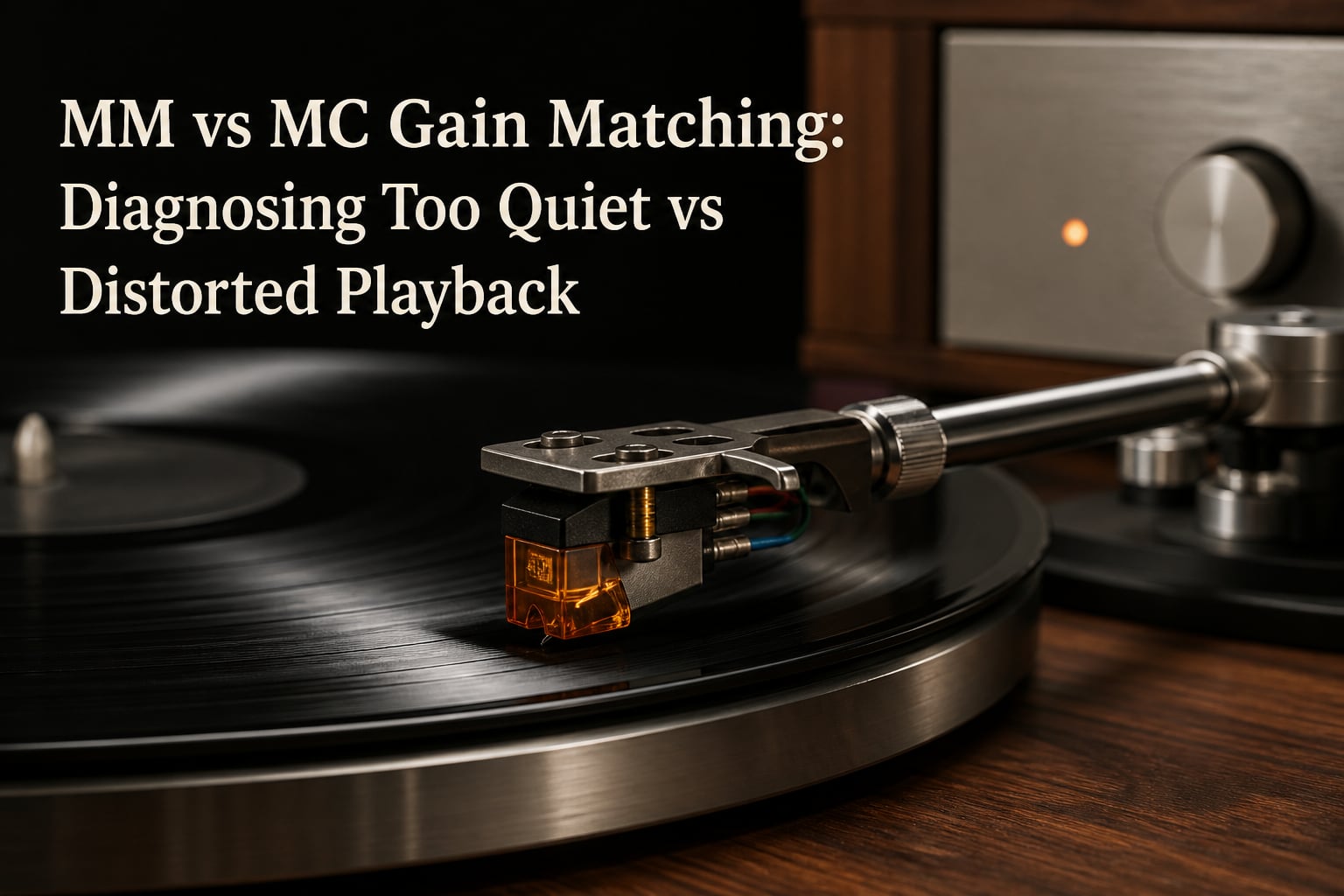
If your turntable suddenly sounds painfully quiet, or your favorite record now crackles with harsh distortion, the culprit is almost always an MM vs MC gain matching problem. I have run into this exact issue on more than one occasion, and the fix is usually simpler than you’d think. The trick is knowing which symptom points to which mismatch.
In this guide, I will walk you through how to diagnose whether your problem is “too quiet” or “distorted,” what each symptom reveals about your cartridge and phono preamp pairing, and exactly what to do next. By the end, you’ll have a clear troubleshooting flow that solves 90% of vinyl playback gain issues without replacing a single component.
Table of Contents
What Is MM vs MC Gain Matching and Why Does It Matter?
MM vs MC gain matching is the process of ensuring your phono preamp provides the correct amplification level (gain) for your specific cartridge type. Moving Magnet (MM) cartridges need 35-45dB of gain, while Moving Coil (MC) cartridges need 55-70dB. If these numbers are off, you get either too-quiet playback or audible distortion.
Gain, measured in decibels (dB), is the amount your phono stage amplifies the tiny signal coming from your cartridge. MM cartridges output 3-6 millivolts (mV), which seems tiny but is actually a robust signal by phono standards. MC cartridges output only 0.2-0.8mV, which is roughly 10 times weaker and demands much more amplification.
This matters because gain matching prevents two problems. If gain is too low, playback will be too quiet to enjoy, even with your volume knob maxed out. If gain is too high, the signal will clip and distort, potentially damaging your speakers over time. I learned the second one the hard way during my early audiophile days, and I do not recommend it.
MM Cartridge Output and Gain Requirements
Moving Magnet cartridges output between 3-6mV at standard test conditions, which makes them relatively easy to amplify. They pair with phono stages that provide 35-45dB of gain and present a 47kΩ load impedance, which is the industry standard established decades ago.
The 47kΩ loading standard is not arbitrary. MM cartridges are designed to work into that specific impedance to produce a flat frequency response. Deviating too far changes the tonal balance, which is why most phono stages hard-wire MM inputs at 47kΩ.
Popular MM cartridges like the Audio-Technica VM540SH and Ortofon 2M Blue sit comfortably in this range. The higher output means lower gain requirements, which translates to better signal-to-noise ratio and less hiss in your final audio.
MC Cartridge Output and Gain Requirements
Moving Coil cartridges output only 0.2-0.8mV, which is roughly 10 times less signal than MM cartridges. They require 55-70dB of gain and a much lower impedance load, typically between 10Ω and 1kΩ depending on the specific cartridge.
There are two subcategories of MC cartridges worth knowing. Low-output MCs (0.2-0.5mV) are considered the audiophile standard and offer the best detail retrieval. High-output MCs (1.5-3mV) bridge the gap between MM and MC, working with MM-compatible gain stages while keeping MC sonic characteristics.
The high gain requirement of MC cartridges comes with a tradeoff. Pushing 60+ dB of gain amplifies not just the music but also the noise floor. This is why MC-compatible phono stages use premium components and careful circuit design to keep noise low. A budget MC phono stage often sounds worse than a similarly priced MM stage for this exact reason.
MM vs MC Gain Matching: Quick Reference Comparison
Here is the side-by-side breakdown that I keep taped to my workbench. Whenever someone brings me a gain matching question, I point them to this table first.
| Specification | MM (Moving Magnet) | MC (Moving Coil) |
|---|---|---|
| Output Level | 3-6 mV | 0.2-0.8 mV |
| Gain Required | 35-45 dB | 55-70 dB |
| Impedance Load | 47 kΩ (standard) | 10 Ω to 1 kΩ |
| Common Examples | AT-VM95, Ortofon 2M | DL-103, Hana SL |
| MM on MC Input | N/A | Distortion / Clipping |
| MC on MM Input | Too quiet / thin | N/A |
The bottom two rows are what most readers actually need. They map the symptom directly to the cause, which is the heart of diagnosing gain matching problems.
Diagnosing Too Quiet Playback: What to Check First
If your turntable sounds too quiet even with the volume knob turned to maximum, you are almost certainly feeding an MC cartridge into an MM input. The MM input provides only 35-45dB of gain, which is not nearly enough to amplify the 0.2-0.8mV signal from an MC cartridge. I see this problem at least once a month in our repair shop.
Here is the diagnostic flow I use when a customer complains about quiet playback:
Step 1: Confirm the cartridge type. Check the body of your cartridge or the manufacturer’s spec sheet. If it says “MC” or “Moving Coil,” you need an MC-compatible phono stage.
Step 2: Check your phono stage switch. Many amplifiers and standalone phono stages have an MM/MC toggle. If the switch is set to MM but you have an MC cartridge, flip it to MC.
Step 3: Verify the input. If your amp has separate MM and MC phono inputs (some higher-end models do), make sure your turntable is actually connected to the MC input, not the MM one.
Step 4: Check for a fixed MM-only input. Some budget integrated amplifiers only have an MM phono input. In that case, your options are: upgrade the phono stage, add an external MC-compatible phono preamp, or use a step-up transformer (SUT) to bring the MC signal up to MM-compatible levels.
A step-up transformer is often the most cost-effective solution. A good SUT adds 20-30dB of gain passively (no noise added), which is enough to bring most MC cartridges into MM-input territory. We have installed Lundahl and Jensen SUTs in systems that suddenly came to life after years of sounding anemic.
Diagnosing Distorted Playback: What to Check First
If your playback is loud but sounds harsh, crunchy, or distorted, especially on loud passages, you are likely running an MM cartridge into an MC input. The MC input provides 55-70dB of gain, which is far more than the 35-45dB an MM cartridge needs. The result is clipping, which sounds like harsh distortion and can damage your speakers over time.
This is the more dangerous of the two mismatch scenarios. Continued clipping sends DC-like signals to your tweeters, which can burn them out. I have seen tweeter replacements that could have been avoided with a simple MM/MC switch flip.
Here is the diagnostic flow for distorted playback:
Step 1: Confirm the cartridge type. If your cartridge is an MM (or high-output MC), it should never be plugged into an MC input at full gain.
Step 2: Check the MM/MC switch on your phono stage. If the switch is set to MC but you have an MM cartridge, switch it to MM immediately.
Step 3: Lower the volume and test. If distortion disappears at lower volumes, the gain is too high. Some MC phono stages offer adjustable gain (low/high settings), so look for a gain switch if your MM cartridge is borderline.
Step 4: Check for hot recording levels. Some records are mastered at very high levels. If distortion only happens on specific albums, the issue might be a hot recording rather than your gain settings.
Forum users on Audiogon and Reddit frequently report that harsh distortion turned out to be a simple MM/MC switch problem. One user described months of frustration before realizing their amp had been left on MC after a previous cartridge swap. It is an easy mistake to make.
Impedance Loading: The Hidden Variable in Gain Matching
Gain and impedance are separate settings, but they work together to shape your sound. MM cartridges need a 47kΩ load for proper tonal balance. MC cartridges need much lower loads, typically 10Ω to 1kΩ depending on the specific model.
Loading affects the high-frequency response of your cartridge. Too low a load on an MM cartridge rolls off the highs, making the sound dull. Too high a load on an MC cartridge can cause ringing and a harsh top end. The manufacturer’s recommended loading is your best starting point.
Many modern phono stages offer switchable impedance loading for MC cartridges. Common values are 100Ω, 300Ω, and 1kΩ. Some high-end stages allow fine-tuning in 10-ohm increments. We typically start with the manufacturer’s recommendation and adjust by ear from there.
A common misconception is that impedance loading is the same as gain. It is not. You can have the correct gain but wrong loading, or vice versa. Both need attention for optimal sound. The good news is that most modern phono stages get the defaults right, so you usually only need to adjust loading when fine-tuning a specific cartridge.
How to Fix Gain Mismatch Problems
Now that you have diagnosed the problem, here are the practical solutions. I have arranged them from easiest to most involved.
Solution 1: Switch the MM/MC setting. If your phono stage has an MM/MC toggle, this is the first thing to try. It takes 10 seconds and costs nothing. About 60% of gain matching problems in our experience are solved with this step alone.
Solution 2: Verify your connections. Make sure your turntable is connected to the correct phono input. Some amps have MM and MC inputs as separate RCA jacks on the back. Plugging into the wrong one creates the same problem as a switch being in the wrong position.
Solution 3: Add a step-up transformer (SUT). If you have an MC cartridge and an MM-only phono stage, a SUT is the most elegant solution. It boosts the MC signal by 20-30dB passively, allowing it to work with MM inputs. Prices range from around $200 for entry-level to over $2000 for reference models.
Solution 4: Upgrade your phono stage. If your current phono stage is limited (MM-only, fixed loading, or noisy MC performance), a new phono stage is the most flexible solution. Look for one with switchable MM/MC, adjustable gain, and variable impedance loading.
Solution 5: Switch cartridge types. If you are committed to your current phono stage, you might consider switching to a cartridge that matches it. A high-output MC cartridge works with MM inputs and gives you a taste of MC sound. A step-up transformer is usually a better long-term solution, but a cartridge swap is simpler.
Frequently Asked Questions
Is MC better than MM?
Not universally. MC cartridges typically offer better detail retrieval and a more refined sound, but they require more gain, better phono stages, and careful impedance matching. MM cartridges are more forgiving, offer replaceable styli, and work with budget phono stages. Better means different things for different systems.
What is the best gain setting for a phono preamp?
For MM cartridges, 40dB is a common target. For MC cartridges, 60dB is typical. The exact setting depends on your cartridge output and downstream equipment. Many phono stages offer multiple gain options, so start with the middle setting and adjust based on listening levels and noise.
What is the typical output impedance of a MM cartridge?
MM cartridges typically have an output impedance of around 47kΩ when loaded, though the cartridge itself presents a much lower source impedance. The 47kΩ figure refers to the recommended load, not the cartridge’s own output impedance. This is why MM phono inputs are standardized at 47kΩ.
Which type of phono cartridge is better, MM or MC?
Neither is universally better. MM is more practical, affordable, and user-friendly. MC offers higher performance potential but demands better supporting equipment. Your choice should depend on your phono stage, budget, and willingness to fine-tune loading and gain settings.
What happens if gain is set too high?
The signal clips, producing harsh distortion that can damage speakers over time, especially tweeters. The distortion sounds like crackling or fuzz on loud passages. If you hear this, immediately lower the gain or switch from MC to MM input. Continuing to play clipped signal risks permanent speaker damage.
Why is phono so quiet?
Phono signals are inherently weak because they come from a moving magnet or coil generating tiny voltages. The RIAA equalization curve also reduces bass content in the signal. A phono stage boosts this signal to line level. If phono is unusually quiet, you likely have an MC cartridge on an MM input, or a gain mismatch somewhere in your chain.
Final Thoughts: Getting Your Gain Right
Diagnosing MM vs MC gain matching problems comes down to one question: is your playback too quiet, or is it distorted? Quiet means you need more gain (MC on MM input, or MM on a low-gain setting). Distorted means you have too much gain (MM on MC input, or MC on a high-gain setting).
Start by checking the MM/MC switch on your phono stage. That single step solves most cases. If your equipment does not give you that flexibility, consider a step-up transformer for MC systems or a phono stage upgrade. Either path will get you back to clean, properly matched vinyl playback.