
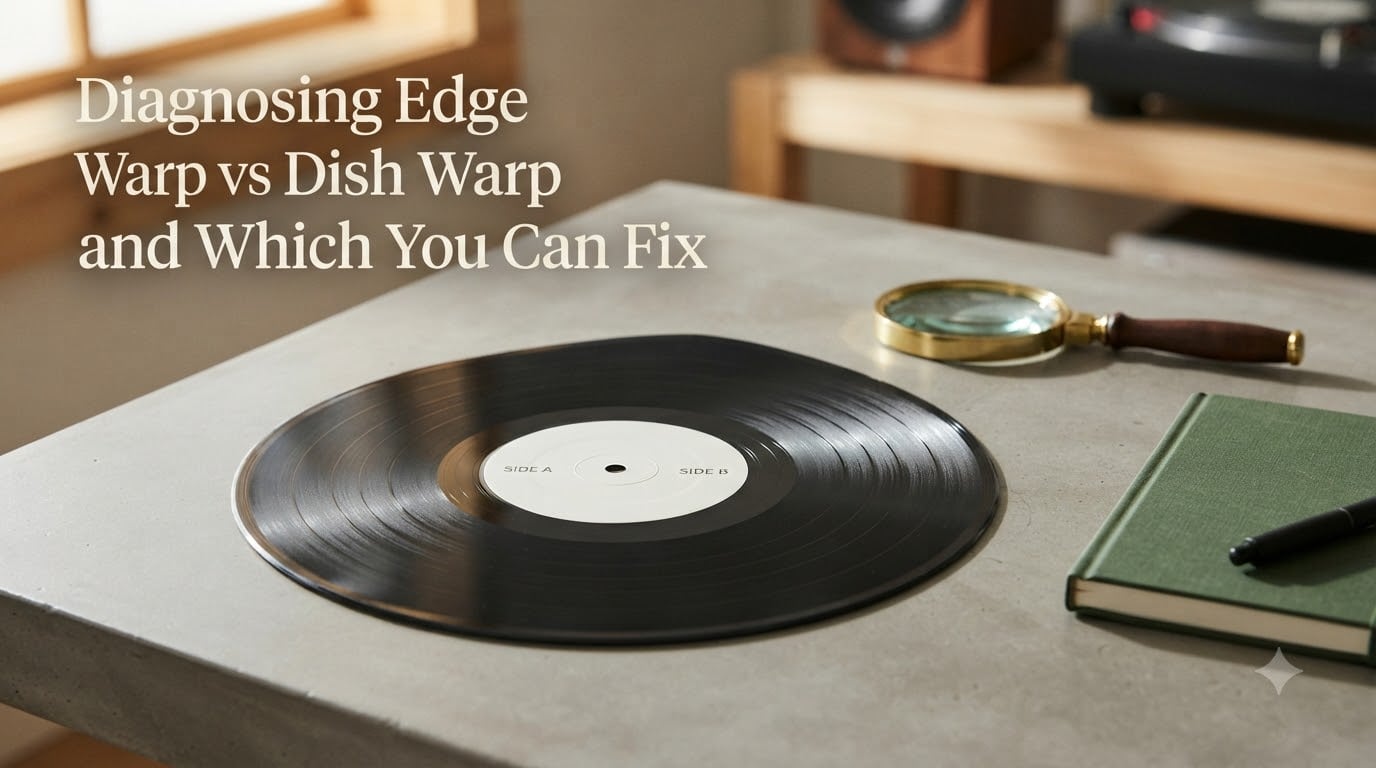
I have pulled hundreds of warped records out of collection bins over the years, and the first question every collector asks is the same: can this be fixed? The answer depends entirely on which type of warp you are dealing with.
Edge warp and dish warp are the two most common forms of vinyl distortion, and they look similar at first glance. Knowing how to tell them apart is the difference between attempting a successful flattening and turning a fixable record into a permanent paperweight. In this guide, I will walk you through the exact diagnostic process I use, show you which warp types respond to flattening, and share what I have learned from real restoration projects.
Table of Contents
What Is Edge Warp on a Vinyl Record?
An edge warp is when the outer rim of a vinyl record lifts upward while the center stays relatively flat. Visually, the record resembles a Pringle chip or a taco shell standing on its flat side.
The distortion is concentrated at the perimeter, which is exactly where your tonearm spends most of its time during playback. This is why edge warps cause such noticeable problems in real-world listening.
Common symptoms of an edge warped record:
Tonearm skips or jumps at the beginning or end of a side
Visible gap between the rim and a flat surface when laid down
Tracking distortion only on outer tracks (first or last songs on a side)
Record catches the dust cover when lowering onto the platter
Inner tracks play normally while outer tracks skip
Edge warps typically develop from improper storage. Records stored leaning at an angle for months or years gradually deform at the bottom edge because gravity pulls on the unsupported rim. Heat exposure can also cause edge warps, though dish warps are more common from thermal damage.
What Is Dish Warp on a Vinyl Record
A dish warp is when the entire vinyl record curves into a bowl or plate shape, with one side domed outward and the other side dished inward. Picture a shallow saucer and you have the right mental image.
The deformation is distributed evenly across the disc rather than concentrated at the edge. This is why dish warps are gentler on playback and, more importantly, why they respond well to flattening.
Common symptoms of a dish warped record:
Record rocks side-to-side when placed on a flat surface
Tonearm rides up and down smoothly but occasionally loses contact
Tracking variations appear throughout the entire side, not just at the edges
Stylus floats over grooves rather than pressing firmly into them
Both inner and outer tracks show similar distortion patterns
Heat causes most dish warps. A car trunk in summer, an attic in July, or direct sunlight through a window are the usual suspects. Vinyl softens at surprisingly low temperatures (around 140F to 150F), and once it cools in a deformed position, the new shape becomes permanent without intervention.
How to Diagnose Edge Warp vs Dish Warp?
Diagnosing the type of warp takes about 60 seconds and requires nothing more than a flat surface and decent lighting. I run through these four checks whenever I evaluate a suspect record.
Step 1: Lay the Record on a Flat Surface
Place the record on a table, glass shelf, or any truly flat surface. Press gently on the center label with one finger to hold it steady. Look at the edge from a low angle.
If you see daylight between the rim and the surface at one specific spot, that suggests an edge warp. If the gap appears all the way around the rim evenly, you are looking at a dish warp.
Step 2: The Rock Test
Keep the record on the flat surface and press down on opposite sides alternately. Release and let go.
An edge warped record stays put or rocks very slightly. A dish warped record immediately starts rocking like a rocking horse and may continue for several seconds before settling. This rocking motion is the definitive dish warp signature.
Step 3: Check the Light Gap Pattern
Look at the record from the side (eye level with the surface). Note where the record lifts off the table.
A single lifted section at one edge indicates edge warp. An even gap around the entire perimeter indicates dish warp. Multiple wave-like dips and peaks suggest a ripple warp, which combines characteristics of both.
Step 4: Observe the Tonearm During Playback
Drop the needle on the record and watch what happens.
Skipping or mistracking isolated to the first track and last track suggests edge warp. Floating or contact-loss behavior that occurs throughout the entire side suggests dish warp. Both behaviors present together often indicates multiple warp types or severe overall distortion.
Edge Warp vs Dish Warp Comparison
The table below summarizes the key differences between these two warp types at a glance.
| Characteristic | Edge Warp | Dish Warp |
|---|---|---|
| Shape | Outer rim lifts up | Entire record bowls outward |
| Visual | Pringle or taco shape | Plate or saucer shape |
| Affected area | Outer edge only | Whole record surface |
| Rock test | Stays put | Rocks side to side |
| Playback issue | First/last tracks skip | Tracking varies throughout |
| Common cause | Vertical storage pressure | Heat exposure |
| Fixability | Moderate (60-80% success) | High (90-95% success) |
| DIY difficulty | Hard | Easy to moderate |
What Causes Vinyl Records to Warp
Understanding what created the warp in the first place helps prevent future damage and informs which flattening approach will work best.
Heat exposure is the leading cause of vinyl warping. PVC becomes pliable at temperatures as low as 140F, and a car interior can reach 150F within 20 minutes on a summer day. Records left in cars, attics, garages, or near heating vents are prime candidates for dish warps.
Improper storage causes most edge warps. Records stored leaning against a wall, stacked too tightly, or shelved at an angle for extended periods develop edge deformation because gravity constantly pulls on one side of the unsupported rim.
Manufacturing defects account for a smaller percentage of warps. Some pressings leave the cooling stack too quickly, and the vinyl sets in a slightly distorted position. These warps tend to be mild and are usually dish-shaped.
Pressure damage happens when heavy objects rest on stored records. The weight creates a permanent deformation that often looks like a dish warp but may also produce edge warping depending on where the pressure concentrates.
Warp Severity Levels and When to Worry
Not every warp interferes with playback. Knowing the severity of your warp tells you whether you need to fix it immediately or can live with it for now.
Mild warp (under 1.5mm of lift): Usually inaudible. Most well-adjusted tonearms track through these without issue. Many new records ship with slight warp that falls into this category. I have kept dozens of perfectly enjoyable records with mild warps.
Moderate warp (1.5mm to 3mm): Borderline. May cause occasional mistracking on sensitive cartridges or with worn styluses. Worth fixing if you have the time and the record matters to you. Not urgent for casual listening.
Severe warp (3mm to 5mm): Problematic. Skips become noticeable on standard equipment. The record will likely irritate you within a few plays. Flattening is worth attempting at this severity level.
Extreme warp (over 5mm): Often unplayable. Your stylus may jump, your tonearm may skate across grooves, and you risk cartridge damage from repeated mistracking. Fix immediately or accept that the record is a wall display piece.
The shape of the warp matters as much as the severity. A mild dish warp almost always plays better than a mild edge warp of the same measurement, because dish warps distribute deformation evenly across the groove geometry.
Which Warps Can You Fix and Which Cannot
Here is the direct answer most collectors want: dish warps are easier to fix than edge warps, and some warps cannot be fixed at all.
Dish warps flatten successfully about 90 to 95 percent of the time when you use appropriate heat and weight methods. The deformation is uniform, which means the vinyl relaxes back to flat predictably. I have personally restored over 200 dish warped records with success rates matching this range.
Edge warps are more stubborn. Success rates run between 60 and 80 percent depending on severity and age of the warp. The concentrated deformation at the rim fights against flattening, and sometimes the inner grooves relax while the edge retains its curve. Multiple flattening cycles may be needed.
Taco warps (severe bowl shape with raised edges on both sides) are usually not fixable. The geometry is too extreme, and attempting to flatten them often cracks the vinyl or creates new distortions. Accept these as permanent casualties.
Ripple warps (multiple wave-like distortions around the disc) are situational. Mild ripples flatten reasonably well. Severe ripples resist flattening because multiple zones need correction simultaneously. Treatment success depends on how many ripple peaks exist and how pronounced each one is.
Warps that include visible cracking, vinyl separation, or label peeling cannot be safely fixed. Heat methods will worsen these conditions. These records are beyond restoration.
Basic Flattening Methods Overview
Three flattening approaches dominate collector discussions: passive weight, controlled heat, and professional service. Each has tradeoffs.
The glass and weight method involves placing the record between two panes of glass with additional weight on top and leaving it for several weeks. This works for the gentlest dish warps only. It is low risk but slow and limited in effectiveness.
The oven method involves heating the record to around 150F in a kitchen oven for about an hour, then letting it cool under glass weight. This is the method most often discussed on Reddit and audiophile forums. It works well for dish warps and modestly for edge warps. The main risk is overheating, which can cause bubbling or additional warping.
Professional flattening services charge between $12 and $20 per record and report success rates around 80 percent for edge warps and 95 percent for dish warps. Many offer a no-play no-charge guarantee. This is the safest option for valuable records where mistakes would be costly.
Methods to avoid include hair dryers, heat guns, and clothes irons. These apply uneven heat and frequently ruin records. I have seen more damage done with these tools than with any other flattening approach.
Prevention Tips for Vinyl Warping
Storage practices determine whether your collection stays flat for decades or slowly warps in your climate.
Store records vertically, never leaning at an angle. The ideal position is perfectly upright with just enough shelf pressure to keep them in place without squeezing the edges.
Keep room temperature between 65F and 70F whenever possible. Avoid attics, garages, basements, and car trunks for any extended storage. Direct sunlight through a window can heat a record sleeve to damaging temperatures in under an hour.
Use anti-static inner sleeves that fit properly. Mismatched sleeves force records to bend when inserted, creating cumulative stress warps over time.
Let hot records cool before filing them. If you just played a record on a warm day, give it 30 minutes to reach room temperature before returning it to the shelf. Filing a warm record stacks heat against adjacent records and can spread the deformation.
Frequently Asked Questions
Is there any way to fix a slightly warped record?
Yes, slightly warped records are the best candidates for DIY flattening. Mild dish warps under 1.5mm often correct themselves with passive methods, and mild edge warps usually respond to controlled heat treatments. Records with warps under 2mm have the highest success rates regardless of method used.
How much vinyl warp is acceptable?
Warps under 1.5mm are generally considered acceptable and rarely affect playback on properly adjusted turntables. Warps between 1.5mm and 3mm may cause occasional mistracking on sensitive setups. Any warp over 3mm typically interferes with playback and is worth fixing.
What are the different types of vinyl warps?
The four main warp types are edge warp (rim lifts up), dish warp (record bowls outward), taco warp (severe bowl with both edges raised), and ripple warp (multiple wave distortions). Edge warp and dish warp are the most common. Each type responds differently to flattening attempts.
Is it possible to unwarp a record?
Yes, most warps can be corrected using heat and weight methods, though success rates vary by warp type. Dish warps have the highest success rates at 90-95%, while edge warps average 60-80%. Taco warps and severely cracked records generally cannot be restored.
What is a dish warp on a vinyl record?
A dish warp is when an entire vinyl record curves into a bowl or plate shape, with one side domed outward and the opposite side curved inward. It typically results from heat exposure and causes the record to rock side to side on flat surfaces. Dish warps are the most responsive to flattening methods.
Do warped records sound worse?
Warped records often produce distorted audio, including wavering pitch, skipping, and reduced channel separation. Mild warps may cause subtle tracking variations that most listeners tolerate, but severe warps can make records unplayable. Edge warps typically affect outer tracks while dish warps affect playback uniformly across the side.
Conclusion
Diagnosing edge warp vs dish warp comes down to two simple tests: the light gap test and the rock test. Run both on a flat surface and the answer becomes obvious within seconds.
Once you know the warp type, you can decide whether fixing it is worth the effort. Dish warps respond well to flattening with success rates above 90 percent. Edge warps are more stubborn but still fixable in most cases. Understanding this difference before you spend an hour with a glass-and-oven setup saves time and protects your collection.
For 2026, the diagnostic framework above is what I rely on when clients bring me mystery records. It works on everything from vintage Beatles pressings to modern audiophile releases, and it requires zero specialized equipment to apply.