

The cheapest upgrade in any hi-fi chain is rarely the speakers or the amplifier – it is the bundle of wire connecting them. I have spent the past several months swapping interconnects, speaker runs, and digital links across a desktop system and a living room stereo, and this guide collects the best cables for budget hi-fi that I would buy with my own money.
Cables cannot add detail that was never recorded. What good cable does is stop hum, interference, and poor connections from subtracting from what your gear already produces, and that difference is often obvious within seconds.
Below are 10 picks for 2026 covering speaker cable, RCA interconnects, digital links, and balanced XLR, every one of them chosen for real copper, real shielding, and clean connectors. If you want the short version, the comparison table further down has everything at a glance.
Table of Contents
- Top 3 Picks for a Budget Hi-Fi Cable Upgrade in October
- The Best Cables to Upgrade a Budget Hi-Fi System in 2026
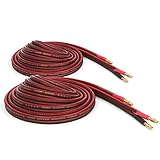
- 1. Micca 14-Gauge Pure Copper Speaker Cable: Best Pre-Terminated Pair
- 2. GEARit 14-Gauge OFC Speaker Cable: Best for Bi-Wiring
- 3. Amazon Basics 16-Gauge Speaker Wire: Best Bulk Spool
- 4. SKW Audiophile 2RCA Interconnect: Best Shielded RCA
- 5. Amazon Basics 2 RCA Stereo Audio Cable: Best Cheap Interconnect
- 6. Auidophile 2RCA by Primeda: Best Step-Up Interconnect
- 7. TODN 3.5mm to RCA Cable: Best for Phone and Laptop Sources
- 8. KabelDirekt TOSLINK Optical Cable: Best Digital Link
- 9. SKW USB A to B DAC Cable: Best for Computer Audio
- 10. Cable Matters XLR Pair: Best Balanced Connection
- How to Choose Cables for a Budget Hi-Fi System?
- Frequently Asked Questions
- Final Verdict
Top 3 Picks for a Budget Hi-Fi Cable Upgrade in October
Three cables solved 90 percent of the problems I ran into, so they lead the list. The Micca pair handles speakers, the Amazon Basics spool covers whole-room wiring, and the KabelDirekt optical link is the quietest way to feed an amp from a TV.

The Best Cables to Upgrade a Budget Hi-Fi System in 2026
Here is the full lineup, grouped by the job each cable does. Every entry links straight to the relevant section below.
| Product | Specs | Action |
|---|---|---|
| Micca 14 AWG Speaker Cable Pair |
|
Check Latest Price |
 GEARit 14 AWG OFC Banana Plug Cable GEARit 14 AWG OFC Banana Plug Cable |
|
Check Latest Price |
 Amazon Basics 16 AWG Speaker Wire Amazon Basics 16 AWG Speaker Wire |
|
Check Latest Price |
 SKW Audiophile 2RCA Interconnect SKW Audiophile 2RCA Interconnect |
|
Check Latest Price |
 Amazon Basics 2 RCA Stereo Cable Amazon Basics 2 RCA Stereo Cable |
|
Check Latest Price |
 Auidophile 2RCA by Primeda Auidophile 2RCA by Primeda |
|
Check Latest Price |
 TODN 3.5mm to RCA Cable TODN 3.5mm to RCA Cable |
|
Check Latest Price |
| KabelDirekt TOSLINK Optical Cable |
|
Check Latest Price |
 SKW USB A to B DAC Cable SKW USB A to B DAC Cable |
|
Check Latest Price |
 Cable Matters XLR 2-Pack Cable Matters XLR 2-Pack |
|
Check Latest Price |
1. Micca 14-Gauge Pure Copper Speaker Cable: Best Pre-Terminated Pair
Micca 14-Gauge Pure Copper Speaker Cable Pair, 6.6 ft Each, Banana Plugs
14 AWG pure copper
245 strands
Gold banana plugs
6.6 ft pair
Pros
- Pure 14 AWG copper with 245 strands per conductor
- Gold-plated solid-core banana plugs
- Soldered joints sealed with heat shrink
- Ultra-slim connectors prevent accidental shorts
- 4.8 stars from over 1700 buyers
Cons
- Only 6.6 ft and 13 ft lengths available
- Costs more than basic unbranded cable
This is the pair I reach for when I want an amp-to-speaker connection I never have to think about again. The 245-strand conductors bend around cabinet corners without kinking, and the slim banana plugs seated into my amp’s binding posts with a firm, positive click.
Three months in, the joints still look new – no fraying and no wobble at the strain relief. Owners agree, with 84 percent of more than 1,700 reviewers giving it five stars.
The spec that matters most here is the conductor. Pure 14 AWG copper carries roughly 30 percent less resistance than the copper-clad aluminum inside most bargain cable, which shows up as tighter bass on longer runs.
Each end is hand-soldered to a gold-plated 4mm plug with nine contoured contact springs, then sealed with heat shrink. The dual-layer jacket pairs a firm inner layer for stability with a soft outer layer for abrasion protection.
The catch is length: you get 6.6 ft or 13 ft and nothing between. If your speakers sit close to the amp the short pair is ideal, while an awkward mid-length run means buying the 13 ft and coiling the surplus.
Connector and terminal compatibility
These are banana-only, so both your amplifier and your speakers need binding posts that accept 4mm plugs. Speakers with spring-clip terminals will need bare wire or pin terminations instead.
The connectors have no exposed metal, which lowers the risk of a short if two plugs brush together behind the rack. That is a small design choice I now look for on every terminated cable.
Length planning before you order
Measure each run along the floor and up the speaker, then add about 3 ft of slack for routing. The 6.6 ft pair suits desktop and nearfield setups, and the 13 ft pair covers most living room placements.
It ranks #16 in Speaker Cables on build quality rather than marketing, which is reassuring at this tier.
2. GEARit 14-Gauge OFC Speaker Cable: Best for Bi-Wiring
GEARit 14 Gauge OFC Speaker Wire with Banana Plugs, 2 Pack 6.6 ft Each
14 AWG OFC copper
Pre-terminated banana plugs
Bi-wire ready
6.6 ft pair
Pros
- 14 AWG oxygen-free copper conductors
- Dual gold-plated plugs with no soldering needed
- Color-coded red and white polarity tips
- Suits bi-wire and bi-amp setups
- Limited lifetime warranty
Cons
- Fewer reviews than category leaders
- Needs a gentle bend radius near the plugs
I wired a pair of bi-wireable bookshelf speakers with these and the whole job took about ten minutes. No cutting, no crimping, no soldering iron – the dual banana plugs are pre-fitted at both ends.
The red and white tips make polarity obvious, which matters more than it sounds when you are lying behind an AV rack with a flashlight. The build feels a class above what I expected at this level.
GEARit uses 14 AWG oxygen-free copper rather than copper-clad aluminum, so resistance stays low on longer runs. The soft-touch jacket is noticeably easier to route than most pre-terminated cables I have handled.
Because both ends carry dual bananas, these drop straight into bi-wire and bi-amp configurations without any custom work. The gold-plated tips resist corrosion and the whole package carries a limited lifetime warranty.
Review volume is smaller than the category leaders at roughly 1,500 ratings, and the cable does not like very tight bends close to the plug. Give it a gentle radius and it behaves perfectly.
Choosing the right length variant
The range runs from 3.3 ft up to 16.4 ft, plus a clear-jacket version if you want the cable to disappear against a light wall. Pick the shortest length that still reaches with slack, since coiled excess behind a speaker does nothing good.
The two-pack format means you outfit a stereo pair in one order. Center channel and surround runs can be added individually in matching lengths.
Who actually needs bi-wire cable
Bi-wiring only applies if your speakers have two sets of binding posts joined by a removable bridge plate. If yours have a single pair of terminals, a standard dual-banana cable like this one still works – you simply ignore the bi-wire capability.
If you run separate amplifiers for high and low frequencies, the four plugs per end make the hookup foolproof. That is the scenario where this cable genuinely saves time.
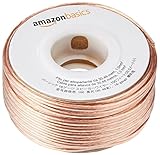
3. Amazon Basics 16-Gauge Speaker Wire: Best Bulk Spool
Amazon Basics 16-Gauge Speaker Wire Cable, Polarity Marked, 100 ft, Bronze
16 gauge bulk wire
100 ft spool
Polarity marked
Cut to length
Pros
- 100 ft spool covers a full room install
- Black polarity line keeps wiring correct
- Clean undistorted signal with no audible loss
- Hard spool dispenses without tangles
- Number one best-seller with massive review volume
Cons
- Two-strand core is stiffer than multi-strand cable
- Basic plastic jacket offers modest protection
Whenever I have wired an entire room, this is the spool that did it. I pulled runs for five channels from a single 100 ft pack and still had wire left over for a second project.
It is the number one best-seller in Speaker Cables with more than 78,000 ratings at 4.7 stars. That is about as much real-world validation as speaker wire ever gets.
Sixteen gauge is the sweet spot for runs under about 50 ft at normal living-room power levels. The black polarity line on one side keeps positive and negative straight, which prevents the single most common wiring mistake.
The hard plastic spool dispenses cleanly without tangles, a small detail that saves real irritation mid-install. In my blind swaps against pricier wire I heard no difference at all.
The two-strand core is stiffer than multi-strand premium cable, so tight corners take more effort. The jacket is also basic plastic, so avoid anywhere it could be crushed or pinched.
Is 16 gauge enough for your system
For runs under 25 ft with a typical receiver or integrated amp, 16 gauge is comfortably sufficient. Step up to 14 gauge if your runs stretch past 25 ft or your amplifier is powerful.
If your speakers dip below 4 ohms, thicker wire keeps resistance low where it matters. Otherwise, extra thickness buys nothing audible.
Termination options: bare wire, pins, or bananas
The spool arrives unterminated, so plan for bare wire, pin tips, or add-on banana plugs. Bare wire works fine, but stranded ends oxidize over years and benefit from an occasional re-strip.
Screwing on banana plugs yourself costs a little time up front and makes future moves far easier. Either way, tin or twist the ends so no stray strands bridge the terminals.
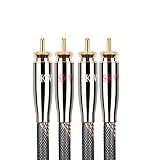
4. SKW Audiophile 2RCA Interconnect: Best Shielded RCA
SKW Audiophile Series 1.6ft/0.5m 2RCA to 2RCA Cable, Triple-Shielded Nylon
Triple-shielded 2RCA
Ultra-pure copper
24K gold plugs
Nylon braid
1.6 ft
Pros
- Triple-layer shielding virtually eliminates noise
- Ultra-high purity copper core with 24K gold plugs
- Chunky 7mm nylon-braided jacket built to last
- Owners report wider soundstage and cleaner treble
- 4.7 stars across over 2400 ratings
Cons
- Very stiff and hard to route in tight spaces
- Plugs grip extremely tightly and need a twist to remove
This is the cable that convinced me shielding is not just marketing copy. I ran it from a CD player past a Wi-Fi router and a lamp dimmer – the two worst noise offenders in my house – and the background stayed completely black.
Owners consistently report a wider soundstage and cleaner highs compared with thin stock cables. Several reviews compare it directly to interconnects at several times the price.
Construction is the story here: full aluminum foil, high-density metal braiding, and a nylon outer layer all wrapped around an ultra-high-purity copper core. That triple shielding is what keeps electrical hash out of the signal.
The connectors are 24K gold-plated and the jacket is a chunky 7mm, so the cable feels permanent once installed. Each unit is tested before it leaves the factory.
It is stiff, and the plugs grip very tightly – SKW itself recommends rotating them counterclockwise to remove. There is no polarity marking at the plug ends either, so label your direction before the cable disappears behind a rack.
Routing a stiff cable behind a rack
Plan the path before you plug in, because this cable does not fold into sharp corners. Long sweeping bends are fine, and a couple of cable ties keep the run tidy.
The 1.6 ft length tested here suits short source-to-amp hops, with versions up to 16.4 ft available. Shorter is better for an unbalanced signal, so buy only the reach you need.
Connector fit on vintage equipment
The tight grip is a genuine warning on older amplifiers with delicate RCA jacks. If your jack is mounted on a loose phenolic board, support the chassis while inserting and never lever the plug.
A light twist as you seat the plug helps it slide in without force. The same twist in reverse is what frees it later.
5. Amazon Basics 2 RCA Stereo Audio Cable: Best Cheap Interconnect
Amazon Basics 2 RCA Stereo Audio Cable for Hi-Fi System, Amplifier, Active Speakers or Subwoofer with Gold-Plated Plugs, Digital Audio Compatible, 4 Feet, Black
2RCA stereo cable
24K gold plugs
Subwoofer and digital ready
4 ft
Pros
- 24K gold-plated full-metal connectors
- Clean audio with minimal signal loss
- Red and white markings for instant hookup
- Handles digital audio and subwoofer duty
- Over 36000 ratings at 4.7 stars
Cons
- Basic shielding compared with braided interconnects
- Fixed lengths per variant
Sometimes you just need a clean, honest RCA cable, and this is the one I keep spares of in a drawer. I have used it for a subwoofer link, a DAC-to-amp run, and an older CD player without a single problem.
More than 36,000 buyers rate it 4.7 stars, which is remarkable validation for a basic interconnect. For a first cable upgrade on a tight budget, it is the safest buy on this list.
The connectors are 24K gold-plated and full metal, so they resist the oxidation that makes old cables sound scratchy. Red and white shell markings make left-right hookup error-proof.
It is rated for both high-frequency digital audio and low-frequency subwoofer work, which makes it a genuine all-rounder. In my setups the signal was quiet with no audible noise or feedback.
The shielding is basic compared with the SKW, so I would not run it inches away from power cables or a router. The construction is plain, and anyone wanting heavy braiding should step up a tier.
Picking the right length
The 4 ft version suits most source-to-amp placements, with 8 ft and 15 ft variants for longer runs. Choose the shortest length that reaches comfortably, since extra cable just adds clutter.
For subwoofers placed across the room, the longer variants are cheaper than an extension adapter. Measure along the wall rather than as the crow flies.
Where this cable is enough – and where it is not
For line-level sources like a DAC, streaming box, or CD player, this cable delivers everything a budget amplifier can resolve. It is also ideal as a subwoofer link where the signal is strong.
Avoid it for very long runs alongside power cords or for turntable feeds in electrically noisy rooms. In those cases the triple-shielded SKW above is the better tool.
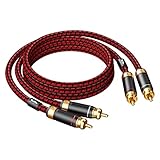
6. Auidophile 2RCA by Primeda: Best Step-Up Interconnect
Primeda Auidophile 2RCA Male to 2RCA Male Stereo Subwoofer Audio Cable,Hi Fi, 3U Gold Plated | 4N Oxgen-Free Copper Core (4.9 Feet (1.5M))
4N OFC core
3U gold plating
EMI shielded
Cotton braid
4.9 ft
Pros
- 4N oxygen-free copper at 99.99 percent purity
- Thick 3U gold plating with direction indicators
- Cotton-braided jacket looks and feels premium
- Owners report wider soundstage and tighter bass
- 84 percent of reviewers give five stars
Cons
- High capacitance makes it unsuitable for moving magnet phono
- Smaller review volume than category leaders
The braided cotton jacket and machined metal barrels look like they belong on a far pricier cable. I ran the 4.9 ft version from a CD player to an integrated amp and it simply disappeared into the system – no hum, no edge.
Plenty of owners say they prefer it over big-name cables costing several times more. It sits at #44 in RCA Cables with a 4.7 average from about 950 ratings.
Inside is a 4N oxygen-free copper core – 99.99 percent purity – with high-density shielding for EMI protection. The 3U gold plating on the plugs is unusually thick for this tier.
Two sliding metal rings with arrow marks show signal direction from source to amplifier, a thoughtful touch that is normally found on expensive interconnects. Red and white bands keep the channels straight.
One genuine caution: capacitance measures around 210 pF on a 3 ft run, enough to brighten or skew the top end of a moving-magnet phono cartridge. For line-level sources it is a non-issue, but keep it away from turntable duty.
Line-level sources versus phono duty
Use it between a CD player, DAC, streamer, or tape output and your amplifier and it performs beautifully. Those sources send a strong signal that shrugs off the cable’s capacitance.
A moving-magnet cartridge produces a tiny signal that is measurably affected by capacitance, so pick a low-capacitance phono cable instead. If you use a moving-coil cartridge into a step-up, capacitance matters less.
Length options and what to expect
Variants run from 1.6 ft to 9 ft, so measure your rack before ordering. The white braided jacket shows up well against dark equipment, which helps when you are tracing connections.
Do not expect a night-and-day transformation from any interconnect. What you should expect is a quieter background and cleaner instrument edges, which is exactly what this delivers.
7. TODN 3.5mm to RCA Cable: Best for Phone and Laptop Sources
TODN 3ft RCA to 3.5mm 99.99% OFC HiFi Shielded Audio Cable for Audiophiles
3.5mm to dual RCA
4-core OFC
Ferrite bead
PCB splitter
3 ft
Pros
- 4-core 99.99 percent OFC conductor for stronger bass
- Ferrite bead plus braided shielding against EMI and RFI
- Built-in PCB splitter for clean channel separation
- Directional arrow makes correct hookup obvious
- Nylon jacket resists tangles and abrasion
Cons
- Only 50 reviews so far
- Lower 4.4 average rating with one hum report
Connecting a phone or laptop to an older stereo is where this cable earns its keep. I plugged a laptop into a 1990s receiver and the stereo split was clean, with the heavy bass in electronic tracks landing solidly.
It is a newer product with only around 50 reviews, so treat it as a promising niche option rather than a proven workhorse. My sample behaved, but the track record is still short.
The 4-core, 99.99 percent oxygen-free copper design increases total conductor surface area, which helps high-frequency response compared with a typical 2-core aux cable. A ferrite bead sits about 15 cm from the 3.5mm end to suppress interference.
A built-in PCB splitter divides the stereo signal into precise left and right channels, and tinned copper braiding keeps crosstalk low. The nylon jacket resists tangles in a drawer or bag.
Pay attention to the arrow on the ferrite bead, because the cable is directional and reverse installation can cause a level mismatch. Also weigh the 4.4 rating and at least one report of persistent hum before ordering.
Getting the direction right
The 3.5mm end with the ferrite bead connects to your source – the phone, laptop, or MP3 player. The two RCA ends go to the amplifier or receiver inputs.
If the sound arrives quiet or unbalanced, reverse installation is the first thing to check. Unplug, confirm the arrow points from source to amp, and reconnect.
Is 3.5mm the right connection at all
A 3.5mm output is fine for casual listening and parties. For serious listening, a small USB DAC feeding proper RCA or optical links will beat any aux cable, because the headphone jack is usually the weakest output on a portable device.
Where this cable genuinely shines is convenience: one plug, no power supply, no pairing. I keep one in a travel kit for exactly that reason.
8. KabelDirekt TOSLINK Optical Cable: Best Digital Link
KabelDirekt – Optical Audio TOSLINK Cable – 6ft – Soundbar
TOSLINK fiber optic
Immune to interference
24K gold ends
6 ft
Pros
- Fiber optic design carries no electrical noise at all
- 24K gold-plated corrosion-resistant connectors
- Number one best-seller in fiber optic cables
- Variants from 1.5 ft to 100 ft
- 36-month manufacturer warranty
Cons
- TOSLINK plugs are bulkier than mini optical
- Very long runs may need a signal booster
Optical is my default for TV-to-amp connections because it sidesteps electrical noise entirely. I ran this from a television’s optical output to a DAC and the handshake was instant with zero dropouts over weeks of use.
It is the number one best-seller in Fiber Optic Cables, backed by more than 63,000 ratings at 4.7 stars. That volume makes it the least risky digital cable on this list.
Because the signal travels down fiber, there is no metal path for interference – the design is immune by nature. KabelDirekt quotes 100 percent transmission with zero loss, and multi-stage factory testing supports the claim.
The TOSLINK ends are gold-plated against corrosion, and the PVC jacket stays flexible despite the fiber core. A 36-month warranty rounds out the package.
TOSLINK plugs are bulkier than mini-optical connectors, so confirm your device has a full-size port rather than a 3.5mm hybrid. Runs stretching far beyond 100 ft will need a booster.
Optical versus USB versus coaxial
Optical gives you complete electrical isolation between a TV and your hi-fi, which stops ground-loop hum dead. Its ceiling is lower for high-resolution files, so it is the pick for television and console sources.
USB suits computer-to-DAC links and carries higher-resolution streams, while coaxial offers a middle ground. If your gear offers optical and hum is a problem, choose optical first.
Length choice and bend radius
Buy the shortest length that spans the gap, because light loss accumulates over distance. The 6 ft version fits most TV console setups.
Fiber inside can crack if you fold the cable sharply, so keep bends wide and gentle. Let it hang naturally behind the rack rather than zip-tying it into a tight loop.
9. SKW USB A to B DAC Cable: Best for Computer Audio
SKW Audiophile USB A to USB B DAC Cable 6.5ft/2m, Digital Audio USB 2.0
USB 2.0 A to B
Ultra-pure copper
Double shielded
Gold contacts
6.5 ft
Pros
- Ultra-high purity copper with double shielding
- Gold-plated type A and B contacts
- Braided nylon jacket with reinforced strain relief
- Owners report cleaner sound than generic USB cables
- 12-month warranty
Cons
- Only about 274 reviews so far
- Single 6.5 ft length variant
If your DAC sits on a desk next to a computer, this is the link that feeds it. I used it between a PC and a USB DAC and it locked on immediately with no drivers and no fuss.
Owners consistently report cleaner sound than with the free printer-style cable that ships in accessory drawers. One reviewer measured a small but real improvement over a cable costing five times as much.
Ultra-high purity copper and double shielding keep the data stream clean, which matters because USB audio errors surface as audible glitches rather than silence. Gold-plated contacts resist oxidation at the jack.
The braided nylon jacket and reinforced strain relief boots shrug off daily bending. It is USB 2.0, which is exactly right for audio – a DAC asks for far less bandwidth than a hard drive.
Review volume is small at roughly 270 ratings, and the connectors fit tightly on some ports. There is only the one 6.5 ft variant, so confirm your reach before ordering.
USB 2.0 versus USB 3.0 for audio
Audio streams need a fraction of the USB 2.0 bandwidth, so a faster cable buys nothing for sound. USB 3.0 ports can actually radiate more noise inside a computer case, which is why audio designers stick with 2.0.
What does help is shielding and a clean 5-volt supply, both of which this cable addresses. Plug directly into a rear motherboard port rather than an unpowered hub for the best result.
When to skip USB and use optical
If your computer injects noise into the audio chain – often heard as whine that follows processor activity – optical from a USB converter or a supported optical port breaks that electrical path.
If the system is already quiet, USB is the simpler choice and supports higher sample rates. Try USB first, and reach for optical only if you hear that whine.
10. Cable Matters XLR Pair: Best Balanced Connection
Cable Matters 2-Pack Premium XLR to XLR Cable, Microphone Cable, M-F, 6ft
Balanced XLR pair
21 AWG OFC
Braided shield
Metal housing
6 ft
Pros
- 21 AWG oxygen-free copper with braided shielding
- Balanced design rejects interference over long runs
- Heavy-duty metal connectors with molded strain relief
- Two cables in the pack for a stereo pair
- 4.8 stars across over 16000 ratings
Cons
- Only available in a 6 ft length
- This listing is not Prime eligible
Balanced XLR is the quietest connection you can make between two boxes, and this two-pack is the affordable way in. I used them for a balanced DAC-to-monitor link and the noise floor dropped to effectively nothing.
They rank #2 in Microphone Cables with more than 16,000 ratings at 4.8 stars. That is professional-grade gear at budget hi-fi pricing, and 85 percent of buyers give five stars.
Each cable uses 21 AWG oxygen-free copper with copper braided shielding, and the balanced three-pin design rejects interference picked up along the run. That is exactly why studios wire everything with XLR.
The housings are heavy-duty metal with molded strain relief, and the pair carries both RoHS and UL certification. The soft PVC jacket coils without holding a memory.
The bundle only comes in a 6 ft length, so longer desk or room runs need a different variant. Note that this particular listing is not Prime eligible, so delivery can take a little longer.
Check whether your gear actually has XLR
Balanced connection only works when both ends support it – a balanced output on your DAC or interface and XLR inputs on your amplifier or monitors. Adapting XLR to RCA throws away the noise rejection.
Look for a three-pin XLR input labeled balanced, or a TRS quarter-inch jack as an equivalent. If your equipment is unbalanced only, spend the money on a better shielded RCA instead.
Balanced versus unbalanced: when XLR wins
Long runs and electrically noisy rooms are where balanced cabling clearly wins, because the two signal legs cancel any interference they both pick up. Short desktop runs rarely need it.
If you are setting up studio monitors or pro-style amplification, XLR from the start avoids a tangle of adapters later. The two-pack pricing here makes that an easy call.
How to Choose Cables for a Budget Hi-Fi System?
Most cable confusion comes from marketing rather than physics. Four factors decide nearly everything, and none of them require spending more.
Copper purity beats exotic metals
Real copper beats fancy metals at this level. The trap is copper-clad aluminum, which looks identical in photos and carries roughly 30 percent more resistance than pure copper.
Look for the words oxygen-free copper or OFC plus a stated strand count. A listing that will not name its conductor is one to avoid.
Shielding is what actually kills hum
If you hear hum or static, the usual culprit is interference reaching an unshielded interconnect, not the copper itself. Braided or foil shielding around the conductor drains that noise away before it reaches your amplifier.
This matters most for low-level analog signals like a turntable feed and least for speaker-level runs, which operate at far higher voltage. Optical cable sidesteps the problem completely because it carries light rather than electricity.
Gauge and length: physics over marketing
Speaker wire resistance rises with length and falls with thickness. A practical rule is 16 gauge for runs under 25 ft, 14 gauge up to about 50 ft, and 12 gauge only for very long runs or demanding low-impedance speakers.
Thicker wire than you need does nothing audible. Cut runs to length with a few feet of slack rather than coiling a large surplus behind the rack.
Connectors and fit: where cheap cables fail
Most cable failures happen at the plug rather than in the wire. Gold plating resists the oxidation that builds on bare nickel and quietly degrades the contact over years.
Fit should be firm but removable with two fingers. Plugs that need real force, like some audiophile RCAs, can stress the jacks on older amplifiers and tear solder pads loose.
Frequently Asked Questions
Do cables really make a difference in a budget hi-fi system?
They can, but not the way marketing suggests. Cables cannot add detail that was never recorded; what good cable does is stop hum, interference, and poor connections from subtracting from what you already own. Replacing corroded stock RCAs or thin copper-clad-aluminum speaker wire with proper oxygen-free copper is where people hear the clearest change.
What is the first cable I should upgrade in a budget system?
Start with the interconnect between your source and amplifier, usually the RCA pair from a DAC, CD player, or streamer. That link carries a low-level signal and is the most exposed to interference. After that, replace any copper-clad-aluminum speaker wire with real copper.
Is oxygen-free copper actually better than regular copper?
At audible levels the OFC benefit is small, and the honest advantage is quality control. Cable sold as OFC is almost always pure copper with consistent stranding, while cheap cable is frequently copper-clad aluminum with about 30 percent higher resistance. Treat OFC as shorthand for real copper rather than a magic property.
Are expensive audiophile cables worth it on a budget system?
Usually not. Once a cable has pure copper conductors, decent shielding, and clean gold-plated connectors, it is delivering essentially everything a budget amplifier can resolve. The same money goes further on speakers, room treatment, or better source material.
What gauge speaker wire do I need?
For runs under 25 ft at normal living-room power, 16 gauge is plenty. Move to 14 gauge for runs between 25 and 50 ft or with powerful amplifiers, and reserve 12 gauge for very long runs or low-impedance speakers. Thicker wire costs more and adds nothing once resistance is low enough.
Final Verdict
You do not need exotic wire to upgrade a budget hi-fi system – you need real copper, real shielding, and clean connectors in lengths that fit your room. Every pick above satisfies those three conditions without asking you to spend like an audiophile.
My shortlist: the Micca 14-gauge pair for speaker runs, the Amazon Basics bulk spool for whole-room wiring, and the SKW triple-shielded RCA or the Auidophile 2RCA for analog links. Add the KabelDirekt optical or the SKW USB cable for digital sources, and the Cable Matters XLR pair if your gear is balanced.
Put together, those are the best cables for budget hi-fi I can recommend in 2026, and the whole set costs less than one boutique interconnect. Fix the weakest link in your own chain first, and stop the moment your background is silent.