
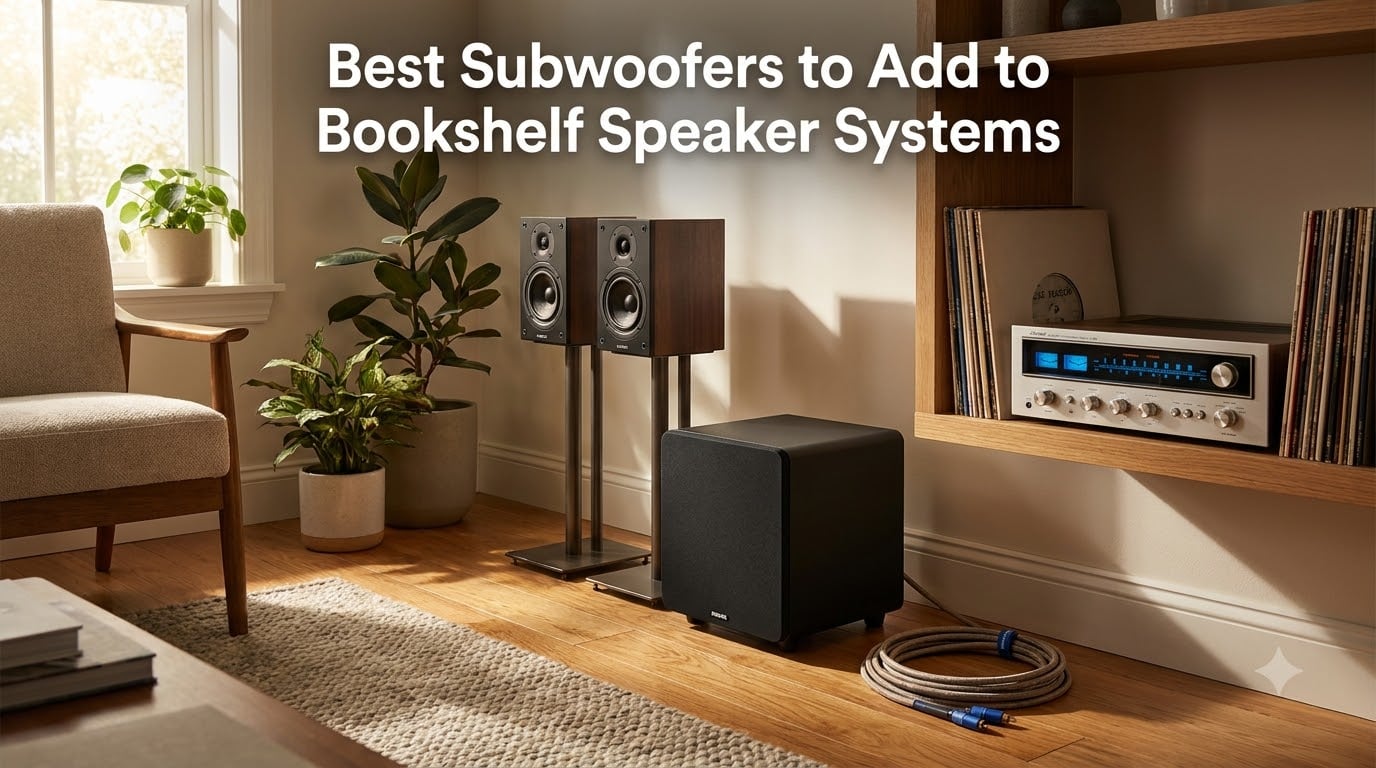
Bookshelf speakers do many things well, but true deep bass is not one of them. Most 5.25 and 6.5 inch designs start losing output somewhere between 55 and 70Hz, which means the bottom octave of a kick drum, a bass guitar run, or a movie explosion never fully reaches your ears. Add the right subwoofer and your main speakers also stop straining to reproduce notes they were never built to handle.
Our team here at SK Records has spent years pairing compact monitors with subwoofers and measuring where the blend works and where it turns into a one-note boom. Getting the match right comes down to three things: driver size relative to your room, the crossover and phase controls on the back panel, and honest output expectations. A 6.5 inch budget sub that sings in a 10 by 12 bedroom can vanish in an open-concept living room. For a broader look at compatible speakers, see our buying guide for bookshelf speakers.
This guide covers the best subwoofers for bookshelf speakers in 2026, from slim desktop options up to a sealed 12-inch reference pick. We dug through real specs and owner feedback totaling more than 22,000 verified reviews across eight models. If you want the short answer up front: the SVS SB-1000 Pro is the cleanest blend we have heard under monitors, the Klipsch R-100SW is the value standout, and the Polk PSW10 remains the most proven all-rounder for tight budgets.
Table of Contents
- Top 3 Picks for Bookshelf Speaker Subwoofers in 2026
- Best Subwoofers for Bookshelf Speakers in October
- 1. SVS SB-1000 Pro – Deepest and Cleanest Bass
- 2. Klipsch R-100SW – Best Value 10-Inch Performer
- 3. Polk Audio PSW10 – Most Proven All-Rounder
- 4. Yamaha NS-SW100BL – Cleanest Port Design
- 5. ELAC Debut 2.0 S10.2 – Audiophile Match for ELAC Owners
- 6. Edifier T5s – Best Slim Pick for Desks and Tight Spaces
- 7. Rockville Rock Shaker 6.5 – Compact Budget Workhorse
- 8. BESTISAN 6.5-Inch – Smallest Footprint With a Remote
- How to Match a Subwoofer to Your Bookshelf Speakers?
- Frequently Asked Questions
- Final Verdict: Our Top Recommendations
Top 3 Picks for Bookshelf Speaker Subwoofers in 2026

Best Subwoofers for Bookshelf Speakers in October
| Product | Specs | Action |
|---|---|---|
| SVS SB-1000 Pro |
|
Check Latest Price |
 Klipsch R-100SW Klipsch R-100SW |
|
Check Latest Price |
 Polk Audio PSW10 Polk Audio PSW10 |
|
Check Latest Price |
 Yamaha NS-SW100BL Yamaha NS-SW100BL |
|
Check Latest Price |
 ELAC Debut 2.0 S10.2 ELAC Debut 2.0 S10.2 |
|
Check Latest Price |
 Edifier T5s Edifier T5s |
|
Check Latest Price |
 Rockville Rock Shaker 6.5 Rockville Rock Shaker 6.5 |
|
Check Latest Price |
 BESTISAN 6.5-Inch Sub BESTISAN 6.5-Inch Sub |
|
Check Latest Price |
1. SVS SB-1000 Pro – Deepest and Cleanest Bass
SVS SB-1000 Pro Subwoofer (Black Ash) | 12-in Driver, 325 Watt RMS, Sealed Cabinet
12-inch sealed driver
325W RMS Sledge amplifier
20Hz extension
App with 3 PEQ bands
Pros
- Tight accurate bass reaching 20Hz
- Excellent smartphone app control
- Compact sealed cabinet for small rooms
- Three PEQ bands for custom tuning
- Easy integration with bookshelf speakers
Cons
- Short power cord limits placement
- No auto room calibration in app
- Underpowered for very large rooms
We ran the SB-1000 Pro under a pair of stand-mounted monitors for a month, and the first thing that struck us was how little it sounds like a subwoofer. Sealed cabinets trade a couple of decibels of output for pitch accuracy, and you hear that trade in every bass line. Kick drums stop and start on a beat instead of smearing into the next note.
This is the model we point to when someone asks about the best subwoofers for bookshelf speakers and budget is not the constraint. The 325W RMS Sledge STA-325D amplifier and high-excursion 12 inch driver dig down to a genuine 20Hz, which is lower than most bookshelf systems ever reproduce. Owners back this up across 613 reviews averaging 4.7 stars, and a meaningful number of them buy a second unit for stereo bass.
The SVS smartphone app is the real differentiator for pairing. You get volume, phase, polarity, and three parametric EQ bands you can adjust from the listening position instead of crawling behind the cabinet with a screwdriver. The 50MHz Analog Devices DSP handles the tuning in your room rather than on paper.
The cabinet is acoustically inert MDF with an extra-thick front baffle and rigid internal bracing, and it shows. We noticed no audible panel resonance even during demanding passages. At roughly 13 by 14.76 by 13.5 inches, it also tucks into spaces most 12 inch subs cannot.
The weaknesses are minor but real. The power cord is short, so plan your outlet location before committing to a spot. The app skips a frequency analyzer and automatic room calibration, both of which larger SVS models include. In very big open rooms the sealed design runs out of headroom before the ported PB-series models do. Reviewers note prices have been increasing in 2026.
Which Speakers It Blends With Best
It blends best with accurate, neutral monitors whose own extension reaches the 50 to 60Hz range, where a 70 to 80Hz crossover slope disappears completely. Pairing it with already bass-heavy speakers risks a thick, sluggish midbass. Speakers in the 85 to 88dB sensitivity range at moderate listening levels are the sweet spot.
Is It Right for Your Room Size
For rooms under about 2,500 cubic feet it is close to ideal for both music and film. In larger open spaces, output becomes the limiting factor rather than sound quality. If your listening area exceeds 3,000 cubic feet and you prioritize movies, look at the ported SVS alternative instead.
2. Klipsch R-100SW – Best Value 10-Inch Performer
Klipsch R-100SW 10″ Subwoofer, Incredibly Deep Bass and an All-digital Amplifier,14 5″ x 12 5″ x 16 4″
10-inch spun-copper IMG woofer
All-digital 300W peak amp
32Hz reach
LFE RCA input
Pros
- Deep clean bass for the money
- All-digital amplifier with low distortion
- Easy LFE and RCA setup
- Less boomy than the Polk PSW10
- Auto power-on convenience
Cons
- 150W continuous limits large rooms
- Can be slightly boomy at high volume
- Front-firing port less flexible for corners
This is the budget pairing we recommend most often, and 3,362 reviews at 4.7 stars suggest plenty of owners agree. The spun-copper 10 inch IMG woofer has a lively, punchy character that fills in the bottom end of bright bookshelf speakers beautifully. It also holds the number five best-seller spot in its category. If you are comparing subwoofers for a home audio setup, this model should be near the top of your list.
What impressed us most is how it manages the classic budget-sub problem: boominess. Multiple owners who compared it directly against the Polk PSW10 report the Klipsch is the more controlled of the two. That matters enormously when the goal is a seamless blend rather than obvious, localized bass.
The all-digital amplifier delivers 300W peak and 150W continuous with low distortion and high efficiency. Frequency response is 32Hz to 120Hz at the -3dB points, which is genuinely deep for this class. Setup takes minutes thanks to line-level LFE RCA inputs that work with nearly any receiver.
Rear-panel controls include volume, low-pass crossover, and a 0 to 180 degree phase switch. Auto power-on means it wakes with your receiver and sleeps when you are done. Coverage is a 5-year warranty on the woofer and 2 years on the amplifier.
The honest limits: 150W continuous is modest for rooms much beyond medium size, and the front-firing port is less forgiving of corner placement than a down-firing box. Some owners also report it turns slightly boomy at high volumes, so keep the gain disciplined.
How It Blends With Budget Bookshelf Speakers
Owners specifically report excellent results pairing it with Micca, Klipsch, and other budget bookshelf lines. Start the low-pass crossover near 90Hz with small monitors, then lower it in 10Hz steps until the bass stops drawing attention to itself. This is the budget subwoofer for bookshelf speakers we suggest first for bright-sounding speakers.
What Rooms and Receivers It Suits
Bedrooms, offices, and small to medium living rooms are its comfort zone. Any receiver or integrated amp with a subwoofer output or pre-out connects directly. If your amp has no sub out at all, skip this one for a model with speaker-level inputs.
3. Polk Audio PSW10 – Most Proven All-Rounder
Polk Audio PSW10 10″ Subwoofer, Big Bass Compact Design, Up to 100 Watts
10-inch Dynamic Balance woofer
100W amp (50W RMS)
80-160Hz crossover
Speaker-level inputs and outputs
Pros
- Excellent value for money
- Tight clean bass that blends well
- Speaker and line level inputs
- Variable 80-160Hz crossover
- 5-year warranty
Cons
- 50W RMS amp is modest for large rooms
- Narrow 80-160Hz crossover range
- Front port can make noise at high output
With more than 15,400 reviews at 4.7 stars, the PSW10 is probably the most-owned subwoofer in the English-speaking world. That kind of track record means its strengths and flaws are documented exhaustively. It has been our default budget recommendation for years. For readers looking at budget options, see our guide to home audio on a budget for more context.
The 10 inch Dynamic Balance woofer uses a directed port design that produces tighter bass than its modest 50W RMS amplifier has any right to deliver. It reaches 40Hz at the -3dB point, which covers the vast majority of music content. For casual listening and small-room home theater, it simply works.
The killer feature for bookshelf owners is connectivity. You get speaker-level inputs with pass-through outputs alongside line-level inputs, which means it connects to amplifiers that have no subwoofer output at all. Vintage integrated amps and desktop amps without a dedicated sub out are fair game.
The continuously variable 80 to 160Hz crossover gives real blending flexibility, and a phase toggle supports multi-sub setups. A 3-position power switch offers Auto, On, and Off modes. Polk covers the woofer with a 5-year warranty and the amplifier for 3 years.
The compromises are the ones long-term owners know well. The crossover range is narrow for precise matching, the front-facing port can chuff at high output, and the grille has a documented rattle at volume. It also lacks a dedicated LFE input with a bypassable crossover.
Speaker-Level Versus Line-Level Connection
Use the line-level input when your receiver has a subwoofer or pre-out, and let the receiver handle bass management. Reserve the speaker-level path for amps with no sub out, running speaker wire from amp to sub, then from the sub to your bookshelf pair. That second path is what keeps this old soldier relevant in 2026.
Running Two Units for Stereo Bass
A popular owner move is buying two PSW10s, one per channel, which smooths room bass response and increases headroom. The phase toggle makes this easy to configure. Two well-placed PSW10s often outperform a single more expensive sub in a difficult room.
4. Yamaha NS-SW100BL – Cleanest Port Design
YAMAHA Audio 10″ 100W Powered Subwoofer – Black (NS-SW100BL)
10-inch cone woofer
100W amplifier
Twisted flare port
Advanced YST II
Pros
- Deep clear bass with strong build quality
- Twisted flare port keeps bass tight
- Advanced YST II efficiency
- Easy integration with Yamaha receivers
- Compact stylish cube design
Cons
- 100W output is modest
- No auto standby mode
- No built-in crossover
- Power button placement is awkward
The NS-SW100BL is the safest-feeling pick in this lineup, with 1,523 reviews averaging 4.6 stars and Yamaha’s build reputation behind it. It is a 17.5 inch cube that looks tidy in a furnished room. For music-first listeners who value control over raw slam, it is a strong choice.
The twisted flare port is the standout engineering touch. By controlling airflow turbulence at the port opening, Yamaha keeps bass notably clean and free of the chuffing that afflicts many compact ported subs. Combined with Advanced YST II, which matches amplifier and driver behavior, the low end stays composed.
Owners report it integrates especially smoothly with Yamaha receivers and soundbars, which matters if your rack is already silver-badge territory. Several reviewers liked it enough to buy a second unit for stereo bass. It handles both music and film capably.
The drawbacks are mostly control-related. There is no auto standby, so it stays on unless you switch it off manually. There is no built-in crossover either, meaning your receiver has to handle bass management. The power button location is awkward if the cabinet sits under furniture.
At 26.5 pounds it is no lightweight, but that mass helps keep the cabinet quiet. Coverage is a 2-year manufacturer warranty. As a subwoofer for bookshelf speakers in Yamaha ecosystems, it is the path of least resistance.
Integrating With Yamaha and Non-Yamaha Gear
With a Yamaha receiver, setup is genuinely plug-and-play. With other brands, use the receiver’s subwoofer output and set its crossover, since the sub itself offers no crossover adjustment. Plan on spending time with phase and level to nail the blend. For more setup tips, check our complete home audio setup guide.
Setting the Crossover Without Onboard Controls
Set your receiver’s crossover to 80Hz as a starting point for most bookshelf monitors, then adjust from there. Small satellites may need 100 to 120Hz. If your amp offers no bass management at all, this is not the sub for that setup.
5. ELAC Debut 2.0 S10.2 – Audiophile Match for ELAC Owners
ELAC Debut 2.0 S10.2 10” Powered Subwoofer, Black – Custom Driver & 200-Watt Peak BASH Amplifier – Braced MDF Cabinets
10-inch long-throw driver
200W peak BASH amplifier
35Hz response
Braced MDF cabinet
Pros
- Tight accurate audiophile-quality bass
- Perfect complement to ELAC Debut 2.0 speakers
- Braced MDF cabinet cuts resonance
- Compact placement flexibility
Cons
- Needs a quality receiver to shine
- Heavy at 28.7 pounds
- Only 1 year warranty
- Stock levels run low
The S10.2 is the pick for readers who already own ELAC Debut 2.0 bookshelf speakers and want a matched voice from the same designer. Owners describe the pairing in unusually consistent terms: accurate, tight, and cohesive in a way generic pairings rarely achieve. Ratings sit at 4.6 across 90 reviews.
Power comes from a 200-watt peak BASH amplifier driving a 10 inch long-throw custom bass driver, reaching a rated 35Hz. That is enough output for medium rooms and most music. The braced MDF cabinet is stiff and quiet, and RCA connectivity makes integration straightforward.
What owners emphasize most is that this sub disappears into the mix rather than announcing itself. That is precisely what you want under accurate bookshelf monitors. Volume control on the cabinet allows quick level matching during setup.
The honest cautions: reviewers say it needs a good receiver to show its capability, it is heavy at 28.7 pounds, and wiring can confuse first-timers. Stock also runs low at times, so availability is worth checking before you commit. Warranty coverage is one year, shorter than Polk or Klipsch offer.
Matching It With ELAC Debut 2.0 Speakers
This is the designed partner for ELAC Debut 2.0 bookshelf and tower speakers, with matched voicing out of the box. With other brands it still performs well, but the tonal synergy is less automatic. If you run ELAC mains, this is the easiest bookshelf speaker subwoofer pairing on this list.
What Receiver Quality It Needs
A receiver with proper bass management and a clean subwoofer output lets the BASH amplifier work as intended. Basic AV receivers with noisy pre-outs hold it back. Budget for decent interconnects and take your time with crossover settings.
6. Edifier T5s – Best Slim Pick for Desks and Tight Spaces
Edifier T5s Powered Subwoofer, 70W RMS, 8″ Woofer, 35Hz Deep Bass, Black
8-inch long-throw woofer
70W RMS Class-D amp
35Hz reach
Slim 6.7-inch cabinet
Pros
- Clean tight bass for the money
- Slim cabinet slides under furniture
- Auto-standby saves power
- Plug-and-play with included cables
- Two connection modes
Cons
- 8-inch driver limits total output
- 70W RMS is modest
- Included RCA cables are cheap
- Auto-standby can be touchy
The T5s solved a problem we have wrestled with on many desktop setups: where to put a subwoofer when there is no floor space. Its cabinet is only 6.69 inches wide, so it slides beside a desk leg or under some furniture. It ranks number two in its category, with 395 reviews at 4.6 stars.
Inside is an 8 inch long-throw woofer powered by a 70W RMS Class-D amplifier, reaching a rated 35Hz. That is impressive depth for the size. Owners consistently describe the bass as clean and tight with minimal distortion even at elevated volumes.
Edifier includes both 3.5mm-to-RCA and RCA cables in the box, making this one of the few true plug-and-play options here. Two connection modes support either a sub-out equipped amp or a series connection with passive speakers. The low-pass filter adjusts from 30Hz to 160Hz with a 0 to 180 degree phase selector.
The 18mm MDF cabinet uses a front-firing driver with a right-firing acoustic port, and auto-standby kicks in after 15 minutes of silence. Build quality feels more expensive than it has any right to at this tier. Coverage is a 2-year manufacturer warranty.
The limits are physical: an 8 inch driver with 70W will not pressurize a large living room or deliver movie-theater rumble. A few owners find the auto-standby trips too eagerly at low volumes, and the bundled cables are worth upgrading. As a small subwoofer for bookshelf speakers on a desk, though, it is our favorite.
Fitting the Slim Cabinet Into Small Rooms
The 6.69 inch width means it fits where nothing else will, including alongside a desk or between furniture pieces. Because the port fires to the right, give it a few inches of clearance on that side. In bedrooms and offices it is close to ideal.
Which Speakers and Amps It Works With
It is the natural companion to Edifier’s own powered bookshelf line, connecting via the sub out on the back of those speakers. It also works with any amp or receiver carrying a subwoofer output. Avoid it for very large rooms or dedicated home theater duty.
7. Rockville Rock Shaker 6.5 – Compact Budget Workhorse
Rockville Rock Shaker 6.5″ Black Powered Subwoofer Home Theater
6.5-inch Y30 magnet woofer
100W RMS Class-D amp
Adjustable crossover and phase
RCA and speaker IO
Pros
- Deep bass for the money
- Adjustable crossover and phase controls
- RCA and speaker-level inputs
- Compact MDF enclosure
- Easy setup
Cons
- 6.5-inch driver limits total output
- Occasional quality control issues
- Return window can be restrictive
The Rock Shaker 6.5 delivers a surprising amount of low-end reinforcement for near-field and small-room systems without asking much of your wallet. Its 337 reviews average 4.4 stars, with owners praising value, compact size, and easy setup. If you want to test whether a sub even belongs in your system before spending more, this is a low-risk way to find out.
The 6.5 inch woofer uses a Y30 magnet and a foam-surround paper cone, driven by a Class-D amplifier rated at 100W RMS and 200W peak. The MDF enclosure feels solid rather than hollow. For a desk or bedroom system it adds real weight to the sound.
Connectivity is more flexible than the price class suggests. You get both RCA and speaker-level inputs and outputs, so it works with receivers and with amps that lack a sub out. Adjustable crossover and phase controls let you tune the blend with your bookshelf pair.
Where it runs out of breath is output. A 6.5 inch driver physically cannot move the air a 10 or 12 inch unit can, so movie LFE and large-room listening are beyond it. The rated 20Hz-200Hz response looks great on paper, but expect reinforced midbass rather than true sub-30Hz pressure.
There are also isolated reports of defective units arriving, and the return window is described as tight. Test yours thoroughly on arrival. At 13.2 pounds it is easy to move around while you find the right spot.
Inputs and Controls You Get
The rear panel carries RCA inputs plus speaker-level input and output terminals, a volume knob, an adjustable crossover, and a phase switch. That control set matches subs costing considerably more. The detachable grille is a nice touch at this level.
Realistic Expectations From a 6.5-Inch Driver
Expect a fuller bottom end and reinforced midbass, not chest-compression effects. Pair it with small bookshelf or satellite speakers in a desktop or bedroom system and it makes sense. Pair it with towers in a big room and it will disappoint.
8. BESTISAN 6.5-Inch – Smallest Footprint With a Remote
BESTISAN Powered Subwoofer, 6.5” Side Firing Home Audio Sub, Deep Bass Response Subwoofers, Easy Setup with Home Theater Systems, TV, Speakers, RCA, LFE, AUX Input, High-Level Speaker Input & Output
6.5-inch side-firing woofer
RCA LFE AUX and speaker-level IO
Bluetooth
Remote control included
Pros
- Compact size for desks and small rooms
- Universal RCA AUX LFE and speaker inputs
- Remote control for easy adjustment
- Deep tight bass for its size
- Versatile connectivity
Cons
- Auto shutoff cannot be disabled
- Some units overheat and shut down
- 50W output is limited
- Higher 1-star review rate
The BESTISAN is the most affordable way into a real subwoofer, with a compact black oak cabinet that measures just 6.3 inches wide. It ranks number 49 in its category with 575 reviews. For desktop and small-room duty, owners are generally happy with what they get.
The 6.5 inch side-firing woofer sits in a bass-reflex cabinet with a bottom port and internal bracing, with response quoted at 35Hz to 200Hz. Connectivity is the strong suit: RCA, 3.5mm AUX, LFE, and high-level speaker inputs and outputs cover virtually every amp and receiver type. A remote handles volume and settings from your chair.
It pairs naturally with BESTISAN soundbars and bookshelf speakers, and the flexible input set means it works with almost anything else you own. For near-field music and gaming at a desk, the bass reinforcement is real and welcome. The black oak finish blends into most decor.
Now the honest part. The 4.0 rating is the lowest in this group, and about 12 percent of reviews are 1-star. The complaints cluster around an auto-shutoff that cannot be disabled and triggers unexpectedly, plus reports of some units overheating and shutting down after 5 to 20 minutes. The 50W maximum output also caps how much it can do.
We include it because the price of admission is low and many owners are satisfied, but go in with open eyes. It is a convenience-first pick, not a performance pick.
Desktop and Near-Field Setup Options
Use the LFE input from your receiver’s sub out, the AUX input from a computer, or the speaker-level path from a basic amp. The remote makes level adjustments easy when the cabinet sits under a desk. Keep expectations calibrated to a small room.
Understanding the Reliability Feedback
Plenty of owners are satisfied, but the thermal and auto-shutoff complaints are consistent enough to mention. Test your unit hard within the return window, and avoid enclosing it in a tight space with no airflow. If reliability worries you, the Edifier T5s or the Rockville above are safer small-room bets.
How to Match a Subwoofer to Your Bookshelf Speakers?
Before you add a subwoofer to bookshelf speakers, it helps to know which variables actually matter. The right bookshelf speaker subwoofer pairing depends on your speakers, your room, and your connections. Here is what we have seen work across hundreds of setups. This guide builds on the principles we cover in our home audio setup guide.
Driver Size and Cabinet Type
Driver size should scale with room size more than with speaker size. A 6.5 or 8 inch driver suits desktops, bedrooms, and offices up to about 1,500 cubic feet. A 10 inch driver is the do-everything choice for small and medium living rooms, while a 12 inch unit earns its keep in larger or open-plan spaces.
Sealed versus ported changes the character more than the numbers suggest. Sealed cabinets like the SVS SB-1000 Pro sound tighter and more accurate, with slightly less output down low. Ported cabinets like the Klipsch, Polk, and Yamaha play louder and deeper for a given tier but can sound boomy when the tuning misses.
Power and Sensitivity Matching
Compare RMS watts, not peak watts. A 50W RMS sub fills a bedroom, 100 to 150W RMS handles most living rooms, and 300W plus serves large or open spaces. Rockville’s 200W peak figure is really a 100W RMS amplifier, which tells you more about real-world output.
Match your sub to your speakers’ sensitivity too. Efficient speakers around 90dB need less sub power than 85dB monitors to hit the same balance. This is the guidance most buying guides skip, and it is exactly why the same sub can thrill one owner and vanish in another system.
Connectivity Options
Check your amplifier before you shop. If it has a subwoofer output, any sub with an LFE or RCA input works. If it has no sub out at all, you need speaker-level inputs, which the Polk PSW10, Rockville, and BESTISAN all provide and the Klipsch does not.
If you want a wireless subwoofer, bookshelf speakers setups can use the SB-1000 Pro with its optional adapter, which helps when a long cable run is impractical. For most bookshelf systems, a wired connection remains the simplest and most reliable path.
Room Size and Placement
Estimate your room’s cubic footage and be honest about open doorways and hallways, since bass does not stop at a room boundary. Subs near a wall gain roughly 3dB of output, and corner placement adds more at the cost of boominess. The subwoofer crawl, where you place the sub at your seat and crawl the room to find where bass sounds best, remains the cheapest tuning tool there is.
Crossover and Phase Setup
Set the crossover where your bookshelf speakers start to roll off, usually 60 to 90Hz for typical monitors, and set the sub’s volume so you barely notice it until you switch it off. Flip the phase between 0 and 180 degrees and leave it where bass is fullest at the listening seat. These two controls do more for a clean blend than any amount of money spent on a bigger driver.
Frequently Asked Questions
Do I need a subwoofer with bookshelf speakers?
Most bookshelf speakers roll off between 55 and 70Hz, so a subwoofer adds the bottom octave they cannot reproduce on their own. You need one if you listen to bass-heavy music, watch movies, or notice your system sounds thin at volume. You can skip one if your speakers already reach below 40Hz and you mostly play acoustic music at moderate levels.
What size subwoofer is best for bookshelf speakers?
A 10-inch driver is the best all-round match for most bookshelf systems in small to medium rooms. Choose a 6.5 or 8-inch model for desks and bedrooms, and a 12-inch model for rooms over about 2,500 cubic feet. Match the driver to your room size rather than to your speaker size.
How do I connect a subwoofer to bookshelf speakers?
If your amplifier has a subwoofer output, run a single RCA cable from it to the LFE or line input on the sub. If it has no sub out, connect speaker wire from the amp to the sub speaker-level inputs, then from the sub outputs to your bookshelf speakers. The Polk PSW10, Rockville, and BESTISAN all support speaker-level connection.
Where should I place a subwoofer with bookshelf speakers?
Start with the sub along the same wall as your speakers, then try the subwoofer crawl to find the spot with the smoothest bass. Corner placement adds output but can sound boomy, and keeping the sub a few inches from the wall reduces tubbiness. Placement affects the result more than any spec on the box.
Can I use two subwoofers with bookshelf speakers?
Yes, and it is a proven upgrade. Two subs smooth out room bass response and reduce dead spots far better than one larger unit. Owners of the SVS SB-1000 Pro and Polk PSW10 commonly add a second unit, and the phase switches on both models make dual-sub setup straightforward.
Final Verdict: Our Top Recommendations
If sound quality is the priority and your budget stretches, the SVS SB-1000 Pro is the finest of the best subwoofers for bookshelf speakers we can recommend in 2026. Its sealed 12-inch driver reaches a genuine 20Hz while staying tight enough to vanish under accurate monitors, and the app-based tuning makes a clean blend almost automatic.
For most readers, the Klipsch R-100SW is the smarter buy. It delivers deep, controlled bass from a 10-inch driver, connects in minutes, and leaves budget for records or upgrades. Pair it with almost any budget bookshelf pair in a small or medium room and it will not be the weak link. For the full picture, see our guide to the best bookshelf speakers.
The Polk PSW10 remains the proven value king, with a 15,000-plus review history and speaker-level inputs that work with amps lacking a sub out. The Yamaha NS-SW100BL suits music-first listeners who value control, the ELAC S10.2 is the obvious match for ELAC Debut 2.0 owners, and the Edifier T5s is our favorite for desks thanks to its slim cabinet.
Whichever route you take, spend an hour on crossover, phase, and placement before judging the result. That single hour shapes the outcome more than the gap between any two models on this list. Add your sub, tune the blend by ear, and your bookshelf speakers will finally sound like the full-range system you built them to be.