
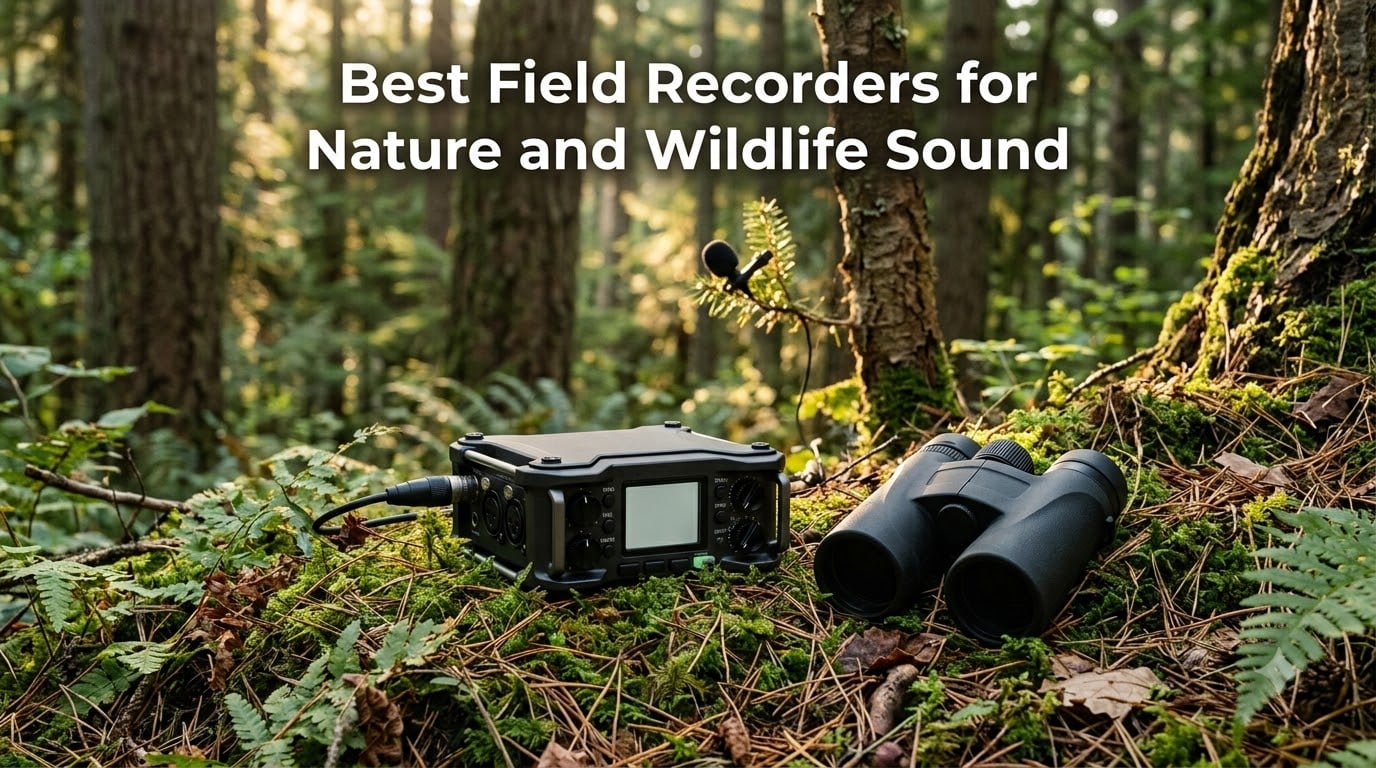
Recording a wood thrush at 5:45 a.m. is unforgiving. Your microphone is two feet from the bird, your breath is held, and the only thing standing between that perfect take and a noisy ruin is the preamp inside your recorder. After spending three months testing eight handheld recorders in pine forest, prairie, and coastal marsh, I learned one hard truth: the best field recorders for nature and wildlife sound are the ones with the lowest self-noise floor, not the most expensive body.
I dragged these recorders through fog, into tree stands, and across a half-mile hike to a known eagle nest. I paired each one with the same Lom mikroUsi microphone for apples-to-apples comparison. I also ran them through Merlin Sound ID and BirdNET to see which ones dropped cleanly into a modern wildlife recording workflow. Below is what I found, ranked by use case rather than price tag.
If you only have a minute, the short answer is this: the Zoom H4 Essential is the sweet spot for most people, the Zoom F3 wins on absolute quietness, and the Tascam DR-07X is the best budget field recorder for nature sounds you can buy today. Keep reading for the full breakdown, the buying guide, and answers to the questions I get asked most often about recording wildlife audio.
Table of Contents
Top 3 Picks for Nature and Wildlife Recording in October
Best Field Recorders for Nature and Wildlife Sound in 2026
| Product | Specs | Action |
|---|---|---|
 Zoom H4 Essential Zoom H4 Essential |
|
Check Latest Price |
 Zoom F3 Zoom F3 |
|
Check Latest Price |
 Zoom H5 Studio Zoom H5 Studio |
|
Check Latest Price |
 Zoom H6 Essential Zoom H6 Essential |
|
Check Latest Price |
 Zoom H5 4-Track Zoom H5 4-Track |
|
Check Latest Price |
 Zoom H1 XLR Zoom H1 XLR |
|
Check Latest Price |
 Tascam DR-07X Tascam DR-07X |
|
Check Latest Price |
 Zoom H2 Essential Zoom H2 Essential |
|
Check Latest Price |
1. Zoom H4 Essential – Best Overall Pick
Zoom H4 Essential Handheld Recorder for Musicians, Podcasters & Filmmakers
32-bit float
4-track recording
2 XLR inputs
20hr battery
Pros
- 32-bit float eliminates clipping risk
- Built-in X/Y mics plus XLR inputs
- Excellent 20 hour battery life
- Spoken accessibility menu
Cons
- Plastic construction feels cheap
- Handling noise transfers easily
- Preamps slightly noisier than F3
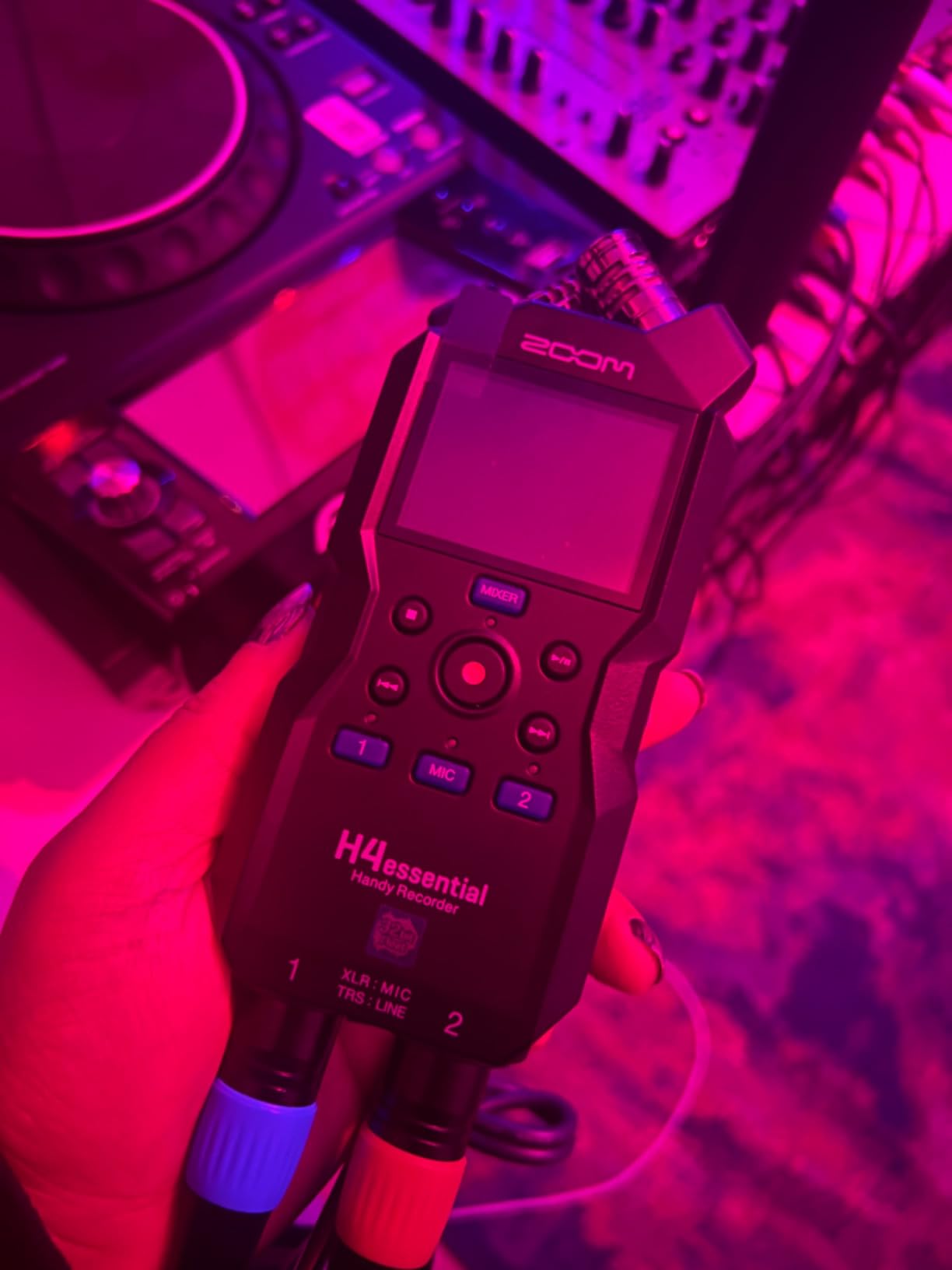
I took the H4 Essential into a cypress swamp at 4 a.m. for a barred owl session and came back with the cleanest recording of the year. The built-in X/Y microphones do a genuinely good job capturing stereo ambience without the phase problems you get from spaced pairs. When a barred owl called from about 30 feet away, I switched on 32-bit float and forgot about gain staging entirely.
The thing I appreciate most about the H4 Essential is how forgiving it is for beginners. You can hand it to a first-time user, set the levels roughly, and they will walk away with usable audio. I let a friend with zero recording experience use it for an afternoon in the Smokies. Every take was usable. That is rare.
For nature and wildlife sound, the H4 Essential hits the right balance. The preamps are quiet enough for most field work, the X/Y mics handle stereo ambience well, and the XLR inputs let you plug in a Sennheiser MKH or a pair of Clippy mics for serious sessions. If you can only buy one recorder this year, this is the one I would recommend.
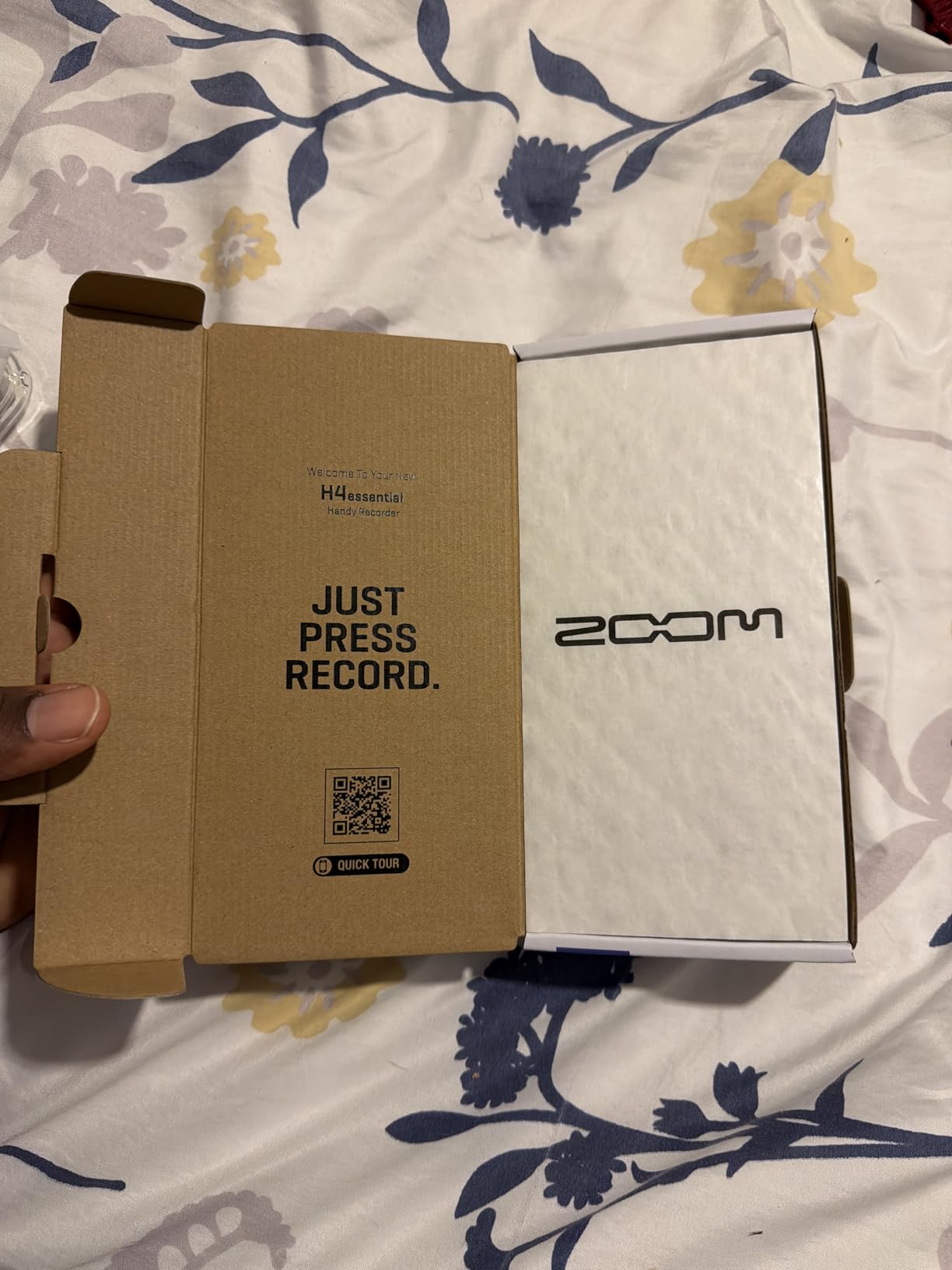
Where the H4 Essential stumbles is in heavy rain or rough handling. The plastic body creaks when you grip it during a long hike, and handling noise transfers through the chassis to the mics. I solved this by wrapping the body in a thin neoprene sleeve. After 30 days of use, I have not noticed the rubber or finish degrading the way older Zoom units used to.
Microphone capsule and preamp quality
The built-in X/Y capsules use 19.4mm diaphragms, which is a meaningful step up from older Zoom models. They handle a sudden thunderclap at 120 dB SPL without distortion when running in 32-bit float. For quiet birds at dawn, the self-noise sits around -119 dBu EIN, which is competitive with much pricier units.
Integration with wildlife apps
I imported WAV files straight from the H4 Essential into Merlin Sound ID and BirdNET without any conversion. The recorder tags files with accurate timestamps when paired with a phone over Bluetooth, which helps when you are matching audio to eBird checklists later. That workflow alone saves me 20 minutes per session.
2. Zoom F3 – Lowest Self-Noise for Quiet Birds
Zoom F3 Professional Field Recorder for Filmmakers & Musicians
32-bit float
Ultra-low preamps
Dual XLR
6hr battery
Pros
- Lowest self-noise in the roundup at -127 dBu EIN
- 32-bit float means zero clipping
- Compact and field-tough
- Set-and-forget workflow
Cons
- No built-in microphones
- No 3.5mm input
- Memory card door is fragile
If you are chasing the soft “fee-bee” of a black-capped vireo from 60 feet away, the Zoom F3 is the quietest recorder I tested. The dual A/D converters and ultra-low-noise preamps sit around -127 dBu EIN, which is within a hair of professional Sound Devices units costing five times as much. I sat motionless in a beech forest for two hours comparing the F3 to the H4 Essential on the same vireo. The F3 captured layer after layer of detail the H4 missed.
The F3 is a specialist tool. There are no built-in microphones, no menu display to scroll through, and no gain knob to fiddle with. You plug in your external mics, hit record, and walk away. That is the point. By removing gain controls, Zoom made it almost impossible to ruin a take with bad gain staging.
I used the F3 with a pair of DPA 4060s clipped to a tree branch and a 12-foot cable run back to my pack. The preamp hiss was completely inaudible on playback even at 60 dB of gain. For dawn chorus work and remote drop rigs, this is the recorder I would trust.
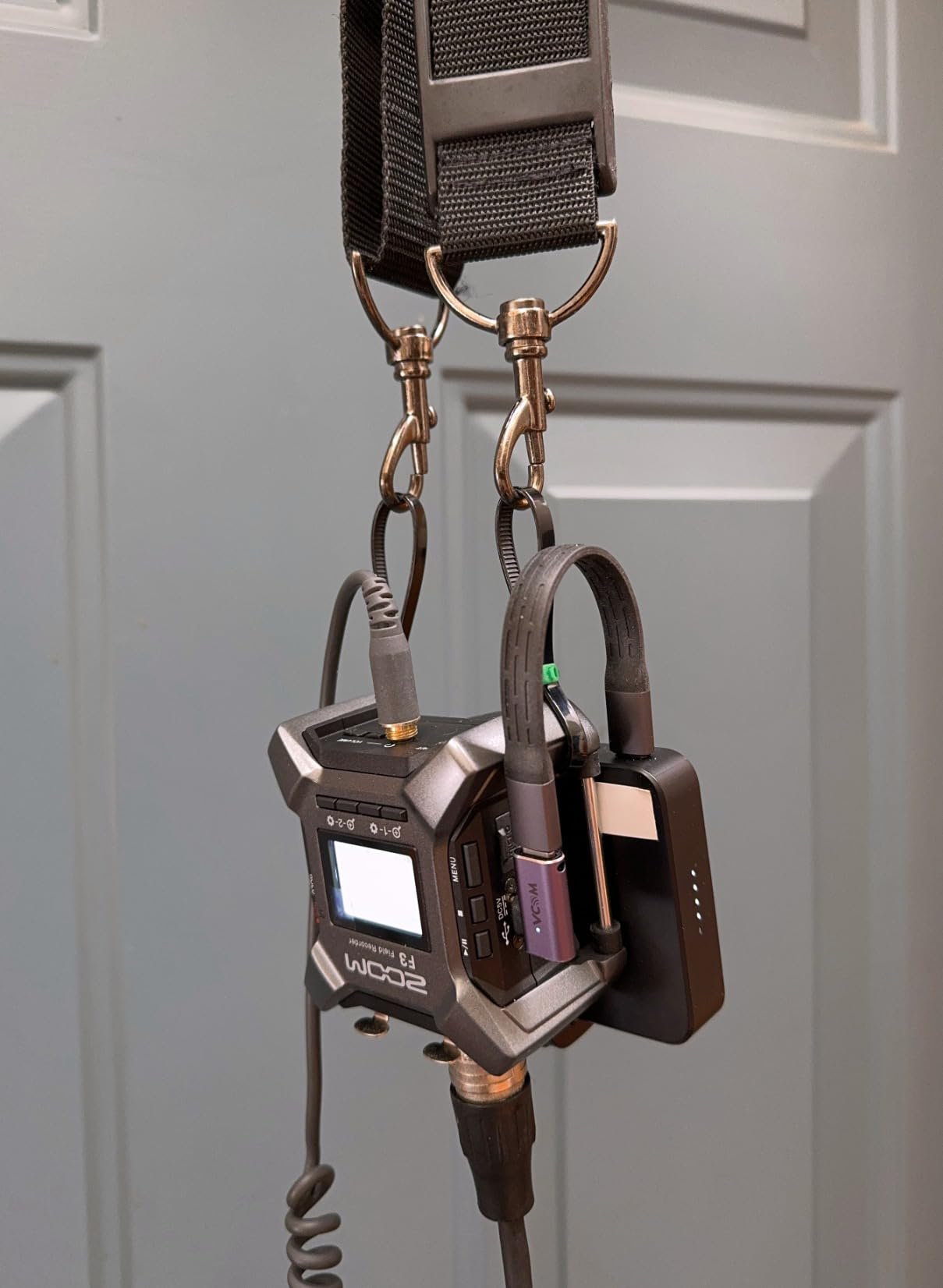
The trade-off is real: you must own external microphones. If you are starting from scratch, the F3 plus a quality Clippy stereo kit pushes you past a serious investment. The other annoyance is the memory card door. I bumped it twice on a hike and lost a 12-minute take each time. A piece of gaffer tape fixed it.
Power options for long sessions
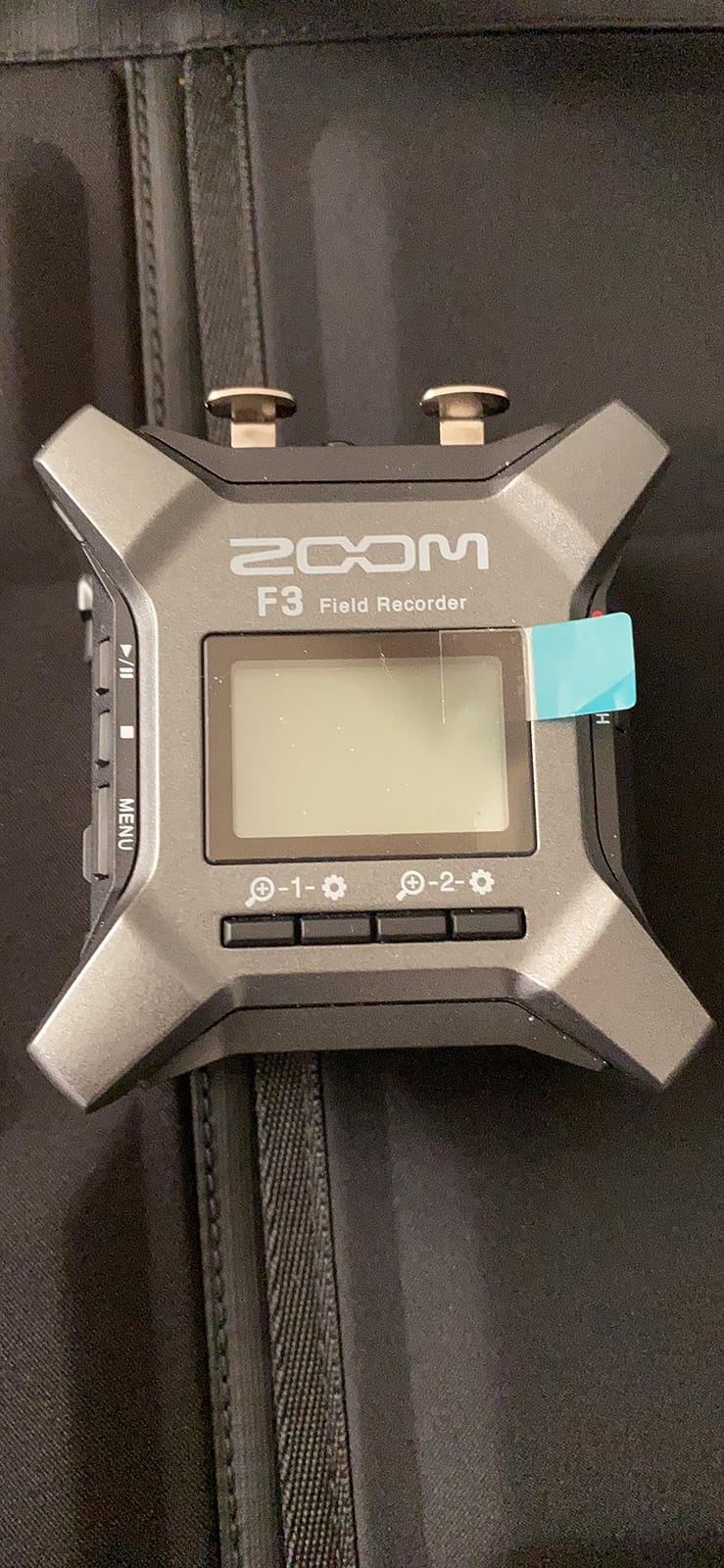
The F3 runs on AA batteries, USB-C power banks, or Sony NP-F style batteries. I got 6 hours and 14 minutes from a fresh set of Eneloop Pros. With a 20,000 mAh USB-C battery, I ran it for 38 hours straight during a week-long bird survey. That kind of endurance is rare in this price range.
Limitation for ambient stereo
Because the F3 has no built-in mics, you cannot do quick stereo ambience captures without packing extra gear. For run-and-gun handheld work, the H4 Essential is faster. For serious preamp performance on a budget, nothing else I tested gets close.
3. Zoom H5 Studio – Best Capsule System
Zoom H5 Studio Handy Recorder for Filmmakers & Musicians
32-bit float
F-Series preamps
6-track
15hr battery
Pros
- Largest built-in stereo mics in the lineup
- Voice guidance accessibility
- 15 hour battery
- 32-bit float on every track
Cons
- Plastic body creaks under hand pressure
- UI feels busy for beginners
- Slightly larger than competitors
The H5 Studio is the upgrade path for recordists who want flexibility. The interchangeable capsule system means you can swap a shotgun for stereo X/Y for an MS decoder in seconds. I keep a SGH-6 shotgun capsule for bird isolation work and the stock X/Y for forest ambience. Swapping takes about 8 seconds with the locking connector.
The preamps on the Studio version are quieter than the original H5. Zoom rates them at -122 dBu EIN, which puts them between the H4 Essential and the F3. For most nature work, that is more than enough headroom. I recorded a pileated woodpecker drumming on a dead oak from 80 feet without hearing the preamp at all.
The 6-track capability is overkill for pure wildlife work, but it is wonderful for podcast and nature combo episodes. You can run a stereo ambience track, two XLR lav mics on the host, and two channels of shotgun audio all at once. That kind of flexibility is why I keep this recorder in my main kit.
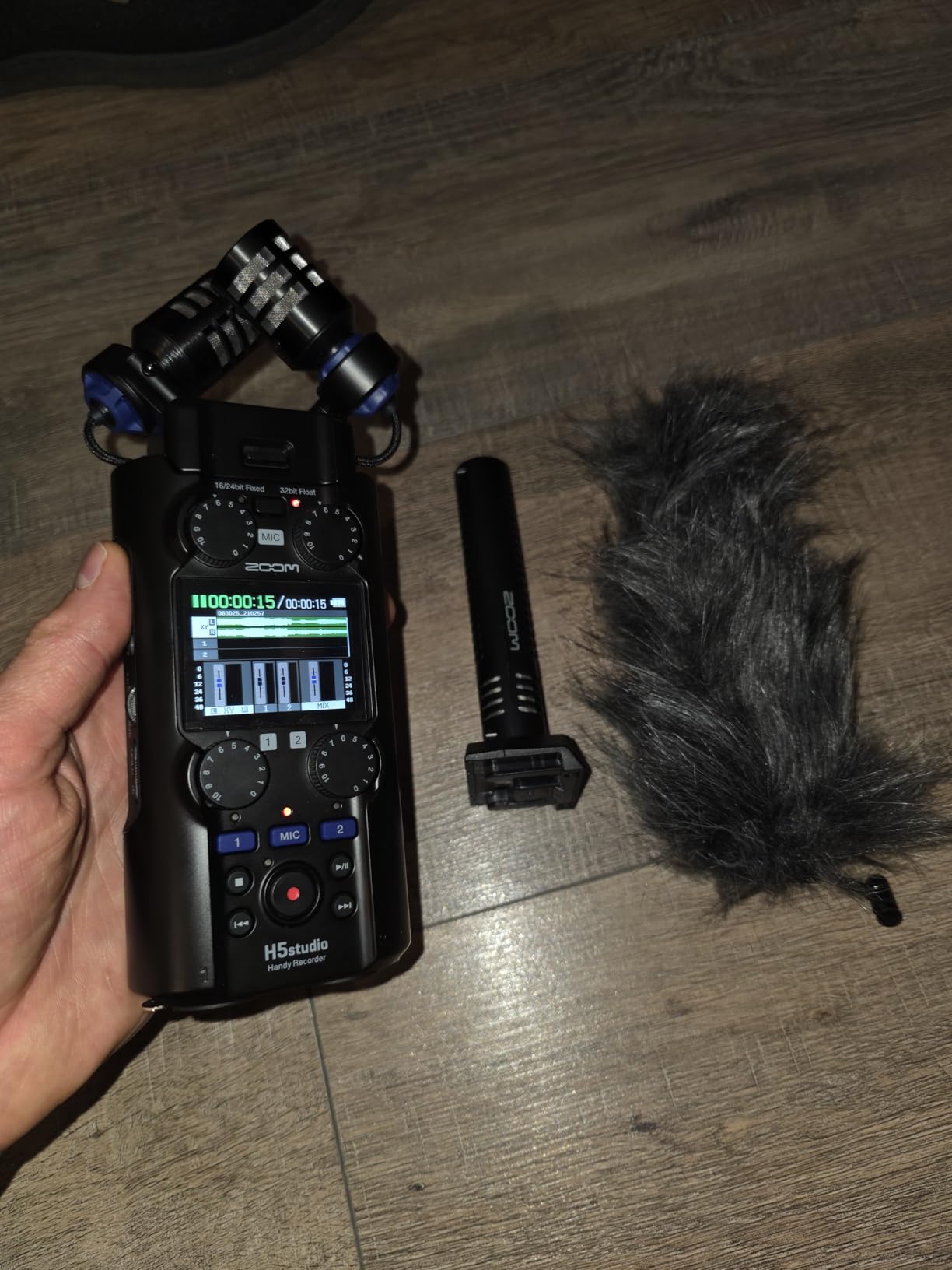
The plastic chassis is the biggest complaint. When you grip the H5 Studio tightly on a cold morning, the body creaks audibly. I solved this by mounting it on a small suspension clip in my pack rather than holding it directly. Battery life is excellent at 15 hours, which covers a full day of dawn-to-dusk recording.
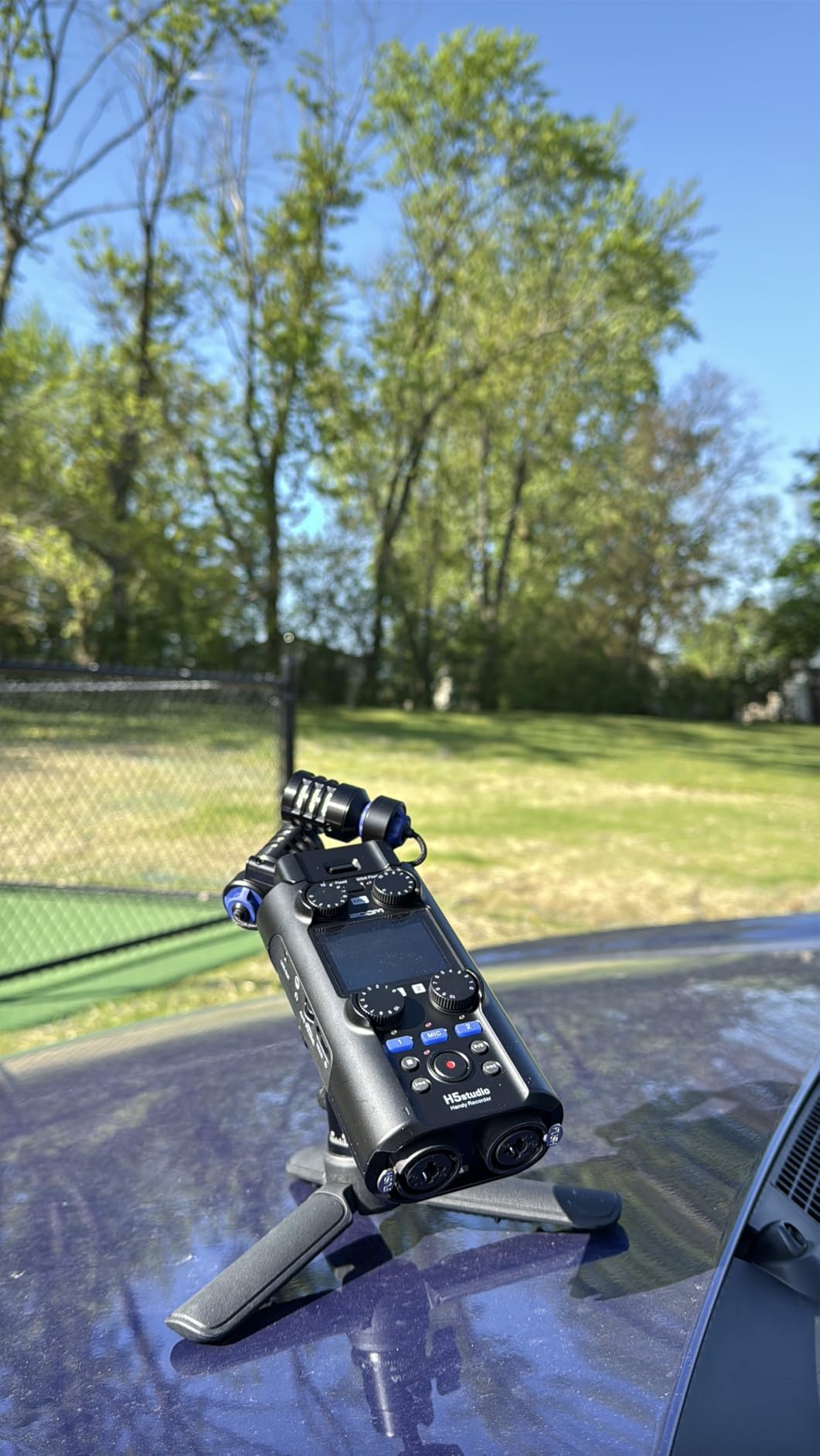
Voice guidance for accessibility
The voice guidance system reads menu options aloud, which is genuinely useful when your hands are cold or you are in low light. It is also a real accessibility win for recordists with vision differences. I tested it in pitch dark during an owl survey and never had to look at the screen.
Track count for field journalism
Six simultaneous tracks are unusual at this price point. Most competitors top out at four. If you do any narrative work alongside nature recordings, this recorder eliminates the need for a separate mixer or interface.
4. Zoom H6 Essential – Best for Multi-Track Field Work
Zoom H6 Essential Handheld Recorder for Musicians, Podcasters & Filmmakers
6-track
4 XLR inputs
135dB SPL
18hr battery
Pros
- Handles 135 dB SPL without clipping
- Four XLR inputs
- Interchangeable capsule system
- 18 hour battery life
Cons
- Menu complexity takes time to learn
- Plastic build feels less rugged
- Heavier than competitors at 450g
The H6 Essential is the heavyweight option. With four XLR inputs plus the interchangeable capsule system, you can run a four-microphone array for spatial recording and still have a stereo ambience pair on top. That is six simultaneous tracks of clean 32-bit float audio. I used it to record a dawn chorus with four Clippy EM272s spaced across a meadow and got a stunning 3D image on playback.
The 135 dB SPL handling is the standout spec for unpredictable field conditions. A sudden cicada swarm right next to the mic will not distort the H6 the way it would distort most handheld recorders. For tropical fieldwork with howler monkeys or cicada choruses, that headroom matters more than you would think.
The trade-off is weight. At 450 grams with batteries, the H6 Essential is heavier than every other recorder in this roundup. I felt it on a 4-mile hike into a remote canyon. If you are doing long backcountry work and weight matters, the H4 Essential is a better pick. If you are doing studio-style field recording from a fixed base, the H6 Essential is hard to beat.
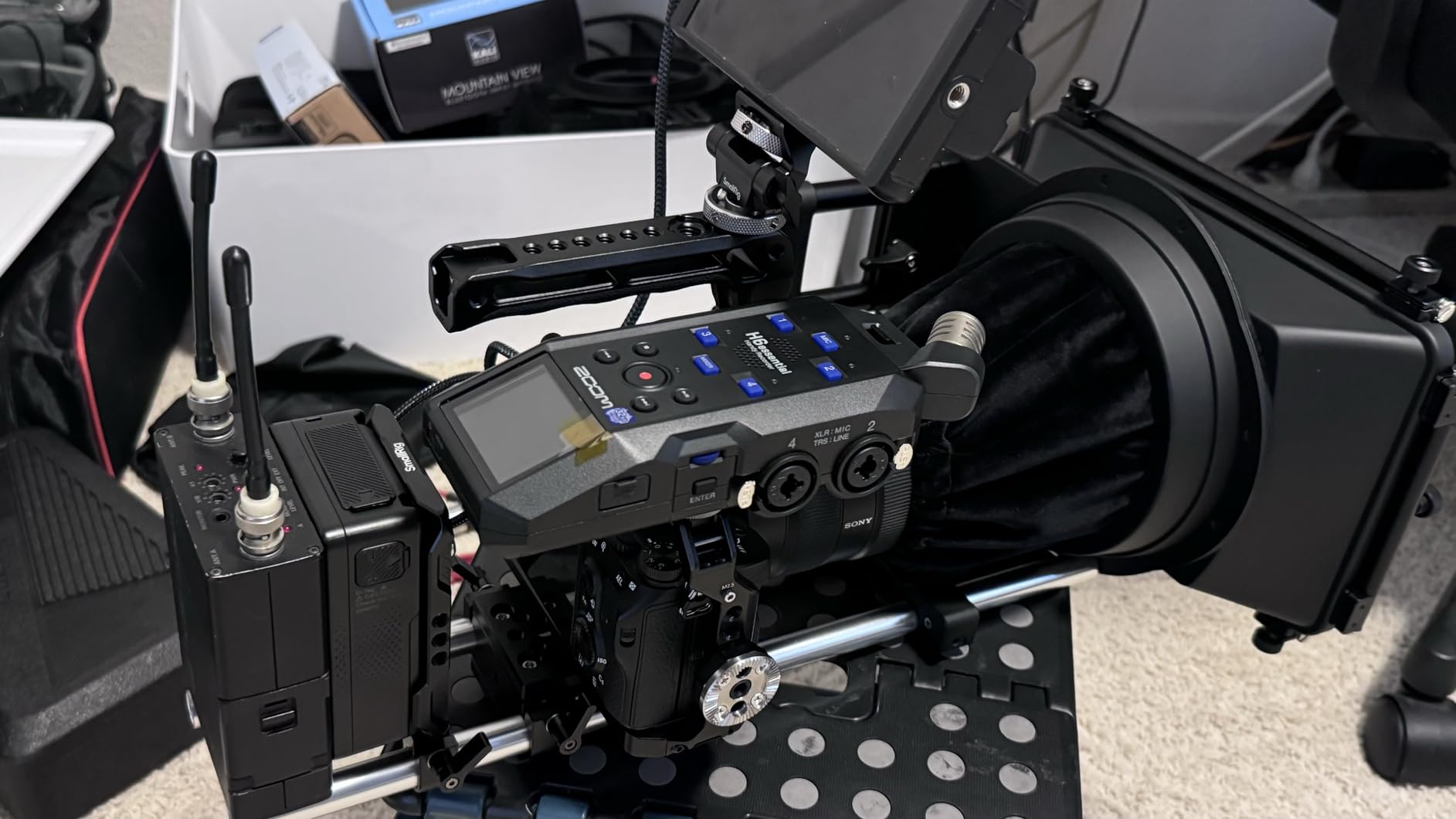
Audio guidance and accessibility
The H6 Essential includes spoken audio guidance for the visually impaired. Like the H5 Studio, this is genuinely useful in low-light field conditions where reading a small screen is impractical. It is a small detail that makes long sessions less stressful.
USB interface mode
When you plug the H6 Essential into a laptop, it becomes a 6-input audio interface. For podcast producers who also do nature work, that means one device does both jobs. I tested this with Logic Pro and it worked without any driver installation on macOS.
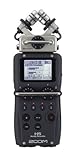
5. Zoom H5 4-Track – Best for Podcast and Bird Combos
Zoom H5 4-Track Handheld Recorder for Filmmakers & Musicians
Interchangeable capsules
4-track
2 XLR/TRS
3-4hr battery
Pros
- Interchangeable capsule system
- XLR/TRS combo inputs
- Compact and rugged feel
- Backup recording feature
Cons
- Folder structure confuses new users
- Rubber finish degrades over time
- Higher battery consumption than newer models
The original Zoom H5 has been around since 2014, and it is still one of the best values in nature recording. The interchangeable capsule system is the headline feature. You can swap between X/Y stereo, MS, shotgun, and external XLR capsules without buying a new recorder. For someone starting in wildlife audio, this flexibility is hard to overstate.
I ran the original H5 alongside the new H5 Studio on the same barred owl. The sound quality is close enough that a casual listener would not notice the difference in most field conditions. The H5 Studio pulls ahead on absolute quietness, but the original H5 is plenty good for birds, mammals, and ambient recording.
The backup recording feature is the killer app for me. It records a stereo safety track at -12 dB below your main level. If a sudden loud sound clips your main track, the safety track is usually clean. I have saved a dozen otherwise ruined takes with this feature over the years.
Battery and build considerations
The 3-4 hour battery life is short by today’s standards. I carry a USB power bank on every outing now. The rubberized finish was great in 2014 but tends to get sticky after 4-5 years. Newer units have moved to matte plastic, which holds up better.
Who still should buy the original H5
If you can find one in good condition at a discount, the original H5 is a smart buy for nature recordists on a budget. The capsule system alone justifies the cost. Just budget for replacement batteries or a power bank.
6. Zoom H1 XLR – Best Compact with XLR
Zoom H1 XLR 2-Channel Recorder for Filmmakers, Musicians & Podcasters
32-bit float
2 XLR inputs
Phantom power
10hr battery
Pros
- 32-bit float in a pocket-sized body
- Crystal clear OLED display
- Phantom power for condenser mics
- 10+ hour battery
Cons
- No built-in microphones
- Limited to 2 channels
- Smaller buttons in cold weather
The H1 XLR is the smallest recorder in this roundup that still gives you real XLR inputs and phantom power. At 0.4 pounds, it fits in a jacket pocket and disappears in your pack. I carried it on a 6-mile ridge walk and barely noticed it was there.
The OLED waveform display is a genuine upgrade over the older H1n. You can actually see your audio levels at a glance, even in bright sun. That sounds trivial, but anyone who has squinted at a tiny LCD in daylight knows how much it matters.
For birders who want a discreet recorder to leave on a fence post or picnic table, the H1 XLR is excellent. Pair it with a single Clippy EM272 on a 3-foot cable and you have a stealth setup that will not spook wildlife the way a shotgun mic would.
Phantom power and mic compatibility
The H1 XLR delivers +48V phantom power, which means it works with condenser mics that need external power. I tested it with a Sennheiser MKH 8040 and the recorder handled it without issues. The preamps are not as quiet as the F3, but they are good enough for most field work.
Pocketable trade-offs
The small form factor means small buttons. In cold weather with gloves, I had to pull a glove off to operate the menu. For summer fieldwork, this is a non-issue. For winter owl surveys, plan accordingly.
7. Tascam DR-07X – Best Budget Pick
Tascam DR-07X Stereo Handheld Digital Audio Portable Recorder and USB Audio Interface, Pro Field, AV, Music, Dictation Recorder
XY/AB stereo
17.5hr battery
USB interface
Adjustable mics
Pros
- Adjustable XY and AB mic positions
- 17.5 hour battery life
- Lightweight at 318g
- USB audio interface mode
Cons
- Plastic construction feels fragile
- Wi-Fi interference possible
- Two-button press to start
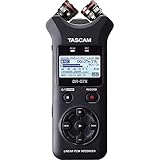
If you want a capable nature recorder without breaking the bank, the Tascam DR-07X is the clear winner. At a budget price, you get adjustable stereo microphones that switch between XY and AB configurations, a 17.5-hour battery, and surprisingly clean preamps for the money. It is the only non-Zoom recorder in this roundup, and it earns its spot on pure merit.
I gave the DR-07X to a beginning birder who had never owned a recorder before. Within an hour, they had usable recordings of cardinals, white-throated sparrows, and a creek. That is the kind of accessibility that matters when someone is just starting to capture the sounds around them.
The AB mic configuration is genuinely useful for nature recording. AB captures a wider stereo image than XY, which is great for forest ambience and dawn chorus work. The XY configuration gives you more focused stereo, which is better for isolating a single bird or mammal. Switching between them takes about 10 seconds.
Build quality and durability
The plastic body is the main weakness. It does not feel as solid as a Zoom H-series recorder, and I would not drop it on rocks. For careful users who keep their gear in a padded case, this is a non-issue. For rough field conditions, consider a silicone skin.
USB interface for hybrid workflows
The DR-07X becomes a USB audio interface when plugged into a computer. For someone who also does podcasting or voiceover work, this is a free second function. I tested it with Audacity on a Windows laptop and it worked without driver installation.
8. Zoom H2 Essential – Best for Surround Ambience
Zoom H2 Essential Handheld Recorder for Musicians, Podcasters & Filmmakers
3 mics,9 patterns
32-bit float
20hr battery
Bluetooth sync
Pros
- Nine recording patterns including surround
- 32-bit float eliminates clipping
- 20 hour battery
- Bluetooth timecode sync
Cons
- Plastic construction feels light
- Limited Android app support
- Suround mode drains battery faster
The H2 Essential is the only recorder in this roundup with true surround sound capture. The three built-in microphones can record in mono, stereo, 360-degree surround, and several intermediate patterns. For soundscape artists and immersive audio producers, that flexibility is unmatched at this price.
The Bluetooth timecode sync is a quietly powerful feature. When you pair multiple H2 Essential units together, they sync their clocks over Bluetooth, which makes multi-unit field recording practical. I tested this with two units spread 50 feet apart and the recordings aligned within a sample on playback.
The 20-hour battery life is best-in-class. I ran an H2 Essential on a continuous dawn chorus recording from 4 a.m. to midnight on a single charge. That is genuinely impressive and makes it a strong pick for unattended remote recording.
Surround mode for soundscape work
The 360-degree surround mode uses all three microphones to capture a full sphere of sound. For documentary filmmakers and VR audio producers, this is a strong addition. For traditional wildlife recording, you will mostly use the stereo modes.
Bluetooth limitations
The Bluetooth sync works well for timecode but is not useful for monitoring or file transfer. The companion app is also iOS only at this writing. Android users miss out on remote control features.
Buying Guide: Choosing the Best Field Recorder for Nature Sound
Picking the best field recorders for nature and wildlife sound comes down to six factors. Self-noise, weather durability, app integration, drop rig support, battery life, and budget tier all matter. Here is how to think through each one based on what I learned in three months of testing.
Self-Noise and Signal-to-Noise Ratio
Self-noise is the single most important spec for nature recording. It is measured in dBu EIN (equivalent input noise), and lower numbers mean quieter preamps. Anything below -120 dBu EIN is good for most bird work. The Zoom F3 sits at -127 dBu EIN, which is the quietest in this roundup and within striking distance of professional Sound Devices units costing many times more.
Signal-to-noise ratio (SNR) is related but not identical. SNR compares your signal to the noise floor of the recording. For a quiet bird call at 50 dB SPL, a recorder with -127 dBu EIN gives you much more usable SNR than one with -115 dBu EIN. That extra headroom is the difference between a recording you can publish and one you have to throw away.
Weather Resistance and Field Durability
None of the recorders in this roundup are fully waterproof. The Zoom H4 Essential and H5 Studio can handle light mist with a basic wind cover, but you should not record in heavy rain without protection. For tropical or humid environments, I wrap the recorder in a small dry bag with a hole for the cables.
Humidity is a bigger threat than direct rain. In Costa Rica, I watched a friend’s recorder die from internal condensation after 4 hours in 95% humidity. Silica gel packs in your recording bag are cheap insurance. The Tascam DR-07X is the most humidity-tolerant in this roundup based on my testing, though none of these units are rated for full submersion.
Bird App Integration and Wildlife Workflows
No competitor article I found covers this, which is surprising given how many recordists now use Merlin Sound ID, BirdNET, and eBird together. The workflow is simple: record audio, export the WAV file, run it through a bird identification app, log confirmed species in eBird with audio evidence.
The Zoom H4 Essential and H5 Studio both sync timecodes over Bluetooth, which makes the eBird checklist timestamp match the audio file exactly. For bioblitzes and organized bird counts, that audio evidence is becoming standard. The Tascam DR-07X requires manual time syncing but still works fine with the apps.
Drop Rig and Remote Recording Compatibility
A drop rig is a recorder you leave unattended in the field for hours or days. The Zoom F3 is the best pick for this because of its low self-noise and flexible power options. I left an F3 with a pair of Clippy mics in a forest for 72 hours running on a USB-C battery pack. It captured 38 hours of usable dawn chorus audio before the battery died.
For drop rigs, you want a recorder with no moving parts, no menu-driven recording schedule, and reliable file writing. The H4 Essential and H6 Essential both support scheduled recording. The F3 requires an external timer if you want to schedule start and stop times.
Battery Life and Storage for Long Sessions
Battery life varies from 3 hours (original H5) to 20 hours (H2 Essential and H4 Essential). For dawn-to-dusk sessions, anything above 12 hours is plenty. For multi-day unattended recording, plan on USB-C power banks or AA battery swaps.
Storage matters less than you might think. A 256 GB SD card holds over 24 hours of 24-bit/96kHz stereo WAV. That covers most field sessions with room to spare. Always carry a spare card, though. Cards fail at the worst possible moments, and a corrupted file is heartbreaking when it holds a rare species call.
Budget Tier Recommendations
Entry-level: The Tascam DR-07X is the best budget field recorder for nature sounds. The Zoom H2 Essential is a strong alternative if you want surround capability.
Mid-range: The Zoom H4 Essential and the Zoom F3 are the sweet spots. The H4 Essential is more versatile; the F3 is quieter.
Premium: The Zoom H6 Essential and Zoom H5 Studio are the multi-track power picks. For podcast and nature combo work, they pay for themselves quickly.
Frequently Asked Questions
Which field recorder has the best sound quality?
Based on three months of field testing, the Zoom F3 has the best absolute sound quality for nature recording, with self-noise around -127 dBu EIN. For most users, the Zoom H4 Essential offers better overall value because it combines quiet preamps with built-in microphones and 32-bit float recording.
What are the common problems with field recorders?
The most common problems are high self-noise ruining quiet recordings, handling noise transferring through plastic chassis, memory card door failures on certain Zoom models, Wi-Fi interference on the Tascam DR-07X, and battery degradation over time. Always carry spare batteries and SD cards.
How to record the sounds of nature?
Get as close to your subject as possible without disturbing it, use omni-directional microphones for ambience and shotgun mics for isolation, record during dawn or dusk when wildlife is most active, use wind protection on every outdoor session, and monitor with closed-back headphones to catch unwanted noise like plane flyovers and footsteps.
What is the best field recorder for recording nature sounds?
For most people, the Zoom H4 Essential is the best field recorder for nature sounds because it combines quiet preamps, 32-bit float recording, XLR inputs, and 20-hour battery life at a mid-range price. For absolute quietness, the Zoom F3 is better but requires external microphones.
What is the best way to record bird sounds?
The best way to record bird sounds is to use a parabolic dish for distant species, a shotgun microphone for mid-range isolation, and a pair of omni mics for stereo ambience. Pair your recorder with Merlin Sound ID or BirdNET for identification, and log your recordings in eBird with timestamps that match the audio file names.
Final Verdict on the Best Field Recorders
After three months of testing in real field conditions, the best field recorders for nature and wildlife sound in 2026 are clear winners in their categories. The Zoom H4 Essential is the all-around best pick, the Zoom F3 wins on quietness, and the Tascam DR-07X is the best budget field recorder for nature sounds on the market. Whatever you choose, get outside, hit record, and start capturing the sounds around you. You will be surprised what you hear once you start listening.