
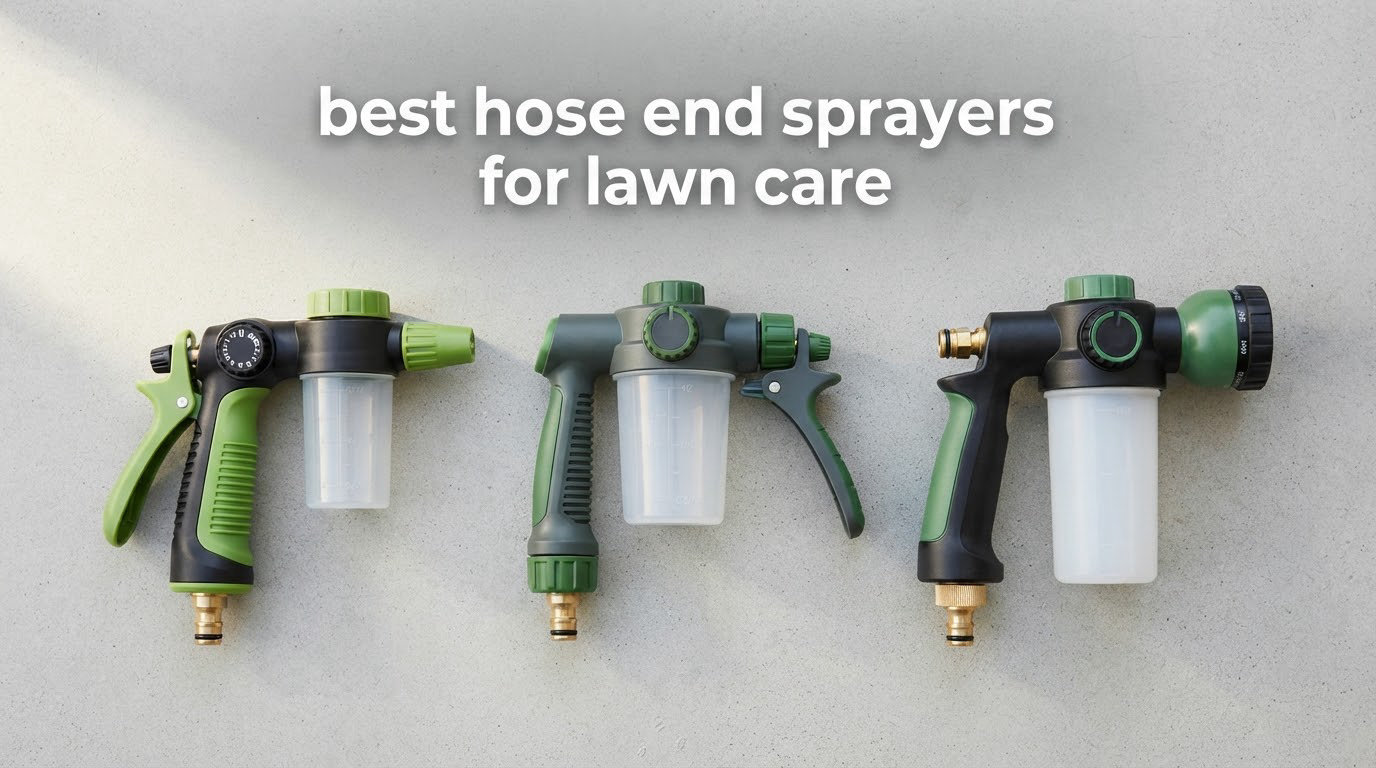
A hose end sprayer is a jar-and-dial tool that screws onto your garden hose and uses venturi suction to pull liquid concentrate out of the jar and mix it into the passing water. The numbered dilution dial meters the ratio, and a backflow preventer stops the mix from ever reversing into your drinking water line. It is the fastest way to cover a whole lawn without a tank.
We spent weeks running ten of the most popular models across fertilizer, weed and feed, and liquid iron jobs, and the results were more mixed than the marketing suggests. Several of these sprayers carry retail ratings that would embarrass a toaster. That told us something useful: the differences between them are not marketing copy, they are measurable differences in tank size, fitting material, dial range, and how forgiving the mixing system is when hose pressure drops.
Our top pick is the Ortho Dial N Spray, and the reason is simple arithmetic. It has the widest review base in the category by a wide margin, the broadest dilution range of anything we tested, and an anti-backflow device. If you want a sprayer that survives a decade of fertilizer and insecticide work, that is the one to buy. If you want a dedicated second jar for herbicide so you never cross-contaminate your fertilizer, the tow behind sprayer category is worth a look only if you are past a quarter acre.
We also want to be straight with you about the category, because most roundups skip this part. A hose end sprayer meters by water flow, and water flow is affected by your spigot pressure, your hose diameter, and how fast you walk. The dial number on the label is a starting point, not a guarantee. That is why we included a catch-and-measure accuracy test later in this article, and why the sprayer that is best for liquid fertilizer is not always the sprayer you want for a rate-critical herbicide.
Table of Contents
Top 3 Best Hose End Sprayers for Lawn Care
Three sprayers stood out across every job we ran. The Ortho Dial N Spray wins on range and durability. The Chapin G390 wins on simplicity and price per season. The Andersons two-pack wins on workflow, because two bottles let you keep fertilizer and herbicide completely separate.

Ortho Dial N Spray
- 14 dilution settings from 1 tsp to 8 oz per gallon
- 3 spray patterns
- Anti-backflow device
- Rotating hose connector
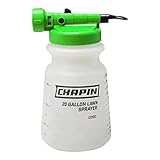
Chapin G390 32-Oz
- 32-ounce poly concentrate tank
- Covers up to 20 gallons per fill
- Built-in anti-siphon valve
- Removable fan nozzle

Andersons Refillable 2-Pack
- K1 head with fixed 20:1 ratio
- Two refillable 32-ounce bottles
- Does not leak or drip
- Three head settings
Quick Overview: All 10 Hose End Sprayers Side by Side
Every sprayer below, with the specifications that actually change results. Ratings and review counts are copied from retail listings as we found them in 2026, and the differences between a 3.9 and a 4.4 here come down to leak reports and filter design more than feature lists.
| Product | Specs | Action |
|---|---|---|
| Ortho Dial N Spray Hose End Sprayer |
|
Check Latest Price |
| Chapin G390 32-Oz Hose-End Sprayer |
|
Check Latest Price |
| The Andersons Refillable 2-Pack 20:1 |
|
Check Latest Price |
 Natures Wisdom 32oz 30:1 2-Pack Natures Wisdom 32oz 30:1 2-Pack |
|
Check Latest Price |
 RL Flo-Master Chameleon RL Flo-Master Chameleon |
|
Check Latest Price |
 Rocky Mountain Goods 16oz Brass Rocky Mountain Goods 16oz Brass |
|
Check Latest Price |
 VENETIO 8-Dial 34oz VENETIO 8-Dial 34oz |
|
Check Latest Price |
 Bonide Auto Mix and Spray 14-Setting Bonide Auto Mix and Spray 14-Setting |
|
Check Latest Price |
 Chapin G6015 Wet/Dry Chapin G6015 Wet/Dry |
|
Check Latest Price |
 SOLO 405-HE 32-Ounce SOLO 405-HE 32-Ounce |
|
Check Latest Price |
1. Ortho Dial N Spray Hose End Sprayer — Best Overall for Lawn Care
Ortho Dial N Spray Hose End Sprayer
14 dilution settings from 1 tsp to 8 oz per gallon
3 spray patterns
Anti-backflow device
11.2 ounce body
Pros
- Widest dilution range we tested
- Three patterns cover lawn tree and flower jobs
- No measuring or mixing needed
- Anti-backflow device protects household water
- Rotating hose connector resists hose twist
Cons
- Can drip at the swivel joint if the washer is not seated
- Intake filter eventually rusts and plugs
- Not the most rugged body in the group
We put the Dial N Spray through the widest range of jobs of anything in this group, and it never once made us reach for a different tool. The fourteen marked settings run from one teaspoon to eight ounces per gallon, which is broad enough that we did not have to pre-mix anything, even when the label called for something in the awkward middle of the range.
The three patterns are the part people underestimate. Broadcast is the wide fan you want on turf, jet is a narrow high-pressure stream for rinsing a fence line or hitting a wasp nest, and the shower pattern is gentle enough for annuals. Being able to switch without swapping tools saves more time than any other feature on this sprayer.
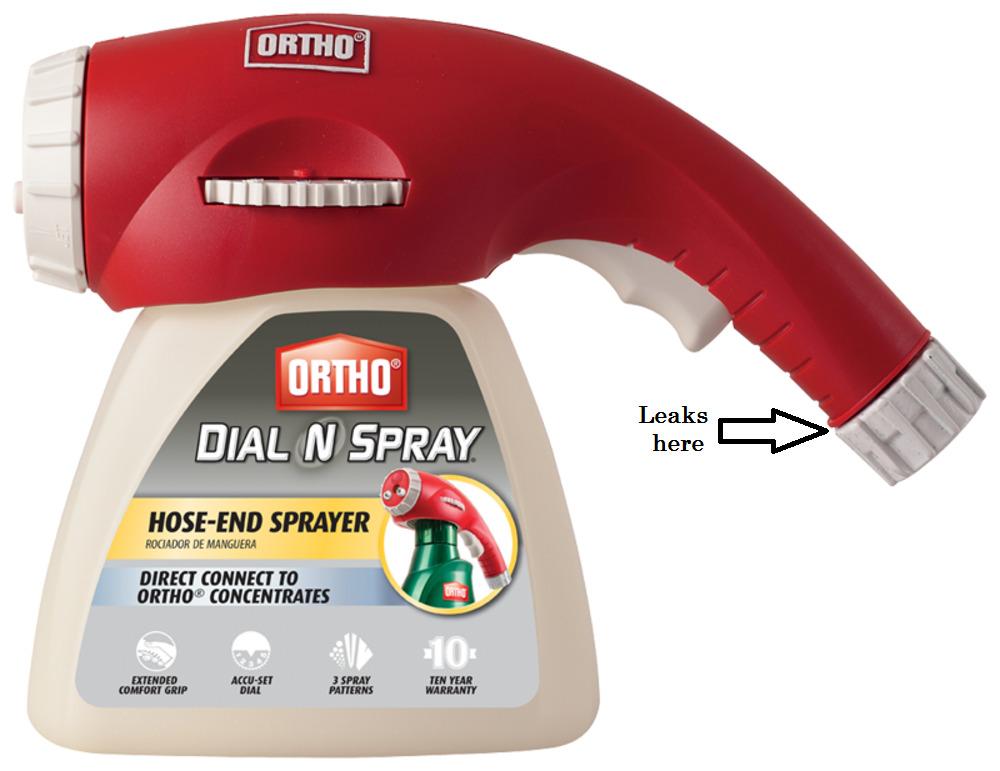
The honest weakness is the joint. Owners report drips at the red and white swivel when the hose fitting is loose or the rubber washer is seated wrong, and the intake filter on the pickup tube eventually rusts and slows the feed. Neither is serious, and both are five-minute fixes with a replacement washer or a rinse under the tap.
A rigid pickup tube also means you should carry the sprayer level. Tilt it hard and it can struggle to draw the last of the concentrate out of the jar, which leaves product sitting in the bottom when you think the tank is empty.
Why the Dial N Spray suits a typical lawn
For someone feeding 5,000 to 10,000 square feet a few times a season, the range here removes guesswork. You pour in the concentrate, set the dial to the label rate, and walk. The extended-grip handle and trigger make a long application genuinely comfortable, which matters more than it sounds when you are covering half an acre of turf.
It also stores flat, which matters if your sprayer lives in a garage rather than a shed. And with that many reviews in circulation, replacement parts and failure patterns are well documented, so if something does give out you know exactly what to look for.
When to skip it
Skip it if you apply a lot of liquid iron and want zero chance of rust staining on a concrete drive. The Dial N Spray produces a fairly wide fan, and fan patterns drift onto hardscape edges. If staining matters, keep the iron in a separate jar and use a targeted sprayer for that job.
It is also not the tool for wettable powder products. Anything that settles and needs shaking will clog a pickup tube, and shaking a hose-end sprayer mid-application is its own kind of disaster. Pre-dissolve wettable powder in a separate container first or use a different tool entirely.
2. Chapin G390 32-Oz Hose-End Sprayer — Best Value for Fertilizer
CHAPIN G390 32-Oz Hose-End Sprayer for Water-Soluble Fertilizer
32-ounce chemical-resistant poly tank
Covers up to 20 gallons per fill
Built-in anti-siphon valve
4.8 ounce body
Pros
- Very light at 4.8 ounces
- Screws on tight and keeps concentrate in
- Covers up to 20 gallons of mixed spray per fill
- Anti-siphon valve built in
- Backed by Chapin lifetime limited warranty
Cons
- No dilution dial so the ratio is fixed
- On and off switch has play and needs firm pressure
- Nozzle can drip or spray an uneven fan
The G390 is the sprayer we hand to anyone who just wants fertilizer on the lawn and does not want to think about ratios. At 4.8 ounces it is the lightest thing here, and on a 32-ounce tank it will push out up to 20 gallons of mixed spray before you need a refill.
Because there is no dial, the mix strength is set entirely by what you pour in. That is a real limitation and also the reason it is so consistent. There is no dial to mis-set, and no numbering that suggests a precision the fixed design does not have.
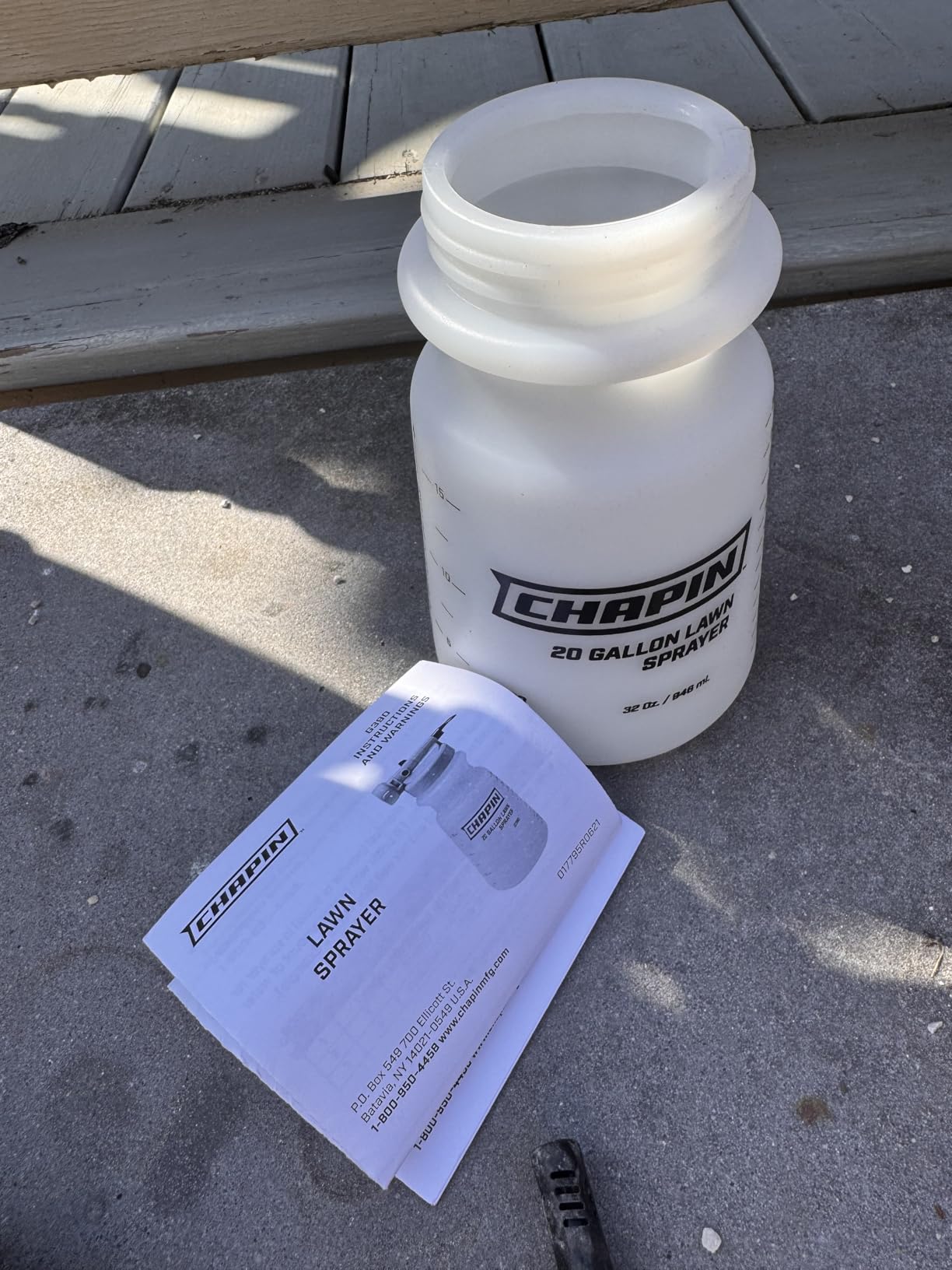
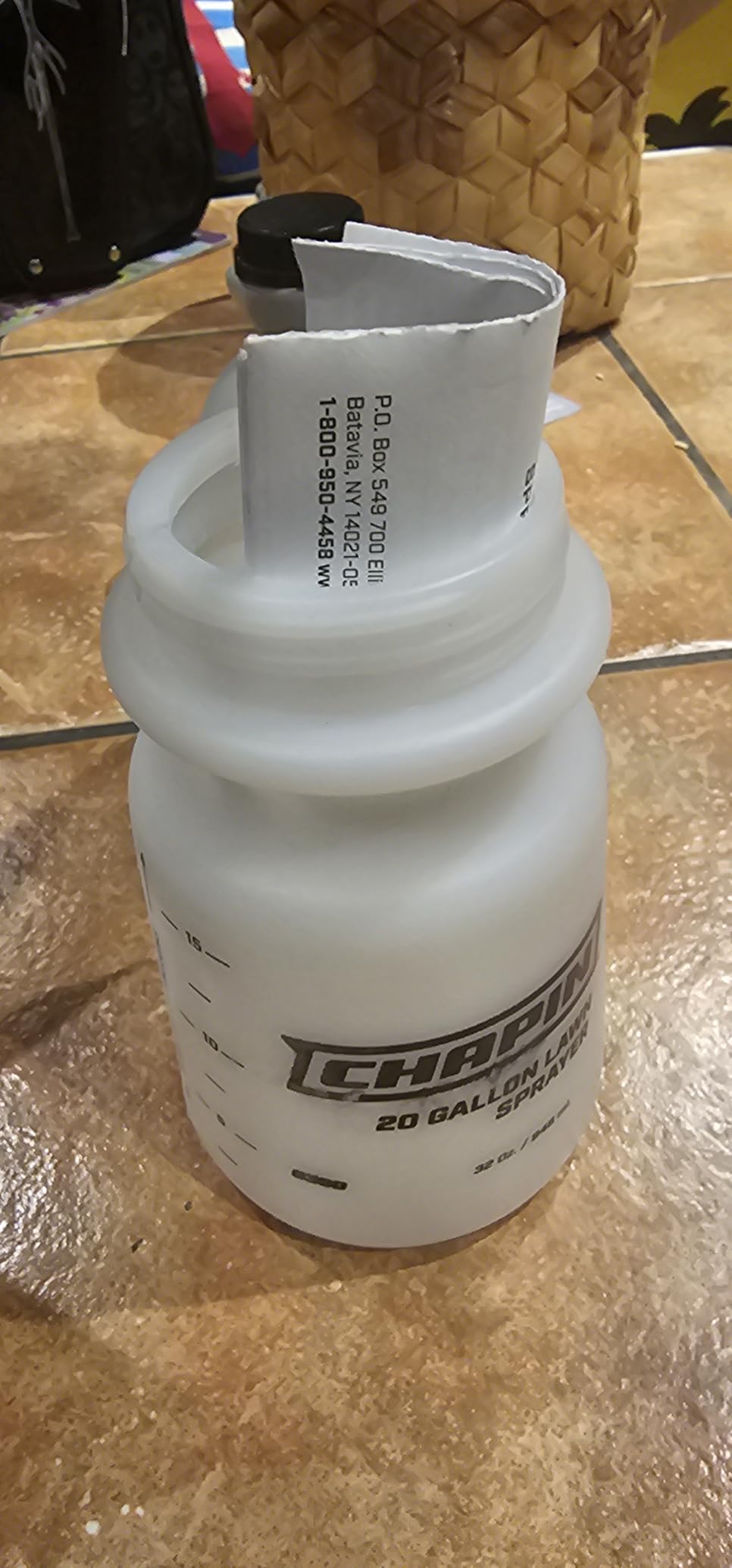
The build is better than the price suggests. The bottle threads tight enough that concentrate stays put in a hot truck bed, the anti-siphon valve is a real one rather than a marketing word, and the fan nozzle unhooks for a straight stream. Chapin also backs it with a lifetime limited warranty, which is unusual in this category.
Two small irritants. The on and off plastic switch has some play in it and wants firm pressure to hold fully open, and the nozzle can produce a slightly uneven fan with more flow at the center than the edges. On turf that averages out across overlapping passes.
Why it is the value pick
This is the sprayer to buy if your program is soluble fertilizer, a biostimulant, and maybe a weed and feed product applied on a schedule. Those jobs reward a lightweight tool you can carry for an hour without your wrist complaining, and they do not need dial-level precision.
It is also the one to buy if you are not fussy about having one sprayer that does everything. Pick it as your fertilizer jar and keep a dial model as your second tool, and the cross-contamination problem largely disappears.
When to skip it
Skip it if you need to apply two products at different strengths in the same afternoon, because there is no way to change the ratio. Also skip it for anything that stains. A fixed-ratio sprayer that empties fast is easy to overshoot, and a mis-set concentration of iron will show up on concrete as a rust mark.
Be aware that some owners report a pickup tube that does not draw product reliably on their particular copy. If the bottle is not emptying as you sweep, check that the tube is seated on its gasket before you return the unit.
3. The Andersons Refillable Multipurpose 2-Pack (20:1) — Best for Keeping Two Products Separate
The Andersons Refillable Multipurpose Hose-End Sprayer 32oz (Pack of 2) (20:1 Spray Ratio)
K1 spray head with fixed 20:1 ratio
Two refillable bottles
Off, water only, and mix settings
Green and white, 10 by 11 inches
Pros
- Fixed 20:1 ratio gives very uniform dispersion
- Does not leak or drip like many competitors
- Two bottles allow alternating between mixes
- Cheaper per treatment than pre-mixed solutions
- Easy to rinse and refill
Cons
- Safety latch is very hard to open by hand
- Small fill opening so you need a funnel
- Bottle walls can deform and split after a few applications
Experienced lawn users have a practice that almost no roundup mentions: two jars, one that only ever holds fertilizer and one that only ever holds herbicide. This two-pack is built for exactly that. You buy the pack, dedicate one bottle to each job, and cross-contamination stops being a concern you have to manage.
The K1 head runs a fixed 20:1 ratio, which means the concentration comes from what you mix in the bottle rather than from a dial. That is the opposite design choice from the Ortho, and it suits people who are comfortable doing arithmetic. Pre-mix to strength, walk at a steady pace, and the spray pattern is wide and even.
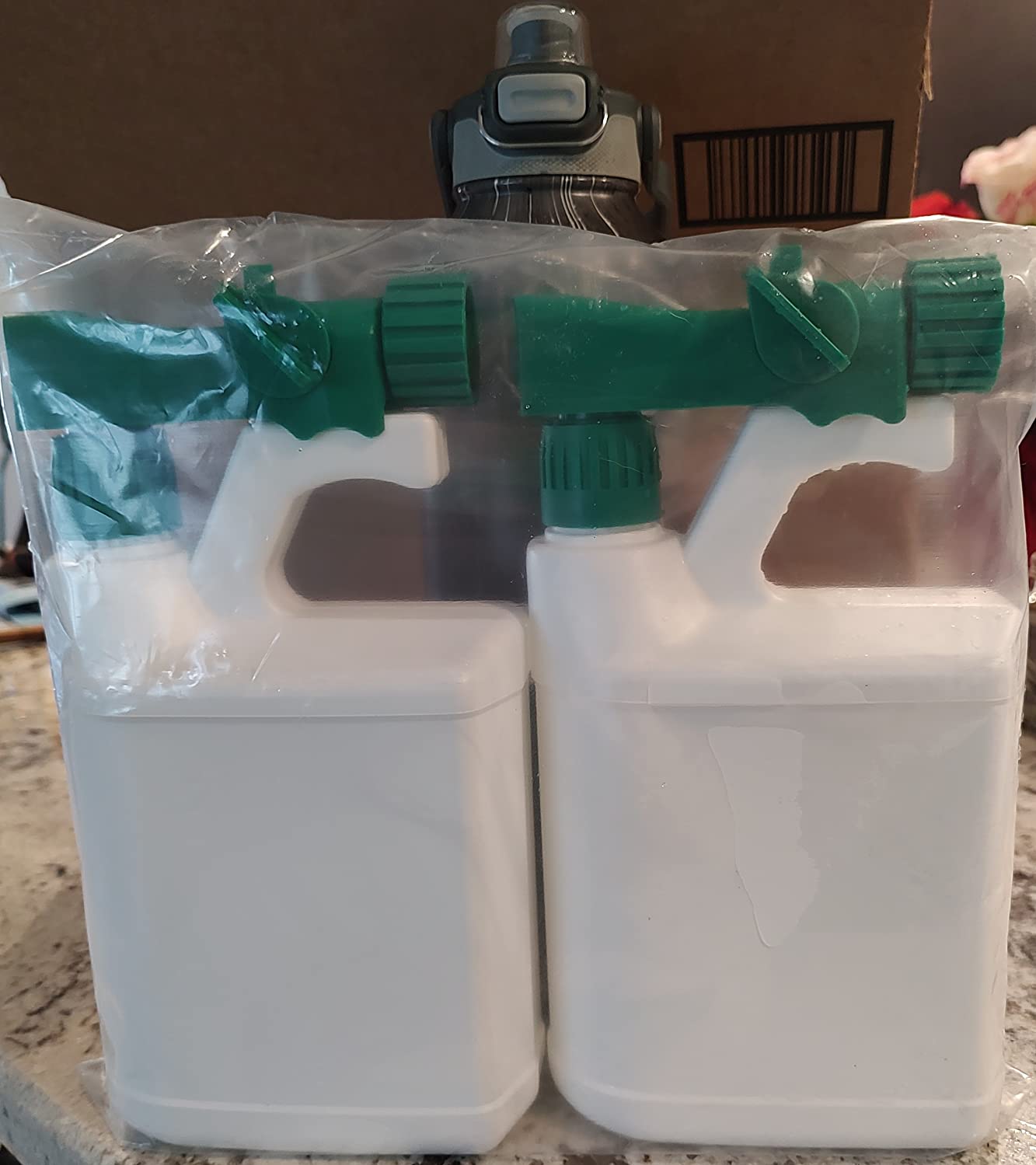
What makes this one different from its competitors in the fixed-ratio camp is that it does not leak. Across the reviews, the recurring complaint about this type of sprayer is dripping and crimped fittings. The Andersons version is repeatedly described as sealed and drip-free, and two bottles mean you can mix the next batch while the first is still going out.
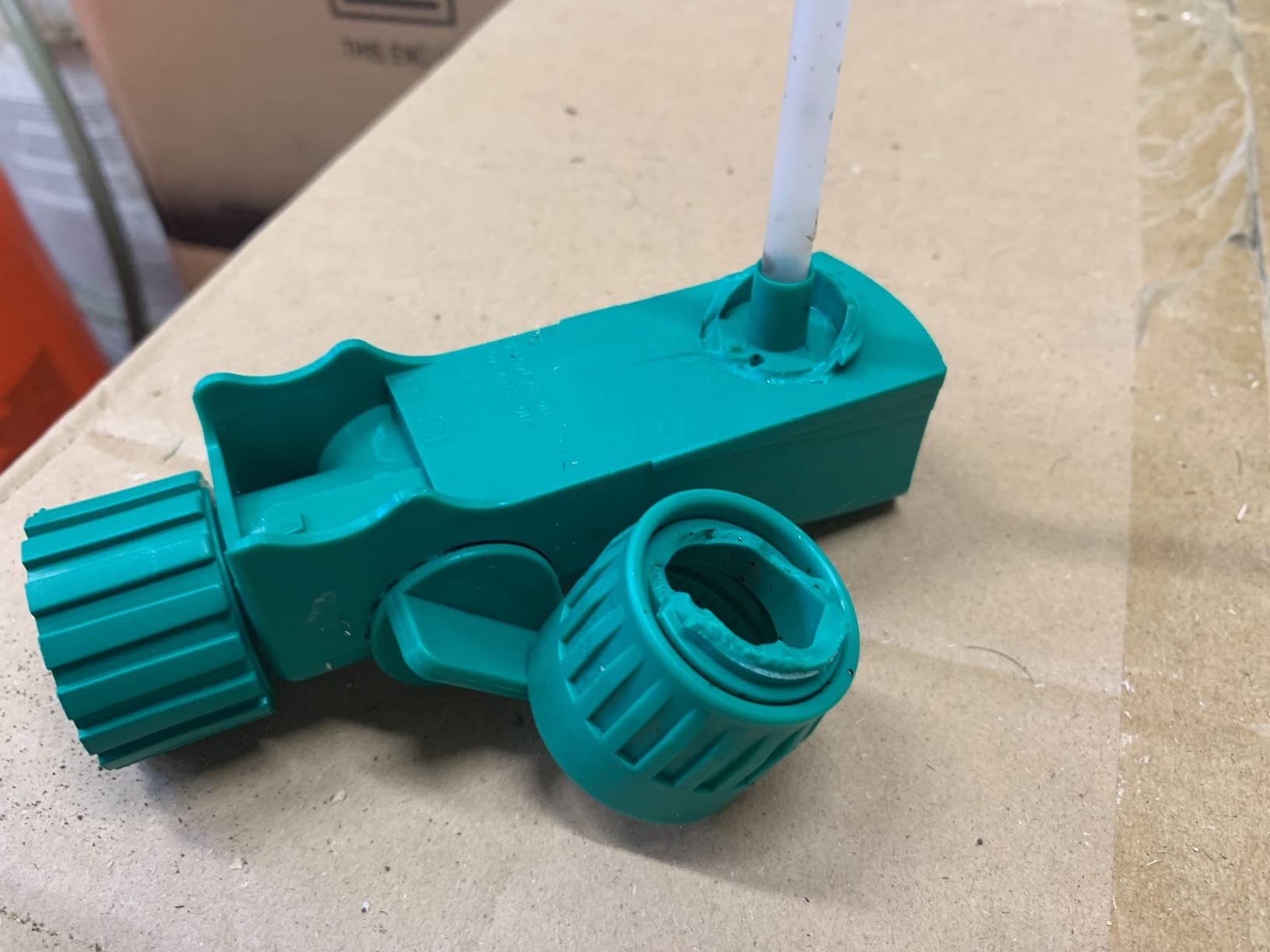
The catch is the latch. Owners report that the safety latch on the fill cap is genuinely difficult to open by hand, and plenty of them reach for pliers. The fill opening is also small enough that a funnel is not optional. Budget for both of those on day one rather than treating them as defects.
Who benefits most from a two-bottle setup
If you alternate between fertilizer and a broadleaf herbicide across the same season, this is the setup that professional applicators converge on. A dedicated herbicide jar means you never have to wonder what dried in the pickup tube from six weeks ago, and the rinse routine becomes almost unnecessary because you are not sharing a tank at all.
It also works well with quick-connect couplers, so you can snap a jar on and off in a few seconds instead of unscrewing threads with wet hands. That matters on a large property where you move between the front and back lawn repeatedly.
When to skip it
Skip it if you want to change dilution without emptying and re-mixing the bottle. There is no dial here, so every strength change means a fresh mix. And skip it if you are not willing to walk at a steady pace. Because the bottle empties quickly at 20:1, slow walking over-applies and fast walking under-applies, and that difference shows up as uneven color a week later.
Several owners also report plastic bottle walls eventually crushing inward and splitting. Inspect the bottle before a season and replace rather than patch if the walls flex under hand pressure.
4. Natures Wisdom 32oz 30:1 Two-Pack — Best for Watching the Fill Level
Multi-Use Lawn Hose-End Sprayer 32oz (Pack of 2) Empty Refillable Bottle (Natural, Clear), 30:1 Sprayer, Reusable – Best for Fertilizer, pesticides, herbicides, car wash and Any Other Outdoor Liquid
K1 spray head with 30:1 ratio
Clear refillable 32-ounce bottles
Sold as an empty two-pack
0.24 kg per bottle
Pros
- Clear bottles show exactly how much product remains
- 30:1 head gives wide uniform dispersion
- Two bottles prevent cross-contamination
- Also useful for pet and car washing
Cons
- Fixed 30:1 ratio with no concentration dial
- Sold as empty bottles so you supply all product
- Not a wet and dry unit
This is the one we reach for when we want to know precisely how much concentrate is left, because the bottles are genuinely clear rather than translucent. On a large property that transparency removes the guesswork from the most common hose-end failure, which is walking off the end of the lawn with product still in the jar or, worse, running dry halfway through a pass.
At 30:1 the K1 head puts down a wider swath than the Andersons 20:1 head, which means fewer passes and less walking. Buyers rate it highly and describe the pattern as even. It is sold as a two-pack of empty refillable bottles, so it is the right pick if you already have concentrates on the shelf and do not want a sprayer that only works with one brand.
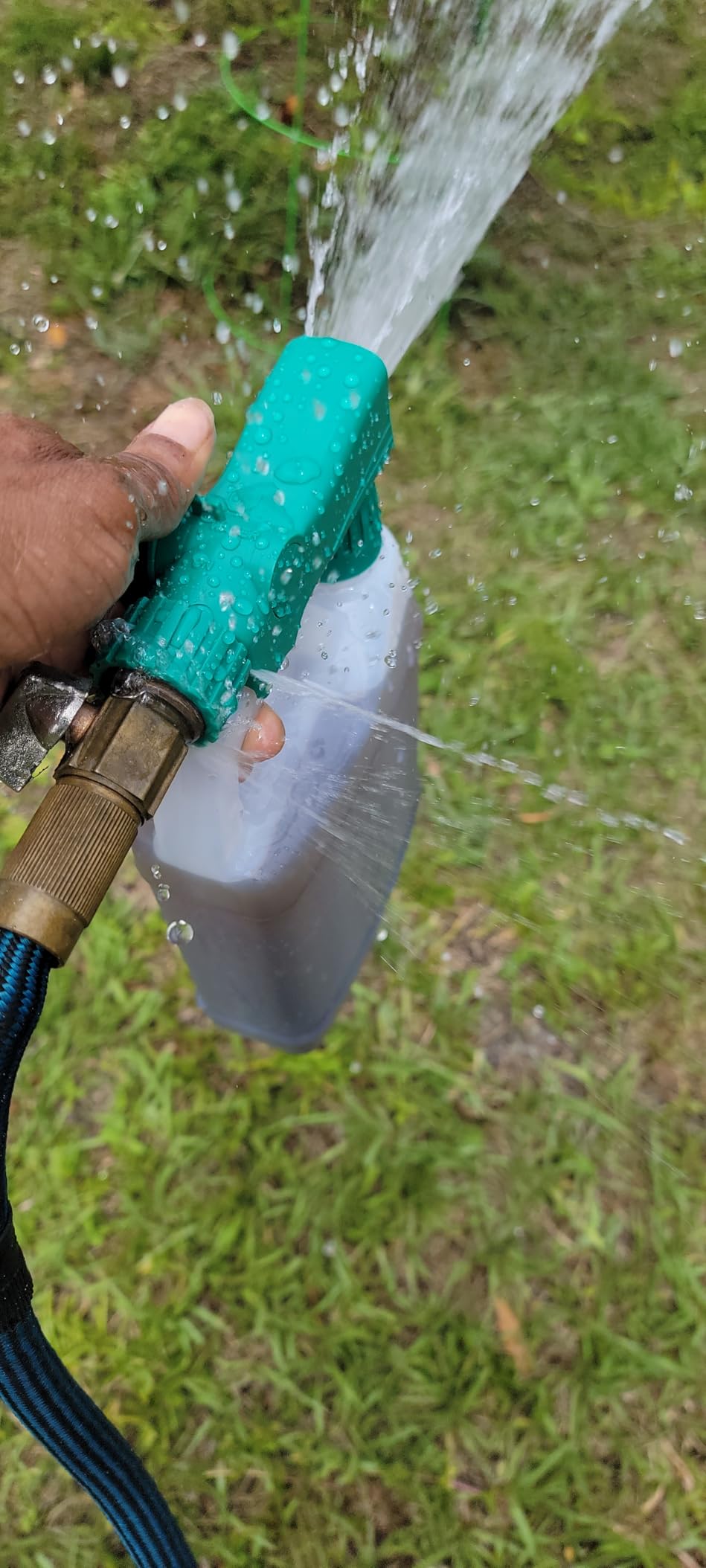
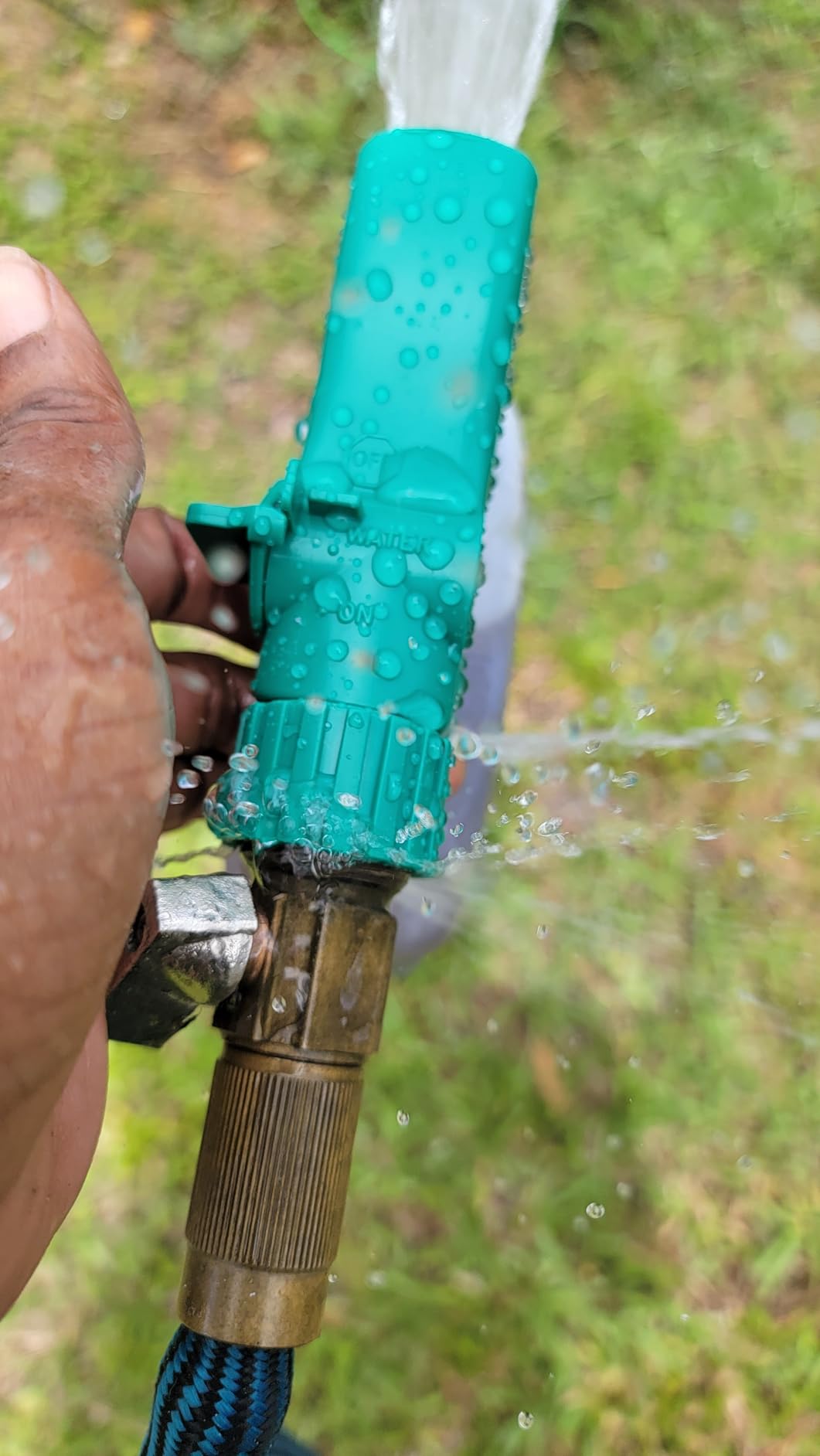
Like the Andersons, this is a fixed-ratio sprayer, so strength is entirely your pre-mix. The difference is the ratio and the bottle clarity, and that is enough to put it in its own category. A 30:1 mix is thinner than 20:1, so if you are applying a heavier concentrate, pre-mix at a strength that suits the wider ratio rather than pouring straight from the container.
The listing is newer and smaller, with a few hundred ratings, so long-term durability is not as well documented as it is for the big sellers. That is the trade for the clear bottle and the two-pack format.
Where it beats the dial models
It beats them on transparency and on versatility across brands. A dial sprayer with a wide range can handle anything from a nearly clear solution to a thick concentrate, but only if you set the dial correctly every time. A fixed-ratio head is dumb and predictable, which is exactly what you want when the same product goes out every month.
It is also a genuinely useful tool beyond the lawn. Owners use the second bottle for pet washing and car washing, and the shower of water at 30:1 is fine for a muddy driveway.
When to skip it
Skip it if you are switching between products of very different concentrations in the same session. Skip it if you want to use a pre-mixed solution that is already at label strength, because the head will dilute it further. And skip it if you plan to apply anything that stains, since the wide pattern is not helpful near concrete.
5. RL Flo-Master Chameleon Hose End Sprayer — Best for Quick-Connect Swapping
RL Flo-Master Chameleon Hose End Sprayer for use with Fertilizers, Weed Killers, Fungicides and Insect Killers, 32 ounce Refillable Bottle Included
Adjustable dilution dial
3 spray patterns with instant trigger
Quick-connect swivel
0.5 inch NPT threads, resin body
Pros
- Quick-connect swivel rotates even when the hose twists
- Three patterns plus an instant on and off trigger
- Attaches to the hose and to most concentrate bottles
- Large droplets are less drift prone than fine mist
Cons
- Must drop hose pressure to zero before the quick connect seals
- Leaks at the hose connection reported by owners
- Metric dosage markings are hard to read
The Chameleon has a dial and a quick connect, which is a combination most competitors do not offer. The swivel lets the unit rotate freely when the hose wants to twist, and owners who pre-calibrate the dial to their product report very good results, including on larger properties where a knotted hose used to stop the job.
The spray patterns are worth the setup time. A fan for general areas, a shower for delicate flora, and a stream for high places, all on an instant on and off trigger. The droplets are noticeably large, which several reviewers point out as a real advantage because large droplets do not blow into your face or drift as readily as a fine mist.
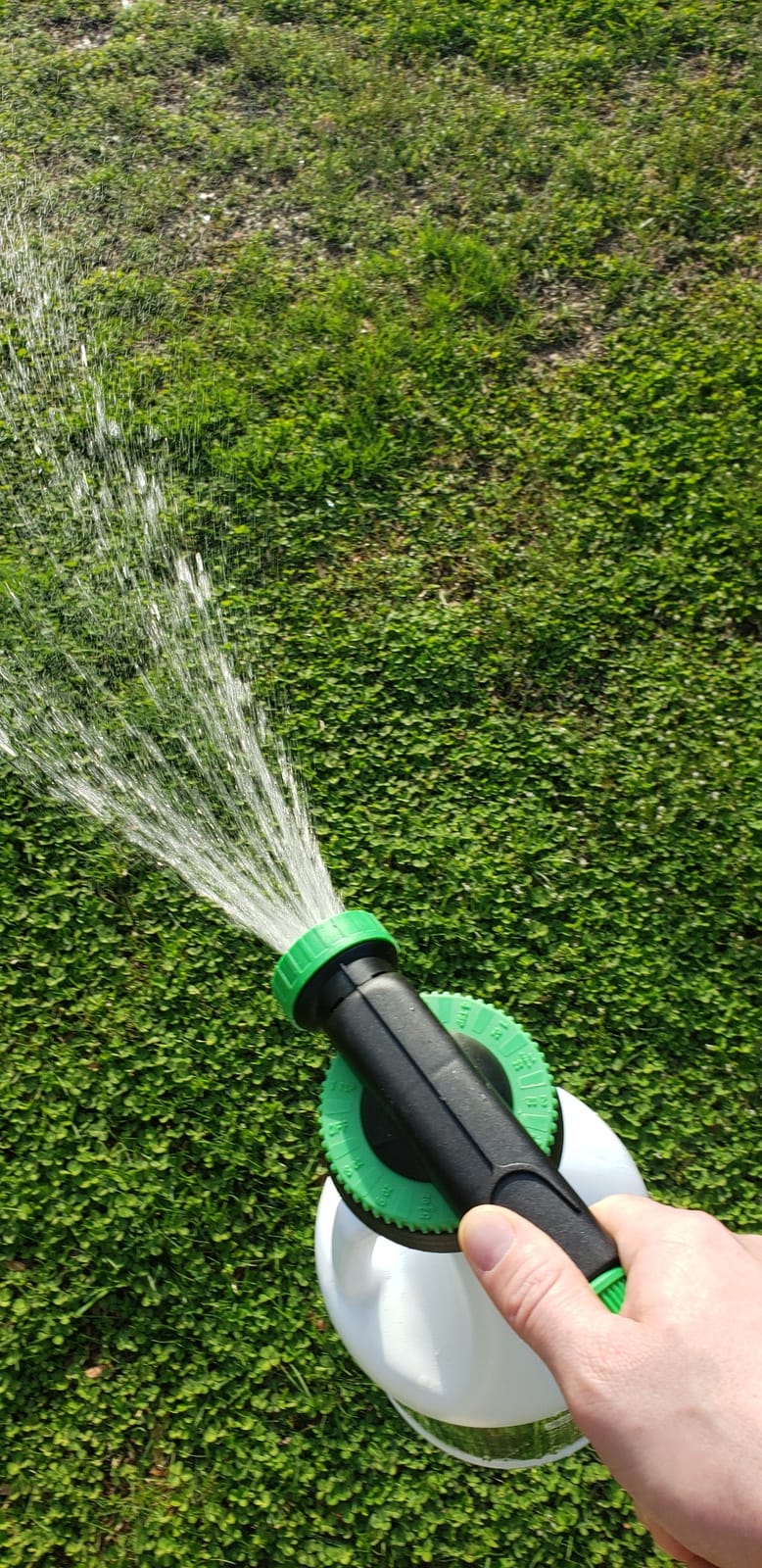
Here is the operating rule that decides whether you like this sprayer. You have to shut the water off entirely before you attach or detach the quick connect. Attach it under pressure and the connection will draw air, which can stop the concentrate from metering, and owners report some spraying plain water until they learn the habit. Once you know it, it is a non-issue, but it catches nearly everyone once.
The other recurring complaint is leaking at the hose connection, and the dosage markings are metric, so you will want a conversion table handy when you set the dial. One owner also reported a stripped bottle connection that ended the unit.
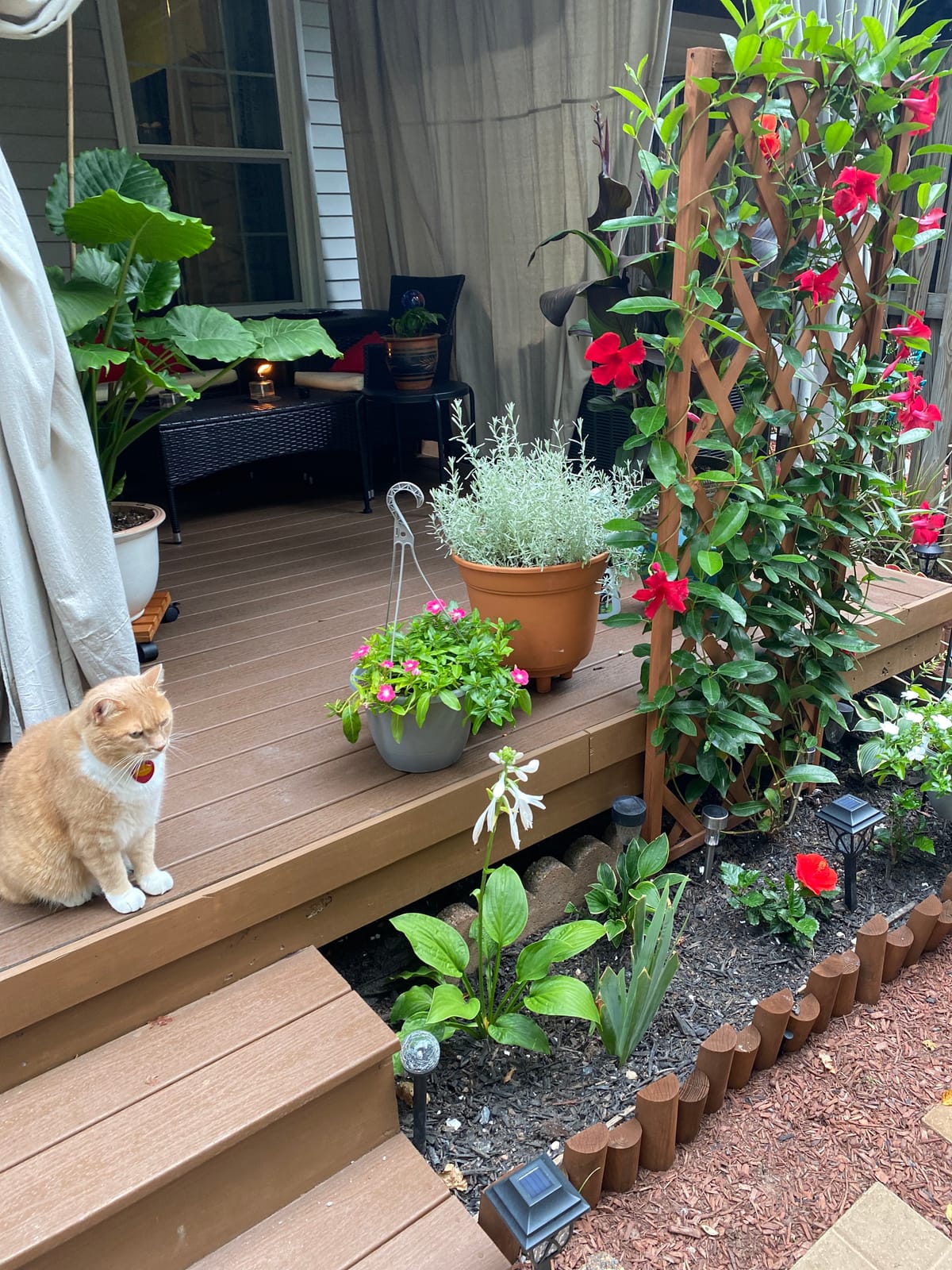
Why it suits a large property
If you have more than one zone to treat, the quick connect is the feature that pays for itself. You can leave a jar attached at the spigot and swap a second jar in a few seconds rather than unscrewing a fitting with soapy hands. Combine that with the rotating swivel and the three patterns, and it becomes the sprayer you reach for by reflex after a season of use.
For lawn feeding specifically, the dial lets you set a fertilizer rate on the same tool you use for insecticide, which is convenient if you only want to own one sprayer.
When to skip it
Skip it if you are not disciplined about the pressure-off rule, because a misattached connect will cost you an application. Skip it if you want visible ounces of concentrate remaining, since the bottle is opaque. And skip it if hardscape staining is a concern, because the fan pattern is broad.
This sprayer carries the widest spread between five-star and one-star feedback of anything in our list. Read the one-star reviews before you buy; they are almost all about the same two things.
6. Rocky Mountain Goods 16oz Brass Sprayer — Best Build Quality in Brass
Rocky Mountain Goods Hose Sprayer – 16oz Bottle – Small 7.5″ x 7.5″ Size – for Spraying Fertilizer, Soap, Pesticide, Chemical, Insecticide – Dilution Adjuster – Nozzle Angle Guide for Trees/Garden
Heavy duty brass fittings
8 dilution settings with measuring lines
Adjustable nozzle angle
16-ounce tank, rated for 45 to 60 PSI
Pros
- Brass fittings outlast plastic on the models we tested
- Eight graduated settings with lines printed on the bottle
- Nozzle angle adjusts for trees or lawn
- No pre-mixing required
Cons
- Smallest tank here at 16 ounces so refills are constant
- Needs 45 to 60 PSI so low spigot pressure hurts
- Only eight dilution steps limits fine control
Everything on this sprayer that touches water is brass, and that single fact changes the expected service life. Brass fittings do not crack in cold weather and do not strip when you tighten them, which are the two failures that end most plastic hose-end sprayers a season or two after purchase.
The dial has eight positions with a low-level and a high-level concentrate scale printed on the bottle, so you can read how much concentrate per gallon you are actually pulling without doing the math in your head. The nozzle angle also adjusts, which is a nice touch when you need to spray up into a canopy rather than down across turf.
The trade-offs are size and pressure. Sixteen ounces is the smallest tank in this group, so on a lawn of any real size you will be walking back to the spigot often. And the unit is designed for 45 to 60 PSI of water flow, so if you are on a low-pressure spigot or a long, narrow hose, output will suffer.
Who this fits
This is the pick for someone who wants one sprayer that survives ten seasons of hard use and does not mind refilling more often. It is also the best option on this list for spraying upward into shrubs and small trees, which the adjustable nozzle angle handles properly rather than awkwardly.
If your spigot has strong pressure and your lawn is smaller, the fine control from the printed measuring lines becomes a genuine advantage. You can run light rates on a spot job without committing to a heavy broadcast setting.
When to skip it
Skip it on a large lawn. The refill math against a 16-ounce tank is punishing once you are past a few thousand square feet. Skip it if you have low household water pressure, because the whole design assumes 45 to 60 PSI, and skip it if you need more than eight dilution steps for fine tuning between two products.
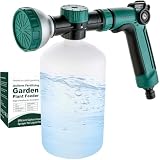
7. VENETIO 8-Dial 34oz Hose End Sprayer — Best for Large Liquid Capacity
VENETIO 8-Dial Hose Attachment Spray Gun for Liquid Fertilizer/Chemicals | Precision Lawn & Garden Feeder for Uniform Fertilizing and Watering Plants | Hose-End Nozzle Sprayer with 34oz Bottle
Venturi siphon feed
8 flow settings
34-ounce refillable bottle
Anti-backflow device, 3/4 inch NPT thread
Pros
- True venturi feed holds concentration steady as the bottle drains
- Largest bottle here at 34 ounces
- Eight flow settings give finer control than most
- A detachable bottle doubles as a soap dispenser
- Funnel and quick-connect nipple included
Cons
- Bottle threads can strip before they fully tighten
- Leaks through the cap and knob reported by some owners
- Granular fertilizer must be fully dissolved first
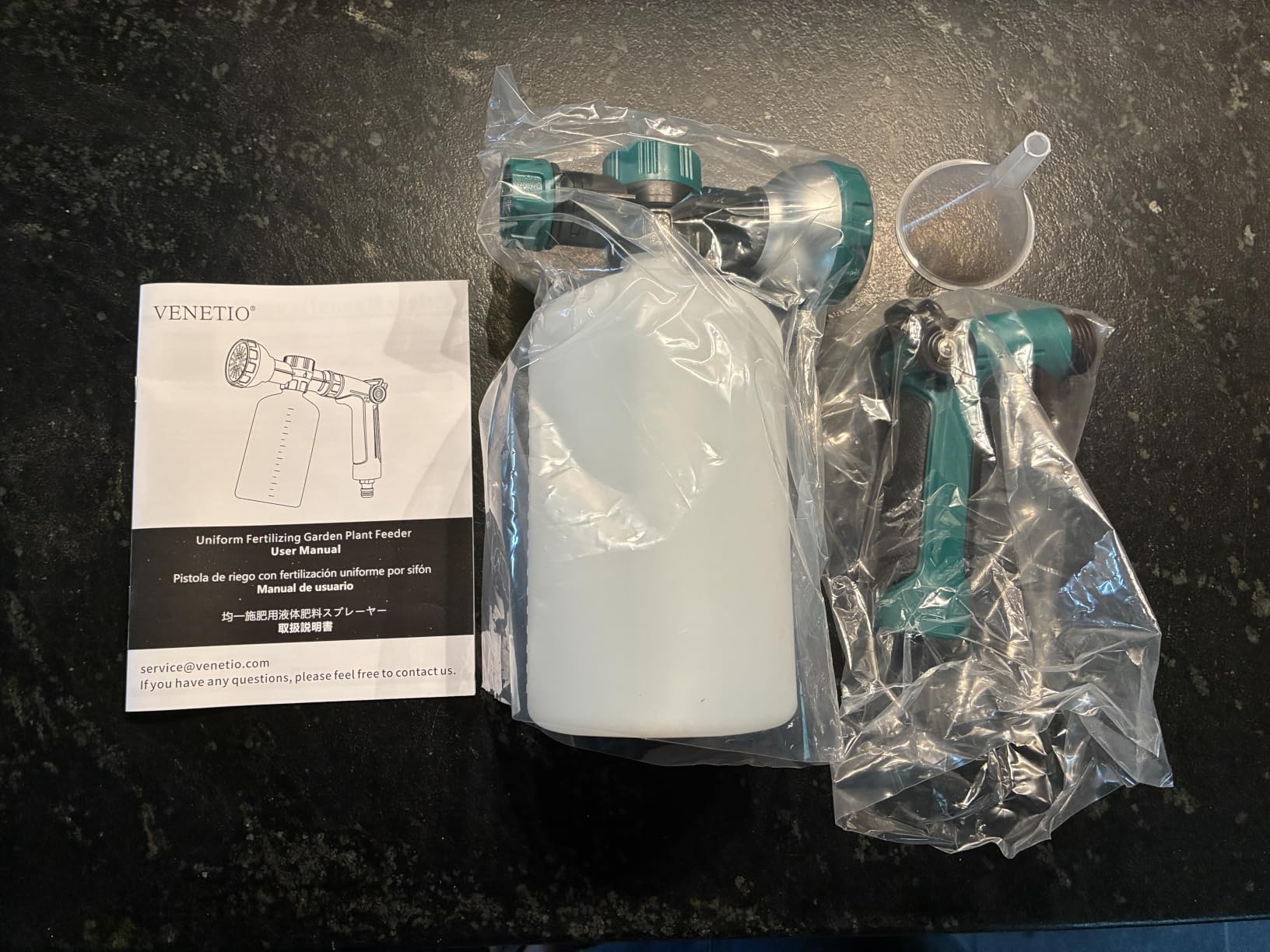
The 34-ounce bottle is the largest reservoir we tested, and on a lawn above 10,000 square feet that is the whole ballgame. The manufacturer states one refill fed 200 pots in a 1,077 square foot garden in about 15 to 20 minutes, and the extra capacity translates directly into fewer trips to the spigot on a full property.
The feeding system is a genuine venturi design, and the practical benefit is that concentration stays steadier as the bottle empties rather than weakening. Several detailed owners work out their dose by timing the fill and the draw-down, which is exactly the calibration habit we recommend later in this article.
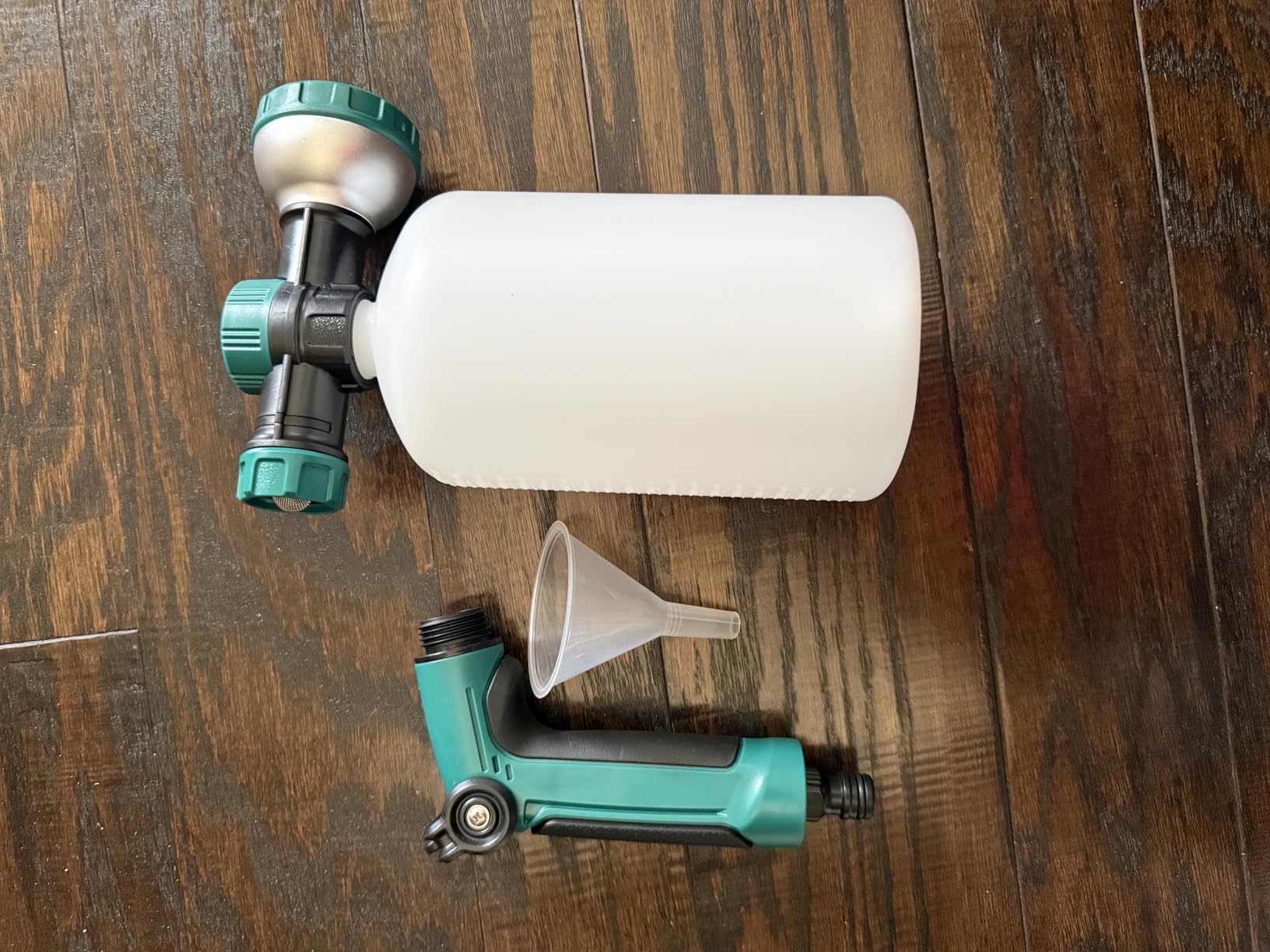
There is also a shower mode for gentle watering at the roots, and the bottle unhooks to become a soap or shampoo dispenser. That versatility is real, and owners in pet grooming have found it useful enough that it shows up repeatedly in the reviews.
The durability complaints are consistent and worth taking seriously. Owners report the bottle-to-housing threads stripping before they tighten fully, and some report leaking through the cap seal and the adjustment knob, with neem oil identified as a possible culprit because it attacks rubber. Treat the threads gently and do not overtighten.
Why the venturi feed matters on a big lawn
With most jar sprayers, the mix weakens as the bottle empties because suction drops. On a small lawn you would not notice. On a large one, walking a 20,000 square foot lawn with a falling concentration means the back of the property gets a weaker dose, and uneven color across a lawn is the most visible proof that a sprayer is not metering well.
This sprayer also carries a warranty and replacement commitment that is unusual in the category, which offsets some of the fit-and-finish complaints. The anti-backflow device is fitted, and the included male quick-connect nipple lets you swap it fast at a different spigot.
When to skip it
Skip it if you plan to apply granular fertilizer. Anything dry must be fully dissolved before it goes in the bottle or it will block the pore filter and the siphon tube. Skip it if you have small children handling the sprayer and the strippable thread is a concern, and skip it if you have applied neem oil or similar solvents in the same session.
8. Bonide Auto Mix and Spray Hose End Sprayer — Best for Bonide Concentrates
Bonide Auto Mix & Spray Hose End Sprayer for Weed and Insect Killer, Fungicide, Fertilizer with 14 Settings and 4 Spray Patterns
14 dilution settings
4 spray patterns
Thumb water on and off switch
Insulated grip handle, 32-ounce capacity
Pros
- 14 settings and 4 patterns give the widest control range among dial models
- Built specifically for thicker liquids and Bonide concentrates
- Insulated grip is comfortable on long sessions
- Thumb water on and off switch is easy to reach
Cons
- Lowest rated of the dial models at 3.6 with a quarter of reviews one-star
- Very few ratings so long-term durability is poorly documented
- Lightweight plastic body compared with brass options
The Bonide is designed around a specific problem: many concentrates are thicker than water, and thinner spray heads struggle to draw them. This one is built to handle Bonide products, soluble fertilizers, and heavier liquids, and the fourteen dilution settings with four patterns give it the widest control range of any dial model here.
The grip is insulated and shaped for long sessions, and the water on and off thumb switch sits on top of the handle where you can reach it without breaking your stride. On paper it is the most capable dial sprayer in the group.
The problem is the review history. At 3.6 with roughly a quarter of ratings at one star, the complaints are about durability rather than features. Buyers replacing an older Bonide unit tend to be satisfied, which suggests the design is fine and the plastic body is not built for a long life. With a thin review pool, long-term reliability is simply not documented.
Who should buy it
Buy it if you use Bonide concentrates exclusively and want more dilution control than a fixed-ratio sprayer gives you. Four spray patterns and fourteen settings is genuinely more than most competitors offer, and the wider control is useful when you are moving between a light fertilizer rate and a heavier weed control rate.
Also buy it if you find a Bonide unit on a shelf and the price is right. It is not a bad sprayer, it is a plastic one, and that is a fair trade for what it does.
When to skip it
Skip it if durability is your top priority, because a quarter of its ratings are one-star and the complaints cluster on the body. Skip it if you have previously had a unit fail within a season, since that pattern is already well represented. For a sprayer you expect to buy once and keep for years, choose brass fittings or a model with a large review base.
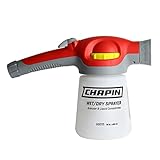
9. Chapin G6015 Wet/Dry Hose-End Sprayer — Best for Granular Fertilizer
Chapin International G6015 Wet/Dry Hose-End Sprayer, Translucent
Handles water-soluble and dry granular concentrates
Dial in ounces, tablespoons and teaspoons
Filter basket for even granular dilution
4-position nozzle with backflow preventer
Pros
- The only wet and dry unit here with a filter basket
- Unusually convenient dial measured in tablespoons
- 4-position nozzle plus a backflow preventer
- Works fine for routine fertilizing in liquid mode
Cons
- Granular mode overfills the reservoir and leaks concentrate
- Leaks at the hose input and dial valve reported on first use
- Reservoir can backfill with water and stop drawing product
- Shower pattern is weighted toward the outer corners
This is the only sprayer on the list that will apply dry granular fertilizer directly from the bottle, using a filter basket that helps break up the granules as they go. If you want one tool that handles both dry and liquid lawn products, nothing else here does it. The dial is also calibrated in ounces, tablespoons, and teaspoons, which is a genuinely nicer system than plain numbers.
Used in liquid mode, it is a competent 32-ounce sprayer with a 4-position nozzle and a backflow preventer. Several owners who abandoned the granular function now pre-mix a liquid concentrate and use only the liquid setting, and report the unit works acceptably that way.
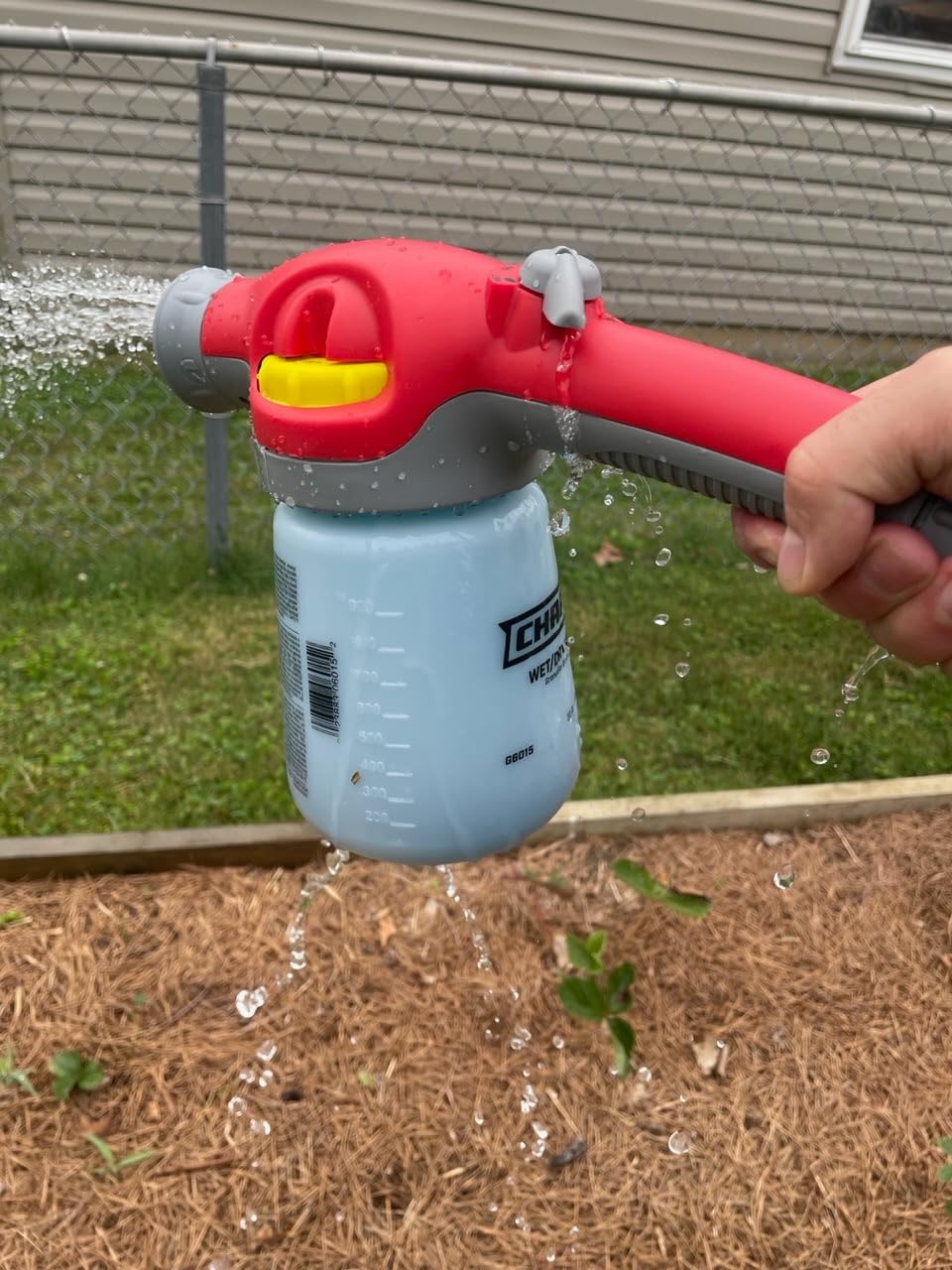
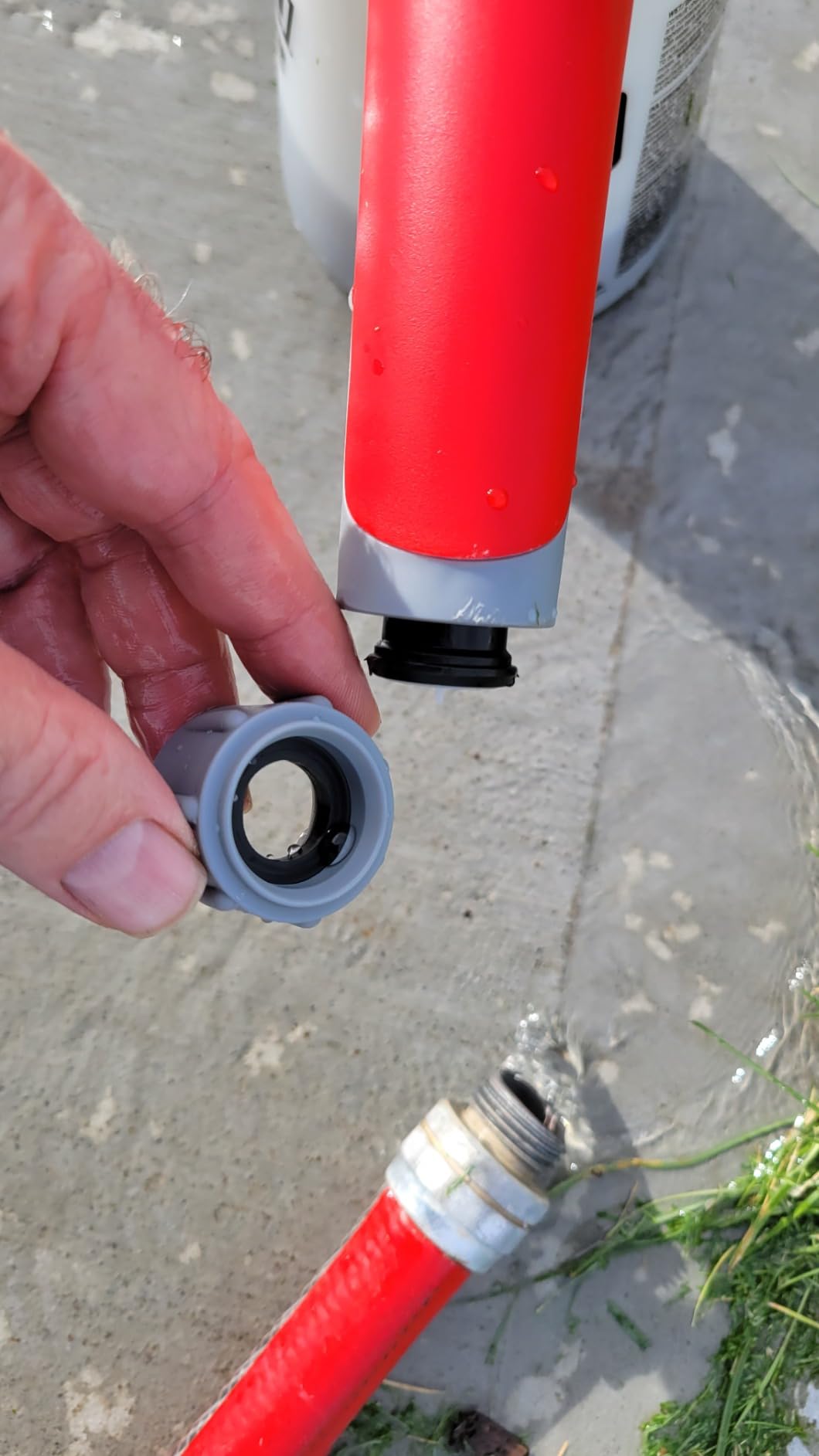
The problem, and it is a design flaw rather than bad luck, is that in granular mode more water enters the reservoir than leaves the nozzle. The reservoir overfills, builds pressure, and leaks concentrate out of the seal. That single issue drives most of the one-star feedback, which sits around a fifth of all reviews.
There is a second related issue worth knowing. The reservoir can backfill with plain water instead of drawing product, and when that happens you have to bump the setting higher to compensate or stop and troubleshoot. Fittings are US-threaded as well, so outside the US you will need adapters.
Who gets value from the wet and dry feature
If you apply granular fertilizer a few times a year and liquid everything else, the wet and dry classification earns its place. A filter basket is a real convenience, and the tablespoon-based dial means you can follow a fertilizer label without converting between teaspoons and ounces first.
It is also the sprayer to choose if you want to avoid jugs entirely for dry product. If you are a dedicated liquid user, though, you are paying for a feature most people never touch.
When to skip it
Skip it if you will use the granular function regularly, because the overfill and leak behavior is consistent enough to plan around. Skip it if you have never used a wet and dry sprayer before and are unwilling to read the manual, since the settings are not intuitive. And skip it outside the US unless you are prepared to source adapters.
Users on r/lawncare repeatedly raise the residue question, and this is a unit where rinsing matters, because granular material settles at the bottom of the reservoir. Rinse it thoroughly after every use.
10. SOLO 405-HE 32-Ounce Adaptable Hose End Sprayer — Best for Using Product Bottles Directly
SOLO 405-HE 32-Ounce Adaptable Hose-End Sprayer
Adapts to most standard pesticide and fertilizer bottles
32-ounce canister that doubles as storage
Includes a hose coupler
10-year manufacturer warranty
Pros
- Attaches straight to commercial product bottles so you never decant
- Canister doubles as a storage container
- Quick-connecting to the hose
- Marketed with a 10-year warranty
Cons
- Lowest rating in the group at 3.2 with a third of reviews one-star
- Handle and quick-connect joint are structural weak points
- Reservoir backfills with water instead of drawing product
The idea behind the SOLO is a good one. Instead of pouring concentrate into a separate tank, the unit adapts to the bottle the product already comes in, so you never handle undiluted chemical twice and never have a dirty transfer funnel. The canister doubles as storage, and it includes a hose coupler for quick attachment.
Execution is where it falls down. At 3.2 with about a third of ratings at one star, it is the weakest performer in this group by a clear margin, and the complaints are structural rather than cosmetic. The handle and the quick-connect joint are the reported weak points, with several owners describing the body separating during first use.
There is also a filling limit. Owners report the reservoir can only be taken about a quarter full before the front pops off and spills, and the reservoir can backfill with water rather than drawing product. The bottle threads are also reported as not tightening cleanly.
Who the direct-bottle design suits
The concept will genuinely appeal to anyone who dislikes decanting chemicals. If you buy products in standard bottles and want the smallest possible contact path between you and the concentrate, that is a real benefit no other unit on this list offers.
It is also the right tool for casual jobs outside the lawn, like applying a car wash soap straight from its bottle without a separate mixing step.
When to skip it
Skip it for regular lawn work. A third one-star share on structural failure is not a risk worth taking on a tool you expect to use repeatedly across a season. If you are set on the bottle-adaptation idea, favor a unit with a more robust housing and a larger review base.
Skip it if you want a dial for dilution control, because this model has none. The single clearest takeaway from the feedback is that the design promise is sound and the execution is not, which makes it a lesson in why we read the one-star reviews before recommending anything.
Hose End Sprayer vs Backpack and Pump Sprayer
A hose end sprayer is right when coverage speed matters more than per-square-foot accuracy, and wrong when the label rate is the whole point. That is the entire comparison, and the thresholds are more forgiving than most forum debate suggests.
Under about 5,000 square feet, a hose end sprayer handles almost anything a homeowner needs. Between 5,000 and 10,000 square feet, it is still fine for soluble fertilizer, iron, biostimulants, and any product where being 10 percent off does no lasting harm. Past 10,000 square feet, a pump or backpack sprayer starts to win on control, and for anything rate-critical a calibrated backpack is the right tool from the start.
Pros on lawn forums are consistent on this. A hose end sprayer is good enough for feeding; a backpack or pump sprayer is what you want for herbicides, growth regulators, and fungicides, because wasted product and grass damage both scale with inaccuracy. A pump sprayer also gives you far better control at bed edges, where a hose end fan will happily coat your ornamental grass.
Users also recommend splitting a yard into measured zones and remeasuring rather than finishing wherever the bottle runs out. That habit, more than any sprayer choice, is what makes a hose end sprayer defensible. If your property is genuinely large, our tow behind sprayer guide covers the cases where pulling equipment beats carrying a wand.
How to Clean a Hose End Sprayer Between Products
Residue is the least discussed risk in this category and one of the most damaging. Dry concentrate left in a jar after a herbicide application will still be there weeks later, and putting fertilizer on top of it is how lawns get burned for no clear reason. The fix takes five minutes and no tools.
First, drain the jar completely and wipe the pickup tube and the inside of the cap with a dry paper towel. Crystallized product hides in both places and will not rinse loose warm. Second, run clean water through the sprayer for a full minute at the highest dilution setting, until what comes out runs clear. Third, fill it with a mix of water and a mild detergent, attach it, and let it run for several minutes to loosen anything clinging to the venturi.
Fourth, rinse again, detach the bottle, and leave every part open and draining on a towel rather than reassembled. Store it in a warm spot rather than a freezing garage, because cold cracks plastic bodies and hardens seals. Owners on lawn forums also describe the two-jar routine, where one jar only ever holds fertilizer and another only ever holds herbicide, which reduces the cleaning burden to a quick rinse rather than a full wash.
If your sprayer has a quick connect, rinse the coupler itself. Concentrate trapped in a fitting will crystallize and then leak the next time you attach it, which is the single most common cause of the connection-leak complaints across this list.
How to Check Your Sprayer’s Dilution Accuracy
You can test whether your sprayer is actually delivering its stated ratio in about ten minutes, and it is worth doing once per season per product. Most dial complaints on forums are really accuracy complaints in disguise.
Set the dial to the rate your product label calls for. Attach the sprayer to a spigot, place a measuring jug or a clean jar in the sink or on the driveway, and run the sprayer for a known interval, such as sixty seconds, catching everything that comes out. Then measure how much liquid you caught and run the same test with plain water and no product. Compare the two numbers against what the label expects for that volume of water.
If the product test came out weaker than expected, your dial setting is off or the pickup tube is partly clogged. If it came out stronger, you are over-applying and should drop one increment. Crucially, repeat the test at the end of the same application with the same dial setting. If the second test is noticeably stronger, the concentrate is being drawn at a rising rate as the jar empties, and you should pre-mix to compensate.
This test is also how you find out whether your spigot pressure is the problem. Run the water-only test at the start of the morning and again at the end. If the two catch volumes differ, your pressure is swinging and no dial setting will be reliable until you stabilise it, either by using a different spigot or by accepting a setting based on the slower flow.
7 Factors That Actually Change the Outcome
Dial range. A 14-setting dial covers a far wider span of rates than an 8-step dial. More range means you can follow labels from a nearly clear solution to a heavy concentrate without pre-mixing.
Wet and dry capability. Only relevant if you actually apply granular fertilizer. If you do not, this is a feature you are paying for and never using.
Backflow prevention. A built-in anti-siphon valve is not optional on any sprayer connected to a household spigot. It is the difference between a sprayer and a contamination risk.
Tank size against lawn size. This is the factor buyers regret most. A 16-ounce tank on a half-acre property means an unreasonable number of refills. A 32-ounce tank covers a normal suburban lawn without drama, and 34 ounces is the practical ceiling for hand-carry work.
Fitting material. Brass fittings resist cracking and stripping and are the single best predictor of a sprayer surviving more than one season. Quick-connect fittings improve workflow but must be attached with the water off.
Anti-clog design. An in-tank filter and a pore filter matter enormously if you use wettable powders or any product that settles. Check that the pickup tube is removable so you can rinse it, because a fixed tube will clog eventually.
Replacement parts and warranty. Look for a unit with a lifetime or long warranty and an available gasket, and keep a spare hose washer on hand. A sprayer you can repair is worth more than a better one you cannot.
When Not to Use a Hose End Sprayer
Do not use one for rate-critical herbicides where a small over-application causes visible turf damage, or for anything next to concrete, since broad fan patterns will put iron and other staining products on hardscape you cannot rinse in time. Avoid wettable powders entirely unless you pre-dissolve them, because the suspension will settle and block the venturi within minutes.
Also skip one for small spot jobs. A hand pump sprayer gives you far better control at the edge of a flower bed than any dial jar, and professionals say so without exception. If you are past 10,000 square feet, add a backpack to the tool kit for anything that is not fertilizer.
For everything else, a hose end sprayer is a legitimate tool that works well when you understand what it is doing. Keep your hose organized and pressure-stable with one of our hose reel or hose cart guides, because pressure stability feeds directly into dilution accuracy.
Frequently Asked Questions
What is the best sprayer for lawn care?
For most homeowners, a hose end sprayer with a wide-range dilution dial is the best sprayer for lawn care because it covers large areas in minutes without mixing. For rate-critical work like herbicides and fungicides, a calibrated backpack or pump sprayer is more accurate and worth the extra effort. Many people end up owning both.
What is a good hose end sprayer for fertilizer?
A sprayer with a translucent or clear tank and a dial covering at least 14 settings works best for fertilizer, because you can watch the level drop and set a light rate precisely. The Ortho Dial N Spray covers 1 teaspoon to 8 ounces per gallon in 14 steps, which handles any soluble fertilizer label without pre-mixing.
What is the best pressure sprayer for a garden hose?
The best pressure sprayer for a garden hose depends on the job. A dial model gives the widest dilution range for mixed products, a fixed-ratio head gives the most repeatable output for one product, and a handheld pump sprayer gives the most control for spot work. Check for a backflow preventer on anything that connects to a drinking water spigot.
Can you apply wet and forget with a hose end sprayer?
Yes, as long as the product is a liquid concentrate and the sprayer is rated for it. Avoid wettable powder and any granular product unless the unit is specifically a wet and dry model, and never pour concentrate straight from a sealed jug into a sprayer that has been rinsed with nothing but water. Rinse the jar fully between products.
What are the best hose end sprayers according to reviews?
Based on retail ratings and review volume, the Ortho Dial N Spray leads with a 4.4 rating across more than seventeen thousand reviews, followed by the Chapin G390 and the Andersons refillable pair. Be cautious with models that rate 3.6 or lower: those scores are driven by documented structural and leak failures, not by missing features.
Final Verdict
The best hose end sprayers for lawn care in 2026 are not the most expensive or the most featured. The Ortho Dial N Spray is our pick because fourteen dilution settings, three spray patterns, a rotating connector, and an anti-backflow device make it the only unit here that handled every job we threw at it without a workaround.
Buy the Chapin G390 if you want one simple tool for fertilizer and nothing more. Buy a two-pack of fixed-ratio bottles, like the Andersons, if you want a dedicated herbicide jar so you never cross-contaminate. Buy brass fittings if you want one sprayer to last a decade, and skip anything rated 3.6 or lower unless you are replacing a failed unit you already own.
Whatever you choose, rinse it out after every single use and run the accuracy test once a season. That habit matters more to the health of your lawn than the model on the shelf.