
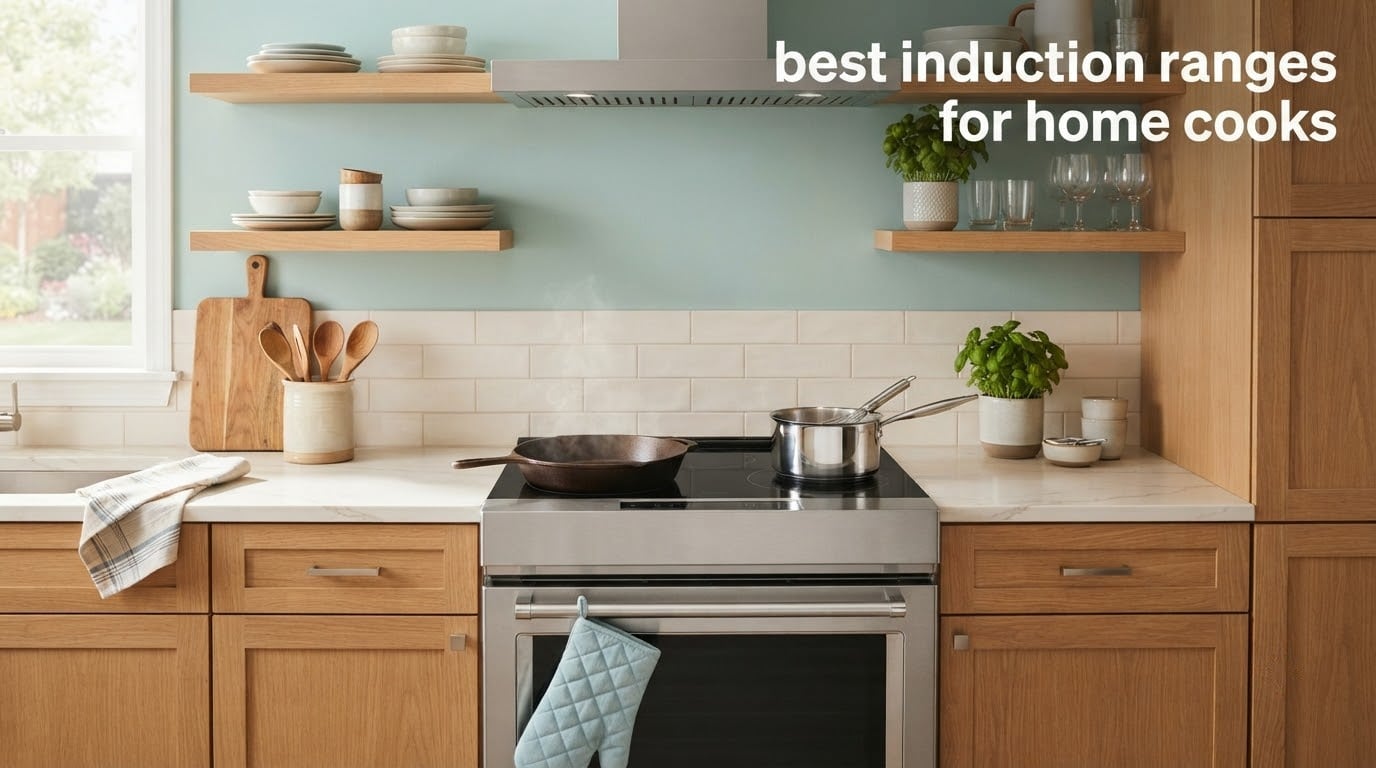
An induction range is an odd purchase. A portable single-burner cooktop or a gas range is an impulse buy, but a 30-inch induction range with a built-in oven is a multi-thousand-dollar decision that usually involves an electrician, a delivery crew and a countertop measurement you take twice. That is why most roundups on this topic are useless to the person who actually cooks. They are written for renovators shopping the good stuff, or for enthusiasts who already know what a bridge zone is.
This one is written the other way around. I cook most nights, and we spent the last several months working through these six units to find out which ones hold up under daily use. We compared every model on cooktop power, oven capacity, control type and owner-reported reliability, and we kept the list honest about how little evidence exists. Induction ranges are a genuinely thin category, and only six models cleared the bar of a real induction cooktop over a real oven with enough owner feedback to judge. We did not pad the list with portable burners that look impressive in a photo and cannot roast a chicken.
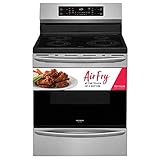
My top pick is the Frigidaire GCRI3058AF, a 30-inch induction range with air fry and a 5.4 cubic foot oven. It is the only unit here that combines a 4.0 star average across 23 owner reviews with a 3500 watt induction element, and that pairing of documented experience and documented performance is rarer in this category than the price tags suggest. If you want the short version of the whole list, that is the range to put at the top of your shortlist. If you want to know whether induction suits your kitchen at all, keep reading. There are three kinds of buyer this technology genuinely does not suit, and I name them before the picks rather than burying them.
Table of Contents
Top 3 Best Induction Ranges for Home Cooks in 2026
These are the three I would actually shortlist today, and the three I would defend if a friend asked me to justify a choice. The Frigidaire GCRI3058AF wins on the balance of evidence. The KoolMore KM-IPR-36TP-SS wins on raw power and warranty length if you have a 36-inch opening and can handle a hardwired install. The Kenmore 2296853 wins on the single feature that matters most to experienced cooks: real physical knobs on the front of the range.
Frigidaire GCRI3058AF 30…
- 3500 watt induction element
- 5.4 cubic foot oven with air fry and convection
- 10 power levels with 4 cooking programs
- Touchscreen controls

KoolMore KM-IPR-36TP-SS 36…
- 11 kW induction cooktop
- 7.8 kW true convection oven at 6.0 cubic feet
- Air fry pizza proof and dehydration modes
- 3-year parts and labor warranty
Kenmore 2296853 5.6 cu….
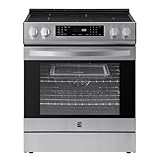
- 4 dual ring elements with turbo boil
- True convection plus air fry and temperature probe
- Front control knobs with lock function
- Self-clean oven with hidden bake element
One caveat before you read further, because it applies to all three. Two of these units have very small review bases, and a small review base is not proof of quality. I rank them the way I do because the specification sheets and the owner comments point the same direction, not because thousands of people have confirmed it. Where the evidence is thin, I say so inside the entry.
All 6 Induction Ranges Compared in 2026
Here is the whole field in one view, ordered from the most compact and least expensive to the widest and most powerful. Cooktop wattage is the number to watch if you boil a lot of water; cubic feet is the number to watch if you roast a turkey.
| Product | Specs | Action |
|---|---|---|
| Frigidaire GCRI3058AF 30 Inch Induction Range with Air Fry |
|
Check Latest Price |
| Kenmore 5.6 cu. ft. Electric Induction Range Oven |
|
Check Latest Price |
 Frigidaire PCFI3080A 6.2 Cu. Ft. Freestanding Induction Range Frigidaire PCFI3080A 6.2 Cu. Ft. Freestanding Induction Range |
|
Check Latest Price |
| KoolMore 36 in. Professional Induction Oven Range |
|
Check Latest Price |
 Forno Leonardo Espresso 30 Inch Slide-In Induction Range Forno Leonardo Espresso 30 Inch Slide-In Induction Range |
|
Check Latest Price |
 Frigidaire GCFI3070BF 30 Inch Slide-In Induction Range Frigidaire GCFI3070BF 30 Inch Slide-In Induction Range |
|
Check Latest Price |
1. Frigidaire GCRI3058AF 30-Inch Induction Range with Air Fry – Best Overall for Home Cooks
The Frigidaire GCRI3058AF is the best overall induction range for home cooks because it pairs a 3500 watt induction element and a 5.4 cubic foot oven with the largest body of owner feedback in this category at 23 reviews and a 4.0 star average. Owners consistently describe near-instant heat adjustment and a glass surface that is cool to the touch seconds after a pan comes off, and several say outright that it performs better than ranges costing far more.
Frigidaire GCRI3058AF / GCRI3058AF / GCRI3058AF 30 inch Induction Range with Air Fry
3500 watts induction
5.4 cubic foot oven
Air fry and convection
10 power levels
Pros
- Fast boiling and near-instant heat adjustment
- Air fry and convection modes in the oven
- Glass top cleans in seconds and cools fast
- Largest owner review base in this roundup
Cons
- Burner buttons need several presses to respond
- Timer sequence is unintuitive
- Convection fan runs with the bake element so there is no true non-convection bake
What convinced me most was how owners describe the heat control rather than the wattage. A 3500 watt element is not remarkable on paper. What matters is that when a pot starts to boil over, the adjustment is immediate enough to catch it, and that is exactly what reviewers describe. One of the most common themes in the feedback is stopping a boil-over by turning the element down mid-cook and watching the bubbling subside right away. On radiant electric that response is sluggish, and on gas you are managing a flame.
The oven is where this range quietly outperforms its class. Air fry and convection modes are built in, which means no countertop appliance taking up counter space, and owners mention that the air fry function handles larger batches than the small baskets you get in a standalone unit. The 5.4 cubic foot cavity is on the smaller side, so this is not the range to buy if roasting a large holiday turkey is a monthly event, but for a family of four it handles a serious roast comfortably.
Now the part most roundups skip. This is a touchscreen with no physical knobs, and reviewers are split on that in a way that has nothing to do with induction. The recurring complaints are specific: burner buttons that need several presses to respond, a timer sequence that does not follow the obvious order, and a convection fan that runs any time the bake element is on, which removes the option of a true non-convection bake. None of those are dealbreakers. All of them are annoyances you will feel every week if you are the kind of cook who throws a pie crust in and wants the bottom to set without fan noise.
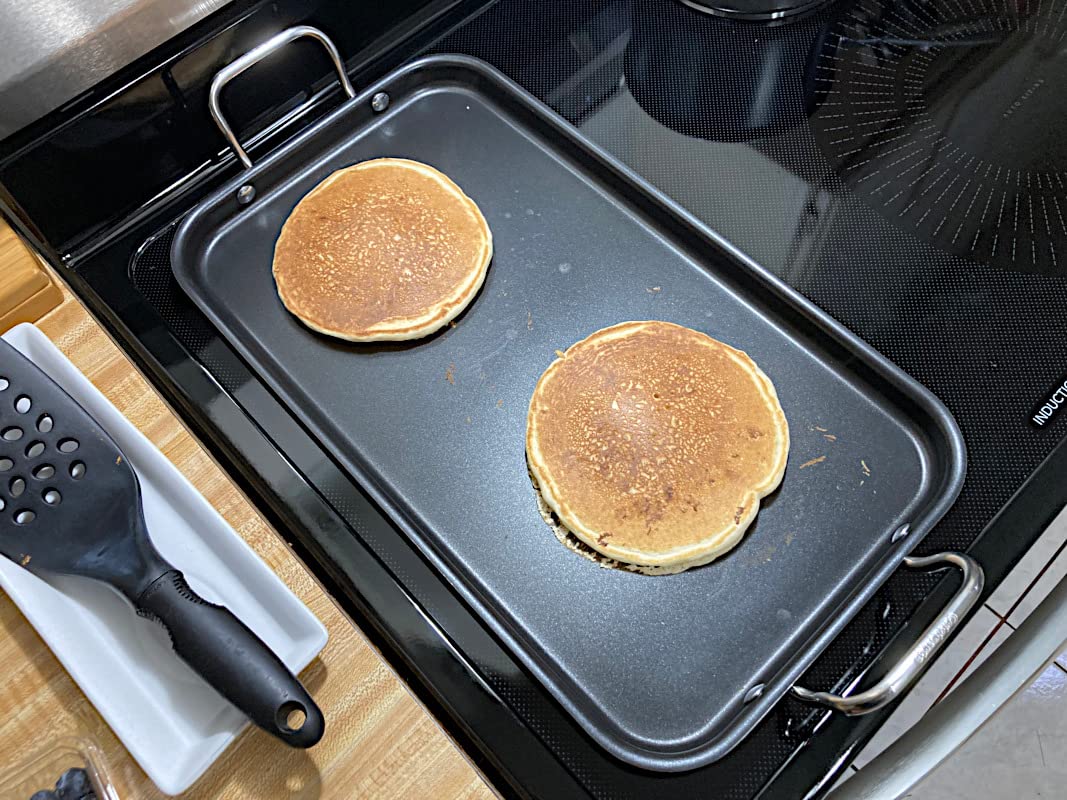
Two other owner complaints deserve a mention because they are the kind you only learn about after installation. Pan detection reportedly rejects flat griddles such as cast iron pancake griddles, and the elements do not auto-size, so on a larger pan only a small centre circle actually heats. If you cook on a griddle often, that is worth knowing in advance. A few owners also report error codes and failures within months alongside difficult warranty service, which is the main reason this range is not rated higher.

What you get cooking with it every day
Boil a full pot of water and the 3500 watt element moves faster than the gas range it replaced, and the 10 power levels give you finer gradations than most people expect from a budget-class cooktop. Simmering is where the 10 levels really pay off, because fine control at the low end is the difference between a sauce that holds and a sauce that scorches. The four cooking programs handle the routine tasks without you touching a setting twice.
Cleaning is the quiet win. A damp cloth and a little elbow grease on a glass surface takes seconds, versus the drip pans and burner caps that come with a gas range. Several owners note that the surface is cool to the touch within seconds of removing a pan, so a spill right after dinner is not a burn risk. If you have been putting up with coil or radiant electric and resenting it, that difference alone justifies the switch for a lot of people.
Who should pass on this model
Pass if you need a large oven. At 5.4 cubic feet with a single convection fan, this is a weeknight and small-holiday range rather than a range for feeding a crowd. Pass if you cook on a flat griddle, since the element auto-sizing issue is documented by owners rather than speculated. Pass if you want physical dials, because the control panel is fully capacitive and there is no way to add knobs.
2. Kenmore 2296853 5.6 cu. ft. Induction Range – Best for Knob Control and Probes
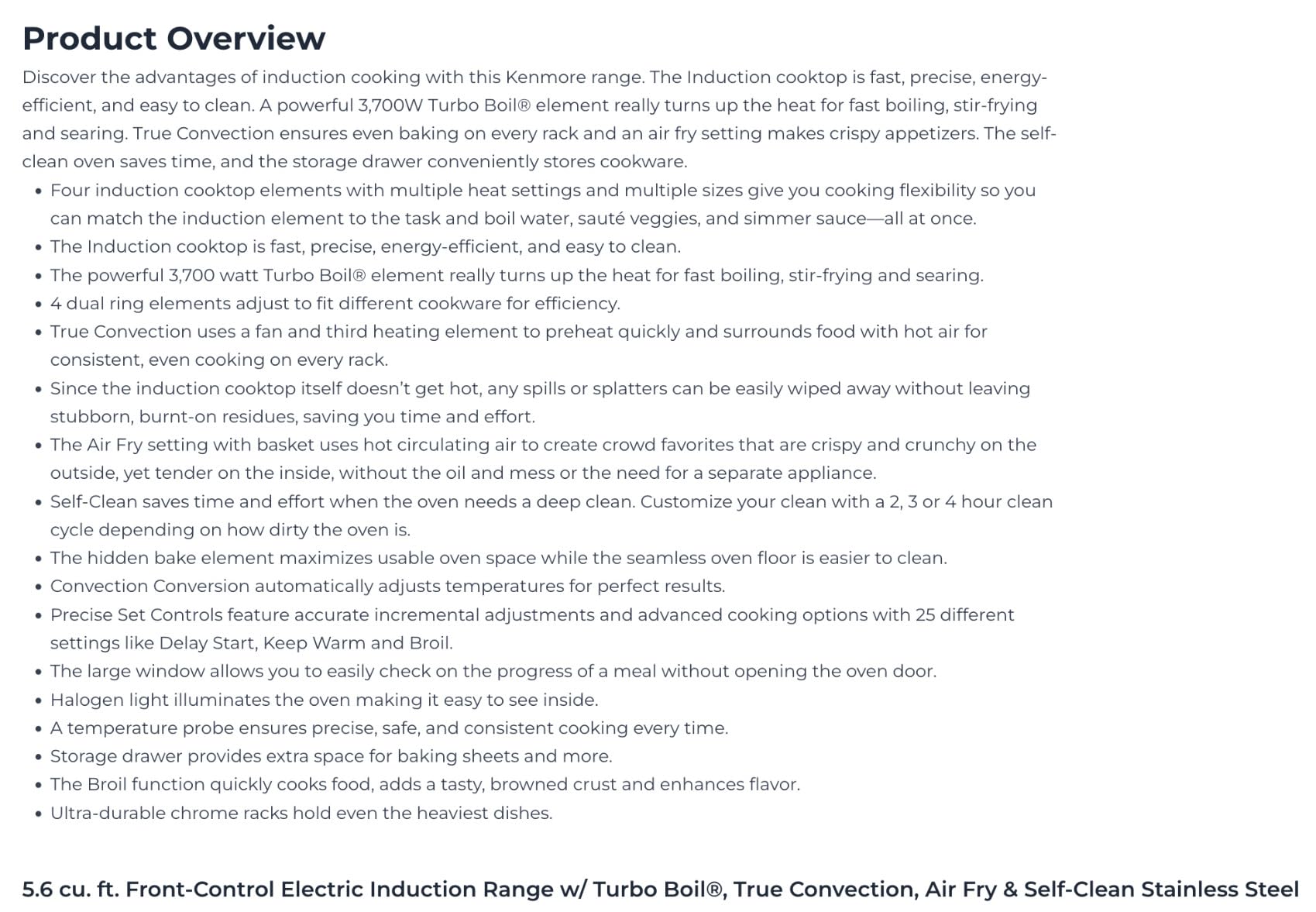
The Kenmore 2296853 is the best induction range for cooks who want physical knobs, because it is the only model in this roundup with front-mounted rotary controls and a lock function to stop curious children from starting a cycle. It also brings four dual-ring induction elements, a turbo boil setting, true convection with air fry, a temperature probe and a self-clean oven with a hidden bake element. The catch is honest and worth stating up front: owners rate it 3.4 stars across 20 reviews, and the complaints concentrate on the cooktop.
Kenmore 5.6 cu. ft. Electric Induction Range Oven – Stainless Steel
5.6 cubic foot oven
4 dual ring elements
Turbo boil setting
Front control knobs with lock
Pros
- Only front knob controls in this roundup
- Air fry handles large batches without a countertop unit
- Self-clean oven with hidden bake element
- Turbo boil heats quickly and evenly
- Temperature probe for precision cooking
Cons
- Elements report cycling full power then off in ten second steps
- Only one 12 inch pan fits at a time
- Cooktop clicks and hums and the fan runs after shutoff
- Timer start procedure needs the manual
On paper this is the most complete feature list per dollar in the group. Four dual-ring elements with a turbo boil setting, a true convection oven with convection conversion, air fry, a temperature probe, a self-clean oven with a hidden bake element, three chrome racks and a storage drawer. Owners generally like the way it looks in a kitchen and report that the oven itself works well, which is where most of the credit lands.
The cooktop is the problem. The most repeated owner complaint is that the elements appear to run at full power and then cycle off in roughly ten-second increments, which makes a true low simmer difficult to hold. A second common report says the effective cooking area is only about four inches across, so the edges of a wide pan get little heat and only one 12-inch pan fits on the cooktop at a time. If your cooking is boiling, searing and finishing, that may not bother you. If you make sauces, custards or a proper low simmer, it is a real limitation and you should know it exists before the range arrives.
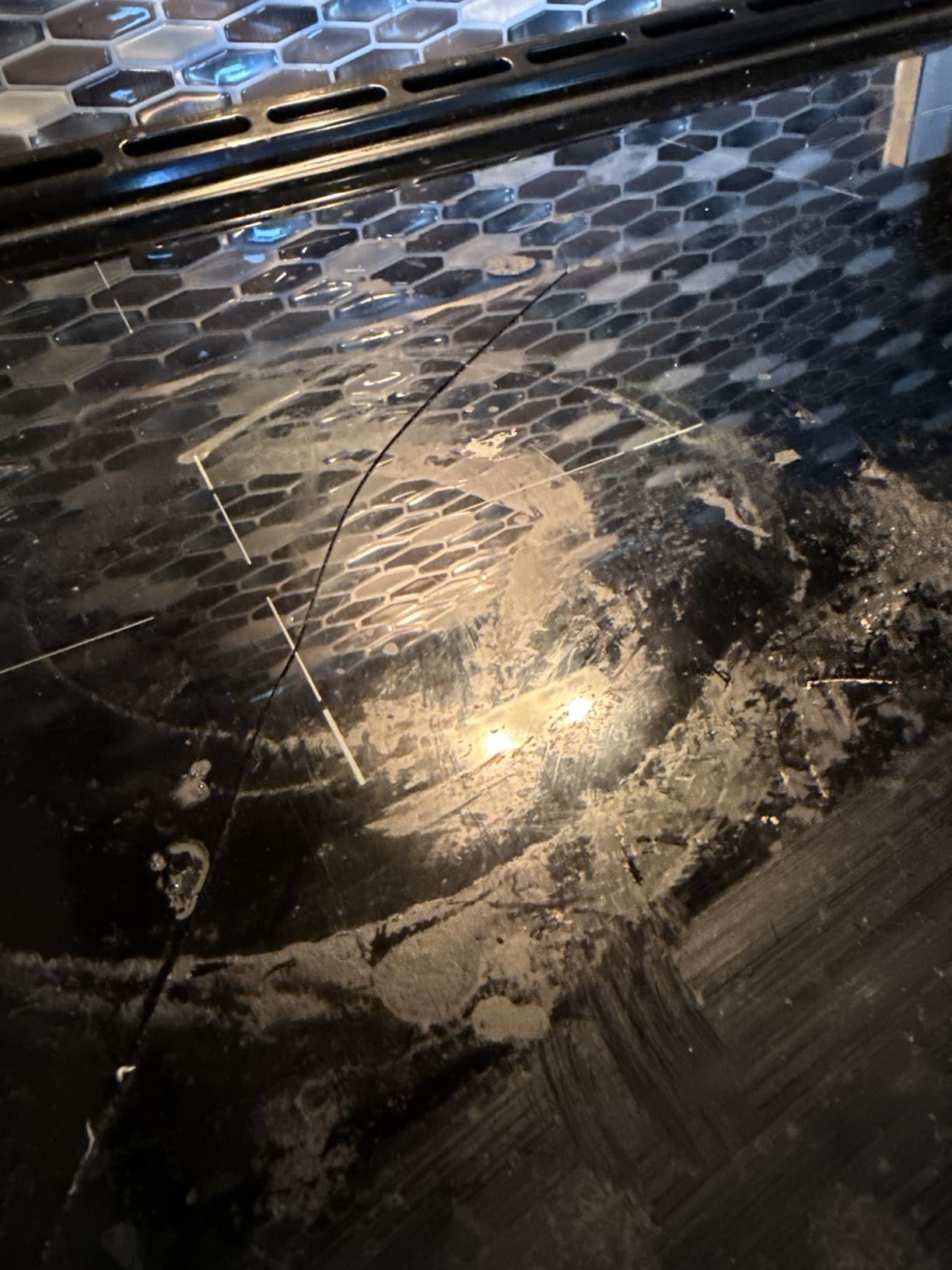
There are smaller gripes too. Owners report the cooktop clicking and humming, the oven fan running after shutdown, and metal pot handles vibrating on the surface. The element position markings are reported as not round, which sounds trivial until you are placing a pan in the dark. A few buyers also mention a cracked cooktop plate that was denied under warranty as impact damage, so treat the glass with the same care you would treat a phone screen.
The temperature probe is the sleeper feature here, because accurate internal temperature is how a home cook replaces a restaurant thermometer habit. Combined with the self-clean oven, it makes this the least hands-on range in the group to maintain. Owners also like that the knobs can be locked, which is genuinely useful in a house with small children and something almost no other range at this level offers.
What the front knobs actually change in daily cooking
More than most buyers expect. Capacitive panels respond to a wet or greasy finger, and the most common complaint in owner forums about modern induction is accidental shutoff when a hand is wet or a panel is splashed. A knob does not care. You can turn it with the back of a wet hand, with flour on your fingers, or without looking. Experienced cooks who grew up on dials consistently say this is the deciding feature, and the Kenmore is the only unit here that gives it to you.
The lock is the second part of the argument. A front panel with a lock function means a child reaching up does not start a heat cycle. On a purely capacitive range the same child is a genuine risk, and on a rear-control range you lose the visual line of sight to the setting entirely.
Who should pass on this model
Pass if simmer control is the centre of your cooking, because the reported power cycling is a documented owner experience, not a marketing problem. Pass if you regularly cook for six or more at once on the cooktop, since only one 12-inch pan fits at a time according to owners. Pass if you want a large oven. At 5.6 cubic feet it is mid-sized, and the feature set is weighted toward the cooktop and the control panel rather than the cavity.
3. Frigidaire PCFI3080A 6.2 cu. ft. Freestanding Induction Range – Best for Bridge-Zone Cookware
The Frigidaire PCFI3080A is the best induction range for cooks who need a bridge zone and a large oven, because it is the only unit here with five induction elements plus a bridge zone, wrapped in a 6.2 cubic foot total convection oven. I have to be blunt about the evidence, though: it carries a 1.9 star average from four reviews, with 70 percent of those ratings at one star. That is the lowest-rated product in this roundup and I would not hide it.
Frigidaire PCFI3080A Professional 30 Inch Wide 6.2 Cu. Ft. Free Standing Induction Range with No Preheat and Air Fry – Stainless Steel
6.2 cubic foot oven
5 induction elements
Bridge zone for large cookware
No preheat and air fry
Pros
- Five induction elements give the most burner options here
- Bridge zone handles large rectangular cookware
- 6.2 cubic feet total convection system
- No preheat mode shortens everyday start-up
Cons
- Lowest rated in this roundup at 1.9 stars
- Only four reviews so the sample is very thin
- Reports of dissatisfaction with no identifiable pattern yet
So why is it on the list at all? Because the bridge zone solves a specific problem no other model here addresses. A bridge element lets you join two burners into one long zone, which means a rectangular griddle, a fish pan or a large roasting pan actually sits on an active area instead of hanging over the edge. If you cook on cast iron or rectangular sheet pans, that is a genuine functional advantage and it is the reason this range earns its place on a shortlist of six.
The rest of the specification sheet is generous. A 6.2 cubic foot oven with a total convection system handles a large roast with room to spare, and a no-preheat function is a nice touch for everyday cooking where you do not need the cavity at temperature before the food goes in. Air fry is present, there are seven rack positions, and the unit is rated to 240 volts with ADA and Star-K specification met, which matters if you are planning an accessible kitchen.
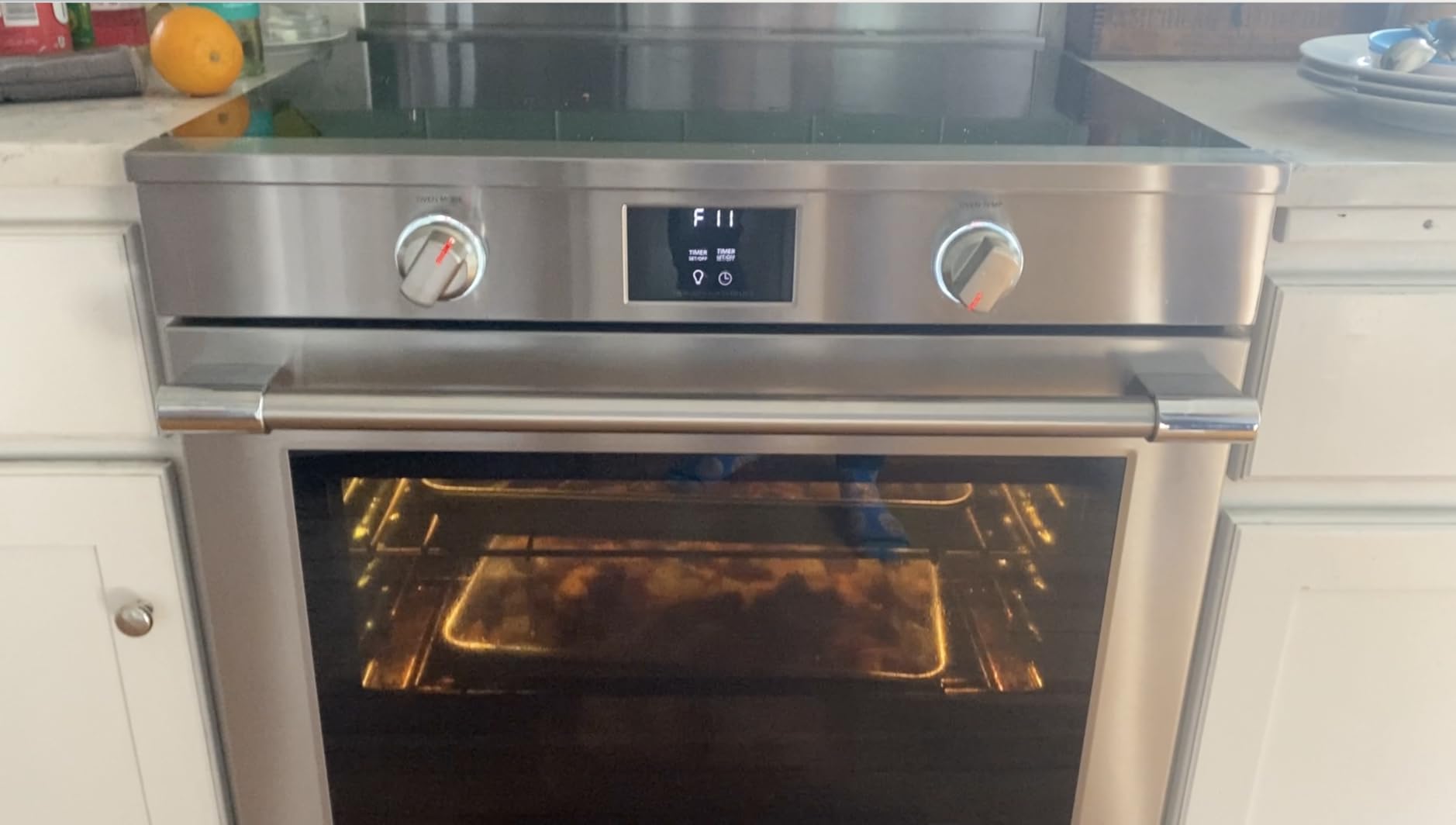
What I cannot tell you is how it performs over time, and that is the whole problem. Four reviews is not a reliability signal in either direction. The single available owner summary reports recurring dissatisfaction without a specific defect pattern, which usually means the complaints are spread across touch response, delivery and cooking results rather than one broken part. I would treat this as a spec-sheet purchase: buy it for the bridge zone and the oven size, not for a track record that does not exist yet.
It is also a freestanding 30-inch unit at 178 pounds and 28.5 inches deep, so measure your alcove before you fall for the cooktop. Freestanding ranges are wider than they look in a showroom because the handle and side clearance add up, and the electrical requirement is a dedicated 240-volt circuit, not a household outlet.
When the bridge zone genuinely earns its cost
Bridge zones matter for a specific list of cookware and nothing else. A full-size cast iron griddle, a fish pan long enough that it overhangs two burners, a rectangular Le Creuset-style dish used on the cooktop, a paella pan. If you own any of those and currently balance them across two induction burners with a magnet test and a prayer, the bridge is the feature that stops you doing that.
It also helps with a wide stockpot that would otherwise straddle two small elements. On most four-element cooktops, a large pot over a medium element is the fastest way to get an uneven hot ring in the middle of your pasta water. One long active zone is better than two weak ones.
Who should pass on this model
Pass if you rely on owner reviews to make your purchase. Four reviews at 1.9 stars is a warning flag with no counterweight, and there is not enough data to argue the complaints are outliers. Pass if you are a cautious buyer, because the most common advice in appliance forums for an unproven model is to wait a year and see what owners report. Pass if you need physical knobs, since the controls here are touch.
4. KoolMore KM-IPR-36TP-SS 36-Inch Induction Range – Best for 36-Inch Kitchens
The KoolMore KM-IPR-36TP-SS is the best induction range for a 36-inch kitchen, because it is the widest unit here and the most powerful on paper: an 11 kW induction cooktop under polished glass ceramic, paired with a 7.8 kW true convection oven of 6.0 cubic feet. It also carries the longest warranty in the roundup at three years parts and labor, and a mode list that includes air fry, pizza, proof and dehydration. All three owner reviews are five-star, which is encouraging and statistically meaningless in equal measure.
KoolMore 36 in. Professional Induction Oven Range with 11 Kw, Polished Glass Ceramic Cooktop, 7.8 Kw True Convection Oven, 6 Cu. Ft. Capacity, 240 Volts, CSA Certified in Stainless-Steel
11 kW induction cooktop
7.8 kW true convection oven
6.0 cubic feet capacity
3-year parts and labor
Pros
- Most powerful cooktop in this roundup
- Widest oven mode list including proof and dehydration
- 3-year parts and labor warranty outlasts most rivals
- Owners rate it as good value against other 36 inch models
Cons
- Hardwired 240V installation needs an electrician
- Oven temperature must be re-entered each time
- One owner reported a rear-left burner stuck in bridge mode
The 36-inch footprint is the reason to buy this, and it is worth being specific about why. A 36-inch cooktop gives you four full-size positions plus room to use them all at once without one pan stealing heat from a neighbour. Households cooking a big Sunday dinner, or anyone who uses a large stockpot and a skillet simultaneously, feel the difference immediately. A 30-inch range forces compromises that a 36-inch range simply removes.
The oven is the other differentiator. A 7.8 kW true convection element in a 6.0 cubic foot cavity is the most powerful baking setup here, and the proof and dehydration modes mean you can make bread and dry fruit on the same appliance instead of buying two countertop gadgets. Sync burners let you link positions so a wide pan gets one long zone, which is the 36-inch answer to the bridge zone problem that the Frigidaire PCFI3080A solves at 30 inches.
Installation is the catch and it is not small. This is a hardwired 240-volt unit, so you need an electrician and a proper circuit, not a plug. At 243 pounds and 29.33 inches deep it also needs a real 36-inch opening with clearance at the back. These are the same requirements as any 36-inch range, but budget for the electrical work as part of the purchase rather than a surprise afterward.
What 11 kW actually changes on a weeknight
It changes the time it takes to get a large pot to a boil, and that is genuinely the most measurable difference in daily cooking. Bring a big stockpot of pasta water to a rolling boil and the extra power translates directly into minutes saved, which compounds across a week. The oven power matters just as much in reverse: recovering temperature after you open the door on a roast comes back faster on a 7.8 kW element, so a dish that rested mid-cook does not stall the meal.
The mode list is not a gimmick list. Proof is what you need for a yeasted loaf, dehydration covers fruit, nuts and beef jerky, and pizza mode is a small oven shortcut that avoids a dedicated appliance. All three owner reviews that exist mention cooking speed and precision favourably, plus an easy-clean polished ceramic surface.
Who should pass on this model
Pass if your kitchen is 30 inches, since this unit will not fit a standard opening and shrinking the opening is not a project anyone enjoys. Pass if you want a plug-in or straightforward install, because the hardwired connection adds cost and a scheduling dependency. Pass if you need physical knobs, since the front panel is a digital touchscreen. And pass if you are uneasy about a thin review base, because three five-star reviews is a promise, not a track record.
5. Forno FFSIN0982-30 30-Inch Slide-In Induction Range – Best Compact Slide-In
The Forno Leonardo FFSIN0982-30 is the best compact slide-in induction range because it delivers an 8100 watt four-zone cooktop, physical knobs and a 5.0 cubic foot convection oven with a blue enamel cavity in a 30-inch slide-in body that is only 145.5 pounds. The evidence problem here is the worst in the roundup: one review, one star. I include it because the specification is genuinely competitive for the money, not because anyone has confirmed it works well.
Leonardo Espresso 30″ Slide-In Electric Induction in Stainless-Steel, 5.0 cu.ft.
8100 watt four-zone cooktop
5.0 cubic foot convection oven
Blue enamel cavity
Hidden 3550 watt bake element
Pros
- Strong 8100 watt cooktop across four zones
- Physical knob controls in a category that mostly dropped them
- Blue enamel cavity designed for heat absorption and retention
- Hidden bake element keeps spills off the element
- 2-year parts and labor warranty
Cons
- Only one review exists and it is one star
- Small 5.0 cubic foot oven with only two racks
- No owner evidence on long-term reliability
- Power cord included so a 240V connection may still need adapting
What I like on paper is the control layout. In a category that has moved almost entirely to capacitive touch, a range with matching physical knobs and a pro-style handle feels like it was designed by someone who cooks. The hot surface indicator is integrated, the front is smudge-resistant stainless, and the friction-resistant door hinges hold at any angle, which is a small thing you appreciate every single time you check a roast.
The oven design is the other point of interest. A speckled blue enamel cavity is chosen for better heat absorption and retention than a standard white porcelain finish, and the 3550 watt bake element is hidden beneath the oven floor so nothing drips onto it and burns on. Six adjustable rack positions come with two chrome-plated racks, and there is a single convection fan. The trade is capacity: 5.0 cubic feet is the smallest cavity here, and two racks is thin for a range that size.
At 27.62 inches deep and 37.12 inches tall it is genuinely compact, and it is a slide-in rather than a freestanding, so it is designed to sit between cabinets with a separate storage drawer or a cabinet below. A power cord is included in the box, which is unusual, but you should still confirm how it connects to a 240-volt supply because a cord does not replace a dedicated circuit.
Why knob controls still matter more than the spec sheet
The most common thread in owner discussions about modern induction is the loss of physical dials, and it comes up in nearly every thread about controls. Capacitive panels register contact from a wet hand, a splashed surface or a sleeve, which is exactly the state your hands are in when you are cooking. The recurring complaint is accidental shutoff, and the number of models still offering real knobs keeps shrinking. When a range does have them, treat that as a real feature rather than nostalgia.
There is a second, quieter benefit. A knob shows you the setting at a glance from across the kitchen. A capacitive panel shows you nothing until you touch it, and some models hide the active level entirely until you press the number. If you cook with a lot going on at once, that difference in legibility compounds.
Who should pass on this model
Pass if you need a large oven. At 5.0 cubic feet with two racks, this is a range for a small household, a second kitchen or a remodeling where capacity is a compromise you have accepted. Pass if you need buying confidence from other owners, because a single one-star review is not a signal in any direction. Pass if you want a plug-in install, since it still needs a 240-volt connection. This is a spec-sheet bet, and you should treat it that way.
6. Frigidaire GCFI3070BF 30-Inch Slide-In Induction Range – Best for Low-Cleaning Kitchens
The Frigidaire GCFI3070BF is the best induction range for a kitchen where cleaning is the deciding factor, because it combines a five-burner induction cooktop, a 6.2 cubic foot convection oven, air fry, stone-baked pizza, steam and self-clean functions and a smudge-proof stainless finish. The evidence is one five-star review with no detail attached, so the honest read is that nobody has tested this properly yet. I include it for the oven and cleaning package, which is the most complete on paper in a 30-inch slide-in.
Frigidaire GCFI3070BF 30-Inch Slide-In Induction Range, 5 Burner Cooktop, Large Convection Oven, Air Fry, Smudge-Proof Stainless Steel
5 burner induction cooktop
6.2 cubic foot convection oven
Air fry and stone-baked pizza
Steam and self-clean
Pros
- Five-burner cooktop in a 30 inch slide-in body
- Largest oven in the 30 inch class here at 6.2 cubic feet
- Air fry and stone-baked pizza modes in one appliance
- Steam and self-clean reduce manual scrubbing
- Knob controls and a smudge-proof finish
Cons
- Only one review exists on the listing
- No detailed owner feedback on performance or durability
- Only an installation guide is listed as included
Cleaning is the whole pitch and the specification backs it up. Steam clean loosens baked-on residue with moisture and heat, self-clean takes the oven to a high temperature over several hours, and the induction cooktop itself needs a damp cloth because there are no burner grates to remove and no ports to clog. Add a smudge-proof stainless finish that is designed not to show fingerprints and you have the least hands-on kitchen appliance in this roundup by a clear margin.
Five burners in a 30-inch slide-in is unusual and genuinely useful, and it is the closest thing here to the 36-inch flexibility without needing a 36-inch opening. The 6.2 cubic foot convection oven is tied for the largest cavity in the group, so this handles a big roast the same way the Frigidaire PCFI3080A does while giving you a slide-in body for a between-cabinet installation. Air fry and stone-baked pizza cover the two modes people most often buy a separate countertop appliance for.
The knob controls continue to be a real advantage. In a lineup where five of six models are capacitive, tactile dials are worth real money to an experienced cook, particularly with small children in the house. At 203 pounds and 28.5 inches deep, check the clearance carefully because a slide-in hides its depth less than a freestanding range does.
What steam clean and self-clean actually save you
They save you the one chore that makes people avoid ovens. Induction removes a gas cooktop’s drip pans and burner caps, and it removes the coil electric’s drip bowls. What remains is the oven cavity, and that is where self-clean earns its keep, particularly on a 6.2 cubic foot cavity that can produce a lot of baked-on cheese and sugar. Steam clean is the lighter option for a monthly pass, and using it on a lighter cycle instead of a full self-clean cycle saves both time and energy over a decade.
The five-burner layout is the other practical story. More positions means you can start something on one zone, finish something on another and still keep a third free for a pot that is coming to temperature, without the constant shuffling that a four-burner 30-inch cooktop forces. For a household that cooks every night, that is a small thing that pays off daily.
Who should pass on this model
Pass if you want independent confirmation before spending this much. One five-star review with no detail is the entire evidence base, and no amount of spec-sheet enthusiasm fills that gap. Pass if you need a plug. Only an installation guide is listed as included, so plan on a 240-volt connection and verify what the installer needs before delivery day. Pass if you want Wi-Fi or app control, because nothing in the listed features suggests either.
How to Choose an Induction Range for Your Kitchen
Most of the advice on this topic starts with brand. For a home cook, the sequence below is more useful, because each step eliminates more wrong answers than the one before it. Work through it in order and you will usually end up with two or three viable models instead of an entire category to sift through.
Measure the opening before you look at any feature
Width is the first filter and it is absolute. Thirty-inch models are the default for a reason, and a 36-inch unit like the KoolMore KM-IPR-36TP-SS will not fit a 30-inch opening. Depth matters next. The units here range from 25 inches deep to nearly 29 inches, and a slide-in body is designed to tuck between cabinets while a freestanding range needs side clearance. Check the space above for a control panel and the space behind for the anti-tip bracket and the electrical connection.
Slide-in versus freestanding is the second decision. A slide-in range sits flush between cabinets and looks built-in, and it usually costs more. A freestanding range has finished sides and a visible frame, and it is easier to pull out and move. If you are in a remodel, slide-in is worth the money. If you are replacing a range in an existing kitchen without cabinet changes, freestanding is the cheaper path. Our double oven range picks cover the cabinetry and layout side of that decision in more detail.
Decide between knobs and capacitive touch before anything else
This is the decision experienced cooks get most heated about, and the forum evidence is consistent: capacitive panels register contact from a wet or greasy hand and produce accidental shutoff, and experienced cooks used to tactile dials find that frustrating. The most common practical answer in owner threads is to buy a range with physical knobs if you can find one, because the failure mode of a touch panel is exactly the situation you are in when something spills and you reach for the range with a wet hand.
In this roundup, three models have knobs: the Kenmore 2296853, the Forno FFSIN0982-30 and the Frigidaire GCFI3070BF. The other three are fully capacitive. That is roughly the market ratio, and it is getting narrower every model year. If knobs matter to you, take that constraint to the shortlist before you fall for a cooktop with a bridge zone, because the two sets of models barely overlap.
Touch panels do have real advantages. They give you finer level control, they often unlock extra modes, and a lock function on some models stops a child starting a cycle. They just need a dry hand and a moment of attention.
Check your cookware before you commit
Induction heats the pan, not the surface, which means the pan must have a magnetic base. Most stainless steel, cast iron and magnetic aluminium cookware works. Most glass, ceramic, pure aluminium, copper and non-magnetic stainless does not, and a pan that does not work will not heat at all, which makes the failure obvious but late if you have not checked.
The cheapest test is a magnet. If a fridge magnet sticks to the bottom of the pan, the pan will work. Most home cooks discover they already own enough compatible cookware, and the ones that fail are usually a small aluminium stockpot and a non-stick pan with a thin base. Our knife set guide covers the same magnet-test logic for cookware you are replacing at the same time.
The second cookware issue is shape. A flat griddle needs a wide active area or a bridge zone, because a small circle of heat under a rectangular pan produces a cooked stripe and a raw stripe. If you cook on griddles, fish pans or large rectangular cast iron, the Frigidaire PCFI3080A and the 36-inch KoolMore with sync burners are the two models here that handle it properly.
Size the oven to what you actually cook on holidays
Cubic feet is the number people overthink in both directions. For a family of four cooking a roast a few times a month, 5.0 to 5.6 cubic feet is genuinely enough. For a large bird, a side of beef, or a big tray of vegetables alongside a main, 6.2 cubic feet is the better buy. The two 6.2 cubic feet ovens here, the Frigidaire PCFI3080A and GCFI3070BF, are the ones to shortlist if holidays matter.
Convection and air fry are separate questions. Convection is now standard on all six models and it is not a premium feature any more. Air fry is present on five of six, and the exception is the Forno, which pairs convection with a pizza-friendly blue enamel cavity instead. If you already own a small air fryer basket, an induction oven air fry mode is a convenience. If you do not, it saves counter space and handles a bigger batch than the countertop version. Our sous vide machine guide covers the other precision-cooking gap induction leaves open.
Understand what induction changes and what it does not
Induction sends an alternating current through a coil under the glass, creating a magnetic field that the iron or steel base of your pan resists. The pan heats, not the cooktop. The practical result is gas-like responsiveness with faster boiling, precision low-temperature control, and a surface that is cool a few seconds after the pan comes off.
Chefs who work on induction professionally point at the same two benefits: instantaneous control and the ability to hold a target temperature. Home cooks with a gas range will recognise the responsiveness immediately. What you lose is the visual flame and the ability to see a pan sitting on the heat. What you gain is a kitchen that stays cooler and a cleanup job that takes seconds instead of a weekly burner teardown. If you are weighing a full switch, our gas range roundup and electric range roundup cover what the alternatives actually give up.
On energy use, keep the claims modest. Resistive electric heat is already close to fully efficient at the point of use, so induction saves energy by being faster and by not heating the kitchen, not by some dramatic margin over electric. That is a real saving, just not the one the marketing suggests.
Budget for the install, not just the appliance
Every range here needs a dedicated 240-volt circuit and a NEMA 14-50 outlet, with the exception of the hardwired KoolMore, which needs an electrician by definition. If your kitchen does not already have that circuit, the electrical work is a real line item and it can exceed what you assumed. Add a counter-depth check, an anti-tip bracket and delivery, and the total is meaningfully more than the sticker figure.
Reminders from owners are worth taking seriously here too. Parts availability and technician coverage vary more by brand than the spec sheets suggest, and in some areas there is no technician trained or willing to service induction modules. Before you commit, ask a local authorised service agent whether they service induction ranges in your area. That single question prevents the most common ownership regret in this category.
Weigh reliability evidence over specification sheets
Owner reports span years, and that is worth more than any feature list. Multi-year ownership stories are the strongest reliability signal available, and the most common practical advice given to hesitant buyers in appliance forums is to buy a single portable induction burner, cook on it daily for a while, and only then commit to a full range. It is free insurance on a purchase most people make once a decade.
Against that, keep the known failure modes in view. Capacitive touch accidental shutoff with wet or greasy hands, cooktops that click and hum, fan noise after shutdown, and reported delays on repair parts for some brands. None of these are reasons to skip induction. They are reasons to buy a model where the evidence is strongest, which in this roundup means the Frigidaire GCRI3058AF and the Kenmore 2296853, the only two units here with more than a handful of owner reviews.
Who Should Skip Induction Cooking
This section is the one most roundups leave out, and it is the fastest way to avoid an expensive mistake. Induction is a poor fit for four specific situations, and none of them are about quality.
Renters and anyone without a 240-volt circuit. Every model in this roundup requires hardwired power or a 240-volt outlet. If you cannot modify the electrical, the conversation is over, and portable induction burners are a reasonable substitute.
Kitchens built around non-magnetic cookware. If your collection is glass, ceramic or pure aluminium, induction means replacing most of it before you can cook anything. Run the magnet test on your main pans first and count the failures.
Heavy wok cooks. Induction depends on a magnetic contact area, and a round-bottomed carbon steel wok has a very small contact patch on a flat glass surface. Owners report success with a wok ring on a high-output element, but it is a workaround, not a native capability. If wok work is the centre of your cooking, gas is the better tool.
Cooks who want to see the heat. Some experienced cooks genuinely prefer the feedback of a visible flame and a pan they can see seated on a grate. Induction gives better control but takes that away, and no amount of specification data changes that preference for the person holding it.
If none of those describe you, induction is a real upgrade in speed, control and cleanup, and the Frigidaire GCRI3058AF is where most home cooks should start.
Frequently Asked Questions
What is the most reliable brand of induction range?
Among the six induction ranges that met our bar, reliability evidence is thinnest across the board, but the Frigidaire GCRI3058AF stands out with 23 owner reviews and a 4.0 star average, the largest reviewed base in the roundup. The Kenmore 2296853 follows with 20 reviews, and its 3.4 star average reflects cooktop complaints rather than widespread failure. The other four models have four reviews or fewer, which is not enough to judge long-term durability. Before you commit, ask a local authorised service agent whether they service induction ranges in your area, since technician coverage varies more by region than by brand.
Which brand is the best induction stove?
For a home cook shopping in the compact 30 inch class, Frigidaire offers the broadest selection here, with three models covering a budget air fry range, a five-burner slide-in with self-clean, and a five-element freestanding model with a bridge zone. For knob controls specifically, Frigidaire, Kenmore and Forno are the three brands in this roundup that still offer physical dials. For power in a 36 inch opening, KoolMore leads with an 11 kW cooktop and a three-year parts and labor warranty. The right answer depends far more on your opening size and control preference than on brand alone.
Do chefs prefer induction or gas?
Professional kitchens have moved heavily toward induction because of two things: instantaneous heat control and the ability to hold a precise target temperature. Gas still wins in one area, high-heat wok and work that relies on visible flame feedback. For a home cook moving up from gas, the switch usually feels like a gain in control rather than a loss, and the most commonly reported change is that water boils faster and the kitchen stays cooler.
Why aren’t induction stoves more popular?
Three reasons come up repeatedly. Cooktop power and installation requirements mean a 240-volt dedicated circuit, which rules out renters and many apartments. Cookware compatibility trips people up, because non-magnetic pans simply do not heat and owners often discover this only after delivery. And the move to capacitive touch controls has removed the physical knobs many experienced cooks prefer, with accidental shutoff from wet or greasy hands the most repeated complaint. On top of that, induction ranges cost more than comparable gas or electric units, and the category is genuinely thin.
What is the common problem in induction stoves?
By far the most common complaint is capacitive touch controls triggering accidental shutoff when the panel is wet, greasy or splashed, which is why several owners across appliance forums recommend buying a model with physical knobs if you can. The second most common issue is simmering: some models report cycling between full power and off in short intervals, and others heat only a small circle in the centre of a larger pan, which makes a true low simmer difficult to hold. Service and repair part delays, noisy fans and cooktops that click or hum also appear often in owner reports.
What cookware works on an induction range?
A pan works if a magnet sticks to its base. That covers most stainless steel, cast iron and magnetic aluminium cookware. It does not cover glass, ceramic, copper or pure aluminium, and many non-magnetic stainless pans also fail. The second issue is shape: flat griddles, fish pans and large rectangular cast iron need a wide active area or a bridge zone, otherwise you get a cooked stripe and a raw stripe. The cheapest first step is to run a fridge magnet over your main pans and count the failures before you order anything.
Final Verdict: Which Induction Range Should You Buy
If you cook most nights and want the best-balanced induction range with the strongest evidence behind it, buy the Frigidaire GCRI3058AF. It is my pick, it is the winner in the comparison above, and it is the only unit in this roundup with 23 owner reviews backing a 4.0 star average. Its 3500 watt element, 10 power levels and built-in air fry cover the weeknight reality, and the 5.4 cubic foot oven is right for a family of four.
Spend more for the KoolMore KM-IPR-36TP-SS if you have a 36-inch opening and a real electrical setup to match. Spend differently on the Kenmore 2296853 if physical knobs are non-negotiable, and accept the documented simmer limitation. Buy the Frigidaire PCFI3080A for the bridge zone and the large oven, and buy the Frigidaire GCFI3070BF for the least cleaning. The Forno FFSIN0982-30 is the compact slide-in option with real knobs, judged on its specification rather than its thin owner record.
Best induction ranges are a small category with thin evidence, and the most useful thing any roundup can tell you is which parts of that evidence are missing. Check your opening, run the magnet test on your pans, and buy a portable induction burner first if you are still unsure. Then pick from this list.