
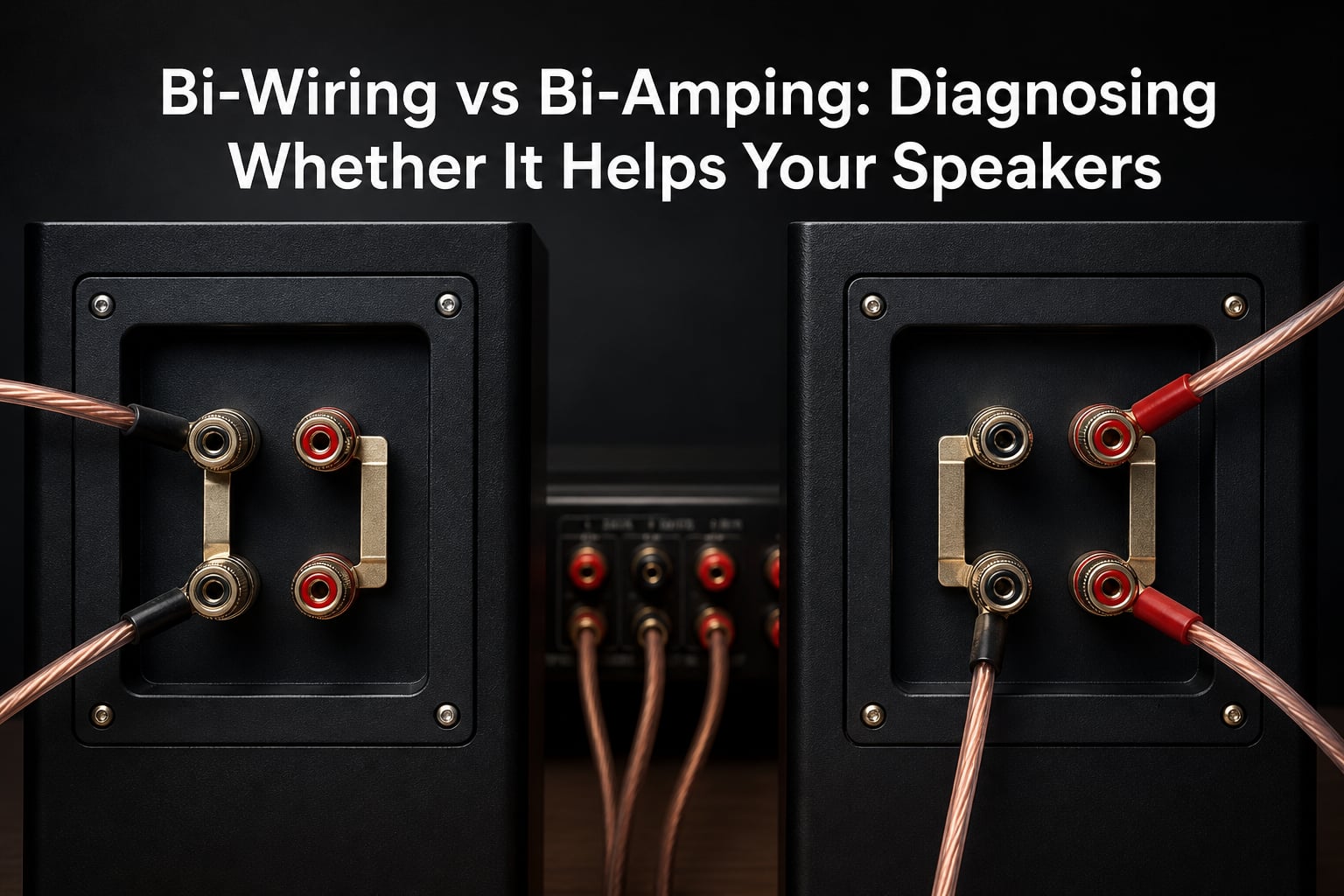
You spot two sets of binding posts on the back of your tower speakers and immediately wonder: should you run one cable or two? The bi-wiring vs bi-amping debate has split audiophiles for decades, and the marketing copy on speaker boxes does not help.
Bi-wiring uses two separate runs of speaker wire to connect a single amplifier to the high-frequency and low-frequency terminals of a single speaker. Bi-amping goes further by using two dedicated amplifier channels to power each frequency section independently. Both techniques require speakers with dual binding posts and removable jumper straps.
I have spent years testing both approaches across different setups, from budget home theater receivers to dedicated stereo amplifiers. Our team also dug through hundreds of forum threads to find out what real listeners actually hear, not just what the marketing claims promise.
This guide breaks down exactly what bi-wiring and bi-amping do, when each approach helps, and when you are better off spending your money elsewhere. By the end, you will know whether your specific speakers and amplifier are worth the extra cables.
Table of Contents
What Is Bi-Wiring?
Bi-wiring connects a single amplifier to one speaker using two separate cable runs instead of one. One cable carries the full-range signal to the high-frequency binding posts, and a second cable carries the same signal to the low-frequency binding posts. Both cables carry the identical full-range signal from the same amplifier output terminals.
The key mechanical requirement is that your speakers must have two sets of binding posts, one pair for the tweeter (high frequencies) and one pair for the woofer (low frequencies). These are typically labeled “HF” and “LF” or “Tweeter” and “Woofer.” When you buy speakers wired conventionally, metal jumper straps bridge these two pairs so a single cable feeds both sections through the internal passive crossover network.
To bi-wire, you remove those jumper straps and run a separate cable from your amplifier’s positive and negative output terminals to each pair of binding posts. The amplifier still sees the same overall load it would with a single cable. The passive crossover inside the speaker continues to do the frequency separation exactly as before.
The theory behind bi-wiring is that separating the cable runs reduces magnetic interaction between the high and low frequency currents traveling through the wire. Whether that magnetic interaction is audible is where the debate gets heated, and we cover that in detail below.
What Is Bi-Amping?
Bi-amping uses two separate amplifier channels to power a single speaker, with one channel dedicated to the high-frequency section and another to the low-frequency section. Unlike bi-wiring, where the signal comes from one amplifier output, bi-amping splits the work at the amplifier level.
With the jumper straps removed, one amplifier channel connects to the HF binding posts and a second channel connects to the LF binding posts. The internal passive crossover still directs frequencies to the correct drivers, but each crossover section now has its own dedicated power source rather than sharing one amplifier output.
This is where the distinction matters: bi-amping means your amplifier is no longer dividing its current between a power-hungry woofer and a delicate tweeter. The LF amplifier channel handles bass demands on its own, while the HF channel focuses purely on high frequencies. In demanding passages, bass transients will not steal headroom from the tweeter’s amplifier channel.
For home theater receivers with assignable channels, this often means reassigning surround back channels to front bi-amp duty. Your receiver needs to support this mode in its setup menu, and you need two runs of speaker wire per speaker instead of one.
Passive vs Active Bi-Amping: What Is the Difference?
There are two fundamentally different approaches to bi-amping, and the difference in results is enormous. Passive bi-amping keeps the speaker’s internal crossover network in the signal path. Active bi-amping removes it entirely and replaces it with an external electronic crossover.
Passive bi-amping is what most home theater receivers do when you select bi-amp mode in the setup menu. Two amplifier channels connect to the speaker, but the internal passive crossover components (capacitors, inductors, resistors) still perform the frequency separation. Each amplifier channel still receives a full-range signal and the crossover still filters it. The benefit is additional headroom, since each amp channel handles a narrower portion of the frequency spectrum even though it is still fed the full signal.
Active bi-amping is the professional approach. An external active crossover sits between your preamplifier and the amplifier channels, splitting the signal into separate frequency bands before amplification. Each amplifier channel receives only the frequencies it needs to reproduce. The speaker’s internal passive crossover is physically bypassed or the speakers are designed without one.
Active bi-amping is far more effective because each amplifier only amplifies the frequencies it will actually reproduce. No power is wasted amplifying signals the driver will never play. This requires significant investment in an external crossover and modification of your speakers, which is why it lives primarily in professional audio and high-end audiophile territory.
Within passive bi-amping, there is also a distinction between horizontal and vertical configurations. Horizontal bi-amping uses one stereo amplifier for both left and right tweeters and a second stereo amplifier for both left and right woofers. Vertical bi-amping dedicates one stereo amplifier entirely to the left speaker and another to the right speaker. Vertical bi-amping is generally preferred because it avoids channel imbalance issues between amplifiers affecting the critical high-frequency crossover point.
How to Know If Your Speakers Support Bi-Wiring or Bi-Amping?
Not every speaker can be bi-wired or bi-amped. The requirement is physical: your speakers must have two pairs of binding posts on the rear panel. Here is how to check.
Step 1: Look at the back of your speakers. If you see four binding posts (two positive, two negative) with metal straps or bars connecting the pairs, your speakers are bi-wire capable. If there are only two binding posts total, bi-wiring and bi-amping are not possible without modifying the speaker internals.
Step 2: Check for jumper straps. These metal bars connect the HF and LF terminals so a single cable can feed both. Bi-wire capable speakers ship with these installed. You remove them to bi-wire or bi-amp.
Step 3: Verify your amplifier or receiver has enough channels. Bi-wiring needs only one amplifier channel per speaker, just with two cable runs. Bi-amping requires two amplifier channels per speaker. A standard stereo amplifier with one pair of outputs can bi-wire but cannot bi-amp. A home theater receiver with assignable surround channels often can.
Step 4: Check your receiver’s setup menu for a bi-amp mode. Most modern AV receivers that support bi-amping require you to assign the surround back channels to front bi-amp duty. Without this setting, running two cables per speaker will not actually give you independent amplification.
Warning: Do not attempt to bi-amp using your receiver’s A and B speaker outputs. On most receivers, A and B terminals share the same amplifier channels wired in parallel. You are not getting two separate amplifier channels, just splitting one channel across four terminals, which can actually increase the load on your amplifier.
Does Bi-Wiring Actually Improve Sound Quality?
This is where the audiophile community draws battle lines. The honest answer based on measurements and controlled testing is that bi-wiring produces no measurable improvement in sound quality under normal conditions.
The theory behind bi-wiring suggests that separating the cable runs for high and low frequencies reduces magnetic interaction between the two. The idea is that large bass currents modulating through a shared cable could interfere with delicate high-frequency signals. In practice, the impedance of a typical speaker cable is so low that this interaction is negligible at anything less than extreme cable lengths or absurdly thin wire gauges.
Forum consensus lines up with the measurements. Over on the r/audiophile subreddit, one frequently upvoted summary puts it bluntly: “Speaker bi-wiring is absolutely useless.” Multiple double-blind listening tests have failed to produce consistent results where listeners could reliably distinguish between bi-wired and conventionally wired speakers using the same quality cable.
That said, some experienced listeners swear they hear a difference. A 50-year audiophile veteran reported real improvements when bi-wiring Klipsch speakers driven by a Parasound amplifier. The DALI speaker brand has also publicly stated that bi-wiring their speakers enhances clarity. These reports are genuine but difficult to separate from expectation bias and the fact that bi-wiring often means using two quality cables instead of one cheaper one.
If you already own quality cable and your speakers are bi-wire capable, trying it costs you nothing but a second cable run. Just keep your expectations realistic. If you are buying expensive specialty bi-wire cables expecting a transformation, your money is better spent elsewhere.
Does Bi-Amping Really Make a Difference?
Bi-amping has a stronger technical case than bi-wiring, and the real-world reports back that up. The benefit comes from giving each driver its own amplifier channel, which means bass transients no longer compete with high frequencies for the same power reserve.
Here is the core advantage. When a single amplifier drives a full-range speaker, demanding bass passages can momentarily draw large amounts of current. This can momentarily reduce the voltage available to the tweeter section, causing subtle compression of high frequencies. In extreme cases, amplifier clipping on bass frequencies can generate intermodulation distortion that reaches and potentially damages the tweeter. Bi-amping eliminates this problem by giving each frequency section its own dedicated amplifier channel with its own power supply.
Real listener experiences support this. A Crutchfield advisor described bi-amping as producing “cleaner, clearer sound with a wider soundstage” in their personal system. On the Audio Science Review forum, the more measured consensus is that the primary practical benefit is isolation: clipping or distortion in the bass amplifier channel will not contaminate the high-frequency channel.
How much you notice depends heavily on your system. If your amplifier is already powerful enough to drive your speakers cleanly at your listening levels, the headroom benefit of bi-amping is minimal. You already have power in reserve. If your amplifier is straining, especially with difficult-to-drive floor-standing speakers in a large room, bi-amping can provide genuinely audible improvement.
Active bi-amping produces the most dramatic results because the amplifier channels no longer waste power amplifying out-of-band frequencies. But passive bi-amping through a home theater receiver still offers real headroom benefits if your receiver’s amplifier section was previously the limiting factor.
How to Bi-Wire Your Speakers: Step by Step
If you want to try bi-wiring, here is the safe procedure.
Step 1: Turn off your amplifier and disconnect all cables from your speakers.
Step 2: Remove the metal jumper straps connecting the HF and LF binding posts on each speaker. Store them safely in case you want to return to conventional wiring later.
Step 3: Run two lengths of speaker cable from your amplifier to each speaker. Connect both cables to the same positive and negative output terminals on your amplifier side. Both cables must carry the identical signal.
Step 4: At the speaker end, connect one cable to the HF binding posts and the other to the LF binding posts. Double-check polarity: positive to positive, negative to negative on both pairs.
Step 5: Use identical cable types for both runs. Mixing cable gauges or brands between the HF and LF runs can create impedance differences that actually cause more problems than they solve.
How to Bi-Amp Your Speakers: Step by Step
Bi-amping requires more setup but the process is straightforward if your receiver supports it.
Step 1: Turn off all equipment and disconnect existing speaker cables.
Step 2: Remove the jumper straps from your speakers, just as with bi-wiring.
Step 3: Enter your AV receiver’s setup menu and assign the surround back channels to front bi-amp mode. Every receiver handles this differently, so check your manual for the exact menu path. Without this step, your receiver will not route separate signals to the second set of terminals.
Step 4: Run cable from the front speaker outputs to the LF binding posts on each speaker. Run a second cable from the reassigned bi-amp outputs to the HF binding posts on each speaker.
Step 5: Power on and verify level matching. Both amplifier channels should produce equal output so the frequency balance of your speakers remains correct. Some receivers handle this automatically in bi-amp mode; others may require manual adjustment.
Important: Never connect the HF and LF binding posts together when bi-amping. With jumper straps removed and two separate amplifier channels connected, bridging the posts creates a short between two amplifier outputs. This can destroy your amplifier and potentially damage your tweeter.
Bi-Wiring vs Bi-Amping: Which Should You Choose?
The decision comes down to your equipment and goals.
Bi-wiring is essentially free if you already have spare cable. Try it if your speakers support it and satisfy your own curiosity. If you hear a difference, great. If not, you have lost nothing but an hour of setup time. Just do not spend money on premium bi-wire cables expecting a transformation.
Bi-amping is worth the effort when your current amplifier is the bottleneck. If you have difficult-to-drive speakers in a large room and you notice your system compressing or losing clarity at high volumes, passive bi-amping through your receiver’s assignable channels can provide real headroom improvement. If your amplifier already drives your speakers effortlessly, the benefit is minimal.
Active bi-amping with an external crossover is a different conversation entirely. That is a system-level upgrade that requires significant investment and delivers correspondingly significant results. It is the domain of dedicated audiophiles and professionals, not a casual weekend tweak.
And for center channel speakers in home theater setups: the same principles apply. If your center channel has dual binding posts and dialog clarity is lacking, bi-wiring or bi-amping can help in the same scenarios described above. Center channels often benefit from additional amplifier headroom since they carry the majority of dialogue.
Frequently Asked Questions
Does bi-amping really make a difference?
Yes, bi-amping can make a noticeable difference when your amplifier is the limiting factor. By dedicating separate amplifier channels to high and low frequencies, each driver gets its own power reserve. This prevents bass transients from stealing headroom from the tweeter. The benefit is most audible with power-hungry speakers in large rooms or when your receiver was previously straining. If your amplifier already drives your speakers effortlessly, the improvement will be minimal.
Does bi-wiring speakers improve sound quality?
In controlled tests and measurements, bi-wiring produces no reliable improvement in sound quality. The theory is that separating cable runs reduces magnetic interaction between high and low frequency currents, but the impedance of typical speaker cable is too low for this to matter. Some listeners report hearing a difference, but these reports are difficult to separate from expectation bias. Bi-wiring is free to try if you have spare cable, so experiment and trust your own ears.
Can any speaker be bi-amped?
No, only speakers with two pairs of binding posts (typically labeled HF and LF) can be bi-amped or bi-wired. The metal jumper straps between these posts must be removable. Speakers with only a single pair of binding posts cannot be bi-amped without internal modification, which is not recommended. You also need an amplifier or receiver with enough assignable channels to provide two separate outputs per speaker.
Is bi-wiring a myth?
The measurable benefit of bi-wiring is effectively a myth. Double-blind listening tests have consistently failed to show that listeners can distinguish bi-wired from conventionally wired speakers using the same quality cable. The magnetic interference theory does not hold up because speaker cable impedance is too low for frequency separation between wire runs to matter. However, bi-wiring itself is harmless and free to try if you already own the extra cable.
The Bottom Line
The bi-wiring vs bi-amping debate comes down to physics and practicality. Bi-wiring is harmless and free to try, but the measurable evidence says it does not change what reaches your ears. Bi-amping has a real technical basis and can genuinely improve clarity and headroom when your amplifier was previously the weak link in the chain.
If your speakers have dual binding posts and you are curious, try bi-wiring first since it costs nothing. If your amplifier is straining with demanding speakers, explore passive bi-amping through your receiver’s assignable channels. And if you want the maximum benefit, active bi-amping with an external crossover is the path that delivers the most dramatic results, provided you are ready for the investment.
The best upgrade is always the one that addresses your actual bottleneck. Identify what is limiting your system before spending money on extra cables or amplifier channels.