
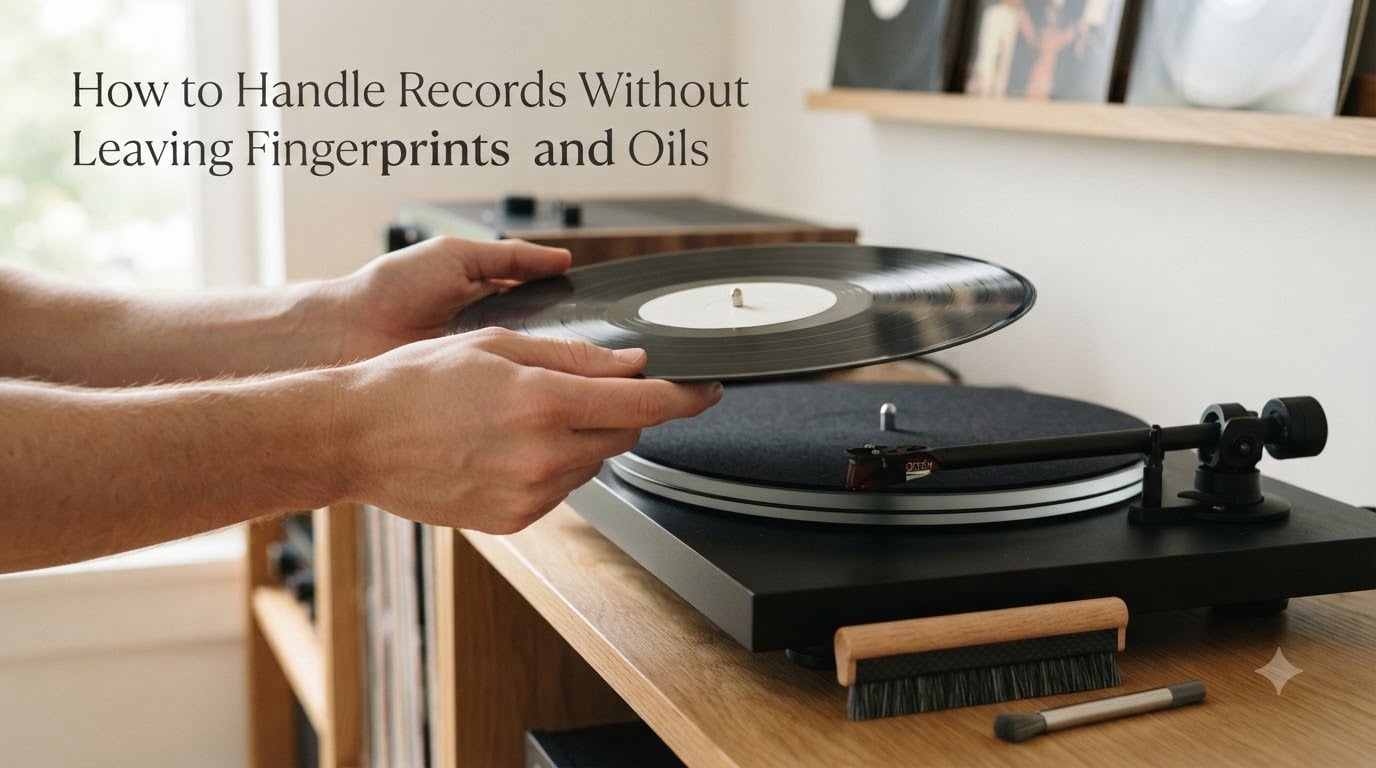
To handle records without leaving fingerprints and oils, always grip the vinyl by the outer edges and center label using the two-point contact method. Never touch the grooved playing surface with bare fingers, since skin oils bond to PVC and cause permanent surface noise over time. Wash and dry your hands before each session, and consider cotton gloves for valuable pressings.
I learned this the hard way. My first “good” record was a 1973 pressing of Pink Floyd’s Dark Side of the Moon I found at a flea market for twelve dollars. I held it like a frisbee the entire walk home. By the time I dropped the needle, every pause between tracks had this scratchy, hazy undertone. That was skin oil baked into 50-year-old grooves. I still have that record, and every time I play it I hear my own fingerprints.
This guide exists so you don’t make the same mistake. Whether you’re a beginner pulling your first LP from a paper sleeve or a seasoned collector refining your routine, the techniques below will keep your records clean, quiet, and playing beautifully for decades. Updated for 2026, these are the methods our team uses daily in our own collection, tested across jazz, classical, and rock pressings from every era.
Table of Contents
Why Fingerprints and Oils Damage Vinyl Records?
Fingerprints are not just visible marks. They are reservoirs of natural skin oil, sweat, salt, and dead skin cells. When these substances contact the microscopic groove walls of a vinyl record, they bond with the PVC in ways that are extremely difficult to reverse.
Skin oil is hygroscopic, meaning it attracts and traps moisture from the air. Once a fingerprint dries on a record, it forms a thin, sticky film that grabs dust and microscopic debris. Your stylus then drags that contaminated material across thousands of grooves per second, amplifying surface noise with every play.
The damage happens in two phases. In the short term, you’ll hear pops, crackles, and a hazy quality in quiet passages. Over months and years, oils oxidize and harden inside the groove geometry, causing permanent degradation that even professional cleaning cannot fully reverse. One experienced collector in the r/vinyl community put it bluntly: “Oils last decades. The groove remembers everything.”
According to industry data, surface noise from contamination accounts for roughly 70% of playback quality issues in home systems. Most of those issues trace back to handling and storage habits, not the records themselves.
The Two-Point Contact Method: The Foundation of Clean Handling
The two-point contact method is the single most important technique for handling vinyl records without leaving fingerprints. It works because it gives you maximum control with minimum surface contact.
Here is the step-by-step grip technique we recommend:
Step 1: Position your thumb and forefinger. Place your thumb on one edge of the record, around the 3 o’clock position. Place your forefinger on the opposite edge at the 9 o’clock position. Your fingers should rest only on the smooth outer rim, never extending onto the grooved area.
Step 2: Establish the second contact point. While your thumb and forefinger grip the edges, let your middle finger rest lightly against the center label. This creates a stable triangle of support and prevents the record from flexing or wobbling.
Step 3: Lift with smooth, even pressure. Raise the record straight up or out of the sleeve with controlled motion. Avoid tilting, as tilting shifts the weight distribution and can cause the record to slip.
Step 4: Transfer with intention. When placing the record on the turntable platter, lower it gently in a single motion. Never adjust position with fingers on the playing surface. If alignment is off, lift the entire record and reposition.
The two-point contact method works because it treats the record like the precision medium it is. Your fingers only touch surfaces that are already safe to handle, namely the smooth outer rim and the printed center label, which contains no audio information.
How to Remove a Record From Its Sleeve Without Touching the Grooves?
Sleeve removal is where most accidental fingerprints happen. The instinct is to grab the record by the sides of the sleeve opening, but this puts your fingers directly above the grooves. Here’s how the experienced collectors on r/vinyl do it.
Step 1: Open the sleeve from the top. Slide the record partially out using the top edge of the sleeve as a guide. Pull just enough to expose the outer rim and a small portion of the label.
Step 2: Grip the exposed edges. Once the top of the record is visible, pinch the rim with your thumb and forefinger in the 9 and 3 o’clock positions. Your fingers should never enter the sleeve itself.
Step 3: Slide the record out smoothly. With your edge grip secure, draw the record the rest of the way out in one continuous motion. Keep the record level to avoid bending.
Step 4: Place directly into your handling grip. Transition immediately to the two-point contact method as you move the record toward the turntable or your workspace.
For records stored in anti-static inner sleeves, the process is similar but the sleeve material has less friction. You’ll feel the record slide more easily. For tight-fitting paper sleeves, work slowly and never force the record out. Forcing causes flexing, and a flexed vinyl record can develop micro-warp that affects playback.
Common Handling Mistakes That Leave Fingerprints Behind
Even experienced collectors develop bad habits. Here are the most common ways fingerprints end up on records, and how to avoid each one.
Mistake 1: Grabbing the sleeve opening. Pulling a record out by gripping the sides of the sleeve puts your thumbs directly over the grooves. Always expose the top edge first.
Mistake 2: Stacking records horizontally. Stacking creates pressure points that can force oils from one record’s sleeve into another’s surface. Always store vertically, like books on a shelf.
Mistake 3: Leaving records on the platter. Records left on the turntable collect dust and expose the surface to static buildup. Return each record to its sleeve immediately after play.
Mistake 4: Adjusting the record on the spindle. When a record lands slightly off-center, the temptation is to nudge it with your fingers on the playing surface. Always lift the entire record and reposition from above.
Mistake 5: Passing records face-to-face. Handing a record to someone with the grooved side facing out is asking for a fingerprint. Always pass records label-out or edge-out.
Mistake 6: Eating or drinking near the collection. Food particles and liquid splashes are a contamination nightmare. Keep snacks and beverages away from your listening area.
Should You Wear Gloves When Handling Records?
The glove question is one of the most debated topics in vinyl communities. Here’s the honest answer.
Cotton inspection gloves prevent direct fingerprint transfer and are genuinely useful in two situations: handling rare or valuable records (original 1950s pressings, test pressings, autographed LPs), and conducting detailed visual inspection of record condition. For these cases, gloves add a meaningful layer of protection.
For everyday handling of standard pressings, gloves are usually unnecessary and sometimes counterproductive. Cheap gloves reduce fingertip sensitivity, making it harder to maintain the two-point contact grip. They can also introduce lint if they’re not perfectly clean.
Our recommendation: skip gloves for daily play, but keep a pair on hand for archival work. Clean hands are more important than covered hands. Wash with soap and water, dry thoroughly, and avoid hand lotions before handling your collection.
Cleaning Fingerprints and Oils Off Records Safely
Even with perfect technique, occasional fingerprints happen. The key is removing them before they bond permanently with the groove walls.
Method 1: Microfiber cloth wipe. For fresh fingerprints, use a clean, dry microfiber cloth and wipe in a circular motion following the grooves. Apply light pressure only. Microfiber lifts oils without scratching the PVC surface.
Method 2: Distilled water. For stubborn prints, lightly dampen a microfiber cloth with distilled water (never tap water, which contains minerals that leave residue). Wipe following the grooves, then dry immediately with a second clean cloth.
Method 3: Dedicated vinyl cleaning solution. Commercial record cleaning fluids contain surfactants that break down skin oils without damaging PVC. Apply to a microfiber cloth, never directly to the record, and wipe with the grooves.
Products and methods to avoid:
Paper towels (wood fibers scratch vinyl)
Household cleaners (ammonia and alcohol degrade PVC)
Windex or glass cleaners (leave residue)
Tap water (mineral deposits)
Rubbing alcohol (dries out and damages groove walls over time)
For deep contamination or a heavily-fingerprinted record, a wet cleaning kit with a vacuum system is the professional-grade solution. These kits apply cleaning fluid and vacuum it away in one pass, removing contamination from deep within the groove geometry.
Pre-Play and Post-Play Handling Routine
A consistent routine before and after each listen protects your records more than any single technique. Here’s the routine our team follows for every session.
Before play: Remove the record from its sleeve using the two-point contact method. Hold the record over the turntable and use a carbon fiber brush to remove any loose dust. Lower the record onto the platter. Cue the tonearm gently with the cueing lever, never drop it manually.
After play: Lift the tonearm and return it to its rest. Remove the record using the two-point contact method. Place it back in its inner sleeve, then into the outer sleeve. Return the record to vertical storage.
The carbon fiber brush is worth highlighting. It discharges static electricity as it sweeps across the surface, lifting dust that would otherwise be pulled into the grooves by static attraction. One pass before each play dramatically reduces surface noise.
Storage Best Practices to Prevent Contamination
Proper storage is the long-term defense against fingerprints and oils. Records stored correctly rarely need cleaning; records stored poorly need constant intervention.
Use both inner and outer sleeves. Anti-static inner sleeves protect the record surface from paper dust and static buildup. Outer sleeves protect the jacket from wear. Both are essential.
Store vertically, never stacked. Vertical storage prevents pressure-related warping and keeps each record separated from its neighbors. Think of your records as books on a shelf.
Control the environment. Vinyl is sensitive to heat and humidity. Keep records in a stable environment between 65 and 70 degrees Fahrenheit with 45 to 50 percent relative humidity. Avoid attics, basements, and direct sunlight.
Keep records away from speakers. Speaker vibration over time can cause resonance damage in stored records. Position your collection away from your playback system.
Transporting Records Without Leaving Marks
Moving records from one location to another introduces handling risks that don’t exist in your home setup. A few simple precautions keep your collection safe during transport.
Always transport records in their sleeves, upright, in a box or crate designed for vinyl. Standard milk crates work well for smaller collections. For longer moves or shipping, use corrugated record mailers with cardboard stiffeners.
Never transport records flat. Flat transport allows records to slide against each other, creating friction that can transfer contaminants and cause scratches. Vertical orientation keeps each record isolated.
For shipping individual records, wrap the sleeved record in bubble wrap, place it in a rigid mailer, and mark the package “Do Not Bend.” Temperature matters too. Records left in a hot car can warp in minutes. In cold weather, let records acclimate to room temperature before playing to avoid condensation forming on the playing surface.
Frequently Asked Questions
Do fingerprints ruin vinyl records?
Fingerprints do not instantly ruin a record, but the oils they leave behind cause cumulative damage. Skin oil bonds with the PVC groove walls, traps dust, and hardens over time. This leads to increased surface noise, pops, and crackles during playback. Long-term exposure can cause permanent degradation that even professional cleaning struggles to remove.
Is there a proper way to handle vinyl records?
Yes. The proper way to handle records without leaving fingerprints is the two-point contact method. Grip the outer rim with your thumb and forefinger at the 3 and 9 o’clock positions, then rest your middle finger on the center label. This creates a stable triangle of support while keeping your fingers away from the grooved playing surface.
Should I wear gloves when handling vinyl records?
Cotton gloves are useful for handling rare or valuable pressings where extra protection matters. For everyday play, gloves are usually unnecessary and can reduce fingertip sensitivity needed for a proper grip. Clean, dry hands are more important than covered hands. Wash with soap, dry thoroughly, and avoid lotions before handling.
How do I get fingerprints off a record?
For fresh fingerprints, wipe with a clean microfiber cloth following the grooves. For stubborn prints, lightly dampen the cloth with distilled water and dry immediately. For heavy contamination, use a dedicated vinyl cleaning solution. Avoid paper towels, household cleaners, tap water, and rubbing alcohol, as all of these can damage the PVC surface.
Final Thoughts on Handling Records Without Leaving Fingerprints
Learning to handle records without leaving fingerprints is really about building muscle memory. The two-point contact method feels awkward the first few times, but after a dozen records it becomes automatic. Combine that grip with proper sleeve removal, a consistent pre-play routine, and vertical storage, and your collection will sound cleaner and last longer.
Perfection is not the goal. Consistency is. Even the most careful collectors get an occasional fingerprint. What matters is removing contamination quickly before it bonds permanently. With the techniques in this guide, you have everything needed to handle records without leaving fingerprints and oils, and to keep your vinyl sounding its best for 2026 and every year after.