
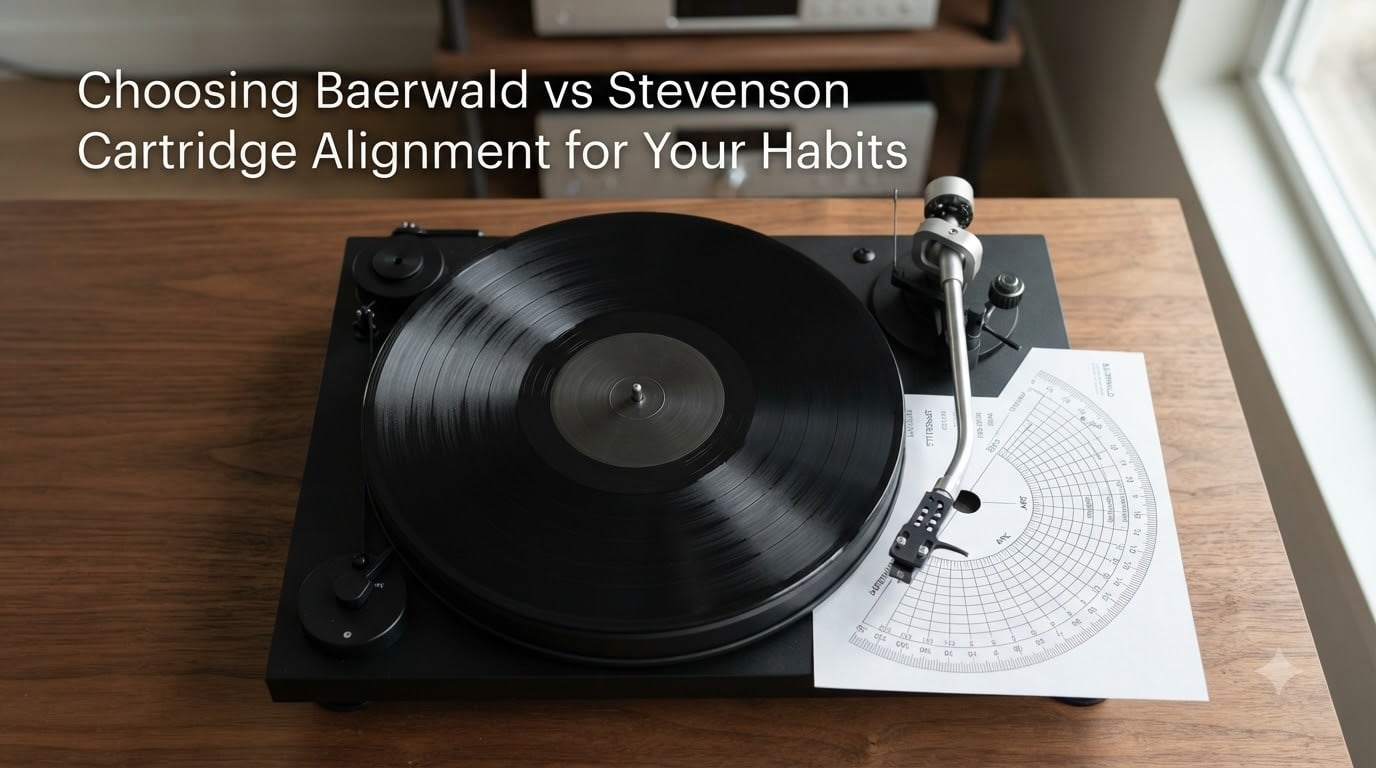
Choosing between Baerwald vs Stevenson cartridge alignment is one of the most common setup questions vinyl listeners run into once they start chasing better sound from their turntable. Both methods are mathematically sound. Both are used by serious audiophiles. The real difference comes down to where on the record each method minimizes distortion, and that depends on what you actually play and how your tonearm is built.
In this guide, I’ll walk you through what cartridge alignment actually does, what null points are, and how Baerwald and Stevenson differ. I’ll also share how to pick the right method for your habits, your turntable, and your tonearm. Whether you sit down with full albums from start to finish or jump from track to track, there’s a clear answer here for you.
Table of Contents
What Is Cartridge Alignment and Why It Matters?
Cartridge alignment is the precise positioning of your phono cartridge so the stylus traces the record groove at the correct angle. The goal is to make the cantilever sit tangent to the groove wall as the tonearm sweeps across the record. When alignment is off, the stylus drags slightly across the groove instead of riding cleanly, and that creates measurable distortion.
A well-aligned cartridge does three things at once. It minimizes tracking distortion across the playable area of the record. It keeps the left and right channels balanced. It protects your records from unnecessary wear. Skipping alignment is one of the fastest ways to lose detail in your playback, even on an expensive setup.
Most modern alignment conventions trace back to a standard called the IEC geometry, which defines how a record groove is cut. The cutting head moves in a straight line, but your tonearm pivots in an arc. To match those two motions, the cartridge body has to be angled slightly. That angle is what every alignment method tries to set correctly.
Understanding Null Points and How They Shape Alignment
Null points are the specific distances from the spindle where a given alignment method produces zero lateral tracking error. At those exact points, the stylus is tangent to the groove wall and distortion from misalignment drops to zero. Between those points, a small amount of error exists, and each method distributes that error differently across the record.
Two-point protractors have two null points where you check the cartridge position. Arc protractors use the curved sweep of an ideal tonearm to set alignment at one or two reference points. Linear protractors are simpler and only set the cartridge at the inner groove, which gives you a single null point. That single-point approach is faster but trades accuracy for speed.
Here’s the key insight from forum discussions and technical write-ups: no method makes the whole record perfect. Every alignment method is a compromise that minimizes error at certain groove radii at the expense of slightly higher error at others. The question is which trade-off matches your setup and your listening habits.
Baerwald Alignment Explained (Lofgren A)
Baerwald alignment is also called Lofgren A, after the Swedish engineer Erik Lofgren who formalized it. The Baerwald method places its two null points at approximately 66mm and 120.9mm from the spindle. This puts one null point in the inner groove and one in the outer groove, with the middle of the record sitting between them.
The mathematical goal of Baerwald is to equalize distortion across the playable area of the record. The inner groove distortion and outer groove distortion end up roughly the same, with the middle groove distortion also kept low. This balanced approach is why Baerwald is often the default recommendation for general-purpose setups.
Baerwald works especially well for adjustable headshell tonearms with a standard effective length of 229 to 236mm. It’s also a popular choice for Technics SL-1200 arms, where the geometry naturally supports the Baerwald null points. If you listen to full albums, play a mix of genres, or want a single method that handles most situations well, Baerwald is a strong starting point.
Stevenson Alignment Explained
Stevenson alignment is the older of the two main methods, dating back to work done in the 1970s. It places its two null points at approximately 60.325mm and 117mm from the spindle. Both null points are pulled closer to the inner groove compared to Baerwald, which shifts where distortion is minimized on the record.
Stevenson optimizes for low inner groove distortion at the cost of slightly higher outer groove distortion. In practice, this means the last few tracks on each side of an LP, where the grooves are tightest and most easily distorted, tend to sound cleaner with Stevenson alignment. The outer edge of the record, where most rock and pop recordings spend less time, will have marginally more error.
Stevenson is the factory default geometry for Rega tonearms, which is why Rega users often default to Stevenson alignment. It also tends to work better with shorter effective lengths, which is why some fixed-headshell arms favor Stevenson. If you mostly listen to longer classical records or jazz LPs that spend meaningful time in the inner grooves, Stevenson can be the better match.
Baerwald vs Stevenson: Side-by-Side Comparison
Here’s a quick comparison table of the two main cartridge alignment methods. Numbers reflect standard 9-inch effective length tonearms and can shift slightly based on your exact arm geometry.
| Feature | Baerwald (Lofgren A) | Stevenson |
|---|---|---|
| Inner null point | ~66 mm | ~60.325 mm |
| Outer null point | ~120.9 mm | ~117 mm |
| Distortion priority | Equalized inner, middle, outer | Minimized inner groove |
| Outer groove distortion | Low | Slightly higher |
| Inner groove distortion | Low | Very low |
| Best for | Full albums, mixed genres | Long sides, inner-groove-heavy listening |
| Default for | Technics, most adjustable arms | Rega, fixed-headshell arms |
| Typical offset angle | ~22.5 to 23.99 degrees | ~24 to 25 degrees |
AudioKarma forum regulars often sum up the trade-off this way: Stevenson emphasizes reduction of inner groove distortion, while Baerwald emphasizes reduction in outer groove distortion. Both are technically correct. The question is where you want distortion to be lowest.
Will you actually hear a difference? Vinyl Engine’s protractor guide is direct on this point. In their words, “It’s unlikely you’ll hear a repeatable audible difference between a cartridge properly aligned to a two-point Stevenson protractor vs a Baerwald or Lofgren version.” The differences are fractions of a percent in distortion measurements, which sit well below audibility for most listeners. Pick the method that fits your gear and your habits, then move on.
Loefgren B: A Third Option Worth Knowing
Loefgren B is the less common sibling of Baerwald. It uses the same two-null-point math as Baerwald but optimizes the geometry for minimum overall distortion rather than equalized distortion. In practice, Loefgren B places one null point at the inner groove and pushes the other further toward the outer edge of the record.
The result is very slightly lower total distortion across the playable area, with the trade-off being a small offset in appearance. Cartridges aligned to Loefgren B can look more crooked in the headshell than Baerwald-aligned ones, which throws some users off even when the geometry is correct.
Loefgren B is worth considering if you want the lowest theoretical distortion and don’t mind the visual difference. For most listeners, Baerwald and Stevenson cover the main practical choices, and Loefgren B is a nice-to-know option rather than a must-use method.
How to Choose Based on Your Turntable and Tonearm
The Baerwald vs Stevenson choice gets easier once you match the method to your gear. Here’s how I think about it for common setups.
Rega tonearms: Stevenson is the factory geometry and works well out of the box. Rega users can stick with Stevenson unless they have a specific reason to switch. Some Rega owners experimenting with Baerwald report visible cartridge tilt but no audibly different result.
Technics SL-1200 and similar straight arms: Baerwald is the standard recommendation because the effective length and geometry match the Baerwald null points cleanly. You can also use Loefgren B if you want minimum overall distortion.
Adjustable headshell arms (SME, Jelco, Grace): Both Baerwald and Stevenson work well. Choose Baerwald for balanced sound across the record. Choose Stevenson if you want the cleanest inner-groove playback.
Fixed headshell arms: Stevenson is often easier to achieve because the geometry is built into the arm tube. Baerwald may require shimming or aftermarket headshells on some fixed-arm designs.
Short effective length arms (under 220mm): Stevenson tends to work better because the null points line up with shorter arm geometry. Baerwald on very short arms can push the cartridge into awkward mounting positions.
Common Cartridge Alignment Mistakes to Avoid
Even with the right protractor, alignment can go wrong. Here are the mistakes I see most often on forums and in setup guides.
Skipping tracking force and anti-skate setup. Alignment alone does not fix playback. Set tracking force first, then anti-skate, then alignment. Each setting interacts with the others.
Using the wrong protractor for your arm length. Protractors are designed for specific effective lengths. A 9-inch protractor on a 12-inch arm will give you incorrect null points. Always match the protractor to your arm.
Relying on a single-point protractor. Linear protractors are faster but less accurate. Use a two-point arc protractor for the best alignment, especially on adjustable headshell arms.
Aligning while the stylus is not seated. The cantilever should rest under normal tracking force when you align. Aligning with the stylus lifted can give false readings.
Worrying about which method is “correct.” Both Baerwald and Stevenson are correct within their design goals. The community consensus on Vinyl Engine and AudioKarma is that a properly executed alignment matters more than which convention you follow.
Frequently Asked Questions
What is the difference between Baerwald and Stevenson cartridge alignment?
Baerwald (also called Lofgren A) places its two null points at roughly 66mm and 120.9mm from the spindle, equalizing distortion across the inner, middle, and outer grooves. Stevenson places its null points at roughly 60.325mm and 117mm, which prioritizes low inner groove distortion at the cost of slightly higher outer groove error.
Which cartridge alignment method is best?
Neither method is objectively best. Baerwald gives balanced distortion across the whole record and works well for general listening. Stevenson minimizes inner groove distortion, which helps with long classical or jazz LPs. Pick the method that matches your tonearm geometry and the music you play most.
What are null points in cartridge alignment?
Null points are the exact distances from the record spindle where a given alignment method produces zero lateral tracking error. At these points the stylus rides tangent to the groove wall, so distortion from misalignment drops to zero. Two-point alignment methods use two null points to set the cartridge body angle.
Why does Stevenson emphasize inner groove distortion?
Stevenson places both null points closer to the spindle than Baerwald does. That positioning minimizes error where the grooves are tightest and most easily distorted, which is the inner groove near the label. The trade-off is slightly more error in the outer groove.
Can I hear a difference between Baerwald and Stevenson alignment?
In most listening tests the difference is not audible. Vinyl Engine notes that you are unlikely to hear a repeatable audible difference between a properly aligned Baerwald protractor and a Stevenson protractor. The measured distortion differences are fractions of a percent, which sits below audibility for typical listeners.
Conclusion
Choosing between Baerwald vs Stevenson cartridge alignment really comes down to your habits and your gear. Baerwald gives you balanced distortion across the whole record and is a great default for most adjustable arms and for listeners who play full albums from start to finish. Stevenson pulls its null points toward the inner groove, which is the right call for Rega owners, fixed-headshell arms, and listeners who spend a lot of time on long classical or jazz sides.
If you’re new to cartridge alignment, start with whichever method matches your tonearm’s geometry. Set tracking force and anti-skate first, then align using a two-point arc protractor for accuracy. Trust the process, use a properly executed alignment, and remember the Vinyl Engine point: a well-aligned cartridge on either method sounds excellent, and the differences between methods are smaller than the difference between a properly aligned cartridge and a poorly aligned one.
At SK Records, we set up every cartridge on our reference table before it leaves the shop, and we default to Baerwald for most adjustable arms and Stevenson for Rega. Whichever method you pick, the right setup will reveal more music in your records, and that’s what really matters.