
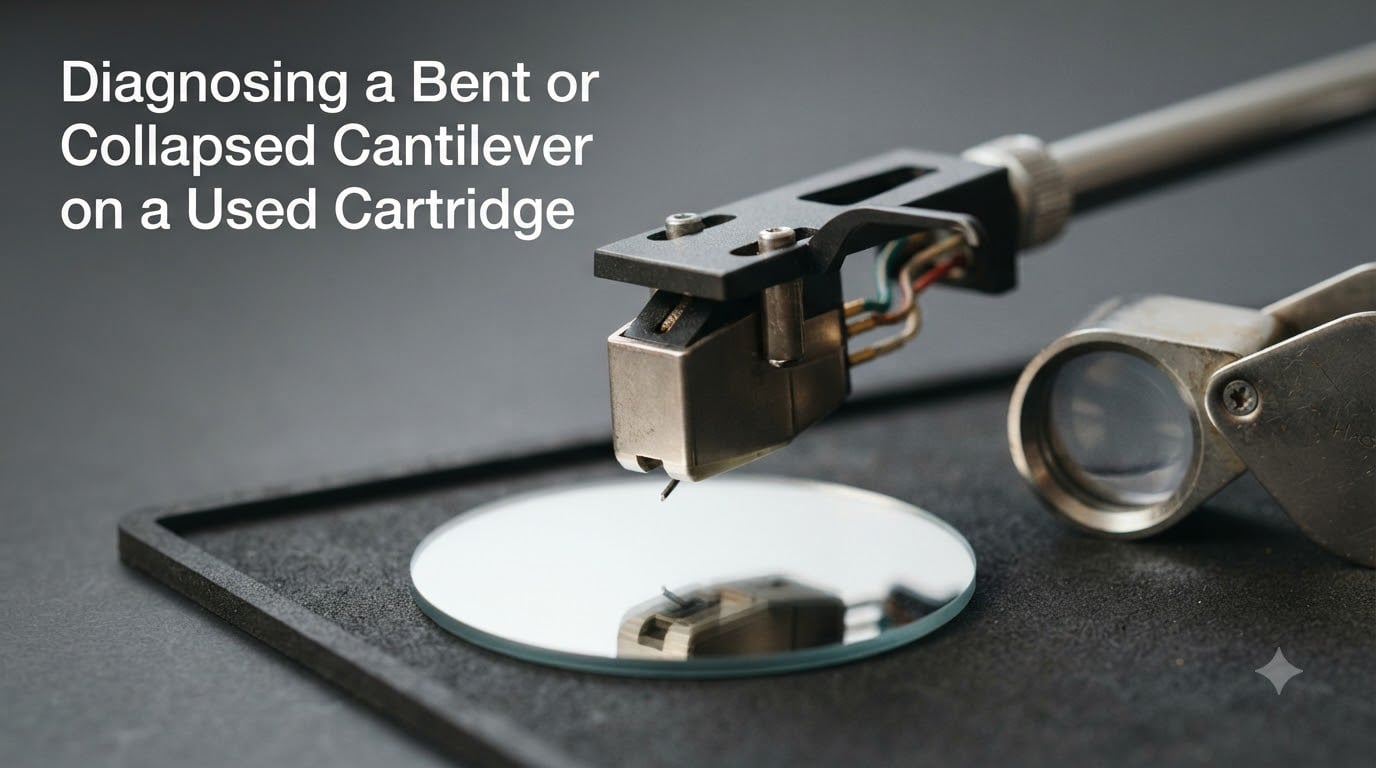
I have been hunting used cartridges on the secondary market for over a decade, and the number one question I get from newer vinyl collectors is some version of this: how do I know if the cantilever is bent before I drop two hundred dollars on a used phono cartridge?
A bent or collapsed cantilever on a used cartridge is one of those problems that hides in plain sight. The stylus tip may look fine. The tracking force may be spot on. Yet the sound comes out smeared, one channel quieter than the other, and your records start wearing unevenly after just a few plays. This guide walks you through exactly how to diagnose a bent or collapsed cantilever on a used cartridge, using the same inspection methods I have relied on for years, plus what I have learned from forum threads on AudioKarma, Vinyl Engine, and Steve Hoffman.
By the end, you will know how to perform the mirror test correctly, how to tell the difference between a bent cantilever and a damaged suspension, what boron versus aluminum cantilevers do when they fail, and when to repair versus replace. No mystery, no jargon for the sake of jargon.
Table of Contents
What Is a Cantilever and How Does It Work?
A cantilever is a thin tube, usually made of boron, aluminum, or carbon fiber, that connects the stylus tip to the cartridge’s motor assembly. It is the mechanical bridge between your record groove and the electrical signal that ends up at your speakers.
The cantilever does not generate sound on its own. It transmits vibrations. As the stylus tracks the record groove, the cantilever rocks back and forth, side to side, and up and down. Those tiny movements move either magnets or coils inside the cartridge body, and that movement is converted into an electrical audio signal.
Because the cantilever has to move in multiple directions with extreme precision, even a small bend throws off the geometry. The stylus tip no longer sits perfectly centered in the groove. Azimuth drifts. Channel balance shifts. And over time, you get record wear that you cannot undo. That is why diagnosing a bent or collapsed cantilever on a used cartridge is one of the most valuable skills any vinyl owner can learn.
The Three Parts Every Cantilever Has
Every phono cartridge cantilever is made up of three working pieces you should know. The tube itself is the long thin shaft you see when you look at the stylus from the side. The suspension is the tiny rubber or elastomer damper that holds the cantilever inside the cartridge body and lets it move freely. The stylus tip is the diamond (or sometimes sapphire) point welded or glued to the far end of the tube.
When people say the cantilever is bent, they usually mean the tube is no longer perfectly straight. When they say it is collapsed, they mean the suspension has failed and the cantilever has dropped or shifted downward, losing its proper geometry. Both problems fall under the umbrella of diagnosing a bent or collapsed cantilever on a used cartridge, but the fixes are very different.
Why a Bent Cantilever Matters for Your Records?
A bent cantilever is not just an audio problem. It is a record preservation problem.
When the cantilever is bent even slightly, the stylus tip applies uneven pressure against the groove walls. One channel gets more contact than the other. The high frequencies start sounding rolled off because the tip can no longer trace the fine groove modulations cleanly. And the groove walls themselves start to wear in an asymmetric pattern that becomes permanent after only a handful of plays on a damaged cantilever.
Records pressed in the 1970s and 1980s were never cheap, and original pressings today are often irreplaceable. I have personally seen a single bent cantilever ruin a $400 original Blue Note pressing in under ten plays. The diagnosis was obvious once I saw the tip tracking skewed. Catching this earlier would have saved the record entirely.
Visual Signs of a Bent or Collapsed Cantilever
Before you run any test, you should know what a healthy cantilever looks like. From a front-on view, the cantilever tube should be perfectly vertical, with the stylus tip sitting exactly centered at the bottom. From a side view, the tube should be perfectly straight with no kinks, dips, or curves.
A bent cantilever almost always shows visible lean. The tube angles to one side instead of dropping straight down. You will usually see this from the front, which is exactly why the mirror test (covered below) is so effective. A collapsed cantilever, by contrast, often sits lower than it should. The tip droops because the suspension has failed or stretched, and the tube may even touch the cartridge body or surrounding guard.
Other visual signs to check for include a stylus tip that looks tilted rather than perpendicular to the record surface, glue residue around the tip mounting point (a sign of prior repair or factory defect), and any visible kink or bend along the length of the tube. A small scratch on the cantilever tube is fine. A bend is not.
How to Perform the Mirror Test Step by Step
The mirror test is the single most reliable method for diagnosing a bent cantilever. It works because a straight cantilever and its reflection in a mirror should form a perfectly straight vertical line when viewed from the front. Any bend shows up immediately as a kink or break in that line.
Tools You Will Need
A small flat mirror (a cosmetic mirror or a polished metal business card works)
A loupe or 10x magnifying glass (optional but recommended)
A stable surface with good overhead lighting
A cueing lever or rest to support the tonearm with the cartridge free
Step by Step Procedure
Lower the stylus gently onto the mirror surface with the cueing lever. Do not drop it. Do not let it skate.
Position yourself so you are looking at the cantilever from directly in front, head-on, with your eye level at the same height as the cartridge body.
Look for the vertical line formed by the cantilever and its reflection in the mirror. Both halves should line up to form one continuous straight line.
If you see a kink, lean, or break in that line, the cantilever is bent in the direction of the kink.
Rotate your viewing angle 90 degrees and look at the cantilever from the side. The tube and its reflection should again form one straight line. A dip or curve here indicates a bend in the vertical plane.
Lift the stylus off the mirror with the cueing lever and set the tonearm back in its rest before drawing any conclusions.
Interpreting the Results
A perfectly straight line means the cantilever is geometrically sound. A slight lean that is the same in every viewing direction is often a factory alignment tolerance and not a defect. A clear kink or break in the line, especially if it shifts when you change viewing angle, confirms a bent cantilever.
If you have access to a USB inspection microscope or a stereo microscope, you can use the same mirror test with much higher resolution. Many forum regulars swear by cameras like the Andonstar or any 7-inch digital microscope for diagnosing a bent or collapsed cantilever on a used cartridge.
Audio Symptoms of a Bent Cantilever
Sometimes the visual is ambiguous, especially on boron cantilevers which can fail in ways that are hard to see. The audio symptoms often tell you as much as the inspection does.
The most common audio sign of a bent cantilever is channel imbalance. One channel plays noticeably quieter than the other, even when you have confirmed the cartridge is properly aligned and the tracking force is correct. This happens because the bent cantilever transfers more energy to one coil than the other.
Other audio signs include sibilance that sounds harsher on one channel, loss of high-frequency detail that does not respond to anti-skate adjustment, and distortion that gets worse on loud passages or inner grooves. If your records suddenly start sounding smeared in the upper midrange and the problem tracks with the cartridge (not with the record), suspect a bent cantilever before anything else.
Bent Cantilever vs Suspension Damage: How to Tell the Difference
This is the most common point of confusion on forums. A bent cantilever and a damaged suspension can produce similar symptoms, but they are mechanically very different problems.
The cantilever is the rigid tube. The suspension is the soft rubber damper that holds the cantilever in place. A bent cantilever is a geometry problem. A damaged suspension is a compliance problem. Both can cause mistracking and channel imbalance, and both show up as the cartridge looking slightly off, but only one of them will show a kink in the mirror test.
Here is a quick way to distinguish them. If the cantilever tube and its reflection form a clean straight line in the mirror test, but the cantilever itself still appears shifted or leaning relative to the cartridge body, the suspension has stretched or collapsed. If the tube and its reflection form a broken line, the cantilever itself is bent.
Suspension damage often comes from years of use, high tracking force, or the cartridge being dropped. It also tends to develop gradually. A bent cantilever usually appears after a specific event, like bumping the tonearm during cleaning, dropping the cartridge, or shipping damage. If the problem appeared suddenly and matches an event, bent cantilever is more likely.
Cantilever Materials: Boron vs Aluminum Failure Modes
The material your cantilever is made from changes how it fails. This matters when you are deciding whether to repair or replace.
Aluminum cantilevers are softer and more forgiving. They tend to bend when stressed. In some cases, an experienced technician can carefully straighten a bent aluminum cantilever using fine tweezers, although this is risky and not recommended for beginners. Aluminum also tends to show visible bends because the material yields before it breaks.
Boron cantilevers are stiffer and lighter, which is why they are favored in higher-end moving coil cartridges. They also tend to shatter rather than bend when subjected to force. If your boron cantilever shows any damage, it usually means the tube is fractured internally or the tip has broken off. Straightening is rarely an option because the material is brittle.
Carbon fiber cantilevers fall somewhere in between. They can bend slightly and sometimes return to position, but they also fatigue over time. A bent carbon fiber cantilever usually needs replacement.
This is why the same impact that bends an aluminum tube on an entry-level cartridge might shatter the boron tube on a $1500 moving coil. Material matters when you are diagnosing a bent or collapsed cantilever on a used cartridge and trying to decide what to do next.
Factory Defects vs User Damage Identification
One of the most common questions on cartridge forums is whether a slightly off-center cantilever is a factory defect or user damage. The honest answer is that both happen, but they look different.
Factory defects usually show as a consistent lean in the same direction at every viewing angle. The cantilever was mounted slightly off at the factory, and it has been that way since day one. If the cartridge sounds fine, tracks test records cleanly, and the cantilever leans consistently without any kink, this is most likely a factory tolerance rather than damage. Many respected cartridges ship this way.
User damage shows as an irregular kink, a bend that shifts when you change viewing angles, or a collapse where the cantilever has dropped from its proper height. If the cartridge worked fine before an event (a drop, a bump, a shipping mishap) and started sounding wrong after, that is almost always user damage.
If you bought the cartridge used and have no history, treat any visible bend as damage. Test records can help confirm whether the geometry is causing problems even if the bend is hard to see.
When to Repair vs Replace a Damaged Cantilever
The repair versus replace question usually comes down to three factors: the cost of the cartridge, the type of damage, and the availability of a replacement stylus assembly.
For entry-level moving magnet cartridges with aluminum cantilevers, replacing the entire stylus assembly is usually cheap and easy. Most manufacturers sell replacement styli for between one third and one half the cost of a complete cartridge. If the cantilever is bent on one of these, replace the stylus and you are done.
For high-end moving coil cartridges with bonded styli, the situation is more complex. Many manufacturers offer retipping services where the original cantilever is replaced with a new one (and often a better stylus profile). This costs less than a full replacement but more than a stylus swap on a moving magnet. If the cantilever is bent on a $1500 moving coil, retipping is usually the right call.
For collapsed suspensions, the answer is almost always replacement. A stretched or failed suspension cannot be reliably repaired, and even if it could, the compliance changes will permanently affect tracking and sound quality.
As a general rule, if the damage is minor and the cartridge is worth less than the cost of a retip or stylus replacement, replace the whole cartridge. If the cartridge has sentimental or financial value above that threshold, contact the manufacturer or a qualified retipping service for an estimate.
Frequently Asked Questions
What is a cantilever on a cartridge?
A cantilever is a thin tube (typically boron, aluminum, or carbon fiber) that connects the stylus tip to the cartridge’s motor assembly. It transmits vibrations from the record groove to the magnets and coils that generate the audio signal.
How do you tell if your cartridge is bad?
The fastest checks are the mirror test for visible bend, channel imbalance on familiar records, and a tracking test using a HiFi News or similar test record. Sudden distortion, uneven record wear, and loss of high-frequency detail are all warning signs.
What does a damaged record player stylus look like?
A damaged stylus tip may look flattened, chipped, or tilted instead of perpendicular. The cantilever may lean to one side, show a visible kink, or sit lower than normal if the suspension has collapsed.
Can a bent cantilever be repaired?
Aluminum cantilevers can sometimes be carefully straightened by a technician, but it is risky and not recommended for beginners. Boron cantilevers usually shatter rather than bend, and damaged boron tubes almost always need replacement or retipping.
Is my cantilever bent or is it the suspension?
Perform the mirror test. If the cantilever tube and its reflection form a clean straight line but the whole assembly appears shifted relative to the cartridge body, the suspension is the problem. If the tube and reflection form a broken line, the cantilever itself is bent.
How to tell if tracking force is too high?
Excessive tracking force causes accelerated record wear, distortion on loud passages, and a dull or constrained sound. Check with a stylus force gauge rather than relying on the dial, and verify the cartridge manufacturer’s recommended range before adjusting.
Final Thoughts on Diagnosing a Bent or Collapsed Cantilever on a Used Cartridge
Diagnosing a bent or collapsed cantilever on a used cartridge comes down to two things: a careful mirror test and a clear understanding of what a healthy cantilever looks like from every angle. Combined with attention to audio symptoms like channel imbalance and high-frequency loss, those two checks will catch the vast majority of cantilever problems before they ruin a single record.
If you are evaluating a used cartridge, do the mirror test before you hand over any money. If you already own the cartridge and suspect damage, perform the test with the cartridge mounted on the tonearm and the stylus on a mirror. When in doubt, contact the cartridge manufacturer or a qualified retipping service rather than trying to straighten the tube yourself. Your records, and your ears, will thank you.