
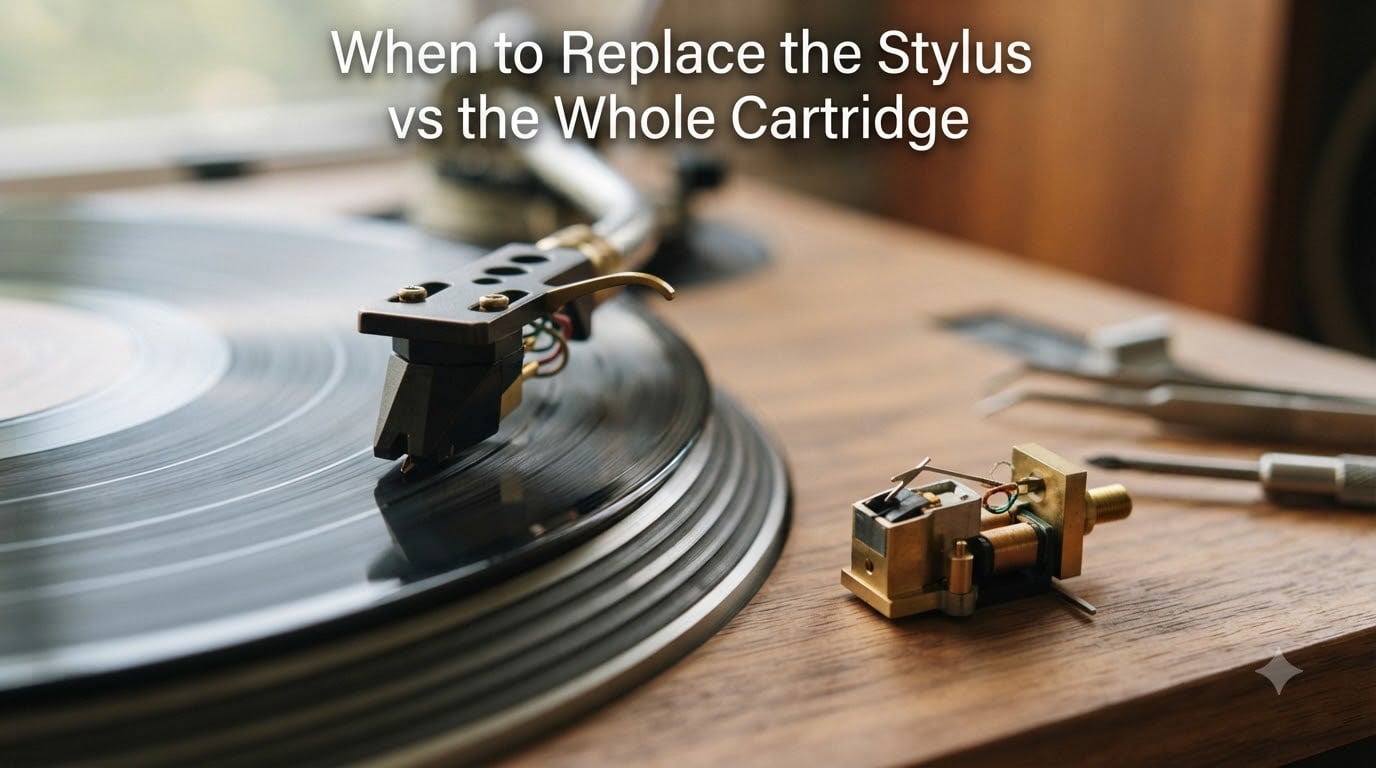
If you have ever pulled your favorite LP out of its sleeve and noticed that vocals sound harsh, cymbals hiss, and the surface noise is creeping up, you have probably asked yourself the same question every vinyl owner eventually asks: do I just need a new stylus, or is it time to replace the whole phono cartridge?
Both options solve the problem, but they cost different amounts, take different amounts of effort, and leave you with a different sonic result. Our team has spent years comparing turntable setups, swapping needles, and weighing whether to upgrade the body of the cartridge or just swap the tip. In this guide, we will walk through exactly when to replace the stylus vs the whole cartridge, what signs to listen for, and how to make the call in under a minute.
Table of Contents
What Is the Difference Between a Stylus and a Cartridge?
The stylus is the tiny diamond tip that physically rides in the groove of your record. It is soldered or glued to a thin tube called the cantilever, which flexes slightly as the groove walls wiggle.
The cartridge is the entire housing that holds the stylus and converts those tiny wiggles into an electrical signal. Inside the cartridge body you will find magnets, coils (or a moving magnet and coils), the cantilever suspension, and the mounting tabs that attach to your headshell.
Think of it this way: the stylus is the pen, the cantilever is the lever, and the cartridge is the entire instrument that turns writing into sound. Because the stylus is the only part that touches your record, it is the part that wears out first.
How Long Does a Turntable Stylus Actually Last?
For typical home listening at correct tracking force, expect about 800 to 1000 hours of playback before you start hearing degradation. That is roughly a calendar year for most casual listeners who put on an album or two a day.
For DJ cartridges, the lifespan drops to about 500 hours. Scratching, back-cueing, and aggressive cueing burn through the diamond much faster because the tip is constantly slammed against the groove wall at high angles.
Three variables push that number lower: dusty or dirty records, a tracking force set too high, and storage in a humid environment. Any of those can cut stylus life in half, so if your listening room is dusty, plan to replace more often.
Signs of Stylus Wear You Can Hear and See
Audio cues are usually the first thing you notice, and they tend to appear in this order:
Treble loses its sparkle and vocals start sounding veiled or dull.
Sibilance (the “s” and “t” sounds) gets fuzzy or slushy instead of crisp.
Surface noise becomes more obvious, especially in quiet passages between songs.
Distortion creeps into loud passages, particularly on bass-heavy records.
The stylus starts skipping or jumping out of the groove on clean records.
One channel drops out or sounds noticeably quieter than the other.
Visual cues confirm what your ears are telling you. Pull the stylus off the headshell and look at the tip under a bright light or a 10x loupe. A healthy tip looks like a tiny cone or elliptical shape with sharp, defined edges. A worn tip looks flat on one side, rounded, or chipped. If you can see the cantilever poking through where the diamond used to be, the stylus is well past due.
The catch is that by the time you can see obvious wear under a magnifier, the stylus has been damaging your records for a while. That is why auditioning with familiar music is more reliable than waiting for a visual clue.
When to Replace Just the Stylus?
Replacing only the stylus is the right call when the cartridge body itself is still working fine. The cantilever suspension is intact, the pins on the back are clean and tight, and the sound character of the cartridge is something you actually like.
Most moving magnet cartridges from brands like Audio-Technica, Ortofon, Shure, and Grado offer a dedicated replacement stylus for every model. That stylus typically runs between $30 and $120, while a brand new cartridge of the same model runs $80 to $300 or more.
Swapping the stylus also keeps your sound signature consistent. If you have spent months dialing in the tracking force, anti-skate, and VTA on your existing cartridge, a fresh stylus drops in with no recalibration headache. You get the same sound, just with the wear restored.
When to Replace the Whole Cartridge?
There are four clear scenarios where you should replace the whole cartridge instead of just the stylus.
The first is physical damage. If the cantilever is bent, the stylus mount is loose, or one of the four pins on the back is broken, the cartridge body is compromised and a new stylus will not fix it.
The second is a manufacturer discontinuation. Many older cartridges, especially budget models from the 1990s and 2000s, no longer have replacement styli in production. If you cannot find a stylus for your specific model in current catalogs, full replacement is your only option.
The third is an intentional upgrade. If you have been listening to a stock cartridge for a year or two and want better detail, lower distortion, or a different sonic flavor, swapping the entire cartridge is faster and more cost-effective than chasing phantom stylus upgrades.
The fourth is a technology shift. Moving from a moving magnet to a moving coil cartridge, or vice versa, requires the entire cartridge to change because the internal generator is different. Stylus-only swaps will not get you there.
Moving Magnet vs Moving Coil: Does the Decision Change
Yes, the choice matters. Most moving magnet cartridges are designed with a user-replaceable stylus. You pull the old stylus down and off the cantilever mount, then push the new one on. It takes about ten seconds and no tools.
Many moving coil cartridges, especially higher-end models from brands like Ortofon Quintet, Hana, and Lyra, do not offer user-replaceable styli at all. Once the stylus wears out, the entire cartridge goes in the trash and a new one is fitted. This is by design: the cantilever and generator are precisely matched in MC designs, and a removable stylus would compromise that matching.
Moving coil cartridges also usually need a step-up transformer or a phono preamp with MC gain. If you are upgrading to MC, factor in the extra cost of supporting electronics before you buy. Moving magnet cartridges plug into any standard phono input with no extra gear.
Stylus Replacement Checklist: Decide in 60 Seconds
Use this quick framework the next time you suspect stylus wear.
Step 1: Listen. Do you hear slushy sibilance, rising surface noise, or distortion on loud passages? If no, your stylus is probably fine and you do not need to replace anything yet.
Step 2: Inspect. Pull the stylus and look at the tip under magnification. Is it pointed and symmetrical? If yes, the tip is healthy. If it looks flat, chipped, or asymmetrical, replace the stylus now.
Step 3: Check the cartridge body. Is the cantilever straight? Are the pins clean and tight? Does the cartridge sit firmly on the headshell? If anything is bent, loose, or corroded, replace the whole cartridge.
Step 4: Check availability. Can you still buy a replacement stylus for your exact model? If yes, swap the stylus. If no, upgrade the cartridge.
Step 5: Decide your goal. Do you want the same sound restored, or do you want a sound upgrade? Same sound equals stylus swap. Better sound equals full cartridge replacement.
Budget rule of thumb: if a replacement stylus costs less than half the price of a new cartridge of equivalent quality, swap the stylus. If the difference is small, use the opportunity to upgrade the whole cartridge.
Practical Tips to Make Either Replacement Last Longer
Whether you replace just the stylus or the whole cartridge, a few habits will keep your next one in good shape for the long haul.
Clean every record before you play it. A carbon fiber brush run across the surface before each side removes loose dust that would otherwise grind into the stylus tip and your groove walls.
Set tracking force with a scale, not by ear. Most cartridges want between 1.5 and 2.5 grams. Going heavier wears the stylus faster and can damage records. Going lighter causes mistracking and distortion.
Match anti-skate to tracking force. If you set 2 grams of tracking force, anti-skate should be at or near 2 as well. Mismatched settings pull the stylus against one groove wall and wear it unevenly.
Control your environment. Keep your turntable covered when not in use, and store records vertically in inner sleeves away from direct sunlight. Dust and humidity are the two biggest enemies of stylus life.
Skip the DIY sharpening kits. Stylus cleaning fluids and soft brushes are fine. Anything that claims to resharpen or restore a diamond tip is a myth and will only damage the stylus further.
Frequently Asked Questions
Do I need to replace the whole cartridge or just the stylus?
If the cartridge body is in good shape and your model still has a replacement stylus available, swap just the stylus. If the cantilever is bent, the body is damaged, or you want better sound, replace the whole cartridge.
How do I tell if my stylus needs replacing?
Listen for slushy sibilance, rising surface noise, distortion on loud passages, and channel imbalance. Pull the stylus and inspect the tip under a magnifier: a worn tip looks flat, rounded, or chipped.
How often should a stylus be replaced?
Every 800 to 1000 hours for home listening, or about 500 hours for DJ cartridges. Dust, high tracking force, and humidity can shorten that interval.
What is the typical lifespan of a turntable cartridge?
The cartridge body itself can last decades if undamaged, since only the stylus touches the record. Many audiophiles keep the same cartridge body for 10 to 20 years and only swap styli.
How long does a vinyl stylus typically last?
Roughly 800 to 1000 hours for a moving magnet stylus used at proper tracking force. DJ styli last about 500 hours due to scratching and back-cueing.
Can I replace the stylus on a moving coil cartridge?
Most moving coil cartridges do not offer user-replaceable styli. Once the stylus wears out, you replace the entire cartridge. Check the manufacturer page for your specific model before assuming it is replaceable.
What does a healthy stylus tip look like?
A healthy stylus tip is symmetrical and pointed, with sharp edges on a conical or elliptical profile. Under a 10x loupe it should look like a tiny sharp pyramid rather than a flattened or rounded bead.
The Bottom Line on Stylus vs Cartridge Replacement
The decision comes down to a single question: is the cartridge body still good? If yes and a replacement stylus exists for your model, swap the stylus and save the money. If the body is damaged, discontinued, or simply not delivering the sound you want, replace the whole cartridge and treat it as an upgrade.
Use the 60-second checklist above whenever you suspect wear, and remember that knowing when to replace the stylus vs the whole cartridge mostly comes down to whether the body of the cartridge is still healthy. Keep your records clean, your tracking force dialed in, and your stylus covered when not in use, and either choice will give you years of great vinyl playback.