
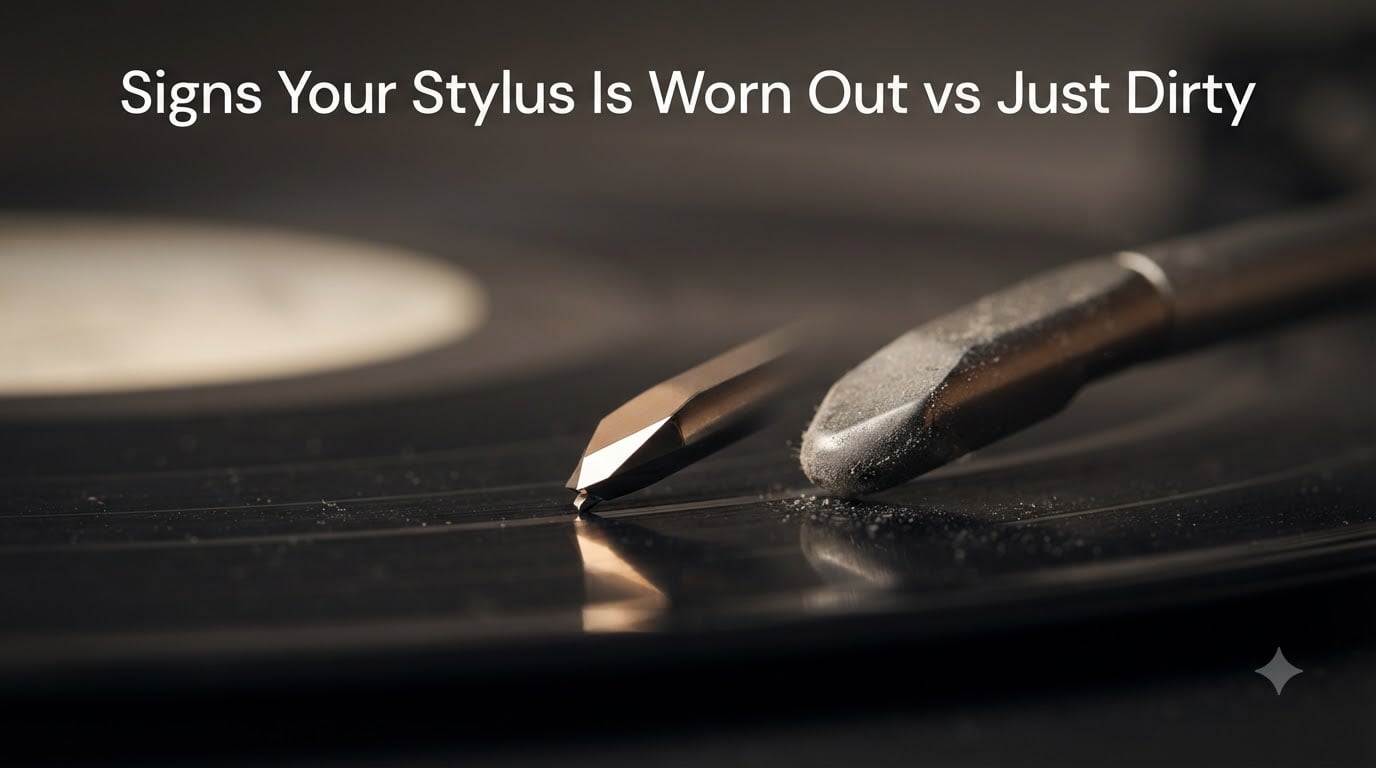
Last month I dug out a record I had not played in over a year, dropped the needle, and immediately knew something was off. The vocals sounded fuzzy, the high hats had a scratchy edge, and the whole track felt buried under a layer of grit. My first thought was that the stylus had finally given up after years of use. After cleaning it for 90 seconds with a carbon fiber brush, the sound came back to life.
That moment is exactly why I wrote this guide on the signs your stylus is worn out vs just dirty. The two conditions produce overlapping symptoms, but they need very different fixes. One costs you nothing but a minute of cleaning. The other means ordering a replacement. Knowing which is which saves you money, protects your records, and keeps your listening sessions frustration free.
In this guide I will walk you through exactly how to tell a dirty stylus from a worn out one. I will cover the audio symptoms to listen for, the visual signs to look for, a side-by-side comparison, and a clear decision flow for cleaning versus replacement. By the end you will know precisely what your stylus is trying to tell you.
Table of Contents
What a Turntable Stylus Actually Does?
A stylus is the tiny diamond or sapphire tip that rides through the grooves of your vinyl records. As it tracks the groove walls, it vibrates and sends a signal through the cantilever to the phono cartridge, which converts those vibrations into the music you hear.
Because the stylus is in constant friction with the record, it is the most wear-prone part of any turntable. A clean, sharp tip tracks the groove accurately. A dirty or worn tip drags, skips, or rounds off the high frequency details. That is why the condition of the stylus directly controls the sound coming out of your speakers.
Signs Your Stylus Is Just Dirty
A dirty stylus is the most common reason your vinyl suddenly sounds worse than it did yesterday. The good news is that dirt almost always cleans off easily, and the symptoms usually disappear the moment you brush it. Here is what to listen for and look for.
Audio Symptoms of a Dirty Stylus
A thin layer of crackle or static that sits on top of the music.
Pops and ticks that happen at random points, not in the same place on every play.
Mild fuzziness that lifts right after the stylus makes contact with the record.
Reduced clarity that gets noticeably better after the first 15 to 30 seconds of play.
Visual Signs of a Dirty Stylus
A visible fuzz or dust ball clinging to the tip under bright light.
Darkened debris around the cantilever where dust has gathered.
Stylus tip that looks dull but is still pointed, not flattened.
Crusty buildup on the cartridge body that suggests loose dust is drifting onto the tip.
If your symptoms match the list above, you almost certainly have a dirty stylus. A quick clean with a properly used carbon fiber brush should restore the sound. If nothing changes after cleaning, the problem lies elsewhere.
Signs Your Stylus Is Worn Out
A worn out stylus is a different problem. The diamond tip itself has physically degraded, usually from hundreds or thousands of hours of play. Cleaning cannot fix this because the geometry of the tip has changed. Here is how to recognize wear.
Audio Symptoms of a Worn Stylus
Excessive sibilance, meaning harsh, spitty SSS and SH sounds on vocals that were previously smooth.
Muddy midrange and loss of detail, especially in vocals and acoustic instruments.
Distortion that gets worse as the music gets louder, with no change after cleaning.
High frequency rolloff where cymbals and strings lose their sparkle and feel dull.
Skipping or jumping that happens on clean, unscratched records.
Visual Signs of a Worn Stylus
A flattened or asymmetric tip when viewed under magnification (10x or higher).
A bent or misaligned cantilever that no longer points straight at the record.
Loose mounting where the stylus sits crooked in the cartridge body.
Chipped diamond edges visible at the contact point.
The most reliable single clue is sibilance. Experienced vinyl collectors consistently point to harsh, runaway SSS sounds as the top indicator that a stylus is past its useful life. If your vocals sound spitty in a way they never used to, that is your cue.
Dirty vs Worn: How to Tell the Difference
The fastest way to separate the two conditions is the cleaning test. Clean the stylus thoroughly with a proper brush, then play a record you know inside and out. If the sound returns to normal, the stylus was dirty. If the distortion, sibilance, or muddiness persists after a careful clean, the stylus is worn out and needs to be replaced.
Here is a side-by-side comparison of the most common symptoms.
Crackle and pops: usually dirty. Random timing and disappears after brushing.
Constant sibilance: usually worn. Present on every play and survives cleaning.
Visible fuzz on the tip: usually dirty. Comes off with a brush and isopropyl wipe.
Flattened or chipped tip: usually worn. Will not change after cleaning and requires replacement.
Skipping on clean records: either worn stylus or a tracking force issue. Diagnose both.
Muddy midrange that persists: usually worn. Suggests the diamond geometry is compromised.
The cleaning test removes doubt in most cases. It is the simplest diagnostic tool you have and costs nothing.
How to Inspect Your Stylus Properly
A good inspection has two parts: eyes and ears. Start with the visual check, then move to the listening test.
Visual Inspection
Park the tonearm and bring a bright, focused light source close to the stylus. A small LED flashlight or a magnifier loupe works well. Look straight down at the tip and from the side. A healthy stylus has a sharp, symmetrical point with no visible debris. Any flattening, asymmetry, or fuzz that does not brush away means trouble.
If you own a USB microscope or a 10x jewelers loupe, use it. Most stylus problems are easier to confirm at 10x magnification or higher.
Listening Test
Choose a record you have played dozens of times and that you know sounds great on a healthy system. Clean the stylus first. Drop the needle on a familiar track and listen for sibilance, distortion, and midrange clarity. Compare what you hear to how the same record sounded a year ago.
If your turntable or stylus is new, compare against a known clean stylus if possible. Otherwise, trust your memory of the music.
When to Clean vs When to Replace
Use this simple decision flow whenever you suspect a problem.
Step 1: Clean the stylus with a carbon fiber brush, brushing back to front only.
Step 2: Test with a familiar record.
Step 3: If symptoms remain, deep clean with a stylus cleaning fluid and soft brush.
Step 4: If problems still remain after cleaning, the stylus is worn. Replace it.
Most styli last between 500 and 1,000 hours of play, depending on the cartridge type and how carefully you set up your turntable. Moving magnet cartridges tend to sit at the longer end. Moving coil cartridges often wear faster because their tips are smaller and lower mass.
For a used turntable, assume the stylus is due for replacement unless you have proof it was changed recently. This is one of the most common pain points flagged by vinyl collectors buying second-hand gear.
Prevention and Maintenance Tips
Most stylus problems are preventable with a small, consistent routine. These habits will extend the life of your stylus and protect your records at the same time.
Brush the stylus before every play session, using back to front strokes only.
Clean your records regularly with a proper record cleaning brush or machine.
Set tracking force and anti-skate to the cartridge manufacturer specifications. Misadjusted tracking force is the number one cause of premature wear.
Keep the turntable covered when not in use to keep dust off the stylus and platter.
Replace the stylus at the recommended hour mark even if it still sounds fine to you.
Tracking force deserves special mention. Too much force grinds the stylus into the groove and wears both the tip and your records. Too little force lets the stylus skate around, distorting the sound and damaging the cantilever. Dial it in correctly and your stylus will last the full rated lifespan.
Why Timely Replacement Matters?
A worn stylus does not just sound bad. It physically damages your records. A flattened or chipped tip grinds against the groove walls instead of tracking them, leaving permanent marks that no amount of cleaning can fix. This is why forum users and reviewers consistently warn against running a worn stylus on valuable vinyl.
If your collection includes rare pressings, autographed records, or albums you care about, the cost of a replacement stylus is small compared to the cost of replacing a damaged record.
Frequently Asked Questions
How to tell if a stylus is dirty?
A dirty stylus usually causes thin crackle, random pops, and a layer of fuzz on the sound that lifts after the first 15 to 30 seconds of play. Visually you will see dust or a fuzz ball clinging to the tip, but the diamond itself will still look sharp. Cleaning with a carbon fiber brush should clear the symptoms immediately. If the sound stays the same after cleaning, the stylus is worn rather than just dirty.
How to tell if a stylus needs replacing?
The most common audio clue is excessive sibilance, the harsh SSS and SH sounds on vocals that should sound smooth. Other signs include muddy midrange, distortion that gets worse with volume, and skipping on clean records. Visually, a worn stylus has a flattened, asymmetric, or chipped tip when inspected under magnification. If these symptoms survive a thorough cleaning, replace the stylus.
How many years does a stylus last?
A typical stylus lasts between 500 and 1,000 hours of play, which translates to roughly 3 to 5 years for a casual listener who plays a few albums a week. Heavy listeners can wear out a stylus in 1 to 2 years. Cartridge type, tracking force settings, and record cleanliness all affect lifespan. If you bought a used turntable, replace the stylus as a precaution since its history is unknown.
What does a damaged stylus sound like?
A damaged stylus typically produces excessive sibilance, fuzzy or distorted vocals, muddy midrange, and a dulling of high frequencies. Cymbals lose their sparkle and acoustic instruments lose detail. Distortion tends to get worse as the music gets louder and does not improve after cleaning. These symptoms are reliable because they come from the physical change in the stylus tip geometry.
Can a worn stylus damage records?
Yes, a worn stylus can permanently damage your vinyl records. A flattened or chipped tip grinds against the groove walls instead of tracking them smoothly, leaving marks that cannot be cleaned away. This is especially concerning for rare or valuable pressings. Replacing a worn stylus on time protects your collection and is far cheaper than replacing a damaged record.
Trust Your Ears
Here is the part the forums keep coming back to. If your stylus sounds worn out, it is worn out. Cleaning will not fix a tip that has lost its shape, and a sharp tip will not sound fuzzy for no reason. Use the cleaning test as your first move, then let the symptoms guide you.
To recap the signs your stylus is worn out vs just dirty, dirt causes crackle, pops, and visible fuzz that disappear after brushing. Wear causes sibilance, distortion, and a flattened tip that no amount of cleaning will reverse. Run the cleaning test, inspect the tip under good light, and when in doubt replace the stylus. Your records will thank you.